
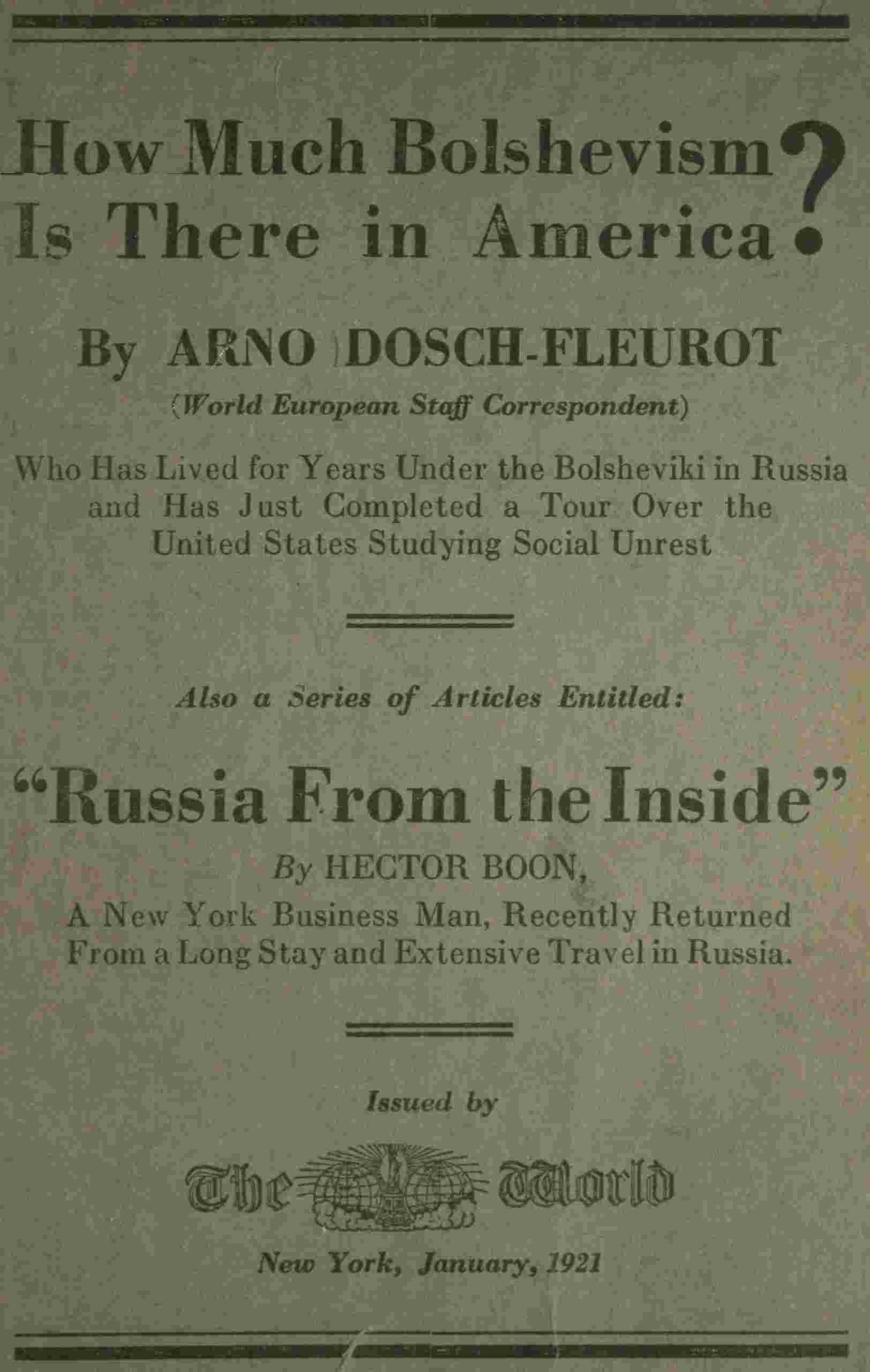
The Project Gutenberg eBook of How much Bolshevism is there in America?
Title: How much Bolshevism is there in America?
Also a series of articles entitled "Russia from the inside"
Author: Arno Dosch-Fleurot
Hector J. Boon
Release date: May 12, 2024 [eBook #73613]
Language: English
Original publication: New York: The World, 1921
Credits: Richard Tonsing, Brian Wilson, Bryan Ness, and the Online Distributed Proofreading Team at https://www.pgdp.net (This file was produced from images generously made available by The Internet Archive/American Libraries.)
Transcriber’s Note:
New original cover art included with this eBook is granted to the public domain.
How Much Bolshevism Is There in America?
EDITOR’S NOTE:
Mr. Dosch-Fleurot travelled about the country to see how much Bolshevism he could find. He has been trying to determine how much effect the social revolution in Europe has had upon America. Returning to New York, he has written five articles:
In No. 1 he contrasts the industrial situation in this rich country to the war-impoverished countries of Europe.
In No. 2 he tells how much Bolshevism he found and how much he did not find.
In No. 3 he gives a new picture of what the industrial unrest in America is and explains the efforts to organize labor industrially instead of in trades.
No. 4 goes into the question of industrial peace and how it can be reached by “industrial councils.”
No. 5 shows how the farmers’ organizations are succeeding in doing what the “proletariat” has not been able to do in the way of organizing industrial unions.
ARNO DOSCH-FLEUROT
Mr. Dosch-Fleurot needs no introduction to the American public. He may be called an expert on Bolshevism, as he was the only American correspondent in Petrograd when the revolution broke out in March, 1917, against the Imperial Government. He remained throughout the Lenine-Trotzky revolution until the dictatorship of the proletariat was firmly established in the fall of 1918. In addition to this remarkable experience, he reported for The World the first vital six months of the German revolution, when the Spartacists attempted repeatedly to upset the Ebert-Noske Government. His careful and faithful studies of social conditions abroad during the period of the war, travelling in Russia, Germany, Austria, Hungary, Roumania, Czecho-Slovakia, Poland, Greece, the Scandinavian countries, Belgium, France and Great Britain, have been features of The World’s news for the past two years.
Mr. Dosch-Fleurot recently has been appointed The World’s chief correspondent for Germany and Central Europe, with headquarters in Berlin. His despatches will be regular features of The World.
AMERICA’S WAR-BORN WEALTH INSURANCE AGAINST SPREAD OF BOLSHEVIST TAINT HERE
Study of Conditions in Various Sections of the United States, From the Point of View of Europe, Convinces Arno Dosch-Fleurot That Same Problems of Unrest Do Not Affect Our Workmen and Ground Is Not Fertile for Insurrection—Prosperity of Workingmen Cause for Thanksgiving Rather Than Complaint.
The biggest questions in industrial, social, political and economic life in America are:
Is Bolshevism finding root here?
Is America facing a political revolution?
Are we tainted by the vast social unrest now so characteristic of England, of all Europe, as well as Asia?
What impulses common to those countries are to be found in our labor structure?
In an effort to throw light an these vital matters, The World brought Arno Dosch-Fleurot back from Europe, where he has been the last four years, to make an investigation. The results of his extensive inquiry, covering the past three months, during which he has visited those centres of activity from which he could best obtain first hand information, are set forth in five articles.
For the past three years I have been living in the midst of the social revolution in Europe. A great deal of it has been active revolution, with the machine guns in the streets. During this time I have often wondered how much of this unrest was being communicated to America or how much we were developing here on our own account.
Looking at America from the point of view of Europe, particularly Eastern Europe, I have wanted to know—
First—How the Bolshevik revolution in Russia affected America.
Second—Whether the class war into which the World War developed had hit America too.
Third—How the United States was readjusting itself to the inevitable social changes.
At the time the Bolsheviki seized the power in Russia, we Americans who were there used to say to one another as we discussed the industrial and social problems that faced the world, “At home we are going to work this thing out another way.”
Are We Working Out the Problems in Another Way?
For several weeks I have been able to search for the answers to my own questions. I have been going about the United States studying the social and industrial unrest. To some of my questions I have answers which are satisfactory, at least to myself. Behind others I must still leave interrogation points. In addition I have seen things I had not thought of, some of them tranquilizing, others disquieting.
In this and the succeeding articles I shall give my impressions of the unrest in America and its significance from my point of view.
In the first place, I am overwhelmed by our wealth. I had been away long enough to forget how rich we were, and we have in the mean while grown much richer. That fact is of prime importance. Being rich, there is not the gruelling struggle for existence that makes the problems of unrest in Europe dangerous. It eases off enormously on whatever strain there might otherwise be.
Everywhere I turn, in every city, every street, every shop, every home, there is so much wealth it is hard to believe. After Europe one would be inclined to say we are disgustingly rich, if the new-wealth, in spite of the war fortunes, were not so widely distributed. I hear people complain that workmen have been making so much money they have been buying themselves $10 silk shirts and their wives are wearing $50 hats.
It does not seem to me a cause for complaint. Rather it would appear to be cause for thanksgiving that such things can be. I have myself seen factory workmen, men who make their living with their hands, men who belong to unions, going to work in their own automobiles. I should like to tell that to some workmen of my acquaintance in Moscow.
Wealth Obscures Depression.
Even though the country is going through an industrial depression there is so much money about that a casual traveller would not know it.
In Detroit, where 150,000 factory workmen have been laid off, it is interesting to see how little difference it has made in the daily life of this city of a million. Half the families in the city are affected, but they have money and go on spending it. I could not believe so many people could be out of work without evident sign of suffering somewhere, but I spent half a day unsuccessfully trying to find a soup kitchen or a bread line in Detroit.
Yes, we are rich, and that has spared us much. But with wealth have come pride and intolerance. I was in a measure prepared for this, but I did not expect to find it generally accepted as right and proper.
George Russell, the Irish writer, said to me just before I came home: “War is an exchange of characteristics. You have been fighting Prussians. You may find America full of Prussianism.”
I should have thought our sense of liberty were proof against contamination, but apparently not. As the first sign of Prussianism we seem to have curtailed free speech. In a dozen cities where I have been a man need only get on a soap-box and he will land in jail. The corner orators who used to act as safety valves for over-heated brains don’t dare show themselves. Men have gone to jail for reading sections from the Declaration of Independence. I admit they did it with mocking or malicious intent, but what of it? Since when, has the democracy of America grown so weak it needs policemen to protect it? In the West a man need only carry an I. W. W. card in his pocket to get arrested. They say in Seattle, “The Red Squad has driven the cards into the shoes.” There are 3,000 “Reds” in jail for various causes. The most important ones are serving long prison sentences.
There seems to be a common impression that the Imprisonment of “Reds” is suppressing Bolshevism in the United States. My observations lead me to the belief the only chance of revolution, and that not immediate, might come from continuing to keep these men in prison. Those who are under prison sentence were convicted under the extraordinary conditions developed by war. These extraordinary conditions no longer exist, but these men are still under sentence. The longer they stay in prison the stronger grows the resentment at their imprisonment. I find an undercurrent of bitterness, not very wide but deep, that can breed trouble. The small minority that is thinking about revolution is thinking about it hard. If these so-called revolutionists were turned loose without further ado, under a general amnesty, it would ease off on that hard thinking and would be helpful to the liberal movement in industry that is trying to “work this thing out another way.”
The same spirit in the country which is backing the red squads of the police seems to be actuating a Nation-wide, open-shop campaign. Men with any liberalism at all—and there are liberals managing great industries—are not in favor of either. They do not want the closed shop, but the ruthless way many employers’ associations and groups of associated industries are trying to use the present reaction as well as the existing depression to “break the back of labor” is regarded by them as the madness of power and wealth.
I find only two groups of rebels against democracy who view with favor this knock-down-and-drag-out fight for the open shop. I might call them roughly Bolshevik employers and Bolshevik employees.
As I travelled about the country I found that the active advocates of the open shop frequently referred to it as “the American plan.” The employers’ association which is pushing it also has a way of ostentatiously flying the Stars and Stripes. This is particularly noticeable in the mining communities where there are large bodies of foreign laborers. At first I could not understand how one group of Americans came to have the temerity to arrogate to themselves the word “American.” Then I discovered it was a survival of the war period. In fighting the Prussian we have adopted some of the Prussian’s disagreeable characteristics. The war is over, but we have licked militarist blood. What surprises me most is how few people recognize the danger of it. The phrase “American plan” has been allowed to stand without protest, though it practically says to union men who are just as good Americans as the members of employers’ associations that they are not Americans if they persist in their union ideas. It is not difficult to imagine how this is misused in the daily contact between workman and boss. It cannot help but do harm.
In Butte I was walking along the street with some labor leaders, bound for their headquarters. Thinking we had reached it, I started to turn into a building over which the Stars and Stripes were flying. “That’s not it,” said one of them. “Don’t you see the flag of the American plan?”
No Serious Bolshevism Here.
And yet there is no serious Bolshevism in the United States, I have been looking for it, and I have not been able to trace a consistent effort at a Bolshevik movement. There are no doubt enough people who believe in Bolshevism who would like to start a Bolshevik movement—but they have not been able to do it. At least they have not succeeded in starting it among wage-paid workmen, and there is no other place to start it.
There is, however, something which is called Bolshevism, and, as it is also rebellious against the existing order of society, it has been labelled Bolshevik, but it is really something different. I refer to the rather crude and unscientific but active, anarcho-syndicalism of the Industrial Workers of the World.
The two have been confused even by some of the leaders of the I. W. W., so it is not surprising that the general public, not to mention the Red squads of the police, have not always been able to make the distinction; but the difference is there and is of sufficient importance to prevent the growth of Bolshevism.
Bolshevism, by which is ment the idea that lies behind the Bolshevik Government in Moscow, is a long way from the One Big Union—the effective idea behind the I. W. W. Bolshevism has proved to be state Socialism in action. The I. W. W. is anarcho-syndicalism trying to make headway in industry.
But even the I. W. W. is not getting anywhere. It may some day, because it has a broader philosophy than Bolshevism behind it and because it is aiding in the movement toward industrial unionism, which is making some headway. But as an immediate revolutionary movement the I. W. W. is powerless before the powerful forces that oppose it.
Chief of these is the American Federation of Labor. The I. W. W. has never even had a chance to play a serious role in the United States because the A. F. of L. has fought it consistently since its inception fifteen years ago.
Industrial unionism, when revolutionary in purpose, even when developed apart from the I. W. W., has met the same opposition. If there had been no system of craft unionism in this country there might have been industrial unionism in this country long ago. Certainly the I. W. W. would have had a much freer hand. In that case the employers of the United States would, like the employers of Europe, have been faced with labor syndicates instead of labor unions, and that is a very different story.
In Europe labor leaders look upon the American Federation of Labor as almost a part of the capitalist system. Rumors that the big American industrials were trying to break the power of the A. F. of L. had come to Europe before I left and it could hardly be credited. The syndicalist labor leaders could not understand why the American manufacturers were fighting their ally.
Since I have been travelling about the United States I have also found many employers of labor who can also not understand why there is this vicious open-shop campaign. The industrial manager of one of the greatest industries in the world said to me hotly:
“If Judge Gary and Wall Street knew what they were leading to they would stop this anti-union campaign. They are trying to break down the conservative American Federation of Labor. If they succeed in destroying the power of Gompers they will remove the only barrier that stands between us and a real revolutionary labor movement, industrial unionism.”
Just how revolutionary industrial unionism is I shall examine later on, but it is certainly much more revolutionary than the A. F. of L. And as the craft unions of the A. F. of L. find it increasingly harder to breathe under the smothering process that is going on under the “American plan,” the industrial unions find a freer field to work in. The revolutionists of America, such as they are, could ask nothing better than the carrying of the open-shop campaign to its most ruthless finish.
Right now the enemies of union labor of any kind can do about what they please. There are plenty of men looking for work and they can break almost any strike that might be declared. Union men and I. W. W. leaders alike are sitting tight and are trying to save what they can to go on with when the fight is over. They are not afraid of being done in forever. They know this period of depression will pass, and, even if meanwhile the open-shop campaign were carried to the point where every union in the country were killed off, the union movement would spring up again. Next time, however, they believe it might take the more revolutionary form of industrial unionism.
LITTLE OF BOLSHEVISM FOUND IN I. W. W., MOST RADICAL OF AMERICAN LABOR MOVEMENTS
The most radical labor movement in the United States, the one that makes the most to-do over its revolutionary programme, is the I. W. W. Whatever there may be of revolutionary tendency in America is in the I. W. W., or closely affiliated. But looking at America from the point of view of Europe, if that is all we have produced in the way of revolutionary material we are certainly in no immediate danger of becoming a “Soviet republic.”
The I. W. W. is popularly considered Bolshevik, and has thus been advertised by the attacks the police have made upon it. There have also been “criminal Syndicalist” laws passed against it which have enhanced its importance. But an examination of what it is does not give cause for serious alarm.
The I. W. W. has never been able to boast of much of a membership, and it has barely enough members now to keep it alive. During the past few weeks I have taken a fairly close look at the I. W. W., or what I could find of it, and I should say it is more of a purpose, more of a labor philosophy, than a movement. It is out for One Big Union, but it has not even one small union that stays put.
Provided Organization of Labor Where No Other Union Could
It has provided a chance for organization when there was no other union to do it. It went into the woods and the harvest fields and organized the migratory workers. It had a free and easy way of organizing, and they were free and easy men. In the woods it acquired some permanency. The loggers of Oregon, Washington and Idaho are about the only active members it has. The important consideration is how much revolution did it instil into them? According to my observations, very little.
The loggers were told about the preamble of the I. W. W., the theme of which lies in its first words: “The working class and the employing class have nothing in common.” With those sentiments the loggers were in hearty accord. They knew better than the I. W. W. organizers how true it was in the woods. They wanted better camp conditions. The I. W. W. gave them a chance for organized protest, so they joined. They are frontiersmen with the virtues of the frontier; they stand by their friends. So they stand by the I. W. W. But to say they become class-conscious revolutionists is absurd.
The leadership at the I. W. W. has syndicalist purpose, but its membership is merely looking for better working conditions. The average man who joins the I. W. W. would as willingly join a union that had less to say about revolution if it were there. The I. W. W., like the Salvation Army, works where more bourgeois organizations fail. At the I. W. W. headquarters in Chicago is turned out a varied supply of I. W. W. reading matter, but you do not see workers pouring over it. They glance at occasional pamphlets, but they do not bother themselves with the anarcho-syndicalist theories. Some few harvest workers have tried sabotage, and that is about the most serious charge against the I. W. W.
No Consistent Idea.
Out of the scores of leaflets and pamphlets they can get no consistent revolutionary idea. They are a confusion of syndicalism, anarchy, Socialism, Communism and Bolshevism. That is inevitable, as the writers, not always very thoroughly informed, have tried to adapt their individual conceptions of the various social revolutionary movements in Europe to American conditions. The I. W. W., being the one outstanding revolutionary movement, has drawn to it so many different types of revolutionists they have mutually destroyed each other’s theories.
The Bolshevists in the I. W. W. have recently had a serious jolt. They tried, without success, to induce the loggers to support the Third Internationale, the propaganda body of the Bolshevik Government in Moscow. They told the loggers that, as part of the proletariat, they should give their indorsement to the dictatorship of the proletariat and the organization of the world revolution from Moscow.
The loggers are not very long on political ideas, but they wanted to know about it first. So the editor of the Northwest Industrial Worker, one of the I. W. W.’s most important publications, explained it. He is himself a syndicalist and no Bolshevist. Moreover, he lives in Seattle and knows the loggers are not to be turned into rubber stamp revolutionists by the propaganda of the Lenine-Zinovieff school. So in the Northwest Industrial Worker for Oct. 20 he printed the following editorial:
‘What about the Russian Workers:’
“A vote for the indorsement of the Third Internationale by the members of the Industrial Workers of the World means a vote indorsing the actions of the small political group which now holds Russia under its rule, the Communist Party. There should be no doubt in the minds of members as to that fact. If the vote for indorsement carries, members should realize that we shall have indorsed a political state that is not only upheld by bayonets but which has sent conquering armies to invade other countries.
“It is unfortunate that members of the I. W. W. have never received any accurate information as to the actual condition of the workers of Russia. We have heard many generalizations as to the conditions of the Russian people, singing the praises of the Soviet Government. But have members of the I. W. W. ever heard a report made by industrial unionists or by syndicalists containing reliable information upon the following matter?”
Questions Are Asked.
“Are the workers of Russia permitted by the Government to organize upon their own lines without interference?
“Are the workers of Russia permitted to freely travel through the interior looking for employment?
“What percentage of the workers in the large industrial sections are organized, and upon what basis?
“Are workers permitted to maintain their own press without governmental interference?
“Until the members of the I. W. W. have information upon these and many other matters they are voting in the dark upon something of which they know nothing. They have a right to know whether Soviet Russia is a ‘working-class government.’ Communist Party propaganda will not afford satisfactory answers to these queries.
“We are endeavoring to get enlightenment upon such matters at first hand, and have already secured some information, but we realize that we have no right to influence, or attempt to influence, the vote upon a referendum which is pending. We want the truth about affairs in Russia. We are interested in the Russian workers more than we are interested in anything pertaining to that country.”
Absurdity of Label.
I have reproduced this editorial in full partly to show the absurdity of simply labelling the I. W. W. movement Bolshevik and letting it go at that. Also, I have never seen an abler editorial against Bolshevism. And this, mind you, was published in the most important organ of the I. W. W.
There were people in the I. W. W. movement who did not like it, and they brought pressure to bear to remove the editor, J. C. Kane, from his editorial chair. But the loggers read the editorial and liked it. They would probably never have read it if there had not been a fuss raised; but, at any rate, they did read it, and approved. Then they heard that the editor had been fired and they got a little “mass action” into play and put him back. And they did not indorse the Third Internationale.
That is a long way from Bolshevism. Nothing like that could happen in Russia. As an incident it is symptomatic. It shows the members of the movement insist on running it according to their individual will. In other words it is not a Bolshevik movement directed by a highly centralized labor autocracy. It is rather an anarcho-syndicalist movement bossed from the “job.”
Is “Job-Controlled.”
The Bolshevik-minded within the I. W. W. do not really belong there. The I. W. W. happens to be the most radical band wagon and they have climbed on. Incidents such as I have just quoted show them where they get off. The men who understand better the I. W. W. movement know it must be based on “job control.” Every time it has ever done anything it has been a case of “job control”—in other words, the men on the job decided what they were going to do. Their successful strikes in the woods the summer of 1917 were, for instance, declared in the camps.
In the I. W. W. dogmatic concepts do not get far. Revolutionary phrases take on new meanings and disconcert their originators. The phrase “direct action,” for example, is well understood in the revolutionary patter to mean direct revolutionary action to put a workers’ dictatorship into governmental power. But it does not mean that in the logging camps. It means direct action by the camp crew and not action according to the decision of the I. W. W. headquarters.
Are Fundamental Democrats.
Fundamentally the I. W. W. members are democrats like the rest of us. They have no far political vision, and they wish to ameliorate the condition in life of workingmen, but they could be trusted in the final analysis not to follow any doctrinaire revolutionist who had thought it all out for them and told them to come along. Lenine could do that with the Russian workers. But no one could do it with American workers. And the membership of the I. W. W., particularly in the woods, is largely American.
The I. W. W. has its ups and downs, and just now it is down. But it will not go out of existence and disappear because it stands for an idea, industrial unionism. There are other labor organizations, such as the Automobile Workers, which also stand for industrial unionism, but the I. W. W. has proclaimed it loudest, though it has perhaps done less effective organizing than some of the others.
Industrial unionism is essentially inimical to the craft unionism upon which the American Federation of Labor is built. The individual unions in the A. F. of L. could unite along industrial lines, and some have, but the results have not been sufficiently striking to remove from the I. W. W. further excuse for existence.
Not Essentially Revolutionary.
There is nothing essentially revolutionary in industrial unionism, though the I. W. W. tries to make it so, concluding its well known preamble with the sentence: “By organizing industrially we are forming the structure of the new society within the shell of the old.” But that is largely rhetoric. In the body of the preamble is written: “We find that the centring of the management of industries into fewer and fewer hands makes the trade unions unable to cope with the ever-growing power of the employing class.” All industrial unionists are of this point of view. Their position was well described to me by William A. Logan, President of the Automobile Workers, who is not a member of the I. W. W.
“Industrial unionism is no one’s invention,” he said. “It naturally follows the combination of manufacturers in an industry. Manufacturers absorb industries which furnish them, so labor does the same thing. The combinations of industries in large plants has so highly specialized the work that no one workman need be a rounded mechanic. Men can also be shifted easily from one machine to another. Common and semi-skilled labor has almost entirely taken the place of skilled labor in industry. I used to be an auto-fitter. There is now no such job. The manufacture of even such a finished article as an automobile has been specialized to a point where one man need know very little. He may have merely to start a nut. So all the men in the industry are on the same footing. There is no longer point in splitting them into crafts. The logical way to organize them is industrially.”
Merely New to United States.
That is all there is to industrial unionism. It is comparatively new to America, but it is an old story in Europe. To organize industrially is just as democratic as to organize by crafts. It all depends upon what is done with the organization once it is formed. Industrial unionism only becomes revolutionarily syndicalistic when a union of industrial unions announces it is going to take over the Government in the name of its syndicalist workers.
The I. W. W. says, “The army of production must be organized not only for the everyday struggle with capitalists but also to carry on production when capitalism shall have been overthrown.”
The less revolutionary automobile workers, whose correct title is United Automobile, Aircraft and Vehicle Workers of America, say more conservatively: “We know that the workers will never know how to manage the State if they should gain that responsibility through political action, until they learn how to act collectively in getting some of their immediate needs satisfied.”
Nothing to Fear.
The I. W. W. foresees the uniting of all the different industrial unions in one big union. It says, “One union—one label—one enemy.” The automobile workers say more modestly, “One union, one industry.”
So the industrial union may, or may not, be used with revolutionary intent. Of itself it is nothing to be afraid of.
Practically industrial unionism has between it and success what even the comparatively mild automobile workers refer to as the power of “Czar Gompers and his Grand Dukes.”
Theoretically the A. F. of L. is not opposed to industrial unionism. Any of the crafts may join forces. But practically the A. F. of L. machine prevents it.
“PROLETARIAT OF AMERICA” JUST GOES AND GETS JOB, WORLD INVESTIGATOR FINDS
At Akron, O., where the rubber industry swelled to enormous proportions in the last few years, business dropped like a skyrocket recently and there were reports of tens of thousands of men thrown out of work. So I went to Akron to see how great were the sufferings of the “proletariat.”
Here, at least, I thought I should find a mass of unskilled labor and a proletarian class consciousness such as I have been in the habit of associating with big industry in Europe.
I found Akron pretty well shut down, but there was no proletariat about. There were no bread lines, no soup kitchens. Still there was no question but that there were some 50,000 fewer men working in the small city than there had been a short time before. Where were they?
They had gone home. They had acquired no stake in Akron. Most of them were from West Virginia. They were migratory workers, and when they were not wanted conveniently disappeared. They went to other towns, other industries, back to the land. Broadly they were a migratory class, but they had no consciousness of class. To-day they were seeking the highest pay in the factories, to-morrow they will be tilling the soil. To a would-be proletarian leader they must be exasperatingly elusive.
I found the manufacturers of Akron deeply grateful to them. They came when they were wanted and took themselves away when they were no longer wanted. Without them it would have been impossible to build industries so rapidly to meet the demands of a day, and if they did not take themselves off when the slump came they would create a disagreeable responsibility for the manufacturer who got them together. It is a situation that is purely American and would leave bewildered any one who tried to fix European ideas of industrial organization upon American institutions.
No Upheaval When Labor Turnover Makes Jobs Vacant
At the plant of the Goodyear Tire and Rubber Company in Akron I was told that the plant had been reduced from 30,000 men to 6,000 men in less than six months without turning men off wholesale. The labor turnover did the trick. The plant stopped taking on new men several months ago, when it began to look as if the strong demand for tires was not going to hold. Each week thereafter some of the migratory workers left. Normally they would have been replaced by new migratory workers who presented themselves for jobs, but in this way each week the payroll decreased automatically. Week after week the usual number of men called for their time and struck out, some because it was summer and their native mountains called them, some to wander further afield into other industrial towns. This went on all summer and fall and when, in November, it became necessary, the management thought, to curtail production sharply there were only 14,000 instead of 30,000 in the plant. The rest had disappeared in the normal labor turnover. In the other rubber plants in Akron the same process went on, so it was not a case of turning tens of thousands of men into the streets when the real slump came.
Much the same thing happened in Detroit. Last year it had more than 100,000 more people than it could properly house. These people had been drawn into Detroit by the high wages. Handy men with intelligence were getting $15 to $30 and more a day. Then came the slump in the automobile market. Beginning last May, the demand for labor in Detroit began to decrease, factories took on fewer men, but the city did not become crowded with idle men. For a certain number took their time each week and moved on. The overpopulation began to disappear. Detroit as a working man’s bonanza was working out. Coming eastward in November from the Pacific Coast, I encountered everywhere men with a few hundred dollars in their pockets, “easy money,” made in Detroit, looking now for something else. By the time I reached Detroit I found the factories had 150,000 less workmen than they had four months before and there was no idle “proletariat” standing about.
Not Possible in Europe.
It is only in wonderfully rich America such things can happen. Here alone we dare organize industry on this bonanza scale. In Europe the big industrials know that if they build in this rapid fashion they must be prepared for the slump. The soil will not reabsorb the migratory workers as it has done for Akron and Detroit. In Europe the workers belong to a proletariat divorced from the soil, descendants of a long line of workmen. They are also class conscious and they do not conveniently disappear in the labor turnover.
Thanks to the different state of affairs in America the present readjustment in the country is going on with little difficulty from the side of labor. In Europe, where there is a process of social revolution, there can be no thought of a readjustment of any kind without first finding out what effect it is going to have on the working classes. But here there is no proletariat, no hard and fast working classes, hence no class consciousness.
I have found recently in my travels about the country that all kinds of people are agreed that prices, rents, wages, everything must come down to somewhere near what they were. Before talking to labor leaders I find the same reasonableness. This would be impossible if there were any sentiment for class war.
Now is the time to test how much of the social turmoil in Europe has been communicated to us. Flush times are passing and whatever discontent there is is sure to show itself. I may be looking for something too precise, but I do not find it. There is the usual discontent over the struggle for existence, but it is not class conscious, as the phrase is used in revolutionary circles abroad. The situation has not even increased the following of the I. W. W. or of the industrial union movement. It would seem like a propitious moment to make a drive, a campaign of instruction, in the effort to convince workmen that industrial unionism is their way to economic freedom. But I see very small signs of such activity.
In Eastern Europe in its present frame of mind a readjustment could not take place without workmen seizing rifles and machine guns and making armed demands. Such doings are not in the American picture.
Workers Are Not Organized.
One reason may be that the portion of the working classes most hit is not organized. Craft unionism has not kept pace with the growth of industry. The important centres of diversified industry, as well as what the Germans call the heavy industries, are not unionized. In the Pittsburgh district there are approximately 400,000 workmen and whatever organization exists among them is too small to count. No big manufacturing centre in America is now union. Chicago, for instance, is industrially open shop. So is Detroit or any other city where industry has had rapid growth. It amused me in asking about the open-shop movement to see the eagerness with which I always was informed that the open-shop principle had always maintained in whatever community I might be asking about.
The truth is, of course, that the big industries have been able to prevent unionizing by keeping a steady flow of immigrants coming into the country and they were clever enough to take them from the farms in Europe, so they did not bring any class consciousness with them. Ever since the famous Homestead strikes the steel industry has been non-union. It was only when the flow of immigrants was dammed by the war that a chance to unionize it came. It was then that John Fitzpatrick and William Z. Foster began. But they tried out organizing industrially first in the Chicago stockyards, and the steel manufacturers watched them from afar, so, as one steel man said to me in Pittsburgh, “We saw them coming and we were ready for them.”
What struck me as an interesting comment on the unionizing of factory workers was made to me in Detroit by Mr. C. M. Culver, director of the Employers’ Association, an institution which handles the labor problem for its members. He said:
“When employers do not combine to hold down wages, unionism does not grow. When employers are competing for workmen, as they have been doing here in Detroit, when they are too busy turning out machines, when the inventive minds are just boiling and the native American genius is concentrated on getting results, men do not join unions.”
Unionism certainly made very little headway in Detroit. The A. F. of L. played a very small role there and the automobile workers had succeeded in enrolling less than one-twentieth of the men who were eligible to this industrial union. It is significant, however, that the automobile workers, even with their small membership, have their importance in the industry, and the manufacturers consider their growth alone a possible menace. It shows the power that would pass into the hands of the factory worker if industrial unionism ever gets a hold on American industry.
In Detroit the percentage of foreign or foreign-born among the workers is about 70 per cent. In Pittsburgh it is even higher. Manufacturers in both places say they do not fear labor organization as long as this percentage persists. Labor organizations built among the foreign workers do not last. They can be organized quickly, as William Z. Foster found when he organized the steel strike in 1919. They give their money freely and enthusiastically for organization, but they expect quick results and do not stand up under adversity. I have just passed through the steel region in Ohio and Pittsburgh where Foster organized most successfully a year ago and there is hardly a trace of his work to be found. With difficulty I found the emaciated skeletons of the flourishing unions Foster developed in a few months.
After visiting the steel towns and the modern factory cities I agree with the I. W. W. that American industry is not organized. Labor, as distinguished from industry, is organized, but the factories, with their hundreds of thousands—added together, their millions—of unskilled and semi-skilled labor, are quite unorganized. The A. F. of L. has not interested itself in them, and the I. W. W. has tried to do it on so pretentiously revolutionary a scale that it has not succeeded. The field is open. The American field of industry is practically unhampered by the prejudices or the hard conditions of Europe. The European-trained agitators have sown the American industrial field time and again with their European-born ideas, but they have not yielded a crop.
There are, broadly, two kinds of employers in American industry. There is the “catch ’em young, treat ’em rough and learn ’em nothing” kind which is loud in support of “property rights” and is backing the ruthless open-shop “American plan.” The steel, coal and copper industries, the heavy industries, are dominated by this spirit even at this late date. To them labor has no rights. It is enough to make a Bolshevik out of any workman who comes in contact with them. Take Butte, where the Anaconda Copper Company rules. If a miner comes to Butte he must go through the copper company’s passport bureau before he can even apply for a job. If he succeeds in getting a “rustling card,” a sort of passport bearing a description of him, he can seek work at the mines. If he is a member of a union that is not in favor, he has to lie about it and say he is not or he does not get a “rustling card.” This is industrial feudalism, and there is no calling it by another name. I was in the office of the Bulletin, the labor paper published in Butte, and I noticed half a dozen rifles in the corner of the plant. “Have you got a Red Guard?” I asked. “No, but the company has a White Guard,” was the answer; “we have to protect ourselves, especially around election.”
Efforts to Solve Problem.
Combating this spirit there is a type of American employer who realizes he has a responsibility toward the men he gathers together in his factories. He comes nearer representing the modern spirit in American industry. He usually begins with some patronizing welfare work, but ends up with whole-hearted co-operation. Men of this type see the gulf between capital and labor, and instead of trying to widen it and perpetuate industrial strife like the leaders in the heavy industries they are throwing out flying bridges across the gulf. They are trying to establish a decent human relationship between employer and employee and give the lie to the I. W. W. preamble that “the working class and the employing class have nothing in common.”
The men who are making these attempts are fairly sane and do not think they are “solving the labor problem.” They are trying to re-establish in modern industry the touch that was lost between the master mechanic and the journeyman mechanic when they stopped working over the same bench. Some are having a real success. Others cannot make it go. It depends upon the amount of sincerity in the undertaking. But there are some 700 plants in America being run on this voluntary “industrial conference” system. They do not pretend to be throwing more than a flying bridge across the gulf, but they may have some permanency. At any rate, it is the most interesting experiment in American industry. If it succeeds it will establish new standards in industry and we shall be able to say that America has succeeded in working out another way the industrial problem that has led to the social revolution in Europe.