
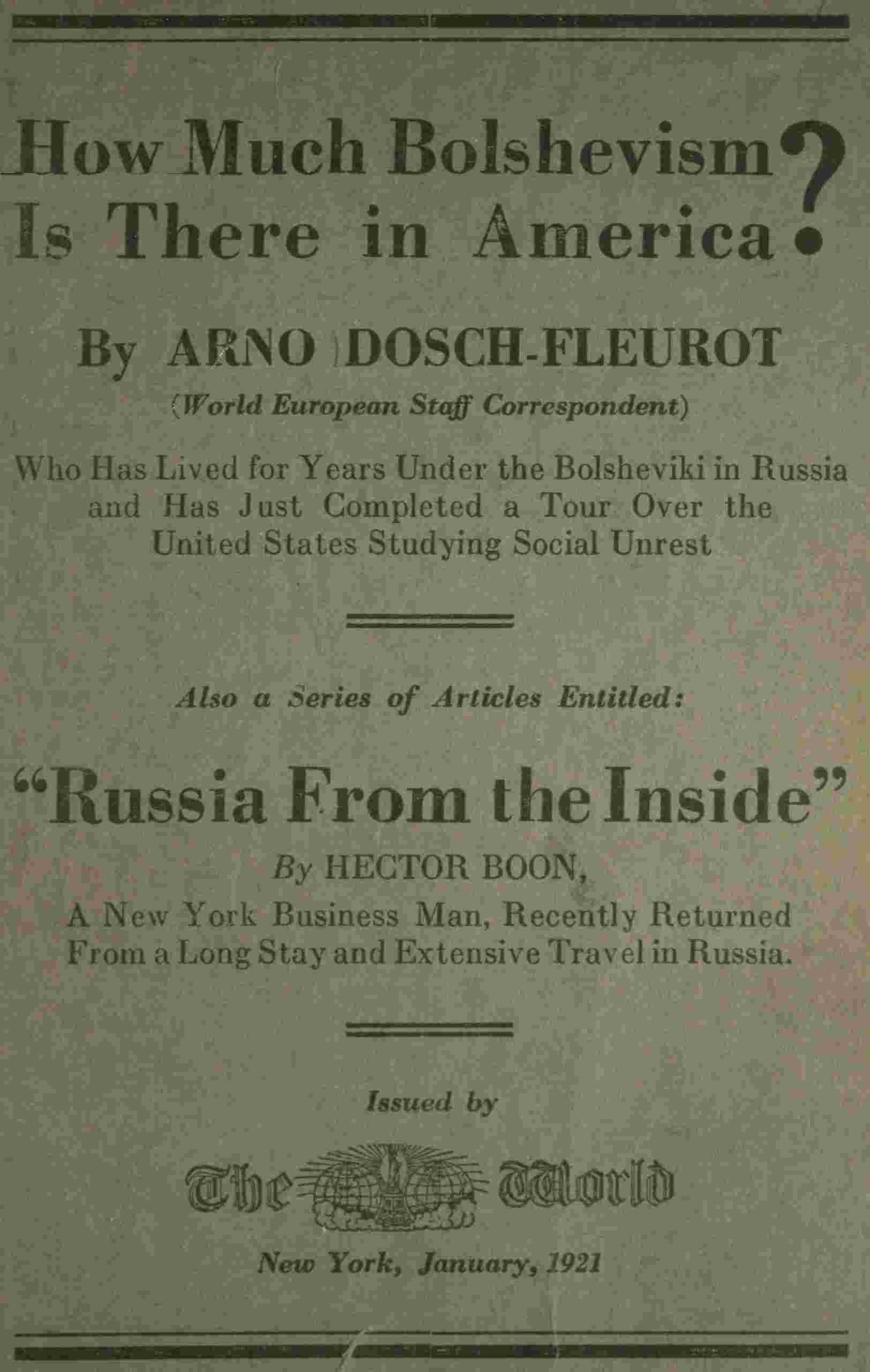
“RUSSIA FROM THE INSIDE”
To The New York World justly belongs the credit for giving the American people the best description of the present situation in Russia that has ever appeared in the American press. Beginning with Sunday, Jan. 9th, and ending on Friday, Jan. 14th, The New York World has published daily articles by Hector Boon, who has just returned from Soviet Russia, which he entered on April 6th and left on Oct. 12th, 1920, after spending more than half a year in Lenin’s kingdom.
Altogether, Mr. Boon spent ten months in Russia, of which four months were spent in the so-called “buffer state,” the Far Eastern Republic, which extends from Verkni-Udinsk to Vladivostok, and more than six months in Soviet Russia proper, mostly in Moscow. * * * To this is added that Mr. Boon was in Russia in 1917, before the Bolsheviki came into power, and thus he was able during his last visit to compare the conditions in Bolshevist Russia with the situation in Russia during the first months after the March Revolution.
From an article by A. J. Sack, Director of the Russian Information Bureau in the United States.
INSIDE FACTS OF RUSSIA TOLD BY NEW YORK BUSINESS MAN
Hector Boon, Trading Expert, Describes in Series of Articles Prepared for The World Conditions Under Regime of Soviet Which He Believes Will Not Last More Than Two Years Longer—First Instalment Relates Experiences in Eastern Siberia After Defeat of Kolchak—He Sought to Recover 5,000 Furs Stolen by Bandit Chief Semionov.
Here is Russia from the inside as seen at close hand for ten months by an unusual observer—not an author, not an artist, not a propagandist, not a sympathizer, not an enemy, not a Socialist, not a reformer, not a reactionary, but a hard-headed, clear-seeing, unimaginative, fair-minded, give-the-other-fellow-a-chance kind of American business man.
Hector Boon saw things as they are—not as some one else says they are—not what Russia promises but what Russia is performing. And in a series of articles which he prepared exclusively for The World he tells plainly and with exactness what he has observed, what he has heard, what he has thought.
Mr. Boon, although of English nativity, is a thorough New Yorker—a keen, wideawake, practical man of affairs, whose business as a financial expert and trading expert, particularly for fur importers, has taken him to many parts of the world. He has just returned from Russia, into whose condition he had opportunities for thorough insight. It was not new territory to him; he knew the country before the Red regime and is able to draw contrasts between that period and the present. He believes the Soviet rule will not last more than two years longer.
The World offers his narrative to its readers for exactly what it is on the face of it—the actual and recent experiences of a plain business man in the land which has been so clouded in mystery despite the reports of writers of various types. Mr. Boon stands sponsor personally for all the statements and opinions contained in his articles.
Sitting here comfortably in New York, with peace and plenty on all sides, I find it hard to realize that it is only a little more than ten months ago since I said goodby in Harbin to one of the principals of the New York firm I represent, and then set forth on my long and interesting journey into Soviet Russia.
During the summer of 1919 we had purchased large quantities of raw furs in Eastern Siberia, and with the defeat of Kolchak these had fallen into the hands of the Bolshevists; so my object in going into Russia was to induce the Soviet authorities to release these furs.
Brands Wells’s Articles as Skilful Bolshevik Propaganda
I entered Soviet Russia on April 6, and left it on Oct. 12, when I crossed the Russian-Latvian line at Sebesh. I arrived in London on Oct. 19, spent some time there recuperating from the effects of months of semistarvation in Moscow, and reached New York Dec. 23.
During my stay in London I read the diary of Mrs. Clare Sheridan, the sculptress; Mr. H. G. Wells’s articles on Russia which were published in the London Sunday Express, and Mr. Winston Churchill’s reply to that modest gentleman who permitted the newspaper in which his articles appeared to describe him as “the world’s greatest living author.”
As these articles have doubtless also appeared in American journals, I venture to believe that the American public will be interested to read the experiences of a New York business man in Russia (notwithstanding that he is an Englishman) and compare them with those of Mrs. Sheridan and Mr. Wells.
I have no aptitude for “sculping”; I lay no claim to literary ability; I am not endowed with the sweet womanly nature which would render me sad at the thought that I should never see again that foul, blood-drenched scoundrel Dzherjinsky; I am simply a business man, and at that have had no experience of life behind a draper’s counter. Had I had, I should probably, like Mr. Wells, be able to tell England and the world how to trade with Russia.
Mrs. Sheridan’s diary, piled with sympathy for the butchers and precious little for their victims, can be dismissed as a breach of good taste on the part of a notoriety seeking female, but we cannot thus lightly dismiss the articles of Mr. Wells. Whereas Mr. Wells’s experience of the Bolsheviks, according to his own admission, was gained as the result of a two weeks’ stay in Russia, mine dates from the time of Lenine’s first attempt, in July, 1917, to overthrow the Kerensky Government.
I regard Mr. Wells’s articles as the most skilful piece of propaganda which the Bolsheviks have so far put forth. Mr. Wells makes no attempt to cloak the appalling conditions of life which to-day obtain in Petrograd and Moscow. In fact he has drawn a very faithful picture of them. Having done so he proceeds to tell the world that these conditions were brought about not by Bolshevism but by the imperialism and capitalism of the Czar’s regime. Nothing could be further from the truth, and I propose, in the course of this series, to show that the Bolsheviks, and the Bolsheviks alone, are responsible for the deplorable condition in which Russia finds herself to-day. In order to do this I shall take the reader with me on my journey through Russia.
In June, 1917, I travelled from Vladivostok to Petrograd over the Trans-Siberian Railroad. On that occasion the journey took ten and a half days, all stops included; this year our actual running time (all stops excluded) was twenty-eight days.
In 1917 I remained in Russia until September, when I went to New York, returning to Petrograd in December, where I remained until April, 1918, when, with my assistants, I was forced to escape on sledges through Karelia into Finland. In October, 1918, I arrived in Vladivostok and remained in Siberia, a close observer of the Kolchak regime, until I crossed the Urals in June this year on my way to Moscow.
In June, 1919, the Ataman Chief Semionov stole from my firm some 5,000 white fox skins at the Station Manchuria, and in July I proceeded to his headquarters at Chita to negotiate for the return of them. I was unsuccessful and went to Omsk, where I spent two-and-a-half fruitless months endeavoring to secure compensation from the Kolchak Government.
Dictator in Name Only.
During my stay in Omsk, where I came into contact with the leading members of the Government, I had an opportunity of studying the methods of Kolchak and his Cabinet. Kolchak, admittedly a man of great personal courage, was a dictator in name only; he possessed none of the qualities fitting him for such an onerous position; his Cabinet consisted principally of unscrupulous adventurers who neglected no opportunity to enrich themselves at the expense of the cause, which they ultimately, by their corruption and treachery, destroyed.
In October, realizing that the fall of Omsk was imminent, I left and went to Chita and reopened negotiations with the bandit of the Trans-Baikal. My stay in Chita was somewhat unpleasantly disturbed by a ten days’ sojourn in the Ataman’s jail which was brought about by my calling him a thief to his face. On my release from prison, which was secured by the British Military Mission, I remained in Chita until the first week in December when, having secured a promise from the Ataman that he would pay for the stolen foxes upon presentation of certain certified statements, I went to Vladivostok to get them.
I left Vladivostok on the return journey toward the end of January. On my arrival in Harbin, however, I was called to Tientsin for a conference with my principals. At this conference they requested me to make an effort to get to Irkutsk from Chita and endeavor to secure the return of a large quantity of furs which we then had in Irkutsk and the surrounding district.
On my return from Tientsin to Harbin I found my friend, Capt. H. S. Walker, the British Military Mission’s representative in China, who had recently left there under the impression that Semionov’s days were numbered. My chances of getting through to Chita looked decidedly small, and when Consul Gen. Harris with the consular staff, and Col. McMorrow with the 27th United States Infantry from Verkni-Udinsk blew into the town with much the same story as Walker’s, they looked even smaller.
However, I decided to try and break through and left on the post train on the 22d of February for the Station Manchuria, although I was assured in Harbin that it was impossible to get past that point as the Baikal Railroad was blocked on both lines with the Czech evacuation. At Manchuria, by great good fortune, I found Lieut. Lee of the American Railroad Corps, with a train of flour destined for the coal miners west of Chita who were supplying coal for the Czechs, and he very kindly agreed to take me through in his private car. We made the journey in 32 hours, a remarkable performance considering that it had taken evacuating Americans ten days.
Saw Remnants of Army.
We got to Chita just in time to witness the arrival of Gen. Voitzikofsky with the remnants of the Kolchak Army, which had retreated from west of Omsk, a distance of nearly 3,000 miles, partly on sledges and partly on foot, in the depth of winter, through a semi-hostile country—a magnificent feat of courage and endurance.
Those of us who were anti-Semionov had great hopes of Voitzikofsky. We looked to him to oust the bandit and his pillaging, murdering associates, and set up a democratic form of government in the Trans-Baikal. When E. B. Thomas, the American Vice Consul and myself interviewed Voitzikofsky, a few days after his arrival, he indirectly led us to believe that he intended to depose the Ataman.
However, he delayed action and his army diminished daily as the result of wholesale desertions. He was credited with having 27,000 officers and men when he arrived. Three weeks later this force had dwindled to 7,000 and Semionov, who had been quaking in his shoes, gradually began to assert himself. When the Japanese finally decided not to evacuate the Trans-Baikal, which had been their intention as soon as the Czechs had passed through, Semionov was once more in the saddle and Voitzikofsky dropped into comparative obscurity.
My negotiations with Semionov came to nothing. It is true he signed an order on the Finance Department to pay the claim in gold (of which he had plenty, having stolen it from a Kolchak echelon some months previously), but when the order was presented the Finance Department declined to honor it and referred us back to Semionov. The Ataman, who obviously had no intention of paying, then impudently referred us to the Czechs for payment, stating that as they had been entrusted with the safe conveyance of the Russian gold reserve to Vladivostok, they were the people to apply to. This, of course, had reference to the action of the Czechs at Irkutsk when, in order to insure the unhampered evacuation of their forces, they traded Kolchak and the gold in return for noninterference with their movement eastward.
I applied to the Japanese Military Mission for assistance, but although the Japanese Foreign Office in Tokio had pledged us, through the American Embassy, the active assistance of their mission in Chita, the Military Mission not only declined to intervene but disclosed to the Ataman private and confidential documents belonging to me, which caused me great embarrassment and undoubtedly endangered my position in the town.
Troops Permitted Thefts.
The Japanese, throughout their occupancy of the Trans-Baikal, acted in a manner prejudicial to the real interests of the White cause. Their troops were engaged in guarding the railway, but they never on any occasion intervened to prevent Semionov from levying on supplies en route to the front or stealing goods belonging to Russian and Allied merchants.
The seizure of goods by Semionov reached such proportions during the summer of 1919 that merchants in Eastern Siberia refused to forward goods through the Trans-Baikal, and in consequence Western Siberia was deprived of the supplies which, if they had been forthcoming, would have done much to win the support of the peasantry and townspeople for the White cause.
Capt. Walker and his assistant, Capt. R. C. Carthew, returned to Chita after I had been there a few days, and at once commenced, with the assistance of the American Railroad Corps, who had a direct wire to Verkni-Udinsk, to make inquiries in respect to the officers and men of the British Railway Mission who had been captured by the Bolsheviks at Krasnoyarsk.
When Capt. Carthew induced the Bolsheviks, through Krassnochokoff, the Commissar at Verkni, to have these prisoners brought to Irkutsk, he obtained a safe conduct to proceed there with food, clothing and medical supplies and kindly offered me a place on his car provided I was able to procure a similar safe conduct.
I then telegraphed Krassnochokoff intimating that I wished to go to Irkutsk for the purpose of discussing trading possibilities with the authorities there, and requested a safe conduct. He telegraphed me back the Russian Socialistic Federated Soviet Republic’s full safe conduct to travel to Irkutsk, guaranteeing my liberty of movement while there, and the right to leave the territory of his Government at my will.
Armed with these documents we said goodby to “Johnny” Walker and Thomas on a bitterly cold afternoon in April and proceeded with a special train consisting of our private car and a goods wagon for our interpreters and servants. We flew a large Union Jack from our observation platform which created a great deal of attention at the stations at which we stopped. We met the last Czech echelon east of Moxon and felt that we had then said goodby to civilization, Carthew for a couple of weeks and I—indefinitely.
PROSPEROUS IRKUTSK REDUCED BY RULE OF REDS
At Irkutsk we found a small Japanese outpost under the command of a junior officer who, although we presented our papers signed by the Japanese Chief of Staff in Chita, declined to allow us to proceed until he had first communicated with the staff. Eventually we were permitted to go on, and reached the advanced Red position at 1 P. M. We called upon the military commandant, who was careful to impress upon us that we were not in Soviet territory but in that of the Far Eastern Republic, at that time called the Buffer State. We were quite willing to take his word for it, but we noticed with amusement that the entire population was sporting hastily improvised red stars and rosettes. In the course of the afternoon our wagons were attached to the post train which was already running daily between Hilok and Irkutsk.
We arrived at Verkni-Udinsk at 11 A. M. the next day and the Commissar Krassnochokoff’s aide-de-camp met me at the station with a motor car and conducted me to the Commissar’s house. I found Krassnochokoff, who had spent many years in America as the head of a Jewish orphanage in Chicago, living in a small room modestly furnished with a deal table, a few chairs and a truckle bed. He made a very pleasant impression upon me.
When, however, he asked questions concerning the conditions in Chita and the intentions of the Japanese, I had to decline to answer them. He was at some pains to impress upon me that the Bolsheviki I had known in 1917 and 1918 had changed decidedly for the better since that time. He went on to say that he realized, however, there was still a strong disinclination on the part of the Entente and America to have trade relations with the Far Eastern republic, and he therefore felt that the establishment of the Far Eastern Republic, extending from Verkni-Udinsk to Vladivostok, would provide a medium for trading with the Soviet. He assured me that there would be no confiscation or requisitioning of private property and that the communistic system would not be indulged in.
Buffer State Only a Fiction; Is Part of Soviet Russia
Krassnochokoff, who is certainly a man of some ability, spoke of his plans in a sincere and convincing manner, and I really think that at that time he believed the scheme would be carried through just as he outlined it to me. However, I must admit I was sceptical.
I had seen, drawn up in the station, the Bolshevik propaganda train, in charge of Dvornik, who had been employed as an interpreter by the American Railroad Corps until he was imprisoned by the Kolchak Government for propagating Bolshevism. It did not augur well for a truly democratic state. Subsequent events have shown that my estimate of the situation was correct. The buffer state exists only in name. It is part of Soviet Russia, administered by Moscow on the communist system. The population is embittered, being half starved. All industry has died and so have men and women at the hands of firing squads, because they unwisely expressed their disapproval of commissar rule.
Krassnochokoff was in Moscow this summer. His efforts to persuade Lenine and company to moderate their policy in the Far Eastern Republic met with fierce disapproval, and for some weeks he walked on thin ice. The butcher Dzherjinsky, of the extraordinary commission, was thirsting for his blood, but he weathered the storm and eventually returned to his job at Verkni-Udinsk.
We left that night for Irkutsk. I was most anxious to get there. I wanted to see our prisoners and get into touch with uncamouflaged Bolsheviks. I hoped to find the latter as Krassnochokoff had described them. The atrocities committed by the whites in Siberia had alienated all my sympathies for them. I was above all else anxious to see whether the wild beasts I had known in 1917 and 1918 had become tame.
I was at this time predisposed in favor of opening up trade relations with the Soviet power, feeling that this would do much toward solving the Russian problem. These were my feelings and my hopes on the eve of my entry into “Lenine’s Paradise” in April. I left that “Paradise” in October determined to do everything in my power to dissuade the outside world from having any dealings whatsoever with the Bolsheviki. They were scoundrels in 1917—they are even greater scoundrels to-day.
We received a great welcome from Major Vining and his six officers and seven men when we arrived in Irkutsk at 3 o’clock the following afternoon. We found that they had with them a party of British civilians who had been captured in Krasnoyarsk. These were evacuated by Carthew. We found that the whole party had been through trying times. Some of them had been dangerously ill with typhus, and all of them looked worn and undernourished. They told us that the sight of the Union Jack flying from our car as we rolled into the station was one which made them thrill with pride. Months later, when in Moscow, I was suffering severely from want of food and my position seemed desperate. I realized just what the sight of that flag must have meant to them.
The day of our arrival in Irkutsk was a “prasnik” or church holiday, and it was therefore impossible to call on the President of the Revolutionary Committee until the morrow.
The town, even making allowance for the fact that it was a holiday, looked dead. All the shops had been closed and their contents removed. Many of the windows on the main street had been perforated by bullets, and over everything there hung that air of gloom so indissolubly associated in my mind with Bolshevism.
I had visited Irkutsk, several times during the Kolchak regime, when it was a thriving trading centre, and now I found it hard to realize that this red-beflagged, poster-besmirched conglomeration of buildings could constitute the same town. The prosperous, well dressed, happy looking townspeople of the past had been replaced by drab and dirty workpeople, peasants and soldiers, all liberally bedecked with red stars. I discovered later that all those who wore red stars were by no means Bolsheviks; in fact, the great majority of them were “radishes,” or red outside and white within, as the Russian phrase goes. With the Reds in power it is advisable to present at least a red exterior.
Wherever one went on the main or side streets, one met lavish displays of gaudy posters; some of an educational character, others blatantly lewd. The majority had for their object the stirring up of class hatred.
Hotels Taken by Bolsheviki.
We found that all the hotels had been taken over by the Bolsheviki for the housing of Soviet officials and their families. The restaurants had either been closed or converted into Soviet dining rooms for Soviet employees, where meals of exceedingly poor quality and consisting mainly of cabbage soup, without meat, and “kasha” (millet). These meals were served at nominal prices on production of the inevitable card.
On the following day I called on Jansen, the President of the Revolutionary Committee. He gave me a very cordial welcome and expressed himself as most anxious to enter into trading relations with American firms. He arranged a meeting with the heads of the various Government departments. This meeting, which took place on the following day, was the forerunner of a great many conferences which extended over a period of nearly two months, and which brought me into close touch with the leaders of the Soviet Government in the town, and afforded me an excellent opportunity of studying their characters and their methods.
I found Jansen, at all times a reasonable, moderate and above all humane man. He had a pretty good grasp of his duties and executed them with efficiency and despatch. He was always ready to render me assistance, and in all my personal relations with him I found him straightforward and reliable.
Of the other leaders, Saxs, a nervous, highly strung little Jew, who had spent many years in prison during the Czar’s regime for political offenses, I found to be a very decent fellow. Despite the fact that his mind has become politically unbalanced, he had remained human and there is more than a little of the milk of human kindness in his make-up.
Waxhoff, who, despite his youth (he was about twenty-three), occupied a position of importance as the head of a Government department, was the source of unfailing interest to me. He was the son of a rich manufacturer in South Russia and had commenced his career by organizing strikes in his father’s factories. He was a youngster of natural ability, but his head unfortunately was crammed full of half-digested revolutionary theories. I found him even a lovable companion, warm-hearted, honest to a degree and incapable of harming a fly. He travelled to Moscow with me.
Reduces the Town to Penury.
Taking then all in all, the men who held the reins in Irkutsk were moderate men, but none the less in carrying out the orders of Moscow they reduced that once prosperous and well-fed town to penury and semistarvation within a few months.
The market was officially decreed closed, but the peasants still continued to bring in foodstuffs until the “Chika” (the Extraordinary Commission) commenced raiding it and arresting sellers and buyers, confiscating their goods and imprisoning them. When I left Irkutsk only a small number of peasants were bringing food into the town.
Siberia, even allowing for the land which has been allowed to go out of cultivation in recent years, still produces, or did during the Kolchak regime, enough to feed the whole of its population and still permit her to export a considerable surplus to European Russia. Notwithstanding this fact, which is incontrovertible, there is not a town of any size in Soviet Siberia which is not suffering from a shortage of food. The Entente blockade is certainly not responsible for this state of affairs: it is the Communist system which is at fault.
I found in those Government departments which I visited a superabundance of staff, occupied mostly in doing nothing. The people in these departments had been forced to work for the Soviet, but they took good care to do as little work as possible and that as badly as they dared. Outside the spy service there is little or no real organization in Bolshevik institutions.
FOOD IS SCARCE IN OMSK, AND MOSCOW IS NO BETTER OFF
Thanks to Jansen, I was able to live in an apartment of six rooms, quite an extraordinary privilege, bearing in mind that people were being crowded four and five in a room. When I took possession of it my drawing room was occupied by an engineer and his family and four other people, making in all nine persons. This engineer, a well-known member of Irkutsk society, had been turned out of his house to make room for a Commissar. His presence in my house led to an unpleasant incident which gave me a glimpse of the methods of the “Chika.”
I was awakened one morning at 2 A. M. by my servant with the news that the house was being searched. On going out to investigate I found half a dozen soldiers and a Commissar busily engaged in searching the effects of the engineer and his family. I formally protested to the Commissar, but as he most politely informed me that my personal rooms would not be disturbed, I was left with no alternative but to go back to bed. I took the precaution, however, of leaving my servant on guard, and he reported to me at breakfast that the search party had left at 6 A. M. with the engineer under arrest.
I inquired into the charges against this man and found that he had been arrested primarily because he was supposed to be rich and also because he had been associated with an organization for sending comforts to the troops during Kolchak’s regime. He was still in prison when I left Irkutsk.
Lack of Food in Omsk Due Solely to Soviet’s System
After two months’ negotiation with the Revolutionary Committee it was found impossible to arrive at any definite arrangement in respect to trading, and I received a telegraphic invitation from the Siberian Revolutionary Committee to go to Omsk and discuss the matter with them, which I accepted. Jansen placed a compartment at my disposal in a private car which was attached to the post train, and I left for Omsk with my two assistants and my servant on the 22d of May.
The journey to Omsk was quite uneventful. We found the town a replica of Irkutsk, a superabundance of red flags, posters, soldiers and a scarcity of food. The lack of food in Omsk, which is the centre of a great agricultural and dairy farming district, is due solely to the Communistic system. The problem of transportation does not even enter into the question. The peasants refuse to hand over their produce at the insignificant prices in worthless paper roubles which the Soviet offers, and the Bolsheviki have so far not dared to proceed to extreme measures in order to coerce them.
The peasants of Siberia are in the main small landowners and were so under the Czar’s regime. Communism does not appeal to them and they will have none of it. I am confident that the Bolsheviki will never succeed in forcing the peasants to accept their theory of government and that if they resort to military measures the peasants will come out on top.
Method Embitters Peasants.
In the early summer of this year the Bolsheviki ordered the peasants in Western Siberia to deliver a certain stipulated quantity of grain to the railway stations nearest their farms. Only 25 per cent. of the quantity demanded was delivered, which represented the quota of those whose farms were in close proximity to the towns. The balance, despite blood-curdling threats, was not forthcoming. This method of requisitioning farm produce embittered the entire peasantry of Siberia, and the net result was nil. Owing to the lack of transport the grain obtained by the above method has not been sent to Moscow, for which it was intended.
We spent ten days in Omsk. We slept on the train and took our meals in a peasant’s house in which I had lived during the previous summer. At that time my full board and lodging cost me a dollar a day; this summer, however, dinner alone cost us $2 a head, and I doubt whether the landlady made any profit. At this house I met a great many peasants and small townspeople. All were without exception bitterly opposed to the Bolsheviki. The majority of them had already suffered from requisitions and they were terrified of the “Chika.”
I had a long talk with Smirnoff, the President of the Siberian Revolutionary Committee. I found him very moderate in his views and a man of heart and vision. He is regarded with suspicion by the ardent Communists on account of his humane and kindly qualities, and but for the fact that he enjoys the personal friendship of Lenine the “Chika” would make short work of him.
I found it impossible to do anything in Omsk for the simple reason that no one there had any authority to enter into trading agreements, and when Smirnoff invited me to go to Moscow I accepted.
Our wagon was attached to a service train conveying supplies for the Polisa front, and there travelled with us several Commissars and their wives and families. The journey, which the post train makes regularly in six days, took us twelve, as we broke down constantly owing to running hot boxes, and when we did not break down we laid up for hours at a stretch in order to arrive at search stations in the small hours of the morning when the militia would be too lazy to bother about us. These precautions were rendered necessary because our good Commissar’s friends had with them a good wagon full of contraband, chiefly foodstuffs, which they were taking to Moscow for their own use and also as a speculation.
On one occasion, when, owing to some miscalculation on the part of our master speculator, the train commandant, we arrived at a search station in the early afternoon a most amusing incident took place. The search party consisted of an officer and six men. The officer informed our commandant that he intended to search the train, whereupon our man called out his guard of two N. C. O.’s and fourteen men, gave the order to load, and then with a twinkle in his eye invited the officer to commence his search. Thanks to our superior numbers no search took place, but the militia got some white flour and sugar to help them keep their mouths shut.
The heat throughout the journey had been intense, so that when we arrived in Moscow we heaved a sigh of relief and were indeed glad to have got there. We arrived on the afternoon of the 22d of June. As we pulled into the goods station I noticed with mixed feelings a number of British general service wagons and other British stores which had been captured by the Bolsheviki in Archangel.
Only Commissars Dine Well.
Waxoff offered to take me to the Moscow Soviet to inquire for rooms. We took a cab outside the Jaroslavski Station. The driver at first demanded 10,000 roubles—i. e., $5, but after some bargaining agreed to take us to the house of the Soviet, which was formerly the residence of the Military Governor of Moscow, for half that sum. The pre-war fare was 15 cents. At the Soviet we saw a Commissar, who gave me a letter to the Foreign Office, which, it appeared, arranged all accommodation for foreigners. As this man interviewed us he partook of his dinner, which I was interested to notice consisted of very good cabbage soup with a large piece of meat in it, followed by a large plate of meat and vegetables, good black bread and tea with sugar. This certainly did not look like starvation. I later discovered to my cost that only Commissars were fed thus well.
At the Foreign Office we met a Jew named Contorovitch, who spoke English fluently. He furnished me with rooms at the Foreign Office Guest House at No. 10 Mala Haritonofskaya, which formerly was the home of a wealthy German merchant. At this house the first person I met was Mrs. Harrison, the correspondent of the Associated Press.
The other people living in the house were Bobroff, a naturalized American Jew (former Russian subject), who was soliciting orders from the Bolsheviki; an Esthonian representative, two tame Bolsheviki from Siberia, two red, or seemingly red, delegates from Corea, and Axionoff.
This man, formerly Colonel of the Imperial Guard, scion of a noble Russian family, was ostensibly working in the Foreign Office, but was in fact a spy for the Extraordinary Commission. He was specially planted in the house to watch the movements of foreigners and report their conversations to Mogilevski, the Chief Commissar of the Foreign Department of the Vetchika (the All-Russian Extraordinary Commission).
During my stay in Moscow I saw a great deal of this mustache-twirling, beard-combing, smirking, Iscariotic apology for a man, and the more I saw of the cowardly renegade the more repulsive I found him. Axionoff, however, was not the only member of the aristocracy I met who had sold his honor and purchased a modicum of comfort and a degree of safety by spying on and betraying his friends. By far the most dangerous spies in Moscow were those recruited from the upper classes.
Potatoes a Delicacy.
The meals at No. 10, which is one of the best guest houses in the city, consisted of tea and black bread and butter or cheese for breakfast; water soup, decorated with particles of vegetables and kasha, or occasionally rice, for dinner, and black bread and again kasha for supper. On rare occasions we were given as a special delicacy boiled potatoes sprinkled with minute portions of meat. As the meat had invariably been a long time dead we found it advisable to remove it before eating the potatoes.
As at all the Soviet guest houses there were two soldiers always on guard at the door, who carefully noted one’s comings and goings. Visitors were only allowed to enter on production of their documents, particulars of which, together with the name of the person visited, were entered in a book which was periodically sent to the Vetchika. In addition to the guard we had a rat-faced commandant who padded about the house in noiseless boots, probably relics of his former occupation.
On calling at the Department for Foreign Trade, which had been presided over by Krassin before he left for Scandinavia and England, I met a Commissar of the name of Voronatzki, who expressed himself as most anxious to trade with us. He proved to be a very decent fellow, but possessed of little or no knowledge of the matters he was handling. The proposition I made him was the same as that which I had advanced in Irkutsk, namely, to supply the Irkutsk district with goods forwarded via Mongolia and the Jakutsk district, in the fur-bearing region northeast of Irkutsk, via Olan, a port on the Pacific, provided the Soviet power agreed to return to us the furs they had seized in Eastern Siberia; payment for the goods to be supplied by us to be made in furs.
These propositions were referred to the Economic Department of the Foreign Office, which declined them on the grounds that they were of no political interest.
AMERICANS JAILED BY MOSCOW REDS ON MERE PRETEXT
The negotiations I have just described had taken about ten days, and during this time there had been several fresh arrivals at No. 10, notably Boni, the correspondent of the New York Sun, who was later thrown into jail because it was alleged he evinced too much interest in the affairs of the Third Internationale. He attended the opening of the conference in Petrograd as the guest of Radek, the Bolshevik editor.
Shortly before the advent of Boni, Mrs. Harding, an Englishwoman, the correspondent of The New York World, arrived. She was in the house exactly four hours, during which time Rozinzki, formerly a tailor in the East End of London and now a spy for the Vetchika, never left her side. On the pretext that she was to be lodged in another guest house, she was taken off in a motor car, accompanied by Mogilevski, and driven straight to the Vetchika and placed in solitary confinement.
Others Thrown Into Prison.
The same treatment was later meted out to two American correspondents, Estes and Flick, who on their arrival in Moscow were driven direct from the station to the Vetchika, where they were thrown into prison and were still there, in a semistarving condition, when I left Moscow. As in the case of Mrs. Harding, they obtained the Soviet power’s permission to enter Russia before they left Reval.
The Italian correspondent, Pennuncio, who stayed while in Moscow at No. 10, also had a dose of prison. It seems that an article appeared in his newspaper which dealt with the morale of the Red Army. Without troubling to inquire whether this had been written by him, they threw Pennuncio into prison and kept him there for ten days.
In arranging for my passport to be visaed for England I came into close contact with the Foreign Office, and in particular with one Rosenberg, a Jew, who had spent several years in London as a master tailor in an East End sweatshop. In 1917 he was secretary to Raymond Robins of the American Red Cross in Petrograd. When I arrived in Moscow he was in charge of the Western Section of the Foreign Office, and as the agent of the Vetchika had the handling of all foreigners in Russia.
This man is without exception the most unpleasant individual I met during my stay in Soviet Russia. He was invariably rude to every one, ofttimes insolent, consumed with his own importance, and violently anti-English, the country which for years had given him an asylum.
When some American friends of mine were arrested on an absurd charge and thrown into prison I ventured to address a letter of protest to Chicherin, the Commissary for Foreign Affairs. This letter came into the hands of Rosenberg, who threatened me with imprisonment for insulting the Soviet Government. I reminded him that I was in Moscow under the protection of his Government’s safe conduct, to which he was pleased to reply that that would not keep me out of prison.
This Threat Effective.
The situation appeared to call for bluff, so I invited him to put me in prison and assured him that within twenty-four hours of my arrest Comrade Krassin (the Soviet’s representative in England) would find himself in prison in London. The threat was effective, for during the whole of my enforced stay of three months in Moscow I retained my liberty. I need hardly say that I do not believe that the English Government would have arrested Krassin or that they would have done anything for me if I had been arrested.
Once upon a time the British Government was a by-word among the nations of the earth for the promptness with which it protected its nationals. To-day the British Government has so little regard for its own dignity that it carries on negotiations with a gang of marauders while its nationals are being ill treated by them, and even appears anxious to elevate that gang to the dignity of a de facto Government. At any rate this is the feeling of those unfortunates who were allowed to starve in prison in Moscow while Krassin was enjoying the comfort of his office on the “Bondski Prospect” and revelling in the luxury of his quarters in Curzon Street, Mayfair.
Repulsed by Krassin.
Just as I was preparing to leave for London Krassin returned to Moscow and I postponed my departure in order to see him. Two days after his arrival I interviewed him in his office at the Foreign Trade Department. He was very full of his supposed success in London, assured me that the trading agreement would be signed and speedily followed by complete recognition of the Soviet Government and went on to tell me that he would have no dealings, direct or indirect, with American merchants until the United States Government fully recognized the Soviet.
He remained adamant on this point but suggested that I should see him again on my return to London. Krassin impressed me as a very shrewd business man, quite unscrupulous and ready to adopt any means to an end. His personal conceit is colossal and he demonstrated it in many ways at this interview.
When he attended a meeting of the Supreme Economic Council, which was held during his stay in Moscow, he was questioned by an ardent Communist as to why he proposed to give away Russia’s riches to British concessionaires. His repay was typical of the man.
“Never mind,” he said. “Don’t fear; we shall give away nothing. We shall get the concessionaires to put in their money, experience and machinery, and when they have done that we will hang them.” This illuminating incident was related to me by a man who was present at the meeting, a man whose reputation is beyond question.
Lived in Commissar’s House.
Almost immediately after this interview with Krassin, and when the Bolsheviks realized that they had nothing to gain from me, I was ordered to vacate my room at “The House of Spies,” viz: No. 10, at two hours’ notice. This was the work of Rosenberg, but he cut off his nose to spite his face, for during the rest of my stay in Moscow I lived in places where there were no guards on the doors or aristocratic spies to entice me into making counter-revolutionary statements.
As the Bolsheviks made no effort to provide me with other quarters I was forced to live in a friendly Commissar’s car at the railway station, which was then waiting to take him back to Siberia. I remained in the car for a week and then found a room in an apartment house on the Kuznetzki Most, the Bond Street of Moscow. The house, which was tenanted chiefly by Soviet employees, was indescribably dirty and verminous.
It was only when, after having been forced to leave No. 10, I had to provide my own meals that I realized what it cost to feed oneself even in the most frugal manner. Taking the exchange current at that time, viz.: 2,500 roubles to the dollar, and converting the rouble prices into their American equivalent, black bread cost 25 cents a pound, white bread $1, butter $2.50, rice $1, meat 50 cents, sugar $2.50, tea $6 and potatoes, which were comparatively cheap, 4 cents a pound.
The foregoing are so-called speculative prices for foodstuffs which are purchasable on the market, whereas the Soviet prices for food obtainable with cards are only a fraction of these.
Buying and selling, except by and to the State, is illegal and the market itself is an illegal institution. As, however, it provides a source of large illicit income to the Commissars of the Emchika (Moscow Extraordinary Commission) it is allowed to operate. The only sellers on the market who are not subject to sudden arrest are those who have an understanding with the Commissars and pay them a regular fixed sum per month for their protection.
The market is raided by the soldiers of the Emchika daily. The arrests per raid average about 60 persons, buyers and sellers. The arrested are herded from the market to the point of preliminary inspection, which is in close proximity to the market place. Here those who are able to make it worth the while of the examining Commissars are set at liberty after their goods have been confiscated; those less fortunate are thrown into prison where they remain sometimes for months without ever being brought before the semblance of a court.