
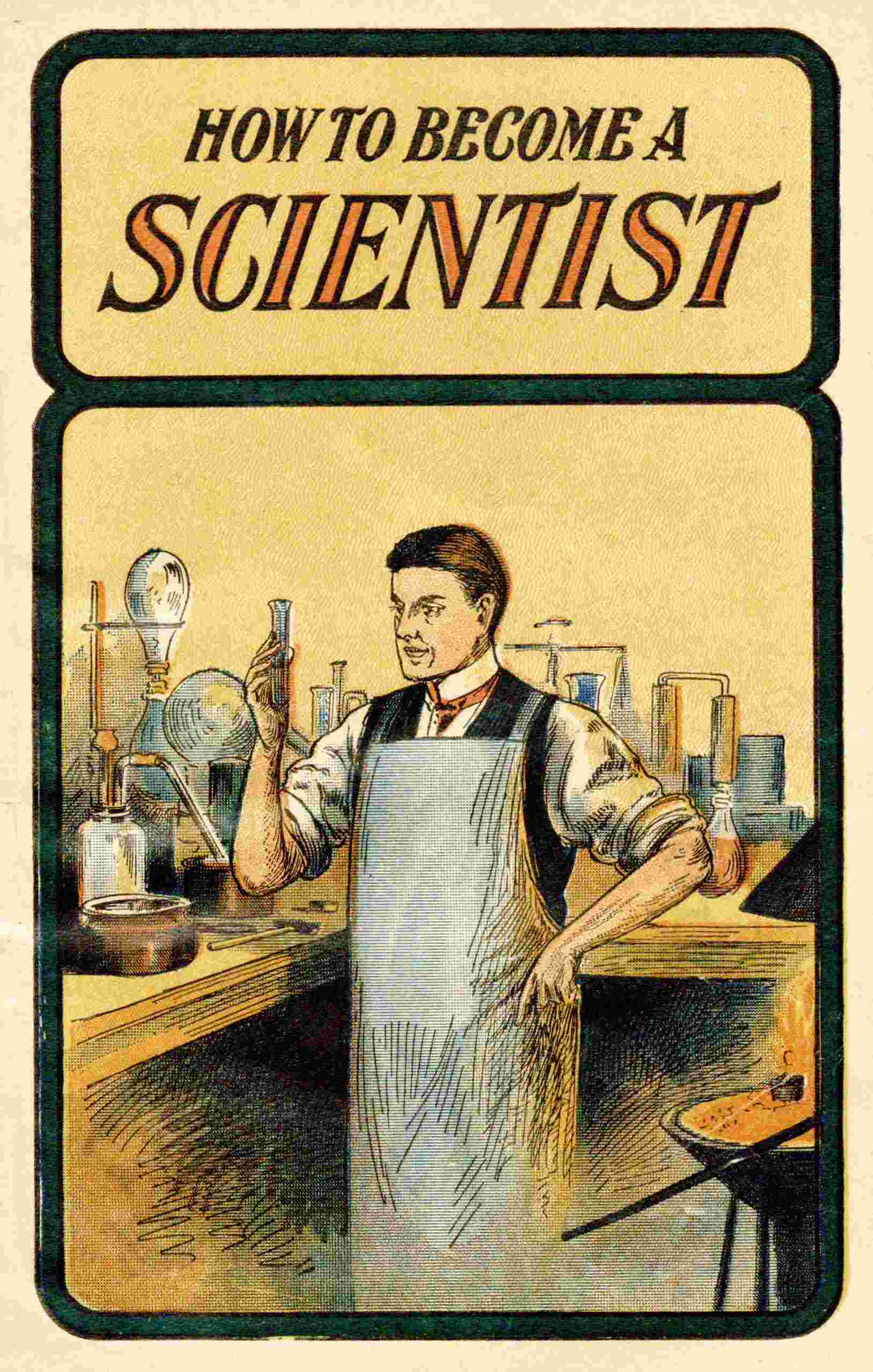
HOW TO BECOME A CHEMIST.
In the eleventh century, and during the reign of King Henry the First, surnamed Beauclerk, or the fine scholar, there appeared for the first time in certain books, professing to teach the art of making gold, the words chemistry, chemist, derived from the Greek. Seven hundred years and more have passed away, and that which was only the pursuit of a shadow called alchemy, has resulted in the acquisition of a great and noble science, now and again called chemistry. So it is with the great edifice Chemistry; we may, in these brief pages, peep in at the open door, but should we desire to go beyond the threshold, there are numerous guides, such as Roscoe, Wilson, and Fownes, who will conduct us through the mazes of the interior, and explain in elementary language the beautiful processes which have become so useful to mankind.
Chemistry is one of the most comprehensive of all the sciences, and at the same time one which comes home to us in the most ordinary of our daily avocations. Most of the arts of life are indebted to it for their very existence, and nearly all have been, from time to time, improved by the application of its principles.
Chemistry is, in fact, the science which treats of the composition of all material bodies, and of the means of forming them into new combinations, and reducing them to their ultimate elements, as they are termed; that is, bodies which we are unable to split up, as it were, or separate into other bodies. To take a common substance as an illustration; water, by a great number of processes, can be separated into two other substances, called oxygen and hydrogen, in the proportion by weight of 8 parts of the first to 1 of the second; but no power that we at present possess can separate the oxygen and hydrogen into any other bodies; they are therefore called ultimate elements, or undecomposable bodies.
Again, sulphate of magnesia (common Epsom salts) can be very easily separated into two other substances,—sulphuric acid and magnesia; and in this instance, both these substances can again be subdivided—the acid into sulphur and oxygen, and the magnesia into a metallic body called magnesium and oxygen; but sulphur, oxygen, and magnesium are incapable of further division, and are therefore called ultimate elements.
These ultimate elements amount to 64 in number, according to the present state of our knowledge, and may be arranged in various ways; the simplest plan, perhaps, is dividing them into Non-metallic and Metallic elements.
The Non-metallic elements are:—1. Oxygen. 2. Hydrogen. 3. Nitrogen. 4. Chlorine. 5. Iodine. 6. Bromine. 7. Fluorine. 8. Carbon. 9. Sulphur. 10. Selenium. 11. Tellurium. 12. Silicon. 13. Boron. 14. Phosphorus. The last-named element is the connecting link with the metals through arsenic, which phosphorus closely resembles in its chemical properties.
The Metallic elements may be sub-divided into the metals of the alkalies, the metals of the alkaline earths, the metals of the earths, and the other metals sometimes called metals proper.
1st. The metallic bases of the alkalies:—potassium, sodium, lithium, ammonium, cæsium, rubidium.
2d. The metallic bases of the alkaline earths:—calcium, strontium, barium.
3d. The metallic bases of the earths:—aluminum, glucinum, zirconium, thorium, yttrium, erbium, cerium, lanthanum, didymium.
4th. The metals proper, the most important of which are:—platinum, gold, silver, mercury, copper, iron, tin, lead, nickel, zinc, bismuth, antimony, manganese, cobalt, arsenic.
Now, from these elementary bodies, united together in various proportions, is formed the infinite variety of substances around us, whether animal, vegetable, or mineral; in fact, a few only are generally employed:—in the case of animals and vegetables, oxygen, hydrogen, carbon, nitrogen, with occasionally some sulphur, calcium, phosphorus, and silicon, suffice for building up the beautiful forms of animated nature; while the fabric of our globe itself consists for the most part of the earths; silex, i.e., flint or crystal; lime, in the shape of chalk, marble, or limestone, such as our flagstones are composed of; slate and granite, which are compounds of aluminium, silica, and small quantities of oxide of iron, and sometimes a little potash, etc.; and through their masses are projected irregular streams—veins as they are termed—of the metals, either in a pure state, as is the case sometimes with gold, silver, platinum, mercury, and perhaps one or two others; or combined with one of the non-metallic elements, or with one another.
Late calculations have determined the composition of the earth’s solid crust in 100 parts by weight to be:
| Oxygen | 44.0 | to | 48.7. |
| Silicon | 22.8 | “ | 36.2. |
| Aluminium | 9.9 | “ | 6.1. |
| Iron | 9.9 | “ | 2.4. |
| Calcium | 6.6 | “ | 0.9. |
| Magnesium | 2.7 | “ | 0.1. |
| Sodium | 2.4 | “ | 2.5. |
| Potassium | 1.7 | “ | 3.1. |
| 100.0 | 100.0 |
All these combinations are effected by certain powers, termed forces; those which cause the union of the elements are called the forces of attraction; those causing their separation, the forces of repulsion.
The force of attraction when exerted between masses of matter, is termed gravitation; when it unites particles of matter of a similar kind and produces masses, it is called the attraction of cohesion; when the particles united are of a dissimilar character, it is then termed chemical or elective affinity. For example, the crystals of Epsom salts are formed from minute particles of the salt, united into a larger or smaller mass by the attraction of cohesion, while the elements of which each particle consists, namely, the sulphur, oxygen, and magnesium, are united by the attraction of chemical affinity.
Cohesion thus unites particles of a similar kind; chemical affinity, of a dissimilar nature. It is to cohesion that the existence of masses of matter is owing, and its power increases as the squares of the distances diminish, in an inverse ratio to the squares of the distances of the particles on which it acts.
The power exerted by cohesion may be exhibited in various ways. This is one: Procure two discs of glass about three inches in diameter, their surfaces being ground extremely smooth; fix each into a square piece of wood, taking care that they are placed accurately in the center; then put them together by sliding their edges very carefully over each other, so as to avoid any air getting between them, and you will find a great force necessary to separate them. A hook should be fixed into the center of each piece of wood, so that they may be suspended, and a weight hung to the lower one. It is almost impossible for any one to separate them by merely pulling them with both hands; a weight of many pounds is required for that purpose. In like manner two freshly-cut surfaces of caoutchouc will, on being squeezed together, cohere so perfectly, that it is difficult to tear them asunder, and it is in this way that tubes of caoutchouc may be rapidly prepared for experiments, where little or no pressure is exerted.
Chemical affinity is sometimes called elective, or the effect of choice, as if one substance exerted a kind of preference for another, and chose to be united to it rather than to that with which it was previously combined; thus, if you pour some vinegar, which is a weak acetic acid, upon some pearlash (a combination of potash and carbonic acid), or some carbonate of soda (a combination of the same acid with soda), a violent effervescence will take place, occasioned by the escape of the carbonic acid, displaced in consequence of the potash or soda preferring the acetic acid, and forming a compound called an acetate. Then if some sulphuric acid be poured on this new compound, the acetic acid will in its turn be displaced by the greater attachment of either of the bases, as they are termed, for the sulphuric acid. Again, if into a solution of blue vitriol (a combination of sulphuric acid with oxide of copper) the bright blade of a knife be introduced, the knife will speedily be covered with a coat of copper, deposited in consequence of the acid preferring the iron, of which the knife is made, a quantity of it being dissolved in exact proportion to the quantity of copper deposited.
It is on the same principle that a very beautiful preparation called a silver-tree, or a lead-tree, may be formed thus:—Fill a wide bottle, capable of holding from half a pint to a pint, with a tolerably strong solution of nitrate of silver (lunar caustic), or acetate of lead, in pure distilled water; then attach a small piece of zinc by a string to the cork or stopper of the bottle, so that the zinc shall hang about the middle of the bottle, and set it by where it may be quite undisturbed; in a short time, brilliant plates of silver or lead, as the case may be, will be seen to collect around the piece of zinc, assuming more or less of the crystalline form. This at first is a case of elective affinity; the acid with which the silver or lead was united prefers the zinc to either of those metals, and in consequence discards them in order to attach the zinc to itself, subsequently a voltaic current is set up between the two metals, and the process will continue until almost the whole of the zinc is taken up, or nearly the whole of the silver or lead deposited.
Again, many animal and vegetable substances consist for the most part of carbon or charcoal, united with oxygen and hydrogen in the proportion which forms water. Now oil of vitriol (strong sulphuric acid) has so powerful an affinity, or so great a thirst for water, that it will abstract it from almost any body in which it exists; if you then pour some of this acid on a lump of sugar, or place a chip of wood in it, the sugar or wood will speedily become quite black, or be charred, as it is called, in consequence of the oxygen and hydrogen being removed by the sulphuric acid, and only the carbon, or charcoal, left.
When Cleopatra dissolved pearls of wondrous value in vinegar, she was exhibiting unwittingly an instance of chemical elective affinity; the pearl being simply carbonate of lime, which was decomposed by the greater affinity or fondness of lime for its new acquaintance (the acetic acid of the vinegar) than for the carbonic acid, with which it had been united all its life,—an example of inconstancy in strong contrast with the conduct of its owner, who chose death rather than become the mistress of her lover’s conqueror.
Gases.
The three permanent gaseous elements are oxygen, hydrogen, and nitrogen.
The compound gases are very numerous, some being combustible, and others supporters of combustion.
Gases are for the most part transparent and colorless, with a few exceptions, and of course, like the air of the atmosphere, invisible. They are little affected by the attraction of cohesion, but rather, on the contrary, the particles composing them have a constant tendency to separate from each other, so that their force of expansion is only limited by the pressure under which they may be kept, and the temperature they may be exposed to. They have a tendency to penetrate each other, as it were; for instance, if you take a jar of heavy gas, such as carbonic gas, set it with its mouth upwards, then invert over it another jar containing hydrogen, a gas nearly twenty-two times lighter, in a very short time the two gases will have become thoroughly mixed, the heavy carbonic acid having risen, and the light hydrogen fallen, until the gases are thoroughly mixed, each jar containing an equal quantity of each gas.
Oxygen Gas.
This gas, so named from two Greek words signifying the maker of acid, was discovered by Dr. Priestly in 1774. He obtained it by heating the red oxide of mercury in a glass retort, when the gas escaped in considerable quantities. In the ensuing year Scheele obtained it by a variety of methods, and a few years afterwards Lavoisier discovered that it was contained in atmospheric air, where it exists in the proportion of about one-fifth, the remaining four fifths being almost entirely nitrogen.
Oxygen gas may be obtained for the purpose of experiment, by heating to redness the black oxide of manganese in an iron bottle, to the mouth of which a flexible tube is attached to convey away the gas as fast as it is liberated from the manganese. The first portions should be allowed to escape, being mixed with the air in the tubes and bottle, and the remainder may be collected in a gasometer, or in glass jars inverted over water.
Another method to obtain the gas, and one to be used only in the absence of other ingredients, is to mix in a retort some of this same oxide of manganese with about half its weight of strong sulphuric acid, and apply heat to the retort, when the gas will come over in considerable quantities; the first portions must be allowed to escape as before.[1] If the gas is required very pure, a small quantity of the salt called chlorate of potassa, may be heated in a retort, and oxygen gas will be evolved, and may be collected as before. If you have an iron bottle, the first mode is by far the cheapest, as the heat of a bright fire is sufficient for the operation, and a large quantity of gas is obtained in a short time from a very inexpensive material. The most rapid and convenient process of all is to heat a mixture of two parts chlorate of potash, and one of powdered black oxide of manganese, in a common clean oil flask, to which a cork and bent tube has been adapted. Care must be taken not to mistake sulphide of antimony for black oxide of manganese, as very serious accidents have arisen from this cause.
Oxygen is largely distributed over our globe, both in its uncombined state, and in union with other substances. Besides forming one-fifth of the atmosphere, it forms eight-ninths by weight of all the water in the ocean, rivers, and springs on the face of the whole earth. It also, in combination with various metals, forms the various earths and minerals of which the crust of the earth consists, so that it is the most abundant and widely distributed substance in nature, and in combination with other elements, forms nearly half the weight of the solid earth.
In its uncombined state it is a colorless gas, somewhat heavier than atmospheric air, without taste or smell. It is a powerful supporter of combustion, and is absolutely necessary for the support of animal life, which cannot exist for any time without a free supply of this gas, which is constantly consumed in the act of breathing and is replaced by an equivalent portion of carbonic acid gas. The want of oxygen is partly the cause of the oppression felt in crowded rooms, where the air cannot be renewed so fast as is required for the number of persons who are constantly consuming the oxygen; and if an animal be confined under a glass jar inverted over water, it will presently die, just for the same reason that burning tapers are extinguished under similar circumstances.
If a jet of this gas be thrown upon a piece of charcoal, sulphur, or almost any combustible body in a state of ignition, it will make it burn with great vividness and rapidity.
FOOTNOTE:
[1] Some boiling water should be added to the mass left in the retort directly the gas has ceased to come away, or it will adhere to the glass so firmly, that the retort will certainly be spoilt.
Experiment.
But by far the most intense heat, and most brilliant light, may be produced by introducing a piece of phosphorus into a jar of oxygen. The phosphorus may be placed in a small copper cup, with a long handle of thick wire passing through a hole in a cork that fits the jar. The phosphorus must first be ignited; and, as soon as it is introduced into the oxygen, it gives out a light so brilliant that no eye can bear it, and the whole jar appears filled with an intensely luminous atmosphere. It is well to dilute the oxygen with about one-fourth part of common air to moderate the intense heat which is nearly certain to break the jar if pure oxygen is used.
Experiment.
If a piece of charcoal, which is pure carbon or nearly so, be ignited, and introduced into a jar containing oxygen or common atmospheric air, the product will be carbonic gas only, of which we shall speak presently. As most combustible bodies contain both carbon and hydrogen, the result of their combination is carbonic acid and water. This is the case with the gas used for illumination; and in order to prevent the water so produced from spoiling goods in shops, various plans have been devised for carrying off the water when in the state of steam. This is generally accomplished by suspending over the burners glass bells, communicating with tubes opening into the chimney, or passing outside the house.
To show that oxygen, or some equivalent, is necessary for the support of combustion, fix two or three pieces of wax-taper on flat pieces of cork, and set them floating on water in a soup-plate, light them, and invert over them a glass jar; as they burn, the heat produced may perhaps at first expand the air so as to force a small quantity out of the jar, but the water will soon rise in the jar, and continue to do so until the tapers expire, when you will find that a considerable portion of the air has disappeared, and what remains will no longer support flame; that is, the oxygen has been converted partly into water, and partly into carbonic acid gas, by uniting with the carbon and hydrogen, of which the taper consists, and the remaining air is principally nitrogen, with some carbonic acid; the presence of the latter may be proved by decanting some of the remaining air into a bottle, and then shaking some lime-water with it, which will absorb the carbonic acid and form chalk, rendering the water quite turbid.
Nitrogen.
This gas is, as its name implies, the producer of niter, or at least forms a portion of the nitric acid contained in niter. It is rather lighter than atmospheric air, colorless, transparent, incapable of supporting animal life, on which account it is sometimes called azote—an objectionable name, as it is not a poison like many other gases, but destroys life only in the absence of oxygen. This gas extinguishes all burning bodies plunged into it, and does not itself burn. It exists largely in nature, for four-fifths of the atmosphere consists of nitrogen gas. It is also an important constituent of animal bodies, and is found in the vegetable world.
Nitrogen may be most easily obtained for experiment by setting fire to some phosphorus contained in a porcelain or metallic cup, placed under a gas jar full of air, and resting on the shelf of the pneumatic trough, or in a soup-plate filled with water.
Nitrogen combines in five different proportions with oxygen producing five distinct chemical compounds, named respectively nitrous oxide, nitric oxide, nitric tri-oxide, nitric tetroxide, nitric pent-oxide, which last, united with water, forms nitric acid, now called hydric nitrate, as nitrous acid is termed hydric nitrite.
Nitrous oxide gas is generally known by the name of “laughing gas,” from the jolly sensations experienced on inhaling it. It may be procured by distilling in a glass retort a salt called nitrate of ammonia, which yields the gas in considerable quantities, and it should be kept standing in jars over water for some hours before it is used. It should be transferred into a silk air-tight bag, furnished with a stop-cock and mouth-piece, from which the gas may be breathed; a little practice is required to do this easily, and more resolution to desist when the gas begins to produce its effects, as it appears to fascinate the experimenter, and actual force is often necessary to remove the bag from the mouth. The effects produced vary according to the temperament of the person inhaling it; they are, however, always of a highly pleasurable nature, muscular action being generally greatly exalted, compelling the individual to race round the apartment and execute leaps and pirouettes perfectly astounding. Some persons shout and sing, and I have seen one expend his superfluous animation in twisting his features into such ludicrous grimaces as would be the envy of the candidates at a grinning match, and beat them all out of the field.
This gas is heavier than air, and supports combustion nearly as energetically as oxygen, as may be shown by introducing a piece of ignited phosphorus into a jar of this gas. It will not, however, support the life of small animals, such as mice, which introduced into it die very quickly.
The next compound of nitrogen with oxygen, when one proportion of nitrogen unites with two of oxygen, is termed nitric oxide gas. It may be easily procured by heating in a retort some copper turnings in dilute nitric acid. It is colorless and transparent, and has the property of combining with oxygen to form other compounds.
Experiment.
Into a jar of this gas standing over water pass some oxygen gas. The jar will be filled with red fumes, which will be rapidly absorbed by the water. If atmospheric air be used instead of oxygen, there will remain in the jar the nitrogen of the air amounting to four-fifths of the air employed.
This gas is destructive to animal life, in consequence of its property of uniting with the oxygen in the lungs, and producing the highly corrosive nitrous acid gas. It will, however, support the combustion of a few substances, phosphorus for instance, provided it is sufficiently heated before being plunged into the gas.
We pass over the third and fourth compounds of nitrogen with oxygen, as they are not calculated for amusing experiments. Nitric acid is easily prepared on the small scale, by gradually heating equal parts by weight of nitric and sulphuric acid in a retort to which a receiver has been adapted. The receiver, which may be a clean oil flask, should be kept cool with wetted blotting paper.
Nitrogen combines with chlorine and iodine, forming detonating compounds, the former being so extremely dangerous that it will be better to pass it by.
The compound with iodine, called iodide of nitrogen, may very easily be made by pouring a strong solution of ammonia (a compound of nitrogen and hydrogen) upon some iodine in a vial, shaking them well together, and after letting them stand for a few hours, pouring off the fluid; the black powder remaining in the vial is the explosive compound, the iodide of nitrogen. When dry, it is very apt to detonate spontaneously; it should therefore be shaken out of the vial while wet, and spread in very small quantities on separate pieces of blotting paper, which should be kept apart from each other. When thoroughly dry, the slightest touch with the point of a feather, shaking the paper on which it rests, or even opening too rapidly the door of a closet where it has been put to dry, will cause it to explode, producing a quantity of violet-colored fumes. The explosion is somewhat violent, producing a sharp cracking noise; and the greatest care should be taken in experimenting with it.
Atmospheric Air.
As has been already mentioned, nitrogen is the principal constituent of the air of the atmosphere which surrounds our globe, extending to a height of about forty-five miles above it, and playing a most important part in the economy of nature, inorganic as well as organic.
This atmospheric air consists by volume of nearly four-fifths of nitrogen, and rather more than one-fifth of oxygen, viz.: seventy-nine of the former to twenty-one of the latter, or twenty-three parts by weight of oxygen and seventy-seven of nitrogen; it generally contains also a variable proportion of the vapor of water, and a very small quantity of carbonic acid gas, being only about four volumes to 10,000 of air. Its constituent parts are easily separated, as it is a mechanical mixture and not a chemical compound, though the mixture by diffusion is so complete that chemists have not been able to ascertain any difference in the composition of air taken from all parts of the world, and from different heights, up to the highest point which has to this time been attained.
The atmosphere presses on the surface of the globe, and every being on it, with a force of about fifteen pounds to every square inch of surface, but as it presses equally in all directions, upwards as well as downwards, its weight cannot be perceived unless the pressure be removed from one surface by some artificial means.
Atmospheric air contains, besides the oxygen and nitrogen, its principal constituents, a small proportion of carbonic acid gas, as has been mentioned, and this may be shown by filling a tube about half full of lime-water, and shaking it with the air contained in the other half, when it will become slightly turbid from the insoluble carbonate of lime formed.
When we consider that every living animal is constantly consuming oxygen, and replacing it by carbonic acid gas, and that all burning bodies, fires in our dwellings, furnaces, artificial lights of all kinds, act in the same way in abstracting the oxygen from the air, and replacing it by immense quantities of carbonic acid gas, which is a poison to all animals who breathe, or attempt to breathe it, we must wonder what becomes of this irrespirable gas, as it is found to exist in the air in quantities so minute, and by what means the oxygen is restored, and the air again made fit for respiration. This is effected by one of those laws which the wisdom of the Creator has impressed upon matter, by which one part of creation as it were balances another, and all proceeds in an endless circle of change. This carbonic acid, which is so poisonous to animal life, is the food of the vegetable world, plants having the power of taking up the carbonic acid into their pores; converting the carbon into their own substance, and rejecting the oxygen, which is again respired by animals, &c. In the same way, all animal refuse is the food of vegetables, and is used under the name of manures.
The atmosphere contains also a variable quantity of vapor of water, invisible as long as it is in the state of vapor, but it may be rendered obvious by bringing any very cold body into warm air, when the vapor will condense on the cold body in the form of small drops of water. A tumbler of fresh-pumped water brought into a crowded room is almost immediately covered with moisture, and it may also be seen on bottles of wine which have been put into ice before coming to table. Fogs are occasioned by the condensation of vapor produced by mixing a current of warm air with a colder air. The banks of Newfoundland are notorious for dense fogs, occasioned by the warm air brought from the south by the great Gulf Stream, mixing with the cold air from the Arctic regions, and thus precipitating the vapor in a visible form, rendering everything but itself invisible. The famous London fogs depend upon the same precipitation of the vapor of water, with the addition of the smoke from the numerous sea-coal fires, which give it that interesting yellow tinge for which it is so remarkable.
Aqueous vapor appears to impart a transparency to air, and permits objects to be seen more distinctly in proportion to its quantity; hence, when distant hills appear nearer, and objects upon them more distinct than usual, rain may be expected, the air being fully charged with vapor ready to be deposited on the slightest cause.
Hydrogen.
Hydrogen gas is the lightest substance known, being fifteen times lighter than atmospheric air. It is colorless and transparent, incapable of supporting combustion or respiration, but is itself combustible. Hydrogen, as its name implies (being derived from two Greek words, signifying the generator of water), is a constituent of water in the proportion of one-ninth by weight, and is always obtained by decomposing that fluid, by presenting to it some body to take up its other ingredient, oxygen, and so set the hydrogen at liberty. If the steam of water be passed through a red-hot gun-barrel, containing iron filings, the water is decomposed, the iron taking the oxygen, and the hydrogen comes over in torrents; but as every one has not a gun-barrel and furnace to heat it, the usual mode is to employ dilute sulphuric acid, and iron filings, or zinc, in small pieces, and it may be collected over water by means of a bent tube issuing from the bottle in which it is formed. It is so light that it was used to fill balloons before coal gas was to be had, and if you procure a light air-tight bag of silk, or thin membrane, such as a turkey’s crop, and fill it with gas, it will ascend rapidly, and dance about the ceiling of a room.
Experiments.
1. Attach a tobacco-pipe to a bladder filled with this gas, and blow some soap-bubbles with it; they will rise very rapidly, and if a lighted taper be applied to them they burn.
If you mix in a soda-water bottle one-third of oxygen with two-thirds of hydrogen, and apply flame, the mixture will explode with a sharp report. Great care must be taken in all experiments with the mixed gases. To avoid danger the gases are placed in separate India-rubber bags, and are only brought together at the jet. This is an expensive apparatus, and should only be used by experienced persons.
2. If a jar of this gas be held with its mouth downwards, and a lighted taper passed up well into the jar, the taper will be extinguished, and the gas take fire, and burn quietly at the mouth of the jar; if mixed with oxygen or atmospheric air, it will explode.
Hold open the jet of hydrogen issuing from a small tube, hollow cylinders of glass or earthenware, Florence flasks, or hollow glass balls, and musical sounds will be produced, which were supposed to depend on some peculiar property of hydrogen gas, until Mr. Faraday tried flame from coal gas, olefiant gas, and even the vapor of ether, when the sounds were still produced, and he attributed them to a continuous explosion, or series of explosions, produced by the union of oxygen with the hydrogen of the flames.
Water.
With oxygen, hydrogen unites to form the important compound water, which exists not only in the obvious form of oceans, rivers, lakes, rains, dews, &c., &c., but is found intimately combined with many substances, giving them some of their peculiar properties. Many crystals have a definite proportion of water combined with them, and on losing this water they lose their crystalline form. Many acids also cannot exist as acids without water. The slaking of lime depends upon the union of water with the lime, the dry powder resulting from the process being a hydrate of lime, the water having become solidified, and in passing from the fluid to the solid state gives out its latent caloric, producing the heat observed during the process. When a large quantity of lime, a barge-load for instance, has got wetted by accident, the heat evolved has been sufficient to set fire to the barge.
At the temperature of 32° of Fahrenheit’s thermometer, water loses its fluid form, and becomes ice. As it solidifies, it starts into beautiful crystals, which unite and cross each other at determinate angles. Ice is lighter than the water on which it floats, forming a protection to the water beneath, and preventing it from being frozen so rapidly; else, if the ice were heavier than water, and consequently sank as soon as formed, each portion of water would be frozen in its turn, until rivers became solid throughout, and every living creature in them must be destroyed. Now, the temperature of the water under the ice is seldom much below 40°, and if care be taken to break holes at intervals to allow access to the air, the fish and other aquatic animals seldom suffer even in our coldest winters.
Although it is impossible to raise ice even one degree above 32° without thawing, it is not difficult to reduce water many degrees below that point without freezing it.
In order to obtain both the constituents of water in a separate state, it must be decomposed by galvanism, each pole of a battery terminating in a separate tube containing water, when the result will be that at the positive pole oxygen gas will be evolved, and hydrogen at the negative, the latter being double the quantity of the former. Now, if you mix the gases thus obtained, introduce them into a vessel called a “Eudiometer,” and pass an electric spark through them from a Leyden vial, a sudden flash will be seen, and the gases will entirely disappear, being again converted into water. If you have a mercurial trough, and perform this experiment over mercury, the inside of the eudiometer will exhibit minute drops of water. Thus you have proved both by analysis and synthesis, that water consists of oxygen and hydrogen, in the proportion of one volume of the former to two of the latter.
Experiment.
Take some perfectly pure distilled water, filter it, surround it with a mixture of light snow, or powdered ice, and salt, taking care to keep it perfectly still, a thermometer having been previously placed in it. The mercury will gradually sink many degrees below the freezing point 32° (it has been reduced as low as 4°), the water still remaining fluid; when all at once, either from shaking the table, or simply because the reduction can be carried no further, it suddenly starts into ice, and the thermometer jumps up at once to 32°, where it remains until the whole is frozen, when the temperature gradually sinks to that of the surrounding medium.
Now if you remove the glass of ice from the freezing mixture into the apartment, and watch the thermometer, you will find it gradually rise to 32°, and there remain until all the ice is melted, when it will gradually acquire the temperature of the room. The reason of this is, that the water in passing from the solid to the fluid form absorbs, and in passing from the fluid to the solid form gives out caloric, so maintaining the temperature at 32°, the point at which the change of form takes place, until it is completed.
Between the temperature of 32° and 212°, water exists in a fluid form, under ordinary circumstances; but at the latter point it assumes the form of vapor or steam, and acquires many of the properties of gases, being indefinitely expansible by heat, the force increasing as the temperature is raised, provided the steam be confined, until it becomes irresistible—witness the frequent explosions of steam-engines in this country, where the engines are worked at a high pressure.
The temperature at which water boils is modified by the pressure applied to it. Thus, as you ascend a mountain, and so pass through a portion of the atmosphere, water boils at a lower temperature, until at great heights it boils at so low a heat, that good tea cannot be made because it is impossible to heat the water sufficiently. Under the exhausted receiver of an air-pump, water boils at about 140°.
Chlorine.
Another gaseous element, sometimes called a supporter of combustion, is named chlorine, from a Greek word signifying yellowish green.
This gas was formerly called “oxymuriatic acid,” being supposed to be a compound of oxygen and muriatic acid gases, until Sir H. Davy, in a series of masterly experiments carried on during the years 1808-9-10 and 11, proved that it contained no oxygen or muriatic acid, and that it was in fact a simple or undecompounded substance, and changed its name to chlorine, which name was, after some discussion, accepted by the scientific world, and is still in use.
This gas may be obtained for experiment, by gently heating in a retort a mixture of muriatic or hydrochloric acid, hydrochloride, as it is now called, with some black oxide of manganese: the muriatic acid, a compound of chlorine and hydrogen, is decomposed, and so is the oxide of manganese, giving out some of its oxygen, which takes the hydrogen from the muriatic acid to form water, while the chlorine gas, with which the hydrogen had been united, is set at liberty, and may be collected in jars over water.
Chlorine gas is transparent, of a greenish yellow color, has a peculiar disagreeable taste and smell, and if breathed even in small quantities, occasions a sensation of suffocation, of tightness in the chest, and violent coughing, attended with great prostration. I have been compelled to retire to bed from having upset a bottle containing some of this gas. It destroys most vegetable colors when moist, and is in fact the agent now universally employed for bleaching purposes.
It has also the power of combining with and destroying all noxious smells, and is invaluable as a purifier of foul rooms, and destroyer of infection. For these latter purposes it is used in combination with lime, either in substance or solution, under the name of “Chloride of Lime.”
Chlorine gas is a powerful supporter of combustion, many of the metals taking fire spontaneously when introduced in a fine state of division into the gas.
Experiments.
1. Into a jar of chlorine gas introduce a few sheets of copper leaf, sold under the name of Dutch foil, when it will burn with a dull red light.
2. If some metallic antimony in a state of powder be poured into a jar of this gas, it will take fire as it falls, and burn with a bright white light.
3. A small piece of the metal potassium may be introduced, and will also take fire.
4. A piece of phosphorus will also generally take fire spontaneously when introduced into this gas. In all these cases direct compounds of the substances with chlorine are produced, called chlorides.
5. If a lighted taper be plunged quickly into the gas, it will continue to burn with a dull light, giving off a very large quantity of smoke, being in fact the carbon of the wax taper, with which the chlorine does not unite; while the other constituent of the taper, the hydrogen, forms muriatic acid by union with the chlorine.
6. This substance has the property of destroying most vegetable colors and is used in large quantities for bleaching calico, linen, and the rags of which paper is made. It is a curious fact that it shows this property only when water is present, for if a piece of colored cloth is introduced dry into a jar of the gas, also dry, no effect will be produced—wet the cloth, and reintroduce it, and in a very short time its color will be discharged.
7. Introduce a quantity of the infusion of the common red cabbage, which is of a beautiful blue color, into a jar of this gas, and it will instantly become nearly as pale as water, retaining a slight tinge of yellow. A solution of sulphate of indigo can always be obtained, and answers well for this experiment.
Muriatic Acid Gas, or Chloride.
With chlorine, hydrogen forms a compound called muriatic, or hydrochloric acid gas. It cannot easily be formed by the direct union of its elements, but is procured from some compound in which it exists ready formed. Common salt (chloride of sodium) is generally employed; and when acted on by strong sulphuric acid (or oil of vitriol), the gas is disengaged in abundance. It must be collected over mercury, for water absorbs it, forming the liquid muriatic, or hydrochloric acid.
A lighted taper plunged into this gas is instantly extinguished. It is very dangerous to animal life if respired. It has the property of destroying animal effluvia, and was once employed to purify the cathedral of Dijon, which was so filled with putrid emanations from the bodies buried in it, that it had been closed for some time. It perfectly succeeded, but it is so destructive to all metallic substances that it is not used now, for the chlorides of lime and zinc have since been discovered to act more effectually than the muriatic acid gas, without its inconvenience.
The compounds of hydrogen with iodine are passed over.
With nitrogen, hydrogen unites and forms one of the most extraordinary compounds in the whole range of chemistry,—the gas called ammonia. This is the only gas possessing what are called alkaline properties; i.e., it changes the blue color of certain vegetables to green, yellow to deep brown, and unites with the acids to form neutral compounds, just as the other alkalies, potash and soda, which are oxides of metals. It may be procured in abundance by heating the hydrochlorate of ammonia, or sal ammoniac, as it is usually called, with quick-lime, which takes the hydrochloric acid, and sets free this remarkable gas. It must be received over mercury, as it is absorbed to almost any extent by water, forming the fluid sold as “spirits of hartshorn” in the shops.
This gas is colorless and transparent, lighter than atmospheric air, and will not support combustion; it has a very pungent but not disagreeable smell. Under certain circumstances it is combustible.
Experiments.
1. Take a bottle containing chlorine gas, and invert over its mouth another filled with ammoniacal gas; then if the bottles be held in the hand (guarded by a pair of gloves), and suddenly turned, so that the chlorine be uppermost, the two gases will unite so rapidly that a white flame fills the bottles for an instant.
2. Substitute for the chlorine of the last experiment a bottle of carbonic or hydrochloric acid gas; in either case the gases disappear, and a light white powder settles on the sides of the bottles, being the carbonate or hydrochlorate of ammonia, according to the acid used.
Carbonate of ammonia is the substance sold for “smelling salts;” and the hydrochlorate, or muriate of ammonia, is the salt called “sal ammoniac,” whence the alkaline gas was first obtained, and from which it got its name of ammonia. The salt itself was so called, because it was formerly brought from the deserts near the ruins of the temple of Jupiter Ammon.
This salt is, as has been shown, a compound of muriatic acid gas and ammoniacal gas, containing therefore only three simple elements—hydrogen, chlorine, and nitrogen, all gases, and known only in the gaseous state, its symbol being NH4C2; yet they by union form a solid body, resembling in all essential qualities the salts of potash and soda, which are oxides of known metals. Moreover, if some mercury be placed in a solution of this salt, and subjected to the action of galvanism, the negative pole being applied to the mercury, and the positive to the sal ammoniac, the mercury presently loses its fluidity, increases greatly in size, and in fact presents the same appearance as when it is mixed with some metal, forming what is called an “amalgam.” When the battery ceases to act, a succession of white films forms on the surface of the amalgam, and the mercury soon returns to its original state. How is this to be explained? Some chemists have supposed that there must be a base united to the mercury, and have named this hypothetical substance “ammonium,” to correspond to potassium and sodium, the bases of potash and soda, which resemble ammonia in so many properties. But what is this ammonium? and how is it formed? for hydrogen and nitrogen are simply elementary bodies. Are all metals compounds of gases? and are there but a few elements instead of the 64 now enumerated? This, however, is a difficult question, not fitted for discussion here.
Carbonate of ammonia may be obtained by mixing together powdered chalk (which is a carbonate of lime) and muriate of ammonia, and heating the mixture in close vessels, when the salt in question will rise in fumes, and be condensed in a mass in the upper part of the vessel. It is, however, so largely produced in other manufactures, particularly in gas-works, that there is no necessity to resort to the more expensive and direct method. It is the well-known “smelling salts.”
The only other salt of ammonia worth our notice here is the nitrate, from the destructive distillation of which is obtained the nitrous oxide, or laughing gas, already mentioned.
Iodine—Bromine—Fluorine.
On the coasts of certain islands belonging to the Duke of Argyll, vast quantities of sea-weed are occasionally torn up from their ocean beds and deposited on the shores. This weed, after being partially dried by exposure to the sun and air, is burnt in a shallow pit; the ashes are then collected, and form the commercial raw material called kelp, from which iodine is procured by a gradual series of processes.
Experiments.
Iodine has a beautiful metallic luster, with a bluish black color, and should be kept in a well-stoppered bottle. A small quantity placed in a clear flask and heated, affords a magnificent violet vapor, which may be poured from the flask into another glass vessel, when it condenses again into crystalline plates. The color of the vapor originates the name of this element, so called from a Greek word, meaning violet-colored. If a little iodine be placed in contact with a thin slice of phosphorus, the latter takes fire almost immediately.
Bromine.
From the Greek, signifies a bad odor, and is most intimately allied with chlorine and iodine; like these elements, it belongs to the sea, and is a constituent of sea-water. Bromine is a very heavy fluid, and should be preserved by keeping it covered with water in a stoppered bottle.
Experiments with liquid bromine are not recommended, as all the most interesting ones can be performed with the vapor, which is easily procured by letting fall a few drops of bromine into a warm dry bottle.
Experiments.
Pounded antimony sprinkled into the vapor takes fire immediately.
A thin slice of phosphorus placed in a deflagrating ladle and placed into the vapor of bromine ignites very quickly.
A solution of sulphate of indigo, or an infusion of red cabbage, are easily bleached by being shaken violently with the vapor of bromine.
Fluorine.
In many parts of England, especially in Devonshire, Cornwall, and above all in Derbyshire, is found a very beautiful mineral, known by the name of Fluor Spar, Derbyshire Spar, and called by the miners Blue John, to distinguish it from another mineral found in the same locality, called Black Jack. It occurs in very regular and frequently large crystals in the form of cubes, and occasionally in octoëdra. It is a compound of calcium with fluorine, and is very abundant in certain fossil bones. This element, in combination with hydrogen and called hydrofluoric acid, acts so energetically upon all substances containing silica, that it cannot be preserved in vessels of glass or porcelain—very few of the metals are capable of resisting its action, lead being nearly the only common metal possessed of this power. Gutta percha may also be employed for vessels to hold it.
This property of dissolving silica has caused this acid to be used for engraving on glass.
Experiment.
Mix one part of fluor-spar, quite pure, with two parts of oil of vitriol, in a saucer, and apply a gentle heat, when the acid will be disengaged in the form of vapor. Prepare a piece of glass after the manner of engraving on copper, by coating it with a thin covering of wax, placing a paper over the wax, and then drawing any design with a sharp-pointed instrument, when, on removing the paper, the wax-coating will be found to be removed wherever the instrument has passed over it. Now invert this glass over the fumes of the acid for half an hour or so, and then heat the glass so as to soften the coating, and wipe it off; the design will then appear “bitten in,” as the term is, that is, the acid will have dissolved the glass wherever it was not protected by the wax, and will exhibit the design indelibly fixed on the glass.
This acid requires the greatest care in handling, for it is extremely corrosive, producing very troublesome ulcers if it comes in contact with the skin; even the fumes will produce smarting if the skin is long exposed to them.
Carbon.
The next substance in our list of elementary bodies is named carbon.
The purest form of carbon is the precious stone called diamond, which consists entirely of carbon in a crystallized form. The French chemist Lavoisier was the first who proved the combustibility of the diamond; and Sir H. Davy found that when once set on fire it would continue to burn in oxygen gas air, and that the product of the combustion was carbonic acid gas, exactly equal in quantity to the gas produced by burning an equal weight of pure charcoal, the most common form of carbon.
Plumbago, or “black-lead,” as it is very improperly called, is also nearly pure carbon, a very small quantity of iron being united with it.
By far the greater part of all vegetable, and a very large portion of animal bodies consists of carbon; and in the state of carbonic acid in combination with lime and some other earths, it forms nearly the half of all the chalk, marble, and limestone of our hills; so that it is, in one shape or other, one of the most widely diffused bodies in nature.
Carbon forms two gaseous compounds with oxygen; the first, called carbonic oxide, is easily obtained by boiling oxalic acid with its own bulk of sulphuric acid, in a flask to which a cork and bent tube is attached. The gas comes over in large quantities, and must be collected in a gas jar, or the pneumatic trough. It is inflammable, and burns with a lambent blue flame.
The other compound, carbonic acid, is transparent, colorless, much heavier than atmospheric air, has an agreeable taste, has the power of irritating the mucous membrane of the nose (as any one can tell who has drunk soda-water), without possessing any particular odor, is absorbed by water, does not support respiration, and extinguishes flame.
Carbonic acid gas may be obtained with the greatest facility by pouring some muriatic or sulphuric acid, diluted with about six parts of water, upon some pieces of marble or limestone in a bottle with a tube attached, when the gas comes over in torrents. It may be collected over water.
Experiments.
1. To show the great comparative weight of this gas, place a lighted taper at the bottom of a tall glass jar, then take a jar full of carbonic acid gas, and pour it as you would pour water into the jar containing the lighted taper; you will soon find the taper will be extinguished as effectually as if you had poured water on it, and the smoke of the taper will float on the surface of the gas in very beautiful wavy forms.
2. Heat a piece of the metal potassium in a metal spoon (platinum is best), and if introduced in a state of ignition into the gas, it will continue burning brilliantly, producing a quantity of dense smoke, which is the carbon from the carbonic acid, the potassium having seized the oxygen, and being converted by it into potash.
3. If a mouse, bird, or other small animal be placed in a jar of this gas, it becomes insensible almost immediately; but if speedily removed it will occasionally recover.
4. Shake up some water with some of this gas in a bottle; the greater part of the gas will be absorbed by the water, which acquires a sparkling appearance and a pleasant sharp taste; with the addition of a little soda this becomes the well-known beverage called soda-water, so famous for removing the morning headaches caused by “that salmon” having disagreed at yesterday’s dinner.
It is the presence of this gas which renders it so dangerous to descend into deep wells, for by its great weight it collects at the bottom, and instantly suffocates any unfortunate person who incautiously subjects himself to it. Hence it is prudent always to let down a lighted candle before any one descends into a well, or other deep excavation, and if the candle is extinguished, it is necessary to throw down several pails of water—lime-water, if possible—and again to try the candle, which must burn freely before it is safe for any one to descend.
It is this same gas, under the name of “choke-damp,” which proves so dangerous to miners, particularly after an explosion of “fire-damp,” for it is the principal product of the explosion, and it is by no means an easy matter to dislodge it.
Carbonic acid gas has been condensed into the fluid form by causing it to be disengaged under great pressure; the fluid acid has the appearance of water. When the pressure is removed, as by allowing some of the fluid acid to escape from the vessel in which it has been condensed, it instantly reassumes the gaseous form, and in so doing absorbs so much latent caloric that a portion of the acid is actually solidified, and appears in the shape of snow, which may be collected and preserved for a short time.
Carbonic acid and lime are mutually tests for each other. If a jar containing a little lime-water be put into a jar of this gas, it speedily becomes turbid, the gas uniting with the lime, and producing chalk (the carbonate of lime), which is insoluble in water.
This gas is produced in large quantities by the respiration of animals, as may be proved by respiring through a tube immersed in lime-water, when the water will be instantly rendered turbid from the formation of chalk.
Carbon and Hydrogen.
To the combination of these elements in various proportions, and with the occasional addition of other substances, we are indebted for all, or nearly all, our means of obtaining light and heat. Coal, wood, spirit, oil, and all the varieties of fats, are composed principally of carbon and hydrogen, and may easily be converted into the gas with which our houses and streets are lighted, which is nearly pure carbureted hydrogen.
The two chief definite gaseous compounds of those two elements are the light carbureted hydrogen and the heavy carbureted hydrogen, or olefiant gas. The first is easily procured by stirring the bottom of stagnant water on a hot summer’s day, and collecting the bubbles in a bottle filled with water and inverted over the place where the bubbles rise. This gas burns with a yellowish flame, and when mixed with a certain proportion of air, or oxygen gas, explodes with great violence on the application of a flame. It is the much dreaded fire-damp generated so profusely in some coal-mines, and causing such fearful destruction to life and property when accidentally inflamed.
The other compound, the heavy carbureted hydrogen, forms part of the gas used for illumination; and, in fact, whatever substance is employed for artificial light, whether oil, tallow, wax, etc., etc., it is converted into this gas by heat, and then furnishes the light by its own combustion.
This gas has some very curious properties, and may be obtained nearly pure by mixing in a retort, very carefully, one part of spirits of wine and four of sulphuric acid. A lamp must be placed under the retort, when the gas will be speedily disengaged, and come over in great abundance; it may be collected over water.
This gas is transparent, colorless, will not support combustion, but is itself inflammable, burning with a brilliant white light, and being converted into carbonic acid and water. If mixed with three or four times its bulk of oxygen, or with common atmospheric air in much larger proportion, it explodes with great violence.
This gas is sometimes called “olefiant gas,” from the property it has of forming an oily substance when mixed with chlorine.
Experiment.
Into a jar standing over water half full of this gas, pass an equal quantity of chlorine gas. The gases will speedily unite and form an oily-looking liquid, which may be collected from the sides of the jar as it trickles down. By continually supplying the jar with the two gases as they combine, a considerable quantity of this substance may be collected. Care should be taken that the olefiant gas is rather in excess.
The substance produced is insoluble in water, with which it should be washed by shaking them together in a tube, and has a pleasant sweetish taste and aromatic smell, somewhat resembling ether.
Coal Gas.
The gas so universally employed for the purposes of illumination is a mixture of the carbureted and the bi-carbureted hydrogen, with minute portions of other gases scarcely worth mentioning. It is procured by submitting coals to a red heat in iron retorts, having a tube passing from one end, along which passes all the fluid and gaseous matter separated from the coal, namely, gas tar, ammoniacal liquor, and various gases, carbureted hydrogen, carbonic acid, sulphureted hydrogen, etc., etc. The tar and ammoniacal liquor remain in the vessel in which the tubes from the retorts terminate, and the gaseous productions are conveyed through water and lime to separate the impurities; the remaining gas, now fit for use, passes into large iron vessels, called gasometers, inverted over water (like the jars in a pneumatic trough), whence it is sent through pipes and distributed where required. What remains in the retorts is called coke. It consists principally of charcoal mixed with the earthy and metallic particles contained in the coal.
Experiment.
If you possess an iron bottle, fill it with powdered coal, and attach a flexible tube to it, and put it in the fire; as soon as it becomes red-hot, large quantities of smoke will escape from the end of the tube, being the gas mixed with all its impurities. By passing it through water (if mixed with lime it will be better), the gas may be collected in jars standing over water, and submitted to experiment. If you do not possess a bottle, take a tobacco-pipe with a large bowl, fill the bowl with small coal, cover it with clay or putty, and when dry put it into the fire, and the gas will soon appear at the other end of the pipe, when it may be lighted, or the gas may be collected over water, as in the former experiment.
The light carbureted hydrogen contained in this gas is given off spontaneously in some coal-mines, and as it forms explosive mixtures with atmospheric air, the mines where it abounds could not be worked except at the greatest risk until about the beginning of the present century, when Sir H. Davy, while prosecuting some researches on the nature of flame, found that flame would not pass through metallic tubes, and he gradually reduced the length of the tubes, until he found fine iron-wire gauze formed an effectual barrier against the passage of flame. He then thought that if the light in a lantern were surrounded with this gauze it might safely be used in an inflammable atmosphere, where a naked light would instantly cause an explosion. Upon submitting the lamp to experiment, he found that by passing coal-gas by degrees into a vessel in which one of his lamps was suspended, the flame first became much larger, and then was extinguished, the cylinder of gauze being filled with a pale flame, and though the gauze sometimes became red-hot, it did not ignite the gas outside. As the supply of coal-gas was diminished, the wick of the lamp was rekindled, and all went on as at first. A coil of platinum wire was afterwards suspended in the lamps, which becomes intensely heated by the burning gas, and gives out sufficient light to enable the miner to see to work. As long as the gauze is perfect it is almost impossible for the external air to be kindled by the wick of the lamp, but the miners are so careless that they will often remove the gauze to get a better light, to look for a tool, or some cause equally trivial, and many lives have been lost in consequence of such carelessness.
The effect of the fine wire gauze in preventing the passage of flame may be shown by bringing a piece of the gauze gradually over the flame of a spirit-lamp, until it nearly touches the wick, when the flame will be nearly extinguished, but the vapor of the spirit passes through, and may be lighted on the upper side of the gauze, which will thus have a flame on either side, though totally unconnected with each other. The flame from a gas-burner will answer as well as the spirit-lamp.
Nearly all the fluids, and solids also, used for procuring artificial light, such as naptha, various oils, tallow, wax, spermaceti, spirits of wine, ether, etc., are compounds of carbon and hydrogen in different proportions, with the occasional addition of some other elements, especially oxygen and hydrogen, in the proportions to form water; as a general rule, those bodies containing the greatest proportion of carbon give the most light, though not necessarily the most heat.
Phosphorus.
The next body we have to notice is phosphorus, a most remarkable substance, procured from the earthy part of bones by a process not worth detailing here. It should be always kept under water, and the naked fingers should not be allowed even to touch it, for the smallest piece getting under the nail will inflame the first time the hand comes near the fire, and produce a sore very painful and difficult to heal. It should be cut under water by a knife or scissors, and removed with a pair of forceps. Its combustible properties have been frequently mentioned. It has also the property of shining in the dark, so that if you write on a wall with a solution of phosphorus in oil, the letters will appear luminous in the dark—there is no danger, excepting from the greasiness of the oil.
Of the compounds of phosphorus with oxygen we have nothing to do here, but it forms with hydrogen a very curious gaseous compound, which takes fire spontaneously on the contact of air, or almost any gas containing oxygen.
Experiments.
It may be procured in either of two ways, according to the purpose for which it is wanted. The simplest way is to put a lump or two of phosphuret of lime into a saucer, about two inches in depth, containing some very diluted hydrochloric acid; bubbles of gas will speedily arise, and bursting on the surface of the fluid will burn with a slight explosion, and a circular wreath of smoke will rise into the atmosphere, enlarging as it rises, and wreathing itself round and round in the most elegant forms. Care must be taken that the phosphuret is fresh, and has been kept in a well-closed bottle, or the experiment will fail. The apartment must be free from draughts. If you desire to collect the gas, another method must be employed.
Fill a small retort quite full, neck and all, of a solution of caustic potash, drop five or six pieces of phosphorus into it, place the finger on the end of the retort, and immerse it in a basin also containing a hot solution of potash, remove the finger, and on applying the heat of a lamp to the retort, the gas will soon be disengaged rapidly, and drive out the fluid in the retort; it then escapes into the air, when it inflames with the same appearances as before described. Or it may be collected in gas jars filled with the potash solution, and held over the mouth of the retort. The object in using hot solution of potash in the basin is, that when the gas ceases to be given off, and the heat of the lamp is withdrawn, the hot fluid may gradually fill the vacuum which will form in the retort, and so prevent its being broken.
This gas is transparent and invisible, like most other gases. It is very poisonous if inhaled. If kept for any time, it loses its property of spontaneous inflammation, and must therefore be made at the time it is required.
Sulphur.
Sulphur, or brimstone, as it is frequently called, is sold in the form of sticks, or roll brimstone, or in fine powder called flowers of brimstone.
It is capable of showing electric phenomena when rubbed, giving out slight sparks, and first attracting and then repelling light bodies, such as small pieces of paper, etc. It is so bad a conductor of heat, that if grasped suddenly in a hot hand, it will crack and split into pieces just as glass does when suddenly heated or cooled—of course I am speaking of the roll brimstone. Water has no effect on it, as may be seen in the pans placed for pet dogs to drink out of, where the same piece of brimstone lies for years entirely unaltered, though it is supposed to prevent the dogs from having the mange!
Sulphur is largely used in the arts, principally in the manufacture of gunpowder, and fireworks of various kinds.
It combines with hydrogen and forms a gaseous compound called sulphureted hydrogen, which is almost the most poisonous of all the gases. It fortunately has so abominable a smell that due notice is given of its presence. Rotten eggs, a dirty gun-barrel, cabbage water, putrid animal and vegetable matter, etc., are indebted to this gas for their inviting odor; and it is found in certain mineral springs, as at Harrogate, where the water contains a considerable quantity of this gas, and is found useful in many diseases of the skin. It is also given off in a gaseous form by some volcanoes.
This gas may be obtained by pouring dilute hydrochloric acid upon a metallic sulphuret, such as that called crude antimony, being a native sulphuret of that metal. The gas may be kept for a short time over water. It is colorless and transparent, inflammable, but quite irrespirable, a small bird dying instantly when placed in air containing only 1-1500th of this gas. Its most remarkable property perhaps is the effect it has on certain metallic oxides and other metallic salts, blackening them instantly. White paint is easily stained by this gas, and it will darken the color of a metal in a solution, especially of lead, even when diluted with 20,000 times its weight of water. By way of experiment slips of ribbon, silk, or even paper, may be wetted with various metallic solutions, such as silver, mercury, lead, etc., or words may be written with the solutions, and on holding them over a stream of this gas they will be instantly darkened.
If this gas be collected in the pneumatic trough, which is usually painted white, you will have the pleasure of seeing the color changed to a very dark brown when your experiments are finished. With this very limited description of some of the non-metallic elements and their combinations, we must, for want of space, take leave of this division of chemistry, “the beginning of which is pleasure, its progress knowledge, its objects truth and utility.”