
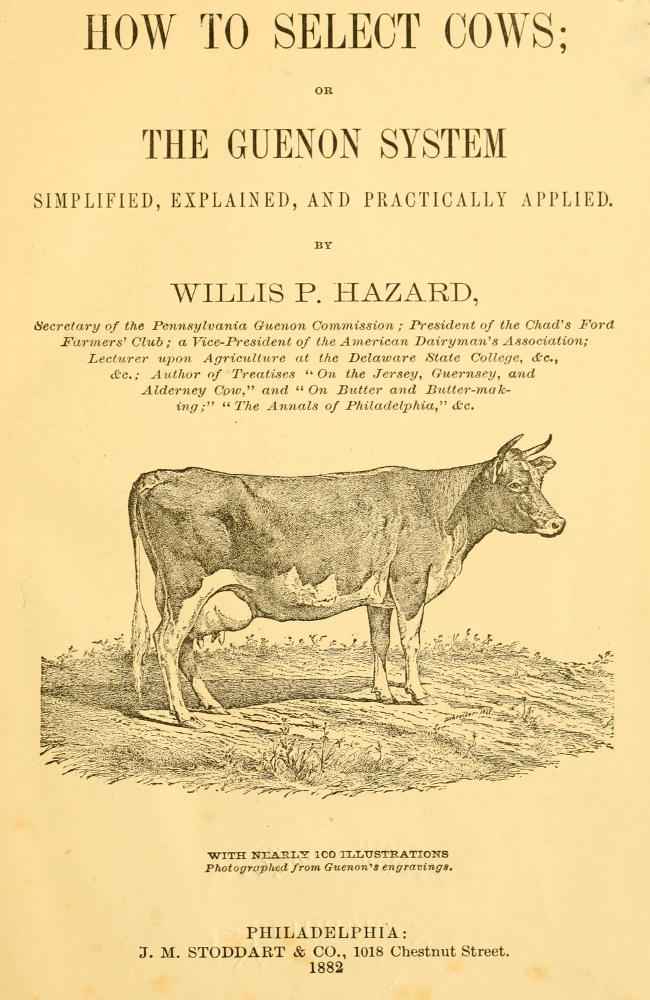
A PERFECT COW—DUCHESS—Imported Jersey, belonging to Chas. L. Sharpless.
Our Mode of Judging Stock.
The beauty of the Guenon system is, that it is an aid to all other modes of selecting stock, and therefore, it gives a decided advantage to the person who understands it over the one who does not. For instance, let two buyers go into a herd, and let them be equal judges of stock, one of them will be very apt to buy a bastard, while the other one would very positively leave her alone, simply because the latter has a knowledge of the best and surest mode of all modes of judging stock. And this knowledge does not prevent him from using his half a dozen other modes of deciding its merits, but aids them. So, too, in selecting a bull for a propagator, the believer in Guenon will select one with a good escutcheon and a fine skin, while the other will decide almost entirely by the form. And so with calves, the one who selects calves by the Guenon marks will be pretty sure to have a dairy of productive cows, while the other will have to dispose of some unprofitable ones. The one makes money, because he is working intelligently with every light of science, while the other is only guessing pretty well.
We first look at a cow from the front, and see that she widens as she gets back to her hips, or is wedge-shaped. Next we look at her side, and we again see that she rises on her back and descends on the belly as she goes back to the tail, or in other words she is wedge-shaped, too, from this point of view. These two looks at her have enabled us to see that she has a feminine appearance; that her head is small and neat in proportion to her body, with a waxy small horn, a mild but large eye, a broad muzzle, and that it is well set on her neck; that she has a good chest, and large deep paunch, with large full ribs, fuller below and joined to a rather high back bone; that is to say she has not the breadth of back we look for in a beef animal. If the chine is double, it indicates a cow above the average; if the chine is single, sometimes we can lay our three fingers in three depressions in it at about the middle of it, showing that she is a loose rangy cow, and fitted for her work. Now we will look at her udder and see that it runs forward as level as possible to the belly, and that it is large, with four good-sized, well-shaped teats slightly strutting from each quarter. Now we gently approach her, and pat her to gain her confidence, and get a chance to feel her hide, her milk veins, and examine her escutcheon. If we find her skin is thin, soft, and greasy, with short fine hair, with rather a furry nature, and showing the skin yellow under it; that her udder and her perineum have soft thin skin, with very short furry hair; that her milk veins are large, zig-zag, and knotty, entering the body with good-sized holes, and particularly if this vein is double, extending and ramifying over the udder well back in prominent veins, and if the veins extend over the perineum, we may then, with great confidence, look for a large well-shaped and formed escutcheon, marked first class, order first, by an oval on each side of the back of the udder, and perhaps two thigh ovals or dips where the vertical escutcheon rises from the broad or thigh escutcheon; and just to finish and find all points corroborating, we will look on the vertical escutcheon for some spots of oily lemon colored dandruff, and at the end of her neat, lightly made tail to find some large yellow pieces of dandruff. We don’t like to see it dry and brown; and as we step back from her, we just give a parting look to see that her hips are rather large, bony, somewhat drooping, that her capacious udder has room to project between her legs.
Then, we feel sure that a loose, open made cow, rather pointed, or sharp and well-defined, and the contrary of what we would look for in a flesh or beef producing animal; with a skin mellow and yellow, covered with soft, fine hair, and the nearer it comes to the quality and color of a first class Guernsey or Jersey cow, breeds which have for hundreds of years been bred for butter making, then we repeat we know she must be a good, rich milker and butter maker; for we never saw a thick, hard skin cow, with coarse, long hair, that was a good butter maker, or fit for anything but giving poor milk, if a strong milker.
Our preference is for a medium sized cow, one that will dress five hundred and fifty or six hundred pounds; and, as far as our observation goes, a Jersey sire, with an Ayrshire dam, is the best cross for a milk and butter cow, and the most profitable for the amount of food consumed; though a Jersey or Guernsey sire to the milking stock of Durhams, or a Holstein, or a large yielding native cow, will produce a better cow for butter than the mother was.
To get thorough practice in valuing the escutcheon, take this book in hand, and go into your dairy-yard; compare the escutcheon of each cow with her picture in this book; see what it calls for time and quantity, and then thoroughly test your cow; don’t guess at it, as most farmers do; and make your own comparisons. Remember the size and class of the escutcheon will give you the quantity and time; the skin and hair will give you the quality; and always remembering the size of the cow, and of what breed she is, for they must qualify your opinion somewhat.
Opinions of the System.
A writer in the Country Gentleman of July 17, 1879, S. Hoxie, of Whitestown, New York, so thoroughly expresses our experience and convictions, that we are led to quote it:
“The writer has been acquainted with ‘the escutcheon theory’ ever since about 1850. During this time he has been a practical dairyman in central New York. At first he approached the study of the escutcheon as a doubter. It seemed to him an absolute absurdity to claim a connection between the growing of the hair and the production of milk, two functions so entirely different.
“At first he examined the herd of cows which he helped milk every night and morning, and was surprised to meet with so many proofs of the truth of the theory. He then observed it upon other herds, and finally extended his observations to various breeds under various circumstances. He was at last compelled to come to the final conclusion that the theory, in the main, was true, but that other points and conditions of the animal must be understood in order invariably to reach a correct judgment:
“1. The breed modifies the quantity and quality of milk production. This is so manifestly true that it needs no argument. A particular order and class of escutcheon indicates a different quantity and a different quality of milk on a Jersey than it indicates on an Ayrshire cow.
“2. The condition of care and feed to which different families of the same breed have been accustomed during long periods modify milk production, and must be taken into consideration. For instance, certain families of Short-Horns have been cared for and fed through several generations with the sole view of beef production; other families have been trained to milk production. Escutcheons upon the former indicate far less quantity of milk than upon the latter. Thus some families with very fine escutcheons give very little milk. The escutcheons in such cases no doubt indicate an original capacity that a few generations of proper treatment might awaken and develop.
“3. The capacity and health of the digestive organs modifies the quantity, and we also think the quality, of milk production. Cows with large, healthy digestive organs will eat and properly digest more food, and give good return at the pail, than one with opposite conditions of the digestive organs. The former may sometimes give the larger quantity of milk, though, indeed, possessed of the poorer escutcheon.
“4. The activity of the nervous system materially affects milk production. This is often seen when the animal is unduly excited. The quiet dispositioned cow that attends to feeding, and is not disturbed by any excitement in the herd or in the surrounding fields, may have the poorer escutcheon, yet give larger quantities of milk than the extremely excitable cow, with the better escutcheon.
“Other conditions will suggest themselves to the observing and reflecting man, that materially affect the quantity and quality of milk production.
“These modifying conditions do not disturb the true theory of the escutcheon. Other things being equal, the escutcheon is indicative of the quantity and quality of milk. Many are misled in estimating the value of the escutcheon, because they have not the patience or the capacity to observe the varying conditions. The escutcheon is of immense practical value. It is easily seen the conditions of flesh do not change it, and animals of all ages, above three months, may be examined by it, and their milking qualities determined with a good degree of accuracy. Other things being equal, the animal with the better escutcheon will invariably make the butter maker. During nearly thirty years of observation, the writer never observed a first class cow that had a poor escutcheon. The escutcheon must be of great value to those who are breeding, and endeavouring to improve thorough-bred cattle of the various milking breeds. It offers a test that may be applied before milking age, and it may be applied to males as well as females. Though the pedigree is ever so long, and though it contains many good ancestors, the animal should be rejected from the breeding herd, unless it has a good escutcheon.”
“One of the Farmers,” a regular correspondent of the American Agriculturist, writes in the number for November, 1878:
“The Value of the Guenon Milk Mirror.—Taken with a good udder and milk-veins, good digestive functions, and capacity for food, good health and thrift, the Guenon milk mirror is a valuable indication of both the quantity and duration of the flow of milk. This seems to be demonstrated by the experience of thousands who have given the subject careful study, and I have never yet met the man who ridiculed it, and called it “folly,” who was able intelligently even to outline the prominent types. The number of calves which do well or ill as milkers, very nearly as indicated by their milk mirrors, is so large, that one of the principal practical uses to which a knowledge of the Guenon system can be applied is in selecting calves to raise, and, of course, to those who buy cows, it comes equally well in use.”
The American Association of Breeders of Dutch Friesian Cattle, composed of some of the most practical and intelligent farmers of the dairy region of central New York, have adopted a new set of rules for entry into registry in their Herd Book, wisely making the performance at the pail one of the necessary requirements. Thus, for a period of not more than twelve months from date of calving, the cow under 2½ years of age must give 6,000 lbs. of milk; over 2½, and under 3½, 7,000 lbs; over 3½, and under 4½, 8,000 lbs; over 4½, 9,000 lbs; also, rule 8: No animal shall be admitted to registry unless of the “milk form,” or of the “combined milk and beef form,” of medium or of large size, without coarseness, and if a female, having a well developed escutcheon, not below the 4th order of the 1st class, the 3d orders of the 2d, 3d 4th, 5th, 6th, 7th, and 8th classes, the 2d order of the 9th class, or the 1st order of the 10th class of the Pennsylvania Commission. With such a record, and with such marks, no one need take the trouble to see the stock, but may safely order it, knowing exactly what they are to receive.
George E. Waring, junior, says:
“If the escutcheon teaches anything it teaches the duration of the flow of milk. This is its great value in connection with the Jerseys—a race of small, rich, and persistent milkers. It does indicate quantity, it is true, but not Dutch quantity, nor Ayrshire quantity; only Jersey quantity, which is quite another affair. It indicates, in at least equal degree, the continuance of the flow of milk. Indeed, this is the great value of Guenon’s discovery. It is easy to judge of the present flow of milk in the case of any given cow, but, so far as I know, there is nothing but the escutcheon to tell us how long she will continue to milk after getting with calf. If she has a first class escutcheon, I think we are safe in believing that she will hold out well in her milking. If she has a very defective escutcheon, we may depend on her to fall away very rapidly when a few months gone, and to shut down entirely three or four months before calving.”
From an exhaustive and admirable treatise on the Ayrshire breed, by John D. W. French, of North Andover, Mass., we make the following extracts from his remarks on the Guenon system:
“Pabst, a German farmer of large experience, with a view to simplify the method of Guenon, and render it of greater practical value, made five divisions, or classes:—
- 1. Very good, or extraordinary.
- 2. Good, or good middling.
- 3. Middling, and little below middling.
- 4. Small.
- 5. Very bad milkers.
“Magne, the French writer, made a still further simplification, by making four classes instead of five:—
- 1. The very good.
- 2. The good.
- 3. The medium.
- 4. The bad.
“In the first class he places cows, both parts of whose milk-mirror, the mammary and the perinean, are large, continuous, uniform, covering at least a great part of the perineum, the udder, the inner surface of the thighs, and extending more or less out upon the legs with no interruptions, or, if any, small ones, oval in form, and situated on the posterior face of the udder. Cows of this class are very rare. They give, even when small in size, from ten to fourteen quarts per day, and the largest size from eighteen to twenty-six quarts a day, and even more. They continue in milk for a long period.
“The second class is that of good cows, and to this belong the best commonly found in the market. They have the mammary part of the milk-mirror well developed, but the perinean part contracted or wholly wanting. Small cows of this class give from seven to ten or eleven quarts a day, and the largest from thirteen to seventeen quarts.
“The third class consists of middling cows. When the milk-mirror really presents only the lower or mammary part slightly developed or indented, and the perinean part contracted, narrow, and irregular, the cows are middling. Cows of this class, according to size, give from three or four to ten quarts per day.
“The fourth class is composed of bad cows. No veins are to be seen either on the perineum or the udder, while those of the belly are very slightly developed, and the mirrors are ordinarily small. These cows give only a few quarts of milk a day, and dry up a short time after calving.
“Mr. C. L. Flint, in his work on ‘Milch Cows,’ says:—
“These classifications, adopted by Pabst, Magne, and others, appear to be far more simple and satisfactory than the more complicated classification of Guenon. Without pretending to judge with accuracy of the quantity, the quality, or the duration which a particular size or form of the mirror will indicate, they give to Guenon the full credit of his important discovery, as a new and valuable element in forming our judgment of the milking qualities of a cow, and simply assert, with respect to the duration of the flow of milk, that the mirror that indicates the greatest quantity will also indicate the longest duration.
“My own attention was called to Guenon’s method of judging cows some eight or ten years ago, and since that time I have examined many hundreds, with a view to ascertain the correctness of its main features, inquiring, at the same time, after the views and opinions of the best breeders and judges of stock, with regard to their experience and judgment of its merits; and the result of my observations has been that cows with the most perfectly developed milk-mirrors or escutcheons are, with rare exceptions, the best milkers of their breed, and that cows with small and slightly developed mirrors are, in the majority of cases, bad milkers.
“I say the best milkers of their breed, for I do not believe that precisely the same sized and formed milk-mirrors on a Hereford, or a Devon and an Ayrshire, or a native, will indicate anything like the same or equal milking properties. It will not do, in my opinion, to disregard the general and well-known characteristics of the breed, and rely wholly on the milk-mirror; but I think it may be safely said that, as a general rule, the best marked Hereford will turn out to be the best milker among the Herefords, all of which are poor milkers; the best marked Devon, the best among the Devons; and the best marked Ayrshire, the best among the Ayrshires; that is, it will not do to compare two animals of entirely distinct breeds by the milk-mirrors alone, without regard to the fixed habits and education, so to speak, of the breed or family to which they belong.”
“In my own herd of Ayrshire cows, the largest milkers have the best escutcheons, and these cows have, in most cases, transmitted these marks to their descendants. On the other hand, the cows with medium or poor escutcheons have rarely transmitted to their calves better ones; but, generally, of the same or lower class than the dams.
“Bulls.—Guenon’s second and hardly less important discovery was that the bull had the same marks as the cow, only somewhat shorter and narrower. Guenon bestows upon these marks the same name, ‘milk-mirror,’ which may be justified, in as far as the bull has greater influence upon the sustaining or obtaining of an abundant yield of milk, as well as the improvement of the breed.
“Some Testimony.—Mr. L. A. Hansen, of Bay St. Louis, writes, in a letter to the Country Gentleman:
“I served my apprenticeship for three years on a dairy farm with two hundred cows, performing all the labor appertaining to a farm, the same as one of the hired men. After this, for twenty years, I had dairies of from eighty to one hundred and seventy cows. Living in the best dairy country then known, and our butter commanding the very highest market prices in London, England, (taking the premium at a butter exhibition in London,) we considered it the best policy to buy our cows instead of raising them, and I consequently had to purchase from twenty to thirty cows every year. Having adopted the Guenon system as a helping guide in my purchases, I necessarily examined more than a hundred cows annually, besides having under daily observation my own cows and those of the neighboring dairy farms. Thus, I had continual practice through a number of years. The classifications of the professor, mentioned in my former article, were, with very rare exceptions, right. In the first two classes, they did not fail once; in the lower classes, more frequently; but as the lower classes, with their sub-division, are of no importance to the dairyman—only the two first being fit for a dairy—the study of them becomes unnecessary, and it is of little avail if they are minutely correct.
“As nothing in this world is perfect, we cannot reasonably expect the Guenon system to be without defects; but, as already stated above, the imperfection is to be looked for in that part which is immaterial for practical application. Under all circumstances, as far as my experience goes, the Guenon theory will always remain a valuable guide in selecting milk cows.”
“Mr. L. S. Hardin writes, in a prize essay:
“Very few, if any, modern writers upon cattle have accepted the complicated theory of Guenon, while no two of them agree as to the extent in value of the escutcheon. As a point of beauty, it should certainly be cultivated in the herd. As to its practical value for indicating the milking qualities of the cow, my experience is that a finely-developed escutcheon is rarely seen on a poor milker, while many excellent milkers have very small or no escutcheons at all. In other words, its presence is a good sign, while its absence is not necessarily a cause for distrust. Milk-veins, as an indication for milking capacity, are of about the same value as the escutcheon.”
“The editor of the Jersey Bulletin, in commenting on this, says:
“We should be very glad to know of a cow, worthy to be called an ‘excellent milker’—duration of the flow after becoming pregnant being one of the tests—which has no escutcheon at all, or a very small one. As at present advised, we don’t believe she exists. Most old cow men would say that, if the escutcheon is as valuable an indication as the milk-veins, too much effort can hardly be made to extend knowledge concerning it.”
“Henry Tanner, professor of agriculture, Queen’s College, Birmingham, England, says, in a volume of prize essays of the Highland and Agricultural Society:
“Some attention has also been given, within a few years, to a discovery, made by Mons. Guenon, respecting ‘the escutcheon,’ as it is termed. Like many other persons, he was carried beyond the boundary of discretion in his speculations, and thus his valuable observations were for a time lost in the mist with which he enveloped them. Sufficient is already known of its value, at least, to lead us to the conclusion that it is worthy of more general knowledge.
“A very extended observation has proved that, other conditions being equal, the modification of form presented by the escutcheon will lead to an estimation, not only of the quantity of milk which the animal will produce, but also of the time during which the cow will keep up the supply of milk.
“Without going into detail upon this point, I may briefly state that the larger the extent of the escutcheon, the greater is the promise of milk, and also of its continuance, even after the cow is again in calf. A cow may have a small escutcheon, and yet be a good milker; but observation leads to the conclusion that, if she possessed a more fully developed escutcheon, she would have been a better milker. It may be considered a point of merit, not as deciding whether or not the cow is a good milker, but rather as an additional indication which may be taken into consideration in conjunction with other characteristic points. It is also desirable, in estimating the extent of the escutcheon, to make full allowance for the folds in the skin; otherwise, a large escutcheon may be taken for a small one. Besides the escutcheon, there are tufts of hair (epis) which have a certain degree of value when seen upon the udder of the cow.”
“I presume there are many men who, although perhaps not caring a pin for an escutcheon, yet consider themselves fully capable of selecting a good milk cow. Now, although ignoring the escutcheon in their judgment, are they not apt, in selecting an ideal cow of any particular milk breed, to find a good escutcheon developed of one class or another?
“Perhaps it may be asked, if the Guenon system is a true one, why are not the Short-Horns a great milk breed, for in them we often find very large and perfect escutcheons?
“This question may be answered as follows: The Short-Horns were originally a good milking breed; but, having been made particularly a beef breed, the milking propensity or mammary system has in most families been changed or bred out. Notwithstanding this change, they may retain the escutcheon, not as a mark of quality, but as one of the characteristic marks of the breed.
“All farmers are aware that a first-class milk cow may, by injudicious feed and treatment, especially as regards milking, become a second-class animal. Now, such a system, carried out generation after generation, must certainly degenerate a milk breed, however good their marks and quality.
“Among the Short-Horns, probably the best milkers have good escutcheons; but an Ayrshire cow, with an inferior escutcheon, might be found to give more milk than a Short-Horn with a superior escutcheon, simply because one breed has been bred especially for beef, the other especially for milk.
“To show how breeding for a purpose through many generations may ultimately change qualities, let us compare the Short-Horns with the Dutch or Holsteins. The early Short-Horns, or the Teeswater breed, as it was called, was of Dutch origin, or was certainly formed by crossing the native cattle of England with stock imported from Holland. This breed was originally considered remarkable for its milking qualities.
“The Dutch breed, bred for generations for the especial purpose of milk, is to-day noted for large milkers, and among the cows may be found extraordinarily developed escutcheons.
“The following extract, from a translation from the French of Magne on milk cows, is apropos, as showing the difference between characteristics of breeds and qualities of the animals:
“A long, fine head, narrow towards the horns, and a slender chest are given by most writers as characteristics of a good milk cow. Now, in Flemish, Danish, Dutch, and Brittany cows the fineness of head and chest is a characteristic of these races and not the indication of particularly developed milking qualities, being met with alike in the good and bad milkers of those races; whilst in some of the Swiss breeds, and especially in those of St. Gervais, nearly all the cows, whether good or indifferent, possess a large head and heavy chest. The farmers of Ariege, while showing us some remarkably good cows, drew our attention to their strength of chest, ampleness of the dewlap, and the volume of the head: these characteristics of race they mistake for qualities, observing them in their best cows. On the other hand, it is to be remarked that cows with fine heads are often inferior milkers. If fineness of head were a true proof of mammillary activity, would not the cows of the Durham breed be amongst the best dairy animals in the world? This characteristic cannot, therefore, be considered absolutely appreciable, as much depends on the race to which a cow may belong. It is indicative of milk only, because it is a remarkable point in those races which have produced milk cows. Thus a characteristic of race has been mistaken for a sign of particular qualities.”
“If, then, we should regard the escutcheon, as well as a fine head, one of the characteristics common in the Short-Horn, it is not necessary to consider it as an indication of any particularly developed quality. Although probably the best milkers would have this sign, yet it might be regarded as a latent sign of milking qualities which had been bred out by disuse. The only fair way to judge of the value of the escutcheon in determining milking qualities, is to consider its influence in the different breeds separately, not comparing one breed with another. In judging grade cows, characteristics and blood must have a certain influence on the judgment. The general type of the animal must be considered.
“In the Ayrshire cow, we must regard the escutcheon, not as a special characteristic of the breed, but as one of the signs denoting quality.
“If the time should come when it has become so universal a sign of quality as to be considered a characteristic of the breed, then we shall have approached much nearer perfection than at present.
“Admitting that the escutcheon theory is a failure, or at least that it has failed as a test-mark of milk, have we any other mark or series of marks that have invariably given better results?
“Magne says, that in Flanders, a cow is considered a good milker, ‘especially when towards the middle of the spine the apophyses (or projections) are separated or scattered so as to leave a space between of about two finger-breadths,’ for the reason that, when the spine is thus formed, the haunches are better spread, and the thighs and croup larger. The other members of the body are also better developed, the basin is ampler, and the organs placed in this cavity, as well as the udder, are more voluminous.
“Now, would our dairymen consider this a more certain indication of milk, than a good escutcheon?
“Without regarding the escutcheon as an infallible sign of quality and quantity of milk, I believe it to be one of the best indications of milk, that nature has provided; but in the use of this system, we must consider:—
- 1. The breed.
- 2. The age.
- 3. The feed.
- 4. The treatment (present and past.)
- 5. The health.
“A good, not to say a thorough, understanding of the Guenon system, cannot be obtained by casual observation, but only by the most painstaking examination of many animals, extending over a long period of time.”
Objections to the System and to the Report of the Commission.
M. Guenon in his Treatise on Milk Cows, does not give any positive reasons why the escutcheon is indicative of the yield. He rested content with the fact, that he had proved it so before many learned men, and risked his reputation upon publishing the facts. The system as far as we have been able to trace it, has always been verified by those who have thoroughly studied it, and tested it by extended practice according to the rules of Guenon. The principal cavilers against it, either admit they have not constantly pursued it, or show by their writings their lack of sufficient knowledge of it. The report of the Pennsylvania commission has incited several to write against the system. The principal paper produced was one read before a meeting of the State Board of Agriculture, by Eastburn Reeder, and which he had reprinted in several papers. Of this essay, it is sufficient to say, he showed he had not studied nor practiced the system thoroughly, and because he could not understand it and got befogged, he quoted a large mass of scientific matter to show the system could not be true. These attempts at argument are so quietly, but completely, set aside in the essay of Prof. D. E. Salmon, D. V. M., on Contested Dairy Questions, quoted below, that we shall not discuss them further. For we cannot any more tell absolutely and positively why the escutcheon reveals what it does, than we can tell why a black cow eating green grass, converts red blood into white milk, than we can tell why the green grass grows. In both questions at issue, we have certain facts and theories to guide our reason and judgment about them, but we know nothing positive, and because it is so, Mr. Reeder and Mr. Hardin won’t believe it is so or can be so.
In addition to what Mons. Magne, the eminent French veterinarian, one of the most celebrated medical professors in France has written, Professor Arnold, of Rochester says, when indorsing what Magne writes:
“The size of the escutcheon is regarded as the measure of the quantity of blood supplied to the milk-producing vessels, and are evidence of their capability of elaborating milk. In the same way, the veins take up the blood, and carry it back in the milk veins which pass through the bag and along the belly, and enter the body through one or more holes, on their way to the heart. The size of these milk veins, and the holes where they enter the body, vary with the escutcheon, and like it, give evidence of the quantity of venous blood passing away, from and through the udder, and they have the same significance with reference to quantity, as the supply of arterial blood and the size of the escutcheon.”
Mr. Reeder also quotes the weights of cattle given by Guenon, and triumphantly exclaims, whoever saw such small cows in this country? Guenon distinctly quotes the weights, as net dead weight, or the animal deprived of its head and horns, its hide, entrails, and feet, and gives the excellent reason for it when he says: “If I had made the calculations for the animal on the hoof, the figures given by me would present a great difference, which would increase according to the amount of fat, sometimes to double the weight.” Unfortunately, Mr. Reeder did not know enough of Guenon’s facts to be aware of this clear statement, and supposed the weights were live weight.
Again, he says the commission did not examine the stock correctly. He would have looked at an animal, decided what escutcheon it had, or “to which class and order she belongs, and then append the figures of Guenon as the result. Any other mode of proceeding is not testing the Guenon system.” Here again his lack of knowledge of the system is shown; it would be exceedingly unjust to the reputation of Guenon, as he distinctly declares the size, the age, the breed, the treatment, the season, the period of gestation, &c., shall be fully considered. It is the judgment of just such men passed upon the system, which have tended to throw any doubt upon the merit of Guenon’s assertions. What would be thought of the judgment of such a person, if told by a physician to administer three things to a patient, and he gave but one, and the patient died, and he excused himself by saying, “you told me to give him medicine, and I gave it.”
Then Mr. Reeder denies the value of the system for pointing out the best feeders. The cow which gives the most butter, and which this system will readily point out, will fatten the most rapidly when dried off; for the butyraceous particles, which go to make the butter, will be diverted from the milk and turn to fat on the animal.
Mr. Reeder objects to the report of the commission, that they “in some cases failed to classify cows,” and “made incorrect classifications,” and “in some cases gave different results from Guenon,” and lastly “the terms employed to denote quantity, quality, and duration, are too vague, indefinite, and unsatisfactory.” In all these objections, Mr. R., it will be readily seen by any practicer of the system, shows his utter ignorance of the mode of applying it.
Guenon says it is sometimes impossible to properly classify an animal, owing to the effects of a cross, or some freak of nature. In such cases they may be judged according to the escutcheon it the nearest resembles. This the commission did, but of course could not classify them.
His judgment as to “incorrect classifications” we must pass by as of no account, he not being any more capable of that than the commission.
The same may be said of “giving different results from Guenon.” That is entirely a matter of judgment. Guenon says, judge of the cow by various things and then the result will approximate the amount stated to each escutcheon. Mr. Reeder says the amount set down to each escutcheon is inflexible. We prefer to follow the skill of Guenon and not the ignorance of Reeder, as it was Guenon we were appointed to test.
Finally, he objects to the terms employed to denote the significance of the escutcheon. The great difficulty of the commission was to find herds of which an accurate test of each animal had been made and kept. We believe not one farmer in one hundred thousand has such a record. Yet the commission are expected by such “infallible” advocates as Mr. R. to tell the exact character of each cow, and that record is to be set down alongside of the inaccurate record of the owner; and if they vary at all, the commission are the ones at fault. The very terms Mr. R. objects to were employed by us by special agreement with the owners, because they hesitated to say how many quarts or pounds each of their cows gave. But where there were such careful farmers as W. M. Large, M. Eastburn, J. Pyle, and M. Conard, who gave quarts, and the commission gave quarts, we would invite attention to the comparative reports as the best answer. And even in Mr. R.’s own case we ask comparison, for the reason why the commission are on most of his cows one or two quarts higher is easily accounted for, because we did not learn until after the examination that he was generally ranked by his neighbors a poor feeder, which would certainly make the difference. In the cases of such fine herds as those of S. J. Sharpless, Thomas M. Harvey, Thomas Gawthrop, and H. Preston, &c., the accounts were highly satisfactory to their owners and confirmed them in the merits of the system. For the same reasons we object to his test of “the system in other herds” as any proof of the merits of Guenon, for it was his interpretation of the escutcheons that is given, and it would be very unfair to judge Guenon as interpreted by one who is not an expert.
Mr. Hardin has written much against the system, but containing very little argument, and no valid objection. We will endeavor to sift out of the mass, any points made:
He thought there should be one “non-believer” on the commission, so as to “make a fair and disinterested report.” What possible use he may have been is a mystery, except to cavil at what perhaps he did not understand. The commission simply put down what they interpreted the escutcheons to indicate, and the owner stated what he knew of his stock. The two accounts were brought together and compared. What more a non-believer could have done, we are at a loss to conceive.
His process of examination was laid down thus: “To take down in writing before you see the cows, the owners’ and milkers’ opinions of all the cows to be tested.” “Make the owners and milkers, out of hearing of each other, tell you the name of the cow, her age, how much milk she gives when fresh, how much milk she gives a year, is her milk rich or poor; have you ever tested the milk by measure, or otherwise to determine the amount or its richness; what breed is she?” “Get a non-believer to make pencil sketches of each escutcheon.” “The Governor to appoint two more on the committee who are not believers.”
Now, having laid out this programme, he does not say what was to be done with it. The inference was to be drawn, we suppose, that the many escutcheons were to be engraved, and the public were to draw their conclusions from them and the reports given by the owners and milkers, and see how Guenon would stand the test. And what were the believing or non-believing commissioners to do? Supervise the taking down of all this? How, at once, this shows Mr. Hardin to know little or nothing of the system! Like Mr. Reeder, he did not know that Guenon assigns many other things to be thought of to form a correct opinion! Was it more proof to be told by the owner all that any one could know about the cow, and then say that corresponds with the escutcheon? Or did it put the system to a severer test, to say to the owner, don’t tell me a word, and then proceed to tell him all about a cow you never saw, simply from examining her escutcheon? In one case, you are assisted to define the escutcheon by the knowledge given you. In the other case, you define the cow’s character by only the knowledge you can get from the escutcheon. No better proof can be given of Mr. Hardin’s lack of practical knowledge of the system.
Another objection he makes, and repeats several times, as being a very strong one with him, is, why did not Guenon, and why do not the commissioners, go to work and buy up all the best cows and sell them at a profit, and thus get very rich. His cry is, why don’t they make plenty of money out of it, if it is so valuable? Simply, because neither of them are in that business, or care to be. But Mr. Harvey, a manager of the Delaware county almshouse, in one year from taking this position, changed the cows there, and increased the yield twofold from the same number of cows, and has bought and sold all the steers and cows on his large farm for many years solely by this system, and has grown wealthy.
He says in another article “feeling the modesty that naturally attaches itself to benighted ignorance,” he “started out in the city in search of some one who was learned on these subjects.” He found “a professor in our medical institute,” “one of our most learned physicians,” and they proceed together to canvass Professors Magne and Arnold’s theories and facts about the formation of the escutcheon. The result of two such wise heads (or of “benighted ignorance”) coming together, was that neither of them ever heard of Professor Magne, and that his dictum was “opposed to all the teachings of physiology.” The learned professor knowing as much about a cow as he did of physiology. And it is such stuff as this which forms the arguments of Mr. Hardin. Professor Salmon in his essay on Contested Dairy Questions effectually settles these “learned” men.
We have devoted enough space to a writer, who finds it so easy to tear down, but is never able to build up, a doubting Thomas, whose only mode of judging a cow, he says is a crumple horn, a large udder, and to test the milk every Monday for one year. What an amount of money the farmers of America would lose annually if they followed his rules, and what an amount they would save by following Guenon’s rules!
The following valuable essay is from the Country Gentleman of August 7, 1879:
Contested Dairy Questions.
By D. E. Salmon, D. V. M.
Several of our prominent dairy writers have been lately discussing the more complicated questions of their department in a very energetic and decided, if not in a scrupulously exact manner. Now, if these questions are worth the time and space necessary for their presentation at length, they are certainly of sufficient importance to receive candid and perfectly truthful treatment; and, though these writers may not have intended to give wrong impressions, their teachings can hardly be considered, in several respects, as representing the present condition of knowledge on these points.
Magne’s Theory of the Escutcheon.—In Mr. Eastburn Reeder’s essay on the escutcheon—which is a valuable paper, though marred in the above respects—there is an attempt at scientific argument in order to ridicule the accepted value of the milk-mirror; and the assumed facts on which this argument is based, are presented in such a positive manner that they will probably be accepted, without further investigation, by the majority of readers unless contested at once. The writer has hesitated to do this in the hope that it would be done by some one else; but the truth is of too much consequence to allow the matter to pass entirely without notice.
The first point to which I will call attention is the attempt to dispute Magne’s opinion that the hair turns in the direction in which the arteries ramify, and that the reversed hair on the udder and adjacent parts indicates the termination of the arteries which supply the udder with blood. When these arteries are large, he holds, they extend through the udder upward and onward, ramifying on the skin beyond the udder, and giving the hair the peculiar appearance which distinguishes it from the rest of the surface. If these arteries are very small, they are not likely to extend much beyond the udder, and, hence, form a small escutcheon; consequently, a small escutcheon indicates a feeble supply of blood, and little material to make milk of.
Now how is this combatted? The first argument is that “when Mr. Hardin showed this paragraph to one of the most learned medical professors at Louisville, Kentucky, he at once wanted to know who this Magne was, and declared his name unknown in the annals of medical science.” What are we to think of such a statement as that? Magne—member of the French Academy of Medicine, formerly director of the Alfort Veterinary School and professor of Lyons—unknown in the annals of medicine!
We are then asked if the arteries are not the same in all cows, and are told that we might as well expect more bones or muscles as more arteries. If Mr. Reeder will turn to Chauveau’s Anatomy—one of the best authorities in the world—he will find, in general remarks on arteries, the following statement, which I translate, not having the English edition: “Arteries very often present variations in their deposition, which the surgeon should keep in mind. These variations ordinarily concern the number, the point of origin, and the volume of the vessels.” And if he will go through the list of arteries, he will find examples given of each of these variations.
Again, he asks, “how is it that the ramification of the arterial circulation causes the hair to grow in one direction on one part of the cow’s body, and in the opposite on other parts?” Not a very difficult question, if we admit that arteries have such an effect, for they certainly do not all ramify in the same direction.
In a revised edition of the essay, subsequently published, some important points were added. Here we are told that “the arteries supplying the udder with blood are called the mammary arteries, and their ramification does not extend beyond the outer surface of the udder. Further down the aorta, or main artery, another pair of arteries branches off, called the femoral arteries. These supply the muscles of the thigh, or what we know as the rounds of beef, with blood, and ramify upon the portion of the escutcheon lying between them. Still further down, another pair of arteries, called the gluteal arteries, leave the aorta, and are distributed through the pelvic region, and ramify upon the extreme upper portion of the escutcheon. Here we have at least three distinct systems of arteries ramifying upon the escutcheon, and two of them most certainly have no connection with the milk secretion whatever.”
Without attempting to point out all the errors of this description, we will once more refer to Chauveau to settle the more important points. The reader will find in that work that the femoral arteries have a branch called the pre-pubic, which in turn has a branch called the external pudic, from which the mammary artery branches. It will also be found that the mammary artery “sends several divisions to the tissue of the udder, and is prolonged between the thighs by a perineal branch, which terminates in the inferior commissure of the vulva, after having furnished glandular and cutaneous divisions.” Turning to the description of the gluteal arteries, we find that they ramify in the gluteal muscles, which are at a considerable distance from the perineum, and that nothing is said of their going to the last named part.
Here, then, is complete and positive refutation of these arguments—not by mere statements of my own, but by the words of a standard work, of world-wide reputation, on the anatomy of these animals. Magne’s facts are correct, then, whether his inferences are or not. The same artery that supplies the udder with blood supplies the skin on which the escutcheon is formed; and, more than this, the artery ramifies in the direction in which the hair of the escutcheon grows. Is there any connection between the two for all that? Who knows? A point or two to show that such a connection is not beyond the possible may still be in place.
Erasmus Wilson, who has made a specialty of the skin and its diseases, shows that the direction of the hairs on the anterior surface of the human body is, commencing at a point near the arm-pit, downwards and slightly inwards towards the umbilicus, and that below this point the direction is upwards and inwards; so that the umbilicus “is the center of convergence of four streams,” as he expresses it.
Now this disposition, complicated though it is, certainly resembles that of the arteries—the branches from the axillary artery passing downwards and inwards, while the epigastric arteries branch from the femorals near the groin, and have a direction upwards and inwards. On the neck, the direction of the hair is upwards and backwards; in front of the ear, it is downwards and forwards; behind the ear, it is backwards—in each case following the arterial ramifications. In addition, Tisserant and others in France, who stand high as authorities, admit that the escutcheon continues to increase in relative surface till the second or third milking—that is, till the development of the udder, and, consequently, of the vessels supplying it have reached their highest point.
In some cases, it must be confessed, the correspondence in question apparently does not exist, but rather the opposite; and as the mammary artery has substantially the same distribution with horses as with cattle, we cannot see why the former should not be as plainly marked as the latter, if the direction of the hair depends on the direction of the arteries.
But, it may be asked, in what possible manner could the one condition influence the other? It must be remembered that physiology is still a growing science, and that there are many things yet to learn, so that it is still pardonable to confess ignorance. We know, however, that the cavity in the skin surrounding the hair (hair follicle) is set in an oblique direction, as well as the hair that emerges from it; the papilla at the bottom of this cavity must also be inclined, and it is this that, in all probability, decides the direction of the hair, as the growth of this takes place by additions of cells from the surface of the papilla. Now, each papilla, or elevation, has a vascular loop, or, as some say, a minute artery and vein, and one can easily imagine how the direction of this minute artery might influence the direction of the papillary summit, and, consequently, of the hair that grows from it.
I do not say that this is the proper explanation, but I suggest it as one way in which the correspondence might be accounted for. I do say, however, that the evidence brought to bear on this point by Mr. Reeder can have no influence in deciding the question, for the reason I have given.
Dr. Henry Stewart, the noted scientific and practical farmer and writer, said lately; “I have for some time past been studying the nature of the escutcheon physiogically and anatomically.” And he has “recently discovered a still more satisfactory connection between the milking capacity of a cow and the development of the escutcheon.”
“The milk-vein is an important mark of the deep-milking cow. But it is not the veins, but the arteries, which supply blood to the system, either for the production of tissue or the secretion of the milk. And yet the veins are important because they bear a direct relation to the arteries, being the return channels for the blood after it has fulfilled its functions; and so the larger supply of blood conveyed by the arteries requiring a vein of large capacity to return it, this vein is an ultimate indication of the vigor of the circulation of the lacteal organs. The main artery which supplies these organs is the subcutaneous abdominal [what Mr. S. says is commonly called the milk-vein.] This important artery supplies a large part of the posterior portion of the system, furnishing blood to the genital organs and the skin covering these and the adjacent parts. The subcutaneous abdominal artery is one of the two branches of the external pudic artery in the female, the other being the mammary artery. This last is very voluminous and distributes several main branches to the mammary glands and tissue, and also by a prolongation between the thighs, supplies the inferior commissure of the vulva and gives off many smaller branches, which spread into a network among the glandular tissue and the cutaneous structure. Here is the close connection, then, between the skin of the posterior part of the cow, from the lower point of the vulva down between the thighs and around the udder, and the udder itself. The same artery supplies all this portion of the skin, furnishes the subaceous glands and the hair follicles, and the whole cutaneous structure, and the hair also with blood, and also provides for the demands of the milk-secreting organs. A vigorous circulation through a voluminous arterial system ... gives a relatively vigorous milk secretion, and, as well, a growth of hair, which curls and forms the well-known peculiar structure of the escutcheon.”