
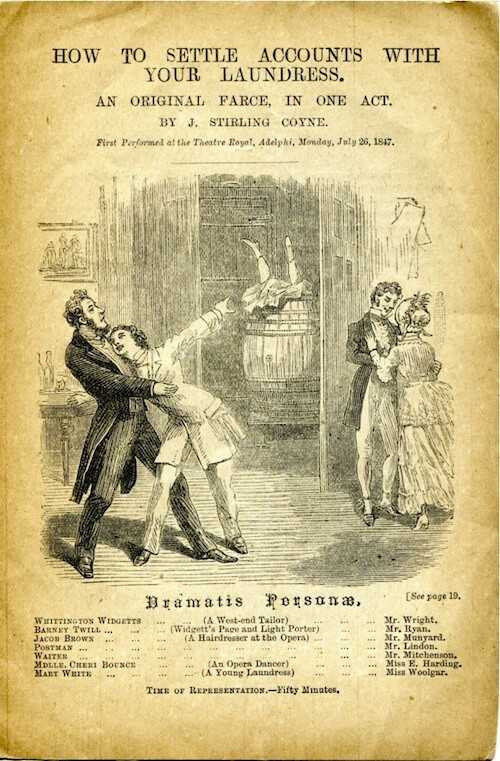
HOW TO SETTLE ACCOUNTS WITH YOUR LAUNDRESS.
AN ORIGINAL FARCE, IN ONE ACT.
First performed at the Theatre Royal, Adelphi, Monday, July 26, 1847.
Dramatis Personæ
| WHITTINGTON WIDGETTS | (A West-end Tailor) | Mr. Wright. |
| BARNEY TWILL | (Widgett’s Page and Light Porter) | Mr. Ryan. |
| JACOB BROWN | (A Hairdresser at the Opera) | Mr. Munyard. |
| POSTMAN | Mr. Lindon. | |
| WAITER | Mr. Mitchenson. | |
| MDLLE. CHERI BOUNCE | (An Opera Dancer) | Miss E. Harding. |
| MARY WHITE | (A Young Laundress) | Miss Woolgar. |
TIME OF REPRESENTATION.—Fifty minutes.
COSTUME.
WHITTINGTON WIDGETTS.—First dress: Blue coat; white vest; gray plaid trousers. Second dress: Green coat; pink vest. Third dress: Black coat.
BARNEY TWILL.—Green page’s suit.
JACOB BROWN.—Puce frock coat; blue vest; nankeen trousers.
MDLLE. CHERI BOUNCE.—Fashionable silk dress; blue satin visite, trimmed with lace; pink bonnet.
MARY WHITE.—First dress: Pink print dress; green shawl; and straw bonnet. Second dress: Blue blouse; drab leggings; red cravat; and fancy cap. Third dress: Drab paletot; white vest; and trousers.
STAGE DIRECTIONS.
EXITS AND ENTRANCES.—R. means Right; L. Left; D. F. Door in Flat; R. D. Right Door; L. D. Left Door; S. E. Second Entrance; U. E. Upper Entrance; M. D. Middle Door; L. U. E. Left Upper Entrance; R. U. E. Right Upper Entrance; L. S. E. Left Second Entrance; P. S. Prompt Side; O. P. Opposite Prompt.
RELATIVE POSITIONS.—R. means Right; L. Left; C. Centre; R. C. Right of Centre; L. C. Left of Centre.
| R. | RC. | C. | LC. | L. |
*** The Reader is supposed to be on the Stage, facing the Audience.