
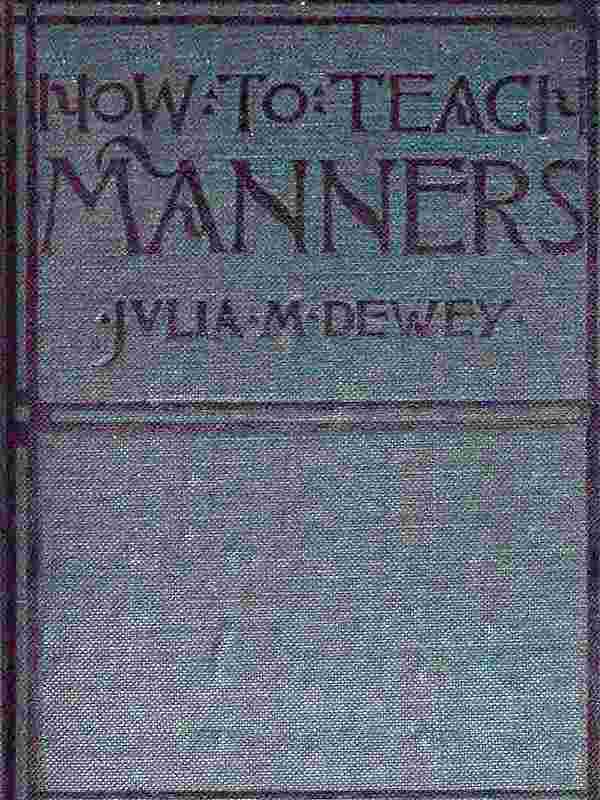
The Project Gutenberg eBook of How to Teach Manners in the School-room
Title: How to Teach Manners in the School-room
Author: Julia M. Dewey
Release date: April 7, 2017 [eBook #54495]
Most recently updated: October 23, 2024
Language: English
Credits: Produced by MFR, John Campbell and the Online Distributed
Proofreading Team at http://www.pgdp.net (This file was
produced from images generously made available by The
Internet Archive)
TRANSCRIBER’S NOTE
Some minor changes are noted at the end of the book.
How to Teach Manners
in the school-room.
By MRS. JULIA M. DEWEY,
Method and Critic Teacher in the Public Schools of Rutland, Vt.;
formerly Supt. of Schools, Hoosic Falls, N. Y.
“Who misses or who wins the prize?
Go, lose or conquer, as you can;
But if you fail, or if you rise,
Be each, pray God, a gentleman.”
—Epilogue to Dr. Birch and his Pupils.
THE A. S. BARNES COMPANY
New York and Chicago
COPYRIGHT, 1888
E. L. KELLOGG & CO.
NEW YORK
INTRODUCTION.
Importance of the definite teaching of manners. Children are close imitators; they will learn some kind of manners, and one who teaches positively or emphatically (or contrariwise) may often see a miniature of himself in his young pupil. With this truth in mind one can hardly attach too much importance to punctilious politeness on the teacher’s part in his intercourse with pupils. But however polite a teacher may be, the informal or unconscious teaching of manners is not enough. The school-room does not afford opportunity to exemplify all the necessary practices in good manners, and there is no other way but to teach the various requirements of an accepted code with reference to actual examples that may present themselves at any time in life.
It is to be remembered that many children have no opportunity of obtaining a knowledge of good manners, either by practice or precept, except as it is afforded by the schools. And as habits formed in childhood are the most enduring, a lack of early training in good manners will show itself as long as life lasts. Many other reasons weigh in favor of the definite teaching of manners, one of which is, if courtesy is demanded of pupils.
The underlying principles of courtesy should be inculcated, that children may know it is more than an empty show.
Children need to learn the definite language courtesy employs. This to many children is a new language, and can only be accomplished by definite teaching. Beside, if manners are considered of sufficient importance to be counted a regular part of the school, they will attract much more importance. Accompanying this by observance on the part of teacher, the pupil acquires a valuable knowledge.
Good manners ever prove an invaluable aid in doing away with many of the unpleasantnesses of school-life. Courtesy of manner under all circumstances means great self-control, and a lack of self-control in teacher or pupil is the origin of most misdemeanors in school. Aside from the benefits to be derived in the school-room, gentle manners help one on in the world wonderfully. They are more powerful in many cases than their other knowledge. “All doors fly open to the one who possesses them.”
“Manners are the shadows of great virtues.”—Whately. “High thoughts seated in a heart of courtesy.”—Sir Philip Sidney. Mr. Calvert says: “A gentleman is never unduly familiar; takes no liberties; is chary of questions; is neither artificial nor affected; is as little obtrusive upon the mind or feelings of others as on their persons; bears himself tenderly toward the weak and unprotected; is not arrogant; cannot be supercilious; can be self-denying without struggle; is not vain of his advantages; habitually subordinates his lower to his higher self; is, in his best condition, electric with truth, buoyant with veracity.”
In a right conception of good breeding the moral element predominates. With this idea in view, no one should attempt to instruct in good manners who has not the ability to instil into the minds of children its fundamental principles. True courtesy implies strict honor, self-possession, forbearance, generous and refined feeling, all culminating in a polished deportment.
When teachers consider manners in this high sense, and teach them accordingly, they give their pupils that which will bring them much more happiness in life than any amount of knowledge teaching without it.
AIM OF THIS WORK.
1. To furnish material for lessons in manners suitable to be taught in the schools, and adapted to different grades of pupils.
2. To furnish illustrative lessons showing the main lines of thought to be pursued, the length of the lesson, and the simplicity of method to be employed.
3. To impress both teachers and pupils with a need of the knowledge of good manners.
“A gentleman can have no better watchword than that sung at Bethlehem: ‘Peace on earth, good will to men.’
“Come wealth or want, come good or ill.
Let old and young accept their part,
And bow before the awful will,
And bear it with an honest heart.
“Who misses or who wins the prize,
Go, lose or conquer as you can;
But if you fall, or if you rise,
Be each, pray God, a gentleman.
“A gentleman, or old or young!
(Bear kindly with my humble lay.)
The sacred chorus first was sung
Upon the first of Christmas days.
“The shepherds heard it overhead;
The Joyful angels raised it then:
Glory to God on high, it said,
And peace on earth to gentle—men.”
—Epilogue to Dr. Birch and his Young Friends.
T. T. Munger in “On the Threshold.”
CONTENTS.
| PAGE | ||
| Introduction, | 3 | |
| Importance of the definite teaching of manners, | 3 | |
| The underlying principles of good manners, | 3 | |
| Aim of the work, | 5 | |
| CHAPTER I. | ||
| General directions for teaching manners, | 13 | |
| Special directions to teachers, | 15 | |
| Practical training in manners | 18 | |
| CHAPTER II. | ||
| Lessons on Manners. For the Youngest Pupils. | ||
| Lesson 1. | Awakening an interest in manners in general, | 21 |
| 2. | Kindness an element of politeness, | 22 |
| 3. | Seeking the happiness of others an element of good manners, | 23 |
| CHAPTER III. | ||
| Lessons on Manners. Second Two Years. | ||
| Lesson 4. | Kindness and unselfishness two underlying principles of good manners, | 25 |
| 5. | To follow the example of the best people a reason for cultivating good manners, | 26 |
| 6. | Gaining the esteem of others a reason for cultivating good manners, | 28 |
| CHAPTER IV. | ||
| Manners in School. First Two Years. | ||
| Illustrative Lessons. | ||
| Lesson 7. | The necessity of good manners in school, | 29 |
| 8. | Regularity of attendance at school is a mark of good manners, | 30 |
| 9. | Punctuality of attendance at school is a sign of good manners, | 31 |
| 10. | Cleanliness is one sign of good manners in school, | 33 |
| 11. | Care in keeping the school-room clean is a sign of good manners, | 34 |
| Subjects for Additional Lessons. | ||
| 1. Care of school-furniture, | 35 | |
| 2. Care of halls, piazzas, walls, | 35 | |
| 3. Care of school-grounds, | 35 | |
| 4. Care of books, | 35 | |
| 5. Economy in using what is furnished by the school, | 35 | |
| 6. Care in using and returning borrowed articles, | 35 | |
| 7. Quiet conduct in the school-room at all times, | 35 | |
| Lesson 12. | How pupils should conduct themselves toward their teachers, | 35 |
| Subjects for Additional Lessons. | ||
| 1. Rendering assistance to teachers, | 36 | |
| 2. Care in not interrupting a teacher, | 36 | |
| 3. Kind treatment of school-mates, | 36 | |
| 4. Respectful treatment of the janitor, | 36 | |
| 5. Respectful treatment of visitors, | 36 | |
| 6. Respectful treatment of those who address the school, | 36 | |
| CHAPTER V. | ||
| Manners in School. Second Two Years. | ||
| Illustrative Lessons. | ||
| Lesson 13. | The necessity of good manners in school, | 37 |
| 14. | Regularity of attendance at school is a sign of good manners, | 38 |
| 15. | Punctuality of attendance at school is the sign of good manners, | 40 |
| 16. | Cleanliness is one sign of good manners, | 41 |
| 17. | Care for school-belongings is a sign of good manners, | 42 |
| Subjects for Additional Lessons. | ||
| 1. Care of books, | 43 | |
| 2. Economy in using what is furnished by the school, | 43 | |
| 3. Care in using and returning borrowed articles, | 43 | |
| 4. Quiet conduct in the school-room at all times, | 43 | |
| Lesson 18. | How pupils should conduct themselves toward their teacher, | 43 |
| CHAPTER VI. | ||
| Manners at Home. First Two Years. | ||
| Illustrative Lessons. | ||
| Lesson 19. | Awakening an interest in home manners, | 45 |
| 20. | The attention due to home friends, | 46 |
| “Keys” suggested for additional lessons, | 47 | |
| CHAPTER VII. | ||
| Manners at Home. Second Two Years. | ||
| Illustrative Lessons. | ||
| Lesson 21. | The polite attentions due to home friends, | 48 |
| Subjects for additional lessons. | ||
| 1. Special politeness to very old people in the family, | 49 | |
| 2. Polite treatment of visitors, | 49 | |
| 3. Polite treatment of servants, | 49 | |
| Reminders, | 49 | |
| CHAPTER VIII. | ||
| Manners in Public. First Two Years. | ||
| Illustrative Lessons. | ||
| Lesson 22. | The necessity of good manners in the street, | 51 |
| 23. | Undue curiosity shown in the street is impolite, | 52 |
| CHAPTER IX. | ||
| Manners in Public. Second Two Years. | ||
| Illustrative Lesson. | ||
| Lesson 24. | The necessity of good manners in the street, | 54 |
| Subjects for Additional Lessons for Both Grades. | ||
| 1. Polite attention toward elderly people on the street, | 55 | |
| 2. Polite attention towards strangers who make inquiries, | 55 | |
| 3. Church manners, | 55 | |
| 4. Manners at places of entertainment, | 55 | |
| CHAPTER X. | ||
| Table Manners. First Two Years. | ||
| Illustrative Lessons. | ||
| Lesson 25. | The necessity of good table manners, | 56 |
| 26. | Punctuality at the table is desirable, | 57 |
| 27. | Polite attention is specially due the lady of the house, | 58 |
| 28. | Selfishness at the table is a sign of bad manners, | 59 |
| 29. | Some forms of polite expressions used at table, | 60 |
| CHAPTER XI. | ||
| Table Manners. Second Two Years. | ||
| Illustrative Lessons. | ||
| Lesson 30. | The necessity of good table manners, | 61 |
| 31. | The deference due the lady of the house at table, | 62 |
| 32. | Some polite usages at table, | 63 |
| Subjects for Additional Lessons for Both Grades. | ||
| 1. Use of fork and spoon, with practical illustrations, | 63 | |
| 2. Impoliteness of rapid eating, | 63 | |
| CHAPTER XII. | ||
| Lesson on Manners. For Advanced Pupils. | ||
| Lesson 1. | To suggest the underlying principles of good manners, | 64 |
| CHAPTER XIII. | ||
| Manners in School. | ||
| Lesson 2. | The necessity of good manners in school, | 66 |
| 3. | Regularity and punctuality of attendance are signs of good manners, | 67 |
| 4. | Cleanliness is one sign of good manners in school, | 67 |
| 5. | Care for school-belongings is a sign of good manners, | 68 |
| 6. | How pupils should conduct themselves toward their teacher, | 69 |
| Subjects for additional lessons, | 71 | |
| Reminders, | 71 | |
| CHAPTER XIV. | ||
| Personal Habits. | ||
| Lesson 7. | The necessity of attention to personal habits, | 73 |
| Suggestions for instruction relating to personal habits, | 74 | |
| CHAPTER XV. | ||
| Manners in Public. | ||
| Lesson 8. | Some particulars of street manners, | 76 |
| Suggestions for further instructions, | 77 | |
| Reminders, | 78 | |
| CHAPTER XVI. | ||
| Table Manners. | ||
| Lesson 9. | The importance of good table manners, | 81 |
| Subjects for additional lessons, | 82 | |
| Reminders, | 82 | |
| CHAPTER XVII. | ||
| Manners in Society. | ||
| Suggestions for lessons, | 85 | |
| Reminders, | 87 | |
| CHAPTER XVIII. | ||
| Miscellaneous Items. | ||
| Miscellaneous items, | 90 | |
| Suggestive stories, fables, anecdotes, and poems, | 91 | |
| 1. Little Jack. | 13. The Drum and the Vase of Sweet Herbs. | |
| 2. The Boy and the Sparrows. | 14. Love. | |
| 3. The Unhappy Boy. | 15. Treatment of the Aged. | |
| 4. Which was the Gentleman? | 16. Civility to Strangers. | |
| 5. The Elder Brother. | 17. A Good rule. | |
| 6. The Gnat and the Bull. | 18. Character. | |
| 7. A Real Lady. | 19. Honor. | |
| 8. Cautions. | 20. Consideration for Others. | |
| 9. Letter of Recommendation. | 21. Truthfulness. | |
| 10. A Gentlemanly Lad. | 22. Delicacy. | |
| 11. A Series of Don’ts. | ||
| 12. Family Intercourse. | ||
| Memory Gems, | 102 | |