
“Eusebe:—You desired to purchase me; but I did not sell myself. I send you the forty-eight notes which you placed in my hands. I deposited the money at my banker’s. The interest has sufficed to defray your expenses. Allow me to retain the leather belt in which you used to carry the money, for my commissions. You will not return to your chestnut woods, and nowhere else could you have further use for this rustic purse.
“Adieu, Eusebe,
“Adéonne.”
“Insolent creature!” muttered Bonnaud, and, turning to the notary, he added, in a whisper, “Will you put in an additional clause, to the effect that, in case of the decease of one of the parties, if there be no children born of their union, all the property shall go to the survivor?”
CHAPTER XLV.
When all the honest bourgeois friends of Bonnaud and Lansade had satisfied their appetites, they did not leave the table, but began to drink, and, as they drank, they sang. It was Bonnaud himself, the father of the bride, who commenced: the guests joined in the chorus. Take ten men of the world, accustomed to every variety of debauch, give them the means to indulge in the most fearful orgies, and at the moment when the riot and revel are at their height call them to the window to see a newly-married couple pass from church. Then you will behold a novel and curious spectacle. The orgies will cease; the ribald song will be hushed. The happy couple will pass, and the innocent laugh of their friends will alone disturb the silence of the hour. These revellers are suddenly reminded of their sisters, of their mothers, and of the days of their youth, blighted and darkened by vice and debauchery. Well, for marriage—this solemn and formidable sacrament,—this act, horrible, or sublime, which rivets forever two beings to a chain, of which each broken link is a grief or a shame—the bourgeois have not the least respect. They await the moment when the priest shall have finished, to break forth in silly songs or idle jests.
CHAPTER XLVI.
Great sorrows only encroach upon one’s life little by little, and Heaven has given to the man who must experience such trials the strength to support them. In the presence of a great misfortune, nature seems to harden itself; it bends or breaks only under the petty miseries of existence.
On the day after his marriage, Eusebe began to realize the depth of his love for Adéonne. He felt that the simple pronunciation of the sacramental words by a man in priestly robes did not suffice to destroy the greatest of human weaknesses,—habit. By nature mild and honest, the son of the skeptic Martin did not seek to deceive himself. He saw the magnitude of his misfortune, and determined to bear it with resignation. Daily and nightly comparisons between the objects by which he was then surrounded, and those to which he had been accustomed, destroyed his tranquillity of mind and heart. The modest coldness of Clementine’s manner contrasted painfully with the passionate enthusiasm of Adéonne. The sober simplicity of his wife had no charm for him like the warm sympathy of the actress. The interior of the chemical factory gave him the vertigo. He never touched the books in the counting-house without fear and disgust. He regretted the pleasures of the past, and suffered continually from ennui and gloom.
CHAPTER XLVII.
One morning, an irresistible impulse drove Eusebe to visit Adéonne.
“Jenny,” said he, on entering the house, “where is madame?”
“Madame is dead,” replied the girl, beginning to weep.
Eusebe threw himself on a divan, and for two hours patiently waited an effusion of his grief in tears. His heart beat violently, and his throat seemed parched; but no tears came to his relief. Jenny had at first regarded Eusebe with anger, for his desertion had caused her mistress’s untimely end. But the depth of his sorrow touched her pity.
“Monsieur,” said the girl, producing a small steel casket, “I was about to write you, in order to fulfil the last wishes of my poor mistress. She said to me, ‘One week after my death, take this to Eusebe.’ Here it is, monsieur: here it is.” And the girl sobbed more bitterly than ever.
Eusebe took the casket, looked at it fixedly for a moment, and then opened it with a key he found behind the frame of Adéonne’s portrait. In the box there was a letter. Eusebe broke the seal with a trembling hand, and read:—
“My dear Eusebe:—
“When you read this ugly letter, I shall be dead; my love for you will have killed me. Weep for me, but do not pity me. I prefer to die of this love than from any other cause. I feel myself gradually sinking, yet I experience a certain joy in thinking that it is for you I am about to part with life. If you only knew how good it is to love so wildly and so faithfully! Marie Bachu has endeavored to console me with her pity and her reasoning: how foolish!
“What follows, my dear Eusebe, I wish you to regard as my last will and testament. I bequeath to you my ring, set with turquoise and brilliants; it was the first article I purchased with money I had earned. You will find in one of my drawers my other jewels, in little packets, with names written upon them. These are souvenirs for my companions of the theatre. You will give my watch and chain to Madame Marignan, my dresser, and pay forty-two francs that I owe to Adolphe, the coiffeur. You will wear mourning for me for at least a month, will you not, my dear Eusebe? you can say at home that you have lost a cousin. I have seen your wife: she is beautiful, but her beauty will not remind you of Adéonne. Give all my dresses and linen to Jenny, my maid, and, also, two thousand francs, upon condition that she marry her lover. When you have done all this, and sold all my furniture, you will have about fifteen thousand francs. Go to Strasburg and seek out a turner in wood, named Antoine Krutger. If you find him, ask him if he was not a sutler in a regiment of chasseurs, at Saumur, twenty-two years ago. If he should reply in the affirmative, give him all the money. He is my father,—a respectable man, who would have despised me, if he had known how I was living. If he be dead, give the money to his children. Are they not my brothers and sisters? And now, my dear Eusebe, farewell forever. I have loved you,—oh, I cannot tell you how I have loved you; and I embrace you now as I embraced you the day you wished to purchase me. Farewell forever!
“Adéonne.
“P.S.—I ask pardon for the trouble I give you; I am yours for life, but that will not be long.”
Eusebe sobbed and moaned. After having read and reread Adéonne’s letter, he summoned Jenny.
“Jenny,” said he, “madame has not forgotten you: she has left you a dowry.”
“How, monsieur? Then I can return to my native town. Ah! monsieur, poor madame was so good.”
“From what town are you?” inquired Eusebe.
“From Strasburg.”
“Did madame know you were from Strasburg?”
“No, monsieur. In Paris, Alsatians have difficulty in procuring places. Upon coming here, I said I was from Nancy.”
“Did you ever hear of a turner named Antoine Krutger?”
“Antoine Krutger!” exclaimed the girl. “Did you know him? He was my father.”
“Was he ever attached to the army?”
“Oh, yes, monsieur: he served in the cavalry at Saumur. If he had lived, I should have been better off than I am.”
“My girl,” said Eusebe, after a pause, “all that is here belongs to you. Madame has made you her sole legatee.”
“Ah, monsieur!” exclaimed Jenny, weeping with joy and sorrow, “I am very happy and very unhappy at the same time. I had no need of this to make me love madame like a sister.”
CHAPTER XLVIII.
Eusebe, oppressed with grief, returned home a prey to a violent fever. Notwithstanding his efforts to conceal his suffering, he was forced to take to his bed, where he remained for a month, almost without consciousness. When he recovered his senses, he found Paul Buck and Gredinette at his bedside. Eusebe asked for his wife: they told him that she had gone to attend a dying sister. Some days afterwards, Eusebe, being convalescent, walked in the garden, leaning on the arm of Gredinette.
“Eusebe,” said the young woman, stopping suddenly, “since you must learn the truth sooner or later, I prefer relieving my mind by telling you at once. Prepare yourself to hear of a great misfortune.”
“Speak!” said Eusebe: “I could not be more unhappy than I am.”
After much hesitation and circumlocution, Gredinette informed Eusebe that his wife had eloped with Isidore Boncain, and that the guilty couple had carried away with them the money of the firm.
Eusebe made no response, nor did his countenance betray any inward emotion.
“He takes it better than I thought he would,” said Gredinette, in the evening, to Paul.
By degrees, Eusebe was restored to health. One morning he said to his two friends,—
“I am about to bid you farewell. I am going to return to La Capelette, which I should never have quitted. I shall say good-bye to my father-in-law, and set out this very evening. Thanks for all your kind friendship: I shall never forget it. If, some day, weary of life, you should desire to taste the sweets of repose, come to my home, and I will love you as you have loved me.”
“Do not go to see Bonnaud,” said Paul: “the distracted father accuses you of being the cause of his daughter’s fault.”
“Accuses me!”
“Yes. He pretends that this elopement is one of the results of your liaison with Adéonne. Nor would I advise you to trouble yourself any more about Madame de la Varade. She is absorbed in the preaching of a missionary who is creating a sensation at Versailles.”
“A missionary? What is that?”
“Missionaries, my friend,” replied Paul, seriously, “are men, or rather children of God, who traverse the seas, and encounter a thousand perils, to bear to benighted savages the word of God and civilization. The priest of whom I speak has been crucified, and has been six times in danger of being eaten.”
“I will go to see him,” said Eusebe; and he departed.
Father Vernier belonged to the Congregation of Lazaristes of Turin. He was an old man, with a snowy beard and a bronzed complexion. His black eyes were full of courage and good nature. He received Eusebe kindly.
“What do you desire, my son?” he inquired.
“Father,” replied the young man, “I am weary of struggling with the contradictions and troubles of life. The more I seek truth, the more deeply do I become involved in doubt. To-day I come to you, like the wounded bird flying for rest to the branch of an aged oak. In the name of Heaven, tell me where to find the true, and where the false is hidden.”
“Monsieur,” said the priest, dryly, “I have devoted my life to the service of the Lord. I have traversed the wilderness to teach His word to the heathen. I owe my support to the humble and the suffering, to whom I am devoted. I have neither time nor inclination to enter into philosophic speculations.”
The same evening, Eusebe departed for the home of his childhood. Not finding at Limoges any vehicle to convey him to La Capelette, he determined to perform the rest of the journey on foot. He had proceeded scarcely half the distance, when a violent storm arose and forced him to seek shelter in a wayside inn. While the landlady was preparing his supper, he picked up, mechanically, a greasy volume which was lying on the table, and read. After he had eaten, he retired to his chamber, where he passed the night in reading the same book. At dawn he arose and tendered a golden louis to the landlord for the privilege of carrying away the volume in which he was so deeply interested. When once more on the road, Eusebe said,—
“Why have I gone so far and exposed myself to so much sorrow in the search of truth, when it was at my very door?”
The volume contained the various books of the New Testament.
“I was wrong to let the gentleman carry away the book,” said the innkeeper to his wife.
“Bah! it cost only twelve sous,” she replied.
“And suppose it did: would he have given us twenty francs for it, if it had not been worth more?”
On reaching the great gate of his father’s house, Eusebe knocked.
“Ah! The good Lord be praised, Monsieur Eusebe,” exclaimed Katy, who soon appeared, “here you are at last. Hurry up to your father’s chamber: he so wishes to see you before he dies.”
Eusebe ascended quickly to his father’s chamber.
“Do I behold you at last, my son?” said M. Martin, gasping. “Have you attained your object? Tell me, if you can, before I die, where is the false; where is the true?”
“Father,” replied Eusebe, “the false is on earth; the true is in heaven!”
“You are perhaps right,” said the dying man; “and if the Abbé Jaucourt were not dead, and there were yet time, I would invite him to my bedside.”
“Father,” rejoined the young man, “the preachers of the word of God never die. They have no need to marry to reproduce themselves. Religion is a prolific mother. For one of her children who dies, ten are born.”
“You may be right, my son,” murmured Martin, in a tone that was scarcely audible; “but I do not wish to see the Abbé Faye: he has such red hair!” And so he breathed his last sigh.
“Father! father!” cried Eusebe, not yet aware that his parent was dead, “believe me, there is nothing true but the greatness of God!”
“And,” cried the Abbé Faye, who at that moment thrust his red head in at the door,
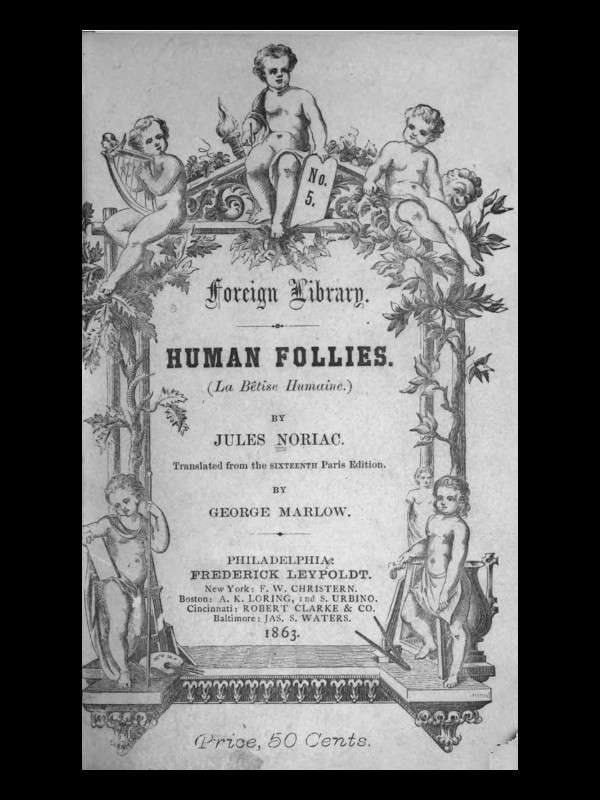
“Human Follies!”
STEREOTYPED BY L. JOHNSON & CO.
PHILADELPHIA.
Transcriber’s Notes
Page 4 (blank in the original) was replaced with a Table of Contents to facilitate eBook navigation.
Quotation marks missed by the printer have been restored.
Period spellings were retained.
“hand” changed to “hard” on page 166. (It is hard to die)
“renowed” changed to “renowned” on page 172. (a renowned maître d’armes)