
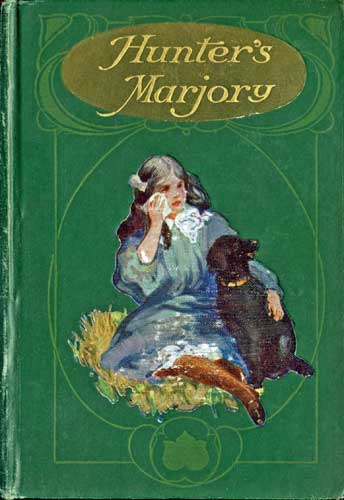
And the things they know and see there are so wonderful and grand—
Things that wiser, older folks cannot know or understand.
In the woods they meet the fairies, find the giants in their caves,
See the palaces of cloudland, and the mermen in the waves,
Know what all the birdies sing of, hear the secrets of the flowers—
For the Land of Little People is another world than ours."
Anon.
So this is the little gypsy Blanche has been telling me about!"
Such was Mr. Forester's greeting to Marjory when she went to Braeside on a return visit.
Marjory was not sure that she liked being called a gypsy. That dark hair of hers was always a sore point, but she was quite certain that she did not like the kiss which Mr. Forester bestowed upon her in all kindness of heart. To begin with, she did not like being kissed by strangers; and secondly, if the said strangers happened to possess moustaches, it made their offence the greater. Mr. Forester was a stranger, and, moreover, was the proud owner of a long and silky moustache, so Marjory felt that she had some excuse for her resentment.
"'Don't like being called a gypsy, and don't like being kissed' written large all over her face—eh, Blanche?" said Mr. Forester mischievously.
"Papa, you are a horrid tease. Go away and leave us in peace. I don't wonder Marjory doesn't like your nasty, tickly kisses."
"Oh dear, please don't send me away," he said in mock dismay. "Mayn't I stay if I promise to be very, very good?"
"You must ask Marjory."
Marjory's reply was to burst out laughing.
"Ah, that's better," said Mr. Forester. "Now we're all quite happy. Sit down, both of you, and listen to me."
The girls obeyed, and Mr. Forester continued,—
"Guess what I brought from Morristown to-day?"
"Sweets!" cried Blanche.
"No. Guess again."
"Anything to eat?"
"I should be very sorry to eat it, but some people might like to."
"Lesson books," hazarded Marjory.
"No; nothing so useful, I'm afraid."
"Does mother know?"
"Oh, do tell us, papa."
"Well, you are a pair of duffers. I thought you would have been sure to guess, but I'll go and fetch it."
Mr. Forester returned carrying a small hamper. There was straw poking out of it in places, and it was labelled, "This side up, with care."
"Oh, it's a new tea-set for the schoolroom," cried Blanche. "Mother said we needed one."
"No, it's not a new tea-set for the schoolroom, Miss Clever. There's a new pupil, and that's quite enough for any schoolroom. You're no good as a guesser, and yet you've been worrying my life out for weeks about this very thing."
Mr. Forester meanwhile was untying the string which fastened down the lid of the hamper. He slowly raised it, and there, curled up in the straw, lay a little black retriever puppy, its baby face puckered up partly in fear and partly in interest over this new experience.
"What a perfect little darling!" cried Blanche. "Oh, isn't he sweet? But how could you say some people might like to eat him, papa?"
"Well, I've heard of the Chinese eating puppy-dog stew; it comes after birds'-nest soup, you know."
"Papa!" indignantly.
Mr. Forester lifted the little fellow out of the basket and set him on the floor. He began running along with such a queer little waddle that they all laughed. Then he stopped and contemplated them questioningly, as much as to say, "What are you laughing at?"
"There, Miss Blanche," said her father, "you've got your work cut out for you to train that small person in the way he should go. Don't make a fool of him, dear; love him as much as you like, but make him obey orders. He's a game little beggar, isn't he?"
Blanche was delighted. "O papa, thank you a thousand times. Is he really for my very own, like Marjory has Silky? Oh, I am so glad to have him! You darling!" she cried, catching up the dog and hugging him close.
"I thought I was the darling," said Mr. Forester comically. "In fact, I'm sure I am, for thinking of it all myself."
"So you are—the dearest, darlingest papa in all the world." And the girl sprang into her father's arms.
This scene made Marjory a little bit sad.
"If only I had my father too, how happy I should be!" she thought. "But I don't even know if I've got one." And she sighed.
Blanche noticed the cloud on her friend's face, and instinctively felt what had caused it. Tears of sympathy rushed to her eyes, and she picked up the puppy and put him into Marjory's arms.
"Now," she said, with a look which Marjory understood, it was so full of sympathy, "you must christen him."
Marjory looked attentively at the little fat ball of a dog, and then said thoughtfully,—
"What would you think of 'Curly'? He is one of the curly kind, different from Silky."
"Yes, that will do beautifully. We'll call him Curly. Do you agree, papa?"
"Right you are," replied Mr. Forester. "But it doesn't matter so much what you call him as whether he comes when he's called; that's the chief thing." And so saying he left the girls to enjoy the new treasure by themselves.
Marjory was quite as enthusiastic as Blanche. She was passionately fond of animals, and the young ones always charmed her. She was able to give Blanche instructions as to how Curly should be fed; and they made a set of very strict rules for his training, which was to begin at once.
Their consultation was interrupted by the entrance of Mrs. Forester. She had been out driving, and was very beautifully dressed. Marjory thought she had never seen such a lovely lady before. She kissed the girl tenderly, and, putting her arms round her, said,—
"I am very glad to welcome you here, little Marjory, and I hope this will soon feel like a second home to you. Now," brightly, "I've got a great piece of news for you. Miss Waspe writes that she would be very glad to have an extra week's holidays till the eighteenth of September. What do you say?"
Blanche clapped her hands. "Oh, how jolly! a whole week more to do as we like! Do let her have it, mother."
Mrs. Forester laughed. "Yes, I think we must let her have it. She will be just as pleased as you, no doubt. Well, then, you will begin lessons on the eighteenth of September.—Will that suit you, Marjory?"
"Oh yes, it's my birthday."
"In that case, wouldn't you rather wait until the next day, dear? It won't make any difference to us."
"Oh no, thank you. I think it would be splendid to begin on my birthday. I've wanted to learn things for such a long time, it will be a kind of present," said Marjory.
"How funny you are!" cried Blanche. "I should hate to have lessons on my birthday. I always have a holiday. Mine is in June, and Waspy and I always have a treat of some kind."
"Miss Waspe also says, Marjory, that she is very glad indeed that you are going to be her pupil, and is looking forward to the term's work with two of you to teach."
Marjory blushed with pleasure. "She is very kind. I am looking forward too."
Mrs. Forester turned to go, saying that she hoped the girls would enjoy their tea and have a nice time. Marjory followed her as she left the room, and when they were outside the door asked,—
"Do you think I ought to say I'm sorry for calling Mary Ann Smylie a beast?"
Mrs. Forester smiled in spite of herself at Marjory's solemn face.
"Do you feel sorry?" she asked.
Marjory looked down. Her conscience had pricked her several times about it, but she could not honestly say that she felt really sorry. In fact, she felt quite sure that if Mary Ann were to say the same thing again, she would feel inclined to call her names again.
"I see," said Mrs. Forester, "you don't feel very sorry. Well, do you think it was a nice, lady-like way to speak?"
"Oh no," replied Marjory quickly.
"Then you are sorry that you used an unbecoming word, but you still think Mary Ann richly deserved some punishment for her unkind words?"
"Yes, that's just it," said Marjory, wondering how it was that Mrs. Forester understood her so well.
"But you still feel uncomfortable when you think about Mary Ann?"
"Yes."
"Well, if I were you, I should go to Mary Ann and say, 'I am sorry I used an ugly word to you, but I still think you were very unkind in what you said.' Then, if she is a nice girl, she will say she wishes she hadn't said what she did; and if not—well, you must just leave it, dear. I will go with you if you like. We can all drive to the village to-morrow afternoon."
"Oh, how good of you! Thank you so much." And Marjory, much relieved, went back to Blanche.
As a matter of fact Mrs. Forester had her own reasons for going herself with Marjory, for that very afternoon Mrs. Smylie, by way of ingratiating herself with the newcomer, had been making unkind remarks about Marjory and her bringing-up, and warning Mrs. Forester that she would not be a suitable companion for her daughter. Mrs. Forester had known very well how to reply to these statements, but she thought it would be a very good thing to show the Smylies that their spiteful, unkind words had no weight with her.
Mrs. Smylie's ambition knew no bounds as far as her daughter was concerned. She was conscious of the fact that she herself was a plain, ordinary, country woman, and would never be anything else; but with her daughter it was different. With her looks and education she ought to be able to associate with the best of people. Such was this foolish mother's dream, and she had thought to curry favour with the lady of Braeside by her remarks on what she considered should be the behaviour of a well-brought-up young lady, and what she had always aimed at in the education of her daughter. Mary Ann would have laughed could she have read her mother's mind and seen to what heights her ambition rose.
Marjory forgot about her for the time being. Blanche had so many treasures to show her and so much to say to her that the afternoon passed all too quickly.
They had tea by themselves in the room Mrs. Forester had chosen as a schoolroom—comfortable and cheerful, with windows looking over the garden. A new set of shelves had been put up, and all Blanche's books were arranged on them—her story books on the top and her lesson books on the lower shelves.
Marjory feasted her eyes upon the collection. Here were Blanche's old favourites, amongst them Grimm's "Fairy Tales," and Hans Andersen's, "Alice in Wonderland," "Black Beauty," and many others. One after another she took them down to show to Marjory.
"You must read every one of them," she said, "and then your mind inside will be just like mine."
"I should love to read them all, but I wouldn't be allowed to read the fairy tales," with a sigh.
"Why not?"
"Uncle doesn't approve of them."
"What a pity!" cried Blanche. "I wonder why. Do you think he would let you if I were to ask him? I could take him my 'Grimm' and show him what splendid tales they are."
"Would you dare to?" asked Marjory, awestruck by her friend's bold plan.
"Dare to? Of course I should. I can't think why you are so frightened of Dr. Hunter, he looks such a dear old thing. If he were a cow or a bull it would be different," laughing; "but you don't seem a bit afraid of them, with their great horns and bulging, glaring eyes."
"That's just where we're different," said Marjory, laughing too. "You're afraid of animals and not of people, and I'm afraid of people and not of animals."
"Well, anyway, I'm not afraid to ask about the fairy tales. I shall tell him that of course we don't really believe in them in our everyday heads, but they are nice to think about, and to think perhaps some day a fairy thing might happen."
Marjory laughed. "Isn't that believing in them?"
"No, not really. I can't quite explain what I mean."
"I've made fairies for myself," said Marjory. "There are plenty of them in the garden, and I understand what they say. They know me quite well, and I only have to sit very quietly and hardly breathe, and I can hear them. They live in the flowers, and you can hear them ringing their tiny little bells and talking to one another, so low that it is only just a whisper."
"Do go on," urged Blanche.
"I don't know if you would be able to hear them. Peter says he can't; but then he's old and deaf, and he says he never thought of listening when he was young."
"What made you think of it?"
"Nothing; it just came. I seem to have known about the flower fairies all my life. I miss them so in the winter, when they all go away under the ground to their winter palace, and I am always so happy when I see the first snowdrop come. I always go and kiss her, and tell her how glad I am to see her, and how brave I think she is to be the first to come; and I promise her that if a hard frost comes I will put some nice leaves round her to keep her warm."
"Why, this is a fairy tale. What does your uncle say?"
"I have never told him; it wouldn't be any good. He would only tell me to sew my seam, or knit my stocking, or do something useful."
"But couldn't you make him understand?"
Marjory shook her head. "I don't think so."
"Do tell me some more," said Blanche.
"Well, there are all sorts of fairies that belong to the different kinds of flowers. The head one of all, who is great queen, arranges everything for them, and tells each one exactly how long she may stay; and they come up out of the winter palace through the ground inside the buds, and they live in the flowers until they begin to fade, and then they go back again and wait for the next flower time. The fairies bring the sweet scents with them. They have to see that their flower houses are shut up in good time at night, and in the daytime they have to be kind in receiving the bees and insects that fly into them, and give them what they can. They have to try to keep away bad insects and worms and caterpillars that do harm, and before they go they have to see that everything is ready for the seeds to form, because they mean homes for the fairies when the next year comes. So they are really quite busy all the time. I'm always so glad to think that the fairies are all girls, and yet how important they are! Not like us human beings: boys are always most wanted and most important with us. I heard Dr. Morison say to Uncle George one day, 'It's a pity she wasn't a boy; she might have been such a help to you.' Of course that meant that I wasn't a help at all. The doctor has two boys. I don't like them much; they seem to think such a lot of themselves, and they never believe that I can do anything, because I'm a girl; but I can do most things that boys do."
"I'm very glad you're not a boy," said Blanche. "You're just as good as one in being strong and knowing how to do things, but you're much nicer than a boy." And she gave her friend a loving hug; then continuing, "I don't suppose the fairies would talk to a boy like they do to you."
"No, they say that they only talk to people who believe in them," laughing, and looking at Blanche.
"I say, Marj," said Blanche suddenly, "do you believe in ghosts?"
"No. Why?"
"Because," lowering her voice and speaking in a low, mysterious tone, "Crossley—that's our maid—told me that the people in the village say your house is haunted, that a light comes there in the middle of the night, and moves about in the old part. Have you ever seen it?"
"No; the old part is always shut up. I never heard about any light."
"Wouldn't it be fun if we could find out about it?" said Blanche excitedly.
"Yes. But how could you be there in the middle of the night? I might go and look some night."
"Not by yourself; you couldn't. Besides, it would be much jollier to be together. It would be so exciting finding out what it is, and so romantic. Mother says that all such stories can generally be explained by some quite ordinary thing; but still it's fun finding out, isn't it?"
Marjory agreed, but her busy little brain was trying to discover some possible explanation of the mysterious lights. She had no fears of the darkness. Her simple faith taught her that she was as safe in the dark as in the daylight, but she had many fancies—fancies that had come to her as she lay alone in her little bed watching the moonbeams playing across her windows, and listening to the whispering of the leaves outside. The darkness was full of mystery and charm to the lonely child, but fear had no place in her thoughts concerning it. What could these lights be—lights that moved about when every one else was asleep? Could they be the will-o'-the-wisp that Peter had told her about? Could they perhaps be angels with beautiful white wings and stars on their foreheads—guardian angels watching over the house while its inmates slept peacefully?
"Oh, I should like to see what it is!" she cried. "We must try some night, if only you could come and stay with me!"
"If mother and dad ever have to go to London for anything, then I might—that is, if Waspy isn't here."
"Oh, I do wish they would go! Wouldn't it be lovely if they did, and you came to stay?" And Marjory drew a long breath of delight at the thought of such a pleasure.
The girls had been talking so eagerly that they had not noticed the passing of the time, and it was quite a shock to them when a maid came to say that Dr. Hunter had come for Miss Marjory, and would she please to go at once.
Marjory gave Curly an affectionate good-night hug, and rushed downstairs with Blanche, afraid that her uncle might be angry with her for staying so long, it seemed such an unusual thing for him to come to fetch her. To her relief, however, he was all smiles when she appeared, and seemed quite interested in her account of the afternoon's doings as they went home.
"Fix in your minds—or rather ask God to fix in your minds—this one idea of an absolutely good God."—Kingsley.
Marjory did not sleep very much that night, her thoughts were so busy. The events of the day kept crowding in upon her, the story of the lights in the old wing, and running through all was the disquieting thought that to-morrow she must go to the baker's daughter and say that she was sorry. It seemed to Marjory that it would be very hard, and yet she felt sure that it was the right thing to do. Had not Mrs. Forester said so? and had not her own conscience told her so? Still, she dreaded the doing of it, for Marjory was proud as well as very shy, and Mary Ann's unkind words still rankled in her memory. She had yet to learn that the punishment of offences against us, great or small, lies in other hands than ours, and that absolute justice is watching over the affairs of men—that each action, good or evil, bears its own fruit. Thinking over Mrs. Forester's words, a dim realization came to her of that great truth, which, once grasped, brings calm trust and faith—the truth which promises that obedience to the voice of conscience keeps the soul in harmony with its Creator, so that outward circumstances cannot really harm or hurt. Marjory was but a young girl, with no experience, yet she knew this voice—she knew that obedience to it or disobedience meant either happiness or unhappiness inside herself, as she expressed it; but to-night, for the first time, she felt something of that trust in perfect justice which gives peace within, and she gradually began to lose the feeling of resentment against Mary Ann, and to feel that what she had to think of, and was responsible for, was her own behaviour—she must answer for her own thoughts and words.
She set out bravely the next day with Mrs. Forester and Blanche. Her heart beat very quickly as the carriage stopped at the post office.
"Why, Mary Ann, if this is no Hunter's Marjory in the carriage with thae new folks frae Braeside," exclaimed Mrs. Smylie to her daughter as she saw the party arrive. "After a' I telt the leddy yesterday too."
Marjory came into the post office alone.
"Good-afternoon, Mrs. Smylie," she said shyly. "Can I see Mary Ann?"
Mrs. Smylie did not return her greeting, and without looking up from the stamp desk called to Mary Ann.
"What is it?" cried Mary Ann from the parlour behind the shop.
"Come an' see," was her mother's reply. "I canna tell ye."
Mary Ann came sauntering into the shop. When she saw Marjory she stopped and stared.
"Hallo!" she said mockingly. "Want some more of what you had last time?"
Marjory flushed, and then with an effort, and speaking very quickly, she said,—
"I've come to say I'm sorry I called you an ugly name, but I think you were unkind in what you said."
"Do you suppose I care whether you call me names or not?" And the girl gave a hard laugh.
"No; but I care. I am ashamed of myself."
Mrs. Smylie looked on and listened, curious to see how the affair would end.
"You are a queer little kid," said Mary Ann. "Any one can see you haven't been to school. No girl in our school would come and eat humble pie like this. Well, I believe I did say a lot of stuff just to rub you up, and if you're sorry I'm sorry too, so we'll shake hands—eh?"
The girls shook hands, and Marjory, again saying good-afternoon to Mrs. Smylie, left the shop.
Mrs. Smylie replied by a nod. She was a little disappointed at the turn things had taken. She rather enjoyed having a grievance, and Hunter's Marjory and her "tantrums" had been a fertile subject for gossip during the last few days.
"Ye needna hae gien in sae sune," she remarked to her daughter when the carriage had driven off.
"That was my business," replied Mary Ann, with a toss of her head.
"Hoots, lassie, ye needna haud yer head sae high wi' yer mither. I was but thinkin' ye micht hae held it higher wi' yon chit."
"I'll never be like her, not if I live to be a hundred and go to fifty schools—so there." And Mary Ann banged out of the shop, leaving her mother silent with amazement.
Mary Ann had something to think about. She had been quite taken aback by Marjory's apology, and for a little while the real Mary Ann had shown herself. She was not a bad-hearted girl in reality, but she had been spoiled by those who should have known better; and although every now and then, at moments such as this, her better nature would assert itself, it was gradually becoming choked and crushed by selfishness, conceit, and carelessness. Marjory had been inclined to envy the baker's daughter her privileges, but in reality Mary Ann was to be pitied rather than envied, for she had no one to guide and help her. Her parents' chief care was that she should be better dressed and better educated than her neighbours. This they felt they could accomplish; and having done so, they were content, and satisfied that they had done their duty by their daughter.
The days were full of pleasure for Marjory and Blanche. When the garden had been thoroughly explored, there were many beautiful places for Marjory to show her friend. She must go to the woods, to the moors, and to the loch. Dr. Hunter had a pretty little sailing-boat, and Marjory was an expert sailor, and was allowed to go out on fine days by herself, though never without permission, in case she should be overtaken by a sudden storm. The doctor made a study of the weather day by day, and was able to foretell it to a certain extent. Sometimes, on a day which looked to Marjory to be quite fine, he would forbid her going on the loch, and she would find that he had been right.
The days were not long enough for all the delights the girls would have crowded into them. Marjory always remembered the first Sunday after her meeting with the Foresters. It came round in due course, and she did not greet it with much pleasure at first.
First of all came clean clothes, and amongst them a stiffly-starched petticoat. This was one of Marjory's pet aversions. It crackled as she walked and made her feel self-conscious. Then there was the best frock to be put on, which always seemed several degrees tighter than the everyday ones. Then came breakfast, an hour later on Sundays, to distinguish it from week days. Another distinguishing mark was the absence of the usual porridge and the presence of a plate of drop scones, a favourite dainty of Marjory's which Lisbeth always made for Sunday.
Dr. Hunter always devoted himself to his niece on Sunday mornings. He did not usually have much to say at breakfast during the week, but on Sundays he always made a point of inquiring about her doings, her garden, her pets, her sewing, and anything else he could think of. He always came down in his black clothes, and they had a slight odour of camphor, which the careful Lisbeth used to preserve them from moths. Marjory ever afterwards associated the smell of camphor with Sunday mornings at Hunters' Brae. The doctor, like Marjory, never wore his best clothes unless he felt absolutely obliged to, and sometimes for months together they only came out once a week. There was camphor in Marjory's wardrobe too, but she was careful to keep as many bags of lavender as she could amongst her clothes, to fight the camphor, as she told Lisbeth; and on the whole the lavender had the best of it.
Seated at the breakfast-table, Marjory always knew what was coming. As soon as they each had a cup of coffee and something to eat, the doctor would say, "Well, Marjory, how's things?"
It was always the same question, and it usually received the same answer. Marjory would feel very shy and awkward, and say, "All right, thank you," and nothing more. She never could think of anything that she felt would be interesting to her uncle. Week after week she would resolve to try to be less awkward, but when the time came it was usually only by a long list of questions that her uncle could get any information from her. On this particular Sunday morning she sat waiting for the inevitable question. It soon came. "Well, Marjory, how's things?"
Marjory made a valiant effort, and at last she gave her uncle a different reply. She looked up and said, "Better, thank you, uncle."
"Better, eh?" he said, with a twinkle in his eye. "That's good, if better can be good!"
"Everything's so different since Blanche came," Marjory went on, "and now that I'm going to have real lessons."
"It certainly has been an exciting week for you. First you quarrelled with that frizzle-pated Smylie girl, then with your old good-for-nothing of an uncle, then you met Blanche, then you made up your quarrels, Blanche came here, you went there, and so on." And the doctor smiled.
Marjory answered the smile, thinking how nice her uncle looked when he smiled, and wishing that he would do it oftener.
The smile was simply a response to her own effort in trying to understand her uncle better. She had been blaming him for his seeming indifference to her, when in reality she herself had been very much at fault. Of late the doctor had begun to feel that it was no use trying to win Marjory's confidence, she seemed to keep herself so aloof from him; but since she had faced him in the study, first like a little fury demanding to be sent to school, then pale and trembling, asking for his pardon, he had felt that he knew something more of the real Marjory, and he, too, had determined to try to preserve this better understanding.
Soon after breakfast they started off to church. It was a walk of about a mile, and Marjory and the doctor always went together. Silky always knew when Sunday came round. He would sit quite still by the gate and watch them with serious, longing eyes, but he never offered to accompany them. He made it a rule, however, to go to meet them on the way back. He always sat waiting by a certain milestone, and as soon as they turned the bend of the road beyond it, he would go bounding towards them, frisking and wagging his tail, and barking excitedly.
The walks to church were not altogether pleasant ones for Marjory, as a rule. Her best clothes were always rather a worry to her, and she was obliged to wear gloves. Lisbeth was in the habit of seeing them start off. She took great pride in the doctor's appearance on the "Sawbath," and surveyed him critically from the crown of his shining silk hat to the sole of his well-polished boots. She never failed to set Marjory's hat straight, to give sundry little pats to her frock, and to what she called "sort" her hair. Marjory wore it in a plait all the week, but on Sunday it was allowed to hang at its will, and Lisbeth loved to see the wavy black mass which reached to the girl's waist, though she would not for worlds have told Marjory so, in case it might encourage her in the sin of vanity!
Another bugbear of Marjory's was the little bag which Lisbeth always insisted upon her carrying. Everybody had a bag for their books, she said, so Marjory must have one too; and Sunday after Sunday in they went, with a clean handkerchief and, it must be confessed, a sweetie. These sweeties were kept in a bottle in the study, of all places. It was never allowed to get empty, and Marjory often wondered if the doctor took them to church too. There was a certain moment, when the congregation was settling itself to listen to the sermon and there was a general rustling of clothes and clattering of feet, when the sweetie found its way to Marjory's mouth. She would begin by determining to make it last as long as the sermon, but, alas! it would become thinner and thinner, and finally disappear altogether before Mr. Mackenzie had got to "thirdly."
Besides the drawbacks of the best clothes and the bag there were usually many admonitions from her uncle, such as, "Marjory, turn out your toes. Hold up your head, child. Turn out your toes, I say," or, "O Marjory, do not swing that bag"—all very necessary, no doubt, but they had the effect of making the girl self-conscious. Thinking about her head, she would forget about her toes, and vice versâ, and her uncle would be apt to think that it was obstinacy on her part and to tell her so, and then there would be sullen silence till the church door was reached. But to-day it was not so. Half-way to church they joined the Foresters, and Marjory and Blanche walked together behind their elders, so that their deportment could not be criticised.
Blanche gave Marjory the cheerful news that as there was to be a children's service in the afternoon, Mrs. Forester was going to beg for Marjory to be let off writing the morning sermon if she wrote the afternoon one instead.
"I don't suppose uncle will say yes, though," objected Marjory.
"Oh yes, he will; people always do to mother."
"How different it would be!" sighed Marjory. "I'm sure I could understand it better if I didn't have to keep thinking about writing it out."
"And mother's going to ask Dr. Hunter to come to tea, and you will come home from church with us. Won't it be nice?"
"Yes; but I don't believe he will let me." Blanche's face clouded. "Oh," she said, disappointment in her tone, "why not?"
"I've never been out anywhere on Sunday."
"But this is different—it isn't like going to a party; and we have such nice Sundays, and I do want you to come. I love Sundays, and I always look forward to them; don't you?"
"No," replied Marjory candidly, "not much."
Blanche looked sympathetically at her friend.
"Well, of course yours don't seem to be quite so nice as ours; but you'll see they'll be different now."
Blanche was right. Mrs. Forester won the day, and to Marjory's intense satisfaction, as they went in at the churchyard gate her uncle told her that she need not write the morning sermon if she would do the afternoon one, and that she was to be allowed to go to tea at Braeside after the service.
The Heathermuir church was an old one; its pews were of the straight, high-backed kind, and once inside them their occupants could see little of their surroundings except the minister, whose desk was raised above the level of the floor. With no temptations to look about her, and relieved of her weekly task, Marjory gave her whole attention to Mr. Mackenzie, trying to understand his meaning instead of mechanically taxing her memory, parrot-like, with his words. She watched the noble old face with its lines of kindliness and patience, the eyes now liquid with pity for the sorrowful wrongdoer, now flashing with indignation as he spoke of the unrepentant and the careless, then softening again as he expressed the hope that their hearts might be touched, and the belief that they too would win forgiveness from a loving Father.
Parts of the sermon were not to be understood by a child such as Marjory—it was addressed to men and women—yet her eyes never left the preacher's face, the sweetie had been quite forgotten, and she carried away with her a mind-picture of a Being full of love, sorry when His children do wrong, just in His punishments, but all-forgiving when they are truly repentant and try to make amends.
In the afternoon Marjory sat in the Braeside pew with Mrs. Forester and Blanche. Again the preacher's theme was love—"the greatest thing in the world"—love to the Creator, and, through it, love to all His creatures great and small. The old man told how love can smooth rough places, can right wrong, can win battles; how love and kindness attract love and kindness in return, and how a loving thought, word, or action is never lost. The words she heard that day sank deeply into Marjory's mind. They were full of hope and encouragement for all, and she felt something of that spirit which prompted the poet to sing so joyously,—
"God's in His heaven; all's right with the world."
Service over, they walked back to Braeside. It was a pretty walk across a bit of moorland, through the heather and bracken, here and there a moss-grown rock, here and there across the path a tiny trickling stream with stepping-stones.
"Did you have to ask the doctor very hard to make him let Marjory come, mother?" asked Blanche as they walked along.
"Not very hard," replied her mother, smiling. "I explained to him that we always keep our Sundays quietly, enjoying the day of rest, but that at the same time we like it to be bright and happy; and when I told him that the pleasure of our friends' company would greatly add to the brightness and happiness, he said 'yes' for Marjory, and promised to come himself."
When they arrived at Braeside they found the doctor already there. Mr. Forester and he had established themselves under a shady tree on the lawn, both looking the picture of comfort, smoking their pipes, and talking together like old friends.
Marjory felt almost bewildered by the turn things had taken. Truly they were different, both for herself and for her uncle.
Tea was brought into the garden, and they all had it together, the girls waiting upon their elders. It was all so peaceful and happy that Marjory found it hard to tear herself away when the time came, but she consoled herself with the thought that there was to-morrow to look forward to now. Hitherto she had always disliked Monday. It was the day for the washing to be counted, for one thing, and Lisbeth was always rather flustered in consequence, although the counting of it was all she had to do, as a woman from the village came to do the actual washing. Then there was the sermon to write and her wardrobe and drawers to tidy. Lisbeth was very strict about the tidying. All these things gave Monday an atmosphere prosaic in the extreme in Marjory's opinion. Now it would be different; she could look forward to it because there would be Blanche to compare notes with. She would make haste and finish her duties, and then they could go off into the woods or on to the moor, as free as air, and with no one to interfere with them. She went to bed full of these plans, and feeling her heart overflowing with gratitude to the great and loving Father who had given her such happiness.
"'Tis now the very witching hour of night."
Shakespeare.
Next morning, directly after breakfast, Marjory went as usual to her room to signal to Blanche. Blanche was already at her window, waving wildly with a handkerchief in each hand, which meant might she come up at once. Marjory, all eagerness and excitement, waved back "yes," wondering what could be the reason for such an early visit. She was just going to run down the garden to meet Blanche when she heard Lisbeth's voice calling, "Hae ye coontit yer claes, Marjory? Jessie's waitin'." She hastily collected her things together, and wrote, not in her best writing, the list which Lisbeth always insisted upon, and which Marjory always argued was quite unnecessary, as the clothes were washed at home, and there was no other girl of her size at Hunters' Brae. Lisbeth remained firm, and every week the list was made. Marjory was just adding the last item when she heard Blanche's voice downstairs asking breathlessly where she was. "Coming!" she cried, and rushed downstairs, two steps at a time, to find Blanche capering up and down with excitement.
"Such news!" she cried. "Something so exciting to tell you. You'll never guess."
"What is it? Please don't make me guess. I can't wait." And Marjory caught hold of her friend's arm, trying to make her stand still and tell her news—a difficult task, for Blanche was almost beside herself with excitement, and was also bent upon tantalizing Marjory. But Marjory's arms were stronger than Blanche's, and she succeeded in making her stop dancing about.
"There now, tell me," she cried, when Blanche was fairly pinioned between her arms. "I shan't let you go till you do."
"Oh dear; then I must tell you, I suppose. Well, Marjory, what do you think?" very slowly and provokingly. "Mother—says—that—"
A shake from Marjory produced the end of the sentence more quickly.
"Oh!" and Blanche's laugh rang out; "don't, Marjory. Mother and father want to go to London for a few days, so can I come and stay here?"
A shriek of delight was Marjory's reply, and the two girls were executing a kind of war-dance round the hall, when suddenly the study door opened, and the doctor put his head out. He had a book in his hand, and was wearing his spectacles, which always made him look more formidable. Marjory wished that the floor might open and swallow her; but it was no use—they were fairly caught.
"Dear me," said the doctor when he saw them, "what is all this disturbance about?"
Blanche ran forward.
"Please don't scold Marjory," she said; "it is all my fault. I came to tell her something very exciting, and we were both so pleased that we quite forgot we oughtn't to make a noise. You see, there isn't anybody learned like you in our house, so I haven't got into the way of remembering not to disturb you. I am very sorry." And Blanche looked confidingly at the doctor.
He smiled and pushed his spectacles up on his forehead.
"You haven't told me this exciting piece of news, though—the wonderful information that was the cause of this disturbance of the peace."
"Mother was coming to tell you—that is, to ask you about it. It depends on you, you see." And Blanche looked up into the doctor's face.
Marjory stood by, a silent listener. She quite expected a scolding, and was amazed at Blanche's boldness.
"Well, suppose you tell me, now you are here."
Blanche looked again at the doctor. She was afraid that this might not be a very good time to make her request. She could not quite tell by his face what he was thinking, but she took courage and said,—
"Father wants mother to go to London with him for a few days, and she says she will if you will be so good as to let me come and stay with Marjory."
"What! A noisy little person like you!" The doctor was only in fun, but Blanche's face fell, and her eyes slowly filled with tears.
Marjory spoke up. "O uncle, she isn't really noisy. I made just as much noise as she did; and if only you will say yes, we will promise to be very quiet.—Won't we, Blanche?"
"Yes," faltered Blanche.
"Tut, tut," said the doctor; "I don't want you to be quiet; it isn't natural for young things. Yes, my child; come and stay as long as you like, and make as much noise as you like. I was only teasing you, but you didn't like my little joke," laughing.
"Oh, how good you are!" cried Blanche, and she put her arms round the doctor's neck and kissed him, her tears leaving little wet places on his cheeks.
Marjory looked on in wonder. How could Blanche dare to be so familiar with her uncle? she thought; and, stranger and still more unexpected than that, her uncle seemed to like it. She watched him take out his handkerchief and wipe the wet places, also his own eyes, and then take off his spectacles and polish them vigorously, asking Blanche meanwhile which day her parents would be leaving. It would be the next day, Tuesday, she replied; and the doctor told Marjory she had better see Lisbeth at once, and ask her to make the necessary preparations. Marjory gave her uncle a grateful look, which was meant to make up for the formal "Thank you, uncle," which was all that she could find to say.
The girls went to the kitchen, where Lisbeth was working. Lisbeth having set the laundrymaid to work, was once more her usual smiling self, and was quite pleased to hear the news. She made no difficulties, and promised that Jean should put a second bed into Marjory's room, as that was what they said they would like best.
As they left the kitchen Lisbeth called to Marjory to be sure and not forget to tidy her wardrobe and drawers, and to see that there was room for Miss Blanche's things.
"Isn't she a dear old thing?" exclaimed Blanche, when they were out of hearing. "She seemed quite pleased for me to come. Some servants are so cross if there is anything extra, that it makes you feel quite uncomfortable."
"Lisbeth's not a bit like that. Besides, anybody would be glad to have you," said Marjory, looking at her friend with intense admiration, of which Blanche seemed quite unconscious.
"Yes," she said, "people are very kind. Mother says there are far more kind people in the world than unkind ones."
Marjory looked at the sweet face beside her, and thought that it would be a very unkind person indeed who could be unkind to Blanche. Then she said, rather sadly,—
"Uncle George seems quite a different person with you."
"O Marj, he's a dear old thing. I felt sure he was directly I saw him. I can't think why you are so afraid of him."
"I am," with a sigh.
"I'm sure you needn't be. Think of him just now. He was busy in his study, and we made all that noise, and he wasn't a bit cross. Most people would have been, even if they had only been writing a letter; and daddy says that Dr. Hunter's work is most important and valuable, and that he is a great man. You must be very proud of him, aren't you?"
"Yes; only I don't quite know what it is that he does."
"Neither do I; but, anyway, he is very clever. Daddy says so, and he says he considers himself very fortunate in being able to know Dr. Hunter."
This was quite a new aspect of affairs to Marjory. She had been used to the idea that she and her uncle were rather shunned than otherwise by other people, that her uncle was a stern old man with whom no one wanted to be friendly. But now that a man like Mr. Forester, from the great far-away world of London, should consider her uncle's acquaintance a privilege—this was indeed something new, and it gave Marjory food for thought and speculation.
Mr. and Mrs. Forester went to London, and Blanche to Hunters' Brae. Marjory and Peter fetched her in the pony-cart, and she brought Curly with her, as she could not bear to leave him for other people to look after. Silky was delighted with the puppy, and allowed the little fellow to take all sorts of liberties with him. It was a pretty picture—the big dog fondling the small one and playing with him.
Lisbeth had done as she had promised, and a second bed had been put up in Marjory's room. Such a pretty room it was—the best in the house, and looking out upon the garden. It was pretty by reason of its shape—long and low, with beams across the ceiling, and casement windows—and not from any extra decoration or those many knick-knacks which most girls contrive to collect around them. There were dainty white muslin curtains and covers, everything was spotless, but there were no ornaments or trifles lying about. On the bookshelf were Marjory's Bible and Psalm-book and a copy of the "Pilgrim's Progress"—no other books. These were all that the doctor considered it necessary for Marjory to have. There was a glass bowl on the chest of drawers, which was kept filled with flowers all the year round, and that was the only ornament in the room. Some might have thought it bare, but it had a simple charm of its own, with its spotless whiteness and its faint odour of lavender, stronger when the wardrobe or the drawers were open.
Marjory had been struck by the difference between Blanche's bedroom and hers when she had paid her first visit to Braeside. There the walls were covered with pictures of all sorts and sizes, the table was littered with silver toilet articles, photographs and trinkets, and the bookshelf was filled with books. Most of these things were presents from her father and mother, or from relations or acquaintances, and spoke for themselves of the difference in the lives of the two girls—the one solitary and simple in a remote country place, the other in the midst of friends and relations in the rush and hurry of a great city.
"How sweet your room is!" said Blanche as they went in.
"It isn't like yours, though," replied Marjory doubtfully. "You have such a lot of pretty things."
"Oh, but I love this!" cried Blanche enthusiastically, sniffing the lavender-scented air and walking to the window; "and what a lovely view! I could sit and look out all day."
They decided to wait till the next night to watch for the ghost, for they thought it would be better to pay a visit to the old wing in the daylight first, and to explore it thoroughly, so that they should both be well acquainted with the staircases and the various rooms. They spent some time in discussing their plans, and Blanche's cheeks flushed and her eyes grew bright as they talked them over.
"Isn't it exciting?" she cried. "I do hope the light will come, so that we shall be able to see it. I hope I shan't feel frightened when the time comes, but I don't think I shall with you, Marj. You don't seem to be afraid of anything."
"Except Uncle George," amended Marjory.
"Yes; and I can't think why. Fancy being less afraid of a thing that might be a ghost than you are of a real flesh-and-blood uncle, who is really quite a dear old man!"
"It does seem silly," admitted Marjory, "but it's no good pretending it isn't true, because it is."
They went to the old wing next morning. It consisted of a large square hall, from which led a wide staircase to a gallery above, and two or three other rooms on the ground floor. From the gallery led several narrow corridors, with many turns and corners, steps up and steps down, which were traps for the unwary visitor. It was seldom that any one came to the old wing; its tenants were rats and spiders. Birds built their nests in the crumbling walls, and it smelt damp and musty, as if it had seen no sunlight for many a day.
The girls' footsteps and voices echoed through the empty rooms and passages. The old place had a fascination for Marjory, and yet she could never go through it without a shiver of something like awe. What had these mouldering walls seen? What tales could they tell if they could speak? Then her heart would swell with pride at the thought that she came of a long line of Hunters who had lived here and made the name famous. She, too, must do her part. Sometimes she would wish that she bore the old name; then she would rebuke herself for the thought, which was like treason to that unknown father of hers.
They went carefully through each room. There was nothing unusual in any of them; old boxes, pieces of broken furniture, rusty bits of iron strewed the place. One thing took Blanche's fancy. It was in a tiny room opening out of one of the large ones, and was so big that it almost filled it. It was an immense chest, studded with nails, and ornamented with handsome brass hasps.
"It's like the chest in the 'Mistletoe Bough,'" cried Blanche. "Do let's try to open it."
But try as they would, they could make no impression upon it. It was locked, and to break it open would require greater strength than theirs.
"I do wish we could get it open," said Blanche, when at last they gave up trying. "Do you think Peter could do it?"
"He doesn't much like coming here," was the reply. "He always says the old walls might fall in at any time; but since you told me about the lights being seen, I've been thinking that perhaps he has heard about them too, and that's why he won't come here if he can help it. But we can ask him. What is the 'Mistletoe Bough'? Is it a story about a chest?"
"Haven't you heard it?" asked Blanche, surprised. "I believe I can repeat it to you. Let's sit on the old box and pretend it is the one."
They scrambled up on to the chest, regardless of dust and cobwebs, and Blanche began,—
"'The mistletoe hung in the castle hall,'"—
and went on through the ballad.
Marjory sat entranced, listening to the story of Lord Lovel and his bride, and the fateful game of hide-and-seek, which ended in the lovely lady being shut into the old oak chest, which none of the distracted seekers thought of opening, and which did not disclose its grim secret until many years afterwards, when at last it was opened.
"How dreadful!" exclaimed Marjory. "Fancy being shut up in a box like this! I wonder if this one has a spring lock. I wish we knew what is inside it."
They made up their minds to ask Dr. Hunter about it, and went on with their investigation of the rooms, until both felt that they knew every door and passage in the place.
Blanche was of the opinion that it would be of no use going to look for the ghost until after midnight. The time passed very slowly after they went to bed. They talked in whispers, Blanche telling all the ghost stories she had ever heard, which came chiefly from servants and from her young cousins in London.
"But mother says," she repeated several times, as if to reassure both herself and Marjory, "that there is nothing more to do us harm at night than there is in the daytime; that everything belongs to God, and so we are just as safe in the dark as in the light. But I don't feel the same at night as I do in the daylight; do you?"
"Well, I'm not afraid of the dark," said Marjory, and this was quite true. She was fearless with regard to all natural things; storms, gales, all Nature's moods she could meet without flinching. Animals of all kinds had no terrors for her; neither had the dark—that land of blackness peopled with horrors for so many children. It was only in her dealings with her fellows that fear entered, and with her uncle especially.
They listened to the church clock at Heathermuir chiming the hours and half-hours. They watched the moon rising, glorious in its fullness, till it flooded their room with light. At last the clock boomed out its twelve echoing strokes. The time had come!
Each put on a dressing-gown and slippers, and then they started upon their enterprise. Marjory went in front, carrying a lighted candle. Very gently she opened the bedroom door and stood listening. There was not a sound to be heard. Silky looked questioningly at his mistress, as if wondering what her business could be at this time of night, and why she was thus disturbing his slumbers. Marjory beckoned to Blanche, and as she came out of the room, pushed the dog in, whispering, "Good dog, Silky. Be quiet and keep watch till we come back." Then she cautiously shut the door.
They crept along the corridor on tiptoe, every creak of the boards as they went causing their hearts to beat quickly. They had to pass Dr. Hunter's bedroom, and Marjory fancied that she could hear some movement within. Full of apprehension, she hurried on, Blanche following close at her heels.
Once in the old part of the house, they could breathe more freely, feeling safe from discovery by any of the other inmates.
The deserted hall looked shadowy and mysterious as they passed through it, the pale moonlight casting weird shapes across its walls. Blanche caught Marjory's sleeve. "Look!" she whispered, pointing to a window where something like an arm and hand, with fingers outstretched, was waving up and down.
"It's only the branch of a tree," Marjory whispered back.
Everything looked so eerie and unfamiliar in the moonlit darkness that Blanche began to wish she had not come; but as the expedition had been her suggestion from the first, she felt in honour bound to proceed.
Up the stairs they went, and round the gallery. Not a sign of anything unusual did they discover. There was no light, no sound of any kind. Something flitted across Blanche's face; she gave a little stifled scream.
"Oh! what can that be?" she panted.
Marjory turned and held up the candle. It came again, and she saw what it was.
"It's only a bat," she said reassuringly; "it won't hurt you."
"A bat!" echoed Blanche. "Oh, how horrible! They bite, don't they?"
"Oh no, they are quite harmless. Dear little soft things they are when you see them in the daylight, although they aren't pretty."
"O Marj, I don't like it; you won't let it come near me, will you?" And Blanche clung to her friend.
"No, you needn't be frightened; I'll keep it away."
Marjory could not exactly understand Blanche's fears, but she saw that they were real. She could see nothing to be afraid of in a tiny little bat, but the feeling that she was able to protect some one weaker than herself made her very tender towards her friend.
"We'll go back if you like," she whispered.
"No, no," replied Blanche breathlessly; "let's go on, now we've come so far."
On they went. They passed the door of the room which contained the old chest. Nothing was to be seen; but, turning a sharp corner at the end of one passage leading to another which was apparently a blind alley, they stopped suddenly.
There before them, at the end of this passage, was a faint seam of light, hardly perceptible. There it was, looking as if it came from under a door, but they knew that no door was there. Where could it come from? They looked all round, but could find no clue to the mystery. Marjory shaded the candle with her hand, in case the light might in some way be reflected from it; but no—there was the straight narrow seam, shining as before.
They crept along the passage until they stood in front of the wall. They felt cautiously for a handle, but there was none—no sign of anything in the shape of a door or entrance of any kind.
A thought struck Blanche.
"Perhaps it's a secret sliding panel," she whispered. "I've read about them in books. They go by a spring in some way. You have to press in one place, and it slides back. Shall we try?" she said, breathing fast, her eyes large with mingled fear and excitement.
"Yes, if you're quite sure you're not frightened. It might do you harm to be frightened," said Marjory, whispering very softly. "I could take you back and come again by myself."
"No, I'm not frightened—at least, not much—and we must try. What can it be?"
They began to press cautiously against the wall above the crack which showed the light. They tried for some time—it seemed hours to them—when suddenly, neither of them knowing who had touched the spring, there was a sharp click, the panel flew back, and a flood of light shone out upon them. Blanche's theory had been correct. It was a secret door, designed by some bygone Hunter in dangerous times.