
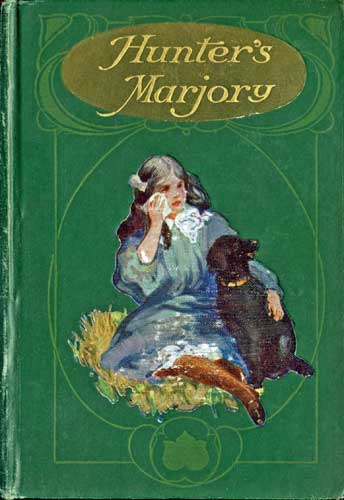
The Project Gutenberg eBook of Hunter's Marjory
Title: Hunter's Marjory
A story for girls
Author: Margaret Bruce Clarke
Release date: January 3, 2007 [eBook #20258]
Most recently updated: January 1, 2021
Language: English
Credits: Produced by Louise Pryor, Janet Blenkinship and the Online
Distributed Proofreading Team at https://www.pgdp.net
Hunter's Marjory
A STORY FOR GIRLS
BY
MARGARET BRUCE CLARKE
Author of "The Little Heiress," etc., etc.
TOMAS NELSON AND SONS
London, Edinburgh, Dublin, and New York
1907
Transcriber's Note
Inconsistency in spelling and punctuation is as in the original.
Contents
| I. | TEARS. | 9 |
| II. | A FRIEND IN NEED. | 23 |
| III. | UNCLE AND NIECE. | 38 |
| IV. | TEA AT HUNTERS' BRAE. | 52 |
| V. | A VISIT TO THE LOW FARM. | 66 |
| VI. | CONFIDENCES. | 79 |
| VII. | MARJORY'S APOLOGY. | 94 |
| VIII. | THE SECRET CHAMBER. | 108 |
| IX. | PETER'S STORY. | 124 |
| X. | MARJORY'S BIRTHDAY. | 144 |
| XI. | THE MYSTERIOUS STRANGER. | 160 |
| XII. | MARJORY KEEPS A SECRET. | 175 |
| XIII. | THE OLD CHEST. | 188 |
| XIV. | THE PROPHECIES. | 202 |
| XV. | TWELFTH NIGHT. | 218 |
| XVI. | MISS WASPE GIVES GOOD ADVICE. | 232 |
| XVII. | ON THE LOCH. | 246 |
| XVIII. | THE STRANGER RETURNS. | 259 |
| XIX. | IMPORTANT LETTERS. | 274 |
| XX. | THE DOCTOR'S DISAPPOINTMENT. | 288 |
| XXI. | HOPES REALIZED. | 300 |
HUNTER'S MARJORY.
And very few to love."—Wordsworth.
Marjory was lying under a tree in the wood beyond her uncle's garden; her head was hidden in the long, soft coat of a black retriever, and she was crying—sobbing bitterly as if her heart would break, and as if nothing could ever comfort her again.
"O Silky," she moaned, "if you only knew, you would be so sorry for me."
The faithful dog knew that something very serious was the matter with his young mistress, but he could only lick her hands and wag his tail as well as he was able with her weight upon his body.
A fresh burst of grief shook the girl; and Silky, puzzled by this unusual behaviour on Marjory's part, began to make little low whines himself. Suddenly the whines were changed to growls, the dog shook himself free from the girl's clasping arms and stood erect, staring into the wood beyond.
Marjory was too much overcome by her grief to notice Silky's doings, and it was not until she heard a voice quite close to her saying, "You poor little thing, what is the matter?" that she realized that she was not alone.
She looked up, startled, wondering who this stranger could be making free of her uncle's woods. She saw a lady, tall and fair, looking kindly at her, and a girl who might have stepped out of a picture, so sweet and fresh and pretty she looked in her white frock and shady hat.
For one minute Marjory gazed at her in admiration, and then, conscious of her tear-stained face and tumbled dress, let her head droop again and sobbed afresh.
The lady spoke again: "My dear child, what is wrong?"
"Nothing," sobbed Marjory—"nothing that I can tell you."
She felt ashamed of being seen in such a plight, and had an instinctive dislike of showing her feelings to a stranger, for Marjory was an extremely shy girl.
"But, my dear," remonstrated the lady, "I cannot leave you like this; besides," with a smile most winning, if only Marjory could have seen it, "I believe you are trespassing upon our newly-acquired property."
Marjory raised her head at this, and said quickly, and perhaps just a little proudly,—
"Oh no, I'm not; this is my uncle's ground."
"Oh dear; then Blanche and I are the trespassers, though quite innocent ones. And you must be Marjory Davidson, I think—Dr. Hunter's niece; and if so, I know a great deal about you, and we are going to be friends, and you must let me begin by helping you now."
So saying, the lady seated herself on the ground beside Marjory, her daughter looking on, at the same time stroking and patting Silky, who seemed much more disposed to be friendly than his mistress.
"Can't you tell me what the trouble is, Marjory? I am Mrs. Forester, and this is my daughter Blanche. We have just come to live at Braeside. Your uncle called on us to-day, and told us about you. Blanche and I have been looking forward to seeing you and making friends.—Haven't we, Blanche?"
"Yes, I've thought of nothing else since I heard about you," said the girl, rather shyly, the colour coming into her face as she spoke.
Marjory stole another glance at her, and she thought she had never seen or imagined any one so sweet and pretty as this girl.
"Blanche," she thought—"that means white; I know it from the names of roses and hyacinths. I've seen it on the labels. And she is just like her name—like a beautiful white rose with the tiniest bit of pink in it."
"Come now, Marjory dear," coaxed Mrs. Forester; "won't you take us for friends, and tell me a little about this trouble of yours? Won't you let me try to help you out of it?"
"No, you can't help me; nobody can. It's very kind of you," stammered Marjory, "but it's no use."
"Suppose you tell me, and let me judge whether I can help you or not." And Mrs. Forester took hold of one of Marjory's little brown hands and stroked it gently.
The soft touch and the gentle voice won Marjory's heart at last, and she said brokenly, between her sobs,—
"It's about—learning things—and going to school—and uncle—won't let me, and—and he won't tell me about my father, and I don't belong to anybody."
"Poor child, poor little one, don't cry so. Try to tell me all about it. I don't quite understand, but I am sure I shall be able to help you."
Bit by bit the story came out. The poor little heart unburdened itself to sympathetic ears, and the girl could hardly believe that it was she—Marjory Davidson—who was talking like this to a stranger. She felt for the first time in her life the relief of confiding in some one who really understands, and she experienced the comfort that sympathy can give. She felt as though she were dreaming, and that this gentle woman, whose touch was so loving and whose voice was so tender, might be the mother whom, alas! she had never seen but in her dreams.
Marjory's mother had died when her baby was only a few days old, and all that the child had ever been told about her father was that he was away in foreign parts at the time of her mother's death, and that he had never been seen or heard of since. Many and many a time did she think of this unknown father. Was he still alive? Did he never give a thought to his little girl? Would he ever come home to see her?
The true story was this: Dr. Hunter had been devotedly fond of his sister Marjory—the only one amongst several brothers and sisters who had lived to grow up. Many years younger than himself, she had been more like a daughter to him than a sister. On the death of their parents he had been left her sole guardian, and she had lived with him and been the light and joy of his home. The doctor might seem hard and cold to outsiders, wrapped up in his scientific studies and pursuits, giving little thought or care to any other affairs, but he had an intense capacity for loving, and he lavished his affection upon his young sister, leaving nothing undone that might increase her happiness or her comfort.
All went well until she married Hugh Davidson, handsome, careless, and of a roving disposition, as the doctor pronounced him to be. They loved each other, and the doctor had to take the second place.
Mr. and Mrs. Davidson made their home in England for a few months after their marriage; then he received an imperative summons from the other side of the world requiring his presence. He was needed to look after some mining property in the far away North-West in the interests of a company to which he belonged. He bade a hurried farewell to his wife, promising to be back in six months. She went home to her brother at Hunters' Brae, and lived with him until her death. She never recovered from the shock of the parting. Her husband's letters were of necessity few and far between. She had no idea of the difficulties and hardships of his life, and although she defended his long silences when the doctor made comment upon them, still she felt it was very hard that he should write so seldom, and when he did write that the letters should be so short. Could she have seen him struggling through an ice-bound country, enduring hardships and even privations such as are unknown to the traveller of to-day; could she have seen all this, she could never have blamed him, she could only have praised him for his faithful service to those who had sent him, and the cheerful tone of his letters to her, with no word of personal complaint.
But Mrs. Davidson slowly lost her strength. She faded away as a beautiful fragile lily might, and Hunters' Brae was once more left desolate—yet not quite desolate, for there was the baby girl; and, thinking of her, the doctor resolved that she should take her mother's place with him. He would devote himself to her, he would try to avoid all the mistakes he had made with his sister, and, above all, her father should not even know of her existence. He would keep her all to himself, she should know no other care but his, and thus her whole affection should be his alone.
It must be owned that jealousy had blinded Dr. Hunter to his brother-in-law's good qualities. He had never troubled to inquire into the circumstances of his going abroad. Enough for him that the man had left his wife alone only a few months after their marriage, and he obstinately refused to hear one word in his defence, and would believe no good of him. He was quite honest in his desire to do the best that was possible for the child, and in the feeling that it would be better to keep all knowledge of her father from her. He looked upon Hugh Davidson as a black sheep. A black sheep could do no good to any one; therefore, he argued, he should not come near this precious child.
Acting upon this determination, he wrote a very curt note to Mr. Davidson, acquainting him with the fact of his wife's death, and telling him that it was entirely his fault—that he had practically killed her by leaving her alone—but making no mention of the child.
Poor Mr. Davidson received this letter just at a time when he dared to hope that his work was nearly done and he could allow himself to think of going home, and his grief was pitiable. He had no near relatives, having been the only child of his parents, who had been dead many years. His wandering life had cut him adrift from the acquaintances and surroundings of his youth. He and his wife had lived in a world of their own during those few short months, and she had been his only correspondent in the old country when he left it. Thus it came about that there was no one to give him the information which Dr. Hunter withheld; and the poor man, thinking himself alone in the world, with no ties, no friends, never had the heart to return home to the scenes of his former happiness; and thus it was that he never knew, never thought of his little girl growing up in that remote Scottish home, lonely like himself, longing for and dreaming of things that seemed beyond her reach.
In the first weeks after his sister's death Dr. Hunter derived much consolation from the thought of the child. He had named her Marjory after her mother, and took it for granted that she would be just such another Marjory—fair-haired and blue-eyed—and he pictured her growing up gentle and quiet, as her mother had been. Certainly the infant's eyes were blue at first, and there was no hair to be seen on her head to trouble the doctor's visions by its unexpected colour; but slowly and surely it showed itself dark—black as night—crisp, and curly like her father's. The eyes deepened and deepened till they too were dark, liquid, and shining, with a look of appeal in them, even in those early days.
To say that Dr. Hunter was disappointed would be a most inadequate description of his feelings. He was dismayed at first when he realized the total reversal of his expectations, and finally enraged to think that this living image of the man he disliked, and whom his conscience at times would insist he had wronged, would be constantly before him to remind him of things he would prefer to forget.
But these feelings passed, and the child soon found her way into her uncle's heart—the heart that was really so big and so loving, though the way to it might be hard and rough. The little toddling child knew no fear of her stern old uncle; it was only as she grew up that shyness, restraint, and awkwardness in his presence took possession of Marjory.
Dr. Hunter had looked after her education himself. She had been a delicate little child, and he had not troubled about any lessons in the ordinary sense of the word for some years. He wished her body to grow strong first, so she had spent her days in the garden, on the hills, or on the lake with him; she had learned the ways of birds and flowers and animals, and meanwhile had grown sturdy and healthy. Her uncle had not allowed her to make friends with any of the children in the neighbourhood; he himself was intimate with none of his neighbours except the minister, Mr. Mackenzie, and the doctor, Dr. Morison. The minister had no children, and the doctor's two boys were at school, so that Marjory only saw them occasionally in the holidays. She had no playmates of her own age, and the children of the village looked upon her as an alien amongst them, regarding her almost with dislike, although it was not her fault that she was obliged to hold aloof from them.
Dr. Hunter had a theory that his sister had been too dreamy and romantic; that he had petted her and given in to her too much, instead of insisting upon her learning to be more practical. He blamed the fairy tales of her childhood, the influence of her school companions, the poetry and novels of later years as the chief causes of what he called her dreamy ways and romantic nonsense, and he determined that Marjory should be very differently brought up. She must learn to cook and to sew and to be useful in the house. She should not be allowed to read fairy tales or poetry, nor should she be sent to school; he himself would teach her what it was necessary for her to learn; he would be very careful before allowing her to make any friendships; and with all these precautionary measures he felt that she must grow into a good, strong, sensible, capable girl.
So Lisbeth the housekeeper was ordered to teach the child to dust and to sew and other useful things; and Peter, her husband, must teach her to hoe and to rake, to sow seeds in her little garden and keep it tidy. The doctor's own part in the programme was to teach her to read and write and cast up figures. That would be enough, he considered, for the present. Music, languages, and poetry were to be left out as being likely to lead to romantic ideas and dreams and unrealities. "Time enough for them when she is older," he decided. "When the foundation of common-sense has been laid, there will be no danger. Till then I shall keep her to facts and nothing else."
The doctor did his best to carry out these plans, which he honestly believed to be for the child's good in every possible way. Lisbeth and Peter, grown old in service at Hunters' Brae, were warned on no account to talk to Marjory about her father or old times, or to encourage her in doing so; and they tried hard to do as their master bade them, though it was difficult sometimes to resist those pleading eyes when the child would say, "Won't you tell me about my father, Lisbeth dear?" or "Peter darling," as the case might be. Peter was a gardener and man-of-all-work, and his hands were sometimes very dirty, but he was a darling all the same to Marjory, and indeed he was a good old man. If he and his wife had known the truth, that Mr. Davidson had never been told about his child, it is likely that Peter's strict sense of justice would have prompted him to right that wrong. But, like every one else, he took it for granted that the news had gone to Mr. Davidson, and in his kind old heart was often tempted to blame the seemingly careless father.
"Could he but see the bonnie lamb," he would say sometimes to his wife, "the vera picter o' himsel', he wouldna hae the heart to leave her. I've wondered whiles if the doctor wouldna send him a bit photograph, just to show him what like she is."
Lisbeth would reply, "Peter, it's just nae manner o' use thinkin' o' ony sic a thing. The doctor he's that set against Mr. Davidson that ye micht as weel try to move Ben Lomond itsel' as to move him."
These conversations usually ended in an admonition from Lisbeth to Peter to eat his meat and no blether. The suggestion was never made to the doctor, no word ever reached Mr. Davidson, and things went on much in the same way year after year; and although at times the doctor would question the efficacy of his plans for Marjory's education, on the whole he was fairly satisfied with them.
The day on which this story opens had seen the doctor take a most unusual step. Hearing from an old acquaintance in London—a scientific man and student like himself whose opinion he considered worth something—that some friends of his had bought Braeside, the property adjoining Hunters' Brae, he determined to do his duty as a neighbour, and go to welcome the newcomers as soon as they arrived. His friend had written, "Mrs. Forester is a most charming woman, Forester himself a thoroughly good fellow, and their little girl Blanche one of the sweetest children I have ever seen. She will make a good companion for your niece, poor little thing."
This letter had set the doctor thinking. First, he was nettled by his friend's use of the words "poor little thing." Why should Marjory be pitied as a poor little thing? Had he not done everything he possibly could for her? Then came one of those painful stabs of conscience which insisted now and then on being felt. What about her father? Have you done right in that matter?
He salved his conscience for the time being by making up his mind to go and see the Foresters, and if they were indeed all that his friend had said, there could be no reason why he should not encourage a friendship between the two girls. Marjory certainly had been very quiet and inclined to mope of late, and it would be a good thing for her to be roused by this new interest. The child was seldom out of his thoughts for long together; he loved her as his own; and yet Marjory was not happy—she was lonely, she did not understand her uncle and misjudged him, and he found her cold and unresponsive. There was something wanting between them; both were conscious of this want, yet neither knew how to supply it and so mend matters.
And gladness hides her face in scorn;
Put thou the shadow from thy brow—
No night but has its morn."—Schiller.
Things had come to a climax that afternoon. Marjory had driven by herself to the village to get some things that Lisbeth wanted, and also to buy some stamps for her uncle. Peter usually accompanied her on these expeditions, but to-day he was busy in the vine-house, and excused himself from attending upon his little mistress. She was quite accustomed to driving, however, and Brownie, the pony, was a very steady, well-behaved little animal, and a great pet of Marjory's; so she started off in good spirits, Silky running beside the cart as usual. She did her errands in the village, finishing up at the post office, which was also the bakery and the most important building in the place. Mrs. Smylie, the baker's wife and postmistress, served her with the stamps, and Marjory was about to say good-afternoon and leave the shop, when Mrs. Smylie opened a door and called out,—
"Mary Ann, here's Hunter's Marjory; maybe ye'd like to see her." And turning to Marjory, she explained, "Mary Ann's just hame frae the schule for a wee bit."
The Smylies were the most important people in the village of Heathermuir. Their mills supplied the countryside with flour, and their bakery was the only one of any size in the district. They had built their own house; it had a garden attached to it and a greenhouse; and, to crown all, their only child Mary Ann was to be brought up as a lady. With this object in view, the ambitious parents had sent the girl to a "Seminary for Young Ladies" at Morristown, some twenty miles away, and were greatly pleased with the result, feeling that Mary Ann was really quite a lady. That young person was delighted to come home and be worshipped by her admiring parents; and their idea that a real lady should never soil her fingers by household work, or indeed by work of any kind, suited her very well.
Mrs. Smylie, bursting with pride as her daughter appeared, watched the meeting between the two girls. Mary Ann's dress was very much overtrimmed, her hair was frizzed into a spiky bush across her forehead, and her somewhat freckled face was composed into an expression of serene self-complacency. She was the only girl in the village who was at a boarding-school; not even Hunter's Marjory, with all her airs, could boast this advantage, she thought; and Mary Ann felt her superiority, and gloried in it.
Mrs. Smylie noted with great pride that the hand her daughter held out to Marjory was white and delicate—in great contrast to Marjory's brown one. "But then," she reflected, "the puir bairn hasna got her mither to watch her like oor Mary Ann has. Bless me! how the lassie glowers! Mary Ann has the biggest share o' manners onyways."
It must be confessed that Marjory was "glowering." She regarded the overdressed girl with aversion, answered her mincingly-spoken "How do you do, Marjory?" very curtly, and continued to "glower," as Mrs. Smylie described it, without saying another word.
"Won't you come into the house?" asked Mary Ann, and Marjory went.
She did not care about these people; she had never liked Mary Ann, and could hardly bear to look at her now, or listen to her affected way of talking. Still, she did not wish to be rude, so she followed Mary Ann through the shop into the house, and was ushered into the sitting-room, or parlour as it was called. The room was like Mary Ann's dress—full of all sorts of bright colours and gaudy ornaments of poor quality.
There was one thing about Mary Ann which interested Marjory profoundly, and that was her school experience. She felt that she would like to question the girl about it, and yet was too proud to betray her curiosity by bringing up the subject. Mary Ann, however, saved her the trouble, for as soon as they were seated she began at once,—
"Why don't your uncle send you to school? Any one would think a great girl like you ought to be sent to school. Why don't he send you?"
"Uncle doesn't wish me to go to school."
"Maybe he don't want to pay the fees," said Mary Ann.
Marjory said nothing.
"I learn French and German and music. I'm getting on fine with the piano, and papa's going to buy me one of my own soon. You haven't got a piano at Hunters' Brae, have you?"
"No," said Marjory shortly.
As a matter of fact there was a piano at Hunters' Brae, but it was kept in the room that had been her mother's—a room that Marjory was not allowed to enter. For reasons of his own the doctor had forbidden Marjory to go into it. She should do so on her fifteenth birthday, but not before. Lisbeth went in once a week with pail, broom, and duster, but she always carefully locked the door behind her, and Marjory knew nothing of the room or its contents. "Some bonnie day," was all that the old woman would say when she questioned her.
"It seems a shame you can't be made a lady of too."
"I can be a lady without going to school," said Marjory sulkily.
The other looked at her in surprise.
"Oh no, you can't. Who is there to teach you? You have to learn manners and deportment and accomplishments and all that sort of thing first. I don't see that you've got any chance here, you poor little thing," patronizingly.
"I don't care," said Marjory, knowing in her heart that she did care beyond everything, and that her greatest desire was to learn all sorts of things. "I don't care a pin," she repeated.
"Yes, you do, or you wouldn't get so red," said Mary Ann provokingly. Then she continued, "Your uncle's queer, isn't he?"
"What do you mean by 'queer'?"
"Well—queer—in his head, you know. People say he is, and, anyhow, he does queer things—keeping that room shut up, and all that. I should say he must be a little bit mad."
"He isn't," indignantly. "He's a very clever, celebrated man."
Mary Ann went off into peals of laughter.
"Oh dear! who told you that?" she cried at last.
"Lisbeth," defiantly.
Another peal of laughter greeted this statement.
"It really is too funny; you little simpleton, to believe such a thing. Why, if he was celebrated, he would be rich enough to send you to school, and he wouldn't let you sew and dust the way you do, just like any village girl. I never dust; mamma doesn't wish me to." And Mary Ann looked at her white hands admiringly, and shot a glance, which Marjory felt rather than saw, at the brown ones nervously clasping and unclasping themselves.
"I wonder," continued her tormentor, "that you don't insist on being sent to school, so that you could learn to earn your own living. I've heard mamma say your uncle gets no money for your keep; no letters ever come from foreign parts from your father. It must be strange to have a father you've never seen. It must be horrid to be like you, because, really, when you come to think of it, you are no better off than a charity child, are you?"
But Mary Ann had gone too far. A tempest was raging in Marjory's heart, and as soon as she could find her voice, which seemed suddenly to have deserted her, she cried,—
"You are a beast, Mary Ann Smylie, and I hate you; and although I haven't been to school, I don't say 'if he was,' and 'don't' instead of doesn't." And with this parting shot Marjory rushed through the shop and jumped into the cart; and Brownie, infected by his mistress's excitement, galloped nearly all the way home, his unusual haste and Silky's sympathetic barking causing quite a commotion in the sleepy, quiet village.
Arrived home, Marjory ran to her uncle's study, knocked loudly at the door, and hardly waiting for permission, went in, leaving Silky, breathless and panting, outside.
The doctor was sitting in his armchair in his favourite attitude—his legs crossed, the tips of his fingers meeting, his eyes fixed upon them, but his thoughts far away. As a matter of fact he was thinking of Marjory at this very moment, of his visit to the Foresters, and the plans they had been making for the two girls.
"Well, Marjory, what is it?" he asked kindly, as the excited girl stood before him. She was trembling with agitation, her cheeks were scarlet, and her dark eyes flashed upon her uncle as she replied,—
"I want you to send me to school. I don't want to live on your charity any longer. I never knew I was till to-day," with a sob; then, piteously, "Won't you send me to school, Uncle George?"
"My dear child!" exclaimed the doctor, "what is all this? Who has been talking to you and putting such nonsense into your head?" looking at his niece in astonishment.
The quiet, usually almost sullen girl was transformed into a passionate little fury for the time being, and her uncle hardly recognized her. She burst out again,—
"Mary Ann Smylie looks down on me because I don't go to school. She says I can't ever be a lady; and she says that you get no money for my keep, and that I am no better than a charity child. I want to learn what other girls learn. I want you to send me to school, and I want you to tell me about my father, and to let me go into my mother's room!"
The child almost screamed these last words, and stamped upon the floor to emphasize them.
The doctor, now thoroughly aroused, rose from his chair, saying very sternly,—
"Marjory, I cannot alter my decision upon these matters. I do not wish you to go to school. I refuse to tell you any more than you have already been told about your father. I have promised that you shall go into your mother's room and take possession of it on your fifteenth birthday. That is enough. I am grieved that you should have listened to vulgar gossip about our affairs; but I may tell you that your mother left money to provide for you ten times over, if need be."
"Then you are unkind and cruel not to use it to send me to school and let me have what other girls have," cried Marjory passionately.
"Marjory," said her uncle quietly, "I cannot listen to you while you are in this mood. You had better go, and come back again when you can talk more reasonably."
"Yes, I will go, and I wish I need never come back. I hate everything, and I wish I were dead."
With these words she flung out of the room, rushed blindly through the house into the garden and on into the wood, where she threw herself down under a tree, and sobbed out her grief to the faithful Silky until Mrs. Forester found her.
Dr. Hunter was very much troubled and puzzled by his niece's behaviour. Never before had she given way to such an outburst. He had not believed her capable of such a storm of passion, and felt himself quite at a loss. He was grieved and shocked beyond measure by Marjory's words. "Unkind, cruel," he muttered to himself. "Surely not. I love the little thing as though she were my own." And while Marjory was weeping bitterly under the tree in the wood, her uncle, very sorrowful and thoughtful, was pacing up and down his study wondering what he could do for the best. It seemed all the more grievous as, only that afternoon, he had been making plans for Marjory with Mrs. Forester—that she should share Blanche's lessons and enjoy her companionship.
Mrs. Forester had heard much of the doctor and his niece from the mutual friend in London who had written to the doctor, and she knew exactly how to manage things, so that in the course of one short hour plans were made which were to alter Marjory's whole existence.
But she, poor child, knew nothing of this, and her grief was bitter—the more so as she slowly realized that she had been wrong to give way to her passion. First, she had called Mary Ann Smylie a beast. Well, she had been very much shocked once to hear a child in the street use that word to another, but she herself had used it quite easily, and still felt as if she would like to use it again; but, worst of all, she had called her uncle unkind and cruel. Thinking over the scene in the study, she remembered the look on his face as she said these words. "It was as if I had struck him," she thought; and then came more tears and sobs.
Mrs. Forester's motherly heart yearned over the girl as she made her confession. Brokenly and with many tears the story was told, and relief came to Marjory in the telling of it. Blanche, with instinctive tact, had walked away a little distance with Silky, so that Marjory should feel free to talk to her mother. When the recital was over, Mrs. Forester said cheerfully, "I told you I thought I should be able to help you. First of all, I have got some delightful news for you. Only to-day your uncle and I have been making plans for you to share in Blanche's lessons. You are to learn everything that she does, including French and music," with a smile at the recollection of her battle against the doctor's prejudices.
A breathless "oh" was all that Marjory could say.
Mrs. Forester continued,—
"Blanche has a very good, kind governess. Unfortunately, she has rather an ugly name, and it may make you smile. It is Waspe—W, a, s, p, e—not pretty, is it? But she is as sweet as she can be, and very accomplished, and Blanche gets on nicely with her. It will be much more interesting for Blanche to have some one to share her lessons with, and good for you too, won't it?"
"Oh, indeed it will!" replied Marjory, bewildered by this wonderful piece of news.
"And in return for this I want you to teach Blanche all you can."
"I?" asked Marjory in surprise.
"Yes, you," with a smile at the girl's puzzled expression. "Blanche is a little too much like her name at present; she isn't very strong. Living in London didn't suit her, and it is for her sake that we have come to live here. I want you to show her all your favourite nooks and corners, to teach her all you know about the birds and flowers, and to let her help you in your garden. Will you do this, and keep her out of doors as much as you can?"
"I shall love it!" cried Marjory emphatically. "It's like a dream, and seems too good to be true."
"Now, my child," continued Mrs. Forester seriously, "listen to me. I think you have been doing your uncle a great injustice. You say you called him unkind and cruel; he is neither the one nor the other."
"I know," replied Marjory in a low voice.
"He is very fond of you," said Mrs. Forester.
Marjory looked up quickly.
"He never says so," she objected.
"Ah!" said Mrs. Forester, "now we have got to the root of the whole matter. So, then, just because her uncle doesn't say, 'Marjory, I am very fond of you,' therefore Marjory thinks that he doesn't care for her very much."
Marjory nodded.
"My dear child, you never made a greater mistake. It is not in your uncle's nature to say much; he is content with doing things for you. This afternoon he talked of nothing but his plans for you, his ideas for your education—how his first care has been that you should grow strong and healthy amongst those outdoor things that you love. For your sake he has been content to stay in this obscure place, when he would receive the recognition he is entitled to if he went more into the world. His very meals he takes at times which he considers best for you. Look at your frock. Perhaps you don't think much of it, but let me tell you it is made of the very best tweed that Scotland can produce. Your boots are strong and sensible-looking, but they are of the finest quality of leather; your stockings are the best that money can buy. Let me see your handkerchief. Ah! I thought so," as Marjory obediently produced from her pocket the little hard, wet ball her tears had made. "This is a plain handkerchief, but so fine that it is fit for a princess to use. I don't suppose you ever thought about these things; but it must mean a great deal of trouble and care to your uncle to get them for you. He told me he looks after your wardrobe himself. Now, haven't I proved that he thinks about you a great deal?"
Marjory nodded.
"Don't you believe that, even if your mother had not left you provided for, your uncle would have been glad to keep you—that he would never have felt you a burden?"
"I don't know," said Marjory slowly. She was beginning to see her uncle in a new light, but she could not see him as he really was just yet.
"Well, you will know some day. There are many things which you are too young to understand, and you must try to trust in your uncle's knowing what is best for you in the matter of your father, who will return to you some day, I hope."
"Oh! do you really think that is possible?" cried Marjory. "Could it ever happen?"
"Certainly it might. I don't see any reason at all why you shouldn't hope for his coming. And if you will promise to be very patient, and to hope for the best, I will tell you something very nice that I heard said about your father a little while ago."
Marjory's eyes grew big with wonder. "Oh, do tell me. Indeed I will try to be patient."
"Well, an old friend of mine in London, who knows your uncle, and met your father long ago, said to me, 'A fine fellow was Hugh Davidson. I always feel that he may turn up again some day.'"
Mrs. Forester did not repeat other words said at the same time—namely, that "Hunter was always jealous, and would see no good in him;" but she felt justified in telling Marjory what she did, for she well knew how the girl would treasure the words, and how they might often comfort and encourage her.
"Oh! that is good," said Marjory. "I do thank you for telling me." And she squeezed her friend's hand.
"Now you must try to be very patient and hopeful. If God sees fit, be sure that He will give your father to you for your very own some day. In the meantime you must do all you can to be the sort of girl that a father would be proud of; and, Marjory, I have been thinking that your uncle might say the same of you as you do of him. You are fond of him, really, aren't you?"
"Yes, of course," assented Marjory.
"Well, do you ever tell him so?"
"No."
"Why not?"
"Oh, I shouldn't dare to."
"Nonsense! I suppose you would quite like it if he were to put his arms round you and call you his dear little Marjory?"
"Yes." Marjory was quite sure that she would like it very much, but she could hardly imagine such a thing happening.
"Well, do you ever go near enough to him to let him do it if he wanted to, or do you simply give him your cheek to kiss, morning and evening, and nothing more?"
"Yes, that's just what I do," confessed Marjory, laughing.
"Then perhaps your poor uncle thinks that you consider yourself too big to be kissed and hugged, and so he doesn't do it. You can't blame him, you know; if you just give him a little peck, and run away, you don't give him a chance. You take my advice: try to be a little more loving in your manner towards him, and it will soon make a difference. Perhaps you don't like a stranger to speak so plainly to you, but I have heard so much about you that I don't feel like a stranger at all. But I must be going now. Dr. Hunter has invited Blanche to come to tea with you to-morrow, and I hope this will be the beginning of a brighter life for you, my child. Good-bye, dear," kissing her.—"Come, Blanche; we must be going now."
The girls bade each other good-bye somewhat shyly, while Silky looked on approvingly, wagging his tail, as if he knew that in some way these strangers had been good to his mistress; and when they were gone he turned to Marjory and rubbed his soft, wet nose against her hand as if to say, "It's all right now, isn't it?" Marjory returned the dog's caress, and walked slowly and thoughtfully towards the house.