
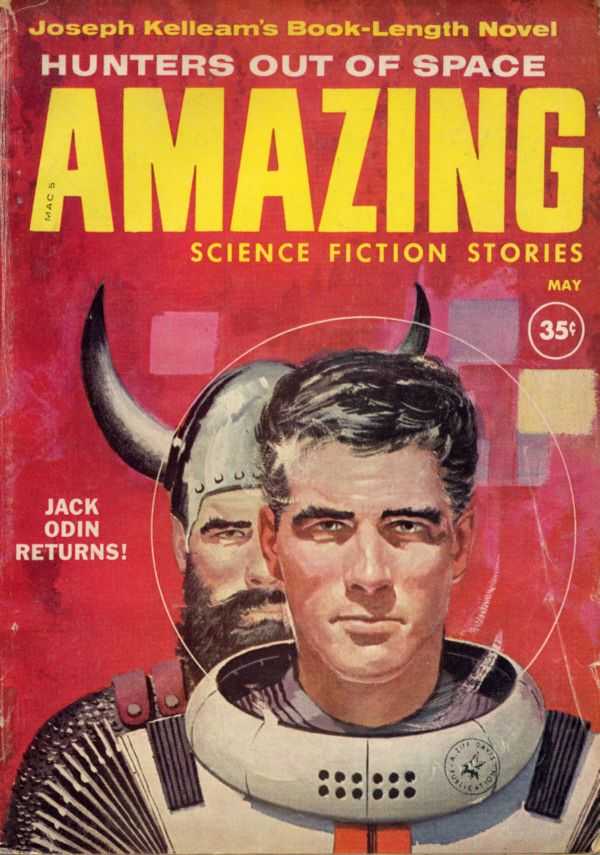
CHAPTER 6
IN THE days that followed there was no time for rest. Thanks to the smaller prototype which had already gone into space, no elaborate tests were required of the new ship. Moreover, the scientists had taken centuries to go over the Old Ship, bolt by bolt, part by part, wire by wire. Improvements had been made, but these had been incorporated into the little prototype which was now successfully berthed within a cavern somewhere on the moon. Over thirty men and women had gone with it. Wolden was constantly in touch with them and daily growing more envious of their position.
Odin knew little of such matters, but he sat daily at the council table where progress reports and squawk-sheets were examined and discussed. The speed with which they were developing the new ship was amazing. There was one innovation to be noted.
Wolden referred to it as the Fourth Drive. Odin gathered that the Old Ship had been equipped with such a drive, but new principles and new mechanics had been added. Odin showed him a little book, which had been privately printed in the world above some fifteen years before. It was entitled: “Einstein and Einsteinian Space, with Conjectures upon a Trans-Einsteinian concept.” Wolden said it had been written by a young refugee from the Nazis, and he doubted if over two or three copies of the manuscript were now in existence. Memories of concentration camps, poverty, and the internecine battles of the professors in a small college where the refugee was an assistant in the Physics Department, had finally driven the poor fellow to suicide.
“He was grasping at something new,” Wolden explained. “His concept was only nascent. But such a mind! The book has been invaluable. Still, it is nothing but a starting point—but such a starting point!”
Time passed. It was like working in a dream, where no sooner was one task done than another was ready. Odin ached. His head spun with all the information that Wolden had given him—the basic principles behind those machines that had gone into the ship.
Then, at last, it was finished. A young girl who reminded him of Maya was hoisted up on a scaffold to the highest bulge of the hour-glass shaped craft. Workers and visitors stood below by the thousands while she spoke into a tiny microphone and swung a ruby-colored bottle against the ship.
“You are christened The Nebula,” she cried. “Go out into space—”
They had used a bottle of red wine for the christening. A shower of ruby-glass and winedrops came sprinkling down. They fell slowly—like drops of blood, and the onlookers, who were by nature opposed to crowds, began to disperse.
“That girl,” Odin grasped Gunnar’s arm “Who is she?”
Gunnar looked at him curiously. “Her name is Nea. A distant cousin of Maya’s. Also, a distant cousin to Grim Hagen.”
Nothing else was said. But Odin suddenly realized that since the day he had been unwillingly carried back to the world above in the elevator he had not noticed any girl at all.
That night Jack Odin could not sleep, although he had never slept more than five hours at a time since returning to Opal. Getting up he found a little radio and turned it to a frequency which occasionally caught some of the stations above. A hill-billy band was playing, and a comic was singing: “So I kissed her little sister and forgot my Clementine.”
He turned off the radio with a curse and finally got to sleep, and dreamed of star spaces and emerald worlds ruled by beautiful Brons girls who looked like Maya—or maybe a bit like Nea. Until the worlds streaked across the dark sky like comets. And Gunnar was shaking him by the arm and a streak of light was coming in at the window.
“Ho, sluggard. We start to load the ship today. How long have you waited for this? We were going to savor each moment, remember! And you lie here like a turtle in the sun.”
Odin yawned. “The lists are ready. Everything is packed. I, myself, have checked the lists.”
Gunnar laughed. “How much time have your people spent checking lists? You are the world’s best list-checkers. And the worst. I wish we were just a handful of warriors going out for a fight. But whole families are coming along. Apparently the Brons intend to sow their seed among the stars. And with families. I’ll wager that your lists are not worth a darning needle. Something will be left behind. A slice of some bride’s wedding cake. Little Nordo’s favorite toy. Papa’s best pocket-knife. Mama’s button-box.” The strong little man made a wry face. “Bah, this is no trip for families. They want too much. They are never satisfied. With warriors it is much different. They can take things as they are and grumble a bit—or if they grumble too much, Gunnar can slap them silly. But families—on a trip like this. No!”
“Well, they’re going,” Odin retorted. “From what I hear, you were the only one who voted against them. So you had better get ready to listen to the patter of little feet, and squalling babies, and Mamas and Papas arguing over whose idea it was to make the trip anyway.”
“Oh, well, it does not matter. I am not of the Brons, but I go because of a promise.” Gunnar shrugged and his face appeared sad and seamed. “My Freida and the boys will be here today. I want you to meet them. I have spent over half my days a-wandering, Jack Odin, but now I have a sick feeling inside me. And I think to myself if I could go back to the farm with Freida and the boys, I could work there, and die an old, old man—as my father and his father did before me. But the wanderlust is heavy upon me. Freida understands. And I swore that I would go after Grim Hagen—and after Maya. But this way, I die up there among the stars some day, and no one unless it be you and Maya will think of Gunnar.”
Odin slapped his arm across Gunnar’s shoulders. “You are chief among the Neeblings. Stay here with your family. I will go out there to the stars, and I will always remember Gunnar. Faith, man, you owe us nothing. The debts are ours—”
But Gunnar shook his head. “I swore by my sword. And I go.”
A few hours later, they stood at the water’s edge and waited for Freida and the boys. It was not long before a boat hove into sight. And soon Gunnar was helping Freida and the three sons upon the landing.
Family meetings always made Odin ill at ease. He stood there, shuffling his feet.
Freida was a short, broad woman, with big breasts and broad hips. Her eyes, the palest blue, were still beautiful. Odin guessed that when she was young her face had matched her eyes. But the face was worn and the hand that she offered him was calloused. She was dressed in linsey-woolsey, and the overalls of the three sons were also home-spun.
The three lads, miniature copies of Gunnar, stood there solemnly. Each wore a new straw hat with a black and red band around it. They were barefooted. Odin guessed that the hats had been bought special for the occasion.
For the next three days Odin was kept busy by Ato. There were a million things to go on the ship. The Brons had done a wonderful job of warehousing. All was packaged and tagged. A place for each box or machine was already marked and numbered on the prints of The Nebula. The tunnel had been cleared for two lanes of trucks and tractors. Steadily the line of laden cars moved down to the ship and steadily another line came back for more supplies.
Odin was assigned to superintend one of the warehouses, and he was both annoyed and pleased to find that the girl Nea was his assistant. She was a hard worker and pleasant enough, though she said little to him. And the only time he saw her flustered was when she ordered a young man of the Brons out of the building. Jack felt a bit sorry for the fellow. He was scarcely out of his teens and was all shook up because Nea was going out there into space instead of staying here in Opal with him.
So the work went on at a furious pace, and before he realized that three days had gone he was back at the improvised docks with Gunnar and his family.
The parting was a quiet one. Gunnar told the boys to mind their mother and not stay out late at night. “Get strong muscles on your legs and shoulders,” he told them. “A man is not too good at thinking, and he never knows what will happen next. The muscles will keep him going, and after the muscles are gone a fighting heart will carry him a little farther.”
No tears were shed. They talked of little things, and laughed at old jokes that Gunnar’s grandfather had told them. One of those family jokes that never seem very funny to an outsider.
After that, Freida worked the conversation around to the voyage that Gunnar would soon be making.
“They say it is cold out there,” she ventured cautiously.
“Oh, yes. Very cold.” Gunnar agreed.
“Then you wrap up good, Gunnar. We wouldn’t want you to have a chill.”
Gunnar scoffed, “I never had a chill in my life.”
“Oh, such talk. Don’t pretend to be so big. I have nursed you through many a chill.” Then she produced her parting gift—a muffler that would have swathed poor Gunnar from chin to belt.
“You promise you wear this if it gets cold,” she urged.
“I tell you, mama, I don’t need such things. You don’t know how tough old Gunnar is.”
“Yes, I know. You promise to wear the muffler—”
Gunnar took it as he cast a sheepish look at Odin. “All right. All right. I’ll take it—”
After Freida’s boat had disappeared, Gunnar tried to joke about the muffler. But he was a bit proud of it too, and put it around his neck. The ends almost brushed the ground, but it was so warm that he soon had to roll it up and carry it with him.
The two went for a meal. But Gunnar ate little, grumbling at the food. Once he assured Odin that he had never had a chill in his life—that Freida was too thoughtful about him—
“Sure. Sure.” Odin agreed.
Then, finally, Gunnar cleared his throat and spoke the things that were in his mind.
“Friend Odin,” he began, looking down at his plate as though he expected to see an answer there. “I fear that I have seen my family for the last time. We are in for a trip beyond the dreams of men. Beyond Ragnarok—to the edge of the night where the mad gods make bonfires of worn-out suns—where space itself serves the mad squirrel.”
Gunnar paused to mutter a few words to himself and then looked up at Odin with the old smile on his broad face. “Oh, well, a man must go as far as his heart will take him—”
But for all his big talk, Gunnar tossed and muttered that night. And once, Odin heard him cry out—“So, Hagen, the stars swing right at last, and you are mine for the taking. Oh, my lost little boys and my lost little girl—”
And Gunnar, the strong one, sobbed in his sleep.
The ship was loaded at last. The time for departure was near. The crew of The Nebula—over two hundred men, women and children—went quietly into the tunnel. Thousands of relatives and friends had come to the Tower to see them off. There was little weeping though most of the faces were sad and lined.
Ato and Wolden had some last words with the captains who were working upon the rebuilding of Opal.
“We can talk to you from the moon,” Wolden was saying. “Beyond that, when we swing into the Fourth Drive, we cannot. May your work prosper.”
The last man had filed up the ramp to the sphere at the center of the hour-glass shaped craft. The door was finally closed and sealed.
There were no portholes in the Nebula. But at least a dozen screens were mounted at convenient locations. These showed the outside world as clearly as a window.
The ship moved along its rails to the Great Door. The door opened. Then it closed behind them. The second door—the one that opened upon the sea—slowly parted and slid back into the walls of the tunnel. The water poured in. For a second or two, all that Odin could see was swirling bubbling water. Then water was all around them. Seaweed still swirled in mad little whirlpools. A fish swam close to an outside scanner, and seemed to peer closer and closer at them until there was only one great staring eye upon the screen. Then it flirted its tail at them and sped away.
The ship moved on. Far out upon the floor of the Gulf, it paused. There were twenty minutes of last-minute checking.
Then, swiftly, as a cork bobs upward, the Nebula arose through the parting waters.
Then the sea was below them and they were still rising. The scanner showed the sea receding. They were looking down at a segment of a curved world. Far away was land, and Odin saw two dark specks in the distance which he thought were Galveston and Houston. The world below them became half of a sphere that filled the viewer. And then it was a turning globe, growing smaller and smaller. As it diminished, the stars winked out on the screen’s background.
The sensation of rushing upward was no worse than being in a fast elevator. And yet, as Odin watched the earth recede, he realized that they must have risen from the water at a speed much faster than a bullet.
Soon the earth appeared no larger than a basketball. The viewers were changed. The moon appeared upon it—a growing sphere, with its mountains and craters all silver and black in the reflected light.
Wolden turned to Odin. “See how it is done. We left there quietly. Not a drop of water entered Opal. We left so fast that I doubt if your world even noticed us. Grim Hagen always loved the sensational. There was no need for the havoc that he made—”
In less than an hour, the onrushing moon filled the screens. And with scarcely a quiver of excitement the Nebula circled it swiftly—and landed.
CHAPTER 7
WOLDEN and Ato, acting as pilot and co-pilot, set The Nebula down with as much ease as a housewife putting a fine piece of china upon the drainboard.
There was no fuss and no noise. Jack Odin had seen B-47’s come in with a great deal more hubbub and dithers than the Nebula had caused.
The screens were still on. Out there all was dark, and a wealth of stars was in the purple-black sky. They seemed larger and brighter. Wolden touched a knob and the stars on the screen before them slowly grew larger and larger. “An astronomer’s paradise,” he said to Odin. “Look closely and you can see Centauri’s binary suns. Here, with no refraction, a small telescope can do as well as the best that your people have made. There is no telling what your large ones could do. Ah, the riddles that could be answered.”
Odin shrugged. Like almost everyone else, he had often fancied how it would be to land on the moon. Now he was here, and the surface of the moon was blacker than the blackest night he had ever seen. Moreover, there had been no change in gravity. The Nebula had been built to take care of that.
As though sensing his thoughts, Wolden began to explain. “We are less than fifty miles from a spot where the earth could be seen. Not over a degree below the curvature. In fact, if the moon were full, there would be a bit of light here, for a strong light playing upon any globe always lights up over half of it. We are not far from the Heroynian Mountains and the Bay of Dew. Just a few miles within that other side of the moon which none of your people have ever seen before.”
Odin remembered Jules Verne’s account of a volcano spouting its last breath of life in that zone, but out there was nothing but the dark and the stars that smoldered like sapphires, rubies, and diamonds upon a black velvet sky. There were no shadows. The darkness was solid, as though it had frozen there since old and no spark had ever invaded it.
“Be patient, my friend,” Wolden had sensed his thoughts again. “Before long, you will see more of the moon than men have ever known. We sent a smaller ship into space. Remember! Our scientists are here. In a place beyond your dreams. Look. They are coming now.”
Wolden was adjusting the screen again. Far off, something like a long jointed bug with a single glaring light in its head was crawling toward them.
It drew nearer. Jack Odin saw that it was no more than a huge caterpillar tractor with several cars attached, armored and sheathed with sort of a bellows-type connection at each joint. As it neared the Nebula, it played its light around so that Odin got his first glimpse of the moon. Barren, worn, cindered. An ash-heap turned to stone. Puddles and splashes shaped like great crowns, as though liquid rock had congealed at the very height of its torment. Needles of rock, toadstools of rock, bubbles of rock, and glassy sheets of rock—this was the surface of the moon.
Then the crawling tractor with its cars lumbering along behind it on their endless tracks was below them and playing its single light upward.
An air-lock in the Nebula opened and a huge hose came slowly down. Odin watched it on the screen. It seemed to have been pleated and shoved together like an accordion. Now it opened out in little jerking movements, extending itself about two feet at each writhing twitch. As it grew longer it expanded and was nearly three feet across when it reached the top of the first car. A round door opened. Unseen hands reached the end of the big hose and fastened it securely.
Odin had often dreamed of landing on the moon. There, in the traditional space-suit, with a plastic bubble about his head, he would leap twenty feet into the air, and maybe even turn a somersault as a gesture of man’s escape from the tiring tyranny of gravity. Compared to this dream, his arrival upon the moon was just a bit ridiculous. He and over a score of others simply slid down the inside of the long, slanting hose like a group of third-graders practicing on the fire-escape at the school house.
Larger than the others, Odin landed awkwardly upon the floor of the car. Before he could jump aside, another passenger piled upon him. It was a girl, and the perfume in her hair was the same that Maya had always used. He helped her to her feet and drew her aside just as another voyager came sliding down. The girl was Nea. Somehow, he had an odd feeling that Maya was here. He was just a bit annoyed at Nea, and wished to himself that she wasn’t making the trip. She shook her black curls and thanked him softly.
“How awkward of me,” she explained. “It wouldn’t have happened if I had not been carrying this—”
She held up a little round satchel. It was exactly like the cases that people used in his country for carrying bowling balls. Odin was puzzled. And he assured himself that he would never understand women. Why would the girl be carrying a bowling ball with her into outer space?
Odin joined Wolden, Ato, and Gunnar in the “engine” of the bumpy little train. Here were real windows of quartz, and he could see more of the moon’s surface as the tractor and its jointed cars wheeled about in a great circle and headed off in the direction from whence it had come.
Once there was a loud Ping upon the roof above them. The tractor shook.
“A meteorite,” the driver explained. “They’re thick tonight. Don’t worry. There’s a screen upon the roof that slows them down and melts ’em. The larger ones never reach us. Some of the tiny ones get through.”
They came to a sheer mountain which in the beams of the tractor looked like a silver pyramid painted across a jet-black canvas.
As though answering an unheard vibration, a door opened and they lumbered in. The door closed behind them. For a moment they were in such darkness that even the beam from the tractor seemed alien. Then another door started to open before them and a widening shaft of light was there to greet them.
Odin was thinking that each race must have some craft at which it excels all others. If so, then the building of air-locks was certainly the Brons’ highest art.
Then they advanced into a cavern where five tiny atomic suns were strung out at equal distances upon the ceiling. The cavern was geometrical. Roughly, it was a mile long, half a mile wide, and half a mile high. The floor was smooth; the walls were sheer. “As though they had been shaped by human hand,” Odin thought, but he soon learned that other hands had sheered those walls.
In the very middle of the cavern was a little lake, shaped in the same proportion as the floor. It was surrounded by green grass, and at one corner was a profusion of water-lilies and cat-tails. There were no trees, but flowers were everywhere. A few small bushes. Here and there were great clumps of vines. Odin guessed them to be wild cucumber and trumpet vines, for they had grown riotously.
It was beautiful indeed, but there were other things to catch the eye. At least a hundred hemispheres—little igloos of porcelain—were scattered about the floor of the cave. Each one was a different color. They shimmered and glittered. Scarlet, mauve, mother-of-pearl, the blue Capri, and the blue of cobalt. Pinks, yellows, oranges. Every possible shade had gone into those porcelain igloos. And the lighted walls of the cavern were covered from floor to ceiling with numberless figures, marching, fighting, working, playing. At first, Odin thought it was a vast procession of armored knights with huge chests and closed visors. But none of them stood completely erect—and each of them had two sets of arms.
Straining his eyes at the windows to look up, Odin learned that the vast ceiling was completely covered by similar figures.
In contrast to these was one huge tower of rough stone which Odin guessed to be new.
So they came to the moon, and disembarked. And at last Odin felt the lightened pull of the moon’s gravity. He felt so free that he laughed and leaped into the air and turned a somersault just as he had dreamed of doing. Then one of the Brons’ scientists gave him a heavy pair of shoes—as if to remind him that no man can be altogether free.
As he glumly strapped the heavy shoes to his feet, Jack thought of something his father had told him: “No man was ever really free, unless it was Robinson Crusoe. Then Friday showed up and became Crusoe’s servant, and Crusoe’s freedom flew away.”
Forty-eight hours had passed since they came to the cavern. Odin and Gunnar had gone with Wolden to visit the Scientist who had led the first expedition to the moon. The Scientist, whose name was Gor, was explaining: “—They were hardly out of the Iron Age. That was how we found this place. Our instruments detected a surplus of iron in this area. They must have developed fast—for life did not last long. Insectival, beyond a doubt. Also, they had what we call The Moon Metal. Their houses, practically everything they used, are made of that. It must have been an accident. In cooling, the moon spewed this new alloy out upon its surface. Yes, it looks like porcelain—but it is as hard as steel. It has strange vibrations. They had musical instruments—although they may have produced tingling vibrations instead of sound. When these people saw that all was lost, they retreated here and closed the cave.
“For over a thousand years, theirs was an economy of death and rottenness. Mushrooms and toadstools were their food. Banks of rotting mushrooms made their light. Also, it appears they had some rocks which gave out a dim glow. Even their dead went to feed the mushrooms. And so they lived. With time on their hands they covered the walls with paintings. Also, we think they must have developed their music to a high degree—though we may never know about that. Then their water and air gave out and they died.”
Good heavens, Odin thought, what a cold-blooded obituary for any race!
“And so, Wolden,” the Scientist continued, “it has worked out well. We were lucky to find this spot. We fashioned the two doors first, for the cave was open when we reached it—I think a meteor must have crashed here long after these people died. After that, it was easy to build the lights and to draw moisture and air from the rocks. We have struck a balance now. I said all along that it could be done, if we could escape the constant interference from those ruffians above us—uh, Odin, I beg your pardon.”
Odin always resented these cracks at his people so he ignored the request by asking another question. “But how did you do all this in so short a time? Those vines look like they have been growing for years.”
“Just as they do in Alaska during the growing season. We kept our suns burning all the time. Soon we may be able to afford both day and night, but not yet.
“And after that,” the Scientist went on, “we were able to get back to your work on the Time-Space Continuum. We have made some wonderful advances. I would like to show you—but Gunnar and Odin, I am boring you.”
“Wouldn’t you care to look at the new lake?” Wolden urged.
“I can take a hint,” Gunnar grumbled. “Nobody wants a fighting man about until the swords are flashing—”
As Odin and Gunnar went down the front steps of the tower, they met the girl Nea. She was swinging the bowling-ball-shaped satchel at her side.
When they greeted her, Odin felt that he could hold back his curiosity no longer. “Are you a bowler, Miss Nea?” he asked.
“A bowler!” Then she laughed a silvery laugh. “Oh, no. This is an invention of mine. My father and I were working on it. He died in the tunnel when it was flooded.” For a second her dark eyes appeared infinitely sad. Then she laughed again. “But it is not perfected. It may not ever be perfected now. I thought that perhaps Wolden and Gor might help me with it.”
Gunnar muttered some words that might be roughly interpreted as “Fat Chance” and he and Odin left the girl on the steps.
As they walked around the little lake which was as smooth as a mirror, Gunnar explained. “Her mother was a cousin to Maya’s mother. You know how the Brons number their kin to the seventh generation. Her father was one of the Scientists. A brilliant man—but a poor provider. However, he died nobly. Remember, Nors-King, Nea’s branch of the family is a strange group. They have done brilliant things, but they have thought up some hare-brained schemes, too. As I said before, she is also kin to Grim Hagen—”
Another day had passed. The voyagers had been summoned to a council hall within the tower. A screen was set up for the convenience of those who had been left upon the Nebula.
Wolden arose to speak. “My friends, a troubled question has entered my mind. As you know, I am a man of peace. My entire life has been spent in developing theories upon what I call this subject before me. I had thought it to be something that could be developed within three generations—if we were left at peace. But we were not left at peace. And I accepted your decision that we go forth into space and find Grim Hagen. But now I have learned new things. This discovery of the Moon Metal has advanced my work by fifty years. Gor here has advanced it farther. We are upon the brink of perfecting my life’s work. Now, I ask that I be relieved of command. Look, you have my son Ato. A much better commander than I could ever be. Let me stay here with my work, I beg of you.”
So the votes were taken, following a century-old ritual. Wolden was relieved of command and Ato was given his place.
Hours later Gunnar and Odin sat with Ato in his quarters, making some last-minute decisions.
There was a knock at the door. Wolden entered, carrying a strange-looking slug-horn that glimmered like mother-of-pearl. “I want you to take this with you,” he begged his son. “It is made of the Moon-Metal. I think I know its secret now. A vibration that defies a vacuum. I hope to perfect my work, but I may not. Here,” he offered the tiny horn to his son. “Blow it if you need me. It is soundless, but it defies time and space just as my work does. I carry a ring to match it. I may not succeed. But blow it when you need me, son, and if I can I’ll be there—”
Tears were in the eyes of both when Ato took the slug-horn from his father.
CHAPTER 8
AT THEIR request, eight couples and their children were brought from The Nebula to the cavern. For the crew of the first ship had been old men—and the cavern had never known a child’s laughter.
Then Ato led his group back to the moon’s surface.
As a little conveyor belt hoisted him through the tube into the central core of the ship, Jack Odin found himself worrying a bit about Nea. She had decided to go on with them. Due to her experimental interests, Jack had supposed that she would stay with Wolden. But there she was, still carrying that perplexing case of hers. Quiet and sad-eyed, a little smaller than Maya, her face a little sharper, she still looked so much like Maya that Odin couldn’t get his thoughts away from her.
There was one last period of final check-outs. Then Ato gave the signal, standing lean and tall in the control room, with a tight belt about his narrow waist, and Wolden’s slug-horn fastened securely to it.
The Nebula leaped toward the star-studded skies.
Odin watched the moon disappear below them. Mars with its canals and mossy deserts loomed ahead—swerved aside, and was behind them, Jupiter with its red clouds and its protean “eye” reached out for them and was left behind. The planets became smaller. They winked at them and cheered them on with a far halloo. Then Pluto loomed ahead, lost and forgotten up there in the night. And to Odin’s surprise, one last tiny planet, frozen to the color of a moonstone, looked at them like a dead thing that could not even remember life—and asked them what they were—and wearily bade them goodbye.
When the planets were no more than seed-pearls floating in the vast behind them, Ato gave the signal for all to make ready. There was a scurrying aboard ship for couches and over-stuffed chairs. And after the warning bell had ceased clanging, Ato muttered to Odin and Gunnar: “This has been tested enough. It ought to work.”
With one last shrug of his lean shoulders, Ato pulled the lever that threw them into the Fourth Drive.
The stars and the planets became streamers of light. They burst like sky-rockets and a million sparks fell into the void. The sparks winked out and the ship hurtled on through a darkness that seemed to take form before them. It was as though they burrowed through swathes of black cotton.
Once before, Jack Odin had experienced a feeling akin to this. It was the time when he had used Ato’s belt, and Gunnar had flung him into space as though he had been a minnow at the end of a snapping line. But that experience had been momentary. This built itself up—until Odin felt himself expanding and contracting at each pulse beat. His heart seemed to beat slower and slower. Waves of smothering pain struck him when they passed the speed of light. Then the pain diminished. He gasped for air, and it seemed to take years to reach his chest. The pain and the feeling of speed went slowly away. They were merely drifting now, as though in a dream, with a feeling of high exhilaration flooding over him. He remembered feeling that way once as a boy when a heavy storm had passed, taking its wracks of clouds with it, and the sinking sun had come out to turn all the trees to emeralds.
And now, beyond life, and beyond death, with eternity curving like a rainbow of light around them, they dashed on and on into the unknown.
Time did not exist. Space had a new concept. Speed was something that advanced them. It was little more than a sensation until Alpha Centauri began to loom larger upon their screens. From their vantage point in Trans-Einsteinian space, it did not look like a star at all. It was two intertwined circular spirals of light, and at the intervals where the two coils met were little nodules of gold.
The crew was given instructions on the anticipated sensations that were to follow.
“It will be like plunging back from immortality to mortality,” Ato told Odin. “Over four years have passed, as light is measured. We have not eaten more than twenty meals.”
He pulled the lever that slowed them out of the Fourth Drive into three-dimensional space. There was the same sickening sensation when they dropped lower than the speed of light. And, braking all the while, they zoomed swiftly down upon the binary suns and their seven worlds.
Odin had been watching the screens for three hours. He felt sick and old over the things that he had seen. Seven worlds—all blackened and burned out. Life had been there, but what form of life only Grim Hagen might have told them. They were cindered—their atmosphere, which had not been oxygen, had burned away. Ato’s probing instruments found neither liquid nor gas. His screens found an occasional shattered city, where broken spires reached twisted fingers into the vacant sky.
Ato was watching the needles upon another machine. “The Old Ship has been here. What happened I do not know. They may have defied Grim Hagen. Maybe they refused to join him. Certainly, in all the worlds, billions of them, there must be many where conflict and submission are unknown. These people might not have been able to understand Grim Hagen’s ultimatum. They may have died trying to figure out what the strange voice from the sky was talking about. On the other hand, he may not have given them an ultimatum at all. This may have been a practice assault—like Hitler’s attack upon Poland, just to see how much death could be inflicted. We shall never know.”
They flashed away into space. Ato threw them into the Fourth Drive again. And once more the lights from the far-off stars circled like fireflies. And eternity curved in a rainbow of light about them.
Hours no longer existed, but it seemed to Jack Odin that many hours passed while he tried to get that sick, cold feeling out of his chest. Time crawled by while he tried to resolve his thoughts. Perhaps Wolden had been right. Men did not belong here. Man and Brons were orphans of the stars. Was there some element upon the earth that made them vicious? Was there any way that they could come out here into space on equal terms with living things? Or must they always come as conquerors, eager to fight, or refugees who soon became resentful of the natives. Would the worlds out there become mere plundered planets with a portion of the aborigines’ land grudgingly set apart for reservations?
Of course, Grim Hagen was a Bron—one of the worst of them. But Brons and men had lived so close together for so long that there was little difference between them. Odin knew some men who, given the ship and the weapons, would have done as Grim Hagen had done. And would have arrogantly demanded a medal, besides.
Oh, well, there was no sense in staying in the doldrums forever. Out there, time was on the side of the stars. If a demon of discord stole in, time could wait—
They readied themselves for combat. Ato’s instruments were probing space for a sign of the Old Ship. The ancient weapons and some new ones were now in place. Each man took his turn at practice.
But Gunnar, although he was put in charge of one of the needle-nosed guns, took the service lightly. In his spare time he busied himself with his and Odin’s swords.
“Grim Hagen has all of these. We have defenses for such weapons. So has Grim Hagen. The total of all such endeavor will be zero. And then, when the chips are down, it will be the old swords and the knives and the strong arms. Wait and see—”
However, Odin soon learned that there was one new weapon aboard ship. At the request of Nea, Ato called a meeting of his ten captains.
The girl was dressed neatly in a white skirt and blouse. She wore a red ribbon in her hair. Odin had not known her to take any interest in clothes. Ordinarily she was the poorest dressed woman on the ship.
Now, she produced her invention with a proud toss of black curls and a flush of excitement on her pale face.
“My father’s work is finished,” she told them proudly. “The Scientist back there within the moon gave me the last idea. But, all in all, it is my father’s invention. Had he lived, he would have perfected it. Just as I have done.” Her eyes flashed. “Yes, some who are within this room thought that he wasted his time away. He washed beakers in the labs because some of you said that he produced nothing—”
Ato’s face was thin. “Nea, the past is behind us. Why carry your resentment with you? Your father died a hero’s death. We have honored him.”
Again Nea’s dark eyes flashed. “Oh, once he was dead you thought very well of him. And as for resentment, isn’t this whole trip being made because you resent Grim Hagen—”
Ato’s face was growing darker. “You signed the ship’s articles, Nea. We go to rescue our friends and loved ones. We go as a police force to punish one who has done much evil—”
A grizzled Bron nodded in agreement. “Yes, Nea, this talk serves no purpose. Get along with your invention.”
“Very well. I asked for a live thing, but Ato would not agree.”
Again Ato was on the defensive. “There are not a dozen pets on the ship. I do not approve of such experiments. Besides, the batteries are already set up.” He pointed to a row of dry-cells, connected together and wired to a large volt-meter upon the wall.
“All right.” Nea threw a switch that put the batteries in circuit. The needle of the gauge moved over to its farthest point. “Now,” she told them. “You shall see. But be still. I am sure I can control it—”
Odin thought there was just a bit of doubt in her voice. If so, it would only be natural.
She opened the case and took out something which still looked to Jack Odin like a bowling ball—except that it was studded with little brads of copper and a swatch of fine, silky wires was wrapped around it.
She pressed a button upon its surface. It began to hum. Slowly it rose into the air. The silky wires drooped down. They writhed and probed about.
“This is as near as man has ever come to making a living thing,” Nea explained. “It moves. It reacts to sensations. It makes its own energy. Watch!”
Slowly the globe with its trailing tentacles moved about the room. It whined hungrily when it found the batteries. It hovered above them and the silky wires fanned out. Then it darted down. The wires felt over the batteries and their connections—softly—eagerly. The whine changed to a purr of enjoyment. The thing fed. And slowly the pointer upon the volt-meter moved over to zero.
Nea raised a tiny whistle to her mouth. There was no sound, but the copper-studded globe seemed to hear. It raised itself back into the air. The silken wires wrapped themselves about the round body. It came back to Nea—slowly—almost defiantly—and settled into her arms like a plump cat returning to a doting mistress.
Nea pressed the button again and put it back into its case.
“Wonderful,” Ato applauded. “I move that we give Nea a vote of thanks.”
“But what earthly good is it?” Gunnar asked. “I could have swatted it with a broom.”
“And you would have died.” Nea turned upon him like a tigress. “It feeds upon electricity and it can discharge a lightning bolt. Don’t you see? There are few weapons that can resist it. But that is not all. In your own brain, Gunnar, there is a charge of electricity. It may be the only real life that you have within you. This can take it all away. That was why I asked for a live thing to demonstrate—”
The grizzled Bron who had spoken once before now laughed good-humoredly. “Demonstrate it on Gunnar,” he suggested.
“And I will thump your skull—” Gunnar was ready to go for him, but Odin grabbed the little giant’s arm.
“He jokes. Besides, you are ruining the girl’s show. This means much to her.”
Nea gave him a grateful glance. The council voted their thanks to Nea and a tribute to her father. She was assigned a half-dozen helpers to fashion as many of the globes as she could. They adjourned.
As The Nebula drove on, it became harder and harder for Odin to judge time. He could only gauge it by some event such as the council meeting and say “before this” or “after that.”
He and Gunnar were with Ato in the control room when suddenly warning bells began to jangle and red lights flashed on and off.
Ato adjusted the largest screen. And there, slowly revolving like an hour-glass of gold amid uprushing sparks of sun and flame, was The Old Ship.
Ato pointed to a bright star. “Aldebaran. They are headed there.”
His voice was shaking just a bit when he called into the speaker: “Battle stations, everyone!”
Gunnar took off for the needle-nosed instrument which he had grown to hate. Odin stood by to help with the screens.
“Watch forward now!” Ato warned. “Sight at thirty degrees above the equator of The Nebula. Adjust for Doppler—X over Y. We have him on the screens now. This means that he can get a fix on us. Careful now—”
As he watched the screen, Jack Odin saw three tiny sparks leap from Grim Hagen’s ship. They danced toward them, growing as they came. At first they were blue, but as they filled the screen, almost hiding the Old Ship from his vision, they changed to amber and topaz.
Bells and klaxons shrieked their warnings.
Ato watched and waited. Just as the three growing lights filled the screen he touched a lever. The Nebula danced away. Breathless, Jack Odin altered the screens and watched the three globes of flame hurtle past them.
Far away now, they slowed like living things, puzzled at having lost their prey.
Slowed they merged together—
And turned back upon their quarry!
CHAPTER 9
THE three sunlets of flame merged together and dripped yellow blobs of light into the darkness. They grew into a great soap bubble that turned to topaz.
Like something moving in a dream it gained upon The Nebula, until it was pacing beside them—a little larger now and still growing—dwarfing them and filling half the screen.
A shadow—no, two shadows—were growing within it, Odin tried to make them out. But they were dark and wavering. Still, they looked something like a high priest standing above a prone victim stretched out upon some sacrificial altar.
Odin was working the screens like mad. Keeping their entire crew before his and Ato’s eyes and at the same time watching the topaz bubble.
The bubble cleared. Over the loudspeakers came Grim Hagen’s shriek of wild laughter.
Odin turned another knob and the bubble loomed larger.
Grim Hagen stood there, one lean hand rubbing his chin as he laughed at them.
And the figure lying prone upon a couch beside him was swathed by a sheet which came almost to its eyes. But the shadows were leaving the bubble now. And Odin saw that it was Maya. Asleep. Statuesque. Like a carving upon a tomb—but it was Maya.
Then he cried out in alarm. For upon another screen he saw Gunnar and his crew swing their weapon into action. Shell after shell of greenish fire burst about the globe. Green flame thrust out tiny rootlets that crawled over it, outlining it in garish light. Another shell seemed to burst upon Grim Hagen’s chest, tearing the bubble of light apart. And as Jack watched, horrified and sick, the shards of flame came back together. And there was the globe again—with Grim Hagen and Maya as whole as ever. And a green streak of fire—one of Gunnar’s misses—went careening off into space until it shrank to a pinpoint of light and then vanished.
At a signal from Ato, the firing stopped.
Grim Hagen was still laughing.
“You are wasting your energy, Ato. I am only a projection. And so is this that is with me. I have Maya.” He bowed mockingly. “See, Odin. Come and get her, Odin, so I can kill you. I had thought I was done with you but it is just as well. Out here, somewhere, somewhen, I can kill you slowly. Look, she sleeps.”
Shrouded there within a bubble of changing light, Maya looked like a bronze statue. Lying upon her back with her arms folded across her breasts, and with half of her face covered by the flowing folds of a coverlet, she was like a bride of death, waiting the end of eternity.
Hagen laughed again. “Here in Trans-Einsteinian space there is neither size nor time as we once knew it. I could leave her on a giant planet, a statue ten miles long for the ages to marvel at. Or I could cast her adrift to make the trillion-mile-long trip with the suns until the last explosion when space will dissolve and be born again. So give up now. Bother me no more. Space and its treasures are mine for the taking, and I have waited too long.”
Then the topaz globe twitched as a bubble vanishes. And it was gone. Out there was nothing but the night.
Ato set a course for Aldebaran. His watch finished, Jack Odin sat alone in the lounge and watched the star upon the screen. It did not seem to be much larger. A single brilliant jewel of flame that beckoned them on.
Gunnar had long since gone to bed, grumbling that the way order and military discipline were maintained aboard ship they probably couldn’t whip their way out of a child’s wading pool. Odin was thinking of all the things that had happened to him since that night when Maya and the dwarfs had brought the helpless Grim Hagen to the old Odin homestead. Lord, how long had it been? Out here, where time could not be measured, and perhaps did not exist at all, it seemed futile to count the weeks and the months.
He stared at the single star upon the screen until he was half asleep. Behind it Maya’s face, outlined in black curls, seemed to peer at him—and her pouting lips parted as she smiled.
He stared and shook his head. The dream-vision vanished from the screen. Someone had entered the room.
It was Nea. Dressed in slacks once more, she slouched over to his chair and drew a hassock up beside it. As she looked at him, Jack Odin saw that her eyes were tired—tired—tired. As though they had not rested for months.
“You ought to be asleep,” he warned. “Now that your work is finished—”
“And is it finished?” she asked. “Is anything ever finished?” Nea drooped upon the hassock. Resting her chin upon her hands she looked up at the screen.
“That is where we are going?” she asked.
“Ato is certain that Grim Hagen is headed for Aldebaran,” Odin answered.
“One star out of millions. What difference does it make?”
“You have been working too hard—”
“Oh, damn!” she said angrily. “There is more to the work than you and the others guessed. Now, we are going to rescue a cousin of mine and to punish another cousin. The old rat-race. Tell me why don’t people just go sit in a corner and enjoy themselves. So far, we have done nothing but increase our scurrying a thousand-fold.”
He tried to make a joke of the matter. “You sound like a beatnik.”
“Perhaps,” she answered slowly, still looking up at the screen. “They considered my father beat—dead-beat. But I know more of this science than you do, Jack Odin. What if I told you there was little chance of finding Maya. Or, if you found her, she might be an old, old lady.”
“Well, I’d say ‘Nuts.’ We would keep on looking. But why such gloomy thoughts?”
“You do not understand. Here, flashing through Trans-Space, we are in another time. Oh, it goes by. But not as the clocks of Opal. Once a ship slides out of here to a planet it is caught in a web of time and space. The clocks resume their old work of grinding the minutes and the hours to bits. The black oxen of the sun take up their measured march. Oh, I could show you the mathematical formula to prove this, but it would take a blackboard larger than the screen. Don’t you see! While we search through Trans-Space, it is highly possible that Grim Hagen, Maya, and all their crew are growing old on some planet that you might never find.”
Odin drew his hand across his face in dismay. “You make all this sound like a mad voyage. Why, this is insane!”
“Check with Ato if you wish.” Her sad smile was almost a sneer. “And men talk of going to the stars. Where is the clock they will use? Where is their yardstick? Where is the concept? Why, out there, for all you know, Huckleberry Finn is still floating down the river, and Macbeth walks through the halls of Dunsinane. And the last man, in the year one-million AD, may be squatting over a fire, watching his last stick of wood turn to ashes.”
Lithely she got to her feet and reached a dial upon the screen. The lone star vanished. A thousand pinpoints leaped out.
“There is but a segment,” she said, sitting back upon the hassock again. “I have known Maya all my life. I was the poor relation. I envied her, but I did not hate her. And so with Grim Hagen. I should hate him, but I remember him as a frustrated cousin who always ran second in the races. And all that—even my father—seems far away and long ago. Why do you bring love and hate with you out here to the stars, Jack Odin?”
“Because I am a man, I suppose.”
She sighed again. “There is much more to this invention of mine that I showed you. Upon that screen there must be ten thousand worlds. Let us pick one, you and I. We can glide out of here at any time. And we can make that world over as we please. We might even eat of the fruit of life and become as gods—”
As though it came from the dark corridor of the years, Jack Odin seemed to hear the resounding echo of slow footsteps, and a deep voice that thundered: “For I, thy God, am a jealous God—”
She had almost hypnotized him with her weary, earnest voice. For a moment, it had seemed that all this frantic quest was nothing. That it would be far, far better to find a home with Nea and build a world of his own than to go on searching the stars.
Then he answered slowly, trying to measure his words, for he did not want to hurt her feelings. “No, Nea. If I go wandering forever, it will be no worse than my fathers did before me. For a man is vagrant and restless. What he gets, he loses. And if he is lucky, he can hold fast to his dreams.”
For a moment dark anger blazed in her eyes. Then they were calm and sad again. She got to her feet, as though she were very tired.
She smiled. “If I followed all the books, I would make a scene now. I have offered myself and a world to you and have been refused. But I wish you and your dreams well, Jack Odin.”
She bent over him, and her lips brushed his. Faintly, like the touch of a rose petal, and the perfume of her hair seemed to fill the room.
Then she was gone.
Jack Odin sat there, looking long and long at the swarm of stars upon the screen, thinking of the unseen worlds about them—the worlds that he had just renounced.
Until finally he got up and went to bed.
CHAPTER 10
ATO’S probing instruments still pointed the way to Aldebaran. In a surprisingly short time, the warning signals were flashing and jingling throughout The Nebula. There was that same sick feeling as it moved slower than the speed of light.
And there was a glowing sun with nine planets circling stately about it. Slower The Nebula moved, and slower, until the outermost planet sparkled in the light of its sun below them. They swooped down.
Not a single blast was fired at them. Every man was at his post, while Ato guided them in, and Odin worked the screens.
Once more, Jack was disappointed. He had looked forward to some alien—even exotic—civilization. Here were fields and streams. And there were cities—looking very much like the cities of his world and of Opal.
Those other worlds which he had seen had been blasted. So there was no way of knowing how their cities had looked. But these were too recognizable. He was certain that he had seen several of the taller buildings before.
Was space no more creative than this? Had the worlds dedicated themselves to the same monotonous pattern? He had caught a glimpse of conventional, rocket-shaped spaceships, plying their courses back and forth among the planets. He saw boats and cars and a few long-nosed airplanes, with the merest trace of vestigial wings far back near the empennage, streaking through the sky in high arcs, leaving curling trails of fog and smoke behind them. But there was little here that his world had not already mastered—or at least had on the drawing board.
The Nebula came to rest upon a bare plain not far from the nearest city. As he turned to the scanner upon it, Odin saw that while it looked familiar enough there was one exotic thing about it. Toward the outskirts of the city, in the bend of a wide river, was the Taj Mahal.
He felt nearly as bewildered as he had been when Nea explained her theories of the Time-Space Concept to him.
They had hardly landed before one of Ato’s scientists announced that there was good clean air outside. Oxygen and nitrogen with good old water held as moisture within it.
The city sat there upon the plain and stared at them. The Nebula looked back.
At length a procession of cars moved toward them.
Grim Hagen’s voice came thundering over the loud-speakers.
“A truce, Ato. I offer you a week’s truce in return for a few meetings. This world has seen enough destruction—”
Gunnar and his crew leveled their death-gun at the advancing party. Odin kept them on the screen. Ato and a few of his captains got ready to disembark.
As Odin watched, he kept puzzling over that voice. It certainly was Grim Hagen’s. But it was different. Perhaps it was a bit lower, a bit more commanding. But there was just a bit of weariness in it. And the answer came to him suddenly—although he never knew why.
The voice was older!
Then Grim Hagen and his staff were below The Nebula. They were dressed in white and gold uniforms. That was not surprising, either. Ato and his men advanced for a parley. Odin watched and listened.
At first he could not get a clear look at the man for Ato’s broad shoulders. Then Ato turned aside, and Grim Hagen’s head and shoulders filled the screen.
Odin gasped in amazement. Grim Hagen was nearly twenty years older than when he had seen him last.
The shoulders and arms were larger although there appeared to be little fat upon Grim Hagen. The dark hair was streaked with gray. The face was seamed, and though the black eyes still blazed they now burned with a fanatic hate and desperation. Where pride and ambition had once made a face coldly handsome, there was now nothing but seamed lines like scars and blazing eyes. It was an evil face. Grim Hagen had become a devil.
Hagen looked at the much younger Ato and laughed. “So, the cub comes to fight with the tiger? Didn’t you know? Didn’t you guess? While you came galloping after me, I had already landed within this system. And time began its old alnage. These were a peaceful people. We wrecked them. We enslaved them and built the nine worlds in our own fashion. Nearly nineteen years, Ato! No Caesar ever dreamed of a larger kingdom. I even gave them a new goddess—for I did not want them to do much thinking. Yonder.” He pointed to the duplicate Taj Mahal in the distance. “She sleeps. My only failure. No older. And sometimes I go there and look at her, and my youth seems to walk beside me—”
“We want the people that you brought with you, Grim Hagen,” Ato answered coldly. “And the treasures.”
Grim Hagen laughed again. “Those that came with me willingly are dukes and kings beyond their wildest dreams. Those who would not take oath to serve me are still slaves. Except for Maya, who sleeps. As for the treasures, my treasure houses are so full now that I doubt if I could separate one thing from the other. So youth grows old. But you must admit that this is better than cringing in a hole in the ground—”
“None of us cringed, unless it was you,” Ato retorted angrily. “We have come beyond time and space—for Maya and her friends—for the treasures—and for you—”
The mad light flamed in Grim Hagen’s eyes as he laughed again. “You could not get a thousand feet into the air unless I permitted it. Come, now, I have given a week’s truce. Relax and enjoy yourselves. After all, we are kinsmen in a far country.” He rubbed his chin thoughtfully and repeated. “A far country.”
Three days had passed since they had landed on Grim Hagen’s planet. Ato, Gunnar, Odin, and a score of others had gone into the city where they had been given quarters in a palace that made Windsor look like a second-class lodging.
Odin and Gunnar shared a suite. As he dressed that morning, Odin looked about him at the splendor. Every bit of woodwork was hand-carved. The walls were covered with frescoes. The chandeliers were jeweled masterpieces and the carpets were thick crimson piles. The lace curtains must have ruined the eyes and hands of a dozen women.
He had heard that the planets of Aldebaran had been peopled by a blond peaceful race who were on a par with the culture of the Middle Ages when Grim Hagen arrived. Lord, how he must have worked himself and them to bring them this far along in nineteen years. There was a peaceful air of prosperity about the planet; and trade, he understood, was flourishing with the other worlds of the system. But the people were no more than slaves—beaten and cowed into submission. Oh, they worked hard. But Odin wondered what had been their punishment in years past for not working. There was something in their eyes—a stunned, unhappy look—that made him wonder what would happen some day when they learned as much as their masters and turned upon them. Moreover, he had been told that the planets were over-crowded when Grim Hagen arrived. They did not seem so now. How many graves throughout those nine planets were dedicated to the conquerors?
Only once had he seen one of them mistreated. That was at a dinner the night before. The banquet hall had been a combination of medieval, modern, and Brons’ splendor. The dishes, the food, and the music had been superb. But a fair-skinned girl had spilled a few drops of wine when she was serving Grim Hagen. His face had grown dark. Half arising from his high-backed chair at the head of the table, he had doubled up his fist and struck her below the cheek-bone. She reeled back, her face crimsoning from the blow and the shame. The other servants pretended to see nothing. But in the girl’s eyes and in the eyes of the others he saw the old promise that had been written in the eyes of slaves since time began: “Some Day! Some Day!”
Then, with perfect calm, Grim Hagen had sat down, wiping his lips with a lacy napkin. “Pardon me, gentlemen, but they have so much to learn in so short a time.” Then he looked down the long table at Odin and could not resist one gibe. “You don’t know how happy I was to find that these planets were peopled by a light-skinned race.”
That was all. True to his promise, Grim Hagen had given them the run of the city. But there was always one of Hagen’s men or some native in uniform to politely assure them that there was little to see down the off streets. The main squares were a tourist’s paradise. Beautiful buildings—in all colors and styles, black marble and silver. Tracings of gold. Clocks, bells, statues, fountains. All the architecture of the world they had left, with fine selections and matching, with daring improvisations. And everything new. Odin had to admit that the squares were beautiful. Some day this conquered race might even owe a debt to Grim Hagen and his crew. But right now they did not seem to be bubbling over. The natives were polite—too meek for comfort. Some of the women were beautiful; most of the men were too slight of build, almost effeminate.
But once Jack Odin and Gunnar managed to stroll down a narrow street without anyone noticing them. It was the cry of the birds that caused them to turn aside into even a narrower one. So they came to a little run-down park that looked old enough to have survived the conquest. Then they saw the scaffoldings. And there were twelve shapes hanging from ropes and meat-hooks. As they neared, a flock of fat revolting-looking birds arose and complained as they fluttered away.
Gunnar and Odin had stood there looking up at the half-dried mummies that swung slowly about and grimaced at the tiny wind that perplexed them. The gibbets were spotted with blood and filth. Flies swarmed about them.
“So,” Gunnar remarked. “The leopard does not change his spots. Grim Hagen still gives lessons to these people. And knowing Grim Hagen I would say he is a rough schoolmaster.”
They did not stay long. And a guard opened his mouth in surprise when he saw them entering the square from the dark, little street.
Today Grim Hagen had invited them to another conference. Gunnar and Odin dressed carefully. But Gunnar took a last look at harness and sword as he complained: “He wants something. And Grim Hagen can be mean when he doesn’t get what he wants. We should have started wrecking this world before we landed. The people would be no worse off. And maybe we could have rid ourselves of a snake. Ato needs a big drink of tiger milk—”
“Oh, quit complaining, little giant. We still have some bargaining power.”
“Yes, our swords. This meeting reminds me of the conference that a king once held to decide upon another conference which would decide what the next conference would be about. Bah!”
“Quit worrying. One of us will kill Grim Hagen, sooner or later.”
But Gunnar went on with his complaining. “You had better stay close to me, you understand, or you will be hanging from one of Grim Hagen’s meat-hooks.”
So they went to the conference. All of Ato’s men and at least fifty of Grim Hagen’s were there. Contrary to Gunnar’s prediction, Grim Hagen got to the point at once.
“Kinsmen,” he began mockingly. “You may have wondered why I called a truce when I could just as well have destroyed you—”
“That I doubt,” Ato answered him. “We have defensive weapons. Even now the guns from our ship are trained upon the city.”
Grim Hagen shrugged. “Let us not quibble, Ato. Your father was a quibbler before you.”
Ato flushed in anger.
Grim Hagen continued with an apologetic smile. “I’m only joking. But I do know certain things. Your father, Wolden, is a brilliant man, Ato.” He bowed slightly as he admitted this. “From time to time, as you hurtled through the star spaces, I picked up scraps of conversation with my instruments. Also, I knew something of what Wolden has been working on all these years.”
“Now, you’re quibbling,” Gunnar jeered. “Get on with your speech, Grim Hagen.”
Grim Hagen bowed to the broad-shouldered little man. “Some day, Gunnar, I may have to kill you—”
“Now. Now.” Gunnar urged, fairly jumping in rage. “Just the two of us, Grim Hagen. Just the two of us with bare hands—”
“Not yet.” Grim Hagen sneered. “Now, I will continue. From what I have learned, it appears that Wolden’s work has been a success. It is possible for men to master both time and space. I have mastered space, but time is turning everything to dust and ashes. What good is it to be an old emperor? No better than to be an old herdsman.” Again he tossed a sneer in Gunnar’s direction—
“That’s easy,” Gunnar retorted. “The old herdsman sleeps well at night.”
“Bah. Who wants to sleep? Please quit interrupting, Gunnar.”
“Even before we came to Aldebaran,” Hagen went on, “I was in contact with a dying world out there at the edge of space. Those people are desperate. And they are weary of life, having seen too much of it. They have agreed to go with me. Why, this sun and these worlds are piddling trifles. With that invention we could go from sun to sun. Space would be ours to play with—”
“Loki, the Mischief-Maker, running through creation—” Gunnar muttered.
Grim Hagen may not have heard him for he continued in that same desperate, pleading voice. “So here is my proposition, Ato. Give me your father’s secret. In return, I give you the treasures, the Old Ship, the prisoners, and even Maya. Is not that complete surrender?” He smiled disarmingly.