
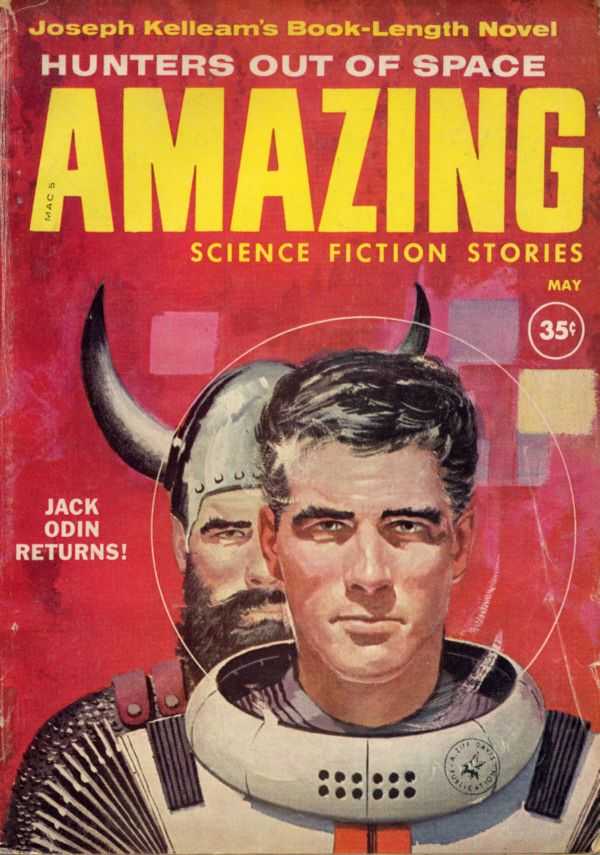
Ato stood tall and proud as he answered. His eyes were blazing now, as he saw through Grim Hagen’s plan. “So, you thought I would bargain away Wolden’s secret, did you? Well, your surmises were wrong. When last I saw him his work was not finished. I know so little about it that I could tell you nothing of any value. But if I did,” Ato’s voice was trembling in disgust. “If I did, Hagen, would I turn you and your hells’ spawn loose upon the stars to perplex them forever?”
Grim Hagen’s face was almost blue with rage. “You have said enough. And there are other ways to make you talk. Make these swine prisoners,” he screamed.
A dozen knives flashed. A dozen death-tubes were pointed toward Ato and his followers.
But one of Grim Hagen’s lieutenants, a Bron who was now silver-haired, intervened. “No, Grim Hagen. They are under truce. The week is not yet up. I will not see you go back on your own word—”
Grim Hagen flamed. “You will die on the hook for this—”
“Maybe so. One thing is certain: I will die. And I can face it. But you can’t, can you, Grim Hagen? You would prefer to be some sort of eternal devil, working its fury upon the stars. Now, where is the new thinking that you used to preach? That dream is as old as the incantations beside the cave-fires—”
“Arrest them all,” Grim Hagen screamed. “Arrest Rama too,” he added with rage.
But the knives and swords were back in their holsters. The guns were lowered. One by one his men filed out of the council room. Grim Hagen’s face was so dark that Odin feared a stroke. But with a curse at Ato and Odin, Hagen lifted his chin high and followed his men from the room. Only the one called Rama remained.
“I will do what I can, Ato,” he said quietly. “I was nearly fifty when we started this journey. And we lived hard and fast. I am old now. I married one of the slave-girls. We have children. Were it not for that, I would go with you. But I am tired. God, I’m tired—”
He saluted them as he went out the door.
They never saw Rama again.
CHAPTER 11
ALTHOUGH Gunnar had spent most of the past four days in grumbling and polishing his sword, there had been hours and hours when Odin had not seen him. The little man had a secret, but what it was he would not tell. “For,” he said to Odin, “then it would not be my secret. It would be mine and yours, and I would own but half of it. Does a man give half of his flocks away?”
Odin was a bit hurt over his friend’s behavior. He even wondered if Gunnar had taken a liking to one of the white-skinned slave-girls—for they were beautiful. Still, that did not seem like Gunnar. But you could never tell. After all, he found himself quoting, there’s no fool like an old fool.
Mixed up in this secret was a buckskin bag that Gunnar had brought with him from the ship. When Odin had inquired about it, Gunnar had replied: “Magic. A very old magic.”
That too was not like Gunnar. He relied upon his sword, since the Norse gods were usually busy with their own affairs. Those gods ate their rejuvenating apples every day and then went out like healthy boys to see what was happening; and though they meant well they usually were somewhere else when they were needed. Therefore, the use of magic bags and incantations was a lot of foolishness. But here was Gunnar fondling a tightly-drawn buckskin bag as though it held eternity’s secrets.
“You ought to get yourself a witch-doctor’s mask and a couple of hollowbones to whistle through,” Odin had told him scathingly.
“Never mind. Never mind. Old Gunnar will be there when they put out the fire and call the dogs. Now, you stay here in this room, Odin. And don’t go looking after any of these slave-girls. They are too pretty. And you are young. After all, there’s no fool like a young fool. So don’t go wandering off. Just stay here and polish your sword and wait until I return. I think my magic will do a great deal this afternoon.”
“Touché!” Jack Odin thought as Gunnar departed. “So he’s been worrying about me and the girls, has he?”
Odin polished his sword and looked at the paintings. But the entire palace seemed to be whispering. An air of tension hung over it. The halls were quiet, where servants usually were busily going back and forth.
Once he heard shouts and the sound of fighting far off. There was a loud shot and a scream of pain. After that, the unusual quiet returned.
This was the sixth afternoon that he had spent on this enslaved world. Odin did not enjoy it. He tried to make plans to rescue Maya, but he had gone over those same plans many times before. The Taj Mahal was well-guarded. There was an unshaded road that went from the city to it. Also, the road was usually crowded with pilgrims. He never knew whether they went out there in some strong belief that here was a goddess from outer space, or whether they were forced to go. After all, Grim Hagen was clever—
He took a bath and changed clothes. Then Jack Odin read one of those books that Grim Hagen had stolen. It was a first edition of the Rubaiyat, the one with the jeweled peacock cover, and it would have been worth a fortune back home. But here it was just another of Grim Hagen’s treasures—it was dusty and neglected, and Odin wondered if he were not the first to take a look at it since Hagen had brought it here.
The windows were dark when Gunnar returned. Jack Odin sat by a single tiny light, and greeted his old friend in a glum and sour fashion. But Gunnar was in a gay mood.
“Look, I told you that my magic would do great tricks. See, the bag is nearly empty.” He held the buckskin bag high and it was much thinner than before. “You waited, did you? Good, Nors-King. I had to make sure that no one came here while I was gone.”
“Just myself,” Odin replied. “Now what—”
“Oh, I told you I had great magic in that bag. You shall see.” Gunnar returned to the door, opened it, and led a tall white-skinned slave into the room. A man of about thirty dressed in white uniform with some sort of insignia upon his shoulders. Odin had never bothered to learn the different gradations in Grim Hagen’s slave-world.
“This man goes by the name of Piper,” Gunnar announced simply.
The man bowed and smiled nervously.
“And he is a Bro-Stoka among the slaves,” Gunnar continued.
Odin was about to reply that he didn’t give a damn if the man were a colonel or a two star general. But Gunnar hurried on to explain. “A Stoka is a captain of a hundred. But a Bro-Stoka is a captain over ten Stokas and all their men. Not often does one advance so at an early age—”
Gunnar seemed to be buttering up the man for some reason or other so Jack Odin decided to go along. “I have never seen a Bro-Stoka so young,” he admitted. This was true, Odin thought, since this was the first Bro-Stoka who had ever been identified to him. And he wondered if maybe Bro-Stoka were not a local term for “Ninety Day Wonder.” God knows he had seen too many of them.
Gunnar seated himself comfortably and swung the nearly empty bag to and fro. “Ah, I told you that I carried great magic in the bag. With Piper’s help, Maya will be ours before midnight.”
Odin’s lethargy was gone now. “Gunnar, old friend! What magic was in that bag of yours?”
“The oldest magic in the world. Pieces of gold, diamonds, and rubies. When we left the Nebula I said to myself that if Grim Hagen owned everything here, it was quite possible that many would be eating very little. Knowing Grim Hagen, I said to myself, there will be a mad scramble for money and position. It would be the only kind of a world that Grim Hagen could fashion.”
Odin slapped him on the back. “Gunnar, you are a genius, a sheer genius.”
“Not at all. When I was a young man I learned such strategy from studying the world above me.”
Odin winced.
Gunnar continued. “Well, it has turned out even as I figured. Only more so. When traveling in far countries you should try to learn how the people live, Odin. It is enlightening. I had an old uncle who always said that travel broadens one. It must have, for he weighed nearly two-hundred when he died.”
“Please, Gunnar. When will we see Maya—”
“So, I have been working ever since we arrived. A jewel here. A bit of gold there. It is amazing how a diamond can make a man see just what you tell him to see. Much better than ordinary glasses. Then I found Piper here. And Piper is ambitious. Do you know what it costs to become head-man and chief tax-gatherer of a town of five-thousand, Odin?”
“Gunnar, I know nothing of these matters. Tell me about Maya—”
“Well, Piper has been paid. The town will be his if our plan works out tonight. Otherwise, I will twist his neck.” And Gunnar paused to scowl at the young man in the white uniform until poor Piper began sweating.
“Many others have been paid. They are to stay away from their posts. They will see nothing and hear nothing at certain times tonight. Here, hand me your book.”
Odin obliged and Gunnar produced a ragged bit of pencil and started drawing a map upon the fly-leaf. “Here,” he said, “is the city. And here is the river. Now, if you remember, there is a deep bend in the river, and this tomb that Grim Hagen has built is within the bend of the river. There is a good road that goes from the city to the tomb, but it is guarded. The Nebula is on the other side of the bend. So the answer is quite simple. We go up the river. Piper has a boat waiting for us—”
“I have already paid many and have sworn them to silence,” Piper interrupted. “But it will be a dangerous business. I would not dare it at all except that it will be five years before I am eligible for tax-gatherer, and the waiting is killing me. A city of my own—”
Piper, Jack Odin gathered, was a very ambitious man.
The boat moved up-river in darkness. There were beacons upon the shore, turning this way and that, but they seemed to be trained a bit high this night.
Once a motor-boat passed them, going at a fast clip, and somebody called out that he saw a shadow over toward the far side of the river. And another voice answered. “You’re always seeing things. A log, maybe. Didn’t I tell you that I found some money in the street? And aren’t we going to have the best meal that money can buy? Do you want to stay here with an empty belly on this cold river all night? Our watch is nearly over. I’m tired. Let’s get along—”
Later, some one hailed them from the bank and threatened to shoot if they did not pull in. Then there was a loud scream that died in a weltering gurgle. They heard a splash as something hit the water—and then all was still. They waited. A peculiar little whistle sounded three notes from the darkness.
As though reassured, Piper took up his oars.
“That was the last guard,” Gunnar whispered. “It took a ruby the size of a sparrow’s egg to get him killed. Oh, well, blame Grim Hagen. He shouldn’t have gouged these people so hard—” And then, to Piper: “You’re bright enough, I guess, but you don’t know how to row a boat. Give me the oars.”
He took them and slid them into their hole-pins. “Now, give Gunnar room.” He bowed his broad head, leaning forward almost to his toes. Then he dug the oars into the water and straightened up and bent backward like a machine. Noiselessly the oars came up again. He bent forward and dipped them into the river again. And as he worked faster he began to count to himself in a panting whisper: “Huh—huh—huh—huf!”
The boat streaked across the river’s surface like a water-bug.
At last they slid into some thick cat-tails. Gunnar got a hand-hold and propelled them forward until the prow grounded in the shallows.
“This is as far as I can go,” Piper told them in a sweating voice. “Over there is the tomb.”
Odin and Gunnar scrambled ashore. Piper pushed the boat back into the river and was gone. Three thin sickles of moons were cleaving their way across the sky. A few unfamiliar stars were out. There was enough light now for them to see Maya’s tomb not far away. It seemed to be fashioned of moonbeams. It was such a perfect copy of the Taj Mahal that here both death and sleep were brothers—and a nirvana of peace hung over it in an aura of silver light.
“That Piper is a smart lad,” Gunnar whispered. “He knows what he wants. He’ll go far—maybe.”
They approached. Odin knew that four guards were stationed here at all times. They were all gone. The two went in, Gunnar turned on a little flash.
Had there been time, Odin might have grudgingly given Grim Hagen a few kind words for the work he had done and the tribute he had paid Maya. The best of a planet’s treasures and art had been brought here. But all he could see was Maya, lying upon a golden, diamond-set couch. A silk embroidered coverlet was drawn over her, and it too seemed to have been spun from moonbeams. She looked no older. Odin could see no sign of breath. But he touched her hand and it was warm. He knelt beside her.
“Here,” Gunnar handed him the light. “Hold this while I get busy. Here now, Nors-King. No blubbering.”
He opened his buckskin bag and took out the last of its treasures—a small hypodermic case. He filled the hypodermic from a little vial that glittered in the light of the lamp. “Turn the light upon her forearm, now,” he instructed.
Gunnar slowly counted to sixty after he had given her the shot. Maya’s breasts moved. She sighed and raised a hand to her dark curls. Then her eyes opened—in fear and wonder as a child opens its eyes in a strange place.
Then her vision cleared and she recognized them.
“Jack—Gunnar—” she gasped. Then she was in Odin’s arms. And Gunnar, the strong one, was standing over them—sniffling.
It was one of those moments that seem to last forever. And then it was over and she drew her hand through his light hair, “What happened? Where are we? I dreamed the strangest dreams.”
“Never mind,” Odin comforted. “We will explain later. Can you walk now?”
“Walk? Of course I can walk.” But when Maya tried to sit up, she moaned in pain. “My whole body is stiff and sore. Have I been sick?”
Odin helped her to her feet. As he did so, hundreds of precious stones that had been heaped upon the couch rolled unnoticed to the floor.
Maya winced as she stood up. Reaching down, she rubbed the calves of her legs and then stood straight with a little gasp of pain.
“Carry her, Nors-King,” Gunnar muttered. “The night grows old and we must make our way to the Nebula.”
Odin lifted her easily. She put her arms around his neck and clung to him. The perfume of her hair was as faint as the ghost of autumn flowers. Her breath was warm and caressing against his throat.
Then the mausoleum turned into a blinding glare of lights. Gunnar dropped the flash and his broadsword shrieked against the scabbard as he drew it. Odin set Maya’s feet upon the floor. Still holding her with one arm, he drew his sword and made ready to stand beside Gunnar.
A dozen cloaked figures came into the room. The first was Grim Hagen, smiling sardonically. The others were Brons. The last to enter was carrying poor Piper’s dripping head by a handful of hair.
“So.” Grim Hagen bowed. “The Princess awakens. And here is Prince Charming. And here is the last Neebling that I shall ever kill. I would like to kill you very slowly, but I am afraid I do not have time. Hell is bubbling over in that fair city of mine tonight. I thought I paid my captains well, but some of them wanted more. Or they wanted what I could not give them. It doesn’t matter. Let them fight it out. We have the Old Ship with the New Drive. Out there at the edge of space a desperate people are waiting for me. And now I have Maya. Gunnar, that was a mean trick. You used the science that your people stole from us to cheat me of my bride and my slave.”
Gunnar had heard enough. The huge sword flashed in a circle as he swung it above his head with both hands. A Bron stepped forward and Gunnar slashed him from shoulder to stomach-pit.
Odin thrust Maya to the couch as he came forward to help.
But Grim Hagen had merely stepped back. Now he was holding a deadly little tube in his hand. A cold light winked on and off. Odin felt his muscles harden as though a hundred charley-horses had struck him at once. He froze, and out of the corner of his eye he saw Gunnar standing like a statue, his sword still upraised, a look of agony upon his face.
“One more flash and you will be dead.” Grim Hagen mocked. “But before you plunge into the night, remember that I watched you so I could get Maya back. You were not clever at all, Gunnar. Ato can have these worlds if he wants them. I have the ship and Maya. And space is mine to ravage as I please.”
Then, at last, while Maya watched with fear-struck eyes, the tube flashed once more. Gunnar and Odin stood there for a second. They fell like unbalanced things of stone.
A Bron stepped forward and drew his sword. But Grim Hagen waved him aside as he bent over the two silent forms. “Put up your sword,” he said quietly. “They are dead.”
CHAPTER 12
HE HAD been drowned. He was floating in a sea of light, and now and then shining little fishes swam inquisitively up to him and stared. They would look at him with wide, cold eyes and then dart off into space, leaving a flashing wake behind them. They hurtled through the murky light like shooting stars. And once two of them dashed together and burst like a rocket. The sparks came falling down through a billion miles of space, and as they fell they built up planets and systems of their own. Until a dark coil that had the shape of a dragon slithered across the milky way and began to devour them one by one. The sparks disappeared into its dark maw. Then it turned about and came snuffling the air as it looked for him. It found him and buried its long fangs in the back of his skull.
Jack Odin groaned in pain and awoke. The pain hit him again and he thrust out with his arms. But strong hands were holding him down.
He became conscious of a buzzing, murmuring sound. It was neither sad nor glad. Something like the sound that the last bee of autumn makes as it hovers above the last ball of clover.
Something was falling across the back of his neck and spreading out across his shoulders. Like a woman’s hair, he thought. Perhaps it was a bit coarser. But not much. But then, just as the strange soothing feeling was putting him back to sleep, the hairs changed their soft caress and a dozen of them plunged into his spinal cord and upward into that small old-brain where all the bogies of the stone age still cowered.
Odin yelled in pain and fought. But the hands held him tight. In his ears he could hear someone else screaming and cursing—threatening all sorts of vengeance. The voice was Gunnar’s.
Three times more the soft mane of hair caressed him and three times more just as he was getting ready to go back to sleep the torture began. And all the while he was lying upon his belly, his face thrust into a pillow. He could see little as he writhed from one side to the other. The hands held him securely. And once when he almost struggled clear, a strong knee was thrust into his back and forced him down.
At intervals, he could hear Gunnar’s voice—and his own—crying, pleading, threatening.
Then at last it was over. The hands turned Odin upon his back and he lay there, gasping and hurting, like one who has just come up from deep water.
The lights were so bright that at first he could see nothing. Then his vision cleared and he knew where he was—in the surgery room of the Nebula.
Ato was standing nearby, trying to reassure him. Beside Odin on another bed was Gunnar, lying flat on his back and stripped to the waist. Gunnar was howling curses and kicking like a frog.
A doctor and a nurse were there. And completing the group was Nea holding a round object in each hand—round things with unkempt, trailing hair. He was not completely conscious—and for a second she looked like a high priestess of the Amazon, holding two mummified heads before her—
The pain left him. His mind cleared and he lay there gasping from the ordeal.
Ato and Nea smiled at them. So cheerfully that he almost expected them to write out a bill for surgical fees.
“God, that was a close one,” Ato said, and wiped his forehead. “Five hours of it. And it was touch and go all the time.”
“What happened?” Odin asked. He remembered something about a glittering tomb and Maya awakening from her long sleep and Grim Hagen. He even remembered the Bron carelessly swinging Piper’s head by the hair. But these were mere scenes that flashed before his mind. He could not fit them together, as yet.
“Tell him, Nea,” Ato said.
She smiled proudly. “It was my invention that saved you. You see, I have two of them now. I told you that they are as near as we can get to making living things. And I also told you that there is much more to them than you saw. They are destroyers and they are builders. We found you dead—or nearly so. Hagen had sent volt after volt through your bodies. You were electrocuted.”
“We hurried you back to the ship. And all this time, while Ato steered us back into space, the Kalis and I—for that is what I have decided to call them—have been working over you. You might say that we are master electronicians, rebuilding circuits, repairing transistors and condensers—”
“You were plenty rough,” Gunnar grumbled.
“We had to be. Do you remember a story about the bush-men dying from a curse? Here.” She held her two precious Kalis in one arm while she tapped the base of her skull. “In here is a bulb, the old brain, not even an idiot’s brain, that brought you up from the jungle. It is a simple, worrying brain. Easily frightened. Easily convinced. It was convinced that you were dead. We had to arouse it.”
Odin fancied that he could hear the two Kalis purring contentedly like cats. Well, they had done a good job. Let them purr. He would like to have thanked them, but how can you thank two bowling balls with scalps of cat’s whisker wire?
Gunnar sat up and began grumbling anew: “Well, thanks. Now, get me some clothes. Freida would not like it if I sat here half-undressed before a young lady. And tell me where we are?”
It was Ato’s turn to talk. “I threw The Nebula into the Fourth Drive some time ago. That may have helped to save your lives too. We should check on that, Nea.”
“Will you please tell me where we are?” Gunnar demanded.
“Give me time, little man,” Ato retorted. “We are back in Trans-Einsteinian space, and Aldebaran and its worlds are far behind us. Ahead of us is Grim Hagen and the Old Ship. Maya is with him. So are at least a hundred of the white-skinned captains from the planet we just left. Also, a dozen Brons. Maybe more, but not many. What we saw at the council that day when Rama defied Grim Hagen was just a sample of what was to follow. The people were bled white. Graft, corruption, and patronage had taken its toll. Some of the Brons were older and wanted to rest. But injustice couldn’t stop until the last tear had washed away the last drop of blood. A few of the Brons and most of the slaves revolted. They won, of course. Grim Hagen should have known the result. He and his men were in flight when they found you and took Maya. They gathered at the Old Ship and took off. Meanwhile, we fought our way out of the city. We decided to have one last try for Maya. But we found you two and a dead Bron and the head of a native. We brought you here and took off. All this time I have had a fix on Hagen.”
“Can’t we overtake him?” Odin asked.
“We are trying to. He seems to be heading for a huge dust-cloud. He also sent us a message. Some nonsense about having contacted some race at the edge of creation who would go with him to plunder the stars. He demanded the secret of Wolden’s invention again. I think his mind is going fast.”
“Not as fast as he will go if I ever get my hands on him,” Gunnar promised.
“But Maya is awake now,” Ato explained. “We had time on our side before. Now, if he gets away from us he can live out his days on some obscure planet. The years will pass like a whirlwind—while we go dashing this way and that, and in a surprisingly short time our willing and unwilling fugitives will have lived out their lives. They have the vagaries of time, space, and speed upon their side.”
Nea laughed. “Even as I said before.” She gave Jack Odin a searching look, but Odin avoided her gaze—
“Then, what have you done?” Odin asked.
“All that I could do under the circumstances. I have a fix upon him. We sapped all the energy from Aldebaran that we could. We have power enough, but there are no stars nearby. As I said before, he is heading for a dust-cloud. There, both ships can replenish their energy. After that we will have to stick close by him and see what happens. After all, we are behind him. By the old Airmen’s rule of thumb, a ship with another upon its tail is a hundred percent loss.”
“Only at that moment,” Odin corrected. “If not destroyed, it has a chance to improve its percentage when the pursuer has made its pass.”
“True enough,” Ato admitted. “That is why I propose to stay close behind it. I can’t seem to find that dust cloud on any map. It must be far, far away.”
Nea laughed again. “What is far? What is near? You do not even have catch-words for Trans-Space. You are looking into the books of the advanced classes, and you have not yet opened the primers of space.”
Ato flushed in anger. “Nea, I was my father’s helper for years and years. I know as much about space as any man.”
She shrugged. “Oh, you can cover blackboards with formulas, and I don’t doubt that they will be right. But living things and living emotions demand something to cling to. A measuring stick. Grim Hagen tried to give them something substantial back there: A system of brutality and graft that worked for the last-minute Caesars. He even threw in a goddess. Did he succeed?”
She paused to caress the two things she held in her arms. “My pets know more about time and space and energy than all of you, don’t you, dears?” She kissed one of them and gave Odin a mysterious smile.
The Kalis began purring contentedly, as though space were no more than a huge living room, and they were beside a comfortable fireplace, looking up at their all-powerful mistress.
CHAPTER 13
THE dust-cloud was farther away than Ato had guessed. Long before they reached it, his instruments began to waver.
He looked at a star-map. Meanwhile, Nea fed rows of figures into a humming calculator.
“We’ll never make it this way,” Ato said. “Not even the emergency storage would help us. Here,” he pointed to a pinpoint of light upon the map. “A white star. We can reach it, I think.”
Nea sighed. “That dust-cloud is beyond our calculations. We should be nearly there, but it’s still far-off. I think it is shrinking and expanding. At the same time it’s dashing off into space at a terrific rate of speed. You’ll have to swing toward that star, Ato. I’ll try to probe the cloud some more. My father would have liked this problem—”
“I don’t like the problem at all—” Gunnar complained. “Just where is Grim Hagen?”
“He must be having as much trouble beating his way to that dust-cloud as we are,” Ato assured him. And then, doubtfully, he added. “But he has more energy. The Old Space Ship was sitting there below Aldebaran for years and years. He surely took advantage of the time to replenish his fuel. All the while, we were using ours up in an effort to find him.”
Jack Odin’s science did not go far enough to pursue the conversation. He knew that their power was something like a solar battery. When in gear, the current that went through the “frame” of the hour-glass-shaped craft turned it into a huge blob of plasma, a miniature nebula, and hurled it into space. As for the Fourth Drive, he hadn’t the slightest idea how it worked. Ato had said that the scientists who developed it were not sure—just as men had developed generators long before they knew the laws that governed them. Ato had a theory that the Fourth Gear slid the ship from plane to plane. If a bug were crawling along a million mile spiral of wire, he might go on until he died before getting anywhere—but if he simply lumbered across the intervening space to the next coil, would he have traveled a short distance, or a million miles? Ato had also told Odin that the ship took energy from the gravitational field that it created when traveling at tremendous speeds, so that the motors were 99% efficient.
Ato set a course for the distant star, and in a short while it was looming upon the screen with sheets of atomic flame leaping out like the teeth of a circular saw. One huge explosion flicked a long tongue of heat at them. The corona of the sun gleamed and writhed like a thin band of quicksilver.
“We’re going in there,” Ato decided. “It’s the quickest way.”
Warnings were sounded all through the ship. The screens were turned off now, as no eye could have survived the sight of that flaming ball which was rushing toward them at such extraordinary speed.
The ship groaned as it hit the corona. Vast whirlwinds of flame shook it. The motors coughed and spat. Then the gyroscopes took over. It steadied itself and went through. Like a moth fluttering through a candle-flame, The Nebula drew away from the star. But this moth was unharmed—and a million cells had drunk so much energy that the ship reeled with its power.
On and on. In zig-zag pursuit of Grim Hagen, they crashed through Trans-Space. The dust-cloud loomed larger now upon their screens. It was still no larger than a baseball, though it must have been millions of miles across.
Three times they had to sweep from their course to renew their energy from straggling suns that seemed to be farther and farther apart. The first was a tiny blue sun that burned its way through the emptiness. The second was a huge nebula that pulsed and spouted flame and protean worlds into space—enveloped them again as it breathed, scared them, and cast them out once more. And Odin wondered if in such a furnace and such torment his own world had been born. He had now seen as much of space as any man, with the exception of Grim Hagen, and so far it had been a tumultuous creation that he had watched. Nothing was still. The forges of space were white-hot. As they sped toward this sun, they passed two planets, perilously close together, pelting each other with splashing gobs and spears of flame and slag. The third was a red sun with lonely burned-out planets circling wearily about it. As they skimmed above its surface Odin slid a dark plate over the screen and watched. Here were molten lakes of metal rimmed by red flames that looked like writhing trees. The surface was splitting and bubbling. A mountain of molten ooze swiftly grew to a height of thirty miles. Then it burst into red flame from its own weight and came toppling down.
As they hurled away from the red star, Ato turned to Odin and Gunnar and said: “I’m afraid that will be the last. Even the stars are behind us—”
The screens now showed nothing but the dust-cloud, with specks of light and coils of darkness threaded through it. It loomed larger and larger until it filled the screen.
“Ragnarok,” Gunnar growled in his throat. He adjusted the shoulder strap that harnessed his broadsword to his back and looked at Odin curiously.
“You should have rest, Nors-King. You look gaunt and tired—but stronger too. I wonder if I have changed as much as you since we started this trip. Eh, Nors-King,” he chuckled, “if you had but one eye, I would swear that you were old Odin himself, rushing out to the edge of space to start that last bonfire of suns.”
“Quiet,” Nea pleaded as she worked with the calculator. “So far this has defied computation. It’s unstable, Ato. Before I can identify it, a factor is added or taken away.”
“Grim Hagen went in there,” Ato replied as he studied his instruments. “If he can, we can.”
“Perhaps,” she answered. “But space out there is curdling in his wake.” She shivered. Nea’s shoulders were beautifully shaped, and Odin found himself thinking that they were made for a man’s arms instead of bending over calculators and machines.
“Oh, well!” he thought. “They are not for my arms, but why doesn’t Ato wake up and claim her? Then there wouldn’t be distractions like this—”
With one warning blare, The Nebula plunged into the fringe of the dust-cloud.
The boat rocked. A spattering sound like the falling of heavy sleet filled the control room. Needles jumped and wheeled. Dials turned madly, spun back and forth, and jammed.
The lights flickered on and off. For a time they were in darkness. Then the lights came back, but continued their flickering. The screens were dark.
Nea worked with the instruments. When power enough was available she began probing the dust-cloud as though nothing had happened. Then she fed more figures into the calculator and handed the result to Ato.
“Try this,” she said in a tremulous voice. “It may work.”
Ato took the tape from her hands and set the controls accordingly.
The lights dimmed again—came on—and remained steady. The expanses of dim yellow light through which coils and ellipses of darkness crawled like black worms.
Odin knew that such a feeling was impossible out here, but it seemed to him that The Nebula leaped forward.
Ato cried out in triumph. “I’ve got another fix on Grim Hagen. He’s much nearer now.”
“Hurry, Ato. Hurry,” Nea was pleading.
They drove on and on. The screens remained as before. Yellow light and crawling shadows. Then, suddenly, the screens were filled with dancing circles of flame. They blazed brightly, and thrust out little fiery arms and took their neighbors’ hands. They danced. They gleamed and glistened. They became circles of flame. They grew toward each other and ran together into little puddles of light.
“Ato. Hurry,” Nea screamed. One of her instruments melted as she stared into it and she jumped back, her hands to her eyes—
Then they were out of the cloud, and space lay empty and free before them, with only one tiny sun in view.
Jack Odin twisted the controls to take a look at what was happening back there in the cloud.
Just as he got it in view, the moiling space out there coalesced into one smoldering ember. Crushed by the awful weight, that single giant of flame suddenly burst into a thousand pieces. Comets streaked away. Dripping suns streamed across the mad sky. Worlds spewed out—and moons dripped tears of light as they followed after their mothers. They crashed and wheeled. They merged in gigantic splashes of fire. Pinwheels rushed across the screen. Rockets flashed. And fountains of flame spilled sun after sun into the sparkling void. Odin stood transfixed by the sight.
Then, momentarily, the holocaust of flame was over. New suns and new worlds drifted calmly, with only a few erratic meteors and some settling dust-clouds left to tell of the explosion that had shaped them.
All was as bright and calm out there as the day after creation. But only for a while. For a very short time the new suns sparkled clean and fresh. Then one by one they guttered and winked out. They drew closer together as though afraid of the dark. Then smoldered and flickered. Then they were gone. And all that was left was one dark cloud that slowly drifted away.
“It was an artificial explosion,” Nea murmured in a puzzled voice. “Grim Hagen’s ship and ours destroyed the balance and caused a premature burst. There must be some law—some time and weight factor that governs these things. I would judge that the explosion was not violent enough.”
“Not violent enough,” Odin exclaimed. “How violent can an explosion be?”
Her eyes were still wide and creamy with wonder when she replied. “I don’t know. Something went wrong. Relatively speaking, it may have been a mild explosion. At any rate, that new galaxy was unstable. I wish we had time to go back and make some tests—”
Gunnar shivered. “Not back there. I have seen enough. Now, Ato, what lies ahead?”
Ato shrugged his lean shoulders. “I still have a fix on Grim Hagen. And there seems to be but one place for him to go.”
He turned a dial and the screens picked up one lone red sun far away. One tiny black dot slowly circled it.
That was all. Space itself was wrapped in primeval darkness. And the sable wings of nothingness spanned the void. Odin’s eyes ached at sight of the awful emptiness. His heart felt heavy as the weight of dread distances pressed upon him. Could space itself reach some limit and curve wearily back upon itself? Like folds of black silk, the emptiness out there shimmered and flowed away—
One other speck now appeared upon the screen. A pinpoint of light that crawled toward the lone sun and its single huge planet.
Grim Hagen and the Old Ship!
Time, if time existed at all, went slowly by. They ate and slept. Nea and her workers were busy with the Kalis, as she called them. Four were now finished. A fifth had been fashioned, but Nea had sent it through the locks into space and it had been lost. It had simply sailed out there and disappeared.
“Sunk from sight,” were Gunnar’s words, and this explained the disappearance as well as anything. It was as though they had been on a boat and the thing had dived overboard.
Nea, who had been trained to scientific thinking since she was knee-high, had to think up an answer. Her explanation was that it had slid down a plane into three-dimensional space. Even now, it might be on some planet, puzzling and worrying the natives. For the Kalis were almost like living things—and almost like gods.
That was like Nea, Odin thought. A scientist, always. Anything unexplainable must be immediately attached to a theory—whether the theory were right or wrong. Just as long as there was an explanation to hang upon a phenomenon she was happy enough. She might blithely think up a new theory tomorrow and throw the old one away, but that was of no consequence. Odin had grown skeptical of such thinking when he was a medical student. Each doctor had his own pet diagnosis—and too many tried to fit the patient to the cure instead of working out a cure for the patient. Oh, well, that was far away and long ago.
How far away and how long ago!
Meanwhile, the red sun and its planet were looming large upon the screen. The shining light that was the Old Ship was crawling nearer to them. Twice Grim Hagen had hurled sheets of flame at them. And once he contacted The Nebula on the speaker—and cursed everyone fluently in three languages. He assured them that he now had a fighting crew and would soon join up with others. He had a dozen new weapons. So why didn’t they simply get lost?
Sleep after sleep went by and still the two ships crawled toward that last port on the edge of space.
Until, finally, they saw the Old Ship leave Trans-Space and glide down to the huge planet. And with a last burst of speed, Ato came in behind it.
CHAPTER 14
THE two ships landed a few miles apart at almost the same time.
They settled to the plane’s surface like whirling hour-glasses. Fire spouted from them in all directions. Then their movement stopped. Smoke shrouded them and slowly drifted away.
They were upon a reddish plain. Above them, the red sun filled a twelfth of the sky. That sky was one vast swirl of crimson. Even the few clouds seemed to be on fire. And yet their instruments showed that the temperature of the thin air outside was in the sixties.
There were no mountains or valleys. The giant planet had weathered down to one great curving plain. It was mostly red sandstone, but here and there were reddish carpets of moss and grass. In the distance were a few gaunt trees. They had seen no rivers or seas before they landed. Odin learned later that there were many muddy ponds left upon the surface from the remains of stagnant seas. He also learned later that huge reservoirs were underground.
With the exception of the trees, the only thing that broke the monotonous line of the horizon was one great dome of violet stone or metal. It flashed like an amethyst in the red glare of the sun—and it was certainly man-made.
But on that occasion Jack Odin had little time to look at the scenery. They had hardly settled to the planet’s surface before Grim Hagen trained his guns upon them and began to fire. Flame enveloped them. Bombs of acid and steel shook The Nebula. The battle-stations were already manned, and Ato gave orders to return fire. For nearly an hour, the holocaust continued. Both ships rocked upon their steady foundations. They were bathed in flame, acid streamed down their sides, and rockets tore at them. Shells burst upon them. And then it was over.
The two ships, scarred and blackened; glared at each other across a three-mile expanse that had now turned to cinders. And that was all. Practically indestructible, and evenly matched, they had fought to a standstill. Neither ship had lost a man.
“See how it is, Nors-King?” Gunnar said as he drew his fingers across the shaft of his sword. “It is as I told you before. We have the same weapons. The same defenses. I will use the Blood-Drinkers yet, before this is over.”
There was a demanding buzz from the loudspeaker.
Ato turned the dial. A strange, harsh voice was calling. “You there, on the Second ship. You on the second ship. Answer.”
“Yes!” Ato replied gruffly. “Who are you?”
“I am the head man of the city—the city within the dome.”
“How did you know our language?”
“We have known it for thirty years. For that long have we been in contact with Grim Hagen.”
Jack Odin was never quite able to cope with the passing of time on these planets, while the ships scurried through Trans-Space in what appeared to be a matter of a few days.
The voice continued. “We invited Grim Hagen to our world. We did not invite you. Go away.”
“I don’t think I like his tone,” Gunnar interrupted. “Some day I will catch the owner of that voice and make him eat his ears.”
“We are not going away,” Ato told the voice stubbornly.
“Then you can stay where you are. We have just witnessed the battle. We do not have weapons such as yours. But we do have a defense. An electric screen nearly half a mile across has been placed about you. Watch.”
They looked at the screen, and a tiny drone-torpedo came winging its way from the violet dome. It came to within a thousand yards of them and suddenly crashed into an unseen barrier. Broken and blazing, it came falling down like a crippled bird.
“There,” the voice said triumphantly. “That is what will happen to you. Why don’t you leave us? You are not wanted. Leave us.”
“Faith, he’s a hospitable soul,” Odin murmured.
Ato’s voice was shaking in wrath when he answered. “We can find a way to smash that curtain. We want Grim Hagen and his prisoners. When we have them we will depart.”
“Grim Hagen is our ally. We have already sworn our allegiance. I have no more words for you.”
There was a clicking sound and the loudspeaker died with a sputter of static.
It sputtered again, and this time Grim Hagen’s voice mocked them. “There, Ato. You have your answer. You are wasting your time. But I am a reasonable man. You can have Maya. You can have the ship. You can have the prisoners—the few that are left. I will trade all these for Wolden’s secret.”
“Greed has you in its hand, Grim Hagen. I know nothing of my father’s secret. I do not even know if he succeeded—”
“Then summon him and let him decide for himself. You are young, but two-thirds of my life is gone now—”
“Your calculation is wrong,” Gunnar shouted. “You life is nearly all gone, Grim Hagen.”
“The dwarf still lives,” Grim Hagen answered with a curse. “But so does Maya, my slave. I had to beat her the other day. My boots were not polished very well—”
“Talk on, Grim Hagen,” Odin growled. “I am here. And I intend to kill you—Just as I promised.”
“Like most of your race, you talk too loud, Odin. Well, Ato, Gunnar, and Odin, I am going now. Please don’t get in my way or I will hatchet the flesh from your bones.”
Another click and the loudspeaker was silent.
They had landed on the giant, worn planet very early in the day. Now, as time went on, they watched Grim Hagen’s ship and tried to make plans.
Gunnar was in favor of hazarding an attack on the barrier and then going on to the city.
Ato and Odin voted in favor of waiting, although they admitted that they could think of no better plan. Ato was sure that The Nebula could plunge through any curtain, but he wanted to try that as a last resort.
Meanwhile, a steady stream of tractors and men was going back and forth from the Old Ship to the city. Odin watched them on the screen. They were mostly the white-skinned people of Aldebaran. The Brons who had gone out into space with Grim Hagen had dwindled away. Odin saw a few white-headed ones. And once he saw a captain stop to lash a worn, gray-haired Bron who must have been one of the original prisoners. The poor fellow looked so old and frazzled that Odin could not recognize him. His heart grew heavy as he thought of those prisoners. They had done no harm. Their lives had been wasted away because of their loyalty to Maya. And the words of an old poet came to his mind: “Think of man’s inhumanity to man and write your poem if you can.”
The day passed wearily by.
Odin felt that it was one of the worst days of his life. They had spanned thousands of light-years and time had slid by like a stream of quicksilver while they hunted through space. And now, at the last, they were pinned down on a gaunt planet while a triumphant Grim Hagen went back and forth from the Old Ship to the violet dome. Welcomed like a conqueror, and holding every card, Grim Hagen was the man of the hour.
Yes, it was certainly Grim Hagen’s day.
Night fell quite suddenly. But the sky above them turned to the faintest mauve, and there was still a pale ghost of a light hovering over the plain. There were no stars. No moon. Jack Odin learned later that the people of this planet had fed their moon to the dying sun long before.
They ate supper—as Gunnar called it—and then Ato and Odin studied some photo-maps which they had taken just before they landed. Meanwhile, Gunnar busied himself with the sword. And Nea, who stayed in her lab most of the day, brought in a few calculations on the barrier that prisoned them.
“It’s an old idea,” she told them quietly. “It can be broken by a steadily increasing force. Twenty days, perhaps, after I rig up the machine—”
Odin groaned. “In twenty days Grim Hagen will be back among the stars—”
She smiled quietly. And now he saw how tired her face and eyes were. Like the face of a child that has worked too hard. “I think not,” she answered him simply. “Gunnar is always talking about fate. I do not believe in such. But all day I have felt that the end is drawing near. Remember, I still have my Kalis. With them I could have been a huntress on some greener planet—another Diana, perhaps. Oh!” She stamped her foot in worriment. “We held creation in our grasp out here. We could have forced the last secrets from her. Yes, I will say it! We could have been as gods. And where is it ending? A mad chase after a madman. And for all the years and all the lives that have been spent on these two ships, time and space are the only winners.”
Nea went back to the lab. Odin and Ato continued their study of the maps. Gunnar was putting a fine edge to his broadsword.
Then the warning buzzer sounded its alarm. Odin dived for the screen and turned on the controls.
A long procession of mauve shadows was approaching. Already inside the barrier, they came single-file and slowly circled The Nebula.
Even in the pale weird light, they certainly seemed to be men.
Ato ordered “Battle-Stations” and sirens sounded all over the ship.
But the circling host made no offer to attack. Odin turned the receiver up to its highest point, and speaking brokenly in the language of the Brons a voice came through.
“Men of the strange ship. Men of the strange ship—”
“Yes,” Odin answered.
“Good. You hear me. We are those who have been driven out of the city. We would visit you in peace. We are called Lorens.”
Within a few minutes, a dozen of the strangers had been brought aboard The Nebula. Ato summoned Nea and the rest of the captains.
The leader of the visitors was a man by the name of Val. He was a tall, lean man with a Norman nose and his dark skin was drawn so tightly about his face that he looked a bit like a mummy. Val was over sixty, Odin judged, and though his wrists were skinny the tendons and muscles on his arms stood out like taut lengths of cable. He and his men were dressed alike—a sleeveless shirt of walnut-brown plastic, dark peg-bottomed trousers of corduroy, and footgear that looked like engineer’s boots with rippled soles. The tops of the boots were tight-fitting and the peg-bottomed trousers were drawn snugly over them. Odin learned later that what had appeared to be green moss out there on the weathered plain was a kind of thistle with cat-claw thorns.
Each man wore a heavy black belt about his waist. Attached to the belt were at least a dozen weapons: several grenades, a pistol, another pistol with a flaring muzzle, a long knife, a glassy looking tube fitted to a pistol-butt, and a blue-black ugly thing which was shaped like an over-sized toadstool.
In addition to this odd assortment of gear, each man carried something in his hand which greatly resembled the frame of an old-fashioned umbrella—except that half a dozen vari-colored buttons were set into the handles.
“It was nearly thirty years ago,” Val was explaining, “that the voice of Grim Hagen began to interfere with our broadcasting system. Some said it was a god. Some said it was a devil. It came from space. It came from almost anywhere. We have been an intelligent race, but we were sore beset. Our sun was dying. All that we had was our sun and a huge dust-cloud in the distance. In times past, our astronomers had seen the glow of millions of suns, millions upon millions of miles away. But we were never able to perfect a telescope that could bring a single sun into view.
“Nor did we ever have a chance to do this. The dust-cloud surged out toward us every twenty years, and our scientists were able to use a gravitational beam to deflect a part of it toward our sun. In this way we kept it alive and might have been able to do so for ages. But now the dust-cloud is gone.”
Val paused to sigh, and then resumed his story. “The voice—I mean the voice of Grim Hagen—promised my people that if they would accept him he would take them forth into the stars. They would plunder thousands of worlds and they would live for centuries while generations died. Also, he said, he was on the brink of discovering eternal life—”
“He was playing at being the eternal Loki—the old mischief-maker—” Gunnar interrupted and went on edging his sword.
“Well,” Val continued, “I cannot blame my people too much for believing this story. Our plight was desperate. But there were those of us who did not believe him. He seemed to know too much, when according to our philosophy the only wise man is the one who admits that he knows nothing—”
“I am not a philosopher,” Gunnar interrupted again. “I only know that once you have thrust a foot of steel into a man he does not bother you again.”
“Please, Gunnar,” Ato begged. “Let Val go on with his story.”
“The rest of the story I do not understand at all,” Val said with a shake of his grizzled head. “This Grim Hagen said that he did not age until he stopped to conquer a planet and replenish his ship’s energy. It was thirty years ago when he first spoke to us. He looks like a man of forty-five now. Could he have been an upstart of fifteen when he first spoke into our receivers?”
“I will try to explain that later,” Ato answered.
“Well, there were those of us who could not agree with the general idea. There are even some of the Lorens in the Violet Dome who think he is a god. We think he is an evil man. We have no desire to plunder the stars. If he is so great, why doesn’t he give new life to our feeble sun? That is what we really need. Meanwhile, the people of the Dome are building five new ships, as Grim Hagen directed. They have been working upon them for years—”
“Good God,” Jack Odin was thinking, “what a hideous propaganda machine these ships are? To condition and instruct a whole generation while you flash through space in the twinkling of an eye!”
“And that is all,” Val finished with a shrug of his lean shoulders. “Those of us who had never agreed with the idea were thrown out of the city as soon as Grim Hagen arrived. We have come to join forces with you.”
“How did you get through the barrier?” Nea asked.
Val lifted the umbrella-frame. “We have had the barrier for years. There are strange beasts out there on the plain. This instrument allows us to go through the barrier when we please.”
“Then we can go to the city?” Gunnar exclaimed with a joyful war-whoop. “To kill, and kill, and kill—”
“You are right,” Ato admitted. “Delay will only increase Grim Hagen’s advantage. To the city—as fast as we can—”
CHAPTER 15
VAL and his men had brought along enough of the umbrella-shaped defenses to get them through the barrier.
They held a short council of war. It was agreed that every able-bodied man would go into the city. Nea and a few of the older men were detailed to stay by The Nebula and take care of the women and children.
Nea had screamed and protested against that. She had only agreed to stay upon one condition: That she be left one of the umbrella-skeletons.
The nights, Odin learned, were about sixteen hours long on this dying planet. It was toward midnight when they started out from the ship toward the violet dome. The strange half-light still hovered over the ground. In the sky, splinters of mauve tore at curtains of purplish flame. Something like northern lights, they glinted and gleamed, wrestled and writhed. There was no peace up there in that abandoned sky. But there was enough of that unearthly light glimmering below for him to watch his footsteps.
They had brought every kind of weapon that they could lug with them. Atomic machine-guns. Needle-nosed things that spat blobs of flame. Anti-gravitational bombs. Bombs that swirled slowly toward the enemy and cut him down with scythe-blades.
Gunnar had laughed at that. “Hang on to your sword and knife, Nors-King. We will need them yet.”
With the umbrella frames held over them, as though protecting them from a flood, they went through the barrier. Beyond it, thousands of men rose up from the scarred plain to join them. Val had a much larger following than Odin had ever guessed. These men were swathed in long coats and capes. Similar items of apparel were hastily furnished the crew of The Nebula—for when they were through the barrier the temperature dropped to about thirty. Once they passed through a thin swirl of snow.
Then something screamed at them out there in the night and came at them like a juggernaut. It must have stood nearly fifty feet high, and came rushing at them on a score of legs, with dozens of eyes flashing green as it hurtled forward.
The men of Loren were not greatly worried. They began to fire at it with the pistol-shaped weapons. There was only a popping noise, but Odin could hear the bullets smashing into the onrushing thing. Others used the tulip-flared guns, which made no noise at all, but bolts of lightning sank into the sides of the behemoth.
After it was dead its furious drive sent it nearly a score of yards forward. It slid into a clump of twisted trees and tore them to splinters before it stopped quivering. Finally the way was clear.
They waited there for a time to see if they had attracted any attention from the city of the violet dome. Nothing happened, so they advanced again. At least five thousand men now made up this little army. Val guessed that there were a hundred thousand fighters left in the city, not counting the experienced ruffians that Grim Hagen had brought with him.
They had advanced not over half a mile before the pale glow of the night turned to utter darkness. Something that looked like a vast sea-nettle was slowly sinking down toward them from the sky. Its tentacles glowed faintly as it fell—and it must have been a hundred yards across at the top. Once more bullets, lightning bolts and sheets of flame were hurled at the descending thing. It fell apart and came writhing down. Men rushed to get away from the reach of those flailing arms. They laid low and watched while the thing died.
“Listen,” Gunnar warned.
From far away came the sound of shots and an eerie whine that seemed faintly familiar. The shots died down. The whine continued, louder and louder, almost to the top peak of sound, as though a tiger was growling to itself as it feasted.
Then all was still.
“It was from the Old Ship,” Gunnar said. “I wonder—”
But there was no time left to wonder. As the thing died, the phosphor glow faded from its lashing tentacles. Finally it was still. They picked themselves up and went on toward the dome.
The dome was propped upon miles of forty-foot columns, all carved and decorated like those from the Hall of Kings. Below the dome, the same barrier came pouring down like an unseen waterfall. Again they used their protective umbrella-frames. Then, sweating and cursing and grunting, they hauled their weapons of war into the city.
Val the Loren had explained that the city was not a city as Ato and Odin understood the words. Being domed, there was no use for rooms of any kind. The temperature stayed constant. There were wide streets, paved with blocks of pink and black marble. These streets were flanked by sidewalks and walls. At intervals of a hundred feet the huge columns were placed. They were minutely decorated and carved. These supported a silver and clear-plastic framework that held up the violet dome. Looking upward, Odin had the impression that he was standing beneath a vast spider-web.
There were many hedges, all neatly trimmed. Some resembled privet, but most of them were like pomegranate with larger reddish blossoms that seemed to drip blood.
Here and there were railings with steps going down. Like subway entrances, Odin thought, except they were more elaborately carved. These steps went down to tier after tier of labyrinths. It was a skyscraper-city turned upside down, Odin gathered from Val’s explanations. The first level below the city was made up of factories and machine shops. The next was where plants, flowers, and trees were forced, producing the city’s food. Below that, for nearly a thousand feet, were the living quarters of the people.
The ground-level of the city was in reality a beautiful park. During the day, Val explained, it was busy with street-vendors, open-air schools, theaters, and thousands who came up from underground to drink the air and the sun.
Now, it was nearly empty. The columns were evenly spaced and at a spot exactly between each two columns was a great cresset of stone. At the top of each cresset were flickering flames that burned without leaving any smoke. “Like stone tulips with petals of flame,” Gunnar said as he looked at them. They stood nearly twelve feet high. Their pedestals were broad; their stems were nearly a foot thick, nearly a yard across. Their flames were violet, tipped with blue. They made a beautiful sight, but it did not matter. For within less than an hour this lovely park with its carved columns and tulip-shaped cressets of fire was turned into a shambles.
They had not gone a quarter of a mile before a guard hailed them. A score of guns popped like opened bottles and the guard died before the echo of his voice was gone. But his cry was taken up by others. And now Odin saw that up there in the spider-web framework that held the dome were hundreds of little cubicles—all manned.
Shafts of flame darted through the dim-lit area. Bullets whizzed. Ato’s needle-nosed machines began to whine and the metal in the guards’ cubicles grew red-hot and melted. Charred bodies came tumbling down. Men came pouring out of the subway entrances. There was a crashing and grinding as hidden elevators brought weapons of death to the surface. The fires in the cressets danced higher. They fought now in mid-day light.
There was a blast nearby that nearly burst Odin’s eardrums. A crash of flame that half-blinded him. A gun-crew screamed and died as one of the needle-nosed machines melted into puddles of steel. One by one these guns exploded, taking their crews with them. But even as they died, they littered the streets with the bodies of those who were pouring up from the depths of the city. Even as one melted, its needle-nose swung upward and its beam cut through girders as though they were soft cheese. There was an awful grating sound as the heavy dome sagged a few inches. Splinters of glass and plastic rained down upon invader and defender alike.
Guns burst in men’s hands—or turned to soft wax. The machine guns grew red-hot and melted. Ato sent his swirling bombs toward the enemy. The scythe-blades dripped as they cut swaths through massed rows of human flesh. But from far down the street a swarm of red sparks came rushing at the bombs like hornets. They swirled about them, humming angrily. And then the bombs and the hornet-sparks were gone.
Odin learned that the toadstool-shaped weapon which Val’s men carried was a defense against the lancing beams from the glassy tubes. So one by one the weapons of offense and the weapons of defense fell apart. Sirens were screaming within the city. Hordes were still arriving from the depths below.
Ato had set up a huge, slowly-whirling globe that was studded with spines. As it turned upon its axis, it emitted a strange pulsing light. As the defenders came rushing up the stairways to the upper world, the guns at their belts exploded in furious heat. They died by the hundreds at those entrances. They filled the stairways and the halls below. Screams from seared throats drowned out the noise of battle. The stench of burned flesh and blood was now so heavy that it was hard to breathe. Another wild shell crashed into the spider-web framework of the dome. It sagged again with a shriek and a groan of protest. And once more a rain of glass showered down upon them.
The defenders cleared the choked stairways and came on—dying at the entrances and falling back and blocking the stairs again.