
[51] All quotes in this section unless otherwise credited are from E. Blaine Cliver who visited the site with the author on November 11, 1969, and taped his comments. Mr. Cliver is with the firm of Geoffrey W. Fairfax, AIA, Honolulu, Hawaii, where he is working as restoration architect for Iolani Palace. Calder Loth, architectural historian with the Virginia Historic Landmarks Commission visited the site with the author on May 12, 1969. Their comments were of immeasurable value in the investigation.
[52] All measurements are approximate, and are only used to suggest scale and distance.
[53] In this area examples include Arlington House, 1802-17; Tudor Place, about 1815; and Oatlands, Loudoun County, 1800-27.
[54] Similar moldings may be found at Sully, 1794, Fairfax County, and at Monticello, about 1770-1808.
[55] This was a relatively common cornice line in the Washington area. It appears on, among others, Earps Ordinary in Fairfax, last half of the eighteenth century; Millers House, Colvin Run, about 1825; servants wing of Decatur House, 1818, Washington.
[56] This design is used, among other places, in the outbuildings at Bremo, about 1820, Fluvanna County, and the jail, about 1848, Palmyra. In the immediate area the use is known to the author only in the barn at the Oxon Hill Childrens Museum, Prince Georges County, Maryland, early nineteenth century.
[57] The icehouse at Belle Grove, Middletown, late eighteenth century, is the former type, while Woodlawn, Fairfax County, 1805, is believed to have been the latter type.
Figure 24. Architect George Hadfield's exhibit at the Royal Academy, 1780-82. |
Figure 25. Hadfield's design, bed chamber story plan. Courtesy, Avery Library, Columbia University |
CHAPTER IV
THE ARCHITECT OF HUNTLEY
The construction of Huntley was probably not supervised by an architect. There are too many imperfections for that. At the same time, it is too architectonic to have either evolved or been put together from style manuals. It is likely instead that the building derived from an architect's plan.
The Architectural Plan
The mansion house at Huntley has remarkable refinement for a secondary house of a Virginia planter's family. This includes not only concept, scale, and the manner in which the component parts hold together, but extends to detail as well. For example, both the center first floor room and the east wing have corner blocks, of two different designs, as a part of door and window architraves. The architect Benjamin Latrobe used corner blocks, for which the drawings still exist, in some of the rooms at Decatur House in 1818.[58] Fiske Kimball, the architectural historian, believes that:
In the Forrester House and the Andrew House there [Salem, Massachusetts] at this time [1818], and in the Decatur House, Washington, just before, we find the first examples of doors framed, not by a mitred architrave, but by moulded bands with corner blocks, which remained characteristic through the middle of the Century.[59]
That Huntley, c. 1820, should have corner blocks, is probably too much to expect from a local carpenter's design, if Mr. Kimball's dates are correct. Inasmuch as the corner blocks are an integral part of the design of the center first floor room at Huntley, there can be no question that they were original. It is interesting to note that at Decatur House, as at Huntley and Arlington, corner blocks are used only in some rooms, and not uniformly throughout the house, as is common later.
Of course, Thomson Francis Mason could have had easy access to the works of Gibbs, Morris, Benjamin and others. George Mason IV had enough knowledge of architecture and design to employ William Buckland to design the interiors at Gunston Hall and his library was extensive. Mrs. Rowland, in speculating on what was in that library, notes that it was divided among his five sons, including T. F.'s father, and further notes that:
The editor of the "Spotswood Letters" notices the libraries, really extensive for the time, of the second William Byrd of "Westover," of Sir John Randolph of Williamsburg, and of John Mercer of "Marlboro," and numerous others nearly as large, among them that of George Mason of Gunston.[60]
Books might have given Mason an appreciation and knowledge of architecture and design, but it is highly unlikely that the design for Huntley derived from a book. In discussing the design of houses in this period architect Robert Mills noted in his "Autobiographical Notes" that:
The principle assumed and acted upon was that beauty is founded upon order, and that convenience and utility were constituent parts ... the author has made it a rule never to consult books when he had to design a building. His considerations were first, the object of the building; second, the means appropriated for its construction; third, the situation it was to occupy; these served as guides in forming the outlines of his plan. Books are useful guides to the student, but when he entered on the practice of a profession, he should lay them aside and only consult them upon doubtful points, or in matters of details or, as mere studies, not to copy buildings from.[61]
At Huntley the designer certainly considered convenience and utility, while keeping in mind "the object of the building ... the means appropriated for its construction" and "the situation it was to occupy."
Area Architects, Circa 1820
During the first quarter of the nineteenth century, Dr. William Thornton, Charles Bulfinch, Robert Mills, Benjamin Latrobe and George Hadfield were all designing buildings in the stylistic mode of Huntley. Mason would have been aware of Dr. Thornton's work at Tudor Place in Georgetown, completed about 1815, and at Woodlawn Plantation, near Huntley, completed about 1805. Though Thornton did not die until 1828, he was already an elderly man by 1820, and Tudor Place is the last house he is known to have designed.[62]
Mason would have been aware of Bulfinch's work from his visits to Boston, and Bulfinch arrived in this area in 1817. He immediately busied himself as Architect of the United States Capitol, however.[63] Robert Mills studied in Washington with Latrobe, and later designed buildings here, but he was not in Washington at the time Huntley was built.[64] Latrobe, who died in 1820, was at the height of his career and had ample commissions in the period of time from 1810-20. Hadfield, on the other hand, was available, needed work,[65] and had not yet begun his City Hall. Huntley would have provided not only suitable work, but a challenging site, and a suitable family for whom to work.
George Hadfield
Hadfield, a British subject, was born in Leghorn, Italy, about 1764.[66] His architectural training and collection of architectural prizes were outstanding when he arrived in this country in 1795 to superintend the construction of the United States Capitol. He, and his sister Maria Cosway, a painter, were both friends of Thomas Jefferson. Jefferson championed Hadfield here, though his actual recommendation to the Capitol job was from John Trumbull, the American artist. Soon difficulties began with Dr. William Thornton, who had won the competition for design of the Capitol and Hadfield lost his job.
From the time of Hadfield's dismissal from the Capitol in 1798, until 1820, when he was busy with his magnum opus, the City Hall, the records are sketchy and incomplete. He elected to stay in this city rather than go to Philadelphia where the social and political centers were. This decision must have been made deliberately, with the prospect of designing many buildings in this growing metropolis. He was without a steady income during all this period, yet he was able to keep busy on many jobs that enabled him to stay alive.[67]
Hadfield was obviously not always happy with the commissions which came his way, however. On September 22, 1822, he wrote Jefferson:
... am much obliged to you Sir, for the wish you express to inform my Sister that I am in good health and doing well: the former, thanks to Providence, I enjoy; as to the latter, I cannot say much; there is here a stagnation in the building line, owing to the scarcity of money, that is very injurious to both architects and mechanics. I have for the two preceding seasons been occupied in the building of the City Hall....[68]
We know little of what Hadfield accomplished in Washington, though his obituary, in 1826, gives some leads:
It is a duty we owe to the founders of our city, when any of them are called from the scene of their former usefulness, to do honor to their memory, by recording with truth, whatever they have done in laying the foundations of our infant metropolis, or promoting its welfare. It is but doing justice to the dead; and it is to be hoped, when such men die, that it will excite the living to emulate them. Amongst this class may be placed the late Mr. GEORGE HADFIELD, Architect, who died at his residence in this city, on Sunday evening, the 5th instant, aged about 62 years....
The obituary notes that Mr. Hadfield never married, mentions his early training and prizes, his arrival in Washington to superintend the construction of the Capitol and the subsequent arguments. His accomplishments were summarized:
Amongst the works which will serve to perpetuate his memory in this city are the City Hall; the Public Offices, which were built from his design; Mr. Custis's house [Arlington House]; Com. Porter's; Mr. Way's Row, now occupied by Mr. Gunton and others; Heightman's Row, now occupied by Mr. Poor and others; Col. Taylor's, now Williamson's Hotel; the Mausoleum, built for the families of Van Ness and Burns; and the Branch Bank of the United States. It is only to be regretted that there are so few remains of his uncommon talents.[69]
There are "remains of his uncommon talents" which are not in that list. Hadfield is known, for example, to have provided plans and designs for the Marine Barracks in Washington.[70] There are also good reasons to believe that he designed Analostan, located on what is now called Theodore Roosevelt Island, for John Mason, Thomson Francis Mason's uncle.[71]
Similarities to the Work of Hadfield
Among the few known drawings of Hadfield is one labelled "A Country House—Geo. Hadfield—Exhibited Arc. designs at Royal acad. in 1780-82...."[72] The house is of three-part construction and has windows set into arched recessed panels. Arlington House (Custis-Lee Mansion) is of three-part construction and has windows set into arched recessed panels.[73] The City Hall in Washington, now the District of Columbia Court House, is of three-part construction, with connecting hyphens, and has windows set into arched recessed panels.[74] The same is true of the plan for Analostan, though one wing evidently was never constructed.
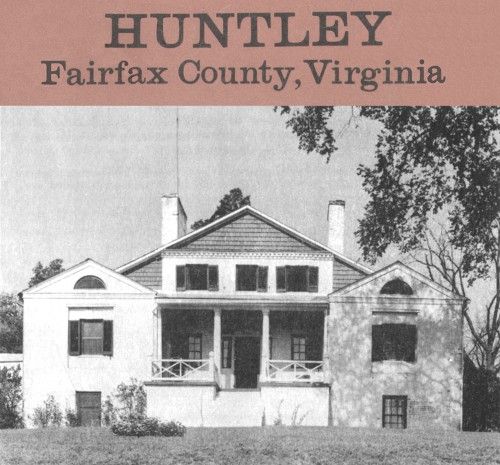
Huntley, too, is of three-part construction and though the windows are not set into arched recessed panels, they are set into the center of square recessed panels, which serve the same design function of catching and reflecting light and shadow. The recessed arch appears at Huntley in the root cellar superstructure, however, duplicating Hadfield's use in the structures mentioned above.
Figure 26. Arlington House (Custis-Lee Mansion) showing portico designed by
Hadfield. Photo courtesy National Park Service.
Figure 27. Analostan, now demolished, formerly stood on Theodore Roosevelt
Island. Possibly designed by Hadfield. Photo by Abbie Rowe.
Courtesy National Park Service.
Arlington House has a two story center section with one story wings, as does Huntley. It is possible that had Huntley been built on different terrain, it might have followed the more common "I" plan of Arlington House. Given the limited space on Huntley's hill, however, the "H" plan obviously made more usable space available on the site. The chimneys at Arlington, and those at Huntley, are placed in the same position in relation to the center structure and the wings; the wooden mantels in both houses have obvious stylistic similarities.
When Huntley is compared with Analostan another similarity shows up. The gable end at Analostan has a relatively shallow cornice, common in the period, outlining a pediment strikingly similar to the gable ends of the wings at Huntley. Located within the pediment at both houses is an elliptical ventilator.
The design for Huntley could easily have come from Hadfield. There were opportunities for T.F. Mason to have met him through Jefferson or through his uncle, General John Mason of Analostan.
George Washington Parke Custis of Arlington House and Thomson Mason of Hollin Hall were both sheep raisers and there was much rivalry between the two families in this field, including Mason entries which took prizes at Custis exhibitions and shows.[75] This offers, in addition to the day-to-day opportunities presented to Mason through his political and social standing, one more means whereby T.F. Mason might have learned of Hadfield, observed his work, met him, and contracted for design assistance in the construction of his country house.
In addition, Mason was a lawyer, who later became a justice of the peace and a judge. For several years before and after 1820, Hadfield was involved with the design and construction of the City Hall, which was to house the Courts of the District. Mason would have been aware of this and would probably have known Hadfield.
Certainly the design evidence of Huntley indicates the work of an architect. The structure is much too architectonic to have evolved and in many respects much too advanced for its day to have been designed by a local carpenter-builder. Perhaps at some future time we shall discover information which indicates precisely whose trained hand put all the pieces together in this highly satisfactory manner.
Until that time, the evidence strongly points to George Hadfield.
Chapter 4 Notes
[58] Paul F. Norton, "Decatur House: Design and Designer," Historic Preservation, Volume 19, Numbers 3-4 (July-December 1967), pp. 9-24.
[59] Fiske Kimball, Domestic Architecture of the American Colonies and of the Early Republic, (New York: Dover, 1966 Reprint), p. 27.
[60] Rowland, George Mason, Volume II, p. 369.
[61] H. M. Pierce Gallagher, Robert Mills (New York: Columbia University Press, 1935), p. 170.
[62] Deering Davis, Stephen P. Dorsey, Ralph Cole Hall, Georgetown Houses of the Federal Period. (New York: Bonanza Books, 1944), pp. 21-23.
[63] Lonnelle Aikman, We the People (Washington: U.S. Capitol Historical Society, 1965), p. 33.
[64] H.M. Gallagher, Robert Mills, p. 169.
[65] George S. Hunsberger, "The Architectural Career of George Hadfield," Records of the Columbia Historical Society, Volume 51-52 (1955), pp. 46-65.
[66] Ibid.
[67] Ibid. p. 51. See also: Allen Johnson and Dumas Malone, Dictionary of American Biography (New York: Charles Scribner, 1932 (1931)), Vol. IV, p. 76.
[68] Letter, George Hadfield to Thomas Jefferson, Thomas Jefferson papers. Volume 222, op. 39775, Library of Congress.
[69] Daily National Intelligencer, February 13, 1826.
[70] Karl Schuon, Home of the Commandants (Washington: Leatherneck Association, 1966), pp. 61-64.
[71] Harry F. Cunningham, Joseph A. Younger, Wilmer Smith, Measured Drawings of Georgian Architecture in the District of Columbia, 1750-1820 (New York: Architectural Book Co., 1914), Sheets 58-61.
[72] Original watercolor signed "Geo. Hadfield, Sept. 1798," Avery Library, Columbia University.
[73] Murray H. Nelligan, Custis-Lee Mansion (Washington: National Park Service, 1950), pp. 2-4, 6, 15, 24. The staff at Arlington House was also kind enough to allow the author the use of Mr. Nellingan's unpublished manuscript on Arlington House.
[74] H. Paul Caemmerer, Historic Washington (Washington: Columbia Historical Society, 1960), pp. 34, 39.
[75] Edith Moore Sprouse, "Died in a Kind of Fit Like....", Hollin Hills Bulletin, May and June-July, 1969.
SUMMARY
It should be clear from the picture of Mason which emerges from an earlier part of this report that his tastes and his capabilities could have included a house designed by a known architect. His family ties, educational background, travels, position and social standing evidence the highest standards of his day. His acquisition of Colross, his sensitive repairs of that structure and the manner in which he seems to have furnished the house again indicate taste and awareness of current architectural trends.
The design evidence indicates that Mason did build well at Huntley, and that he sought assistance in doing so. Huntley's similarities to other area structures designed by the architect George Hadfield are striking. In addition, of all the architects in the area at the time Hadfield was most available and is believed to have already designed one house for the Mason family, Analostan. There is also good reason to believe that Thomson Francis Mason and Hadfield knew each other.
Whatever the derivation of the mansion house at Huntley, it survives as a notable example of early nineteenth century architecture; as an example of a farm or country house of an early nineteenth century city dweller; as a Mason family house and as a part of a well sited and relatively complete complex. When considered together, these factors make Huntley an important architectural landmark.
Figure 28. Huntley, front elevation, 1946. Edward M. Pitt, Architect. Blueprints
courtesy Col. and Mrs. Ransom Amlong. Photo copies by Wm.
Edmund Barrett.
Figure 29. Huntley, rear elevation.
Figure 30. Huntley, basement floor plan.
Figure 31. Huntley, first floor plan.
Figure 32. Huntley, second floor plan.
APPENDIX A
SOME MASON HOUSES IN NORTHERN VIRGINIA
Mason land holdings were vast in Stafford, Prince William, Loudoun and Fairfax Counties in Virginia, and in Maryland and Kentucky. In the northern Virginia area the Masons built or occupied a number of houses many of which are mentioned here.
Thomson Francis Mason Houses
501 Cameron Street, Alexandria. This is believed to be the "large and comodious" dwelling which, according to an 1823 entry in the Alexandria Gazette, Mason was renting at the corner of Cameron and Pitt Streets. The house is a three-story brick structure, probably built during the first quarter of the nineteenth century. It is still standing. (Alexandria Gazette, March 13, 1823 and November 1, 1833.)
Colross, Alexandria, 1100 block of Oronoco Street, block between Oronoco, Pendleton, North Henry and North Fayette. This was an existing house built in the last quarter of the eighteenth century, acquired by Thomson F. Mason in 1833. Mason was buried in a tomb behind the mansion after his death in 1838. The main house was moved to Princeton, New Jersey, in 1929 and rebuilt there. Today the block in Alexandria includes a warehouse, car wash, automobile repair facility and a transformer station. The present location of the remains of Thomson F. Mason, removed from Colross, is not known to the writer. (Mary G. Powell, The History of Alexandria, Va., Richmond, Wm. Byrd Press, 1928, p. 261; New York Herald Tribune, July 7, 1929, "Colross Built 1785, to come to Jersey site."; Mrs. Betty Carter Smoot, Days in an Old Town, Alexandria, privately printed, 1934, pp. 121-32; Henry H. Saylor, Alexandria Virginia, The White Pine Series, New York, Russell F. Whitehead, 1926, (photographs and drawings); plus additional material available in the Alexandria Public Library.)
The Hallowell School, 609 Oronoco Street, Alexandria. A two-and-a-half-story brick structure, built circa 1800, it is the companion house to the Lee Home, next door at 607 Oronoco. At 609, Benjamin Hallowell operated a school among whose students was Robert E. Lee. T.F. Mason acquired the house after the Hallowell School moved elsewhere, at public auction on February 9, 1835, though he may have lived there earlier as a tenant. By the time of purchase he was already a resident at Colross, but a sale advertisement for 609 Oronoco Street in 1839 calls it " ... the late residence of the Honorable T. F. Mason ...". The house is still standing. (Deering Davis, Stephen P. Dorsey and Ralph Cole Hall, Alexandria Houses, Cornwall, N.Y. Architectural Book Publishing Co., Inc., 1946, pp. 88-89, 126; Benjamin Hallowell, Autobiography, Philadelphia, Friends Book Association, 1884, pp. 95-120. Alexandria Gazette, August 30, 1839,; Alexandria Deed Book V-2, p. 355(1835).)
Huntley, 6918 Harrison Lane, Groveton, Fairfax County. Still standing. Though Huntley was built during Mason's ownership of the property, no record has been found that he actually lived there.
115 South St. Asaph Street, Alexandria, is a two-and-one-half-story brick structure over an English basement built about 1800, and still standing. A sign on the structure says "Home of Thomas Mason, circa 1775." It was purchased by Mason in May of 1832, at about the same time that he purchased the lot next door at 117 S. St. Asaph Street. A three-story structure of the last quarter of the nineteenth century now stands there. Mason may have been a tenant at 115 before his purchase, but was already out of the house by November 8, 1833, when a Dr. Wheelwright announced that he had "... removed to the house on St. Asaph Street ... formerly occupied by Thomson F. Mason, Esq." (Deering Davis, Stephen P. Dorsey & Ralph Cole Hall, Alexandria Houses, Cornwall, N.Y., Architectural Book Publishing Co., Inc., 1946, p. 126; Alexandria Gazette, November 8, 1833. Alexandria Deed Books: U-2, p. 27 (1832); U-2, p. 29 (1832); and M-3, p. 646 (1852).)
This list includes only part of the real estate owned by Thomson Francis Mason. He lived in the Cameron Street house during the 1820's. He may have lived in either the Oronoco Street or St. Asaph Street houses before he purchased them. At any rate, he purchased Colross, Hallowell School and the St. Asaph Street houses in the decade before his death. He died in 1838 and was buried at Colross. There are long periods of time unaccounted for and probably many real estate transactions which have not yet been documented.
Other Mason Houses
Analostan, home of General John Mason. Located on the Potomac River in the District of Columbia on Theodore Roosevelt Island, known in the past as Barbadoes, Mason's Island, or Analostan. Built in the 1790's, its design is attributed to George Hadfield. General Mason sold the house about 1833 and moved to Clermont. Parts of the Analostan house stood until the 1930's when they were demolished by the Theodore Roosevelt Memorial Association. (Sunday Star, Feb. 6, 1921, Rambler "... History of Analostan Island;" Star, June 4, 1958, Rambler, "Revisits Analostan Island;" Virginia Record, July 1956, p. 9, Mollie Somerville, "George Mason's Island;" Rowland, George Mason, New York, Russell & Russell, 1892 and 1946, Vol I, p. 117; Harry F. Cunningham, Joseph A. Younger, and J. Wilmer Smith, Measured Drawings of Georgian Architecture in the District of Columbia, 1750-1820, New York, Architectural Book Company 1914, Sheets 58-61.)
Clermont, which was purchased by General John Mason and to which he and his family moved in 1833. Site near Fairfax County-Alexandria line, off Clermont Drive, near point where the Richmond, Fredericksburg & Potomac tracks cross Cameron Run. It was demolished in the 19th Century. ("Diary of Miss Mason," beginning Sept. 20th 1833, property of Mrs. Augustus Thorndike, partial copy in Gunston Hall archives (Analostan file); Christine Gibson unpublished report, Fairfax County Public Library, Virginiana Collection.)
Gunston Hall, home of George Mason IV, in Fairfax County. The house is a one-and-one-half-story brick structure, with interiors by William Buckland joiner and architect. In the garden is one of America's best surviving stands of English Boxwood. The house still stands on Route 242, 4 miles southeast of Route 1, and south of Fort Belvoir. It is owned by the Commonwealth of Virginia and administered as an historic house museum by a Board of Regents of the National Society of Colonial Dames. (Thomas Tileston Waterman, The Mansions of Virginia, Chapel Hill, University of North Carolina Press, 1946.)
Hollin Hall, built for and occupied by General Thomson Mason, son of George Mason IV of Gunston Hall, and father of T.F. Mason. It was a two-story frame structure, which burned early in the nineteenth century. Part of the complex may still exist, or be incorporated into the present structure known as Little Hollin Hall at 1901 Sherwood Hall Lane, in Fairfax County south of Alexandria. (Rowland, George Mason, New York, Russell & Russell, 1892 and 1946, Volume II, pps. 307, 351, and numerous others; Hollin Hills Bulletin, May 1969, June-July, 1969.)
Lexington, in Fairfax County, built for George Mason V, son of George of Gunston Hall and uncle of T.F. Mason. The house stood on Mason Neck, near Gunston Hall. The structure burned in the nineteenth century. (Rowland, George Mason, New York, Russell & Russell, 1892 and 1946, Volume I, p. 112; Edith Moore Sprouse, Lexington, unpublished report, June 1967, Virginiana Files, Fairfax County Public Library.)
Okeley, home of Richard Chichester Mason, brother of T.F. Mason. The structure was destroyed during the Civil War. It was located in Fairfax County on S. Kings Highway, just south of Huntley. (Rowland, George Mason, New York, Russell & Russell, 1892 and 1946, Volume II, p. 473; Alexandria Gazette, March 30, 1841).
Spring Bank, owned by George Mason, son of William Mason and first cousin of T.F. Mason. There may have been an earlier structure on the site, but the house in which this George Mason lived is a two-story brick structure, built about 1850, which is still standing. It is located at Penn Daw in Fairfax County in the Spring Bank Trailer Park, at the intersection of Kings Highway and the Jefferson Davis Highway (Route 1). (Rowland, George Mason, New York, Russell & Russell, 1892 and 1946, Volume II, pps. 366, 369, and others.)
Woodbridge, home of Thomas, son of George of Gunston Hall, and uncle of T.F. Mason. It stood in Prince William County almost directly across Occoquan River from Colchester and was demolished prior to 1892. (Rowland, George Mason, New York, Russell & Russell, 1892 and 1946, Volume I, p. 112.)
APPENDIX B
CHAIN OF TITLE
1949—June 11, Deed Book 694, page 400: AUGUST & ELEANOR S. NAGEL to RANSOM G. AND MARGUERITE K. AMLONG.
1946—September 1, Deed Book 515, p. 60: ARMISTEAD L. BOOTH, executor under the will of ALBERT R. HARRISON to AUGUST W. & ELEANOR S. NAGEL.
1911—April 5, Liber J, No. 7, p. 22: CLARA B. HARRISON, UNMARRIED, MARY C. HARRISON, UNMARRIED, ALBERT R. HARRISON, UNMARRIED, first part, MARGARET N. HARRISON GIBBS AND HER HUSBAND J. NORMAN GIBBS, second part. (Albert W. Harrison died intestate.)
1871—March 11, Liber O, No. 4, p. 338: NATHAN W. & SUSAN E. PIERSON to ALBERT W. HARRISON.
1868—November 21, Liber I, No. 4, p. 236: BENJAMIN KING to ALBERT W. HARRISON AND NATHAN W. PIERSON OF NEW JERSEY.
1862—June 12, Liber E, No. 4, p. 195: JOHN A. SMITH to BENJAMIN KING.
1859—December 7, Liber B, No. 4, p. 451: JOHN FRANCIS MASON AND ARTHUR PENDLETON MASON, first part, JOHN A. SMITH, second part, BENJAMIN KING, U.S. ARMY, NOW RESIDING IN THE DISTRICT OF COLUMBIA, third part.
1859—November 7, Liber B, No. 4, p. 449: BETSEY C. MASON to JOHN FRANCIS MASON AND A. PENDLETON MASON, SONS OF THE SAID BETSEY C.
1859—November 7, Liber B, No. 4, p. 448: BETSEY C. MASON to JOHN FRANCIS MASON AND A. PENDLETON MASON, SONS OF THE SAID BETSEY C.
1839—February 4, Will Book T, No. 1, p. 3: "To all persons to whom the presents shall come, greetings. Know ye that the last will and testament of Thomson F. Mason of Alexandria County deceased hath been in duo form of law exhibited., proved and recorded in the Office of the Register of Wills of said County, a copy of which is to these presents annexed and administration of all the goods, chattles and credits of the deceased is hereby granted and committed unto Betsey C. Mason, the Executrix of the said will appointed...."
1839—February 18, Will Book T, No. 1, pp. 1-4: Will of THOMSON F. MASON. Will was dated December 14, 1838.
1825—Chancery Suit referenced in Liber W, No. 2, pp. 162-65: THOMSON F. MASON vs. GEORGE W. MASON, RICH C. MASON, FAYETTE BALL AND MARY HIS WIFE, GEORGE MASON AND HELLEN, JOHN, GEORGE, AND SALLY MASON HIS INFANT CHILDREN AND SAMUEL DAWSON AND EUGENIA AND MASON DAWSON HIS INFANT CHILDREN. (Suit was not located.)
1823—October 1, Liber W, No. 2, p. 199: THIS INDENTURE MADE THIS FIRST DAY OF OCTOBER IN THE YEAR OF OUR LORD EIGHTEEN HUNDRED AND TWENTY THREE BETWEEN GEORGE M. MASON, AND MARY HIS WIFE, RICHARD C. MASON AND LUCY B., HIS WIFE, GEORGE MASON OF GUNSTON, AND ELEANOR ANN, HIS WIFE, ALL OF THE COUNTY OF FAIRFAX AND STATE OF VIRGINIA, AND FAYETTE BALL AND MARY T. HIS WIFE AND SAMUEL DAWSON, BOTH OF THE COUNTY OF LOUDOUN AND STATE AFORESAID, all of the one part, AND THOMSON F. MASON OF THE TOWN OF ALEXANDRIA IN THE DISTRICT OF COLUMBIA, of the other part.
1820—November 21, Will Book M, No. 1, p. 130: Will of THOMSON MASON OF HOLLIN HALL, dated April 15 1797. The land on which Huntley is located had come to Thomson by the will of his Father, George Mason of Gunston Hall.
1792—August 23, Will Book F, pp. 104-105: Will of George Mason of Gunston Hall granting lands to his son, Thomson Mason, which were part of the Ball patent on both sides of the North Branch of Little Hunting Creek.
1772—June 18, Deed Book K-1, p. 54: Sampson Darrell to George Mason the lower part of a tract granted to John Ball by the proprietors of the Northern Neck of Virginia in September, 1695; willed to his son George Ball August 14, 1722; sold to John Carlyle, March 17, 1742/43; sold to Sampson Darrell August 16, 1748.
LIST OF SOURCES
Books
Aikman, Lonnelle, We the People. Washington: U.S. Capitol Historical Society, 1965.
Caemmerer, H. Paul. Historic Washington. Washington: Columbia Historical Society, 1966.
Carne, William F. Alexandria Business Book. Alexandria: M, Hill Co., 1897.
Cunningham, Harry F.; Younger, Joseph A.; and Smith, Wilmer. Measured Drawings of Georgian Architecture in the District of Columbia, 1750-1820. New York: Architectural Book Co., 1914.
Davis, Derring; Dorsey, Stephen P.; and Hall, Ralph Cole. Georgetown Houses of the Federal Period. New York: Bonanza Books, 1944.
Gallagher, H.M. Pierce. Robert Mills. New York: Columbia University Press, 1935.
Gordon, C.A. History of the House of Gordon. Aberdeen: D. Wyllie & Son, 1890.
Gouverneur, Marian. As I Remember. New York: D. Appleton & Co., 1911.
Hallowell, Benjamin. Autobiography. Philadelphia: Friends Book Association, 1884.
Hopkins, G.M. Atlas of Fifteen Miles Around Washington. Philadelphia: privately published, 1879.
Johnson, Allen; and Malone, Dumas, eds. Dictionary of American Biography. New York: Charles Scribner, 1932.
Kimball, Fiske. Domestic Architecture of the American Colonies and of the Early Republic. New York: Charles Scribner Sons, 1922.
Mason, Stevens Thompson. Mason Family Chart. Baltimore: Privately published, 1907.
Miller, Helen Hill. George Mason Constitutionalist. Cambridge: Harvard University Press, 1938.
Nelligan, Murray H. Custis-Lee Mansion. Washington: National Park Service, 1950.
Powell, Mary G. The History of Old Alexandria Virginia. Richmond: William Byrd Press, 1928.
Rowland, Kate Mason. The Life of George Mason. New York: G.P. Putnam's Sons, 1892, Volume II.
Schuon, Karl. Home of the Commandants. Washington: Leatherneck Association, 1966.
Smoot, Mrs. Betty Carter. Days in an Old Town. Alexandria: Privately printed, 1934.
Sprouse, Edith Moore. Potomac Sampler. Alexandria: privately published, 1961.
Waterman, Thomas Tileston. The Mansions of Virginia. Chapel Hill: University of North Carolina Press, 1946.
Articles
Bundy, Charles S., "History of the Office of the Justice of the Peace." Washington: Records of the Columbia Historical Society. 1902.
Hunsberger, George S. "The Architectural Career of George Hadfield," Records of the Columbia Historical Society, Vol. 51-52, 1955.
Norton, Paul F., "Design and Designer," Historic Preservation, Volume 19, Nos. 3-4, July-December 1967.
Regis, Noel F. "Some Notable Suits in Early District Courts." Washington: Records of the Columbia Historical Society, 1922.
Somerville, Mollie. "George Mason's Island," Virginia Record. July, 1956.
Newspapers
Alexandria Gazette: November 24, 1817; March 13, 1823; August 5, 1828; November 1 & 8, 1833; May 16, 1837; December 27, 1838; August 30, 1839; June 12, 1862; October 12, 1864; May 13, 1868; May 3, 1870; May 16, 1870; May 14, 1892; March 3, 1911; January 1, 1930.
Daily National Intelligencer: February 13, 1826.
Fairfax Herald: March 10, 1911.
New York Herald Tribune: July 7, 1929.
Syracuse (N.Y.) Journal: July 28, 1875.
Washington Sunday Star: February 6, 1921; June 4, 1958.
Manuscripts
Nelligan, Murray H. "Custis-Lee Mansion." Unpublished manuscript. National Park Service.
Sprouse, Edith Moore. "Lexington." Unpublished report, 1967.
Thomson Francis Mason Papers. Collection of William Francis Smith, Alexandria, Virginia.
Thomson Francis Mason Papers. Duke University, Durham, N.C.
Legal Records
Fairfax County Courthouse, Deeds, Wills, Chancery Court Cases: Will of George Mason, August 23, 1792; Will of Thomson Mason, April 15, 1797, Will Book M, No. 1, p. 130, November 21, 1820; Liber W, No. 2, p. 199. October 1, 1823; Liber W, No. 2, pp. 162-65; Will Book T, No. 1, February 18, 1839; Will Book T, No. 1, p. 3, February 4, 1839; Liber B, No. 4, p. 448, November 7, 1859; Liber B, No. 4, p. 451, December 7, 1859; Liber E, No. 4, p. 195, June 12, 1862; Liber I, No. 4, p. 236, November 21, 1868; Liber O, No. 4, p. 338, March 11, 1871; Liber J, No. 7, p. 22, April 5, 1911; Deed Book 515, p. 60, September 1, 1946; Deed Book 694, p. 400, June 11, 1949.
Division of Planning Publications Staff
Peter T. Johnson, Chief, Operations Branch
Stephen H. Lopez, Historic District Planner
Nan Netherton, Historic Research Supervisor
Elizabeth David, Research Assistant
Jay Linard, Copy Editor
Gloria Matthews, Book Designer