
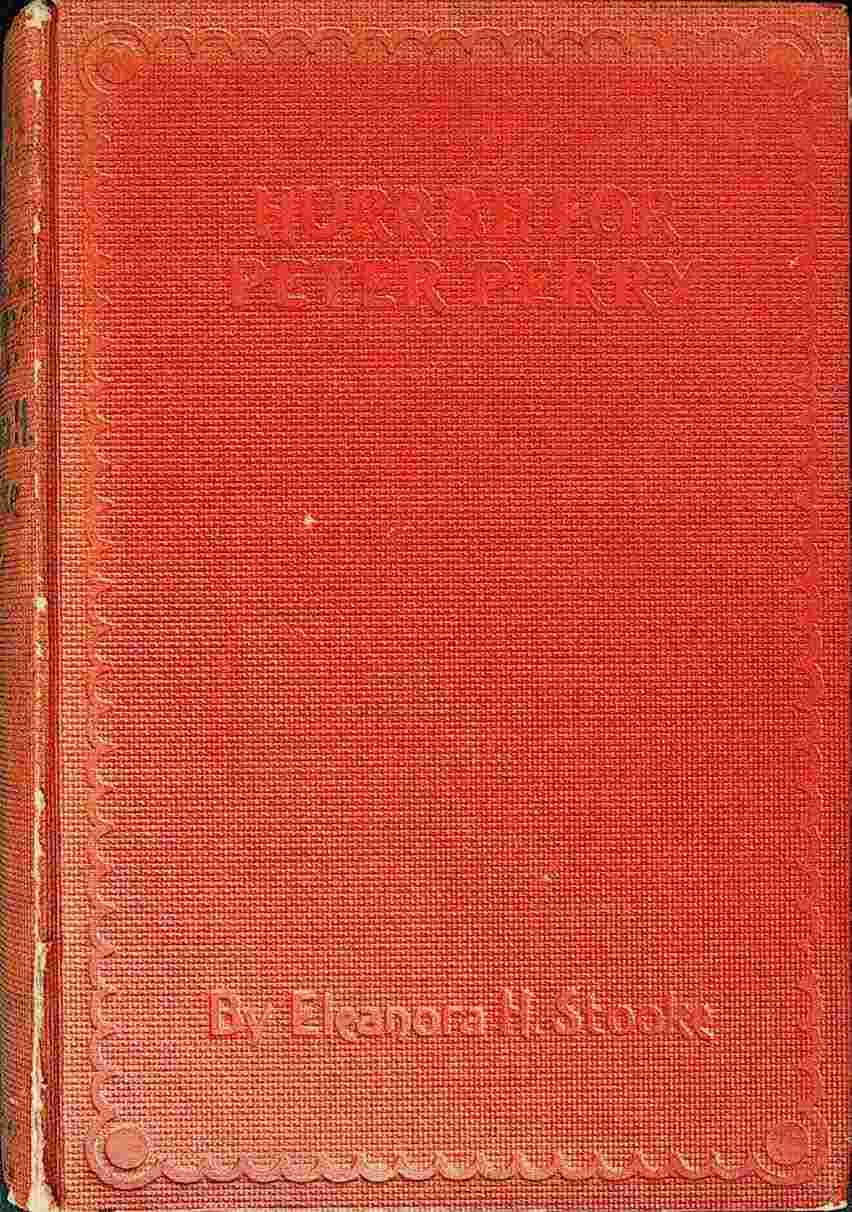
The Project Gutenberg eBook of Hurrah for Peter Perry!
Title: Hurrah for Peter Perry!
Author: Eleanora H. Stooke
Illustrator: Florence Meyerheim
Release date: May 23, 2023 [eBook #70843]
Language: English
Original publication: United Kingdom: Wells Gardner, Darton & Co., Ltd, 1924
Transcriber's note: Unusual and inconsistent spelling is as printed.
Tearing off his coat, Tom sprang into the road.
Hurrah for Peter Perry!
BY
ELEANORA H. STOOKE
AUTHOR OF
"THE BOTTOM OF THE BREAD PAN," ETC.
ILLUSTRATED BY F. MEYERHEIM
LONDON
WELLS GARDNER, DARTON & CO., LTD.
3 & 4 PATERNOSTER BUILDINGS, E.C.4
PRINTED IN GREAT BRITAIN
WELLS GARDNER, DARTON & CO., LTD.
CONTENTS
CHAP.
CHAPTER I. THE BEGINNING OF THE HOLIDAYS
CHAPTER II. AN OPPORTUNITY MISSED
CHAPTER III. THE GIPSIES' ENCAMPMENT
CHAPTER IV. AN UNEXPECTED CALL
CHAPTER V. LOST—AND FOUND AGAIN
CHAPTER VIII. TOM'S PRESENCE OF MIND
CHAPTER IX. "UNA AND THE LION"
CHAPTER X. TOM MEETS THE DWARF
CHAPTER XII. THE CHRISTMAS HOLIDAYS
LIST OF ILLUSTRATIONS
Tearing off his coat, Tom sprang into the road.
It was no other than Peter Perry's dog, Bounce.
"A dwarf!" Tom exclaimed, and stopped to look at him.
Hurrah for Peter Perry!
CHAPTER I
THE BEGINNING OF THE HOLIDAYS
"WE'RE not to go to the seaside? Oh, Mother, why not?"
"Because, dear, we can't afford it. I'm very, very sorry, but you must try to enjoy your holidays at home; and, please, Tom, don't let your father guess that you greatly mind—of course, it's only natural that you should be disappointed."
The scene was the comfortable though decidedly shabby sitting-room at No. 3 Ladysmith Terrace, a row of new houses on the outskirts of Chilaton, a large provincial town; and the speakers were Mrs. Burford, a pretty, rather delicate-looking woman of thirty, and her ten-year-old son, Tom, whose usually bright face was now wearing an expression of mingled amazement and dismay. It was a pleasant afternoon at the close of July, and on the previous day the school, which Tom attended as a day-scholar, had broken up for the long holiday. Always, hitherto, Mr. Burford, who was a clerk in a bank in Chilaton, had taken his holiday in August, and gone with his family to the seaside; but Mrs. Burford had just told Tom that that programme could not be carried out this year.
"You see," she continued, "we have had extra expenses to cope with— Nellie's illness, for instance, and—"
"Dr. Brewer said that a change of air would set Nellie up quicker than anything!" Tom broke in, eagerly; "you haven't forgotten that, Mother?"
Mrs. Burford shook her head, and her lips quivered. There was a minute's silence, then she said, quietly: "If it was possible, we should carry out Dr. Brewer's prescription, Tom, but it is not. We must live within our income, and we could not do that if we took a holiday under existing circumstances. I hope, next year, if your father should get a rise—"
Tom, who was standing by the open window, gazing into the small patch of flower garden which divided the house from the road, turned sharply and looked at his mother as her voice altered and stopped. Mrs. Burford was seated in a low chair, a stocking, which she had been darning, drawn over her left hand, but she had ceased working, for she could not see on account of the tears which had suddenly filled her eyes. The boy's heart swelled with sympathy for her as he saw the sad feelings she was trying to keep down. "Oh, Mother," he cried, "don't look like that! I daresay Nellie will get quite well without going away! You know she is much better than she was a month ago! Why, I heard you say, yesterday, that you really thought she was a little fatter! And she's quite lost her cough!"
"Hush!" whispered Mrs. Burford, blinking away her tears, and hastily restarting her work, "here she comes! Well, Nellie, my dear!"
The door had opened to admit a little girl, followed by a small, smooth-haired fox-terrier. She crossed the room to her mother's side, where she seated herself on a stool, leaning her curly golden head against the arm of her mother's chair; she was a very pretty child, nearly two years younger than Tom, but whereas six months before she had been full of merriment and high spirits, she was now, as her brother complained, "as quiet as a mouse and with no fun left in her." This change was the result of a serious illness she had had in the spring.
"Shall we take Tim for a walk, Nellie?" suggested Tom, as the terrier came up to him, and stood wagging his tail and looking at him with an eager expression, which he read aright, in his sharp brown eyes. "He's asking me to go," he added.
Tim was a very intelligent little animal, and his face, quaintly marked, one side quite white and the other black and tan, was wonderfully expressive; at the present moment it seemed to say: "Come out into the sunshine! Don't stop indoors wasting this beautiful summer afternoon!"
"I'm tired, Tom," Nellie replied, "I'd rather stay with Mother if you don't mind. Besides, if I don't go you'll be able to take Tim farther—I couldn't walk very far, you know."
This was true, so Tom said no more and left his sister at home. Five minutes later, with Tim trotting on ahead of him, he had turned his back on Ladysmith Terrace, and was strolling along a wider road than the one in which his home was situated, which led to the open country. By and by he came within sight of a pretty ivy-covered detached house, with a well-kept lawn before it, around which, on one side, was a wide carriage-drive, whilst the other side was edged with flower-beds, gay with summer and early autumn flowers. This was Halcyon Villa, the residence of Miss Perry, an elderly maiden lady who was said to be very rich.
Tom, walking along with his hands thrust deep in his trousers pockets, his eyes fixed on the ground, and his mind full of far from happy thoughts, was paying no attention to Tim, and did not observe that, on reaching the big iron gate leading into the grounds of Halcyon Villa, he had met another dog—an Irish terrier; and, therefore, he looked up with a start at the sound of a voice— a startled voice which cried:
"Bounce! Bounce! Come here! Oh, please, whoever you are, take your dog away!"
The speaker was a dark-haired, dark-complexioned boy, apparently about Tom's age. He was standing within the gate, his face close to the bars, an expression of great anxiety upon his features. It was evident he feared that the dogs, who, with raised backs, were walking stiffly around each other, growling, meant to fight.
Tom gave him a glance of contempt, secretly thinking him a coward, and answered: "Easier said than done! Come out and fetch your dog in!"
The words were barely out of his mouth when the dogs closed with each other, and a moment later found them fighting in the middle of the road. Tim fought pluckily, but he was not evenly matched, his antagonist being bigger and stronger than himself, and in less than a minute the Irish terrier had got him under, and doubtless would have done him serious injury if a man had not come along and separated the animals; whereupon the Irish terrier, looking rather ashamed of himself, retreated to the side of his master, who had come out into the road and now hastened to fasten a leash to his collar.
"You should keep your dog under control!" cried Tom angrily and very unreasonably. "I never saw a more savage brute!"
"He doesn't fight unless he's interfered with," the other boy answered, his dark cheeks flushing. "But, as a rule, I have him on the lead. I was giving him a run in the garden, and he went out over the hedge. I heard your dog come up and growl at him. I hope your dog is not hurt?"
"Not much. He has a bite on one of his forelegs, I see, but that's nothing."
Tom was beginning to be ashamed of the temper he had shown. He could quite believe that Tim, who was always fierce to strange dogs, had been the first to show a hostile spirit.
"Oh, I am glad of that!" the dark boy said. "What sort of dog is he, and what is his name?"
Tom was bending over Tim, examining his injury. He looked up in surprise; then laughed rather scornfully.
"Why, he's a fox-terrier, of course!" he exclaimed; "and nearly thoroughbred, too. His name's Tim. What do you call your dog? Oh, I remember!—Bounce."
"Yes, Bounce. He was always a very good dog in London. My home's in London, you know. But the last few days, since I have been here with Aunt Harriet, he's given a lot of trouble: got away by himself, and not come back for hours. Aunt Harriet thinks he goes hunting in the woods."
"If he does, he will end by being caught in a trap."
"Oh, do you think so? I did not know there were traps in the woods."
"There are. Poachers set them for rabbits, and whatever else they can catch."
There was a minute's silence. Then Tom inquired:
"Is Miss Perry your aunt?"
"Yes, my father's sister. I'm going to spend my holidays with her."
"Jolly for you! She's awfully rich, isn't she? You'll ride about in her motor-car, and have no end of a good time! What's your name?"
"Peter Perry. And yours?"
"Tom Burford."
"Do you know my aunt?"
"Rather not. We're not rich people living in a big house, with servants to wait on us, and everything we want! We're poor!"
There was a note of bitterness in Tom's voice, of which he was scarcely conscious himself, but Peter heard it, and replied sympathetically: "It must be dreadful to be poor—to be short, perhaps, of even food, and clothes, and—"
"Oh, I didn't mean we were so poor as that," Tom interrupted, crimsoning, and aghast at the false impression he had evidently given. "I meant—why, what's this?"
The other boy had stepped close to him and had slipped something— a shilling it proved to be—into his hand, murmuring that he was so sorry for him and that he wanted him to have the money to buy something for himself.
Tom looked at the coin in amazed silence for a minute, the hot colour slowly receding from his cheeks in his shame; them amazement and shame gave place to anger, and he flung the shilling in the road at his companion's feet.
"Pick it up from there, if you want it!" he cried wrathfully. "I don't know what you can think of me! Get out of my way and let me pass!"
"Oh, wait, wait!" cried Peter Perry, seemingly much distressed.
But Tom pushed him roughly aside, and, followed by Tim, who was now in a chastened frame of mind, strode off at a great rate in the direction of his home, his heart hot with anger against the boy who, he considered, had insulted him.
"I shan't tell them about it at home," he decided; "for I suppose I oughtn't to have said we were poor. But, oh! how was it he didn't see I wasn't the sort of boy to take money? How could he have made such a mistake?"
CHAPTER II
AN OPPORTUNITY MISSED
THE first week of the summer holidays had passed when, one morning, as Nellie and Tom Burford were standing looking into the window of their favourite sweetshop in the town, a handsome motor-car, painted dark green, with a chauffeur in dark green livery, drew up before the adjoining shop (a draper's), and an elderly lady, with a plain, kind face, got out of it.
"I shall not be long, Peter," the children heard her say.
"Miss Perry!" whispered Nellie, as the lady went into the draper's shop.
Tom nodded. He was gazing at Peter Perry, who, with Bounce by his side, occupied the seat behind the chauffeur's in the car.
"I wonder who the boy can be?" Nellie continued, in the same tone. "I never saw him before, did you?"
"Once," Tom answered. "He's Miss Perry's nephew. Have you decided what you will buy, Nellie?" he inquired.
"Yes," said the little girl; "caramels, I think. I'd have chocolates, only they don't last so long. You like caramels, don't you?"
"Oh, yes! I'll wait outside while you get them."
Accordingly Nellie, who had twopence to spend, went into the shop, followed by Tim. As soon as the pair had disappeared, Tom, with a would-be-indifferent air, strolled a few steps forward and passed the motor-car, then turned and repassed it. The chauffeur had got out, and was standing on the pavement, but Peter Perry had not moved, and was sitting with his eyes fixed straight before him.
"I wonder if he saw me?" Tom said to himself. "I don't think he did. Of course, I shouldn't dream of speaking to him. I should like him to know that."
He strolled forward again and paused in a line with the car, giving a slight cough to attract Peter's attention, intending, as soon as the boy looked at him, to give him a withering glance and move on— in short, to cut him.
But the unexpected happened. At the sound of the cough Peter started slightly, and immediately turned his dark eyes upon Tom; there was not the very faintest sign of recognition in them, however, and he did not speak. At that instant Miss Perry came out of the draper's, and Tom beat a hasty retreat to the sweetshop doorway. Instead of having cut Peter Perry, he had been cut by him. Tom's cheeks were aflame with anger when his little sister joined him.
"Oh, Tom," she cried, looking with an expression of mingled wistfulness and admiration at the car, which was now on the point of starting, "how nice it must be to be rich like Miss Perry! I wish she was our aunt, don't you? What a good time that boy must have, mustn't he? Oh, what a nice dog!"
"Come along, come along!" said Tom gruffly. "Don't stare so, Nellie! The dog's a savage brute!"
"How do you know, Tom?"
"Because he fought Tim the other day—would have half killed him, I believe, if a man hadn't come along and interfered. His name is Bounce."
"How did you find out that?"
"His master—he belongs to Miss Perry's nephew—told me so."
"Oh, then you've spoken to Miss Perry's nephew? Tell me about him!"
"There's nothing to tell, except that he's called Peter Perry."
"Is he nice? Do you like him?"
"Like him? No!"
Nellie opened her eyes wide in surprise, for her brother's voice sounded quite fierce. They were walking homewards now, and a few minutes later they turned into the road, on one side of which was Ladysmith Terrace. As they did so they saw a caravan, painted yellow and red, and laden with brushes and baskets and tin-ware, going on ahead of them, drawn by a big grey horse, whilst a young gipsy woman was calling at each door of the terrace trying to make sales. "Isn't it a dear little home?" exclaimed Nellie, her gaze fixed with admiration on the gaudy caravan; "doesn't it look pretty and snug? I wish I could see what it is like inside."
They quickened their steps to overtake it, which they did easily, for it was going very slowly. A swarthy, black-eyed man was seated on the right shaft, driving; he was whistling a merry tune, and appeared the picture of contentment.
"Oh, look at the pretty little lace curtains in the windows!" cried Nellie. "Aren't they clean? And tied with pink ribbons, too!"
As she spoke the caravan came to a stop close to the pavement. The driver ceased whistling, jumped off the shaft, and proceeded to slip a nosebag over the horse's head. That done, he went to the back of the caravan and opened the door, whereupon a little girl, almost a baby, came out on the steps and flung herself into his arms. He laughed and kissed her, then set her on the ground; she immediately toddled around the caravan, and going up to the old grey horse, clasped one of his forelegs in her chubby arms. The animal ceased eating for a minute, turned his head and looked at her, then, by no means disturbed, went on with his meal. Much interested, Nellie and Tom stood by, watching.
"If I were you I should be afraid the horse would trample on her," Tom remarked, addressing the gipsy man; "I suppose she's your child, isn't she?"
"Yes," was the answer, "my only one. Old Bob trample on her? Not he! He's as quiet as a lamb. Zingra can do what she likes with him."
"Zingra! What a pretty name!" whispered Nellie to her brother. "I wonder if she likes sweeties," she said aloud, "because if she does she shall have some of mine." She opened her packet of caramels as she spoke, and the gipsy child turned from the horse to watch her. "Hold out your hand, please, Zingra!"
Zingra obeyed, her rosy lips parting in a smile which revealed two rows of pearly teeth, and Nellie placed three caramels in her tiny brown palm. At that minute the gipsy woman came up, and seeing what Nellie had done, exclaimed: "There, now, Zingra, isn't that kind of the pretty little lady? What do you say?"
"T'ank-oo," lisped Zingra, who was already skinning the thin paper from one of her caramels.
Meanwhile Tom had read the name painted on the side of the caravan, and learnt that the gipsy man was called Moses Lee, and that he was a licensed hawker. He asked him where he was going, and was told that it was to Hatwell Green, a piece of waste ground by the roadside, rather more than a mile from Chilaton. It was the gipsies' intention to encamp there for a few weeks whilst they traded in the town and district.
Mrs. Lee, having been to the doors of all the houses in Ladysmith Terrace, now seated herself with her little daughter on one of the steps at the back of the caravan, and her husband, having relieved Bob of his nosebag, perched himself on the shaft once more, and drove on, slowly as before. Whilst Nellie and Tom stood looking after the caravan, the former exchanging waves of the hand with Zingra, a motor-horn sounded in the road behind them, and looking round they recognised Miss Perry's car. As it passed them Tom shot one swift glance at its occupants, and it seemed to him that Peter deliberately turned his face away as he did so.
"I hate that boy!" he exclaimed passionately; "I shall hate him as long as I live!"
"Why?" questioned Nellie. "You may as well tell me," she added coaxingly; "do, Tom!"
"Well, perhaps I will by and by, but it must be a secret, mind."
"Very well."
Later in the day, Nellie, whose curiosity had now been thoroughly aroused, succeeded in prevailing upon Tom to give her his confidence. When she had learnt his cause for grievance against Peter Perry she was quite as indignant as he was himself.
"Oh, Tom, it was dreadful for you!" she declared, "and do you mean to say that he didn't apologise afterwards?—when you had flung his shilling back, I mean?"
"No. He wanted me to stop, but I wouldn't. I walked straight away."
"I think you ought to have waited," Nellie said after a minute's reflection.
"He could have apologised to me in the town to-day if he had liked," Tom reminded her.
"Yes, of course. And he pretended he didn't see you?"
"No, not exactly. He looked straight at me, and took no notice of me whatever. It was pretty cool behaviour, wasn't it?"
"It was horrid of him! Worse than his offering you money! He may have meant that kindly—you had told him we were poor—"
"Do you think I look like a beggar?" Tom broke in hotly.
"Oh, no, no!"
Nellie, with Tim by her side, was curled up on the sitting-room sofa, a delicate flush on her thin cheeks, her blue eyes very bright, whilst Tom moved restlessly about the room, his hands in his trousers' pockets. By and by the boy came to the sofa and stood looking down at his sister.
"What a colour you have, Nellie!" he said. "I don't think there's much amiss with you now!"
"Oh, no," she agreed, "I'm quite well, but I wish I was not so tired— I'm always tired! Oh, Tom, how I wish we could have gone away to the sea, don't you?"
"Yes, but I didn't know you felt like that! I thought you didn't mind our having to stay at home."
"I do really, but I don't want Mother and Father to know it. I—I suppose it's my fault we're not going. Oh, you know what I mean! I heard Mother and Father talking, and Father said my illness had cost nearly fifty pounds; he said it wouldn't have mattered if he'd had a rise at the bank, but he hasn't, you know."
"Yes, I know. It's a great shame. He expected to be made cashier, but another man, whose father has shares in the bank, has been given the post."
"Oh, how very unfair! Did Father tell you?"
"No. He told Dr. Brewer. I don't think they thought I was listening. Dr. Brewer thought it very unfair, too. He said: 'Never mind, old man, your turn will come.' But Father said he was afraid it would be a good while coming, because he had no friends at court."
"No friends at court?" echoed Nellie wonderingly. "What did he mean by that?"
"I couldn't think; so I asked Mother. She said he meant he wasn't well known by the heads of the bank: directors, I think she called them. If Father knew a director, he might get a better post. See?"
Nellie nodded, looking very thoughtful. "I suppose there's no way of our getting to know a director?" she asked, an eager light in her blue eyes.
"I should say not," Tom answered, with a short, amused laugh.
The little girl concluded that she had said something her brother considered silly, so put no more questions. On the strength of his two years' seniority, he sometimes treated her with an air of superiority, which she secretly disliked.
"I wish the holidays were over," Tom said presently, in a grumbling tone. "There's nothing for me to do, and no one for me to play with except you. I say, Nellie," he continued, his voice brightening, "wouldn't you like to go with me to Hatwell Green to-morrow and see the gipsies' encampment?"
"Yes, indeed I should," Nellie answered. Then her face clouded, and she added: "But I'm afraid I couldn't walk there and back."
"Why, it's only a mile distant!"
Sudden tears filled the little girl's eyes, and her lips quivered.
"If you only knew how tired I get, Tom," she faltered. "It isn't that I don't want to go." Her voice broke with a sob.
Tom felt as though a cold hand had gripped his heart. It was fear— fear that he might lose his little sister. He knew how ill she was. He turned away from her, and moved to the open window, where he stood quite still and silent for some minutes.
"Here's Miss Perry's car again!" he exclaimed by and by. "And, yes, Peter Perry's in it. Come and look!"
Nellie obeyed. As she reached her brother's side, Tim, who had followed her, jumped on a chair and stood with his forefeet on the window-ledge, also looking out. After the motor, which was being driven slowly, had passed by, Tom cried: "There! What do you think of that? His face was turned this way, and he must have recognised me, yet you see he took no notice. He must have recognised Tim, too. Oh, I know the sort of boy he is: nasty, stuck-up snob!"
CHAPTER III
THE GIPSIES' ENCAMPMENT
THE following morning, at the breakfast-table, Mr. Burford remarked to his little daughter: "Dr. Brewer's coming to see you some time to-day, my dear, so you must stay indoors until he has been here."
"Very well, Father," Nellie answered. "Did you ask him to come?" she inquired. "He said the last time he saw me that he shouldn't call again without he was sent for, and I'm not ill, you know."
"No, not ill," Mr. Burford agreed. "But you're not very strong, are you? Didn't I hear you complaining of leg-ache last night?"
"Yes," said the little girl; "my legs are always aching now, and they feel so weak and funny sometimes, just as if they were somebody else's legs, not mine."
"Perhaps Dr. Brewer may be able to give you some medicine to put them right," suggested Tom. "He may, mayn't he, Mother?"
"Oh, I hope so," Mrs. Burford replied. She spoke with a smile and in a cheerful tone, but her glance as it rested on her little daughter showed anxiety to Tom's sharp, watchful eyes.
Nellie was looking very pale and languid this morning, and did not in the least mind having to remain indoors. Breakfast over, Tom said he would walk to the bank with his Father, and soon afterwards the pair set off together, accompanied by the ever-ready Tim.
"Father," began the boy, as soon as they had left the house, "I believe you're worried about Nellie, aren't you?"
"Yes, Tom, I am," Mr. Burford replied. "Don't alarm yourself," he continued hastily, for Tom had suddenly become quite white. "I don't think she's actually ill, but you know that illness of hers pulled her down dreadfully, and—well, she's a frail little thing, and she doesn't pick up strength so quickly as we hoped she would."
"I know what Dr. Brewer will say when he sees her," Tom said in a troubled tone; "he'll say, as he did before, that she ought to go to the seaside for a change."
Mr. Burford nodded. "Yes, I quite expect that will be it," he agreed. "If he does, we must manage to send her," he added, to Tom's surprise.
"But, Father, how can it be managed?" the little boy questioned. "I thought you couldn't spare the money. Mother told me you couldn't."
"I can't spare the money for a holiday for us all this year, and if I could, that would only mean a fortnight's change; but I've been hearing of a school—a sort of nursing home it is really— at Broadstairs, where for a small sum a week, delicate children are medically treated, taught, and well cared for. If I don't manage to send Nellie there for a few months—say, till Christmas—"
"What, by herself?" broke in Tom, utterly aghast at this idea. "Oh, I'm sure she wouldn't like that!"
"Of course, some one—her mother, most probably—would take her to Broadstairs," Mr. Burford explained. "I was not suggesting that she should make such a long journey alone."
"But she would be alone with strangers afterwards! In a strange place, too! Oh, how can you bear to think of it, Father? I'm sure Mother won't let her go. You don't think she will, do you?"
"Yes, certainly, if it is best for our little girl. It may be a matter of life or death whether Nellie goes to Broadstairs or not. Yes, Tom, indeed it may. The air there is very good, I am told, and Dr. Brewer believes it would be the best medicine Nellie could possibly have. Of course, we shall miss the child dreadfully, but we must put all personal feelings aside for her sake. I know her mother will, and so must you and I, Tom."
Tom liked to be linked with his father in that way, and his face, which had been overcast with dismay, suddenly brightened.
"Remember, our conversation has been confidential," Mr. Burford reminded him. "Don't say anything about Broadstairs to Nellie for the present. You understand?"
Tom nodded assent. They had reached the bank now, so there was no time for further conversation. The little boy stood outside on the pavement for several minutes after his father had left him, reflecting on what had been said; then, noticing that Tim was looking up at him with a questioning expression in his brown eyes, he stooped and patted the dog, saying: "All right, old fellow; we'll have a good walk in the country before we go home, I know that's what you want."
A quarter of an hour later Tom had left the town and was passing along the road which led by Halcyon Villa. So occupied was his mind with thoughts of his sister that he had reached the end of the road, and had turned into a narrow lane, shaded by hazel bushes which nearly met overhead, when a low growl from Tim warned him that another dog was near.
"To heel, Tim!" he commanded, sharply, and, as Tim obeyed, he caught sight of Peter Perry, seated on a mossy bank on one side of the lane, holding Bounce by a leash. "Don't let your dog go!" he shouted.
"All right, I won't!" Peter answered. He rose as he spoke, his dark cheeks flushing, walked a few steps forward, and stopped. "It's Tom Burford, isn't it?" he said, in a hesitating, nervous tone.
Tom stared at him, struck dumb with amazement. Was it really possible that Peter did not recognise him? Oh, he could not believe that!
"Of course it is Tom Burford," Peter continued. "I knew your voice the minute I heard it. I had been wondering who was coming. I'm so glad it's you! I've been hoping to meet you—"
"That's enough!" interrupted Tom, angrily. "You have been hoping to meet me? You expect me to believe that? If it was true you'd have spoken to me the other day in the town!"
"The other day in the town?" echoed Peter. "Oh, did we meet in the town? I wish you'd spoken to me, then—"
"Why should I have spoken to you?" Tom interrupted again; "I don't want to have anything to do with you!"
"I didn't think you did," Peter replied, with surprising meekness; "of course there was no reason why you should have spoken to me— I only said I wished you had. I want to tell you how very, very sorry I am about that shilling. Please do believe that I didn't mean to insult you. I—I thought if you were so poor—" He broke off, looking greatly distressed.
"I wouldn't have taken your money if I'd been starving!" declared Tom.
"I didn't mean to insult you," Peter repeated, and, to Tom's amazement, there were actually tears in his eyes as he spoke. "How could I tell what sort of boy you were?"
"You might have seen, I should have thought!"
"Oh, but surely you know—" Peter was saying eagerly, when the two dogs, which had been regarding each other with hostile glances, began to snarl. "Oh, they're going to fight again!" he exclaimed; "what can we do?"
"You'd better go on," Tom said, gripping Tim by the collar; "I couldn't hold my dog if he struggled much—he's awfully strong. Don't wait any longer! Go on—do go on!"
Thus adjured, Peter did go on, and in a very few minutes disappeared, with Bounce, around the turn leading from the lane into the road.
"Well, that is the most extraordinary boy I have ever met," Tom reflected, as, having released Tim, he went along the lane; "the idea of his pretending he didn't recognise me in the town, or to-day either until I spoke! I don't think he can be quite right in his head."
By and by he came to a five-barred gate. It was locked, but he climbed over it and crossed two grass fields to a wood beyond. Through the wood he went, and into the road which passed by Hatwell Green. Five minutes later he had reached the gipsies' encampment.
Hatwell Green was a triangular piece of common ground, with fields on two sides and the high road on the other. There were several caravans there besides the Lees', and two tents; in front of one of the latter a group of children were playing, amongst whom was Zingra. The little girl left the others as soon as her bright dark eyes espied Tom, and made for the red and yellow caravan, calling for her mother. A moment later Mrs. Lee descended the steps of the caravan, and, with Zingra holding to her skirt, came and spoke to Tom. "Good morning, young gentleman," she said, smiling. "Look, Zingra, at the pretty doggie!"
Zingra dropped her hold of her mother's skirt, and clasped Tim around the neck. At first Tom was afraid the dog might resent this treatment, but instead of doing so he seemed much flattered by the little girl's embrace, and licked her brown cheek.
"It isn't often a dog will hurt a child," Mrs. Lee observed; "Zingra's like her father, and has a soft spot in her heart for dumb animals."
"Don't you keep a dog?" inquired Tom.
The woman shook her head. "Our last was shot by a gamekeeper," she said, and Moses says he won't get another. "The poor creature crawled back to the caravan wounded, and died." She passed her hand across her eyes. "I can't bear to think of it," she added feelingly.
"I dare say not," Tom answered, with ready sympathy.
Mrs. Lee was a very friendly and talkative woman. She informed Tom that there were three families encamped on the Green, and that the heads of the families, with the exception of herself, had gone to attend a fair which was being held at a town some miles distant; she had been left to fulfil some domestic duties and see the children came to no harm, she explained. By and by she asked Tom if he would like to look around, and when he gave an eager assent, allowed him to go into the tents, one of which was used as a kitchen and had a stove in it, whilst the other was the sleeping quarters for the men. The gipsy children had all stopped their game and were clustered around Zingra, watching her and Tim.
"I think I must be going now," Tom remarked at last, "they don't know at home where I am; so I must say good-bye, Mrs. Lee. Come, Tim!"
"No, no!" cried Zingra, "me keep Tim!" And she held the dog tight by his collar.
There was a general laugh at this, but Zingra was quite serious. Tom, intensely amused, answered gaily: "Very well, then. That's settled. Good-bye everybody!"
He did not speak to Tim again, but scarcely had he taken half-a-dozen steps when there was an outcry from Zingra. Tim, the moment he had seen his master turn his back on the Green, had struggled himself free; he now bounded up to Tom and jumped against him in a state of great excitement.
"Down, Tim, down!" cried Tom, laughing delightedly, and caressing the little animal. "So you won't stay with the gipsies? Not likely! I didn't think you would, my boy!"
There were two ways back to Chilaton, one way across country by which Tom had come, the other by road, and the little boy chose to return by the latter. His conversation with Mrs. Lee had quite dismissed Peter Perry from his mind for the time, but as he neared Halcyon Villa his thoughts reverted to him.
He was close to the big iron gates when he heard voices in the garden within, and caught the words: "Yes, I know Bounce would not be likely to lead you into danger, but please don't go away from the house again without either myself or one of the servants is with you."
"Oh, all right, Aunt Harriet," Peter's voice answered submissively, "I didn't intend to have been away so long. I'll keep in the garden in future."
"Wants a nurse to look after him, evidently," Tom said to himself as he passed on, "and he's as old as I am, I should think! What a molly-coddle the fellow must be!"
CHAPTER IV
AN UNEXPECTED CALL
"WELL, as Peter Perry has said he didn't mean to insult you, I wouldn't think any more about it if I were you," said Nellie, after her brother had told her of his meeting in the lane with Peter: "about the shilling of course I mean. I dare say he's sorry enough he offered it to you now."
"Oh, yes, I'm sure he is that!" Tom answered. "He was sorry, I expect, as soon as I flung it back at him. But, Nellie, he must be a dreadful fraud, mustn't he?"
"A dreadful fraud?"
"Yes—to pretend he hadn't recognised me that day in the town, and—"
"Perhaps he cannot remember faces," the little girl put in eagerly; "you may depend that's it! Didn't you say he told you he had been hoping to meet you?"
"Yes."
"Well, he wouldn't have said that if he'd known he'd meet you, would he?"
"I don't know. Perhaps not. He certainly looked as though he was speaking the truth."
Tom, on his return home, had found Nellie in the yard at the back of the house, where it was cool and shady on this hot August day. She was reclining in a hammock chair, and had been listlessly looking over a picture-book which had not interested her much; her thin little face had brightened when her brother joined her, and it was now expressive of eager attention.
"I think there is something very odd about him," Tom continued, his mind still dwelling on Peter Perry; "I can't understand him at all. One thing I am sure of, and that is that he is a coward; he was in a regular panic of fear at the idea of the dogs going for each other again."
"Well, it's dreadful to see a dog-fight," Nellie remarked, with a shudder; "I know it makes me shake all over, and—"
"But then you're a girl!" Tom broke in. "If you were a boy you wouldn't feel like that!"
"I believe I should! And dogs make such a frightful noise when they fight!"
Tom laughed. "The noise does no harm, Nellie. Yes, in my opinion Peter Perry's a coward. And fancy a boy as big as I am promising not to go out alone! Ah, I haven't told you about that!"
"No. Tell me, Tom, do."
He repeated the snatch of conversation he had overheard when passing Halcyon Villa on his way home, whilst she listened with amazement.
"That does seem very strange," she remarked, "for he looks quite able to take care of himself, doesn't he? Perhaps he gave his aunt the promise to please her, because she wished it; if that was it of course it was very nice and kind of him."
"Oh, very!" Tom replied sarcastically. Then he quickly changed the conversation by telling his sister of his visit to Hatwell Green, and made her laugh about Zingra and Tim, concluding with: "I do wish you had been with me, Nellie!"
Nellie wished so, too, but she did not say so, only heaved a deep, deep sigh. At that minute Mrs. Burford appeared at the back door of the house, and called to her little daughter to come in and see Dr. Brewer.
"May I come as well, Mother?" requested Tom, for he was eager to hear the doctor's opinion of Nellie.
"No, Tom," she answered; adding, "I do not expect Dr. Brewer will keep Nellie long."
So Tom remained in the yard, feeling very anxious, and tormenting himself by the fear that the doctor might discover there was something really seriously amiss with his sister. A quarter of an hour dragged by, then Nellie, looking, to his intense joy and relief, smiling and hopeful, returned.
"Dr. Brewer says he believes he has thought of something which will make me quite strong again," she informed him gleefully; "but I shan't have it just yet because he has to write about it—send away for it, I suppose."
"Oh!" exclaimed Tom, very puzzled. Then suddenly he comprehended the situation. Dr. Brewer meant that Nellie should be sent to Broadstairs.
"I hope," added the little girl, "that it won't be a very expensive medicine, because already I've cost Father so much."
Mr. Burford came home to dinner at mid-day, and, later, Tom again walked to the bank with him. Mr. Burford had had a few words in private with his wife, and he told Tom that it had been decided that Nellie was to go to Broadstairs, if possible, in September.
"I shall return and spend the afternoon with her, now," Tom said to himself, as soon as he had parted from his father at the bank door. "Oh, how dreadfully we shall miss her when she's gone!"
A quarter of an hour later Nellie, who had settled herself in an easy chair close to the window in the sitting-room, so that she could see the passers-by in the street, perceived her brother hurrying along towards home. The first glimpse of his countenance, which she could read like an open book, told her that something had happened to rouse his naturally quick temper, and she looked at him with an expression of inquiry in her eyes when, a very few minutes later, he burst noisily into her presence. "He's done it again!" he cried; "yes, he's actually dared—dared to do it again! This time I met him face to face—I was so close to him that I could have touched him!"
"Him? Who?" questioned Nellie. "Oh, do you mean that boy, Peter Perry?" There was sudden understanding in her tone.
"Of course I do! No one but Peter Perry would have treated me so—so abominably as that! After speaking to me as he did, this morning, too! It's no good trying to make excuses for him now, Nellie! I met him on the pavement, walking arm in arm with his aunt, and he neither looked at me nor spoke to me. I might have been— I might have been—"
The boy broke off, fairly choking with anger. There was a brief silence, during which Nellie, looking deeply concerned, watched him with kind eyes, then he went on:
"You can't think how I hate him—the cad! Oh, it is awful—awful to be treated with such contempt! Oh, look!—there he is again!"
"Where?" cried Nellie, leaning forward in her chair to gaze out of the window.
Tom pulled forward one of the lace curtains, and through it the sister and brother looked out at Peter Perry and his aunt, who were walking on the other side of the street. When they came directly opposite the house Miss Perry said something to her nephew, with whom she was still arm in arm; whereupon they immediately stepped off the pavement and crossed the road. A few moments later there was a knock at the front door of the house.
"Why, they've come here!" cried Tom, flushing scarlet; "they've made a mistake!—come to the wrong place!"
"Mother is out," Nellie said, "and Jane's dressing—I heard her go upstairs not many minutes ago, so she can't be ready to answer the door yet. One of us will have to do it."
"I shan't!" Tom declared. "Let them wait till Jane comes down."
Jane was the maid-of-all-work, a good-natured girl who had been living with the Burfords for nearly two years.
"Perhaps I had better go," said Nellie, rising; "Jane will think me unkind if I don't. Besides, I should like to know what Miss Perry wants; she may not have made a mistake."
The little girl left the room, full of curiosity. Tom followed her into the passage, where he subsequently stood, watching and listening, his lips firmly compressed, a frown on his face.
Nellie opened the door, and, as she had expected, found herself confronted by Peter Perry and his aunt. The latter smiled at her in a friendly fashion, and inquired: "Mrs. Burford lives here, does she not?"
"Yes," Nellie answered; "but she's out—she's gone shopping. Did you want particularly to see her?"