
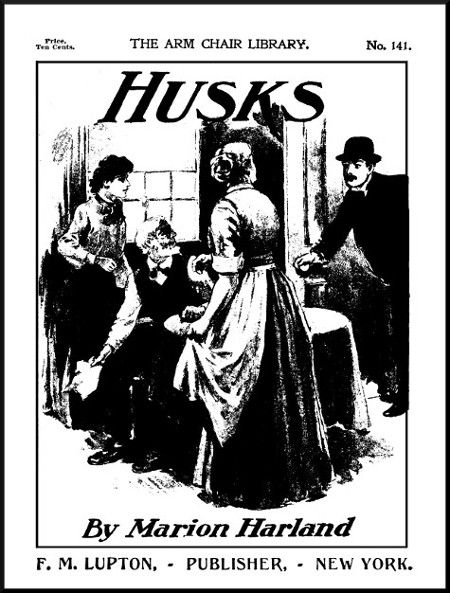
The Project Gutenberg eBook of Husks
Title: Husks
Author: Marion Harland
Release date: March 11, 2015 [eBook #48461]
Most recently updated: October 24, 2024
Language: English
Credits: Produced by Chris Whitehead, Demian Katz and the Online
Distributed Proofreading Team at http://www.pgdp.net (Images
courtesy of the Digital Library@Villanova University
(http://digital.library.villanova.edu/))
The cover image was restored by the transcriber and is placed in the public domain.
HUSKS.
BY MARION HARLAND.
CHAPTER I.
It was a decided uncompromising rainy day. There were no showers, coquetted with by veering winds or dubious mists, that at times grew brighter, as if the sun were burning away their lining; but a uniform expanse of iron-gray clouds—kept in close, grim column by a steady, although not violent east wind—sent straight lines of heavy rain upon the earth. The naked trees, that, during the earlier hours of the deluge had seemed to shiver for the immature leaf-buds, so unfit to endure the rough handling of the storm, now held out still, patient arms, the rising sap curdled within their hearts. The gutters were brimming streams, and the sidewalks were glazed with thin sheets of water.
The block of buildings before which our story pauses, was, as a glance would have showed the initiated in the grades of Gotham life, highly respectable, even in the rain. On a clear day when the half-folded blinds revealed the lace, silken and damask draperies within, when young misses and masters—galvanized show-blocks of purple and fine linen, that would have passed muster behind the plate-glass of Genin or Madame Demorest—tripped after hoops or promenaded the smooth pavement; when pretty, jaunty one-horse carriages, and more pretentious equipages, each with a pair of prancing steeds, and two "outside passengers" in broadcloth and tinsel hatbands, received and discharged their loads before the brown-stone fronts—had the afore-mentioned spectator chanced to perambulate this not spacious street, he would have conceded to it some degree of the fashion claimed for it by its inhabitants. There were larger houses and wider pavements to be had for the same price a few blocks further on, in more than one direction, but these were unanimously voted "less eligible" and "deficient in style," in spite of the fact that as good and better materials were employed in their construction, and they were in all respects equal in external show and inside finish to those in this model quarter. "But our block has a certain air—well—I don't know what; but it is just the thing, you know, and so convenient! So near the avenue!" would be the concluding argument.
The nameless, indescribable charm of the locality lay in the last clause. "Just step around the corner and you are in the avenue," said the favored dwellers in this vicinity, as the climax in the description of their abode, and "that way fashion lies" to every right-minded New Yorker of the feminine gender.
But the aristocratic quiet of the neighborhood, rendered oppressive and depressing by the gloom of the day, was disturbed by a discordant sound—a child's cry, and what was especially martyrizing to refined auriculars, the lament had the unmistakable plebeian accent. The passionate scream with which the pampered darling of the nursery resents interference with his rights and liberty of tyranny or the angry remonstrance of his injured playmates, would have been quite another species of natural eloquence, as regards both quality and force, from the weak, broken wail that sobbed along the wet streets. Moreover, what respectable child could be abroad on foot in this weather? So, the disrespectable juvenile pursued her melancholy way unnoticed and unquestioned until she reached the middle of the square. There a face appeared at a window in the second story of a house—which only differed from those to its right, left and opposite in the number upon the door—vanished and in half a minute more a young lady appeared in the sheltered vestibule.
"What is the matter, little girl?"
The tone was not winning, yet the sobs ceased, and the child looked up, as to a friendly questioner. She was about eleven years of age, if one had judged from her size and form; but her features were pinched into unnatural maturity. Her attire was wretched, at its best estate; now, soaked by the rain, the dingy hood drooped over her eyes; the dark cotton shawl retained not one of its original colors, and the muddy dress flapped and dripped about her ankles. Upon one foot she wore an old cloth gaiter, probably picked up from an ash heap; the remains of a more sorry slipper were tied around the other.
"I am so cold and wet, and my matches is all sp'ilt," she answered in a dolorous tone, lifting the corner of a scrap of oil-cloth, which covered a basket, tucked for further security under her shawl.
"No wonder! What else could you expect, if you would go out to sell them on a day like this? Go down into the area, there, and wait until I let you in."
The precaution was a wise one. No servant in that well-regulated household would have admitted so questionable a figure as that which crept after their young mistress into the comfortable kitchen. The cook paused in the act of dissecting a chicken; the butler—on carriage days the footman—checked his flirtation with the plump and laughing chambermaid, to stare at the wretched apparition. The scrutiny of the first named functionary was speedily diverted to the dirty trail left by the intruder upon the carpet. A scowl puckered her red face, and her wrathful glance included both of the visitants as alike guilty of this desecration of her premises. The housemaid rolled up her eyes and clasped her hands in dumb show of horror and contempt to her gallant, who replied with a shrug and a grin. But not a word of remonstrance or inquiry was spoken. It was rather a habit of this young lady's to have her own way whenever she could, and that she was bent upon doing this now was clear.
"Sit down," she said, bringing up a chair to the fire.
The storm beaten wanderer obeyed, and eagerly held up her sodden feet to the red grate.
"Have you no better shoes than those?"
"No, ma'am."
"Humph! Nor dress, nor shawl?"
"No, ma'am."
"Are you hungry?"
A ray shot from the swollen eyes. "Yes, ma'am."
The lady disappeared in the pantry and presently returned with five or six slices of bread and butter hastily cut and thickly spread, with cheese and cold meat between them.
"Eat!" She thrust them into the match-girl's fingers. "Wait here, while I go and look for some clothes for you."
As may be supposed, the insulted oracle of kitchen mysteries improved the time of the benefactress's absence by a very plain expression of her sentiments towards beggars in general, and this one in particular; which harangue was received with applause by her fellow-servants and perfect equanimity by its object. She munched her sandwiches with greedy satisfaction, watching, the while, the little clouds of steam that ascended from her heated toes. She was, to all appearances, neither a sensitive nor intelligent child, and had known too much of animal want and suffering to allow trifles to spoil her enjoyment of whatever physical comfort fell to her lot. Her mother at home could scold quite as violently as the cook was now doing, and she was more afraid of her anger, because she beat while she berated her. She was convinced that she stood in no such peril here, for her protectress was one in power.
"Have you eaten enough?" said the clear, abrupt voice behind her, as she held two sandwiches in her fingers, without offering to put them to her lips.
"Yes, ma'am. May I take 'em home?"
"Certainly, if you like. Stand up and take off your shawl."
She put around the forlorn figure a thick cloak, rusty and obsolete in fashion, but which was a warm and ample covering for the child, extending to the hem of her dress. The damp elf-locks were hidden by a knitted hood, and for the feet there were stockings and shoes and a pair of India-rubbers to protect these last from the water.
"Now," said the Humane Society of One, when the refitting was at an end, "where do you live? Never mind—I don't care to know that yet! Here is a small umbrella—a good one—which belongs to me. I have no other for myself when I go out in bad weather. I mean to lend it to you, to-day, upon the condition that you will bring it back to-morrow, or the first clear day. Will you do it?"
The promise was readily given.
"Here's an old thing, Miss Sarah," ventured the butler, respectfully, producing a bulky, ragged cotton umbrella from a corner of the kitchen closet. "It's risky—trusting such as that with your nice silk one."
"That will let in the rain, and it is entirely too large for her to carry. You understand, child? You are to bring this safely back to me, the first time the sun shines. Can you find your way to this house again?"
"Oh, yes, ma'am, easy. Thank you, ma'am!"
She dropped an awkward curtsey as Miss Sarah held open the door for her to pass, and went out into the rain—warm, dry and shielded against further damage from the storm.
Unheeding the significant looks of the culinary cabinet, Sarah Hunt turned away and ascended the stairs. She was a striking-looking girl, although her features, when in repose, could claim neither beauty of form nor expression. Her complexion was dark and pale, with a slight tinge of olive, and her hair a deep brown, lips whose compression was habitual, an aquiline nose, and eyes that changed from dreamy hazel to midnight blackness at the call of mind or feeling, gave marked character to her countenance. Her sententious style of address to the child she had just dismissed was natural, and usual to her in ordinary conversation, as was also the gravity, verging upon sombreness, which had not once during the interview relaxed into a smile.
The family sitting-room, her destination at present, and to which we will take the liberty of preceding her, was furnished elegantly and substantially, and there, leaning back in lounging chairs, were Miss Lucy Hunt, the eldest daughter of the household, and her bosom friend, Miss Victoria West. Each held and wielded a crochet needle, and had upon her lap a basket of many-hued balls of double or single zephyr worsted, or Shetland or Saxony wool, or whatever was the fashionable article for such pretty trifling at that date. Miss West had completed one-quarter of a shawl for herself, white and scarlet, and her friend had made precisely the same progress in the arduous manufacture of one whose centre was white and its border blue.
"Yours will be the prettiest," remarked Lucy regretfully. "Blue never looks well in worsteds. Why, I can't say, I'm sure. It is too bad that I can wear so few other colors. But I am such a fright in pink or scarlet or any shade of red!"
"As if you could be a fright in anything," returned her companion, with seeming indignation.
Lucy smiled, showing a set of faultless teeth that, to a stranger's first glance, would have appeared by far the most attractive point of her physiognomy. If closer examination discovered that her skin was pearly in whiteness and transparency, that her form was exquisite, with a sort of voluptuous grace; her hands worthy, in shape and hue, to become a sculptor's model; still, in the cold, unflattering light of this rainy afternoon her want of color, her light gray eyes, her yellow hair, drawn straight back from the broad, low brow, precluded the idea that she could ever, with all the accessories of artificial glare, dress and animation, be more than a merely pretty girl. Miss West knew better, and Lucy realized the power of her own charms with full and complete complacency. Secure in this pleasant self-appreciation, she could afford to be careless as to her every-day looks and home people. She saw and enjoyed the manifest surprise of those who, having seen her once in morning deshabille, beheld her afterwards in elaborate evening toilet. Then the abundant hair waved in golden ripples about the classic head, the most artfully simple of tasteful ornaments—a camellia, a rosebud, or a pearl hairpin, its sole adornment; her eyes, large, full and soft, were blue instead of gray, while the heat of the assembly-room, the excitement of the crowd, or the exultation of gratified vanity supplied the rounded cheek with rich bloom and dewy vermillion to the lips. But nature's rarest gift to her was her voice, a mellow contralto, whose skillful modulations stole refreshingly to the senses amid the sharp clash of strained and higher tones, the castanet-like jingle which most American belles ring unmercifully into the ears of their auditors. Lucy Hunt was not "a great talker," still less was she profound or brilliant when she did speak; yet she invariably conveyed the impression to the mind of a new acquaintance of a thoroughly cultivated woman, one whose acquirements were far beyond her modest exhibition of thought and sentiment. The most commonplace phrase came smoothly and roundly from her tongue, and he was censorious indeed who was willing to lose the pleasure afforded by its musical utterance in weighing its meaning. At school she had never been diligent, except in the study of music, and her painstaking in this respect was rewarded by the reputation, justly earned, of being the finest vocalist in her circle of associates. In society she shone as a rising star of the first magnitude; at home she was happy, cheerful and indolently amiable. Why should she be otherwise? From her babyhood she had been petted and admired by her family, and the world—her world—was as ready with its meed of the adulation which was her element.
There were, besides the two sisters already introduced to the reader, three other children in the Hunt household—a couple of sturdy lads, twelve and fourteen years of age, and little Jeannie, a delicate child of six, whom Lucy caressed with pet titles and sugar-plums of flattery, and Sarah served in secret and idolatrous fondness. This family it was Mrs. Hunt's care and pride to rear and maintain, not only in comfort, but apparent luxury, upon the salary which her husband received as cashier of a prominent city bank, an income sufficient to support them in modest elegance, but which few besides Mrs. Hunt could have stretched to cover the expense of their ostensible style of living. But this notable manager had learned economy in excellent schools, primarily as a country girl, whose holiday finery was purchased with the proceeds of her own butter-making and poultry-yard; then as the brisk, lively wife of the young clerk, whose slender salary had, up to the time of his marriage, barely sufficed to pay for his own board and clothes, and whose only vested capital was his pen, his good character and perfect knowledge of book-keeping. But if his help-meet was a clever housewife, she was likewise ambitious. With the exception of the sum requisite for the yearly payment of the premium upon Mr. Hunt's life insurance policy, their annual expenses devoured every cent of their receipts. Indeed, it was currently believed among outsiders that they had other resources than the cashier's wages, and Mrs. Hunt indirectly encouraged the report that she held property in her own right. They lived "as their neighbors did," as "everybody in their position in society was bound to do," and "everybody" else was too intent upon his personal affairs, too busy with his private train of plans and operations to examine closely the cogs and levers and boilers of the locomotive Hunt. If it went ahead, and kept upon the track assigned it, was always "up to time," and avoided unpleasant collisions, it was nobody's business how the steam was gotten up.
Every human plant of note has its parasite, and Miss Lucy Hunt was not without hers. There existed no reason in the outward circumstances of the two girls why Miss Hunt should not court Miss West rather than Miss West toady Miss Hunt. In a business—that is, a pecuniary—point of view, the former appeared the more likely state of the case, inasmuch as Victoria's father was a stock-broker of reputed wealth, and with a probable millionaireship in prospective, if his future good fortune equalled his past, while Mr. Hunt, as has been stated, depended entirely upon a certain and not an extravagant stipend. But the girls became intimate at school, "came out" the same winter at the same party, where Lucy created a "sensation," and Victoria would have been overlooked but for the sentimental connection between the debutantes. Since then, although the confidante would have scouted the imputation of interested motives with virtuous indignation of wounded affection, she had nevertheless "made a good thing of it," as her respected father would have phrased it, by playing hanger-on, second fiddle, and trumpeter general to the belle.
"As if you could be a fright in anything," she had said, naturally and perhaps sincerely.
Lucy's smile was succeeded by a serious look. "I am sadly tempted sometimes! Those lovely peach-blossom hats that you and Sarah wore this past winter were absolute trials to my sense of right. And no longer ago than Mrs. Crossman's party I was guilty of the sin of coveting the complexion that enabled Maria Johnston to wear that sweet rose-colored silk, with the lace skirt looped with rosebuds."
"You envy Maria Johnston's complexion? Why don't you go further and fall in love with her small eyes and pug nose?" inquired Victoria, severely ironical. "I have heard that people were never contented with their own gifts, but such a case of blindness as this has never before come under my observation."
"No, no! I am not quite so humble with regard to my personal appearance as you would make out. Yet"—and the plaintive voice might have been the murmur of a grieving angel—"I think that there are compensations in the lot of plain people that we know nothing about. They escape the censure and unkind remarks that uncharitable and envious women heap upon those who happen to be attractive. Now, there is Sarah, who never cares a button about her looks, so long as her hair is smooth and her dress clean and whole. She hates parties and is glad of any excuse to stay out of the parlor when gentlemen call. Give her her books and that 'snuggery,' as she calls it, of a room upstairs, and she is happier than if she were in the gayest company in the world. Who criticises her? Nobody is jealous of her face or manners or conversation. And she would not mind it if they were."
"She has a more independent nature than yours, my dear. I, for one, am rejoiced that you two are unlike. I could not endure to lose my darling friend, and somehow I never could understand Sarah; never could get near to her, you know."
"I do not wonder at that. It is just so with me, sisters though we are. However, Sarah means well, if her manner is blunt and sometimes cold."
The entrance of the person under discussion checked the conversation at this point, and both young ladies began to count their stitches aloud, to avoid the appearance of the foolish embarrassment that ever overtakes a brace of gossips at being thus interrupted.
Sarah's work lay on her stand near the window, where she had thrown it when the crying child attracted her notice, and she resumed it now. It was a dress for Jeannie. It was a rare occurrence for the second sister to fashion anything so pretty and gay for her own wear.
"Have you taken to fancy work at last?" asked Victoria, seeing that the unmade skirt was stamped with a rich, heavy pattern for embroidery.
"No!" Sarah did not affect her sister's friend, and did not trouble herself to disguise her feelings towards her.
Lucy explained: "She is making it for Jeannie. She does everything for that child."
"You are very sisterly and kind, I am sure," Victoria continued, patronizingly. "You must quite despise Lucy and myself for thinking of and doing so much for ourselves, while you are such a pattern of self-denial."
A blaze shot up in Sarah's eye; then she said, coldly: "I am not self-denying. Have I ever found fault with you or Lucy for doing as you like?"
"Oh, no, my dear. But you take no interest in what we enjoy. I dare say, now, you would think it a dull business to work day after day for three or four weeks together, crocheting a shawl which may go out of fashion before one has a chance to sport it at a watering-place."
"I certainly should!" The curl of the thin upper lip would have answered for her had she not spoken.
"And you hate the very sight of shellwork and cone-frames, and Grecian painting, and all such vanities?"
"If I must speak the truth, I do—most heartily."
Victoria was not easily turned from her purpose.
"Come, Sarah! Tell us what you would have us, poor trifling, silly things, do to kill the time."
"If you must be a murderer, do it in your own way. I have nothing to say in the matter."
"Do you mean that time never hangs upon your hands—that you are never ennuyee—blasee?"
"Speak English, and I will answer you."
"I want to know," said the persevering tormentor, "if the hum-drum books upstairs, your paint-box and your easel are such good company that you are contented and happy always when you are with them—if you never get cross with yourself and everybody else, and wonder what you were put into the world for, and why the world itself was made, and wish that you could sleep until doomsday. Do you ever feel like this?"
Sarah lifted her eyes with a wondering, incredulous stare at the flippant inquisitor.
"I have felt thus, but I did not suppose that you had."
"Oh, I have a 'blue' turn now and then, but the disease is always more dangerous with girls of your sort—the reading, thinking, strong-minded kind. And the older you grow, the worse you will get. I haven't as much book knowledge as you have, but I know more of the world we live in. Take my advice and settle down to woman's right sphere. Drive away the vapors with beaux and fancy-work now. By-and-by a husband and an establishment will give you something else to think about."
Sarah would have replied, but Lucy broke in with a laugh, light and sweet.
"You two are always at cross-questions! Why can't you be satisfied to let one another alone? Sarah and I never quarrel, Vic.. We agree to disagree. She gives me my way, and I don't meddle with her. If she likes the blues (they say some people enjoy them), where's the harm of her having them? They never come near me. If I get stupid, I go to bed and sleep it off. Don't you think I have done ten rows since breakfast? What a godsend a rainy day is, when one has a fascinating piece of work on hand!"
Too proud to seem to abandon the field, Sarah sat for half an hour longer, stitching steadily away at the complicated tracery upon the ground to be worked; then, as the dimmer daylight caused the others to draw near to the windows, she pushed aside her table and put by her sewing.
"Don't let us drive you away!" said Victoria's mock-polite tones, and Lucy added, kindly, "We do not mean to disturb you, Sarah, dear."
"You do not disturb me!" was the reply to the latter. The other had neither glance nor word.
Up another flight she mounted to a room, much smaller than that she had left and far plainer in its appointments. The higher one went in Mrs. Hunt's house the less splendid everything became. In the state spare chamber—a story below—nothing of comfort and luxury was wanting, from the carved rosewood bedstead, with the regal-looking canopy overshadowing its pillows, down to the Bohemian and cut-glass scent bottles upon the marble of the dressing-cabinet. Sarah's carpet was common ingrain, neither pretty nor new; a cottage bedstead of painted wood; bureau and washstand of the same material; two chairs and a small table were all the furniture her mother adjudged needful. To these the girl had added, from her pittance of pocket-money, a set of hanging bookshelves, a portable desk, an easel and two or three good engravings that adorned the walls.
She locked the door after her, with a kind of angry satisfaction in her face, and going straight to the window leaned upon the sash and looked down into the flooded street. Her eyes were dry, but there was a heaving in her throat, a tightening of the muscles about the mouth that would have made most women weep for very relief. Sarah Hunt would have scorned the ease purchased by such weakness. She did not despise the sad loneliness that girt her around, any more than the captive warrior does his cell of iron or stone, but she held that it would be a cowardly succumbing to Fate to wound herself by dashing against the grim walls, or bring out their sleeping echoes by womanish wailings. So, presently, her throat ached and throbbed no longer, the rigid muscles compressed the lips no more than was their wont, the hands loosened their vise-like grasp of one another—the brain was free to think.
The rain fell still with a solemn stateliness that befitted the coming twilight. It was a silent storm for one so heavy. The faint hum of the city, the tinkle of the car-bell, three blocks off, arose to her window above its plashing fall upon the pavement, and the trickle of the drops from sash to sill. A stream of light from the lamp-post at the corner flashed athwart the sidewalk, glittered upon the swollen gutter, made gold and silver blocks of the paving stones. As if they had waited for this signal, other lights now shone out from the windows across the way, and from time to time a broad, transient gleam from opening doors told of the return of fathers, brothers, husbands from their day's employment.
What was there in the line that should make the watcher catch her breath in sudden pain and lay her hand, with stifled moan, over her heart, as she repeated it aloud?
Witness with me, ye maternal Hunts, who read this page—you, the careful and solicitous about many things—in nothing more ambitious than for the advancement and success in life of your offspring—add your testimony to mine that this girl had all that was desirable for one of her age and in her circumstances. A house as handsome as her neighbors, an education unsurpassed by any of her late school-fellows, a "position in society;" a reasonable share of good looks, which only required care and cultivation on her part to become really distingue; indulgent parents and peaceably inclined brothers and sisters—read the list, and solve me, if you can, the enigma of this perturbed spirit—this hungering and thirsting after contraband or unattainable pleasures.
"Some girls will do so!" Mrs. Hunt assured her husband when he "thought that Sarah did not seem so happy as Lucy. He hoped nothing ailed the child. Perhaps the doctor had better drop in to see her. Could she be fretting for anything, or had her feelings been hurt?"
"Bless your soul, Mr. H. There's nothing the matter with her. She always was kind o' queer!" (Mrs. Hunt did not use her company grammar every day.) "And she's jest eighteen year old. That's the whole of it! She'll come 'round in good time, 'specially if Lucy should marry off pretty soon. When Sarah is 'Miss Hunt,' she'll be as crazy for beaux and company and as ready to jump at a prime offer as any of 'em. I know girls' ways!"
Nor am I prepared to say that Sarah, as she quitted her look-out at the high window at the sound of the dinner bell, could have given a more satisfactory reason for her discontent and want of spirits.
CHAPTER II.
Mrs. Hunt's china, like her grammar, was of two sorts. When her duty to "society" or the necessity of circumstances forced her to be hospitable, she "did the thing" well. At a notice of moderate length she could get up a handsome, if not a bountiful, entertainment, to which no man need have been ashamed to seat his friends, and when the occasion warranted the display she grudged not the "other" china, the other silver, nor the other table-linen.
She did, however, set her face, like a broad flint, against the irregularity of inviting chance visitors to partake of the family bread and salt. Intimate as Victoria West was with Lucy, she met only a civil show of regretful acquiescence in her proposal to go home as the dinner hour approached, and Robbie or Richard Hunt was promptly offered to escort her to her abode upon the next block. If she remained to luncheon, as she would do occasionally, Lucy, in her hearing, begged her mother to excuse them from going down, and to send up two cups of tea and a few sandwiches to the sitting-room. This slight repast was served by the butler upon a neat little tray, in a tete-a-tete service—a Christmas gift to Lucy "from her ever-loving Victoria," and sentimentally dedicated to the use of the pair of adopted sisters.
Therefore, Sarah was not surprised to find Victoria gone, despite the storm, when she entered the dining-room. An immense crumb-cloth covered the carpet; a row of shrouded chairs, packed elbow to elbow, stood against the further end of the apartment, and a set of very ordinary ones were around the table. The cloth was of whity-brown material, and the dishes a motley collection of halt and maimed—for all Mrs. Hunt's vigilance could not make servants miraculously careful. There was no propriety, however, according to her system of economy, in condemning a plate or cup as past service because it had come off second best, to the extent of a crack or nick or an amputated handle, in an encounter with some other member of the crockery tribe. "While there is life there is hope," was, in these cases, paraphrased by her to the effect that while a utensil would hold water it was too good to be thrown away.
It was not a sumptuous repast to which Sarah sat down after she had placed Jeannie in her high chair and tied the great gingham bib around her neck. On the contrary, it came near being a scant provision for the healthy appetites of seven people. Before Mr. Hunt, a mild, quiet little man, was a dish of stew, which was, in its peculiar line, a thing—not of beauty, but wonder.
Only a few days since, as I stood near the stall of a poultry vender in market, a lady inquired for chickens.
"Yes, ma'am. Roasting size, ma'am?"
"No. I want them for a fricassee."
"Ah"—with a look of shrewd intelligence. "Then, ma'am, I take it, you don't care to have 'em overly tender. Most ladies prefers the old ones for fricassee. They come cheaper and very often bile tender."
"Thank you," was the amused rejoinder. "The difference in the price is no consideration where the safety of our teeth is concerned."
Mrs. Hunt suffered not these scruples to hinder her negotiations with knowing poultry merchants. A cent less per pound would be three cents saved upon the chicken, and three cents would buy enough turnips for dinner. It is an ignorant housekeeper who needs to be informed that stewed chicken "goes further" than the same fowl made into any other savory combination. Mrs. Hunt's stews were concocted after a recipe of her own invention. Imprimis, one chicken, weight varying from two and a half to three pounds; salt pork, a quarter of a pound; gravy abundant; dumplings innumerable. It was all "stew," and if Jeannie's share was but a bare drumstick, swimming in gravy and buried in boiled dough, there was the chicken flavor through the portion.
For classic antecedent the reader is referred to the fable of the rose-scented clay.
To leave the principal dish, which justice to Mrs. Hunt's genius would not permit me to pass with briefer mention, there were, besides, potatoes, served whole (mashed ones required butter and cream), turnips and bread, and Mrs. Hunt presided over a shallow platter of pork and beans. What was left of that dish would be warmed over to piece out breakfast next morning. The children behaved well, and the most minute by-law of table etiquette was observed with a strictness that imparted an air of ceremonious restraint to the meal. If Mrs. Hunt's young people were not in time finished ladies and gentlemen, it was not her fault, nor was it for the lack of drilling.
"Do as I tell you; not as I do," were her orders in these matters. Since Lucy had completed her education, the mother added, "Look at your sister; she is never awkward." This was true. Lucy was born the fine lady. Refinement of manner and grace of movement, an instinctive avoidance of whatever looked common or underbred were a part of her nature. Only the usage of years had accustomed her to her mother's somewhat "fussy" ways.
Had she met her in company as Mrs. Anybody else, she would have yielded her the right of way with a feeling of amazement and amiable pity that one who meant so well should so often overdo the thing she aimed to accomplish easily and gracefully. Following out her excellent system of training, the worthy dame demanded as diligent and alert watching from her butler as if she were having a dinner party. The eggless rice pudding was brought on with a state that was absolutely ludicrous; but the family were used to the unsubstantial show and took it as a matter of course.
After the meal was over Mrs. Hunt withdrew to the kitchen for a short conference with the cook and a sharp glance through the closets. It was impossible that the abstraction of six slices of bread from the baking of the preceding day, three thick pieces of cheese and more than half of the cold meat she had decided would, in the form of hash, supply the other piece of the breakfast at which the beans were to assist, should escape her notice.
Mr. Hunt was reading the evening paper by the droplight in the sitting-room, Lucy was busy with her shawl, and Sarah told a simple tale in a low voice to Jeannie as she leaned upon her lap, when the wife and mother entered, with something like a bluster. All present looked up, and each one remarked the cloud upon her brow.
"What is the matter, mother?" said Mr. Hunt, in a tone not free from alarm.
"I am worried! That's the whole of it. I am downright vexed with you, Sarah, and surprised, too! What upon earth possessed you, child, to take that beggar into my kitchen to-day? After all I have told you and tried to learn you about these shameful impostors! I declare I was beat out when I heard it. And to throw away provisions and clothes upon such a brat!"
Lucy opened her great eyes at her sister, and Mr. Hunt looked perplexedly towards his favorite, for at heart he was partial to his second child.
"I took the poor creature to the fire, mother, because she was wet and cold; I fed her because she was hungry; I gave her some old, warm clothes of mine because hers were thin and soaked with rain."
"Poor little girl!" murmured Jeannie compassionately.
Sarah's hand closed instantly over the little fingers. The simple-hearted babe understood and sympathized with her motive and act better than did her wiser elders.
"Oh, I have no doubt she told a pitiful story, and shed enough tears to wet her through, if the rain had not done it already. If you listen to what these wretches say, and undertake to relieve their wants, you will soon have not a dress to your back nor a house over your head. Why didn't you send her to some society for the relief of the poor?"
"I did not know where to find one, ma'am."
This plain truth, respectfully uttered, confounded Mrs. Hunt for a second.
"Mrs. James is one of the managers in a benevolent association," she said, recovering herself. "You had ought to have given your beggar her address."
"Even if I had known that fact, mother, the girl would have been obliged to walk half a mile in the storm to find this one manager. What do you suppose Mrs. James would have done for her that was not in my power to perform?"
"She would have asked the child whereabouts she lived, and to-morrow she would have gone to hunt her up. If she found all as she had been told, which is not likely—these creatures don't give a right direction once in ten times—why, she would have brought the case before the board at their next meeting, and they would help them, if neither of her parents was a drinking character."
"God help the poor!" ejaculated Sarah, energetically. "God help the poor, if this is man's style of relieving his starving brother! Mother, do you think that hunger pinches any the less when the famished being is told that next week or next month may bring him one good meal? Will the promise of a bushel of coal or a blanket, to be given ten days hence, warm the limbs that are freezing to-night? Is present help for present need, then always unsafe, imprudent, insane?"
"That all sounds very fine, my dear." Mrs. Hunt grew cool as her daughter waxed warm. "But when you have seen as much of the world as I have you will understand how necessary it is to be careful about believing all that we hear. Another thing you must not forget, and that is that we are not able to give freely, no matter how much disposed we may be to do so. It's pretty hard for a generous person to say 'No,' but it can't be helped. People in our circumstances must learn this lesson." Mrs. Hunt sighed at thought of the curb put upon her benevolent desires by bitter necessity. "And, after all, very few—you've no idea how few—of these pretended sufferers are really in want."
This preluded a recital of sundry barefaced impositions and successful swindles practiced upon herself and acquaintances, to which Mr. Hunt subjoined certain of his personal experiences, all tending to establish the principle that in a vast majority of cases of seeming destitution the supplicant was an accomplished rogue and the giver of alms the victim of his own soft heart and a villain's wiles. Jeannie drank in every syllable, until her ideal beggar quite equalled the ogre who would have made a light supper off of Hop-o'-my-Thumb and brothers.
"You gave this match-girl no money, I hope?" said Mrs. Hunt, at length.
"I did not, madam. I had none to give her." Impelled by her straightforward sense of honesty that would not allow her to receive commendation for prudence she had not shown, she said, bravely: "But I lent her my umbrella upon her promise to return it to-morrow."
"Well!"
Mrs. Hunt dropped her hands in her lap, and stared in speechless dismay at her daughter. Even her husband felt it his duty to express his disapprobation.
"That was very unwise, my daughter. You will never see it again."
"I think differently, father."
"You are too easily imposed upon, Sarah. There is not the least probability that your property will be returned. Was it a good umbrella?"
"It was the one I always use."
"Black silk, the best make, with a carved ivory handle—cost six dollars a month ago!" gasped Mrs. Hunt. "I never heard of such a piece of shameful imprudence in all my born days. And I shouldn't wonder if you never once thought to ask her where she lived, that you might send a police officer after it, if the little thief didn't bring it back to you?"
"I did think of it." Sarah paused, then forced out the confession she foresaw would subject her to the charge of yet more ridiculous folly. "I did think of it, but concluded to throw the girl upon her honor, not to suggest the theft to her by insinuating a doubt of her integrity."
Mr. Hunt was annoyed with and sorry for the culprit, yet he could not help smiling at this high-flown generosity of confidence. "You are certainly the most unsophisticated girl of your age I ever met with, my daughter. I shall not mind the loss of the umbrella if it prove to be the means of giving you a lesson in human nature. In this world, dear, it will not do to wear your heart upon your sleeve. Never believe a pretty story until you have had the opportunity to ascertain for yourself whether it is true or false." And with these titbits of wordly wisdom, the cashier picked up his paper.
"Six dollars! I declare I don't know what to say to you, Sarah!" persisted the ruffled mother. "You cannot expect me to buy you another umbrella this season. You must give up your walks in damp weather after this. I can't say that I'm very sorry for that, though. I never did fancy your traipsing off two or three miles, rain or shine, like a sewing girl."
"Very well, madam!"
But, steadied by pride as was her voice, her heart sank at the possibility of resigning the exercise upon which she deemed that so much of her health, physical and mental, depended. These long, solitary walks were one of the un-American habits that earned for Sarah Hunt the reputation of eccentricity. They were usually taken immediately after breakfast, and few in the neighborhood who were abroad or happened to look out at that hour, were not familiar with the straight, proud figure, habited in its walking dress of gray and black, stout boots, and gray hat with black plume. It was a uniform selected by herself, and which her mother permitted her to assume, because it "looked genteel," and became the wearer. Especially did she enjoy these tramps when the threatening storm, in its early stages, kept others of her class and sex at home. The untamed spirit found a fierce pleasure in wrestling with the wind; the hail that ushered in the snow-storm, as it beat in her face, called up lustre to the eye and warm color to the cheek. To a soul sickening of the glare and perfume of the artificial life to which she was confined, the roughest and wildest aspects of nature were a welcome change.
I remember laughing heartily, as I doubt not you did also, dear reader, if you saw it, at a cut which appeared several years ago in the Punch department of "Harper's Magazine." A "wee toddler," perhaps four years old, with a most lack-a-daisical expression upon her chubby visage, accosts her grandmother after this fashion: "I am tired of life, grandmamma! The world is hollow, and my doll is stuffed with sawdust, and if you please, ma'am, I should like to go to a nunnery!"
Yet, that there are natures upon which the feeling of emptiness and longing herein burlesqued seizes in mere babyhood is sadly true. And what wonder? From their cradles, hundreds of children, in our so-called better classes, are fed upon husks. A superficial education, in which all that is not showy accomplishment is so dry and uninviting that the student has little disposition to seek further for the rich kernel, the strong meat of knowledge, is the preparatory course to a premature introduction into the world, to many the only phase of life they are permitted to see, a scene where all is flash and froth, empty bubbles of prizes, chased by men and women with empty heads, and oh, how often empty, aching hearts! Outside principles, outside affections, outside smiles, and most pitiable of all, outside piety! Penury of heart and stomach at home; abroad a parade of reckless extravagance and ostentatious profession of fine feeling and liberal sentiments!
"Woe," cried the preacher, "to them that make haste to be rich!" If he had lived in our day, in what biting terms of reprobation and contempt would he have declaimed against the insane ambition of those who forego the solid comforts of judicious expenditure of a moderate income would afford; spurn the holy quiet of domestic joys—neglect soul with heart culture—in their haste to seem rich, when Providence has seen that wealth is not to be desired for them! Out upon the disgusting, indecent race and scramble! The worship of the golden calf is bad enough, but when this bestial idolatry rises to such a pitch of fanaticism, that in thousands of households copies in pinchbeck and plated-ware are set up and served, the spectacle is too monstrous in its abomination! This it is that crowds our counting-rooms with bankrupts and our state-prisons with defaulters; that is fast turning our ball-rooms and other places of fashionable rendezvous into vile caricatures of foreign courts, foreign manners, and foreign vices; while the people we ape—our chosen models and exemplars—hold their side in inextinguishable laughter at the grave absurdity of our laborious imitation. It is no cause for marvel that, in just retribution, there should be sent a panic-earthquake, every three years, to shake men to their senses.
Such was the atmosphere in which Sarah Hunt had always lived. In the code subscribed to by her mother, and the many who lived and felt and panted and pushed as she did for social distinction, nothing was of real, absolute value except the hard cash. Gold and silver were facts. All things else were comparative in use and worth. The garment which, last winter, no lady felt dressed without, was an obsolete horror this season. The pattern of curtains and furniture that nearly drove the fortunate purchaser wild with delight, three years back, was now only fit for the auction room. In vain might the poor depleted husband plead for and extol their beauties. The fiat of fashion had gone forth, and his better half seasoned his food with lamentations, and moistened her pillow with tears until she carried her point. We have intimated that Sarah was a peculiar girl. Whence she derived her vigorous intellect; her strong, original turn of thought; her deep heart, was a puzzle to those who knew her parents. The mother was energetic, the father sensible, but both were commonplace, and followed, like industrious puppets, in the wake of others. They were pleased that Sarah brought home all the prizes offered at school, and both considered that she gained a right, by these victories, to pursue her studies at home, provided she did not obtrude her singular views and tastes upon other people. Mrs. Hunt sighed, frequently and loudly, in her presence, that her genius had not been for shell, or bead, or worsted work, instead of for reading volumes, that did not even decorate the show book-case in the library.
"If you must have so many books, why don't you pick out them with the tasty bindings?" she had asked her daughter more than once. "And I wish you would paint some bright, lively pictures, that would look handsome on the walls, instead of those queer men and women and cloudy things you have got upstairs. I'd have 'em framed right away, and be real proud to tell who done them."
Sarah remained proof against such hints and temptation, and, shrinking more and more from the uncongenial whirl around her, she turned her eager, restless spirit into her secret, inner life, where, at times, it was flattered into content by the idealities upon which it was fed; at others, ramped and raved, like any other chained wild thing. The sweetest drop of pleasure she had tasted for many a day was the thrill she experienced when the forlorn object she had rescued from the power of the storm stood before her, decently and comfortably clad. The rash confidence she had reposed in so suspicious a stranger was the outgoing of a heart too noble and true in every impulse to pause, for a moment, to speculate upon the chances of another's good or bad faith. The great world of the confessedly poor was an unknown field to her—one she longed to explore. Her footsteps loitered more often near the entrance of some narrow, reeking street or alley, down which she had promised her mother not to go, than on the spacious pave, where over-dressed women and foppish men halted at, and hung around bewitching shop windows. She wondered how such throngs of breathing beings contrived to exist in those fetid, cramped quarters; how they lived, spoke, acted, felt. The great tie of human brotherhood became daily more tense, as she pondered these things in her heart.
On this particular day, as she sat, silent and thoughtful, at her needle, the chit-chat of her companions less heeded than the continual dropping of the rain without, the wail of the shivering wanderer caused a painful vibration through every nerve. The deed was done! the experiment was tried. She was ashamed that an event so trivial held her eyes waking, far into the night. At least, she said to herself, she would not be without a lesson of some kind; would learn whether deceit and falsehood prevailed in the lowest, as well as the higher ranks of society. If, as she still strove to believe would be the case, the child returned the borrowed property, she would make use of her, as the means of entering upon a new sphere of research and action. After so complete a refutation of her theories respecting the utter corruption of all people, who had not enough to eat and to wear, her mother could not withhold her consent to her petition that she might become a lay-missionary—a present relief committee to a small portion of the suffering, toiling, ill-paid masses. She would then have a work to do—something to call out energy and engage feeling in healthy exercise—and soothed by the romantic vision, she fell asleep with a smile upon her lips.
The morning dawned between breaking clouds, that soon left the sky clear and bright. All through the day Sarah watched for her visitor of the preceding day—watched with nervousness she could not wholly conceal, from morn to night, for two, three days—for a week. Then she looked no longer while at home; her question, at entering the house, after a drive or walk, ceased to be, "Has any thing been left for me?" So palpable was her disappointment that her father forbore to make any allusion to her loss, and Lucy, albeit she was somewhat obtuse to the finer points of her sister's character, good-naturedly interposed to change the subject when her mother sought to improve the incident to her daughter's edification and future profit. Mr. Hunt was right in supposing that the "unsophisticated girl" had learned something. Whether she were happier or better for the lesson thus acquired was another thing.
Once again Sarah had an opportunity for speech with her delinquent protege. Two months later she was passing through a by-street in a mean neighborhood, very far up town, in her morning ramble, when her progress was arrested, for an instant, by two boys, who ran out of an alley across the walk. One overtook the other just in front of the lady, and catching him by his ragged collar, threw him down.
"That's right! beat him well! I'll help!" screeched a girl, rushing out of the court whence they had come.
Grinning with delight, she flung herself upon the prostrate form and commenced a vigorous assault, accompanied by language alike foul and profane.
Sarah recognized her instantly, and while she paused in mingled amazement and anger, the child looked up and saw her. In a twinkling she relinquished her grip of the boy's hair—jumped up and sped back into the dirty alley, with the blind haste of guilty fear.
Yes! Mr. Hunt was a wise man, who knew the world, and trebly sage in her generation was his spouse. If their daughter had never acknowledged this before, she did now, in her disgust and dismay at this utter overthrow of her dreams of the virtuous simplicity to be found in lowly homes, where riches and fashions were things unknown.
CHAPTER III.
Summer had come to the country with its bloom and its beauty, its harvests and its holidays. In town, its fever heat drew noisome smells from overcharged sewers, and the black, oily paste to which the shower that should have been refreshing had changed the dust of crowded thoroughfares. Cleaner pavements, in the higher portions of the city, burned through shoe-soles; glass radiated heat to polished stone, and stone radiated, in its turn, to brick, that waited until the evening to throw off its surplus caloric in hot, suffocating waves that made yet more oppressive the close nights. The gay procession of fashionable humming birds had commenced their migrations, steamboats and excursion craft multiplied at the wharves, and the iron steed put forth all his tremendous might to bear onward the long train of self-exiled travelers.
The Hunts, too, must leave town; Lucy must, at all events, have a full season, and a brilliant one, if possible, for it was her second summer, and much might depend upon it. Her mother would accompany her, of course; and equally of course her father could not; that is, he must return after escorting them to Saratoga, and spend the remainder of the warm months at home. His business would not allow him to take an extended vacation. The boys were easily disposed of, being boarded every summer at the farmhouse of an early friend of Mr. Hunt, where they were acceptable inmates, their clothes as well cared for as they were at home, and their morals more diligently cultivated. The younger girls caused that excellent manager, their mother, more perplexity. This was not the first time she had repented her indiscretion in allowing Sarah to "come out" before her elder sister had "gone off." But "Sarah was so tall and so womanly in her appearance that it looked queer, and would set people to talking if I kept her back," she was accustomed to excuse her impolitic move to her friends. This summer she realized, as she had not done before, the inconvenience of having two full-fledged young ladies upon the carpet at once. Lucy's elegant and varied wardrobe, and the certain expenses in prospect for her and her chaperon at Spa, seaside, and en route, left a balance in hand of the sum allotted for the season's expenditure that was startling in its meagerness. Mrs. Hunt was a capital financier, a peerless economist, but the exigency taxed her resources to the utmost.
One morning she arose with a lightened heart and a smoother brow. "I've settled it!" she exclaimed to her husband, shaking him from his matutinal doze.
The "Eureka!" of the Syracusan mathematician was not more lofty in its exultation. Forthwith she unfolded to him her scheme. She was a native of New Jersey, "the Jarseys" she had heard it called in her father's house—had probably thus denominated the gallant little state herself in her girlhood. In and around the pretty, quiet village of Shrewsbury there were still resident scores of her relatives whose very names she had sedulously forgotten. One alone she could not, in conscience or in nature, dismiss to such oblivion. This was her elder and only sister, long married to a respectable and worthy farmer, and living within a mile of "the old place," where both sisters had drawn the first breath of life. Twice since Mrs. Hunt had lived in the city had this kind friend been summoned on account of the dangerous illness of the former, and her presence and nursing had restored peace, order, and health to the household. The earlier of these occasions was that of the second child's birth, and in the softened mood of her convalescence Mrs. Hunt had bestowed upon the babe her sister's name—Sarah Benson—a homely appellative she had ofttimes regretted since. At distant and irregular intervals, one, two, three years, Mr. or Mrs. Benson visited their connections in "York;" but the intercourse grew more difficult and broken as time rolled on and the distance widened between the plain country folk and their rising relations. Then, again, death had been busy in the farmhouse; coffin after coffin, of varying lengths, but all short, was lifted over the threshold and laid away in the village graveyard, until but one was left to the parents of the seven little ones that had been given to them, and to that one nature had denied the gifts of speech and hearing. Grief and the infirmities of approaching old age disinclined the worthy pair to stir from home, and their ambitious sister was too busy in building up a "set" of her own, and paving the way for her daughters' distinction, to hide her light for ever so short a period in so obscure a corner as her former home.
Aunt Sarah, however, could not forget her nurseling. Every few months there arrived some simple token of affectionate remembrance to "the child" she had not seen since she wore short frocks and pinafores. The reception of a basket of fruit, thus despatched, was the suggestive power to Mrs. Hunt's present plan. She had made up her mind, so she informed her husband straightway, to write that very day—yes! that very forenoon, to "Sister Benson," and inquire whether she would board Sarah and Jeannie for a couple of months.
"I don't s'pose she will let me pay board for them, but she will be pleased to have 'em as long as they like to stay. It's never been exactly convenient for me to let any of the children go there for so many years, and it's so fur off. But dear me! sometimes I feel real bad about seeing so little of my only sister!"—a heavy sigh. "And there'll be the expenses of two saved, out and out, for they won't need a great variety of clothes in that out-of-the-way place."
"But how will the girls, Sarah and Jeannie, fancy being sent off so?" inquired Mr. Hunt.
"Oh, as to that, it is late in the day for my children to dispute what I say shall be done; and Sarah's jest that odd that she'll like this notion twenty times better than going to Newport or Saratoga. I know her! As to Jeannie, she is satisfied to be with her sister anywhere. She is getting thin, too; she looks real peaked, and there's nothing in creation so good for ailing children as the salt-water bath. They have first-rate still-water bathing not a quarter of a mile from sister's. It's jest the thing, I tell you! The wonder is it never came into my head before."
Mr. Hunt had his sigh now. "Somehow or other he was always down in the mouth when the family broke up for the summer," his wife frequently complained, and his lack of sympathy now excited her just ire.
"Upon my word, Mr. H.! anybody would think that I was the poorest wife in the world to you to see and hear you whenever I talk to you of my plans and household affairs. You look as if you was about to be hanged, instead of feeling obliged to me for turning, and twisting, and contriving, and studying, day and night, how to save your money, and spend what we must lay out to the best advantage. I can tell you what—there's few women would make your income go as far as I do."
"I know that, my dear. The question is"—Mr. Hunt paused, cleared his throat and strained his nerves for a mighty effort, an unprecedented exercise of moral courage—"the question is, Betsy, whether our income is stretched in the right direction!" Mistaking the stare of petrified incredulity he received for fixed attention, the infatuated man went on: "This doubt is always forced upon me when we separate in July, some to go to one place, some to another, a broken, wandering family for months together. I am growing old, and I love to have my children about me; I begin to feel the want of a home. There is Johnson, in the —— Bank, gets five hundred less per annum than I do; yet, after living quietly here a few years, he bought himself a snug cottage up the river, and has his family there in their own house, everything handsome and comfortable about them. I have been in the harness for a long while; I expect to die in it. I don't mind work—hard work! but it seems to me sometimes that we would all be better satisfied if we had more to show, or to hold, for our money; if there were less of this straining after appearances, this constant study to make both ends meet."
"And it has come to this!" Mrs. Hunt sank into a chair and began to cry. "This is my thanks for slaving and toiling for better than twenty years to get you and your children a stand in the world! It isn't for myself that I care. I can work my fingers to the bone, and live upon a crust! I can scrape and save five dollars or so a month! I can bury myself in the country! But your children! those dear, sweet girls, that have had the best education money can buy, and that to-day visit such people as the Murrays, and Sandersons, and Hoopers, and Baylors, and meet the Castors and Crinnalls at parties—millionaires, all of 'em, the cream of the upper crust! I don't deny that I have been ambitious for them, and I did hope that you had something of the same spirit; and now to think of your complaining, and moping, and groaning over the money you say I've been and wasted; oh! oh! oh!"
"You misunderstand me, my dear; I merely questioned whether we were acting wisely in making so much display upon so little substance. We are not millionaires, whatever may be said of the girls' visiting acquaintances, and I tremble sometimes to think how all this false show may end."
Mr. Hunt's borrowed courage had not evaporated entirely.
"That's distrusting Providence, Mr. H.! It's downright sinful, and what I shouldn't have looked for from you. I can tell you how it will end. If both of us live ten years longer, you will see your daughters riding in their own carriages, and leaders of the tong, and your sons among the first gentlemen of the city. If this does not turn out true, you needn't ever trust my word again. I've set my head upon getting Lucy off my hands this summer, and well off; and mark my words, Mr. H., it shall be done."
One part of her mother's prophecy was fulfilled in Sarah's manner of receiving the proposition so nearly affecting her comfort during the summer. Lucy wondered at the cheerful alacrity with which she consented to be "hidden away in that horrid bore of a farmhouse," and Jeannie cried as her elder sister "supposed that they would eat in Aunt Sarah's kitchen, along with the servant men."
"Lucy, be quiet!" interposed her mother. "Your aunt is not a common poor person. Mr. Benson is a man of independent means, quite rich for the country. They live very nicely, and I have no doubt but that your sisters will be happy there."
Sarah had drawn Jeannie to her, and was telling her of the rides and walks they would take together, the ducks and chickens they would feed, and the merry plunges in the salt water that were to be daily luxuries. Ere the recital was concluded, the child was impatient for the hour of departure, and indignant when she heard that Aunt Sarah must be heard from before they could venture to present themselves, bag and baggage, at her door. There was nothing feigned in Sarah's satisfaction; her preparations were made with far more pleasure than if she were to accompany Lucy. The seclusion that would have been slow death to the latter was full of charms for the book-loving sister. Aunt Sarah would be kind; the novel phases of human nature she would meet would amuse and interest her; and, besides these, there was Jeannie to love and pet, and river, field, and grove for studies and society. She panted for the country and liberty from the tyrannous shackles of city customs.
Aunt Sarah wrote promptly and cordially, rejecting the offered compensation, and begging for her nieces' company as long as they could content themselves in so retired a place. Simple-minded as she was, she knew enough to be sure that the belles and beaux of the neighborhood would be very unsuitable mates for her expected visitors. If her own girls had lived, she would have asked nothing higher for them in this world than to have them grow up respected, beloved, and happy, among the acquaintances and friends of their parents; but "Sister Betsy's children had been raised so differently!" she said to her husband. "I don't know what we will do to amuse them."
"They will find amusement—never fear," was the farmer's response. "Let city folks alone for seeing wonders where those that have lived among them all their lives never found anything uncommon. They are welcome to the pony whenever they've a mind to ride, and Jim or I will find time to drive them around a'most every day; and what with riding, and boating, and bathing, I guess they can get rid of the time."
Before the day set for the coming of the guests there appeared upon the stage an unexpected and welcome ally to Aunt Sarah's benevolent design of making her nieces' sojourn agreeable. This personage we will let the good woman herself describe.
"You needn't trouble yourself to fix up for tea, dear," she said to Sarah, the afternoon of her arrival, as she prepared to remove her traveling dress. "There's nobody here besides husband, and me, and Charley, except husband's nephew, Philip Benson, from the South. He comes North 'most every summer, and never goes back without paying us a visit. He's been here three days now. But he is just as easy as an old shoe, and sociable as can be, so you won't mind him."
"Uncle Benson has relatives at the South, then?" said Sarah, seeing herself called upon to say something.
"One brother—James. He went to Georgy when he wasn't more than sixteen years old, and has lived there ever since. He married a rich wife, I believe"—sinking her voice—"and has made money fast, I've heard. Philip never says a word about their wealth, but his father owns a great plantation, for husband asked him how many acres they worked. Then the children—there are four of them—have had fine educations, and always spend money freely. Philip is not the sort to boast of anything that belongs to him or his. He is a good-hearted boy. He was here the August my last daughter—my Betsy—died, and I shall never forget how kind and tender he was then. I can't look at him without thinking how my Alick would have been just his age if he had lived. One was born on the fourth and the other the fifth of the same April."
Keeping up a decent show of interest in these family details, Sarah divested Jeannie of her sacque and dress, and substituted a cool blue gingham and a muslin apron. Then, as the child was wild to run out of doors, she suffered her to go, charging her not to pass the boundary of the yard fence. Aunt Sarah was dressed in a second mourning delaine, with a very plain cap, and while the heat obliged Sarah to lay aside the thick and dusty garment she had worn all day, she had too much tact to offer a strong contrast in her own attire to her unpretending surroundings. A neat sprigged lawn, modest and inexpensive, was not out of place among the old-fashioned furniture of her chamber, nor in the "best room," to which they presently descended.
Aunt Sarah ushered her into the apartment with some stiffness of ceremony. In truth, she was not herself there often, or long enough to feel quite at ease, her property though it was. Alleging the necessity of "seeing to the tea," she bade her niece "make herself at home," threw open a blind that she "might see the river," and left her.
First, Sarah looked around the room. It was large and square, and had four windows, two in front and two in the rear. The floor was covered by a well-saved carpet, of a pattern so antique that it was in itself a curiosity; heavy tables of a mahogany dark with age; upright chairs, with slippery leathern seats; a ponderous sofa, covered with haircloth; small mirrors, with twisted frames, between the windows; two black profiles, of life-size, over the mantel, and in the fireplace a jar of asparagus boughs, were appointments that might have repelled the looker-on, but for the scrupulous, shining cleanliness of every article. It was a scene so strange to Sarah that she could not but smile as she withdrew her eyes and turned to the landscape commanded by her window.
The sight changed the gleam of good-humored amusement to one of more heartfelt pleasure. Beyond the grassy walks and flower-borders of the garden behind the house lay green meadows, sloping down to the river, broad and smooth at this point, so placid now that it mirrored every rope and seam of the sails resting quietly upon its surface, and the white cottages along the banks, while the banks themselves, with their tufts and crowns of foliage, drooping willows and lofty elms, found a faithful yet a beautified counterpart in the stream. The reflected blush of the crimson west upon its bosom was shot with flickers of golden light, and faded in the distance into the blue-gray twilight. The air seemed to grow more deliciously cool as the gazer thought of the hot, pent-up city, and the beds of thyme and lavender added their evening incense.
The hum of cheerful voices joined pleasantly with the soothing influences of the hour, and, changing her position slightly, Sarah beheld the speakers. Upon a turfy mound, at the foot of an apple tree, sat Jeannie beside a gentleman, whose hands she watched with pleased interest, as did also a boy of fifteen or thereabouts, who knelt on the grass before them. Sarah divined at once that this was her aunt's deaf and dumb son. The gentleman was apparently interpreting to Jeannie all that passed between himself and the lad, and her gleeful laugh showed it to be a lively dialogue. Could this be Mr. Benson's nephew, the beardless youth Sarah had pictured him to herself from Aunt Sarah's description? He could not have been less than six-and-twenty, had dark hair and a close curling beard, an intelligent, handsome face, and notwithstanding his loose summer sack and lounging attitude, one discerned plainly traces of uncommon grace and strength in his form.
"What is he, I wonder? A gallant, professional beau, who will entangle me in my speech, and be an inevitable appendage in the excursions? I flattered myself I would be safe from all such drawbacks," thought Sarah, in genuine vexation, as she obeyed her aunt's summons to tea.
Perhaps Mr. Benson read as much in her countenance, for, beyond a few polite, very unremarkable observations, addressed to her when his hosts made it necessary for him to do so, he paid her no visible attention during the whole of the evening. The next day he set off, the minute breakfast was over, with his gun and game-bag, and was gone until sunset.
Sarah sat at her chamber window as he came up to the back door; and, screened by the vine trained over the sash, she watched him as he tossed his game-bag to Charley and shook hands with Jeannie, who ran up to him with the familiarity of an old acquaintance.
"What luck?" questioned his uncle.
"Nothing to boast of, sir; yet enough to repay me for my tramp. I have been down to the shore."
"Philip Benson! Well, you beat everything! I suppose you have walked as much as ten miles in all!" exclaimed Aunt Sarah, with a sort of reproachful admiration.
"I dare say, madam, and am none the worse for it to-night. I am getting used to your sand, uncle; it used to tire me, I confess."
He disappeared into the kitchen, probably to perform the ablutions needful after his day's walk and work, for it was several minutes before he returned. Charley had carried the game-bag to the mound under the tree, and was exhibiting its contents—mostly snipe and red-winged black birds—to his little cousin.
"It is refreshing to see something in the shape of man that is neither an effeminate dandy nor a business machine," soliloquized Sarah. "Ten miles on foot! I would like to set that task for certain of our Broadway exquisites!"
"She isn't a bit like a city girl!" Aunt Sarah was saying, as she followed Philip into the outer air.
"I am glad to hear that she is likely to be a nice companion for you, madam. I thought, from her appearance, that you would suit each other," was the reply, certainly respectful enough, but whose lurking accent of dry indifference sent the blood to Sarah's face.