
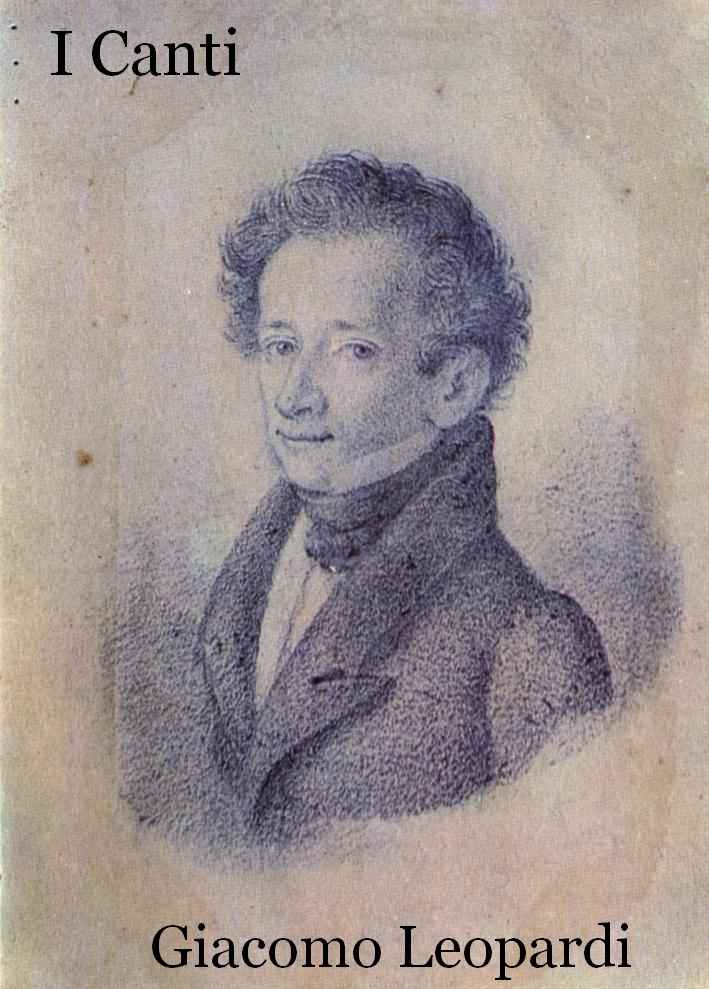
The Project Gutenberg eBook of I Canti
Title: I Canti
Author: Giacomo Leopardi
Release date: August 1, 2017 [eBook #55236]
Most recently updated: October 23, 2024
Language: Italian
Credits: Produced by Andrea Grappolo and Marc D'Hooghe at Free
Literature (online soon in an extended version, also linking
to free sources for education worldwide ... MOOC's,
educational materials,...) Images generously made available
by the Internet Archive.
I CANTI
di
GIACOMO LEOPARDI
| I | ALL'ITALIA. | |
| II | SOPRA IL MONUMENTO DI DANTE CHE SI PREPARAVA IN FIRENZE. | |
| III | AD ANGELO MAI. QUAND'EBBE TROVATO I LIBRI DI CICERONE DELLA REPUBBLICA. | |
| IV | NELLE NOZZE DELLA SORELLA PAOLINA. | |
| V | A UN VINCITORE NEL PALLONE | |
| VI | BRUTO MINORE | |
| VII | ALLA PRIMAVERA, O DELLE FAVOLE ANTICHE | |
| VIII | INNO AI PATRIARCHI, O DE' PRINCIPI DEL GENERE UMANO | |
| IX | ULTIMO CANTO Dl SAFFO | |
| X | IL PRIMO AMORE | |
| XI | IL PASSERO SOLITARIO | |
| XII | L'INFINITO | |
| XIII | LA SERA DEL DI Dl FESTA | |
| XIV | ALLA LUNA | |
| XV | IL SOGNO | |
| XVI | LA VITA SOLITARIA | |
| XVII | CONSALVO | |
| XVIII | ALLA SUA DONNA | |
| XIX | AL CONTE CARLO PEPOLI | |
| XX | IL RISORGIMENTO | |
| XXI | A SILVIA | |
| XXII | LE RICORDANZE | |
| XXIII | CANTO NOTTURNO DI UN PASTORE ERRANTE DELL'ASIA | |
| XXIV | LA QUIETE DOPO LA TEMPESTA | |
| XXV | IL SABATO DEL VILLAGGIO | |
| XXVI | IL PENSIERO DOMINANTE | |
| XXVII | AMORE E MORTE | |
| XXVIII | A SE STESSO | |
| XXIX | ASPASIA | |
| XXX | SOPRA UN BASSO RILIEVO ANTICO SEPOLCRALE, DOVE UNA GIOVANE MORTA E' RAPPRESENTATA IN ATTO Dl PARTIRE, ACCOMIATANDOSI DAI SUOI | |
| XXXI | SOPRA IL RITRATTO DI UNA BELLA DONNA SCOLPITO NEL MONUMENTO SEPOLCRALE DELLA MEDESIMA | |
| XXXII | PALINODIA. Al marchese Gino Capponi | |
| XXXIII | IL TRAMONTO DELLA LUNA | |
| XXXIV | LA GINESTRA, O IL FIORE DEL DESERTO | |
| XXXV | IMITAZIONE | |
| XXXVI | SCHERZO | |
| FRAMMENTI | ||
| XXXVII | "ODI, MELISSO" | |
| XXXVIII | "IO QUI VAGANDO" | |
| XXXIX | "SPENTO IL DIURNO RAGGIO" | |
| XL | DAL GRECO DI SIMONIDE | |
| XLI | DELLO STESSO |
Come prefazione alla ristampa dei Canti, che nel 1836-37, con l'aiuto del fido Ranieri, veniva preparando per l'editore parigino Baudry (Epist. III 39-42; Nuovi documenti, 267-71; Luiso, Ranieri e L., 2-5), il Leopardi avebbe messa la seguente
NOTIZIA INTORNO ALLE EDIZIONI DI QUESTI CANTI.
I due primi furono pubblicati in Roma nel 1818, con una lettera a Vincenzo Monti. Il terzo, con una lettera al conte Leonardo Trissino, nel 1820 in Bologna. Dieci Canti, cioè i nove primi e il diciottesimo, in Bologna nel 1824, con ampie Annotazioni, e copia d'esempi antichi, in difesa di voci e maniere dei medesimi Canti accusate di novità. Altri Canti pure in Bologna nel 1826: i quali coi sopraddetti dieci, e con altri nuovi, in tutto ventitré, furono dati susseguentemente dall'autore in Firenze nel 1831. Diverse ristampe di questi Canti, o tutti o parte, fatte dalle edizioni di Bologna o dalla Fiorentina, in diverse città d'Italia, essendo state senza concorso dell'autore, non hanno nulla di proprio. Undici componimenti non più stampati furono aggiunti nell'edizione di Napoli del 1835, e gli altri riveduti dall'autore e ritocchi in più e più luoghi. Dei Frammenti, i due primi erano già divulgati, gli altri non ancora. Le poche note poste appiè del volume furono cavate quasi tutte dalle edizioni precedenti. In questa Parigina sono aggiunti per la prima volta i Canti XXXIII e XXXIV, finora non istampati.
Il Canto XXXIII è Il tramonto della Luna; il XXXIV, La ginestra. (Cfr. Scritti letterari, II, 387).
Le Note ai Canti son quelle dell'autore; anche da noi relegate, com'egli fece, in fine.