
WeRead Powered by ReaderPub
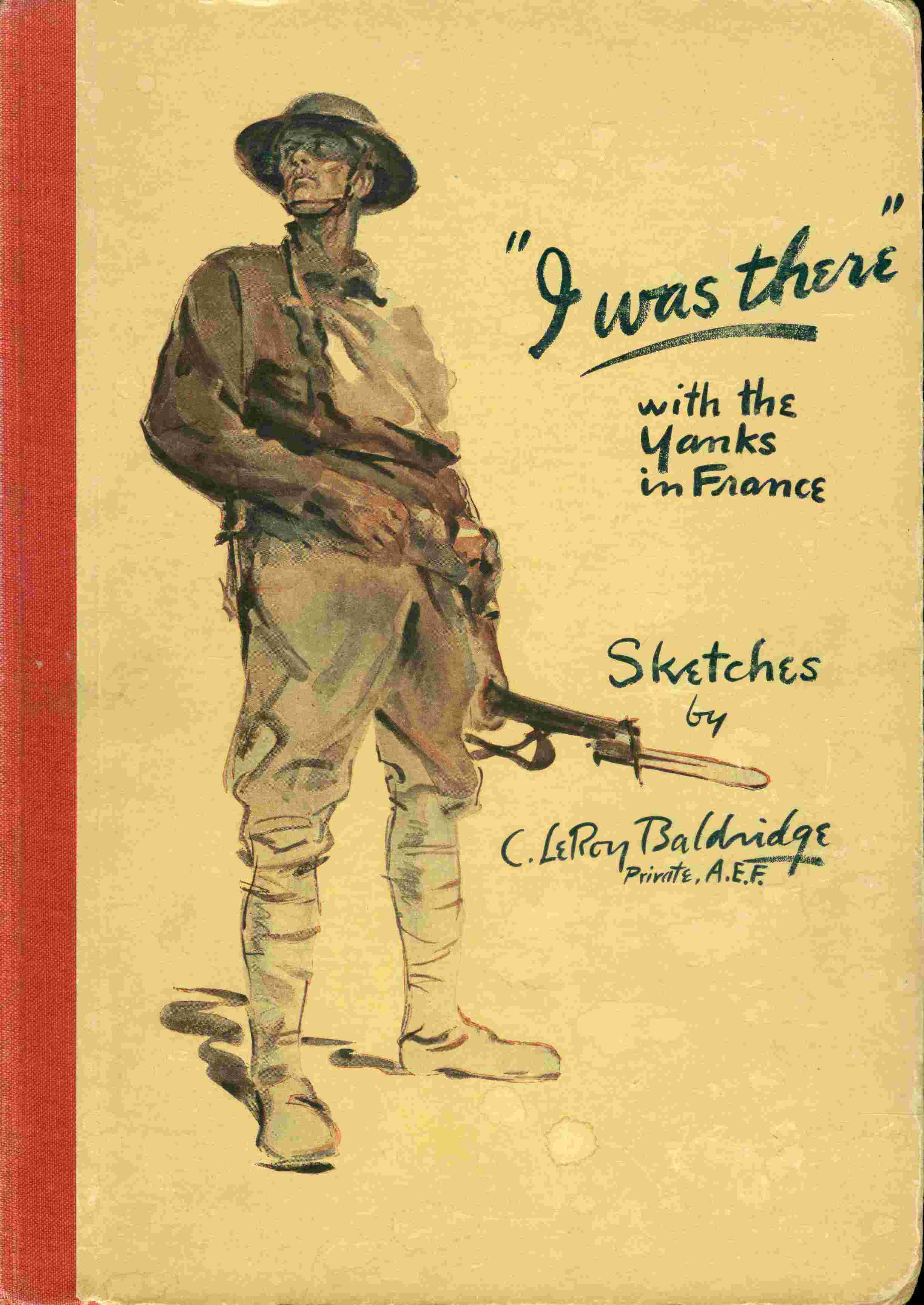
"I was there" with the Yanks on the western front, 1917-1919 cover

"I was there" with the Yanks on the western front, 1917-1919

Chapter 11: "MADELON"
Open in WeRead

About This Book

A collection of sketches and verses presents a firsthand account of life on the Western Front, recorded by a soldier-artist during service with French and American units. Drawings and poems depict trenches, artillery barrages, supply convoys, reliefs, and the daily routines of waiting, cleaning, and fatigue, alongside scenes of civilians, mascots, and comradeship. The tone alternates between wry humor and sober observation, emphasizing the ordinary hardships, small gestures, and visual details that shaped frontline existence.

"Coming out" after "The Washington Birthday Raid" Chemin des Dames$nbsp;1918

(Arabic script) An African Mohommedan, An Indo-Chinese Annamite and a prisoner who all crack rocks nine hours a day for the roads of France

French Colonials from Northern Africa used in shock troops


SALVAGE

I'll be stepping wide in these russet shoes!
Leather putts beside, honest I can't lose!
Guess the guy that had 'em left 'em in a hurry!
What the hell, he's S.O.L.
I should worry.
"That's my second razor!"
"Then gimme the blades."
"Whatcha got there, Buddy?"
"Pair of tailor-mades!"
I'll be walking on air! Yes...they was the top's!
He won't need 'em out there—if a big one drops.
"Going to keep that sweater?"
"No, look at the dirt."
"Put that on you, Buddy,
"You'll have to read your shirt!"
If I get that leave I can use 'em to dance.
Well, I should grieve,—he had his chance.
"Nothing doing! Beat it!"
"Saw that luger first!"
"Ten francs says I want it."
"Done. I'll cure this thirst."
Brand-new russet shoes, I'll be stepping high!
Someone's got to lose, glad I ain't the guy.
If I'm going to use 'em, guess I'll have to hurry,
The next H.E. may be meant for me—
I should worry!

The Gardener's Cottage

In 1870 he lost an arm, in 1917 he lost a son and everything he owns

Lafayette Escadrille Men—
Marcus who helps keep the big planes in order
Pilot
Observer
Loupont France Nov—'17

Making brooms from brushwood at Antibes for use on army roads.

The Signal Corps

The gold star
France, Aug. 1918

Both under Arms—The "pepère" of the '89 class and the Marie-Louise of the last call—Soissons France/17

Cafè group of poilus listening to an American popular song for the first time, sung by Yanks of The American Field Service

Home

Some of the first ones

Feet

Vaux—the town American artillery blew off the map (together with the German inhabitants)

Dugouts built for German officers near Soissons used by them in 1915. Decked out with cement and mosaic floors, tile roofs and stained glass windows. Used by our troops in 1918.

The American Trained Nurse
Am. Hospital No. 5

What one man is fighting for

"Once upon a time—"
Before leaving France 750,000 doughboys contributed enough to support 3,444 French war orphans for one year, and the "Stars and Stripes" newspaper left nearly three million francs toward their education

Annamites—French colonial troops from Indo-China. These paid Colonials were used as attacking troops, as laborers on roads and as drivers of light trucks.

(Blackened teeth are an aid to health and beauty)

An Oriental pipe and a French briquette to light it with

Le Sergent Tam
Lizy-sur-Ourq


EQUIPMENT C

The Loot is getting wabbly,
With his dinky little pack,—
He can hear the sergeant cussing
But he doesn't dare look back.
But we ain't saying nothing
Since we got the order "route,"
Too dog-dead for even wond'ring
If we'll ever hear "fall out."
My damn rifle and my helmet
Keep on getting in the way,
And my brains are numb and dopey
Try'n' to cuss and try'n' to pray.
My throat's as dry as sawdust
And my right arm's gone to sleep,
And the pack-strap on my shoulder
Cuts a slit two inches deep.
I just lift one foot and shove it
And it hits most any place,
Then I lift and shove the other
T'keep from falling on my face.
If the guide should change the cadence
I'll be damned if I could stop;
If you pushed me with a feather—
Well, I'd just curl up and drop.
And I know damn well there's stragglers
That'll ride up on a truck—
Guess if you ain't born a quitter,
You're just simply outa luck.
I suppose we'll keep on going—
Huh? The Skipper's faced about?
Halt!...I'm dreaming...in the daisies...
You don't need...to say..."fall out!"

For some of us the War will never end.

In an old Roman cellar two floors underground where civilians went during air raids as bombing planes passed over on their way to Compiegne, Paris, and interior cities. This "cave" was considered absolutely safe, but in October 1918 was completed demolished by one "155" shell.

Mess and distribution of mail at the "non-com" school for the M.T.C. at Longpont

Far from Broadway—S.R.O.—Christmas 1917 at a YMCA hut

Dressing a gas burn case

"Mission Ambrine"
Compiègne
Hospital for the treatment of burns

Americans quartered in the old abbey St. John de Vine of Soissons in the spring of '18

Henri, who tends sheep with his assistant (Leroy)

She teaches us French

Jean, who comes around at mess time for "confiture Americaine," and who has learned how to say "chewing gum" and "cigarette."

And Pierre picked the spuds

Their last war
Chateau Thierry—France 1918

The town of Cuffies (sur Aisne) held by the Germans till 1916, when the old inhabitants began moving back in; they were assisted in re-establishing their life there by the American Red Cross

The site of the home of Madam Crépin where the Red Cross set up a barrack cottage for her.

The Glory of Reims

Cut off from rations for three days in the wood—with one can of tomatoes for both food and drink—

A sixteen year old volunteer


"MADELON"

It seemed years since I had seen one,—
Years of hiking, sweat and blood,
Didn't think there was a clean one
In these miles of men and mud.
Well, I stood there, laughing, drinking,
Kidding her in bon fransay
But the things that I was thinking
Were a thousand miles away.
Sewed my stripe on like a mother,
Gee! She was a pretty kid...
But I left her like a brother,—
Shake her hand was all I did.
Then I says: "Vous, all right, cherry—"
And my throat stuck, and it hurt...
And I showed her what I carry
In the pocket of my shirt.

"Maison Comtois"

A second floor billet

Outpost at Hershback Germany

Madelon of the village, who washed our clothes—and who still has some of those we had to leave when we pulled out of the sector in the middle of the night

Neat but not gaudy
As we come home—on the transport.

Troops coming home from Marseilles go by way of Africa and stop to coal at Oran. Here the doughboy rests the French Arab soldier with whom He fought side by side at Soissons.

Ready to go Home

Reading the Draft Covenant for the League of Nations—Paris. (President Wilson, center, reads, other figures labelled as) General Bliss, Colonel House, Secretary Lansing, M. Clemenceau, Mr. Balfour

Peace Conference Feb 14 1919

Blue denims for the trip home
S.S. Canada
1919

Outpost at Molsberg, Germany, an ancient castle which stands just on the edge of the American occupied area and the Neutral Zone.


NOVEMBER ELEVENTH

We stood up and we didn't say a word,
It felt just like when you have dropped your pack
After a hike, and straightened out your back
And seem just twice as light as any bird.
We stood up straight and, God! but it was good!
When you have crouched like that for months, to stand
Straight up and look right out toward No-Man's-Land
And feel the way you never thought you could.
We saw the trenches on the other side
And Jerry, too, not making any fuss,
But prob'ly stupid-happy, just like us.
Nobody shot and no one tried to hide.
If you had listened then I guess you'd heard
A sort of sigh from everybody there,
But all we did was stand and stare and stare,
Just stare and stand and never say a word.