
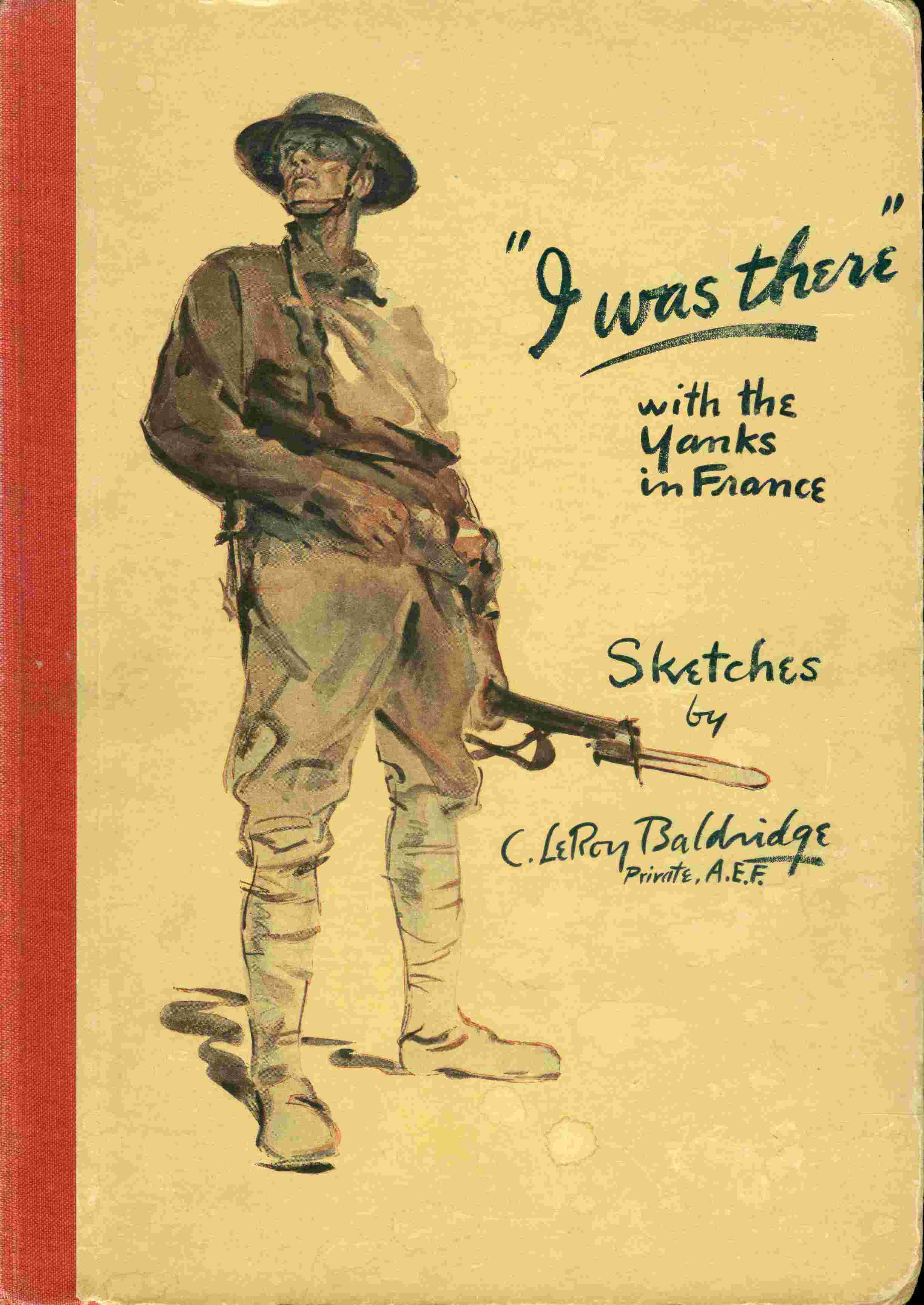
The Project Gutenberg eBook of "I was there" with the Yanks on the western front, 1917-1919
Title: "I was there" with the Yanks on the western front, 1917-1919
Author: Cyrus Leroy Baldridge
Hilmar R. Baukhage
Release date: May 29, 2005 [eBook #15937]
Most recently updated: September 25, 2025
Language: English
Credits: Produced by David Cortesi and the Online Distributed Proofreading Team.
“I WAS THERE”
WITH THE YANKS
ON THE WESTERN FRONT
1917-1919
BY
C. LEROY BALDRIDGE
PVT. A. E. F.
TOGETHER WITH VERSES
BY
HILMAR R. BAUKHAGE
PVT. A. E. F.
G. P. PUTNAM'S SONS
NEW YORK AND LONDON
The Knickerbocker Press
1919
Copyright, 1919
by
C. LEROY BALDRIDGE
TO OUR MOTHERS
These Sketches were made during a year's service as a camion driver with the French army in the Chemin-des-Dames sector and a year's service with the A.E.F. as an infantry private on special duty with "The Stars and Stripes," the official A.E.F. newspaper. Most of them were drawn at odd minutes during the French push of 1917 near Fort Malmaison, at loading parks and along the roadside while on truck convoy, and while on special permission to draw and paint with the French army given me by the Grand Quartier Gènèral during the time I was stationed at Soissons. The rest were drawn on American fronts from the Argonne to Belgium as my duties took me from one offensive to another.
It has been a keen regret to me that my artistic skill has been so unequal to these opportunites. The sketches do not sufficiently show war for the stupid horror I know it to be.
I hope, however, they may serve as a record of doughboy types, of the people he lived with in France, with whom he suffered and by whose side he fought.
Many appeared first in "The Stars and Stripes," "Leslie's Weekly", and "Scribner's Magazine", through the courtesy of whose editors I am now enabled to reprint them.
C. LeRoy Baldridge
Private, Am.E.F.
June 1919
I WAS THERE
Warming up the "corned willy" over the "corned heat" (solidified alcohol)
Rain overhead and mud underfoot
Baldridge Near Montfaucon / 18
Seicheprey.
America's old home sector—first
trenches entirely under
their own command.
THE LINE
The lids we wear—
Dungeree style...
The tin derby with winter knitted helmet...
Old "rain-in-the-face"...
The charming red-and-white effect...
Fuzzy-wuzzy...
The tank helmet...
Some managed to hang on to the old reliable...
With the French army...
With its canvas overcoat on
He used to hunt rabbits in Kentucky
The job that's never ended—Cleaning up for inspection
First time in two weeks!
Montmeuril
The letter from home
reading
The Ration Detail—a job which no one relishes. Each day the other fellow's artillery tries to lay down a fire which will keep these boys from getting back. They travel to where their supply company has dumped the food from mule carts—the point nearest front where creaking wheels may go. The man in the center is carrying a string of French loaves, the round black variety common before we got our own bakeries started.
The Headquarters Company of the Reserve Mallet taking its bath at Chavigny Farm. The tub is a tin-lined cigarette box used by the Y.M.C.A. Water is heated in the old farm fire-place.
“PREPARE FOR ACTION”
"Johnny Redlegs"—guardian of the "Soixante-quinze." (the famous French "75")
...and the doughboy who tries to keep just the right distance from the covering barrage fire.
"I know a girl at home who looks just like you."
6 June
"The Bugs"—Two men, French style tanks
An Indian M.P.—"A Chance to get even"
A Survival of the old regular army
Among the first sent across
They served with the French in '17
Reading their shirts
Her boy too...
American and French field artillery gun crews camped together in a wood near Charsoney. The canvas overhead keeps the fire from being observed by aeroplanes at night.
The linesman at the front—Same old job with just a couple percent more risk than usual
Using a shell-shocked tree for a telegraph pole.
St. Mihiel 1918
Dumb Beasts:
In the Missouri draft
Wagon train
bucks: "Maud" and "Mud"
Former refugee—now mascot and the only man in the outfit who likes monkey meat
Yanks with French Type of Anti-Aircraft
The Aeroplane Fight
The Relief—
Coming up to the front lines through the communication trenches, which
extend a kilometer or so. On these occasions little love is lost on
"beautiful moonlight nights"
The roofs of Vaux after a few minutes of Yank barrage lifted—
"The Germans have gone!"—St. Mihiel
The shell hole Central
On Guard
The noncombatant—
The family with whom I lived in Soissons
In 1870 Grandpère was taken as a prisoner to Coblenz
Madam Framary who sewed on my buttons and who transformed miserable French army rations into marvelous dishes
Erasme, the youngest son who starts his three years of compulsory training in the fall 1919
The eldest son. After his three years of training he was called to war. He has never come back.
Soissons—1918
Awaiting the signal to attack. The sergeant is ready to blow the whistle for his squad to follow him out through a path in the barbed wire. In another minute they will advance close behind the bursting shells of a heavy barrage which, lifting, will leave them face to face with German machine guns.
"American Field Service"
drivers at Longpont/1917
The "Territorial"—the name given French poilu between the ages of 34 and 40. Vailly—1917
Noyon, 1918
The Paris Bus—many kilometers from the Place de l'Opèra—used for transporting troops, horses, and fresh meat to the front
FATIGUE
Built for speed
and with light pack to match
R.B.—Belleau Wood
1918
A Marine
"Steady, buddy!"
Baldridge
Paris 1919
Never too far gone for a smoke
But he wears the Legion of Honor and the "Croix de Guerre"
In an abri waiting for the "Gothas" (big German planes) to go home
The veteran of the Spanish-American war tells 'em how it ought to be done
R. Lufbery—Sketched at the Lafayette Escadrille field near Longpont as the aviator was getting into his "union suit" preparatory to flying in a Chemin-des-Dames engagement
Base port stevedores—Volunteers from the South who work eight hours a
day for seven days a week
Bordeaux/18
A 26th Division Wagon Train moving toward Chasseurs wood—1918
Mule and Prairie Schooner in a country made desert by war
The end of his service
Veterans of the Marne
POILU
Chemin des Dames '17
American being taught by Frenchman to drive truck so that the latter may
return to his farm.
France/17
Moving up—
over a corduroy road hastily laid down by a gérre (engineer) regiment in
war-wasted land. The piece of wall on the right is all that remains of
a French village of five hundred inhabitants
(Arabic script) Arabian Knight
(Arabic script) Between drives he works on the railroad
(Arabic script) On other days he rides a camel in Algeria
Senegalaise types / voluneers used for the attack and for labor on roads Vailly 1917
The aumônier—poilu priest who marches with the troops.
Of the youngest class
A father of the class of '89
Moulin Laffaux
Un cannonier marin sur le front
He handles a big naval gun mounted on railroad cars near Soissons
French "corvée" laborers.
In the war of 1870 he drove a team instead of a camion.
Too old to serve in the active army and so assigned to the more unromatic, uninteresting but vital work of loading camions, tending horses, or building and repairing roads back of the lines. It has been said that the first battle of Verdun was won by the camion service. This is the kind of man who made that victory possible
A "walking case"—France, August -18
Toul(?) sector days—Waiting
for something to happen—
France/17
Un grand blessé
A Medal for Valor
A wounded Chasseur and "Fritz" who has the next cot. They get the same treatment and neither seems to mind the proximity
An American ambulance at a poste de secours (first aid station)
Ostel—1917
An old trench in the Argonne near Montfaucon
The edge
THAT QUIET SECTOR
The water wagon filled with red-hot coffee going to the ration dump via shell fire and not losing any time about it— Outside Belleau wood—June '18
He's been on every front from Chateau-Thierry to the Rhine
Coblenz—1919
After the German Retreat
Cleaning up old quarry used by Fritz as a barracks—Chemin-des-Dames
"Wagon Soldiers" (nickname for artillerymen)
Made in America—France Aug. 1918
"Marraines" (Godmothers) who kept their poilu godsons at the front in good cheer with letters and packages from home, and who took their Yank cousins to their hearts in the same kindly spirit
Sophie—Marie—Madeleine
in Paris and the provinces—
A type to match the ideal of every man who looks
"Papa Perrin"
Soissons
1917
No one knows where the poilu slang word "Pinard" came from, but everyone knows what it means. It's half way between water and red wine, with the kick mostly in the taste. It is served as an army ration. The poilu's canteen is always full of it.
"We ain't no thin red 'eroes, Nor we aren't no blackguards too."
One of the Agent-de-ville = M.P. teams of Paris patrolling the
boulevard. They have authority over both Yank and poilu.
Paris 1919
Belgian Types
The Tommy—Montdiddier 1918
In the month of July
Caught by a star shell at a listening post, and attempting to "freeze" like a rabbit with the hunter upon him, to look as much like a lump of mud as possible until the glare dies down.
Americans quartered in the mediaeval monastary of Pont St. Maxence
French Colonial Types: White, black, and half-way
From Algeria
A Zouave
From Morocco
"P.Gs" (prisonneurs de la guerre) who are keeping in physical trim by
lumber work in a forest where once the kings of France took their
morning walks
Croix St. Ouen 1918
A Yank going on leave
having a midnight cup
of "vin rouge" in a compartment
of a Permissionnares' Train—with a soixante-quinze gunner, a sailor
from a submarine, a
chasseur, an aviation sergeant, and several infantrymen. For the next
ten days of "permission" these men can forget war.
En route—Nice/1918
The barber shop quartette on the trip home— (no ocean rules about noise this time).
Coming Out! dirty, tired and grinning!
Chateau Thierry
June—1918
MAIL!
Brought up to the front by the ration detail
Forty feet underground in an old stone quarry formerly used by the Germans as barracks. Near Fort Malmaux
This is the cellar of her home. The house above no longer exists. For her living she washes clothes for the soldiers. Her daughter with two young children is a prisoner in Belgium. A third grandchild lives in this cave
Poulet
"Lui"
This one has won three army citations
"la soupe"
Liaison dog to carry messages
Red Cross dog
Jack - a yank volunteer
French dogs loaned by private families and trained by the army for use as Red Cross aids, sentinels, and message carriers. Intelligence the only qualification—any breed goes
Kénaro / S'aïd
Two dogs who worked together at Verdun
Sultane / Picard / Marraine / Filon
"mort pour la patrie"
The O.D. Circuit
"Pull the shades down Mary Ann"
A love song from The East—
Our own jazz band