
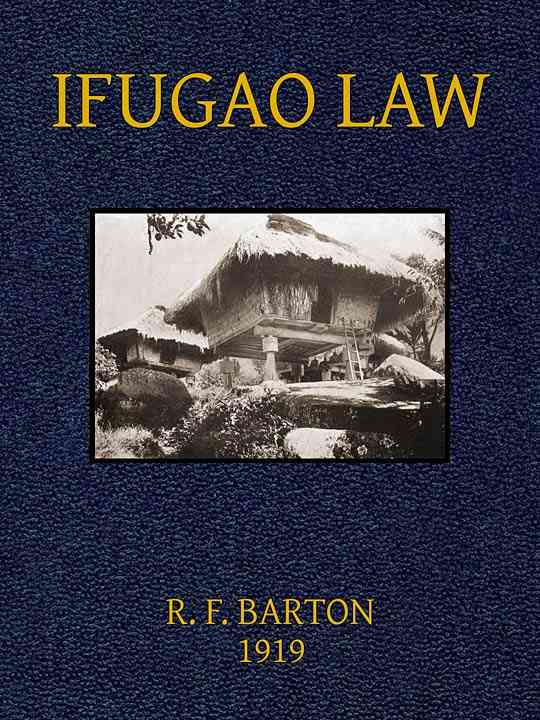
The Project Gutenberg eBook of Ifugao Law
Title: Ifugao Law
Author: Roy Franklin Barton
Release date: September 20, 2012 [eBook #40807]
Most recently updated: October 23, 2024
Language: English
Credits: Produced by Jeroen Hellingman and the Online Distributed
Proofreading Team at http://www.pgdp.net/ for Project
Gutenberg (This file was produced from images generously
made available by The Internet Archive/American Libraries.)
Vol. 15, No. 1, pp. 1–186, plates 1–33
“We are likely to think of the savage as a freakish creature, all moods—at one moment a friend, at the next moment a fiend. So he might be were it not for the social drill imposed by his customs. So he is, if you destroy his customs, and expect him nevertheless to behave as an educated and reasonable being. Given, then, a primitive society in a healthy and uncontaminated condition, its members will invariably be found to be on the average more law-abiding, as judged from the stand-point of their own law, than is the case in any civilized state.
“Of course, if we have to do with a primitive society on the down-grade—and very few that have been ‘civilizaded,’ as John Stuart Mill terms it, at the hands of the white man are not on the down-grade—its disorganized and debased custom no longer serves a vital function. But a healthy society is bound, in a wholesale way, to have a healthy custom.”
R. R. Marrett, in Anthropology.
Contents
Page
Sources of Ifugao law and its present status of development 11
- 1. Relation of taboo to law 11
- 2. Scope of customary law 14
- 3. Connection of law and religion 14
- 4. General principles of the Ifugao legal system 14
- 5. Stage of development of Ifugao law 16
Marriage 17
- 6. Polygamy 17
- 7. Nature of marriage 17
- 8. Eligibility to marriage 18
- 9. The two ways in which marriage may be brought about 18
- 10. Contract marriage 19
- 11. Marriage ceremonials 21
- 12. Gifts to the kin of the bride: hakba 22
- 13. Obligations incurred by those who enter into a marriage contract 24
- 14. The binawit relation 25
- 15. Property rights acquired by marriage 26
Divorce 30
- 17. Divorce because of necessity 30
- 18. Divorce for mutual benefit 30
- 19. Divorce which may be demanded by either party 30
- 20. Cases where divorce may be demanded by one party or the other 31
- 21. The hudhud, or payment for mental anguish 32
- 22. Divorce ceremonies 33
- 23. Property settlements in case of divorce 33
Dependents in relation to family law 34
- 24. Adopted children 34
- 25. Servants 34
- 26. Slaves 35
- 27. Definition of illegitimacy; its frequency 36
- 28. Obligations of father to bastard child 36
- 29. Determination of parentage 37
Reciprocal obligation of parents and their children 37
- 33. The Ifugao attitude toward family property 39
- 34. Rice lands 40
- 35. Forest lands 40
- 36. Heirlooms 40
- 37. Sale of family property 41
- 38. Definition 41
- 39. Houses 41
- 40. Valuable trees 41
- 41. Rice and forest lands 42
- 42. “Homesteading” 43
- 43. Paghok, or landmarks 43
- 44. Right of way through property owned by others 43
Transfers of property for a consideration 44
- 46. The balal 44
- 47. Sales of family property 45
- 48. Responsibility of seller after property has left his hands 49
Transfers of property arising from family relationships 50
- 49. Methods of transfer 50
- 50. Assignment and transfer of property during the lifetime of the owner 50
- 51. Inheritance 50
- 52. The passing of property between relatives because of relationship 50
- 53. The law of primogeniture 51
- 54. The passing of property to legitimate sons and daughters by assignment or inheritance 51
- 55. The passing of property to other relatives 51
- 56. Property rights of bastards 52
- 57. Transfers of property to adopted children 53
- 58. Servants and slaves as inheritors 54
- 59. Wills and testaments 54
Settlements of debts of the aged and deceased 55
- 60. When the debtor has children 55
- 61. When the debtor is childless but leaves a spouse 55
- 62. Debts for which the kin of the deceased are held 55
- 63. Attitude toward debts 56
- 64. Lupe, or interest 56
- 65. Patang, or interest paid in advance 56
- 66. Another form of patang 57
Go-betweens 57
- 67. The go-between 57
- 68. Responsibility of go-betweens 57
- 69. Conditions relieving a go-between of responsibility 58
- 70. Payment due those who find the body of one dead by violence 58
Contracts for the sale of property 59
- 71. On whom binding 59
- 72. The law as to new fields 59
- 73. The law as to water 60
- 74. The law as to irrigation ditches 60
Penalties 61
Circumstances which affect penalty 63
- 76. Moral turpitude not a factor 63
- 77. The nungolat, or principal 63
- 78. The tombok, or “thrower” 64
- 79. Iba’n di nungolat, “the companions of the one who was strong” 64
- 80. The montudol, “shower,” or informer 64
- 81. Servants who commit crimes at the bidding of their masters 64
- 82. Likelihood to punishment 65
- 83. Drunkenness and insanity in relation to criminal responsibility 65
- 84. The relation of intent to criminal responsibility 65
Other factors affecting liability 66
- 85. Alienship 66
- 86. Confession 66
- 87. Kinship 67
- 88. Rank and standing in the community 67
- 89. Importance of influential position and personality 68
- 89a. Cripples and unfortunates 68
The principal crimes and their frequency 69
- 90. List of offenses 69
Sorcery 70
- 91. The ayah or soul-stealing 70
- 92. Other forms of sorcery 70
- 93. Punishment of sorcery 71
Adultery 72
- 94. Forms of adultery 72
- 95. Punishment of adultery 73
- 96. Sex in relation to punishment for adultery 74
- 97. General considerations 75
- 98. Executions justifiable by Ifugao law 76
- 99. Feuds 77
- 100. War 77
- 101. Head-taking 78
- 102. Hibul, or homicide 78
- 103. Attempts to murder 79
- 104. Wounding 79
- 105. Special liability of the givers of certain feasts 79
- 106. The labod, fine assessed for homicide 81
- 107. Accidental killing of animals 82
- 108. Malicious killing of animals 83
Putting another in the position of an accomplice 83
Theft 85
- 110. Of theft in general 85
- 111. Theft of rice from a granary 86
- 112. Theft of unharvested rice 86
- 113. Illegal confiscation 86
Arson 87
- 114. Fines assessed for goba or arson 87
Kidnapping 87
Incest 88
- 116. Rarity of such offenses 88
Rape 88
- 117. Both parties being unmarried 88
- 118. Rape of a married woman by an unmarried man 89
- 119. Rape of a married woman by a married man 89
Ma-hailyu, or minor offenses 89
- 120. False accusation 89
- 121. Baag or slander 90
- 122. Threats of violence 90
- 123. Insult 90
The family in relation to procedure 92
- 124. Family unity and coöperation 92
- 125. Nature of his duties 94
Testimony 95
Ordeals 96
- 127. Cases in which employed 96
- 128. The hot water ordeal 96
- 129. The hot-bolo ordeal 97
- 130. Alao, or duel 97
- 131. Trial by bultong or wrestling 97
- 132. The umpire and the decision 99
- 133. Retaliation 99
- 134. Seizure of chattels 100
- 135. Seizure of rice fields 102
- 136. Enforced hospitality 103
- 137. Kidnapping or seizure of persons 104
- 138. Cases illustrating seizure and kidnapping 104
- 139. The usual sense of the term “paowa” 107
- 140. Another sense of the term “paowa” 107
Termination of controversies: peace-making 108
- 142. Neutrality 109
- I. Ifugao reckoning of relationship 110
- II. Connection of religion with procedure 110
- III. Parricide 120
- IV. Concubinage among the Kalingas 121
Glossary 122
Preface
There is no law so strong as custom. How much more universal, willing, and spontaneous is obedience to the customary law that a necktie shall be worn with a stiff collar than is obedience to the ordained law against expectoration on sidewalks; notwithstanding that the latter has more basis in consideration of the public weal and even in aesthetics.
This little paper shows how a people having no vestige of constituted authority or government, and therefore living in literal anarchy, dwell in comparative peace and security of life and property. This is owing to the fact of their homogeneity and to the fact that their law is based entirely on custom and taboo.
The Ifugaos are a tribe of barbarian head-hunters. Nevertheless, after living among them for a period of eight years, I am fully satisfied that never, even before our government was established over them, was the loss of life from violence of all descriptions nearly so great among them as it is among ourselves. I do not, however, wish to be understood as advocating their state of society as ideal, or as in any way affording more than a few suggestions possibly to our own law-makers. Given dentists and physicians, however, I doubt gravely if any society in existence could afford so much advantage in the way of happiness and true freedom as does that of the Ifugaos.
But we must realize that probably neither security of the individual life nor even happiness are the chief ends of existence. The progress and evolution of our people are much more important in all probability, and this seems to demand the sacrifice of ease and freedom and of much happiness on the part of the individuals composing our society.
Acknowledgments are due first to my teacher and friend, Professor Frederick Starr, for his encouragement and assistance, and, above all, for his inculcation of respect for and tolerance toward customs other than our own.
Captain Jeff D. Gallman, whose work among the Ifugaos stands to the credit of our government of the Philippines second to that of no other man in the archipelago, assisted me in many ways. He is a man learned in the “lore of men,”
“Who ha’ dealt with men
In the new and naked lands.”
Dr. David P. Barrows, now Major Barrows, also rendered me indispensable aid and encouragement. Dr. A. L. Kroeber of the chair of anthropology, University of California, and his associates, Dr. T. T. Waterman and Mr. E. W. Gifford, have read the manuscript and proofs and have made valuable suggestions which are incorporated in the paper as finally published. These gentlemen have been unstintedly generous in welcoming a newcomer in the field in which they are so preëminent.
Dr. George W. Simonton has kindly assisted in preparing the manuscript for the printer.
The photographs, with one exception, were taken by myself.