
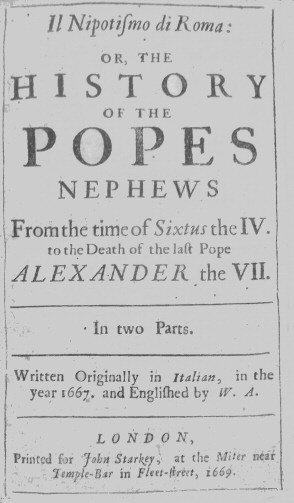
And indeed the people of the Ecclesiastical State are so ill satisfied, and so ill treated by the ill Government of Rome, that is by the Popes Nephews who domineer and lord it over them, that from morning to night they fill the air with their exclamations, from one corner, When will there be an end of their Extortions? from another, O God revenge the cruelties of these Nephews, who have ruin’d us. Nor do the curses thrown out against the Nephews rest at the people only: The very Priests and Ecclesiasticks themselves do daily sacrifice upon their Altars for the destruction of them, who devouring all they can get, leave not the good people so much as will pay for the celebration of a Mass.
In the time the Duke of Parma was in Arms against the State Ecclesiastick, then in the possession of the Barberini, the Cardinal Francesco gave order for the performing the forty hours prayers in his Cathedrals to incourage the People, and to oblige them to pray to God for the extirpation of the enemies of the Church. But whilst the Letany of the Saints was singing, a certain Roman Gentleman, at the pronounciation of these words, Ut inimicos Sanctæ Ecclesiæ humiliare digneris, told a Friend of his that was by, The Church has no greater Enemies than the Barbarini, who molest it both at home and abroad, so that our Prayers to heaven ought to be, to be delivered from them and their Arms.
From hence it may be argu’d, That they who bear a secret hatred and detestation of the Nephews, retain it even in the Church, and the place where they ought to pardon all, and are still contriving revenge; and because they find there is no sure way of freeing themselves from their tyranny in this World, they send up their Prayers privately to Heaven: As if they were afraid of the correction of their Popes, who would by no means suffer the Faithful to appeal against their enormity to the Divine Tribunal, but for all that they do not desist.
Others apply the small durance of the Popes Families to that Philosophical saying, Nullum violentum durabile, as if the great haste and violence they use to make themselves great were that that precipitated them: Like Plants, that by a thousand Arts may be forc’d to bear fruit, and that out of season: But how? Those Artifices, that do offer violence, as it were, to Nature, do not conserve it long; but, weakened by the supernatural force, it loses in a short time its native vigour and is not afterwards to be recovered by all the operations of Art.
’Tis indeed a fine sight to see a Tree bear good fruit in Winter, if it could be made to produce for several years; but if the water they use about the Root be but a little hotter than it ought, ’tis enough to ruine both fruit and tree; So as the heedlesness of the Gardener may destroy all that he thought to have done by Art contrary to Nature; for it is necessary the Root be watered with water warm’d to a just proportion to secure against the frosts in the nights, and that all convenient cultivation be us’d: Otherwise all will be spoil’d, and it will be impossible to preserve a Tree that is by Art constrain’d beyond its own nature.
In the same manner it happens to the Pope’s Nephews, who grow up on a sudden by a violence they themselves offer to their reason; and marching on towards their own greatness by unusual waies, they seem horrid and uneasie, as not being trodden or known by other people.
Others there are that alledge, amongst other reasons, why the Pope’s Family are so transitory, their inexperience in the Art of Managery which is necessary for preserving an Estate, their wealth raining down upon them without any sweat or trouble, or contrivance of their own. Like Hebrews that despis’d the Manna sent them from Heaven, they not only neglect to preserve with any prudence and Oeconomy the great quantity of Riches, which is shower’d down into their Chests by the Capricio of fortune; but even nauseate and abhor that, which they believe unsutable to their Nature.
If a Country-man by accident should light upon a parcel of Rubies, at first sight he would be much delighted with their Lustre; but upon second thoughts they would but trouble and perplex him, because he knew not the value of a thing he had gain’d without labour.
But what shall I say? There is not any thing more dangerous, and which brings the life of man under more hazards, than the filling the belly too full: To eat intemperately, to swallow without measure, and to devour with eagerness and rapacity, must of necessity destroy Nature, and be the ruine of the whole: Sobriety is that which conduceth most to our health, because it gives the Stomach time to distribute the meat proportionably to the whole body.
The Pope’s Nephews know not how to keep their Riches, because they touch them with their hands, but do not see them with their eyes, their greediness of heaping up on a sudden blinding them, and not suffering them to know the true worth of them: by which means they dwindle insensibly, and they themselves are not able to perceive it.
That which is gotten without pains, is in a short time lost without knowing the price of it: The greatest part of these Gamesters are either such as are loose and licentious young men, or else such as have had some good provision from fortune. The first adventure, because they have not yet found a way to live handsomly; the other, because they believe Fortune oblig’d to recruit them. The poor Trades-man, that sweats, and carks, and toils night and day, and all to get one poor Crown, will not certainly be so foolish to venture that in one moment, he gain’d with so much labour in so many hours. He does well, that keeps that he gain’d with difficulty: and he does well, who spends that he came by easily.
Were the Nephews of the Pope content with what Emoluments were justly their due, without doubt the greatness and opulence of their Families would be much longer liv’d: But they fill, devour, and cram up their Stomach with more meat than Nature will sustain; and therefore ’tis no wonder, if they be often forc’d to vomit that up with violence they had so immoderately devour’d.
Many have observed also, most of the Pope’s Kindred have died young too; and I could instance in a thousand examples: But for two reasons I forbear; one is, not to grate too much upon the Nephews of our good Pope Alexander, nor have the long life of Don Mario cast in my dish, though indeed it is not above ten years since he had any relation to the Pope; the other is, because I have something else to think on.
THE SUCCESSION OF THE POPES
Mentioned in this Book.
Sixtus IV. began his Papacy, Anno |
1471 |
Innocent VIII. |
1484 |
Alexander VI. |
1492 |
Pius III. |
1503 |
Julius II. |
1504 |
Leo X. |
1514 |
Adrian VI. |
1522 |
Clement VII. |
1524 |
Paul III. |
1534 |
Julius III. |
1550 |
Marcellus II. |
1557 |
Paul IV. |
1558 |
1562 |
|
Pius V. |
1568 |
Gregory XIII. |
1574 |
Sixtus V. |
1587 |
Urban VII. |
1592 |
Gregory XIIII. |
1593 |
Innocent IX. |
1594 |
Clement VIII. |
1596 |
Leo XI. |
1607 |
Paul V. |
1607 |
Gregory XV. |
1623 |
Urban VIII. |
1625 |
Innocent X. |
1644 |
Alexander VII. |
1655 |
FINIS.