
The Project Gutenberg eBook of Il nipotismo di Roma, or, The History of the Popes Nephews
Title: Il nipotismo di Roma, or, The History of the Popes Nephews
Author: Gregorio Leti
Translator: William Aglionby
Release date: January 17, 2017 [eBook #54001]
Language: English
Credits: Transcribed from the 1669 John Starkey edition by David Price
Transcribed from the 1669 John Starkey edition by David Price, email ccx074@pglaf.org
Note: This book is from 1669 and hence the spelling, grammar and punctuation are not those of modern English: instead they are as they appear in the book.—DP.
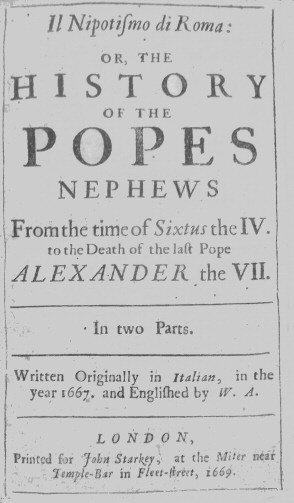
Il Nipotismo di Roma:
OR,
THE
HISTORY
OF THE
POPES
NEPHEWS
From the time of Sixtus the
IV.
to the Death of the last Pope
ALEXANDER the VII.
In two Parts.
Written Originally in
Italian, in the
year 1667. and Englished by W. A.
LONDON,
Printed for John Starkey, at the Miter near
Temple-Bar in Fleet-street, 1669.
The Author to the READER.
Kind Reader,
I should have much to say to thee, and not a few Ceremonies to Complement thee withall, if two Considerations did not make me resolve to hold my peace, and abstain from that courtship, which would become a Preface. The first is, because I will not (as the Proverb sayes) reckon without mine Hoste, and fill thy ears with excuses, before I know whether thy intention be to hear them or no. Secondly, because I think it will not be amiss to forbear Ceremonies in the presence of so many, whose business it hath been to be most accomplish’d in performing of them. What danger would there be for once, to let a Reader judge of a Book, without all those troublesome informations from the Author: For in a word, either the Reader hath parts and learning, and then his own judgment needs no instruction from the Authors; or he hath none, and is illiterate, and then the Author loses his time in excusing himself to one, whose abilities cannot reach his subject: But this our age being so far different from ancient times, wherein little notice was taken of the Author, though much of the thing written, it will be as just for him to inform his Reader, as for a Suppliant to inform his Judge, though never so learned, and to be recommended to him, though his case be never so just. A Friend of mine, calls the Advice to the Reader, the Sauce of the Book, because it is that part, which gives us a stomach to read the rest. I must confess, it is for his satisfaction that I give you mine; I know not how excellent it may prove to thy Palate: but my intention, is not, at least, to put too much Salt in it; and indeed, with what can I season it, or what Ingredients have I left to compound it withall? If I praise my own work, I shall incur the censure of an interested Judge; if I dispraise it, I shall do my self an injury. To tell thee that this Book comes from Rome is in vain, because the very Title of it discovers the place of its birth; and to entreat thee to read it, would be just the way to stifle thy curiosity; for now adayes, every body desires the reading of those Books which are prohibited; and I am certain, that it were a good way, to incite the publick curiosity of the world for any Books, to intreat them that they would be pleased to let them alone, for that, without doubt, would encrease their desire of seeing it. I think I had best do as those Hunters, who for fear of raising the Partridge too soon, talk to one another so softly, and so low, that they scarce hear themselves speak. Therefore, Reader, take notice, this is that famous Nipotismo di Roma, so much desired and wished for by all the ingenious of Europe, before it was brought forth by the Author. I give thee warning to read it in private, and keep it to thy self; for if the news of thy reading it come to the Inquisitors ears, without doubt thou runnest the hazard of an Excommunication; for they have sworn, to indure no Books in Italy, but those that shall flatter the Court of Rome. It is indeed a good policy for them, and for those Church men, who having pretensions to the highest Ecclesiastical Honours, stand all day before the Nipotismo with their Caps in their hands. I know, that in Rome this History will produce the same effect that our Nails do upon a Sore, that is, the more they scratch it, the worse they make it: Yet the itching pleases every body, and the more we scratch, the more we have a mind to scratch still. Neither do I doubt, but that there will be some flatterers and false friends of the Nephews of the Popes, who will express their dislike of this Treatise; but it will be only in appearance, and not from their hearts, which may be forgiven them, for seldome in Rome do the Tongue and the Heart correspond.
In the dayes of Innocent the eighth, some body made a Book, intituled, The Abuses of the Churchmen, very satyrical, for in it were all the Ecclesiasticks Vices, but none of their Vertues, which indeed was somewhat severe: This Book was put into the Popes hands (who by judging things without passion, shewed himself to deserve his elevation to so great a dignity) for having read it in the presence of some Prelates of the holy Office, he turned to them, and said, This Book speaks truth; and if we have a mind that the Author should be found a lyar, we had best reform our selves first. I wish to God, that in this our Age, there were many such Innocents, and that all men were of so sound a judgment, as to profit by good things, and laugh only at ill ones, or rather avoid them: For my part, I think, that if ever there hath been a Book in this world free from a flattering design and interest, that this is one of those; for the Church of God will profit by it, the Romans will draw no small pleasure nor less advantage from the reading of it; and, I hope, that it will be a kind of Looking-glass to the Nephews that are to come, whereby they may guide their actions, and steer their intentions to a better course then their Predecessors. There passed, not long ago, by this Town, a certain Prelate of Tuscany, to whom I gave a sight of this Manuscript before it was printed; he took such delight in perusing of it, that he entreated me to hasten the publication of it, with these words, For Gods sake, Sir, inrich Rome with so great a Treasure as this is; bestow so good an example upon Princes Politicks, and illustrate all Christendome with the demonstration of so much zeal: This was the opinion of a sincere Prelate. But besides, it is most certain, that the Nephews, as well those that now bear sway, as those that are out of date, and those that are to come, if they will judge without pre-occupation, will find, that this History is of no small concern to the promoting of their interest, considering, that the good which is said of them doth much surpass the ill, and, that it demonstrates how necessary a thing the Nipotismo is to the City of Rome. I do not pretend to any thanks or retribution for the good that shall happen to them; neither would I be content, that the harm, if there be any, should reflect upon me. As for the Book, Reader, it is in thy hands, and must stand or fall by thy verdict: I therefore only desire thee to pronounce sincerely, whether it be not as necessary for all Europe as for the City of Rome. I promise thee another Work, much more worthy thy curiosity, and fit for any body that hath a publick Employment, which is Il Cardinalismo, a Work, which speaking in general only of that Dignity, doth yet nevertheless now and then descend to particulars. In a word, I call the Cardinalismo, and the Nipotismo, Brothers; but the Cardinalismo is the eldest, because first conceived by me; in a moneth it will be Printed; if thou wilt have it, thou mayest, and I can assure you, it will please you infinitely.
Farewell.
The First Part.
The FIRST BOOK.
The Contents.
In which is treated, of the difference that there is between the ancient and New Rome. Of the manner of Governing of the ancient Romans. And of the manner of the Popes governing. Of the murmurs of the Gentiles, Hereticks, and Catholicks, against the Church of Rome and the Popes. How to come to the knowledge of present state of Rome by the said murmurs. Of the time in which people began to talk ill of the Popes, and of the cause of this their libertie. Of the Popes first bringing their kindred into Rome. Of the Infallibility of the Popes in admitting their kindred to the Government of the State of the Church. Of the causes that ruin’d the old Roman Commonwealth: and of those that lessen the Honour and Grandeur of the Church of Rome. Why Christ chose to be Born in a time of Peace. Of the Succession of Peter to Christ. Of the Apostles to Peter; and of the Popes to the Apostles. Of the Holiness of Church-men in the primitive Church. Why the vertue of doing Miracles is failed in the Popes. Why for many Ages the Popes Kindred did not much care to own their Relation to him. How the Church came first to be so Rich. Of the Court of Rome. Of the Politick Wit of Church-men. Of the advantage that Politicians gain in frequenting Rome. And of some particular maximes of Innocent the Tenth, which were of utility to himself.
Rome alone amongst all the other Cities of the World can brag of the reputation, of having been alwayes esteemed the Mother of Nations, the whole Universe having almost alwayes taken a pride in paying to her a Tribute of filial Duties, in acknowledgment of which she has also opened her breasts, and pressed her Duggs for the nourishment of those who desired to encrease by their obedience to Her, and be free from those dangers to which they are subject that have not Parents or powerful Protectors.
The glories of Rome were never equalled, no more then Rome it self. Rome hath been seen in all the Cities of the World, not only commanding, but triumphing; and in Rome have been seen at divers times, not only Cities, but whole Provinces, nay, whole Kingdomes, obeying, and submitting. Rome seems to be born to rule the World, and with a great deal of reason, since not only it hath done, but doth still exerce its Empire over a great part of it.
It ruled while it was a Commonwealth; and not content with that Empire which nature, or to say better, the valour of its Citizens had purchased for it, it proposed to acquire all that it could think on, and still the acquisitions seemed small in comparison of that which remained to be acquired.
It rul’d in the time of the Roman Emperours, who made Lawes, and domineered over mankind as they pleased; nay, which was worse, tyranny it self came often from Rome to infect the rest of the Universe which was subject to this seat of Tyrants.
But why should we recall past Ages, and renew those wounds, which though not healed, are nevertheless worn out by the length of time; why should we praise Rome for having ruled the World, if now at this present it rules it more then ever, and domineers over it in a new manner.
In the time of the Commonwealth, in the time of the Emperours, Rome never pretended to command consciences, and exact from soules that Tribute which now they pay to the Vatican.
Every City had its Bishop, every Village its Curate, and every Church its Preacher, who in his Sermons did not make it his business to exalt Rome; neither did the Bishop, nor the Curate expect the rules of governing their flock from Rome.
But now quite contrary maximes have prevailed; for Rome, not content with the temporal power, hath perverted the order of Government, and made the temporal submit to the spiritual, contrary to the received custome of so many Ages.
If the Commonwealth subdued Nations, if the Roman Emperours commanded over kingdomes, they did it in such a manner, that those that obeyed seemed to have had more content then those that commanded; for they let them enjoy the liberty of their souls, and required only from them a Civil Obedience in compliance with the interest of the State.
But the Popes having confounded and mingled together the temporal and spiritual power, laying the stress upon the spiritual, do oblige Princes and people to so exact an obedience, that the only mention of it is able to scare our hearts and minds.
The Popes shutting of Paradise and Heaven when they please, their opening of Hell when they think good, are things that oblige whole Nations to forget the Obedience due to their natural Princes, and to prostrate themselves at his Holinesses his feet. The Commonwealth which ruled with so much wisdome and Policie, the Emperours who governed with the strength of Arms, and the Tyrants who domineered with cruelty, had they but known these secret maximes, might have humbled Nations and reduced Cities with a great deal less paines, and more security.
The Popes having being armed with the Soveraigne Authority over consciences, have so increased the glories of Rome, that there is scarce a corner in Europe, not a place in Asia, not a desart in Africa, nor a hidden solitude in America, where the name of the Pope hath not penetrated, and where there is not some discourse of Rome.
The Gentiles praise the Popes, and despise Rome; the Hereticks praise Rome, and despise the Popes; and the Catholicks despise both Rome and Popes with a greater, though secreter, disdain, then either the Gentiles or the Hereticks, of which I shall give the reasons.
The Pagans attribute all the mischief of Rome to that great number of Church-men with which this City is pestred. The Hereticks, on the other side, lay all the Church-mens disorders upon the Pope; and therefore the Hereticks are willing enough to be reconcil’d to Rome; but by no means will endure the Pope. The Pagans, on the contrary, are content to be friends with the Pope, but not with Rome.
This proceeds from the distinctions that the Heathens make in the person of the Popes, separating the spiritual from the temporal, and Religion from Civil Government; therefore in the time of Sixtus the V. and Gregory the XV. the Persians and Japponeses sent their Ambassador to Rome, taking no small pride in the Popes friendship, whom they esteemed as one of the powerfullest Princes of Italy, and for his greatness desired his Amity; their maxime being to make alliances with the most potent Princes of the World; they thought they could not better address themselves then to him, whom all the other Christian Princes did adore and reverence as their head.
The Hereticks destroy all this, being neither disposed to acknowledg the Pope as a temporal Prince, nor as a spiritual Pastor; so that with them, Popedome, Principality, Religion, Civil Government, all goes down, when they speak of the Pope.
Nay, I know a Gentleman of that Religion, who can by no means be perswaded that the Pope is master of Rome, and Prince of the Ecclesiastick State, though all the Princes of the world acknowledg him to be so, and for all this, the Protestant Gentleman cannot be brought to believe it, but stands firme upon the Negative.
Of the same humour was a great Lord in Spain, who could never be convinced, that Henry the fourth was King of France, though he knew that his own King did acknowledge him for such, and had sent an Embassadour to him, that all differences upon that subject were lay’d, and that all the Crowns in Europe did own him to be lawful King. And yet for all this the good Don could never believe that which all the world was sure of, and he died in this incredulous humour.
Now as for the murmurs that the Gentiles, the Hereticks, and the Catholicks have against Rome, there is this difference between them. The Heathens murmure upon what they hear; the Hereticks against those things that they do not believe; and the Catholicks against those things they see; and certainly of them all the Catholicks murmurs are the worst: for the eyes being as it were the treasurers of the heart, do furnish it so abundantly with the impressions which they receive, that it never is dispossessed of them afterwards; the Proverb being very true, which sayes, That in vain we fly from that which we carry in our hearts. Therefore the Catholicks, murmuring boldly, because they see the abuses of Rome, are much more believed then the others.
But indeed to speak truth, if we ballance the reasons that these three sorts of persons have to talke disadvantagiously of Rome, we shall find that the Hereticks have the greatest and most weighty arguments of their discontent.
But before I prove this, it is necessary to give notice that I make a distinction betwixt Hereticks and Protestants, though the Church of Rome does confound both these denominations; for they are Hereticks who deny the true Religion for a false one, which they set up without any foundation of reason, thinking that their own opinion is enough.
The Protestants are those that abhorre innovations, and do tie themselves to the sense of the Holy Scripture, denying every thing they find not in those Sacred Records: and for my part, I intend to speak only of the Protestants, not of the Hereticks.
Let us return to our subject; and say, that the Popes do neither good nor harme to the Heathens; to the Catholicks they do both good and evil; and to the Protestants alwayes ill, and never good. Looking upon the Heathens as neater, upon the Catholicks as their friends, and upon the Protestants as their greatest enemies.
From thence it proceeds that the Catholicks are more scandalized at the Popes errours; for they being friends are admitted to dive into the bottom of the disorders: The Protestants seeing that the Popes do not only suspect them, but openly profess enmity with them, do busie all their industry in penetrating into those hidden mysteries of the Court of Rome, that they may not be surprised, but have wherewith to defend themselves in their disputes: and therefore that which they report of the Court of Rome is most ordinarily true.
The Heathens let Rome alone as long as Rome lets them alone; and they talke according to the informations they receive from Catholicks and Protestants.
Whosoever therefore intends to draw a quintessence of truth out of so many different relations, must not give credit only to what the Catholicks say; for they being friends and dependants of the Pope, cannot do less for their own reputation, as well as for his, then to hide the abuses and palliate the disorders of his Court; neither ought he to take his informations from the Protestants alone, because they, being prepossessed with an aversion to the Pope, cannot chuse but be blinded by their pre-occupation, and say more then is true, in discredit of the proceedings of his Court.
The method of History would require a strict examination of the relations of both parties in matter of fact, and a ballance of their opinions in matter of policy, and upon so mature a discussion it were fit to frame the body of the History, and found the maximes of policy; for the History would then be true, and the maximes certain.
This hath alwayes been my way of writing, insomuch that many, both Protestants and Catholicks, have not been able to distinguish my Religion in my works, nor know whether the Author were Protestant or Catholick; and this because of the sincerity with which I praise, in both parties, that which deserves commendation, and blame vice, let it be where it will, and in what place and person soever.
But to say true, this present age hath so corrupted and perverted the art of writing, that some write only to flatter, and others to satyrize; and there is no ingenious Catholick but must confess, that there are publish’d every day more Libels by the Catholicks against Rome, then Satyres by the Protestants against the Popes; therefore now adayes the wiser sort of men give more credit to a Protestants relation, then to a Catholicks, meeting with less passion in the first then in the last, against the Popes and Rome.
I have been a great while in Protestant Countries, and have likewise made no small stay in Rome, where I have heard a thousand and a thousand times, both Romans and Protestants, discourse of the Popes Nephews, and their actions; but I must confess, that in Geneva it self I never heard any discourse so full of liberty, nor so satyrical, as those which the Romans, nay the Prelates themselves have vented in my presence, concerning the Popes and the Ecclesiastick authority.
Nay, I’le say more, and it is a thing I am very sure of, having heard it often said by persons of great understanding; the Protestant Gentlemen that travel to Rome are much more scandalized at the Romans proceedings towards the Popes, then the Catholick Gentlemen, who travel in Protestant Countries, are to hear the Pope defam’d and ill spoken of amongst them.
The Protestants, when they talk with Catholicks, because they cannot reasonably expect to be believed, do conceal the greatest part of the imperfections of the Popes kindred; but the Catholicks say a great deal more then becomes them, thinking thereby to show their aversion to vice.
More then all this, I say, that of all that is said in Rome concerning the Popes actions, and his kindred, there is none of it comes from the North, but from Rome it self; but on the contrary, even all that is said in the North, springs from Rome, and is not born in the Protestants Country.
The Romans make the Pasquins in Rome, and then to excuse themselves lay them upon the Protestants: thus the Pope is abused and deceived by the Romans themselves; so that then we may say with a great deal of reason, that out of Rome it self springs the source of all the harm it receives.
I wonder now no longer to see the change of stile which I have observed in Writers from age to age, since in the Court of Rome they change their way of living and speaking from day to day.
In the time that the Popes had golden consciences, and wooden walls, when with bare feet and clothed with sackcloth they went from door to door, accepting the charity of the faithful for their sustenance, and that full of zeal they administred themselves the Sacraments, exposing their lives for the safety of their flock. When the Popes applyed themselves only to their pastoral charge, without concerning themselves in Princes temporal interests: Rome in those dayes knew nothing of other Princes Courts, neither did the Courts of Princes concern themselves for Rome; there was so little mention made of the Popes, that the Church-men and Bishops did scarce know where to find them in their most important necessities.
It would have been indeed a great sacriledge to have spoken ill of a Pope, who from morning to evening did nothing but visit the sick, distribute the Sacraments, comfort the people, and serve the Altar with true zeal and piety.
But when once the face of things was changed, and that the Popes, weary of serving to the Altars, resolved to be served by the Altars themselves, when thinking it too low an employment to visit the sick, they pretended to be visited themselves by the greatest Princes, and have their feet kissed by them; these Popes, who were at first the edification of whole Nations, became a scandal to all the Kingdoms, for both Princes and people being surprised with this sudden change, and wondring at this new scene of grandeur, gave themselves up to seek into the reason of this alteration, and as it often happens, that in the Enquiries into one defect we discover another, so the world found out in the Popes change so many new subjects for murmuring and discontent, that from thence ensued Schismes and Heresies, with an infinite prejudice to the Church of Rome.
If the Popes would have been content to have been the heads of the Church in holiness and good life, and not in majesty and grandeur, the world would never have conceived so many sinister thoughts of their actions; therefore if there be murmurs in Rome, and the rest of Christendome, the Popes may thank themselves, for the fault is not in those that murmur, but in those that furnish them with a lawful subject for their complaints.
But let us speak truth: In the time that the Popes left to the Emperours the secular care of government, and all the interests of the temporal state, holiness and good life did shine in the Popes, as well as in the Church and Church-men; miracles were frequent, and Saints multiplied as fast as tyrant Emperours.
But as soon as the Popes usurped the civil power, and began to meddle with state matters, their holiness disappeared, miracles vanished, and by a strange mutation the Emperors became Saints, and the Popes as passionate for the temporal interest as the greatest Tyrants.
The Hereticks go further, and say, that the Popes are really Tyrants, as having introduced the Inquisition, which by constraining mens consciences to an exteriour worship of what they abhor, does more severely punish the breach of one of the Popes Orders, then it does the violation of one of Gods Commandements.
To this the Popes oppose, as a defence, the reason of policy, that obliges them to establish the Inquisition, leaving to their Divines the task of answering the other more sharp objection; who having no other way to extricate themselves from that difficulty, have written, to confute the Hereticks, such vast volumns of Controversie, that they being not able to read them, remain in their obstinacy, with no small dammage to the Pope and his Divines.
But this strange change of the Popes, from spiritual to temporal, and from holy Bishops to Politick Princes, is not so much to be attributed to the Popes themselves, as to their Nephews and kindred, there is the source and origin of the disease; for while the Popes lead a private life, and let their Nephews alone in their own homes, they were eminent for their zeal to the true Religion; but they had no sooner introduced them into Rome, but forgetting themselves, they fell to idolizing their Nephews, and for the increase of their greatness, employed not only the gold of the Church, but even all the pains and fatigues of the Popedom, nay even the consciences of their whole flock.
Experience teaches us, that many Popes, and particularly those of the greatest reputation, in the beginning of their Popedome did not only renounce their kindred, and refuse to own them, but with a solemn oath did protest to the Cardinals, that they would govern alone, and not admit their kindred upon any pretext whatsoever; so far they were from giving them a share in the government.
Alexander the seventh, who now lives, was one of those for a time, and from him we may conclude of the thoughts of the rest; for in the beginning of his Pontificat he shewed himself to be so averse from his kindred, that some thought him a Saint, or at least a man much above the frailties of humane nature.
Don Mario his Brother, Don Agostino his Nephew, and the Cardinal that now is, did every day offer up their prayers to Heaven, for a change in their Uncles inclination; the Ambassadors of Princes and the Cardinals, did nothing but weary themselves out in alledging to his Holiness the necessity of introducing his kindred, that it would be not only honourable, but of great advantage to the State and Church.
Yet the good Pope remaining unshaken in his opinion, was resolved to deny all their Instances, nay, often would be exceedingly scandalized at those that pressed him to it, saying, he could not in conscience condescend to their desires; as one day being importun’d upon the same occasion by Father Palavicino, a Jesuit, and his Confessor, who now is Cardinal, he answered him in these words, Your obligation, father, is to absolve from sins, and not invite to commit them.
Of this humour hath not been Alexander alone, but in the lives of the Popes there are many other such examples, as that of Adrian the sixth, and Pius the fifth, who were wont to say, that they would make it their task to perswade the world that they could live without kindred.
Now I would fain know, from whence proceeded in them this humour, so opposite to the others? if from an aversion and a kind of hatred to their relations, then certainly it was a sin, since we have as a Commandment from God, Despise not thy own flesh; if to make shew of an apparent zeal, that was worse, for they were guilty both before the world and God Almighty; if out of a design of first bestowing kindnesses on their Friends before they gave themselves up to their Nephews, it was a preposterous charity, which ought to have begun nearer home.
It remains then to conclude, that certainly these Popes, who made this profession of disowning their Relations, did it, because they were really perswaded, that the errors of their predecessors did proceed from this principle of admitting their kindred to a share in the government, and therefore they thought fit to free themselves from so great an imputation.
Therefore to save the reputation of the Papal dignity, I am forced to say, that those Popes, who at first did profess an aversion to their kindred, and yet afterwards admitted them, were certainly seised with some melancholy humors and capriciousness, which made them commit such errors. It must not seem strange if I call them errors, since reason it self must needs call them so; for first, to be perswaded that their predecessors had failed in admitting their kindred into Rome, and in giving up the government of the Church into their hands; then, to swear and protest to keep theirs at a distance, that they may be freed from the like miscarriages; and after all this, not onely to call them into Rome, give them the Keys of the treasure, and put all the administration of the temporal and spiritual into their hands, whereby to make themselves Princes, but also to give them an absolute authority over the Church, the Popedome, nay, the very person of the Pope; this is certainly to demonstrate, that the Pope hath the power of making that to be good and just, which he hath condemn’d for bad & mischievous; which if the people of Rome, or the Courtiers, do believe, certainly people of judgment and sound understanding do not.
As for me, I have not hitherto denyed that opinion of the Roman Divines, viz. that the Popes cannot erre; but when once I came to see the falsity of it proved in the person of Alexander the seventh, certainly I have had a mind to curse those Divines, that flatter thus the Popes, not out of a design to serve the Church, but to make themselves great; and we know very well, that there are now many of them living, who have been made Cardinals, meerly because they had writ to the advantage and honour of the Pope, which thing still stirs up others to do the same; but let them write what they will, all the world shall never perswade me, but that the proceeding of Alexander towards his kindred, in calling them to him, contrary to his oath, is as great an error as ever Pope committed.
Yet let us do them the favour to interpret their Doctrine their own way, and allow of their distinction, that is, that the Popes are infallible in matters of faith, but not in matters of policy; let it be so; but if we do them this kindness, I hope they will be so civil as to requite it with another: we desire them then to tell us a little; The Popes Nephews, have they not the same authority as the Popes themselves, who invest them with it as soon as they are admitted into the Vatican, they govern all affairs, politick, civil, Ecclesiastick, and in a word, sacred, prophane, divine, all things pass through their hands. Then with them sometimes the Popes may erre, even in matters of faith, since often in matters of faith they trust their Nephews, who being men subject to passions, are admitted by all to be capable of error.
I would fain ask you, whether Alexander the seventh, who had so great an aversion to his kindred at first, had the assistance of the holy Ghost, or whether he had it not?
If you answer he had it not, I am well pleased, and do profess with you, that I think that policy and humane reasons were the causes of his proceedings.
But if he had the holy Ghost, how then can you reconcile his first refusing to admit the calling his Nephews to his assistance? for either it was good or bad to admit them to his help in so great a charge; if good, then he failed at first in keeping them away, and shewing himself so alienated from them; if bad, then he failed at last, in repealing his first resolution, and betraying the Church and its riches into their hands.
The holy Ghost is infallible, and to believe the contrary is a high impiety; how is it then that the Popes have the holy Ghost, and yet cannot abstain from failing? certainly to me it appears a kind of Blasphemy and prophanation of the honour of the Divinity. We know that the holy Ghost inspires nothing but what is good, and yet we see that the Popes do commit ill. The Protestants do utterly deny this opinion, and demonstrate by good proofs, that the Pope neither hath, nor can have the holy Ghost in a more particular manner then other men; but for my part I believe that the holy Ghost is in the Popes when he pleases, and they receive him when they can.
So to save the reputation of Pope Alexander the seventh, I’le say, that in the beginning of his Pontificat he had not the holy Ghost, for if he had, he would have received his kindred; but the holy Ghost begun to take possession of the Pope, just at the same time that his kindred took possession of Rome, and of the Church; and therefore the good man was much to blame to keep the holy Ghost and his kindred out so long together, since by this means he deprived himself of the riches of the Spirit, and his Relations of the riches of this world: But now he hath mended his error, and made amends for all. Many believe that the Popes erre with their kindred, and their kindred with them; but for my part I believe that the Apostles did not erre, because that they received the holy Ghost from Jesus Christ himself; but the Popes do erre because they receive the holy Ghost from the Divines, who give it them, how and when they please: I know what I say.
Often Rome hath lost the order of its government, because it was become a prey to the ambition of its Subjects; and as often it hath been brought upon the brim of its ruine, by gold and riches.
Old Rome had much ado to preserve it self by an infinite number of severe Laws, and at last did make a shift betwixt good and bad times, to rub out some Ages, till new Rome came and took its place. By old Rome I mean that Rome that was founded by Romulus, and ended at the time of our Saviour: and by new Rome I understand Rome that was born in Christ, and lives even now in him. Now if the ancient City of Rome came to its ruine through ambition and covetousness, it will become us to consider what effects these very same things do produce in our new Rome.
When we speak of Rome, we speak of a City that desires to be acknowledged by all Nations, as the head of Christendom. Now let us see the difference between the Pagan and the Christian Rome, the old and the new.
In the time that our Saviour was born in Bethlehem, to destroy this old Rome of the Heathens, and give the foundation of this new Christian City, Augustus not only commanded, that all the Nations of the Roman Empire should be numbred, to shew, that with the coming of Christ there was a new Empire begun, but likewise he brought all the world into a calm peace and tranquility; so that our Saviour no sooner appeared, but peace was the joy and comfort of the whole Universe. Christ chose to be born in a time of peace, and not of war and misery, for two causes: First, to set a difference betwixt the new and old Rome; the old having been founded in blood and dissention, under the government of Romulus a Pagan, it was more then just, that the new should begin with peace, under the dominion of the King of Kings, the holy One of Israel. Secondly, to the end that the Successors of the Apostles, who were to reside in Rome, might not one day excuse their faults, with alledging the beginnings of the Christian Religion for example; and therefore our Saviour took possession of Rome in peace, and delivered it to those Popes, who were to govern Rome and Christendome.
To Christ succeeded Peter, to Peter the Popes, as the Divines of Rome teach, and do endeavour to prove, against the Protestants, as a principal point of Religion.
The Popes then took possession of this new Rome, with the holiness of life; and when first they established this Ecclesiastical Senate, they chose out men so holy, and of so good a life, that the Citizens willingly submitted to prostrate themselves at the feet of such Governours.
Ambition was then so far from the hearts of the Bishops, that not only many Prelates did renounce their Bishopricks, but also many retir’d from the Vatican, where they were adored, into deserts and solitudes, to serve God their Creator without trouble.
Gold had not yet found the way to Rome, because there was no hand that would receive it, no Treasurer to keep it, and all its glittering was much below that vertue, which did so eminently shine in those that were the Guardians of Rome. Woe would have been to that man, who should have opened himself a door to preferment in the Church with a golden Key; the Excommunications, the Laws, the pains of this and the next world, were fulminated against Simony, which was as much abhorred by all the Church-men ther, as it is now practised.
In one thing alone old Rome did not agree in its beginnings with the new; for one promoted to its highest honours, those Citizens who had shed their blood, and could produce noble scars received in the defence of their Country; but the other bestowed Offices and Ecclesiastical Dignities upon those, who in consideration of another world did despise this, and mortified their flesh and affections. The Roman Empire rise by Valours, the Roman Church by Holiness.
The Actions of those, that pretended to any place of publick employment in old Rome, were examined by the Senate; and the services, which the State had received from these Candidates, were as it were ballanced with the honour they ambitioned, and the weight of the place they stood for: and if those services were such, as to be able to weigh down these scales of equity, the Candidate was sure to obtain his desires; if they proved too light, he was forced to stay, and with new Endeavours encrease the obligation the publick had to him already.
Just in the same manner did the Popes at first proceed in the distribution of the charges of the Church; for having ballanced the holiness of life, and excellency of parts of him who was to be admitted, with the weightiness of the place; if the goodness of life was so eminent, as to surpass the exigency of the Office, the Demandant was without delay preferred, otherwise he was sent away with shame and confusion.
The Conquests of Kingdoms, and the subduing of Provinces, were the Keys, with which the Romans opened to themselves the door of honour, and an entrance into the Senate; but in new Rome, persecutions, martyrdoms, and mortifications, were the fore-runners of Christian Dignities, and the only way to Bishopricks and Popedoms.
While the Popes lived thus, and that this age of holiness lasted, it was with a great deal of reason, that the rest of the world called their Rome, Roma la Santa, Rome the holy: The Popes were looked upon to be more like Angels then Men, not only because their actions were altogether heavenly, but because that living in this world, without owning any of their kindred, they seemed rather sent from Heaven, then taken from the midst of mankind.
There hath been some Popes, who while they were Bishops and Cardinals did reckon an incredible number of Nephews and Cozens; and yet no sooner were they promoted to the highest Prelature, but all their kindred vanished and disappeared, as if they had never had any.
If in those times you had asked any of them if they were a-kin to the Pope, he would have denyed it openly, so little did the Popes care for their kindred, and their kindred for them: The cause of this was, that the Popes did not measure in their kindred their deserts, by any carnal affection they had for them, but compared their merits by the Standard of Christian perfection; so that if a Kinsman of a Pope should have happened to have had, for competitour in any place, one not much above him in learning and piety, yet without doubt he should have yielded to this his Competitour, and gone without his pretensions.
Hence it came, that the Popes kindred, that they might not receive affronts in Rome, did forbear to come at the City; and least the world should by their absence conclude of the meanness of their deserts, they would give it out, that they were in no wayes related to the Pope, whose kindred they were, saving thus their honour without honour.
In those times, the Popes did often resist the Emperours tyrannical proceedings, and withstood their injuries, not with Armies and Fleets, but with Zeal and Piety they did boldly oppose their vices and corruptions; as amongst others, Gregory the seventh excommunicated the Emperour Henry, and banished him from all commerce with the rest of his Christians, only because he had received I know not what sum of money from a Bishop, who us’d his favour to be preferr’d to a vacant Bishoprick.
Rome was then truly holy without ambition, and without gold; and glorious were the Popes, who with their zeal and good actions made barbarous Kings tremble, and Tyrants humble themselves to the yoak of Christian Religion; and indeed who would not obey that Pope, that should prefer true merit and deserts before Relations and Kindred, Vertue before Vice, Learning before Ignorance, Zeal before Ambition, Poverty before Riches, his flock before his Kindred, and Justice before Favour and Recommendations?
But if hitherto we have spoken of Rome without corruption, and of Popes full of zeal and holiness, so we must now consider Rome under another habit, that is, not holy, but wicked, not pure and innocent, but defiled and full of ambition and avarice.
While the Popes lived in this retired manner, devested of all earthly affections to their kindred, and inclin’d only to recompence deserts and goodness, Rome was happy and holy; but as soon as Christian modesty began to be banish’d by worldly pomps, that favour took place of merit, that ambition overpowered humility, and covetousness laughed at charity, the Popes began to lose their credit, Rome its goodness, the Church its Saints, and there started up another Church, another Rome, and other Popes.
And no sooner did the love of riches take possession of Rome, but Christendom was engaged in desperate Schisms, with no small affliction to the real and pious part of the Christian world.
Two hundred and twenty six years after the birth of Christ, the Popes began to change their poverty into riches, and with them introduced ambition into the Church; this was done in the time of Urban the first, who ordained, that the Church should possess land, riches, power, command, and all other conveniencies, to the end that Church-men might be rewarded out of the revenues of the Church it self.
Before Urban’s time, Ecclesiasticks were to trust to the alms of the faithful, and their charity; and whilst that lasted, they thought of nothing else then the conduct of Souls, having no care to take, either for the encrease or conservation of their Fortunes; but as soon as they saw the Church enriched with Abbyes, Canonicates, and other revenues, they fell to disputing among themselves, every one desiring the possession of the richest benefice.
Urban in doing this had neverthelesse no ill intention; and if his Successors had followed his steps, the revenues of the Church had certainly animated Romes greatness, and yet deminish’d nothing of the Churches riches.
When I speak of the riches of the Church, I mean, not the temporal, but the spiritual riches, as St. Laurence understood it, when being asked by the Emperour where were the riches of the Church, he produced before him a multitude of poor impotent beggars, but of a good life.
Therefore the Church became poor in Saints, and rich in ambitious Ecclesiasticks, who did now employ that time which they used to spend in the Churches, and at the feet of our Saviour, with the Popes and Bishops, in reckoning up the Revenues of their Abbies, and procuring preferments to themselves and others.
The bringing of temporal riches into the Church was a poison which infected the Church, and made the Church-men swell, ’till at last they were ready to burst with their own venome. As the Church encreased in revenues, Rome decreased in Holiness and Holy men, and Saints forsook it when once Courtiers and men of business came into it. I meane living Saints; for as for dead Saints there are too many in it still, it being a part of its Trade to doe now for Gold and Riches, that which before was done by poverty and self-denial, I mean, Canonising of Saints.
Before the Church enjoyed temporal revenues, there was modesty in the Church-mens Apparel, but with the introduction of riches, pride, pomp, and vanity took place; then were invented Mitets, Scarlet Robes with long Traines, Copes, and Tippets; so that with the expense that one is at now to cloath a Prelate or a Cardinal many poor might be fed and covered, and particularly poor Priests, who are faine to beg from Laicks that which their own Prelates should bestow upon them.
Though things were carryed on with this corruption, yet was it not come to that pass that the Popes durst bring their Nephewes to the Sterne, and Government of St. Peters Vessel; they were content to rule the temporal and spiritual without controle, but did not think of entayling the Popedome upon their kindred, which made their Nephews and Relations keep at a distance, being unwilling to be seen in Rome without command and power.
Nicholas the third in the year 1229, went about to make two of his Nephewes of the House of the Ursins Kings, one of Toscany, and the other Lumbardy, to the end that one should keep the Germans in awe, who have one part of the Alpes, and the other the French, who were then Masters of the Kingdomes of Naples and Sicily: and that he might compass his designe with lesse trouble, he perswaded Peter King of Arragon to undertake the recovery of the Kingdome of Sicily, to which he had a right by Constantine his Wife.
But all these designes soon vanished and were buried in the Tombe of the Popes brain, where they were first conceived. ’Tis true, that many say, that the Pope did this, only to satisfie the pressing instances of his Nephewes: but because he affected more the quiet of the Church, then the advancement of his kindred, he persisted not in his enterprise, but just as long as was necessary to make his Kindred believe he had once well resolved it; and thus the Ursins, who aspired to so much Grandeur, remained disappointed, and the Pope was pleased in the demonstration he had given them of His kindness.
The Popes were not yet perfect in the art of raising their kindred; the carnal love of their Relations did but begin a combat with the spiritual zeal for the Church, and as yet the last was too hard for the first, and in all occasions did carry it before their kindness for their Relations.
From Nicolas to Sixtus the Fourth, who was created in the year 1471, the Popes did by little and little humanise themselves, and lay aside that rude severity to themselves, and to their kindred, who now began to come very willingly to Rome, being sure to meet with kinder receptions then heretofore had been shewed to precedent Popes Relations; and when once they were in Rome and in sight of their Uncle, he to prevent them from leading an idle life, would give them entrance into the Vatican, and honour them with places of Honour and Profit.
Withall this things were carried so closely, that though the Church did receive some detriment, yet the people of Rome, and the other Christian Nations had no great occasion of scandal given them neither from the Nephews, nor from the Popes. The first of which were well pleased with any thing that was given them; and the last, that is, the Popes, were so provident as to be liberal only of what was superfluous, and not of that which the Church and Rome could not spare.
But in the time of Sixtus, Ambition and Covetousness introduced themselves so openly, with the utter destruction of the modesty and decorum of the Church, together with the subversion of Christian Piety, occasioned all by his filling the Vatican with such a company of Nephewes, that from that time forward we must reckon the birth and growth of the Nipotismo; in the History of which, before we engage any further, it will not be amiss to give a Character of the Court of Rome, which now at present is maintained by, and depends entirely upon the Nipotismo.
One of the greatest extravagancies that I meet withall in the World, is the error of those who are perpetually exclaiming against Courts; and generally ’tis observed, that few of those that are of this Humour, have been Courtiers, or if they have, yet have they not made any considerable stay in them. But for Gods sake, what kind of thing was the World, before there were any Courts? nothing but the refuge of baseness, the quintessence of ignorance, an apparent blindness, and in a word, a barbarous throne of Vices, and all sorts of ill actions.
Many complain of the Court, but few of themselves, for not having been able to maintain the ground, and keep the place they had once in it; as if the Court were bound to descend to a compliance with every particular mans humour, and not particular men rather frame themselves to a condescendency for the Court.
Who is it that frames and constitutes a Court? ’tis the Prince, without whom there is no such thing. But who brings Vices to the Court? The Courtiers; and yet though the Courtiers be bad, and the Prince good, all the fault is laid upon the Prince.
Princes seldome fayle to recompense those services which they receive from their Courtiers, and without this quality they would not long be Princes. ’Tis true, that some are more reserv’d, others more liberal in their rewards; but still the defect is not in the Prince, but in the courtier, whose ambition is not to be ruled by his Princes judgment, and against whom he exclaimes for not contenting him.
To the ambition or desire of honour is alwayes added an avidity or desire of riches in Courtiers: these two monsters being the natural production of Courts.
The Court is to the World, as a furnace to Gold, to purifie, and refine mens wits. Whensoever any bodies ingenuity is under a cloud, and not known, let him come to Court, for there without doubt he will be prest to an exact trial of his skill; and let him use it all in hiding himself, and drawing as it were a vayle over his designs, yet he shall find the Court to be the true Touch-stone of mens actions, and he shall be known, for what he is really, and not for what he would seem to be.
This general discourse is only, that we may descend with more light and instruction to particulars. All other Courts, are streams, and rivers; but the Court of Rome is the head and source of them all; and as ordinarily we find out the head by following the stream, so I thought it fit to say something in general of Courts, before I came to the description of the Court of Rome. Among all Nations in the World, the Italians are the most famous for managing State Affairs, and being naturally inclined to be good Politicians. Neither do the Princes of the North deny this advantage to the Courts of our Italian Princes, who in the Government of their States, are masters of so much conduct, and subtilty, that none but very excellent and experienced geniuses can penetrate the depth of their Counsels.
But those maximes and Court slights, which in Italy are ordinary, are as it were natural and inseparable from the Church-men of the Court of Rome; which City, upon this score, is become famous in all forreign Countries, not as a place that teaches, and instructs Church-men, but as one that is taught and perfected by them.
He that desires to see politick stratagems, and all that subtilty can compass, let him not forsake Rome, where he shall soon learn how State Affairs ought to be managed.
I alwayes had a great opinion of the cunning and abilities of Church-men in matter of Government; but when once I came to Rome, and began to know by experience something of their wayes, I must confess, that my imagination was far short of the reality of what I had conceived.
It was no hard matter for Rome, both the old, and the new, to be mistress of the World, and give Lawes to Nations, since it hath alwayes been the School of true policies, as having even in its birth drained all the rest of the world of its cunning, and impoverished, it in slights to enrich its self.
For the space of fifteen Ages, the Church-men have already demonstrated to the world their abilities, and subtilty; and that so much the more to the wonder of all, because their beginnings have been so different from the means they have us’d, shifting from one thing to another, and changing upon all occasions, as Seamen do their Sailes with the wind, so that they seem to be born entirely for their own profit.
In the first Ages of the Church, the Court of Rome thought it convenient to comply with the Courts of other Princes, and this slight had its effect, while the Emperours Tyrannised over Rome; but their Tyranny being destroyed, the Court of Rome chang’d its way, and desired a compliance from all other Courts to its self.
Yet this proceeding too, having by little and little, intricated, and perplex’d the Court, and Courtiers, they were fain to come back to their first complyance, and by all Arts appease the male-contents, and keep those that were affectionate from being alienated: but now the face of things is so changed, and the nature of transactions so perverted, that they which now command in the Court of Rome have invented new wayes how to carry themselves, and correspond with Princes, very intricate, and different from those that were us’d in past Ages.
Therefore there are very few who having resided in this Court, do at last forsake it to return home, but they have a great deal of reason to complaine and be ill satisfied of its proceedings; not only because they had not found so much favour as they had expected; but because they found that they had been meerly deluded with faire promises, and at last, as it were laughed at for their paines. For the Courtiers of Rome have a particular maxime, either of perplexing, or of jeering those that come to negotiate with them. The truth is, they have been so subtle in providing for their interest, and have brought things to that pass, that they seem to be able to be without those, who can by no means be without them; upon which score the Ministers of some Princes were wont to say; That Negotiations in the Court of Rome were a mischeif to those that were employed in them, but a very necessary one: And in a word; The Court of Rome cannot be better compared, then to a Labyrinth, out of which, many think they are going, when they do but just enter it.
Many have compared it to the Monky, that hugs its young ones to death; for just so do the Churchmen, who embrace every one with a paternal affection; but in those embraces, they that receive them, find their ruin. Therefore have a Care of Romes kindness. Others do compare it to a Tree laden with fruit, that to look upon, seems ripe and fair, which when you come to taste, you find soure and crabbed.
For my part, I think the Court of Rome is like those pills that Physitians give to their patients, which are all gold without, that they may not displease the sick person by exposing to his view Cassia, or Antimony, &c. and he, poor man, trusting to this glorious exteriour swallowes the Pill, and in the swallowing of it often perceives the bitterness.
So Rome, or rather the Church-men in Rome, cover every thing with the gold of their inventions and slights, giving thus to Princes and Nations most bitter medicines covered with the zeal of Religion, which they have no sooner swallowed, but they find that there was nothing but an appearance of good in it.
In the Court of Rome it often falls out, that he that makes as if he knew all mens intrigues is altogether ignorant, and he that feigns to know nothing, knowes all. The exterior shew of goodness runs like a stream in the sight of all, but it springs from a head of mischeif, which is seen by few, because there they seldome give the sting without the honey.
Nothing is done in Rome without the zeal of Religion; and yet the zeale of Religion is that which prevailes least in all things. For they make a great distinction between those things that they desire, and those that they ought to do. They employ all their resolution and their prudence towards the compassing of the first, but they seldome performe the last, as not being inclin’d to make their wills stoop to their duty.
These maximes, or the like, are common in all the Princes Courts, both within and without Italy; but Rome is the Seminary of these Arts, in which the Church-men are masters.
He that goes to negotiate in Rome as a publick Minister from some Prince or State, must first have made some stay in it as a private person; and for my part, I am perswaded, that to have good success in such an employment, one stands in need of that double spirit which Eliseus asked Elias for; since that Church-men are so double-souled, as to use nothing but slights and subtilties in their negotiations.
He that can live four or five years in the Court of Rome, without meeting with such impediments as shall make him stumble and go neer to fall, may live a whole Age in any other Princes Court without trouble.
We see every day by experience, that many excellent Politicians, Ministers of Princes, and States, who in other Courts had got a great deal of credit and reputation, by managing business to their Princes content, are no sooner come to Rome, but in an instant they lose all that honour that they had taken so much pains for. And indeed many are they that come to the Court of Rome with a great deal of credit, but few come off and leave it with honour and reputation.
In a Climate subject to so many sudden changes, they that live in it must expect thunder and lightning, as well as fair weather. There negotiations must needs be hard, where the face of things is changed every day.
Many publick Ministers lose themselves in Rome, because they know well where they are, but not with whom they are: for whilst they think they have to do with a Monarchy, of a sudden they meet with a Republick and a Senate; and when they imagine to be engaged with a commonwealth and a Senate, they find they have to do with a Monarchy: so that like a ball they are tossed from the Monarch to the Senate, and back again: Because indeed, the government of Rome is a Monarchy without a Head, and a Commonwealth without Counsellors. And thus even they that reside long in Rome are often puzzled in such sudden changes.
The Government of the Popes is much different from that of all other Princes; because that they that are raised to this eminent degree do often come to it, so raw and ignorant of Policies, that they are a great while before they can attain to any perfection in their charge, which when they have done at others expences, it is time for them to leave the world and their government to their Successours, who most commonly are of the same past fortune, introducing Church-men to this so high a command, and nature hurrying them away from the throne before they are fit for it.
I do not wonder, that in the Court of Rome, through a long experience, even the dullest and rawest Politicians do become at last most expert; since that from all the parts of the World, Rome receives none but the wisest and most able Statesmen to negotiate with her.
One of my friends compares this Court to the Sea; for as it receives in its bosome all the Rivers of the Earth, and being by them filled and swelled, fills them again from whom it received its plenty. So Rome doth as it were suck from the rest of the World, their purest milk of policies, and distributes it again, like a kind mother, to all those that are content with the appellation of its children.
Indeed as for the sucking part, I think my friend is much in the right; for Church-mens lips are so fit for this function, that they lose not one drop; but as for the distributive part, they make it a more difficult thing then he or others would imagine.
Neither do I wonder at it, for when they deal with others, they alwayes propose to them the zeal of Religion, and the interest of Christian Piety: While under the pretext of these, they hide their self-policy, to use it in time and place convenient: Which no body can discover but themselves. The truth is, that a good Politician may receive some benefit, by diving into that which they so much endeavour to hide; but he shall never be advantaged by any thing that they shall willingly reveal to him, their undoubtted maxime being never to discover any thing but such as they need not, or that cannot be beneficial to others.
To give a great proof of what I say; I remember, that an Embassadour of an Italian Prince, a wise and able man, being returned home after seven years stay in his imployment at Rome, could give to his master for all account of his Embassy, nothing but ambiguous words, equivocal enigmes, and uncertain answers; whereupon his Prince not understanding him, required a better information at his hands, and was thus answered by him.
Serenissime Prince: The School of Rome hath furnished me with no other Lectures, then what I have already layed open to your Highness: Therefore with all due submission, I beseech your Highness to have compassion of me, if I appear before you so barren and so empty; for in seven years time I have not been able to obtain from these Church-men any solid substance, to fill my self withal. This ’tis that befalls most Ambassadors and Agents in Rome.