
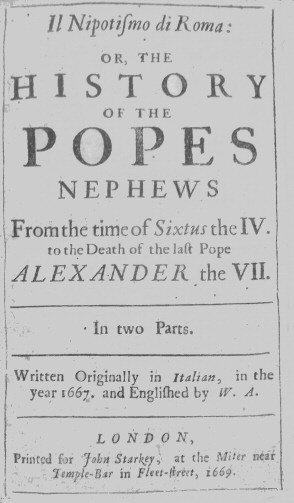
Innocentius the Tenth had brought the Court into such a confusion; that in his time no body knew where to begin any business: For he did so little care to trouble himself with the important affairs of Christendome; that most commonly he refused to meddle, even in those which concerned his pastoral function. His troublesome houres were when he was forced to give audience to a forrain Embassadour, and to be rid of business; his maximes were, To deny all favours, to answer all requests with a negative, and never to come to a final resolution in any thing that might please his enemies; though the thing in its self was very beneficial to the Church and State. If he had any inclination to do good, it appeared only in what he did to his own family, and in the care he took to embellish the City of Rome. But the ill he did was not contained in such easie limits, it spread its self over all Christendome, which did lament to see the Church provided of so extravagant a Pastor.
In the beginning of his pontificat, he shewed himself much enclined to be well informed of the state of Rome, and the Church Territories; which vigilance of his, at last redounded to the prejudice of all his officers. For they thinking at first, that his proceeding came from the love of justice, and good order, came all to Rome with instructions and memorials, wherein their wants and the necessities of their places were set out: but all in vain; for when they expected answer and satisfaction, they found that the intention of the Pope was, to refuse all, and to resolve nothing; so that then every one avoided, not only the presence of the Pope, but Rome it self, and all business in it.
This is the general disposition of the Court of Rome, and of Church-men in common; though the Popes Nephews do often give it another face, according as their designs and thoughts are, which being as different as the humours of one Pope from another; fortune, not merit, raising both Popes and Nephews to this great command; we may say, that things in Rome are rather performed by masked and counterfit persons, then by natural ones: As one of my friends, who lives well, and is one of the best Church-men in the Court of Rome, is used to say, that when once he had put on the habit of a Priest, he could hardly discern his own nature, nor know himself with comparison to what he was before. Which shewes evidently, that Church-men have certain close wayes of treating, particular to themselves, that must make those that have to do with them, stand upon their guard, and use all their policy.
The SECOND BOOK.
The Contents.
In which is discoursed, of the first bringing the Nipotismo into Rome, which happened under Sixtus the fourth, too much inclined to favour his kindred. Of the lascivious life, and of the death of Cardinal Peter his Nephew. Of the government of the Church transferred to Jerom Peter’s brother. Of the number of Sixtus his Nephews. Of the selling of many Jewels. Of the murmurs of the Romans against this Pope. Of the succession of Innocent the eighth to the Popedome. How he was naturally averse from his kindred. What he did for some of his Nephews. Of the assumption of Alexander the sixth to the Popedome. How he made his Bastards great. Of the crimes committed by him. Of the family of the Sforzas, being from Milan. Of the actions of Duke Valentine. How the Pope passed his time. Of his death, caused by poyson. How Duke Valentine carried himself after the death of his Father Pope Alexander. Of the succession of Pius the third to the Popedome, and of his short life. Of what happened to his kindred. Of Julius the second that succeeded Pius. Of his way of carrying himself towards his Nephews. Of the Popedome fallen to Leo the tenth. Of his mind entirely bent to favour the Family of the Medici. How Adrian the sixth succeeded to Leo the tenth. Of the severity he shewed to his kindred. Of the election of Clement the seventh for Pope. Of his great ambition to raise his Family. How Paul the third was chosen Pope. How he likewise was inclined to make his kindred great, and by what means. Of that which Julius the third did in favour of his Family: and how his life was inclined to pleasures and delight. Of the resolution of Marcellus the second, to give nothing to his kindred. How Paul the fourth was made Pope. Of his kindness to his kindred. How Pius the fifth was not naturally inclined to do his kindred good. How Gregory the thirteenth was of a quite contrary disposition. How Sixtus the fifth was made Pope, and how he was inclined to favour his kindred. Of the short life of Urban the seventh, Sixtus his successour. Of the election of Gregory the fourteenth. What was his inclination to his Nephews. Of the election of Innocent the ninth. Of his proceedings and death. Of the election of Clement the eighth: and of what he did for his kindred. Of the desire of Leo the eleventh, successour to Clement, to make his family great. Of the election of Paul the fifth. Of his life and actions, and how he advanced his kindred. How Gregory the fifteenth succeeded to Paul the fifth, and of his great affection to his kindred.
Now we must look back, and return to Sixtus the 4th, who first opened a door to the Nipotismo, and who by introducing his kindred, brought at the same time ambition and riches into Rome; the riches were for his Nephews, and the ambition he left as an inheritance to all Church-men; and it is now one of the greatest mischiefs that oppresseth the Church.
’Tis not to be wondred at, that I begin the History of the Nipotismo, from the time of Sixtus the fourth, since he was the first that delivered up Rome and the Popedom in prey to his Nephews, to the wonder and astonishment of the whole world.
He was then the first introducer of the Nipotismo, and so indulgent a one, that to favour his kindreds interest, he had forgot himself, and the Church, thinking of nothing, but of the means how to advance them to their satisfaction, from whence the murmurs of the people were so great in Rome, that many Confessors were fain to give over their Function, that they might not hear the peoples complaints against the Pope and his kindred: So that it was spread through Europe, that Rome had as many Popes as Sixtus had Nephews.
This Pope, immediately after his election, made two Cardinals; viz. Peter Riario, whom many suspected to be his Bastard, having alwayes been educated, with great care by him, in the same Monastery; the other was Julian, son of Raphad de la Rovere, brother to the Pope, and had been first Bishop of Carpentras, then was made Cardinal by his Brother, and at last came to be Pope, under the name of Julius the second, as we shall relate in due place.
Sixtus gave to the Cardinal, Peter Riario, all that was in his power to give, adding Abby upon Abby, and revenue upon revenue, till he had made him so rich in Church lands, that he lived most splendidly, and seemed to be born to waste a greater fortune; Plays, Balls, Dances, and such pastimes, were the ornament which he bestowed upon his Ecclesiastical dignity, being perswaded, that pomp and vanity were becoming the majesty of a Cardinal.
He lived but two years in this loose life; in which time ’tis thought he spent, in Treats, and Balls, and such like diversions, above two hundred thousand Duckats of gold, besides seventy thousand which he owed at his death, and which were never payed: He dyed at the age of 28 years, to the great regret of his Uncle, his disease having been caused by his debauchery, as the Physitians testified.
Six months before he dyed, the Pope, whose continual study it was, how to make him great, declared and proclaim’d him his Legat over all Italy; not that any urgent business did require such a Function, but only that he might give him an occasion of shewing his Grandeur, and receiving more pleasure in those triumphs and receptions, he was upon this score to have bestowed upon him by the Italian Princes; who to humour the Pope, forgot no honour they could think of, towards the person of his Legat; and could not indeed have done more to the Pope himself; particularly in Venice, Milan, and Padua, he was received with so extraordinary a pomp, that it was almost incredible.
Great was the delight which he took in these publick honours; but much greater were the pleasures, which he tasted in secret, having ordinarily, amongst his Attendants, five or six Russians, whose business it was to satisfie his appetite, though never so inordinate. Being at last come back to Rome, to the possession of his old Mistresses, he ended his dayes amongst them, and went to a new world, whether of pleasure or of pain, God knows.
But the Popes affection to his kindred was not buryed in his grave; for he made his Brother Jerome succeed in his favour and fortune, which he rather increased then diminished; for he made him Lord and Soveraign of Inola and Forli; and gave him the government of all the state of the Church, besides other important Offices.
This Jerome was a quite contrary disposition to his Brother; being naturally severe in words and deeds, and averse from all pleasures but hunting. He married Catharina, natural daughter to Galeazzo, Duke of Milan; and Sixtus made Ascanius, the son of the said Duke, Cardinal into the bargain, contrary to the young mans inclination, which was rather to marriage, then to a single life.
But the inordinate passion of this Pope did not rest in all this; for his ambition of having kindred to advance was such, that not being content with that great number of true Nephews that he had, he substituted and adopted some, that were no relation to him at all; to whom he gave an infinity of places and commands.
He gave to Leonard, his brothers son, a natural daughter of King Ferdinand in marriage, and made him Prefect of Rome: And he being dead, he immediately transferred that honour and place to another Nephew, called John de la Rovere, brother to the Cardinal Julian; giving him besides, the Propriety of the States of Sora and Sinigaglia.
This John had by Giovanna, daughter to Frederick, Duke of Urbin, a son, who was Francesco Maria della Rovere, who after the death of Guido Ubaldo, his Uncle, who dyed without male issue, succeeded by adoption, and in the right of his Wife, to the Dukedom of Urbin.
Besides these, Sixtus made Cardinals the two brothers, Christopher, and Dominic, de la Rovere, who lived in Turin, under the protection of the Duke of Savoy, though they were Soveraigns of Vico Nuovo, and other Estates in Italy.
Besides, he made Jerome Batto, his sisters Son, Cardinal, as likewise Raphael Samson, son to a sister of Pictro Riario, whom he promoted to that dignity, when he was but seventeen years old, upon condition, that he should change his name, and take that of the Popes Family.
This Pope had so much kindred, and was so inclined to advance them, that he often granted the same thing to two different persons, having forgot that he had granted it to the first.
But amongst all his inventions to enrich them, this was one of the best: In the beginning of his Pontificat, he made, as if he had a design to pay the debts, left upon the Church by the precedent Popes, Eugenius, Nicolas, Calistus, Pius, and Paul; but pretending want of money to do it, he compassed his design by this means.
Paul the second, his predecessour, had alwayes had a great inclination for the publick pomp and state of the Popedom, and therefore strove to make the Ornaments of the Popes person and head the richest that was possible for him; to which end, in the Miter, which serves at their Coronation, and other publick ceremonies, he had caused above the worth of a million in precious stones to be set, having bought up (all the world over) the best Diamonds, Saphires, Rubyes, Emeraulds, Chrysolites, &c. that could be had for money; so that afterwards, when he came out in publick, he looked like another Aaron, with a Majesty more divine then humane, being himself very tall, and of a comely port and presence.
Sixtus, who having been brought up in the severity of a Monastick life, did little esteem that outward pomp, which Paul, his predecessour, so much prized, caused these precious Stones to be sold, under pretence of discharging such debts, as the Church was lyable to for his predecessours.
The Jewels were soon sold, and the money consigned into the hands of his Nephews; but the debts were never payed, though the Jewels had been sold to that end: And that which is worth relating is, that the Pope answered every one, that came to demand any thing due to them; that he had already payed the others, that he was sorry it was not their fortune to come sooner, and that the money had proved short to discharge so many debts: So that the poor Creditors were fain to go away cheated, and yet knew not whom to complain of.
The Romans murmured strangely, against this greediness of the Pope and his kindred, and so much the more, because that they had not yet been accustomed to see a Popes passion; for his kindred make him rob and plunder the Church. They wondred what example Sixtus could have for his proceedings, for none of his predecessours had hitherto shewed so little moderation, but in providing for their kindred, had kept some measures. Neither could his education furnish him with this ambition and covetousness; for he had been brought up in a Convent, amongst Religious persons, who professed voluntary poverty, and to whose principles he seemed to be so inured, as not to be able to forsake them: for all the while he managed publick business, before he was a Cardinal, it was with a great deal of candour and disinteressment that he did it; and when he came to be made Cardinal, he was so far from keeping a Court, and living in that splendour, which others thought became that dignity, that his family and Retinue looked rather like a Convent, then like a train of Attendants. But as soon as he was Pope, he changed of a sudden, and lived like a Prince, never troubling himself at what the world said of him, but cared only to please himself, and make his kindred great.
Sixtus being dead, Innocentius the eighth was made Pope, in the year 1484. being of the noble Family of Cibo, which hath had many eminent persons in it. This Pope, remembring the complaints of the Romans against his predecessour, for being too indulgent to his kindred, resolved to be very cautious in that point, and give no occasion of scandal that way: Which he observed so well, that when any one of his kindred came to Rome, and that he had notice of it, he would say, Our kindred had much better stay in Geneva without us, then come to Rome for our sakes; and indeed he was very reserved to them: For to Mauritius Cibo, who was a very accomplish’d Gentleman, he gave nothing, but the Government of the Dutchy Spoleto, and made him President of the State of the Church Employments, which in those dayes were not of any great honour or profit, though now they are both rich and honourable.
So he made Lawrens Cibo, his Nephew, Cardinal, but with very little authority, forbidding him to meddle with publick business of importance, without being called to it. And yet was he forced, as it were, to honour him thus far; for many whispering about the Court, that he was a Bastard, he was fain to shew the world, that he did own him, as being lawfully born of one of his Cozens; which he proved by a process and strict examination before Cardinal Balbo, a Venetian, and one, who had no wayes interest to favour the family of Cibo.
The greatest advantage that this Pope procured his Family, was, that he married Francesco Cibo with Magdalen of Medicis, sister of Leo the tenth that was afterwards, giving him the County of Anguillara, which was not of any importance in those dayes, and making him Captain General of the Forces of the Church: And in this he ended all the favours that he ever shewed his Family, which was very noble besides.
Alexander the sixth succeeded Innocentius in the Popedom, who was a barbarous, lascivious Pope, making no difficulty of bringing desolation upon the Church, and imbrewing his hands in innocent bloud, to advance and make great his kindred. In the reign of this Pope, the Romans used to say, That the Emperours had taught tyranny, and the Popes practised it.
He was cruel, covetous, and insatiable, in heaping riches together: He spent his retired hours all in lascivious pleasures, taking great delight to be embraced and caress’d by fair Ladies; whence the numbers of his Bastards was very great; many taking from thence occasion to say, That he had filled Rome with Bastards, and Spain with Whores. ’Tis true, that he declared for his Heirs only, four male children, and two female: And though he used to change Ladies often, for variety and greater pleasure, yet he gave himself up to Vanoccia, a Roman Curtizan, whom he loved as his lawful Wife, and with whom he would sport and toy in publick, keeping her at his table, and in his house, as if she had been his true Wife, and this while he was Archbishop and Cardinal.
Being made Pope, in the year 1492. the second of August, he introduced into Rome, not a Nipotismo, but rather a Filiolismo, nay indeed, a Bastardismo, that is, a company of Bastards, whom he brought with him, in his return from his Legation in Spain: And his first way to make him great was, by force of Arms, making league with this Prince, then with that, then with another, but still upon these conditions, to give Principalities, which he nam’d, to his bastard sons.
For this end, he joyned in a Confederacy, which proved fatal to all Italy, with Lewis the twelfth of France, with the Catholick King, the Venetians, and the Florentines; the Conditions of which League were, that they should dispossess the true and ancient Owners of the Provinces of La Romagna, La Marca, and Umbria; and that the whole should be made over to Cesar Borgia, the Popes son; who to this end had laid aside his Cardinals Cap, and taken in marriage Charlotte of Albret, daughter to the King of Navarre, and allyed to the French King, and divers other great Princes.
But this design having taken no effect, because of the dispute, that rise between the French and the Spaniard, about the dividing of the Kingdom of Naples, which at last ended in the utter ruine of the French, the Spaniards remaining Masters of the whole Kingdom; the Pope thought it was easier for him to compass his ends, and establish the Grandeur of his Bastards by great and powerful Alliances.
From hence proceeded, that having promised his daughter Lucretia, while he was Cardinal, to a certain Spaniard; as soon as he was Pope, he took her away from him, and bestow’d her in marriage upon John Sforza, Lord of Pesaro, with whom being also fallen out, he took her away from him, and bestowed her upon Lewis of Arragon, natural son to King Alfonse; joyning thus two bastards, that they might not reproach one another: And he likewise dying some months after his marriage, he gave her to Alfonse d’Este, Duke of Ferrare, with whom she lived and dyed. ’Twas in the pomp of her Wedding, that the Pope caused to be celebrated in Rome, Turnaments and Tiltings, together with the representation of a hunting Match; and many say, that in the Ball and Dances the Pope danced every night, masked, with some of his intimate Friends.
Of his sons, he made Godfrey, the youngest Prince of Squillace, a City in Ulterior Calabria, and the Country of Saint Cassiodorus: He made Cesar, who was the second, Cardinal; and his eldest, named John, was by the great entreaties and instances of the Pope, made Duke of Candia in Spain, much against the inclination of the Catholick King; for this John he procured in marriage a bastard daughter of Alfonse, King of Naples; and thus he filled the Vatican with bastards, whereupon Pasquin, with a great deal of reason, call’d it, Il Bastardismo.
Cesar, his second son, being troubled to see his brother John above him, and more beloved by his Father, resolved to take him out of the way; so one night, as John was going in Rome about some business, he caused him to be set upon by some of his Confidents, who having stabb’d him, cast him half alive headlong into the Tyber; and the same evening (a barbarous action) they had supped together, very brotherly, at their Mother Vanoccias house.
The Pope, who was afraid of incurring the same danger from his son, whose temper he knew to be wicked enough for such an undertaking, was forced to dissemble this inhumane action of the Cardinal, and to make no pursuits nor informations about the death of his eldest son.
Cesar, being thus delivered of his brother, began to give himself up to the life of a Souldier, and the practise of Arms, without any consideration of his being a Cardinal: for his great motive in murdering his brother was, that he might attain to the dignity of Gonfalonier, or Standard-bearer of the Church, and Captain General of the Popes Armies; so that a little after his Fratricide, he layed off his Cardinals Habit, and the Pope invested him with all the honours of his dead brother.
Thus being made General of the Popes Army, he united with the French, and married Charlotte of Albret, and had for her portion the Dutchy of Valenza, from whence he was called over, after Duke Valentine, as being a particular acquisition of his own.
With the help of Lewis the twelfth, and of his Father the Pope, he gained a great estate in Italy; his Father being still ready to supply him with vast sums of money, which he spent to purchase greatness.
Having driven the Family of the Sforza’s out of Milan, and put them in prison; by the help of the French King, he made himself Master, with great cruelty, of all the Cities of La Romagna, except Bologna, banishing and murdering the ancient and true Lords and Masters of them.
The first seized upon Forli and Imola, causing the poor young Riarri, who were Lords of those places, to fly for safety; and taking prisoner their Mother Catharine, whom he carried in triumph to Rome; exposing to the eyes of the Romans his barbarous cruelties.
From Forli he passed to Faenza, which City he took by force, putting to death Astorre Manfredi, who was Lord of it.
He did the same by Arimino and Pesaro, forcing Nulatesta, and John Sforza, to avoid by flight, the infamy and cruelty of the death they were sure to undergo, if they fell into his hands.
After this, he besieged Sinigaglia, and took it by force, committing infinite acts of inhumanity in it.
With the same course of Victory, though with craft and deceit mingled with force, he deprived Guido Ubaldo di Feltro of his Dutchy of Urbin, making him fly to Mantua, not without danger of falling into his net by the way.
After this, he lead his Army against the City of Camerino, which he took by force, and put to a cruel death Giulio Cesare, and Venantio Varrani, who were, and had been, long in possession of it. And with the same ardour and ambition, he fell to persecuting all the neighbouring Princes, in hopes to deprive them of their States.
At last, he turned his rage upon the chiefest Families of Rome, beginning with the noble Family of the Gaetani, who were in possession of great Estates in the Country of the Volai, putting to death Honorato and Cola Gaetani.
Next, he fell upon the Colonna’s Family, and having dispossessed them of their Lands, forced them to fly to Apulia, and Sicily, where they were extremely pitied by that people, who had a perfect knowledge of their rare deserts.
But while he thought to do the same to the Ursins, they having leagued themselves with other Princes, raised an Army in their defence; and having at last encountred his, defeated it, and forced him to fly to Imola, or, as some say, to Rome, where the Pope, being frightned with this sudden blow, had recourse to craft and dissimulation; he treats with the Confederates; gives them such Conditions, that they themselves, even triumphant, could hardly expect: And having thus lull’d them asleep, and made them lay down Armes; in the mean while, Borgia having recovered himself, and got a new Army, fell upon them most cruelly; and persecuting them separately, put to death some, banish’d others; and in a word, used all barbarous means to compass their ruine.
All this while the Pope was taking his delight in the Vatican, in Vanoccia’s armes; receiving every day, with new joy and satisfaction, the news of his Sons crimes.
The Revenue of the Church being not sufficient to maintain such an Army as Cesar Borgia’s was, and withall, to supply the expence of his Court, which was truly Royal and Prince-like; Alexander made a new Colledge of fourscore Writers of Briefs, selling every place for two hundred and fifty Crowns of Gold; receiving besides into Rome those Moors, that the King of Spain had driven out of his Dominions, who to enjoy their liberty, gave him great sums of money: And yet all this seeming inconsiderable, he sold divers Cardinals Caps, and at last, for fear of being unprovided of money in some urgent necessity, he resolved to dispatch with poyson, the richest Prelates of the Court, and amongst them some very rich Cardinals, whose Estates he intended to make himself heir to, and so satiate the barbarous greediness of his son.
But Divine Providence, taking compassion of the innocency of so many persons, disappointed this barbarous design most miraculously; for just in the execution of it, the Pope himself was, by the mistake of his Cup-bearer, sent out of the World, and his son Cesar in extreme danger: And thus it happened.
Alexander invited to a Treat, in his Garden of Belocdere, all the richest Cardinals and Prelates, under pretence of honouring them; and had secretly given order to mingle some poyson with most exquisite Wines that they were to drink. But the Cup-bearer, in pouring out his Wine into Glasses, mistook, and poysoned the Pope and his Son Cesar. ’Tis true, that some do believe, that the Cup-bearer did it on purpose, being glad to be the Instrument, that should deliver the State and Church from so much misery, in which they were involved under this Popes tyranny.
Cesar perceiving himself to be poysoned, presently had recourse to Remedies, and with vomiting, being strong, and in the flower of his age, freed himself from the poyson, though very violent: ’Tis true, that he remained impotent, and unfit for action, so that his Army immediately crumbled away, for want of his personal assistance to keep them together.
But the Pope, who was already seventy two years old, was not able to resist the strength of the poyson, though all the Remedies imaginable, were put in use to save him. So he dyed in the Vatican, in the year one thousand five hundred and three.
As soon as the Pope was dead, Cesar, his son, caused himself, and all the Popes Treasure, to be transported to the Vatican, under the guard of twelve thousand Souldiers, with an intention, to force the Cardinals to make a Pope of his liking: But he failed in his design; for the Cardinals met in the Convent of La Minerva: And Cesar having set Michrelletto Correglia, his great Captain, to besiege them, the people of Rome, moved with indignation against such a violence offered to the Cardinals, rose in Armes for their defence; whereupon Borgia resolved to retire to Nepe with his Army, and leave the Cardinals their liberty: Who being free, and having celebrated the Popes Obsequies, went into the Conclave to choose his Successor; and after some dispute, agreed in the Person of Cardinal Picolomini, one of the eminentest Prelates of the Court, who took the name of Pius the third.
The news of this Election being come to Siena, which was the Popes native Country, Pandolfo Petrucci, who was Tyrant of this City, was extremely troubled at it, doubting not, but that the Pope would soon drive him away, and set his Country at liberty; so that to be rid of his fear, he procur’d a Chirurgion to poyson a Sore that the Pope had in one of his Legs; which was done, and the poor Pope dyed, some seven and twenty dayes after his creation.
The Picolomini Nephews and Relations to his Holiness, were already flown to Rome, like so many Bees, but before they could get within the gates, they receiv’d the sad news of their Uncles death; so that they were fain to return to Siena upon the same Horses, upon which they came to Rome. ’Twas certainly believed, that this Pope would have made another Nipotismo in Rome, for he was very tender hearted and kind to his kindred.
To Pius succeeded Jules, the second brother to Sixtus the fourth, who was chosen with so publick a consent and applause, that he was almost proclaim’d Pope before he went into the Conclave; the people receiv’d the news of his Election, with extraordinary demonstration of joy, because of the great esteem they had for his person, Alexander having kept him in banishment from Rome, for the space of ten years together, to the displeasure of the whole Court of Rome.
Jules proved a man of a great Soul, and a noble and constant Defender of the Church, and little inclin’d to make his kindred great. ’Tis true, he did own a great deal of kindness for his Relations, but much more for the Church: And did say, That he would have bestowed upon them all that he had, if all that he had were not the Churches. Therefore he would never give them any State belonging to the Church; and if Francesco Maria, his brothers son, did obtain the Dutchy of Urbin, it was, because that Guido Ubaldo da Feltra, his Kinsman, did adopt him. Some say, that it was by the Popes perswasions, that Guido Ubaldo did this; which though it were true, yet it did not any wayes prejudice the Church: And if he did bestow Pesaro on the same Francesco Maria, which State was lately fallen to the Church by the death of Gio. Sforza, who dyed without Heirs, it was to pay to the said Francesco Maria certain debts, which he pretended due to him from the Church.
Besides, he never gave any extraordinary Authority to four Cardinals of his own kindred and creating; who were very much displeased and discontented at this his severity.
He answered one day two of his Relations, who were very pressing for an Office, which he would not grant; You ought to be content with what my Brother did, who lov’d the house of La Rovere better then the Church.
In his time Rome was almost without a Nipotismo: but no sooner was Leo the tenth raised to this great honour, but things began to run in another stream; for this Pope, though otherwise very worthy of such an Elevation, yet was he no sooner settled in his Dignity, but he began to project the greatness and advancement of the house of the Medicis. And first he bestowed upon Julian, his Brother, the Office of Gonfaloniero, or Standard-bearer to the Church, together with other charges and places: Then he called most of his kindred to Rome, making them Cardinals, and bestowing Dignities upon them. So that the Nipotismo began to take a new possession of Rome and the Church.
Leo undertook, by the means of the Emperour Maximilian, to make his brother Julian Lord of Siena and Lucca, pretending to add to his Domination the Dutchies of Urbino and Ferrara: But Julian dying in the interim, the Pope transferred his kindness upon his brother Lawrens, and attempted the execution of this his design in his favour, by the means of the Emperour Charles the fifth, who was newly come to the Empire. Besides, he put into his hands the government of the City of Florence, with this condition, that he should undertake nothing, without the advice and consent of the Citizens.
Then he enriched him with all the Honours and Offices his brother had enjoyed in the Church-State; and yet desirous every day to make him greater, and to satisfie the instant prayers of his Mother Alfonsina. He made war with Francesco Maria della Rovere, Duke of Urbin; and having sent an Army against him, under the command of Renzo di Lere, he took his Dutchy from him, and invested with the title of Duke of Urbin Lawrens his Nephew; the poor Duke and his Lady being constrained to fly to Mantua for refuge.
With the same intention, though not with the same success, he strove to pick a quarrel with Alfonse, Duke of Ferrara; but he being a Prince experienced in war, and under the protection of a strong City, easily defeated the Popes design and artifices.
Lawrens being dead, the Pope sent the Cardinal of Medicis to Florence, to govern that City; and in him first began to relent that great ardour, with which he had hitherto pursued the advancement of his Family, giving himself over to other Employments, much more necessary, and more becoming a Prelate, whose care was not only to be bounded within the walls of Rome, but over all Christendome.
Adrian the sixth was Leo’s Successour, he had been the Emperour Charles the fifth his Tutor, and was created Pope the year of our Lord 1529. being then in Victoria, a City of Spain: As soon as he received the news of his Election, he embarqued at Terracona, and came to Genoa; where having received the Complements of Ambassadours of all parts, he came in great triumph to Rome.
This Pope was indeed too severe with his kindred; and under him, the Court of Rome pass’d from one extremity to another: for his Predecessours gave all to their Nephews, and he refus’d to give them even that which they deserved; and for this reason he was blam’d, not only by the Court, and forraign Ambassadours, but also by the common people, as being unnatural and clownish.
There was in Siena one of his Cozens sons, maintained there in his studies by the Pope; who being moved with the ambition of rising under his Uncles Pontificat, came to Rome without order; but the Pope no sooner had notice of it, but he commanded (without being prevail’d upon to see him) that he should instantly be carried back again upon a hackney Horse; giving order to his Confessor, to tutor him sharply for being so bold; and bidding him remember to take from his Uncle, an example of modesty and temperance, and apply himself strongly to his study, and the practise of vertue, which would advance him without help of his kindred, or at least very little.
Many others of his kindred, even his Nephews, came from Germany to Rome, with a design to enrich their fortunes, as other Popes Relations had done; but they soon found they had abus’d themselves, for the Pope, angry at their journey, sent them all back, with no other Present, then each of them a woollen Sute, and just as much money as would suffice to bear their charges. Nay, even to one, who out of necessity was come a foot, he refused to give any more then would just defray his expences on foot back again. ’Tis true, that some Cardinals were very Noble to them. This Pope was continually blaming the Prodigality of those who had bestowed such great riches upon the Church. In the year that this Pope liv’d, Rome was so afflicted and visited with Warre, Famine, and Plague, that it cannot be remembred without tears, and the people very unjustly laid all the fault upon the Pope, all mouths being open to clamour against him, and sing the Latin Verse:
Semper de Sextis diruta Roma fuit.
To Adrian succeeded Clement the Seventh of the Family of the Medici, who conserving the wonted ambition of this Family encreased their revenues and power with all his industry, insomuch that after he had been imprison’d and extraordinarily ill us’d by the Emperour Charles the Fifth, he nevertheless entred into a confederacy with him, upon condition that he should give his bastard Daughter Margaret in Marriage to Alexander of Medici, Lawrens his Son, and by force of Arms oblige the Florentines to acknowledge him for their Lawful Prince. All this was accordingly executed, the Emperor having sent the Prince of Orange with a very great Army to settle the Medici in their new principality.
And Clement not content with this; as soon as the Emperour was gone into Spain, made a new league with Francis the First of France, and to strengthen it, Henry the Second, the Daulphin of France, married Catharina of Medicis Daughter to Laurens; the wedding was kept at Marseillis, where the King and the Pope were both present.
The Pope having thus happily setled his family, returned to Rome, and there died: In September 1534. and in the same year, in the Month of October, Paul the Third was chosen to fill his place, with great joy and applause of the people of Rome. He was Alexander Farnese Cardinal, and one who shewed himself worthy of so eminent a dignity.
His first work was to find out means to advance his Family; and therefore in December following he created two of his Nephews Cardinals; one Alexander Fernese, Son to Pietro luigi Farnese his own Son, for the Pope had been married before he was Cardinal; and the other Guido ascanso Forza Costanza his daughters Son. Alexander being suddenly dead, the Cardinal Hippolito Medici was made Vice-Chancellour of the Church, and Vice-Chamberlain after the death of Cardinal Spinola. Thus from day to day, as places and offices became vacant, the Popes Nephews were sure to have them.
Paul was very desirous to procure a meeting between the Emperour and the King of France, where he desir’d to be present in person also; which thing being carried on by his Legat, Cardinal Carpi was well accepted and agreed of by both Princes, the Town of Nizza in Provence, but belonging to the Duke of Savoy: was chosen for the place of meeting, as being conveniently situated upon the Sea side.
The Pope, though old, was the first that came to the place appointed, having endured very great inconveniencies in his journey; and yet he was disappointed at last of his desires; for these two Princes having penetrated into the Popes design, found that it was not out of any love to Christendome, but only out of a fond affection to his family that he had desir’d their company. So they refused to see one another in his presence, but came separatly, and kiss’d the Popes feet with no small mortification to his Holiness, being thus deluded and almost derided.
And indeed this interparly was not desired nor procur’d by the Pope, either with a design of appeasing the differences in Religion, or of making a League betwixt the Christian Princes against the Turk, though this were the pretext, but with a purpose to get Margaret of Austria, the widdow of Alexander Medici, for Octavio Farneze his Grandchild; and following the example of Clement the Seventh, give Victoria, afterwards married to Guido Ubaldo Duke of Urbin, his Neece, to some Prince of the blood of France, having chosen out the Duke of Vendosme, who was a young Prince of great merit and hopes: but for this time the Pope was forced to return to Rome without having effected his designs, as the King of France went to his own Kingdome, and the Emperour to Marseilles, where he visited the French King.
Some time after the Pope obtained from the Emperour the City of Novarre for his Son Pietro Luigi, and made up the match between his Grandchild Octavio and the Princess Margaret Daughter to the Emperour, and widdow of Alexander Medici; this done, the Pope undertook the recovery of the City of Lamerino, which he pretended to be devoted to the Church by the death of Giovani Maria Varrano, who had receiv’d the investiture of that place from Leo the Tenth, and dyed without any male children, and upon this Title made warre against the young Guido Ubaldo da Feltro, who by the Womens side pretended a right to it, but not being able to maintain it, was fain to fly and leave the place to the Pope, who having taken it, presently gave the investiture to his Grand-child Octavio Farneze, making him Duke of Camerino, and Receivour General of the Church, having before made him Prefect of Rome in the place of the Duke of Urbin.
But this Popes ambition swell’d much higher, for he went about to buy the Dutchy of Millan of the Emperour with the Churches money, and make an unalienable Patrimony of the Family of the Farnezes. But the Emperour, though very necessitous and extreamly sollicited by the Pope with a vast summe of ready mony, was nevertheless so prudent as not to dismember from his Empire so considerable a part of it.
Besides this the Pope gave to his Son Pietro Luigi, against the consent of almost all the Cardinals, the noble Cities of Parma and Placentia in Lombardy, which were Fiefs of the Church. The said Pietro Luigi was murdered by the principal Citizens of Placentia in a conjuration layed and carried on by the Emperours order; who all along refused to confirm Pietro Luigi in this new Principality, the Pope pretending that the Emperour should acknowledge him for lawful Lord and Master of these Cities; which he was so far from doing, that he endeavour’d to take them from him; whereupon the Pope was forced, that he might support his Son, to side with the French, who failed not to settle his Grand-child Octavio, though with this condition that he should renounce Camerino, and restore it to the Church, and be content with Parma and Placentia, for which he should pay every year seven thousand Crowns to the Apostolick Chamber.
Thus the Nipotismo was in great credit and Authority in Pauls time: for this Pope spared nothing to make them great, alienating the Churches Lands, and maintaining them in the possession of their acquisitions with the Churches Mony, which stirr’d the indignation of all Christendome, and made the Hereticks, who by this time were multiplied like Grashoppers, take from them an occasion to deny the Popes authority and primacy.
Julius the third, who succeeded Paul, preserv’d his Nipotismo in a handsome condition and rank, but was not so furiously transported with Ambition to settle them in Dukedomes and Principalities. His humour was gay and merry, a good companion, and one that lov’d to eat and drink well with his friends.
And yet though this jovial inclination of his made him little enclin’d to warlike attempts, he nevertheless sent great Succours to the Duke of Florence, Cosino, in his Warre against the Sienezes: and this because the said Duke had promis’d him to make his Brother Baldwin Marquis of Monte san Sabino; which thing was not only executed, but besides, the Dukes Daughter was promised in Marriage to Fabian de monti Baldovin his Son; she was afterwards married to Alfonse Duke of Ferrara.
Giulio made also five of his Nephews Cardinals, to wit, Christopher di Monte, Fulvio de la Corgna, Innocentia de Monte, Geronimo Simoncello, and Roberto de Monte pulcrano. To these he was very liberal, but to say true, not prodigal, as his Predecessors had been. ’Tis true, he did what he could, to make his Brother Baldwin Duke of Camerino, and deprive the Church of so good a State, but the Cardinals oppos’d him so vigorously, that he was fain to desist from his design.
Julius being dead, the very name of the Nipotismo dyed with him, for in the year 1555 Marcelius the Second was made Pope; who would never endure, that any of his kindred should come neer Rome, no not his own Brother. Nay more, he would never suffer that two Nephewes of his, who before his Election liv’d with him, following their Studies in Rome under his care, should receive any visits as his Nephews; and he forbid him to stir out of doors, least in going to School they should be owned in the streets, and receive the Complements of persons of quality.
They that knew much of his mind while he was Cardinal, said after his death, That his intention was altogether bent to apply some remedy to the ambition of the Popes; and that he had particularly resolved to give to his Brother and Kindred but just as much as would maintain them like ordinary Gentlemen; but not so much as a simple Barony, much less Dukedomes and Principalities; and to this he would have the advice and consent of the whole Colledge of Cardinals, having a firme purpose of making most secure decrees, by which the Popes should be bound, and kindred from giving any thing to their Kindred without the consent of all the Cardinals.
But while he was intent upon so good a work, he was surprized by death twenty dayes after his election; so that in so short a time he did neither good nor harme to the Church.
To him succeeded Paul the Fourth, of the House and Family of Caraffa in the same year 1555. This Pope was one of the most fantasticall ill humour’d men that all the World could afford. He presently made his Brothers Son Carlo Caraffa Cardinal; and to him he gave so much Authority, that it seemed that the Popes Will depended upon his pleasure. He excommunicated Mark Antonia Colomna, and Ascanio his Son, under divers pretexts, but indeed only to take from them those offices and honours which they had in Rome, and to seize upon all their Revenues within the Territories of the Church; which was severely executed; the Pope at the same time giving the investiture of all their estates to Giovani, Count of Montorio his Brothers Son, giving him the Title of Duke of Paliano, which place he immediatly went about to fortifie, that it might hold out against the forces the Colonesses were raising to recover their lands, as at last they did.
A little after he made Antonio Caraffa the Earles brother, Marquess of Montebello, a place which he had deprived the right owner, the Earl of Bagno, of, as being contumacious, and for having, as the Pope said, ingrossed that money which the King of France had sent for the War in Italy.
The Nephewes of this Pope became at last so insolent by their Uncles indulgence, that they did rob, spoyl, ravish, kill, and in a word commit all sorts of crimes with impunity; Exercising so many cheats and frauds upon the poor people, that not only they made all the World cry out against them, but at last moved the indignation of their own Uncle, and provoked him to be severe to them, driving them away out of Rome, and depriving them of all honour and dignity.