
The Project Gutenberg eBook of Illustrated History of Furniture, fifth ed.
Title: Illustrated History of Furniture, fifth ed.
Author: Frederick Litchfield
Release date: September 27, 2019 [eBook #60369]
Most recently updated: October 17, 2024
Language: English
Credits: Produced by Jane Robins and the Online Distributed
Proofreading Team at http://www.pgdp.net (This file was
produced from images generously made available by The
Internet Archive)
ILLUSTRATED HISTORY OF FURNITURE
| FIRST EDITION | 1892 |
| SECOND EDITION | 1892 |
| THIRD EDITION | 1893 |
| FOURTH EDITION | 1899 |
| FIFTH EDITION | 1903 |
TRUSLOVE AND BRAY
PRINTERS
WEST NORWOOD S E
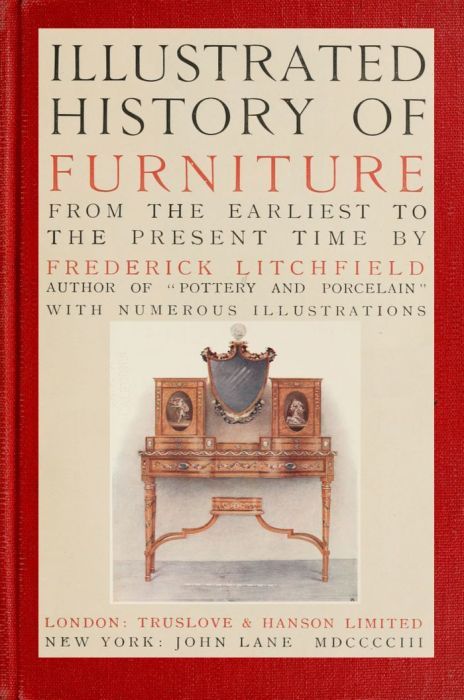
ENGLISH SATIN-WOOD
DRESSING-TABLE.
WITH PAINTED DECORATION.
END OF XVIII CENTURY.
ILLUSTRATED
HISTORY OF
FURNITURE
FROM THE EARLIEST TO
THE PRESENT TIME BY
FREDERICK LITCHFIELD
AUTHOR OF "POTTERY AND PORCELAIN"
WITH NUMEROUS ILLUSTRATIONS
LONDON: TRUSLOVE & HANSON LIMITED
NEW YORK: JOHN LANE MDCCCCIII
PREFACE.
N the following pages the Author has placed before the reader an account of the changes in the design of Decorative Furniture and Woodwork, from the earliest period of which we have any reliable or certain record until the present time.
A careful selection of illustrations has been made from examples of established authenticity, the majority of which are to be seen, either in the Museums to which reference is made, or by permission of the owners; and the representations of the different "interiors" will convey an idea of the character and disposition of the Furniture of the periods to which they refer. These illustrations are arranged, so far as possible, in chronological order, and the descriptions which accompany them are explanatory of the historical and social changes which have influenced the manners and customs, and directly or indirectly affected the Furniture of different nations. An endeavour is made to produce a "panorama," which may prove acceptable to many, who, without wishing to study the subject deeply, may desire to gain some information with reference to it generally, or with regard to some part of it, in which they may feel a particular interest.
It will be obvious that within the limits of a single volume of moderate dimensions it is impossible to give more than an outline sketch of many periods of design and taste which deserve far more consideration than is here bestowed upon them; the reader is, therefore, asked to accept the first chapter, which refers to "Ancient Furniture" and covers a period of several centuries, as introductory to that which follows, rather than as a serious attempt to examine the history of the Furniture during that space of time. The fourth chapter, which deals with a period of some hundred and fifty years, from the time of King James the First until that of Chippendale and his contemporaries, and the last three chapters, are more fully descriptive than some others, partly because trustworthy information as to these times is more accessible, and partly because it is probable that English readers will feel greater interest in the Furniture of which they are the subject. The French meubles de luxe, from the latter half of the seventeenth century until the Revolution, are also treated more fully than the Furniture of other periods and countries, on account of the interest which has been manifested in this description of the cabinet maker's and metal mounter's work during the past fifteen or twenty years. There is evidence of this appreciation in the enormous prices realised at notable auction sales, when such Furniture has been offered for competition to wealthy connoisseurs.
In order to gain a more correct idea of the design of Furniture of different periods, it has been necessary to notice the alterations in architectural styles which influenced, and were accompanied by, corresponding changes in the fashion of interior woodwork. Such comments are made with some diffidence, as it is felt that this branch of the subject would have received more fitting treatment by an architect, who was also an antiquary, than by an antiquary with only a limited knowledge of architecture.
Some works on "Furniture" have taken the word in its French interpretation, to include everything that is "movable" in a house; other writers have combined with historical notes, critical remarks and suggestions as to the selection of Furniture. The Author has not presumed to offer any such advice, and has confined his attention to a description of that which, in its more restricted sense, is understood as "Decorative Furniture and Woodwork." For his own information, and in the pursuit of his business, he has been led to investigate the causes and the approximate dates of the several changes in taste which have taken place, and has recorded them in as simple and readable a story as the difficulties of the subject permit.
Numerous acts of kindness and co-operation, received while preparing the work for the Press, have rendered the task very pleasant; and while the Author has endeavoured to acknowledge, in a great many instances, the courtesies received, when noticing the particular occasion on which such assistance was rendered, he would desire generally to record his thanks to the owners of historic mansions, the officials of our Museums, the Clerks of City Companies, Librarians, and others, to whom he is indebted. The views of many able writers who have trodden the same field of enquiry have been adopted where they have been confirmed by the writer's experience or research, and in these cases he hopes he has not omitted to express his acknowledgments for the use he has made of them.
The large number of copies subscribed for, accompanied, as many of the applications have been, by expressions of goodwill, and confidence beforehand, have been very gratifying, and have afforded great encouragement during the preparation of the work.
If the present venture is received in such a way as to encourage a larger effort, the writer hopes both to multiply examples and extend the area of his observations.
F. L.
32, ST. JAMES'S STREET, S.W.
CONTENTS.
CHAPTER I.
PAGE
BIBLICAL REFERENCES: Solomon's House and Temple—Palace of Ahasuerus. ASSYRIAN FURNITURE: Nimrod's Palace—Mr. George Smith quoted. EGYPTIAN FURNITURE: Specimens in the British Museum—The Workman's Stool—Various Articles of Domestic Furniture—Dr. Birch quoted. GREEK FURNITURE: The Bas-reliefs in the British Museum—The Chest of Cypselus—Laws and Customs of the Greeks—House of Alcibiades—Plutarch quoted. ROMAN FURNITURE: Position of Rome—The Roman House—Cicero's Table—Thyine Wood—Customs of wealthy Romans—Downfall of the Empire 1
CHAPTER II.
Period of 1,000 years from Fall of Rome, A. D. 476, to Capture of Constantinople, 1453—The Crusades—Influence of Christianity—Chairs of St. Peter and Maximian at Rome, Ravenna, and Venice—Edict of Leo III. prohibiting Image worship—The Rise of Venice—Charlemagne and his successors—The Chair of Dagobert—Byzantine character of Furniture—Norwegian carving—Russian and Scandinavian—The Anglo-Saxons—Sir Walter Scott quoted—Descriptions of Anglo-Saxon Houses and Customs—Art in Flemish Cities—Gothic Architecture—The Coronation Chair at Westminster Abbey—Penshurst—French Furniture in the 14th Century—Description of rooms—The South Kensington Museum—Transition from Gothic to Renaissance—German carved work; the Credence, the Buffet, and Dressoir 17
CHAPTER III.
THE RENAISSANCE IN ITALY: Leonardo da Vinci and Raffaelle—Church of St. Peter, contemporary great artists—The Italian Palazzo—Methods of gilding, inlaying and mounting Furniture—Pietra-durá and other enrichments—Ruskin's criticism. THE RENAISSANCE IN FRANCE: François I. and the Chateau of Fontainebleau—Influence on Courtiers—Chairs of the time—Design of Cabinets—M. E. Bonnaffé on The Renaissance—Bedstead of Jeanne d'Albret—Deterioration of taste in time of Henry IV.—Louis XIII. Furniture—Brittany woodwork. THE RENAISSANCE IN THE NETHERLANDS: Influence of the House of Burgundy on Art—The Chimney-piece at Bruges, and other casts of specimens at South Kensington Museum. THE RENAISSANCE IN SPAIN: The resources of Spain in the sixteenth and seventeenth centuries—Influence of Saracenic Art—High-backed Leather Chairs, the Carthusian Convent at Granada. THE RENAISSANCE IN GERMANY: Albrecht Dürer Famous Steel Chair of Augsburg—German seventeenth century carving in St. Saviour's Hospital. THE RENAISSANCE IN ENGLAND: Influence of Foreign Artists in the time of Henry VIII.—End of Feudalism—Hampton Court Palace—Linen Pattern Panels—Woodwork in the Henry VII Chapel at Westminster Abbey—Livery Cupboards at Hengrave—Harrison quoted—The "parler," alteration in English customs—Chairs of the sixteenth century—Coverings and Cushions of the time, extract from old inventory—South Kensington Cabinet—Elizabethan Mirror at Goodrich Court—Shaw's "Ancient Furniture"—The Glastonbury Chair—Introduction of Frames into England—Characteristics of Native Woodwork—Famous Country Mansions—Alteration in design of Woodwork and Furniture—Panelled Rooms at South Kensington—The Charterhouse—Gray's Inn Hall and Middle Temple—The Hall of the Carpenters' Company—The Great Bed of Ware—Shakespeare's Chair—Penshurst Place 47
CHAPTER IV.
English Home Life in the Reign of James I.—Sir Henry Wotton quoted—Inigo Jones and his work—Ford Castle—Chimney Pieces in South Kensington Museum—Table in the Carpenters' Hall—Hall of the Barbers' Company—The Charterhouse—Time of Charles I.—Furniture at Knole—Eagle House, Wimbledon—Mr. Charles Eastlake—Monuments at Canterbury and Westminster—Settles, Couches, and Chairs of the Stuart period—Sir Paul Pindar's House—Cromwellian Furniture—The Restoration—Indo-Portuguese Furniture—Hampton Court Palace—Evelyn's description—The Great Fire of London—Hall of the Brewers' Company—Oak Panelling of the time—Grinling Gibbons and his work—The Edict of Nantes—Silver Furniture at Knole—William III. and Dutch influence—Queen Anne—Sideboards, Bureaus, and Grandfather's Clocks—Furniture at Hampton Court 91
CHAPTER V.
CHINESE FURNITURE: Probable source of artistic taste—Sir William Chambers quoted—Racinet's "Le Costume Historique"—Dutch Influence—The South Kensington and the late Duke of Edinburgh Collections—Processes of making Lacquer—Screens in the Kensington Museum. JAPANESE FURNITURE: Early History—Sir Rutherford Alcock and Lord Elgin—The Collection of the Shôgun—Famous Collections—Action of the present Government of Japan—Special characteristics. INDIAN FURNITURE: Early European influence—Furniture of the Moguls—Racinet's Work—Bombay Furniture—Ivory Chairs and Tables—Specimens in the India Museum. PERSIAN WOODWORK: Collection of Objets d'Art formed by General Murdoch Smith, R.E.—Industrial Arts of the Persians—Arab influence—South Kensington Specimens. SARACENIC WOODWORK: Oriental customs—Specimens in the South Kensington Museum of Arab Work—M. d'Aveune's Work 125
CHAPTER VI.
PALACE OF VERSAILLES: "Grand" and "Petit Trianon"—The three Styles of Louis XIV., XV., and XVI.—Colbert and Lebrun—André Charles Boule and his Work—Carved and Gilt Furniture—The Regency and its Influence—Alteration in Condition of French Society—Watteau, Lancret, and Boucher. LOUIS XV. FURNITURE: Famous Ébenistes—Vernis Martin Furniture—Caffieri and Gouthière Mountings—Sêvres Porcelain introduced into Cabinets—Gobelins Tapestry—The "Bureau du Roi." LOUIS XVI. AND MARIE ANTOINETTE: The Queen's Influence—The Painters Chardin and Greuze—More simple Designs—Characteristic Ornaments of Louis XVI. Furniture—Riesener's Work—Gouthière's Mountings—Specimens in the Louvre—The Hamilton Palace Sale—French influence upon the design of furniture in other countries—The Jones Collection—Extract from the "Times" 145
CHAPTER VII.
Chinese Styles—Sir William Chambers—The Brothers Adams' work—Pergolesi, Cipriani, and Angelica Kauffmann—Architects of the time—Wedgwood and Flaxman—Chippendale's Work and his Contemporaries—Chair in the Barbers' Hall—Lock, Shearer, Hepplewhite, Ince, Mayhew, Sheraton—Introduction of Satinwood and Mahogany—Gillows, of Lancaster and London—History of the Sideboard—The Dining Room—Furniture of the time 173
CHAPTER VIII.
The French Revolution and the First Empire—Influence on design of Napoleon's Campaigns—The Cabinet presented to Marie Louise—Dutch Furniture of the time—English Furniture—Sheraton's later work—Thomas Hope, architect—George Smith's designs—Fashion during the Regency—Gothic revival—Seddon's furniture—Other makers—Influence on design of the Restoration in France—Furniture of William IV. and early part of Queen Victoria's reign—Baroque and Rococo styles—The Panelling of Rooms, Dado, and Skirting—The Art Union—The Society of Arts—Sir Charles Barry and the new Palace of Westminster—Pugin's designs—Auction Prices of Furniture—Christie's—The London Club Houses—Steam—Different Trade Customs—Exhibitions in France and England—Harry Rogers' work—The late Queen's cradle—State of Art in England during the first part of Queen Victoria's reign—Continental designs—Italian carving—Cabinet work—General remarks 203
CHAPTER IX.
THE GREAT EXHIBITION:—Exhibitors and contemporary Cabinet Makers—Exhibition of 1862, London; 1867, Paris; and subsequently—Description of Illustrations—Fourdinois, Wright and Mansfield—The South Kensington Museum—Talbert's Work—Revival of Marquetry—Comparison of Present Day with that of a Hundred Years ago—Æstheticism—Traditions—Trades-Unionism—The Arts and Crafts Exhibition Society—Kensington School of Woodcarving—Independence of Furniture—Present Fashions—Writers on Design—The New Renaissance—"Trade" Journals—Modern Furniture in other Countries—Concluding Remarks 229
APPENDIX.
Lists of Artists and Manufacturers of Furniture—Woods—Tapestry used for French Furniture—The processes of Gilding and Polishing—The Pianoforte 251
CARVED OAK NAPKIN PRESS.
Lent to the South Kensington Museum by II. Farrer, Esq.
EARLY XVII. CENTURY.