
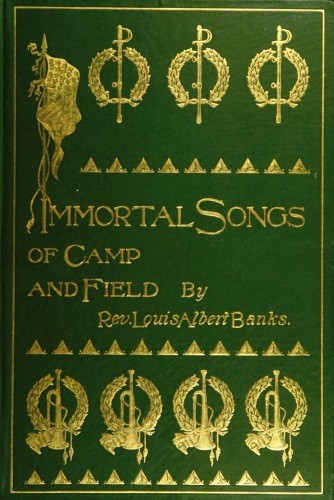
The Project Gutenberg eBook of Immortal Songs of Camp and Field
Title: Immortal Songs of Camp and Field
Author: Louis Albert Banks
Release date: August 22, 2013 [eBook #43539]
Most recently updated: October 23, 2024
Language: English
Credits: Produced by K Nordquist, Chuck Greif and the Online
Distributed Proofreading Team at http://www.pgdp.net (This
file was produced from images generously made available
by The Internet Archive)
| Every attempt has been made to replicate the original as printed. Some illustrations
have been moved from mid-paragraph for ease of reading. (etext transcriber's note) |
IMMORTAL SONGS
OF
CAMP AND FIELD
BATTLE OF BUNKER HILL
(From the celebrated painting by Trumbull)
Copyright, 1898
by
The Burrows Brothers Co.
———
ALL RIGHTS RESERVED
Imperial Press
CLEVELAND
To my sister
Lacibel Ainsworth Wood
this volume is lovingly and gratefully
dedicated by the author
| Page | |
| Thomas à Becket | 76 |
| Otto Eduard Leopold von Bismarck-Schönhausen | 258 |
| John Brown | 96 |
| Joseph Rodman Drake | 16 |
| Daniel Decatur Emmett | 108 |
| Francis Miles Finch | 236 |
| Stephen Collins Foster | 226 |
| Ulysses Simpson Grant | 216 |
| Joseph Hopkinson | 66 |
| Julia Ward Howe | 158 |
| John Wallace Hutchinson | 148 |
| Francis Scott Key | 52 |
| Rudyard Kipling | 290 |
| La Fayette | 268 |
| Robert Edward Lee | 204 |
| Abraham Lincoln | 124 |
| George Pope Morris | 86 |
| Robert Treat Paine | 26 |
| Albert Pike | 118 |
| George Frederick Root | 170 |
| Charles Carroll Sawyer | 180 |
| William Tecumseh Sherman | 192 |
| Charles Edward Stuart, the Pretender | 278 |
| James Thomson | 248 |
| George Washington | 40 |
| Henry Clay Work | 136 |
| Page | |
| Battle of Bunker Hill | Frontispiece |
| Bunker Hill Monument | xii |
| Washington Monument | xiv |
| Mount Hood | 22 |
| Statue of the Minuteman at Concord, Massachusetts | 32 |
| Liberty Bell | 37 |
| Boston Common | 46 |
| Fort McHenry | 58 |
| The Capitol | 72 |
| Statue of Liberty | 80 |
| West Point Military Academy | 90 |
| Harper’s Ferry | 102 |
| Picking Cotton | 112 |
| Fort Sumter | 130 |
| The White House | 142 |
| Moccasin Bend | 152 |
| Faneuil Hall | 164 |
| Fortress Monroe | 176 |
| U. S. Battle-Ship “Maine” | 186 |
| Sherman burns Atlanta and marches toward the sea | 198 |
| Plymouth Rock | 202 |
| The Invasion of Maryland | 210 |
| Mount Vernon | 222 |
| “Still longin’ for de old plantation, And for de old folks at home” | 232 |
| Grant’s Monument | 242 |
| The Tower of London | 254 |
| National Monument, Niederwald | 264 |
| Vieux Port, Marseilles | 274 |
| Stirling Castle | 284 |
| Houses of Parliament | 296 |
JOSEPH RODMAN DRAKE
THE AMERICAN FLAG.
Unfurled her standard to the air,
She tore the azure robe of night,
And set the stars of glory there!
She mingled with its gorgeous dyes
The milky baldric of the skies,
And striped its pure celestial white
With streakings of the morning light;
Then, from his mansion in the sun,
She called her eagle bearer down,
And gave into his mighty hand
The symbol of her chosen land!
Who rear’st aloft thy regal form,
To hear the tempest trumpings loud,
And see the lightning-lances driven,
When stride the warriors of the storm
And rolls the thunder-drum of heaven!
Child of the sun! To thee ’tis given
To guard the banner of the free,
To hover in the sulphur smoke,
To ward away the battle stroke,
And bid its blendings shine afar
Like rainbows on the cloud of war,
The harbingers of Victory.
The sign of hope and triumph high!
When speaks the signal trumpet tone
And the long line comes gleaming on
(Ere yet the life-blood warm and wet
Has dimmed the glistening bayonet),
Each soldier eye shall brightly turn
To where thy sky-born glories burn,
And, as his springing steps advance,
Catch war and vengeance from the glance.
And when the cannon mouthing cloud
Heaves in wild wreaths the battle shroud,
And gory sabres rise and fall,
Like shoots of flame on midnight’s pall;
There shall thy meteor-glances glow,
And cowering foes shall shrink beneath
Each gallant arm that strikes below
That lovely messenger of death.
Thy stars shall glitter o’er the brave;
When death, careering on the gale,
Sweeps darkly round the bellied sail,
And frighted waves rush wildly back
Before the broadside’s reeling rack,
Each dying wanderer of the sea
Shall look at once to heaven and thee,
And smile to see thy splendors fly
In triumph o’er his closing eye.
By angel hands to valor given;
Thy stars have lit the welkin dome
And all thy hues were born in heaven!
As fixed as yonder orb divine,
That saw thy bannered blaze unfurled,
Shall thy proud stars resplendent shine,
The guard and glory of the world.
The author of The American Flag was born to poverty, but by hard work he obtained a good education, and studied medicine under Dr. Nicholas Romayne, by whom he was greatly beloved. He obtained his degree and shortly afterward, in October, 1816, he was married to Sarah Eckford, who brought him a good deal of wealth. Two years later, his health failing, he visited New Orleans for the winter, hoping for its recovery. He returned to New York in the spring, only to die in the following autumn, September, 1820, at the age of twenty-five. He is buried at Hunt’s Point, in Westchester County, New York, where he spent some of the years of his boyhood. On his monument are these lines, written by his friend, Fitz-Green Halleck,—
Nor named him but to praise.”
Drake was a poet from his childhood. The anecdotes preserved of his early youth show the fertility of his imagination. His first rhymes were a conundrum which he perpetrated when he was but five years old. He was one day, for some childish offense, punished by imprisonment in a portion of the garret shut off by some wooden bars. His sisters stole up to witness his suffering condition, and found him pacing the room, with something like a sword on his shoulder, watching an incongruous heap on the floor, in the character of Don Quixote at his vigils over the armor in the church. He called a boy of his acquaintance, named Oscar, “Little Fingal;” his ideas from books thus early seeking embodiment in living shapes. In the same spirit the child listened with great delight to the stories of an old neighbor lady about the Revolution. He would identify himself with the scene, and once, when he had given her a very energetic account of a ballad which he had read, upon her remarking that it was a tough story, he quickly replied, with a deep sigh: “Ah! we had it tough enough that day, ma’am.”
Drake wrote The Mocking-Bird, one of his poems which has lived and will live, when a mere boy. It shows not only a happy facility but an unusual knowledge of the imitative faculty in the young poets of his time.
MOUNT HOOD
The American Flag was written in May, 1819, when the author was not quite twenty-four. It has remained unchanged except the last four lines. It originally concluded:—
That saw thy bannered blaze unfurled,
Shall thy proud stars resplendent shine,
The guard and glory of the world.”
These lines were very unsatisfactory to Drake, and he said to Fitz-Green Halleck, “Fitz, can’t you suggest a better stanza?” Whereupon the brilliant author of Marco Bozzaris sat down and wrote in a glowing burst of inspiration the four concluding lines:—
Where breathes the foe but falls before us?
With Freedom’s soil beneath our feet,
And Freedom’s banner streaming o’er us?”
Drake immediately agreed that these were a splendid improvement on the former ending, and incorporated them into his one poem that is certain of immortality. It was first published in the New York Evening Post, in a series known as the Croaker Pieces, The American Flag being the last one of the series.
The young poet was entirely free from vanity and affectation, and had no morbid seeking for popular applause. When he was on his deathbed, at his wife’s request, Doctor DeKay collected and copied all his poems which could be found and took them to him. “See, Joe,” said he to him, “what I have done.” “Burn them,” he replied; “they are valueless.”
Drake’s impulsive nature, as well as the spirit and force, yet simplicity, of expression, with his artless manner, gained him many friends. He had that native politeness which springs from benevolence—that would stop to pick up the hat or the crutch of an old servant, or fly to the relief of a child. His acquaintance with Fitz-Green Halleck arose in a romantic incident on the Battery one day when, in a retiring shower, the heavens were spanned by a rainbow. DeKay and Drake were together, and Halleck, a new acquaintance, was talking with them; the conversation taking the turn of some passing expression of the wishes of the moment, Halleck whimsically remarked that it would be heaven for him, just then, to ride on that rainbow and read Campbell. The idea was very pleasing to Drake. He seized Halleck by the hand and from that moment until his untimely death they were bosom friends.
ROBERT TREAT PAINE
ADAMS AND LIBERTY.
For those rights which unstain’d from your sires had descended,
May you long taste the blessings your valor has bought,
And your sons reap the soil which your fathers defended!
’Mid the reign of mild peace,
May your nation increase,
With the glory of Rome, and the wisdom of Greece.
And ne’er shall the sons of Columbia be slaves,
While the earth bears a plant, or the sea rolls its waves.
Whose shores are unshaken by Europe’s commotion,
The trident of Commerce should never be hurl’d
To increase the legitimate powers of the ocean.
But should pirates invade,
Though in thunder array’d,
Let your cannon declare the free charter of trade;
For ne’er shall the sons of Columbia be slaves,
While the earth bears a plant, or the sea rolls its waves.
Had justly ennobled our nation in story,
Till the dark clouds of faction obscured our young day,
And enveloped the sun of American glory.
But let traitors be told,
Who their country have sold,
And bartered their God for his image in gold,
That ne’er will the sons of Columbia be slaves,
While the earth bears a plant, or the sea rolls its waves.
And society’s base threats with wide dissolution;
May peace, like the dove who return’d from the flood,
Find an ark of abode in our mild constitution.
But, though peace is our aim,
Yet the boon we disclaim,
If bought by our sovereignty, justice, or fame;
For ne’er shall the sons of Columbia be slaves,
While the earth bears a plant, or the sea rolls its waves.
Let Rome’s haughty victors beware of collision;
Let them bring all the vassals of Europe in arms,
We’re a world by ourselves, and disdain a provision.
While with patriot pride
To our laws we’re allied,
No foe can subdue us, no faction divide;
For ne’er shall the sons of Columbia be slaves,
While the earth bears a plant, or the sea rolls its waves.
Whose roots, like our liberties, ages have nourish’d;
But long ere our nation submits to the yoke,
Not a tree shall be left on the field where it flourish’d.
Should invasion impend,
Every grove would descend
From the hilltops they shaded our shores to defend;
For ne’er shall the sons of Columbia be slaves,
While the earth bears a plant, or the sea rolls its waves.
Lest our liberty’s growth should be check’d by corrosion;
Then let clouds thicken round us: we heed not the storm;
Our realm fears no shock, but the earth’s own explosion.
Foes assail us in vain,
Though their fleets bridge the main,
For our altars and laws with our lives we’ll maintain;
For ne’er shall the sons of Columbia be slaves,
While the earth bears a plant, or the sea rolls its waves.
Its bolts could ne’er rend Freedom’s temple asunder;
For, unmov’d, at its portal would Washington stand,
And repulse with his breast the assaults of the thunder!
His sword from the sleep
Of its scabbard would leap,
And conduct, with its point, every flash to the deep;
For ne’er shall the sons of Columbia be slaves,
While the earth bears a plant, or the sea rolls its waves.
No intrigues can her sons from their government sever:
Her pride is her Adams, their laws are his choice,
And shall flourish till Liberty slumbers forever.
Then unite heart and hand,
Like Leonidas’ band,
And swear to the God of the ocean and land,
That ne’er shall the sons of Columbia be slaves,
While the earth bears a plant, or the sea rolls its waves.
STATUE OF THE MINUTEMAN AT CONCORD, MASSACHUSETTS
The father of the author of Adams and Liberty, or as it has been more usually entitled in later days, Ye Sons of Columbia, was the Robert Treat Paine who was one of the immortal signers of the Declaration of Independence. The author of this hymn was given by his parents the name of Thomas, but on account of that being the name of a notorious infidel of his time, he appealed to the legislature of Massachusetts to give him a Christian name; thereafter he took the name of his father, Robert Treat Paine.
He was a very precocious and brilliant youth. When he was seven years of age his family removed from Taunton, where he was born, to Boston, and there he prepared for Harvard College at one of the public schools, entering the freshman class in his fifteenth year. One of his classmates wrote a squib on him in verse on the college wall, and Paine, on consultation with his friends, being advised to retaliate in kind, did so, and thus became aware of the poetic faculty of which he afterward made such liberal use. He wrote nearly all his college compositions in verse, with such success that he was assigned the post of poet at the College Exhibition in the autumn of 1791, and at the Commencement in the following year. After receiving his diploma, he entered the counting-room of Mr. James Tisdale, but soon proved that his tastes did not lie in that direction. He would often be carried away by day-dreams and make entries in his day-book in poetry. On one occasion when he was sent to the bank with a check for five hundred dollars, he met some literary acquaintances on the way and went off with them to Cambridge, and spent a week in the enjoyment of “the feast of reason and the flow of soul,” returning to his duties with the cash at the end of that period.
In 1792 young Paine fell deeply in love with an actress, a Miss Baker, aged sixteen, who was one of the first players to appear in Boston. Their performances were at first called dramatic recitations to avoid a collision with a law forbidding “stage plays.” He married Miss Baker in 1794, and was promptly turned out of doors by his father.
The next year, on taking his degree of A.M. at Cambridge, he delivered a poem entitled The Invention of Letters. There was a great deal of excitement over this poem at the time, as it contained some lines referring to Jacobinism, which the college authorities crossed out, but which he delivered as written. The poem was greatly admired, and Washington wrote him a letter in appreciation of its merits. It was immediately published and large editions sold, the author receiving fifteen hundred dollars as his share of the profits, which was no doubt a very grateful return to a poet with a young wife and an obdurate father. The breach with his family, however, was afterward healed.
Mr. Paine was also the author of a poem entitled The Ruling Passion, for which he received twelve hundred dollars. Still another famous poem of his was called The Steeds of Apollo.
In 1794 he produced his earliest ode, Rise, Columbia, which, perhaps, was the seed thought from which later sprang the more extended hymn,—
And earth unveil’d her virgin breast,
Supreme ’mid Nature’s vast abode
Was heard th’ Almighty’s dread behest:
‘Rise, Columbia, brave and free,
Poise the globe, and bound the sea.’”
His most famous song, Adams and Liberty,—which is sung to the same tune as Key’s Star-Spangled Banner, or Anacreon in Heaven,—was written four years later at the request of the Massachusetts Charitable Fire Society. Its sale yielded him a profit of more than seven hundred and fifty dollars. These receipts show an immediate popularity which has seldom been achieved by patriotic songs. In 1799 he delivered an oration on the first anniversary of the dissolution of the alliance with France which was a great oratorical triumph. The author sent a copy, after its publication, to Washington, and received a reply in which the General says: “You will be assured that I am never more gratified than when I see the effusions of genius from some of the rising generation, which promises to secure our national rank in the literary world; as I trust their firm, manly, and patriotic conduct will ever maintain it with dignity in the political.”
The next to the last stanza of Adams and Liberty was not in the song as originally written. Paine was dining with Major Benjamin Russell, when he was reminded that his song had made no mention of Washington. The host said he could not fill his glass until the error had been corrected, whereupon the author, after a moment’s thinking, scratched off the lines which pay such a graceful tribute to the First American:—
Its bolts could ne’er rend Freedom’s temple asunder;
For, unmov’d, at its portal would Washington stand,
And repulse with his breast the assaults of the thunder!
His sword from the sleep
Of its scabbard would leap,
And conduct, with its point, every flash to the deep;
For ne’er shall the sons of Columbia be slaves,
While the earth bears a plant, or the sea rolls its waves.”
Instead of being added to the hymn it was inserted as it here appears. The second, fourth, and fifth stanzas have been usually omitted in recent publications of the hymn.
The brilliant genius of Paine was sadly eclipsed by strong drink, that dire foe of many men of bright literary promise. His sun, which had risen so proudly, found an untimely setting about the beginning of the war of 1812.
Liberty Bell
GEORGE WASHINGTON