
From among the profusion of masterpieces by which Velasquez is represented I have passed over the dignified, serene, and powerful picture of Æsop, in favour of the huge and
dramatic painting of the Surrender of Breda—the latter a superb achievement, both in colour and design. “The Surrender of Breda” is regarded as the noblest of the works of Velasquez, and is, perhaps, one of the finest historical pictures in the world. “Such a masterpiece,” says the Chevalier D’Avillier, “must be seen; it cannot be described.” It is usually known in Spain as Les Lanzas from the upright lances that cut the sky. A celebrated art critic has written of the picture, “never were knights, soldiers, or national character, or the heavy Fleming, the intellectual Italian, and the proud Spaniard, more nicely marked even to their boots and breeches. Observe the genial countenance of Spinola, who (the model of a high-bred, generous warrior) is consoling a gallant but vanquished enemy (Justin of Nassau). It is interesting to recall the fact that Spinola took Breda in 1826, and died five years afterwards, broken hearted at Philip the Fourth’s treatment, exclaiming, ‘Me han quitado la honra!’ (They have robbed me of my honour!)” The head placed on the extreme right of the picture, with a plumed hat shading his finely-chisseled brow, is that of Velasquez himself, who has in other of his pictures introduced his personality. In La Familia the artist has represented himself painting the Royal Family of Philip IV., and in it the painter stands before his easel, brush and palette in hand. On his breast is the red cross of Santiago: and tradition has it that the King painted in the decoration in order, as he declared, “to finish the picture.”
By his works in the Velasquez Gallery alone must the great artist be judged. Outside Madrid the painter is apt to be judged by a few gloomy figures, conceived in a stiff, gloomy style, and attired in staid, gloomy costumes; whereas his fertile genius composed a whole gallery of types and examples ranging from kings to beggars, from warriors to clowns, from martyrs to drunkards—all vigorous, living, speaking presentments. Velasquez was, as his pictures in the Museo teach us, a painter of real personages, a chronicler of what he saw, a surprisingly faithful depicter of humanity; but one must go to Madrid to realise and properly appreciate the genius of the master, for it might almost be said that the entire produce of his brush is contained within these walls.
Murillo, with his placid inspiration, which found its outlet in simple and noble elegance of outline, in benign and consoling expressions, and a sweetness of eye and lip on saintly faces that defies description, is represented here in all his glory. Murillo was unequalled in the art of representing the Divine idea in his saints and madonnas, and Spain has rightly named him “The Painter of the Conceptions.” Of the four wonderful “conceptions” that are to be seen in the Museo of Madrid, I have
chosen for reproduction two that all the world has acclaimed to be the most wonderful imaginings of soulful beauty and tender youthfulness that man has given to the world. Devout in purpose and idea, tender and exquisite in execution, his picture of the Sacred Family—called the Pajarito from the little bird held in the Christ’s hand—is one of the most purely devotional pictures of the youthful Saviour in existence. An altarpiece, known as La Porciuncula, from a plot of ground near Assisi, where Christ appeared in a vision to St. Francis, is in the artist’s best style, and El Divino Pastor is another most characteristic and most popular of the master’s works.
Murillo’s heart was divided between beggars and babyhood—he seems to have taught the Spaniards benevolence towards the one and devotion to the other. Most of the beggar-boy pictures have been transferred to foreign collections, but remains the Holy Families and the cherub-peopled Annunciations. Of those Andalusian cherubs a charming American author, Katharine Lee Bates, has written, “Such ecstatic rogues as they are! Their restless ringlets catch azure shadows from the Virgin’s mantle; they perch tiptoe on the edges of the crescent moon; they hold up a mirror to her glory and peep over the frame to see themselves; they pelt St. Francis with roses; they play bo-peep from behind the fleecy folds of cloud; they try all manner of aerial gymnastics. But a charm transcending even theirs dwells in these baby Christs that almost spring from the Madonna’s arms to ours, in those Christs that touch all boyhood with divinity. The son of the Jewish carpenter, happy in his father’s workshop with bird and dog; the shepherd lad whose earnest eyes look toward his waiting flock; the lovely playmates, radiant with innocent beauty, who bend together above the water of life—from these alone might Catholic Spain have learned the sacredness of childhood. But Spain first showed Murillo the vision that he rendered back to her.”
Murillo’s baby Christs are indeed an inspiration, for “they
touch all boyhood with divinity,” as his Virgin’s waken all souls to adoration. De Amicis, the Italian writer whose appreciations of Spain it is a pleasure to read and a privilege to quote, says of Murillo that he is “not only a great painter, but has a great soul; is more than a glory; is, in fact, an object of affection in Spain; he is more than a sovereign master of the beautiful, he is a benefactor, one who inspires good actions; and a lovely image which is once found in his canvasses is borne in one’s heart throughout life with a feeling of gratitude and religious devotion. He is one of those men of whom an indescribable prophetic sentiment tells us that we shall see them again; that the meeting with them is due to us like some prize; that they cannot have disappeared for ever, they are still in some place; that their life has only been like a flash of inextinguishable light, which must appear once more in all its splendour to the ages of mortals.” In transcribing his general impressions of the pictures in the Museo of Madrid, De Amicis pathetically comments: “It is one of the most dolorous consequences of a charming journey, this finding one’s mind full of beautiful images, and the heart a tumult of intense emotions, and only being able to give expression to so small a portion of them! With what profound disdain I could tear up these pages when I think of those pictures! Oh, Murillo; oh, Velasquez; oh, poor pen of mine!” Yet these are the artistic bewailings of a writer who has comprehended as much of, and expressed more faithfully the charm and soulfulness of Murillo than any living critic.
Viva el Rey.
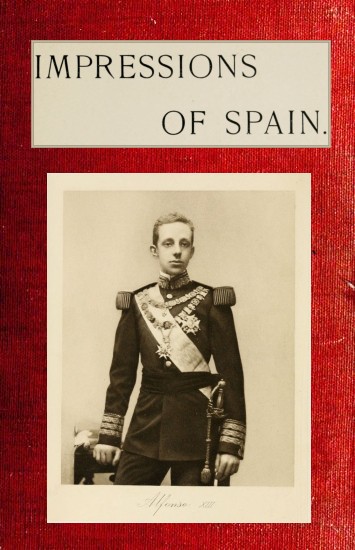
ON the 17th of May, 1902, Queen Maria Christina relinquished the Regency she had sustained so faithfully and unfalteringly for upwards of sixteen years, and Alfonso XIII., or to give his name in full, Alfonso Leon Fernando Maria Santiago Pidro Pascual Marcian Antonio, appeared before his subjects for the first time in the character of ruler as well as King. The eyes of all Europe were directed to Madrid on that day of sunshine and rejoicing, and perhaps in England more than in any country in the world was the nobility and pathos of the Queenly figure, and the brilliant promise given by the young King, most sympathetically appreciated. Queen Christina had devoted her life to her duty; to the service of Spain and the task of fitting her son for the high destiny to which he was born. The difficulty of that task cannot be over-estimated. Taken from the cloistered and secluded life in the Convent of Hochradin in Bohemia, the young Abbess-Princess, who from her earliest years was remarkable for the gravity of her character and her singular piety, was suddenly thrust into the fierce light that beats about a throne to secure a union between the two great Catholic families of the Hapsburgs and the Spanish Bourbons. Married in 1879, Queen Maria Christina enjoyed six years of complete happiness. Handsome, young, and brave, King Alfonso XII. proved a faithful and a devoted husband. His early death left her an alien in a strange land to govern a people who regarded her, if not with dislike, at least with suspicion. The Spanish have no reason to love Austria, and the mere fact of the Queen Mother being an Austrian by birth was sufficient
to excite a feeling of distrust. But the brave Queen outlived the popular want of confidence, and won the admiration and respect of her subjects.
A few months after the death of Alfonso XII., the infant King—he was King from the first breath of life that he drew—“the only child born a king since Christ”—was presented to the great officials and grandees of Spain, lying upon a silver salver. The thrill of the first cry of “Viva el Rey!” that rose outside the Palace of Madrid on May 17th, 1886, and were renewed with tempestuous enthusiasm on May 17th, 1902, has never died in the hearts of the Spaniards. The Divine right of kings is not an unmeaning formula in Spain, in spite of all past history; and to the people who so ardently desired him, the circumstances of Alfonso’s birth gave their King a peculiarly Heaven-sent character. From the moment of his birth he has been hedged about by restrictions and precautions. The hopes of the Royalists and of men of all parties who believe that only monarchical government is possible for Spain have been centred in him, and his every look and action has been watched with a most intense anxiety, rising from the conviction that only the life of this one-time delicate lad stood between Spain and the chaos of revolution.
The weakness of the infant King added to the unparalleled trials that were laid upon the Queen. She has had, in addition, to meet the unquenchable hate of the two political factions—the Carlists, who still dream of a successful coup on behalf of the Pretender; and the Radicals, who would found the Red Republic. She has had to meet the menace of risings in the Carlist North and labour troubles in the Republican South. She has seen Spain drained in men and money in a futile effort to subdue the Cuban Rebellion. More recently still her heart has been wrung by the appalling disasters of the war with America. She saw the gallant army of Spain defeated, its heroic fleet annihilated; Cuba, Porto Rico, and the Philippines—the last remnants of what had once been the greatest Colonial Empire in the World—torn from the Crown of Spain. The Queen Regent bore these terrible misfortunes with dauntless courage; and her wisdom, prudence, and ability enabled her to save the dynasty and to see the Crown placed on the head of the son she so dearly loves.
Under his mother’s untiring care the little King threw off his infant ailings. He had the usual illnesses of childhood, one of so severe a character that it cost the country many days of painful suspense. But, like many other delicate children, he grew in health and strength as the years went by, and his subjects were soon able to assure themselves that it was no weakling that would sit on the throne of Spain. It is a matter of history that he opened his first Cortes in his nurse’s arms at
the age of one; at two years old he sat on a throne to open the Exhibition of Barcelona, and from his earliest years he was taught the lesson of responsibility. Efforts have been made before now to bring up a future ruler of a country in ignorance of his or her coming power, and in subjection to temporary guardians. With Alfonso XIII. the opposite plan was very wisely followed. He has always been the King, subject to no will but his mother’s; and even in his childhood there must have been borne upon his mind some perception of the idea which all the pomp and ceremony surrounding him portended, and some knowledge that he himself was the embodiment of that idea. Until the age of seven, his time was spent between the Palace of Madrid and the Palace of Miramar in San Sabastian, under the immediate eye of his mother and his sisters. Thereafter, in conformity with the traditions of the Court of Spain, he was obliged to have a separate establishment of his own, and his education was entrusted to a distinguished officer of the Royal Household, General Sanchis, assisted by three officers and a staff of professors. His Majesty proved an apt scholar, mastering English, French, and German, each of which he speaks fluently, and obtaining a wide and deep knowledge of the history of his own country. He was also instructed in the elements of law, political economy, and the theory of Government—branches of study for which he showed a very marked aptitude. Like every true Spaniard, the King early disclosed a passionate fondness for the army, and three days in the week he was regularly instructed in military drill and exercises in company with a number of young Spanish nobles. He early became an accomplished fencer, a capital shot, a good swimmer, and an excellent horseman. He has an admirable seat and great pluck and judgment, and never looks better than he does on horseback. In the extensive stables of the Palace, which contains a very varied collection of steeds from all countries, there is scarcely a horse which he has not ridden.
What manner of King was it that on his 17th birthday made his first official appearance as the Constitutional ruler of Spain? Accomplished as a scholar and a musician, and a fine all-round athlete, we know also of him that, thanks to heredity and careful training, he has developed a manliness and resolution of character which promise to stand him in good stead in the future. “Tall and slender,” to quote the description of a writer who was in a position to picture His Majesty with accuracy, “graceful in movement in spite of the length and looseness of his limbs, the King has inherited, not only the mobile features, but also very much of the charm of manner, the bonhomme and easy grace, which made Alfonso XII. so dear to his friends. He is no lover of ceremonious etiquette; but, simple and familiar as he prefers his intercourse to be, he shows a rare tact in one so young in never forgetting, or permitting others to forget, that he is King. Above all, he is Spanish to the backbone; and for this he owes much to his aunt, the Infanta Isabel, the widowed Countess of Girgenti, who has particularly devoted herself to the task of making her nephew a good Spaniard. The Infanta Isabel is deservedly one of the most popular women in Spain; she possesses a rare knowledge of even the intricate mazes of its political life, as well as an absolute and innate sympathy with many national characteristics. Other reasons, too, have contributed to make Alfonso XIII. a good Spaniard. There is no greater incentive to patriotism than national suffering; and it was at the most impressionable age that he learnt, day by day, to listen to the tale of the disasters that were befalling his country. In this connection, it may be added that he shows signs of becoming a keen soldier, and has shown a lively interest in the military life by which he is immediately surrounded. His brother-in-law, the husband of the Infanta, known now by courtesy as the Prince of Asturias, fully shares this inclination, and has proved the best of comrades to the King in that as well as in other pursuits.”
Such was the Royal youth who stood by his mother’s side when the Queen-Regent of Spain presided at her last Cabinet Council in the Palace in Madrid. Sixteen and a-half years before she had been seated in the same vast State hall waiting to receive all the Diplomatic Corps and the message of condolence that they were bringing. Señor Zarco del Valle, introducer of Ambassadors at the Spanish Court, describes her appearance as she sat, crushed by grief and despondency, her face and eyes swollen by the tears she had shed. Her hands lay loosely in her lap and trembled. The sight of the forlorn widow was so heartrending that Señor del Valle hesitated long before he pronounced the official words, “Madam, may I announce to your Majesty His Eminence the Apostolic Nuncio?” Scarcely had the words crossed his lips than Maria-Christina started and stood upright before him, a Queen and a ruler from head to foot, her forehead erect, a fire of resolution burning in the depths of her brown eyes. The late Señor Sagasta, who was then Prime Minister of Spain, was still her chief Minister when she received the official farewells of the Councillors. Señor Sagasta, in the course of an eloquent address, recalled the day when the Queen, who then barely knew him, did honour to his loyalty, and, trembling and weeping at the loss of her Consort, so fresh in her memory, she placed her confidence in him. Sixteen years and a-half elapsed since that day, during which the Queen was sacrificing her youth, a slave to duty and a jealous guardian of her children. She had suffered so much, finding at last compensation in the happiness of the King. He, a grateful and loving son to his mother, on receiving the carefully-guarded deposit of Royal power, would receive therewith a moral education which assuredly he would never forget in all the trials of his life.
The Queen listened to Señor Sagasta’s words with increasing emotion, and finally was moved to weeping. But, recovering herself, she responded, and, in thanking Señor Sagasta, said that she had ever had the earnest desire to do right, even though she might not always have been right; and she ever felt profound love for Spain in return for the kindnesses that had always been heaped upon her. She hoped that the statesmen before her assembled, and those who could and might become Councillors of the Crown, would help her son as effectively as they had helped her.
On the following day the formal enthronement of Alfonso XIII. as King of Spain was accomplished; a chapter in the history of the Spanish Monarchy was closed and a fresh epoch was begun. The young Monarch made his appearance before his subjects under the happiest conditions. Madrid looked its best beneath the bright sun and cloudless skies which fortunately attended the whole course of the city’s festivities. The procession was one of those picturesque and impressive displays in which the Spanish as a people know how to excel. The young King’s demeanour was an engaging mixture of boyish self-possession and boyish delight, together with traces of a maturer air of resolution, which were especially apparent when he recited the oath of enthronement before his Congress. From that body he had a magnificent and remarkable reception. The crowds in the streets vied with their Parliamentary representatives in their acclamations as the King left the Congress, and these unmistakable signs of a loyalty deep and true were received by the King with manifest pleasure. The whole day of rejoicing was one which must live long in the memory of both subjects and Sovereign.
So, amid sounds of universal rejoicing, the young King entered upon his task with all the promise of youth and under fair auspices, and nowhere than in this country was the hope more cordially felt that the unbounded enthusiasm with which he had been proclaimed would be the prelude to a long, ever-brightening record of loyal co-operation between the Sovereign and his subjects, of re-awakened national energies, of solid and enduring gains of domestic unity and progress, and of the attainment of the indomitable aspiration of a noble people.
In every respect these high hopes are being realised. The King’s popularity, based on the solid foundation of respect for wise authority and administration, of his frank, generous, and engaging personality, is growing daily. He has gained the confidence as he won the hearts of his subjects, and it is safe to assert that at no period of recent history has the throne of Spain been more secure, or the future of the country more full of promise. The renaissance of the Spanish nation has commenced; her commercial prosperity is steadily and surely increasing; and with the ever-lessening evil of domestic friction, the expansion of her trade, and the development of her natural and mineral resources, the boundless possibilities before Spain are assuming definite and tangible form.
Mining.
THE history of mining in Spain would fill a dozen books, each twelve times as large as the present volume, and even then only the half, if so much of the story, would be told. It would form a narrative that would combine tragedy and romance, and present a moral as stern as humanity has ever been asked to peruse. The mineral wealth of the Peninsula was responsible for the origination of the African slave trade, for the demolition of Carthage, for the decline of Rome, for the sacrifice of lives innumerable, for tortures unspeakable, for crimes that are without parallel in the annals of the world. In ancient times Spain was ravaged, plundered, and depopulated to provide Carthage with the spoils that were to make her the prey of the Romans, who, in their turn, were to be lulled by wealth and luxury into the deadly sleep of degeneracy that precedes decay.
It is probable that the beginning of the history of precious metals may be traced back to India, although it is commonly assigned to Greece about 900 B.C.; but the earliest specific mention of gold or silver mining in European history is derived from the story of Cadmus, a Phoenician, who mined for copper and gold in Thrace in 1594 B.C., or thereabouts. Jason, another Phoenician, journeyed as far west as Sardinia in search of precious metals in 1263 B.C.; and it is known that the Phoenicians were working the gold placers of the Guadalquiver previous to 1100 B.C. The means of winning the gold—the only mineral that was exploited in those days—were both limited and arduous, and some time between 1200 and 500 B.C. (it is impossible to compute the period more exactly) the auriferous resources of Spain were thought to be exhausted. The results of Phoenician mining enterprise must have been considerable, for about B.C. 500 Darius, of Persia, undertook and successfully executed a military expedition against Phoenicia for the purpose of acquiring the metallic treasure, which its adventurers had carried away from Spain. Some portion of this hardly-won stock of bullion found its way back to Europe some two centuries later when Alexander the Great plundered Persia.
Spain did not benefit in the slightest degree by the earliest discovery of her auriferous riches; and when her silver resources were disclosed, they provided the Carthaginians with a further incentive to pillage and plunder the country which was cursed by the possession of her coveted mineral wealth. Between 480 and 206 B.C. the silver mines were worked by the Carthaginians, who stored their spoil at Carthage against the coming, in B.C. 146, of the plundering Romans who captured the city, rifled its treasure houses, and either sold its myriad inhabitants in the slave markets of Rome, or condemned them to the hideous labour of the Spanish mines. Spain was to the Ancients what Mexico and Central and South America became in later ages to Spain—El Dorado, the land of gold, the richest mining country of the world; and the nearer history of Mexico and Peru—the fate of its aborigines, the subsequent struggle among leading nations for the mastery of its precious metals, the destruction of its soil, the neglect of its agriculture, and the resultant poverty and decay of its population—is no more than a repetition of the ancient history of Spain. The aborigines were easily brought into a state of subjection by the disciplined and well armed soldiers of Carthage, who reduced them to slavery, and compelled them, with every accompaniment of savage brutality, to explore and work the mines.
“These people,” says Didorus, “though by their labour they enriched their masters to an almost incredible extent, did it by toiling night and day in their golden prisons. They were compelled, by the lash, to work so incessantly that they died of their hardships in the caverns they had dug. Such as by great vigour of body continued to live, were in a state of misery which rendered death a preferable fate.” Again Didorus, in describing the conditions under which mining was carried on at this period, tells us that infinite numbers of slaves of both sexes were thrust into the mines, kept at work night and day, and guarded so strictly as to make escape an impossibility. Naked, maimed, and sick they laboured on beneath the lash of the brutal overseers without rest or remission. “Neither the weakness of old age, nor the infirmities of females,” says this authority, “excuse any from the work, to which all are driven by blows and cudgels, until borne down by the intolerable weight of their misery many fell dead in the midst of their insufferable labours. Deprived of all hope, these miserable creatures expect each day to be worse than the last! and long for death to end their griefs.”
The mortality among the workers in the mines of Spain at this period must have been appalling, and the conditions were calculated to decimate the entire race. Soon it became necessary to recruit the fast thinning ranks of native labourers with imported workers, and these were brought in thousands from Africa. Negro slaves had previously been introduced, to a small extent, into Etruria; but the traffic had not hitherto
attained the gigantic proportion that it was then to assume. Jacob, in his History of the Precious Metals, says: “This oppression and exhaustion of the native labourers led to a trade in human beings which was carried on by the Carthaginians with the interior of Africa, and supplied to Andalusia the place of those native workmen who had been destroyed by the excessive toil imposed on them by their Asiatic intruders. This horrid traffic was extended and continued, and it augmented the produce of the mines of Spain in such a degree as to have an influence on the whole commerce of the world at that period. That influence was continued for upwards of seven hundred years, until the Government of the Romans, who succeeded the Carthaginians in the mastery of Spain, had fallen into the hands of the Gothic monarchs.”
The spoils which Phoenicia had won from Spain led to her spoilation by Darius of Persia, in the fifth century before the Christian era; three hundred years later the silver hoards of Carthage excited the cupidity and envy of Rome, and Spain, which provided the booty, was wrested from the Carthaginians by the armies of the Commonwealth. Up to B.C. 400, when mining in Spain was reduced to a regular system, and the output was enormously increased, Carthage was able to utilise her silver in her Indian trade; but with increasing returns the necessity arose for establishing other markets for her precious metals. In Carthage and in Rome the numerary money system still obtained, but about this date the Carthaginians adopted silver currency and endeavoured, but with little success, to dispose of their surplus supplies of silver by offering them in the markets of Rome. But Rome still held to her copper tokens, and was as yet free from the fatal influence of the mines. “Rome trusted to itself and its sword,” says Heeren in his Researches, African Nations, “Carthage to its gold and its mercenaries. The greatness of Rome was founded upon a rock; that of Carthage upon sand and gold-dust.”
But the increasing volume of the trade of Carthage with the Orient did not keep pace with her ever-multiplying returns of silver. Carthaginian silver made its appearance in Italy, and the jealous eye of Rome was led from Carthaginian silver to Carthage and its hugely profitable Indian trade. In B.C. 264 began the first Punic War, which cost Carthage the islands of Sicily, Sardinia, and Corsica—all of them mining countries—and an indemnity of 1,200 talents of silver. Three years after Hamilcar Barca, on the plea that the extension of the Carthaginians’ arms into the interior was necessary in order to make good the loss of the mineral-producing islands ceded to Italy, conducted a marauding expedition through Spain. This campaign of conquest and slaughter culminated in B.C. 219 in the sacking of Saguntum (the modern Murviedro), a Greek colonial city and furnished Rome with the pretext for another war against Carthage. In B.C. 269, prior to the first Punic War, Rome had formally adopted silver as a portion of her monetary system; and the demand for the metal made it necessary for her to devise some means for ensuring a larger and more regular supply than she could obtain from her own mines or by purchase. Italy’s growing commerce with the Orient, which consumed all the silver at her command, hastened the means to the end. The capture of Saguntum by the unauthorised commandoes of Hamilcar Barca was the excuse upon which Rome declared the second Punic War which, in B.C. 207, ended in the conquest of Spain, and the final evacuation of the coveted territory by the Carthaginian forces five years later.
Carthage built her greatness on the spoils wrung from the mines of Spain, and her fall is directly traceable to the same cause. As Alexander del Mar says: “They corrupted the Government of Carthage, and led to the neglect of military discipline and precautions; they introduced a mercenary and gambling spirit into all enterprises; they created monopolies of wealth; they impoverished the masses; they occasioned the abandonment of those industries which had built up the State, and they eventually so crippled its power, that in the memorable contests that ensued with Rome for the mastery of these same mines, Carthage was unable to successfully cope with its more vigorous adversary.”
There is abundant evidence to show that although the Carthaginians were driven out by the all-conquering Romans, they left with the full determination to return at some future time, and they took the most careful precautions to hide their treasures from the eyes of the invaders. The ancient workings that are attributed to Roman miners are, in many cases, of Carthaginian origin; for it appears certain that numbers of these well-developed mines were never discovered by the Romans. The site of a mine at Córdova, for instance, was indicated by a series of seven abandoned and rubbish-filled shafts, forming an irregular row of workings. One or two of these shafts at either end of the row had been tested without yielding any satisfactory results, and when the property passed, at a nominal figure, into the hands of English capitalists the manager received instructions to empty these shafts. He started at one end and cleared three of the seven holes, only to find that they stopped suddenly at a few yards from the surface. Then, following the course that had been taken by the Romans and the more recent Spanish proprietors, he began at the other end only to find that the supposed shafts were no more than huge pot holes. Disappointed with the fruitlessness of his efforts he wired to London, “Have cleared six holes. No trace of lode.” The answer was instantly returned to the despondent manager:—“Clear the seventh.” Acting on these instructions the centre shaft was cleared, and at a little depth he came upon a massive iron door which proved to be the entrance to the enormous ancient workings which the Carthaginians had hidden for over two thousand years by this ingenious device of digging dummy shafts, and so giving succeeding generations the impression that the mine was a worthless and abandoned prospect.
In the majority of these ancient workings in the copper mines that I have inspected, tools of Carthaginian make had been found lying scattered in the tunnels where the workmen had thrown them when they made their hurried departure. One has only to glance from those enormous catacombs to the implements with which the excavations were made to realise the terrific difficulties of the task and the misery and almost super-human labour that was involved in its accomplishment. Human blood was spilt like water to gratify the mineral greed of the Carthaginian conquerors. When the younger Scipio, carrying the war into the enemy’s country, sacked and afterwards burned Carthage to the ground, 60,000 of its citizens were sent to labour as slaves in the Spanish mines of which they had so recently been the opulent masters.
Before the conclusion of the second Punic war Scipio returned to Rome with so great a quantity of the precious metals captured by his forces, that the Roman numerary system was finally abolished, and the complete establishment of silver currency was effected. But the triumph of Rome was the beginning of her end. She had crushed her great Carthaginian rival, and gained her Indian trade; she had extended her possessions to the Atlantic ocean, and made herself the owner of the greatest mineral country of the world. But she had transferred to her own shoulders the curse of Carthage’s decline when she assumed the Carthaginian mantle. Public and private morality was demoralised by the accumulation of the treasure in Rome; wealth was the precursor of corruption; and corruption led to that gross luxury and social and political supineness which sapped the greatness of the empire.
When the impairment of the stock of silver coins by export to India and the surrounding countries necessitated larger and regular supplies of the metal, Rome applied herself to the exploitation of her Spanish mines with a vigour as great as it was pitiless. The native races and their erstwhile Carthaginian masters worked side by side, and their ranks were subsequently swelled by condemned criminals from Italy, and in later times even by legionary soldiers. Jacob tells us that “the silver procured by the Romans by these operations must have cost more than its current worth; and, according to Polybius, the 40,000 workmen who were constantly employed in the silver mines at New Carthage in Spain produced only 25,000 drachmas (valued at under £1,000) per diem—a sum that could scarcely have purchased more than sufficient to keep alive the miserable beings who were immolated in them. Another reason why these mines were worked at a loss at this time, if indeed they were, is supplied by Del Mar, who points out that “when these mines were worked by the Romans there already existed in their own markets a mass of the precious metals that had been obtained at a cost which, reckoned in blood and cruelty, was immeasurable; but which in mere pecuniary outlay of labour, in killing and sacking, was as nothing. It was against the competition of this mass of metals, which pecuniarily cost nothing, that the mine owners had to measure their products in the Roman market; and it is to be hardly wondered at that they found the industry unprofitable. The Spaniards subsequently had the same experience in America, and the Californians and Australians are repeating it at the present time.
The Romans also worked for gold the sands of the Guadalquiver, Darro and Duero rivers, but with what results is not known. They also mined for copper on a large scale, with, it is evident, the most gratifying success. The mechanical resources at their command were limited, and there seems no doubt that many rich mines were abandoned for want of knowledge and the proper appliances with which to treat the ores. In one instance, that of the Escurial Mines at Escurial, a huge lode carrying rich copper was broken by a fault, and the Romans made no effort to pick up the lode again. The present English owners penetrated the fault, and found the lode of the original dimensions on the other side.
During the eight hundred years that Spain was under Arab domination, the mines of Sardinia are believed to have been worked by the conquerors, and they prosecuted their explorations for the precious metals on the main land with some vigour. Yeats, in his History of Commerce, tells us that in the eighth century the old silver mines, thought by the Romans to be exhausted, were made to yield afresh by skilful working; and the Spanish mines then furnished to the world the chief supplies of precious metals. The Arabs exported quicksilver to Constantinople, and it is possible that they extended the industry by opening up new mines. Spain is so full of metals that, after being explored for centuries, new mines are constantly being discovered; and perhaps the richest of all the silver mines—the Hiendelæncina—was opened up in 1843. But what the Arabs did in the way of discovery we have no means of ascertaining. They are believed by Jacob to have re-opened the Roman silver mines in the present French division of the Pyrenees, and to have worked the gold mines at Lares, the silver mine of Zalamea in Andalusia, and that of Constantina, near Cazalla. The hills of Jaen, upon which they principally concentrated their exertions, are pierced with over five thousand shallow pits, which are estimated to have been the work of five centuries. Even the approximate amount of the precious metals obtained as the result of Arab mining in Spain is a matter of the merest conjecture.
It is curious to note that when Spain was at the zenith of her greatness the wealth in which she abounded was not the result of the exploitation of her own vast stores of precious metals, but the fruits of conquest, bloodshed, and cruelties, similar to those which she had herself suffered at the hands successively of the Phœnicians, the Carthaginians, the Romans, and the Arabs. She had seen each succeeding nation of her despoilers crumble into decay, but she failed to learn the lesson that their disastrous endings had for her.
In her turn Spain crushed Mexico and Peru, and grew rich and powerful by tribute and plunder to the neglect of her own resources and her ultimate temporary ruin and submersion among the nations of Europe. Her own metallic hoards were passed over—the treasure for which Carthage, and Rome, and Morroco had fought and bled was neglected; while the methods of the Roman and the Carthaginian conquerors were being practised upon the people of the New World. The result is, that while Spain is to-day recognised as the richest mineral country in Europe, her mineral assets are in a more backward state of development than those of any other European country.