
Yes, I laughed. And unfortunately Imre von N... thought that I sneered; that I sneered at my fellow-men!
"Yes," I replied, "I knew such a man, such a 'person.' On the whole, pretty well. He had other rather acceptable qualities, you see; so I didn't allow myself to be too much stirred up by... that remarkably queer one."
"Lately?" Imre asked.
"Oh, yes, very lately," I returned flippantly.
Imre spoke no word for several steps. Then, hesitatingly...
"Perhaps you didn't know him quite as thoroughly as you supposed. Were you quite sure?"
"Quite sure." Then, sharply in another sentence that was uttered on impulse and with more of the equivocal in it which afterward I understood, I added, "I think we will not talk any more about him: I mean in that respect... Imre."
Again silence. One-two, one-two—on we went, step and step, over the resonant, deserted bridge. I had an impression that Imre turned his head, looking sharply at me in the fluttering gas-light... then glancing quickly away. I had other thoughts, far, far removed from him! I had well-nigh forgot when I was!—forgot him, forgot Szent-Istvánhely........!
But now he laughed out, too, as if in angry derision.
"I say! I knew such a fellow, too.. two or three years ago. And I beg to tell you that he fell in love with.. me! No less! He was absolutely bódult over your humble servant. Did you ever!"
"Really? What did you do? Slap his face, and give him the address of a... doctor of nervous diseases?"
"Oh, Lord, no! I merely declined with thanks the.... honour of his farther acquaintance. I told him never to speak me. He left town. I had rather liked him. But I heard he had been compromised already. I have no use for that particular brand of fool!"
Are there perverse demons, demons delighting to make mortal men blunderers in simplest word and action... that haunt the breezy Lánczhíd in Szent-Istvánhely? If so, some of us would better cross that long bridge in haste and solitary silence after nightfall. For:
"You surprise me," I said lightly. I was thinking of one of his own jests as well of his unbelief in his personal attractions. "How inconsistent for you! Now you are just the very individual I should suspect!...... yes, yes, I am surprised!"
To my astonishment, Imre stopped full in his steps, drew himself up, and faced me with instant formality.
"Will you be so good as to tell me why you are surprised?" asked he, in a tone that was—I will not write sharp, but which suggested to me immediately that I had spoken mal-à-propos or misleadingly; the more so in view of what Imre had mentioned of his ex professio and personal sensitiveness to the general topic. "Do you observe anything particularly womanish—abnormal—about me, if you please?"
Now, as it happened my remark, as I have said, was made in consequence of an impersonal and amusing incident, which I had supposed Imre would at once remember.
"Womanish? Abnormal? Certainly not. But you seem to forget what you yourself said to Captain Molten this afternoon... in the billiard-room... about the menage-cooks... don't you remember?"
Imre burst into laughter. He remembered! (There is no need of my writing out here a piece of humour not transferable with the least esprit into English, though mighty funny in Magyar.) His mood changed at once. He took my arm, a rare attention from him, and we said no more till the Bridge was past, and the corner which divided our lodgings by a street's breadth was reached. We said "Good-night!... till tomorrow!"... the házmester opened his door. Imre waved his hand gaily and vanished.
I got to bed, concluding among other things that so far from Imre's being homosexual—as Uranian, or Dionian-Uranian, or Uranian-Dionian... or what else of that kind of juggling terminology in homosexual analysis—my friend was no sort of an Uranistic example at all. No! he was, instead, a thorough-going Dionian, whatever the fine fusions of his sensitive and complex nature! A complete Dionian, capable of warm friendship, yes—but a man to whom warm, even passionate, friendship with this or that other man never could transform itself into the bitter and burning mystery of Uranistic Love,—the fittest names for which so often should be written Torment, Shame, and Despair!
Fortunate Imre! Yet, as I said so to myself, altruistically glad for his sake, I sighed... and surely that night I thought long, long thoughts till I finally slept.
II.
MASKS AND—A FACE.
Byron
A couple of miles out of Szent-Istvánhely, one finds the fine old seat, or what was such, of the Z... family, with its deserted chateau and neglected park. The family is a broken and dispersed one. The present owner of the premises lives in Paris. He visits them no oftener, and spends no more for their care than he cannot help. The park itself is almost a forest, so large it is and so stately are the trees. Long, wide alleys wind through the acacias and chestnuts. You do not go far from the very house without hares running by you, and partridges and pheasant fluttering; so left to itself is the whole demesne. Like most old estates near Szent-Istvánhely, it has its legends, plentifully. One of these tales, going back to the days of the Turkish sieges of the city, tells how a certain Count Z..., a young soldier of only twenty-six years, during the investment of 1565, was sitting at dinner, in the citadel, when word was brought that a Turkish skirmishing-party had captured his cousin, to whom he was deeply attached; and had cruelly murdered the young man here, in the park of this same chateau, which during some days the lines of the enemy had approached. The officer sprang up from the table. He held up his sword, and swore by it, and Saint Stephen of Hungary, that he would not put the sword back into its sheath, nor sit down to a table, nor lie in a bed, till he had avenged his cousin's fate. He collected a little troop—in an hour. Before another one had passed, he made a sortie, under a pretext, toward his invaded estate. He forced its defences. He drove out the enemy's post. He found and buried his cousin's mutilated body. Then, before dawn, he himself was surprised by a fresh force of Turks. He was shot, standing by his friend's grave... in which he too eventually was buried. Their monument is there to-day, with the story on it, beginning: "To The Unforgettable Memory of Z... Lorand, and Z... Egon", after the customary Magyar name-inversion.
The public was not admitted to this old bit of the Szent-Istvánhely suburbs. But persons known to the caretakers were welcome. Lieutenant Imre and I had been out there once before, with the more freedom because a certain family-connection existed between the Z—s and the N—s. So was it that about a week after the little incident closing the preceding portion of this narrative, we planned to go out to Z.... for the end of the afternoon. A suburban electric tramway passed near the gates.
For two days, I had been superstitiously.... absurdly... irresistibly oppressed with the idea that some disagreeable thing was coming my way. We all have such fits; sometimes justifiably, if often, thank Heaven! proving them quite groundless. I had laughed at mine, with Imre. I could think of no earthly reason for expecting ill to befall me. To myself, I accounted for the mood as a simple reaction of temperament. For, I had been extremely happy lately; and now there was the ebb, not of the happiness, but of the hyper-sensitiveness to it all. The balance would presently be found, and I would be neither too glad nor too gloomy.
"But why.. why... have you found yourself so wonderfully happy lately?" had asked Imre, curiously. "You haven't inherited a million? Nor fallen in love?"
No—I had not inherited a million.......
It was on my way to the tram, to meet Imre, that same afternoon, that I found, from my letters from England, why justly I should exclaim:
I was wanted in London within four days! I must start within less than twenty-four hours! A near relative was in uncertainty and anxiety as to some special personal affairs. And not only was my entire programme for the next few weeks completely broken up; worse still, was a strong probability that I might be hindered from setting foot on the Continent for indefinite time. In any case, a return to Hungary under less than a full twelvemonth was not now to be thought-of.
With this fall of the proverbial bolt out of a clear sky, in the shape of that letter in my pocket, from Onslow Square, I hurried toward the tram and Imre. All my pleasure in the afternoon and in everything else was paralyzed. Astonishing was it how heavy-hearted I had become in course of glancing through that communication from Mrs L..., between the Ipar-Bank and the street-corner.
Heavy-hearted? Yes, miserably heavy-hearted!...
Why so? Was it because of the worriments of Mrs. L...? Because I could not loiter, as a travelling idler, in pleasant Szent-Istvánhely?—could not go on studying Magyar there; and anon set out for the Herkules-Baths? Hardly any of these were good and sufficient reasons for suddenly feeling as if life were not worth living! that a world where departings, and partings along with them, seemed to be the main reason for one's comings and meetings, was a deceitful and joyless kind of planet.
Well then, was my grey humour just because I was under the need of shaking hands with Imre von N..., and saying, "A viszontlátásra!" ("Auf Wiedersehen!") or, more sensibly, saying to him "Goodbye?" Was that the real weight in my breast? I, a man—strong-willed, firm of temper and character! Surely I had other friends, many and warm ones, old ones, in a long row of places between Constantinople and London; in France, Germany, Austria, England. O dear, yes!... there were A.., and B..., and C... and so, on very decently through a whole alphabet of amities. Why should I feel so fierce a hatred at this interrupting of a casual, pleasant but not extraordinary intimacy, quite one de voyage on its face, between two men, who, no matter how companionable, were of absolutely diverse races, unlike objects in life and wide-removed environments?... who could not even understand each other's mother-tongues? Why did existence itself seem so ironical, so full of false notes, so capricious in its kindness... seem allowed us that we might not be glad in it as... Elsewhere? The reply to each of these queries was close to another answer to another question; that one which Imre von N... had asked,.. "And why, pray, have you found yourself so wonderfully happy lately?" That I should find myself so wonderfully unhappy now? Perhaps so.
Imre was at the tram, and in high spirits.
"We shall have a beautiful afternoon, my dear fellow.... Beautiful!" he began. Then... "What the mischief is the matter with you? You look as if you had lost your soul!"
In a few words, I told him of my summons North.
"Nonsense!" he exclaimed. "You are making a bad joke!"
"Unfortunately I never have been less able to joke in my life! Tomorrow afternoon I must be off, as surely as Saint-Stephen's Crown has the Crooked Cross."
Imre "looked right, looked left, looked straight before". For an instant his look was almost painfully serious. Then it changed to an amused bewilderment. "Well... sudden things come by twos! You have got to start off for God knows where, tomorrow afternoon: I have got to be up at dawn, to rush my legs off! For, about noon I go out by a pokey special-train, to the Summer-Camp at P... And I must stay there five, six, ten mortal days, drilling Slovaks, and other such cattle! No wonder we have had a fine time of it here together! Too beautiful to last! But, Lord, how I envy you! Won't you change places with me? You're such an obliging fellow, Oswald! You go to the Camp: let me go to London?"
At this moment, up came the tram. It was packed with an excursion-party. We were hustled and separated during our leisurely transit. Imre met some fair acquaintances, and made himself exceedingly lively company to them, till we reached the Z... cross-road. We stepped out alone.
I did not break the silence as the noisy tram vanished, and the country's quietness closed us in.
"Well?" said Imre, after fully five minutes, as we approached the Z.... gateway.
"Well," I replied quite as laconically.
"Oh come, come," he began, "even if it is I routing out of bed by sunrise tomorrow, to start in for all that P.. Camp drudgery, and you to go spinning along in the afternoon to England... why, what of it! We mustn't let the tragedy spoil our last afternoon. Eh?... Philosophy, philosophy, my dear Oswald! I have grown so trained, as a soldier, to having every sort of personal plan and pleasure, great or small, simply blown to the winds on half-an-hour's notice, that I have ceased to get into bad humour over any such contretemps. What profits it? Life isn't at all a plaything for a good lot of us, more's the pity! We've got to suffer and be strong; or else learn not to suffer. That on the whole is decidedly preferable. Permit me to recommend it; a superior article for the trade, patent applied for, take only the genuine."
I was not in tune for being philosophic, in that moment. And, from the very first words and demeanour with which Imre had received the announcement that so cruelly preyed on my spirits, I was... shall I write piqued—by what seemed to be his indifference; nay more, by his complete nonchalance. Whether Imre as a soldier, or through possessing a colder nature than I had inferred.... at least, colder than some other natures... had indeed learned to sustain life's disagreeable surprises with equanimity, was nothing now to me. Or, stay, it was a good deal that just then came crosswise to my mood; so wholly intransigéant. Angry irritation waxed hot in me all at once, along with increasing bitterness of heart. It is edifying to observe what successive and sheer stupidities a man will perpetrate under such circumstances... edifying and pitiable!
"I don't at all envy you your philosophy, my dear friend," I said sharply. "I believe a good deal in the old notion as to philosophic people being pretty often unfeeling people... much too often. I think I'd rather not become a stoic. Stoic means a stock. I'm not so far along as you."
"Really? Oh, you try it and you'll like it... as the cannibals said to the priest who had to watch them eat up the bishop. It is far better to feel nothing than to feel unpleasant things too much... so much more comfortable and cheap in the end.... Ei! you over there!" he called out to a brown-skinned czigány lad, suddenly appearing out of a coppice, with something suspiciously like a snap-shot in his hand, "don't you let the házmester up at the house catch you with that thing about you, or you'll get yourself into trouble! Young poacher!" he added angrily... "those snap-shots when a gipsey handles them are as bad as a fowling-piece. The devil take the little rascal! And the devil take everything else!"
We walked down an alley in silence. Neither of us had ever been in this sort of a mood till this afternoon. The atmosphere was a trifle electric! Imre drew his sword and began giving slashes at trees and weeds, an undesirable habit that he had, as we strolled onward. Thought I, "A pleasing couple of hours truly we are likely to pass!" I felt that I would better have stayed at home; to start my packing-up for London. Then I pulled myself together. I found myself all at once possessed of a decent stock of pride, if not "philosophy". I undertook to meet Imre's manner, if not to match his sentiments. I began to talk suavely of trifles, then of more serious topics... of wholly general interests. I smiled much and laughed a little. I referred to my leaving Szent-Istvánhely and him... more to the former necessity... in precisely the neatest measure of tranquility and even of humour. Imre's responsiveness to this delicate return for his own indifference at once showed me that I had taken the right course not to "spoil this last afternoon together".... probably the last such in our lives!....
On one topic, most personal to Imre, I could speak with him at any time without danger of its being talk-worn between us; could argue with him about it even to forgetting any other matter in hand; if, alas! Imre was ever satirical, or placidly unresponsive toward it. That topic was his temperamental, obstinate indifference to making the most of himself in his profession; to "going-on" in it, with all natural energies or assumed ones. He was, as I have mentioned, a perfectly satisfactory officer. But there it ended. He seemed to think that he had done his duty, and must await such vague event as would carry him, motu proprio, further toward efficiency and distinction. Or else, of all things foolish, not to say discreditable, he declared he still would "keep his eyes open for a chance to enter civil life"... would give himself up to some more or less aesthetic calling, especially of a musical connection... become "free from this farce of playing soldier." He excused his plan by saying that his position now was "disgracefully insincere." Insincere, yes; but not disgraceful; and he was resting on his oars with the idea that he ought not to try to row on, just when such conduct was fatal. A man can remedy a good deal that he feels is an "insincere" attitude toward daily life. And what is more, any worthy, any elevating profession, and in the case of the soldier the sense of himself as a prop and moral element in the State must not be insulted! The army-life even if chosen merely from duty, and led in times of peace, is a good deal like the marriage of respect. The man may never have loved the wife to whom he is bound, he may never be able to love her, he may find her presence lamentably unsympathisch. But mere self-respect and the outward duty to her, and duty to those who are concerned in her honour as in his, in her welfare as in his.... there comes in the unavoidable and just demand! Honour and country are eloquent for a soldier, always. It was on the indispensable, unwelcome, ever-postponed Hadiskolai course that, once more, this afternoon, I found myself voluble with Imre. If I could not well speak of myself, I could of him, in a parting appeal.
"You must go on! You have no right to falter now. For God's sake, N.....! put by all these miserable dreams of quitting the service. What in the world could you do out of it? You have plenty of time for entertaining yourself with strumming and singing, and what not. Everything is in your own hands. Oh, yes, I know perfectly well that special help is needed to push one along fast... friends at court. But you are not wholly without them. For your father's sake and yours!.... You have shown already what you can do! If you will only work a bit harder! The War-School, Imre, the War-School! That must come. If you care for your own credit, success... stop, I forbid you to sneer... get into the School, hate it as much as you will!"
"I hate it! I hate it all, I tell you! I am sick of pretending to like it. Especially just lately... more so than ever!"
"Very possibly. But what of that? Is there anything else in the wide world that you feel you can do any better?... beginning such an experiment at twenty-five years of age.... with no training for so much as digging a ditch? Do you wish to become a dance-music strummer in the Városliget? Or a second-class acrobat in the Circus Wulff? Or will you throw off your uniform, to take flight to America... Australia... to be a riding-master or a waiter in a restaurant, or a vagabond, like some of the Habsburg arch-dukes? Imre, Imre! Instead be... a man! A man in this, as in all else. You trifle with your certainty of a career. Be a man in this matter!"
He sighed. Then softly, with a strange despair of life in his tone:
"Be a man? In this, as in all? God! how I wish I could be so."
"Wish you could be so! I don't know what you mean. A manlier fellow one need not be! Only this damnable neglect of your career! You surely wish to succeed in life?"
"I wish. But I cannot will..... Do not talk any more about it just now. You can... teremtette! you will write me quite enough about it. You are exactly like Karvaly, once that topic comes into your mind! Yes, like him to half-a-word... and I certainly am no match for either of you."
"I should think," returned I, coldly, "that if you possess any earnest, definite regard for such a zealous friend as Herr Karvaly, or for any true friend, you would prove it by just this very effort to make the most of yourself... for their sakes if not for your own."
I waited a second or so, as we stood there looking across an opening of the woodland. Then I added,—"For his sake, if not for—for such a newcomer's sake as—mine. But I begin to believe that your heart does not so easily stir really, warmly, as... as I supposed. At least, not for me. Possibly for nobody, my dear N...! Odd—for you have so many friends. I confess I don't see now just why. You are a strange fellow, Imre. Such a row of contradictions!"
One, two... one, two... again was Imre walking along in silence, exactly as on the evening when we came over the long Suspension Bridge in town together. And once more was he whistling softly, as if either wholly careless or buried in thought, those same two or three melancholy notes of what I had discovered was a little Bakony peasant-song, "O, jaj! az álom nelkül"—! ("Alas, I am sleepless,—I fear to dream!")
So passed more than an hour. We spoke less and less. My moods of self-forgetfulness, of philosophy, passed with it. I could not recover either.
We had made a detour around the lonelier portion of the park. The sun was fairly setting as we came out before the open lawn, wide, and uncropped save by two cows and a couple of farm-horses. There were trees on either border. At farther range, was the long, low mansion, three stories high, with countless white-painted croisées, and lime-blanched chimneys; an odd Austro-Magyar-style dwelling, of a long-past fashion, standing up solid and sharp against that silver-saffron sky. Not a sign of life, save those slow-moving beasts, far off in the middle of the lawn. No smoke from the yet more removed old homestead. Not a sound, except a gentle wind... melancholy and fitful. We two might have been remote, near a village in the Siebenbürgen; not within twenty minutes of a great commercial city.
Instead of going on toward the avenue which led to the exit—the hour being yet early—we sat down on a stone bench, much beaten by weather. A few steps away, rose the monument I have mentioned... "To the Unforgettable Memory" of Lorand and Egon Z...
Neither Imre nor I spoke immediately; each of us was a trifle leg-weary, I once more was sad and... angry. As we sat there, I read over for yet another time... the last time?... those carved words which reminded a reader, whether to his gladness of soul or dolour, that love, a love indeed strong as death, between two manly souls was no mere ideal; but instead, a possible crown of existence, a glory of life, a realizable unity that certain fortunate sons of men attained! A jewel that others must yearn for, in disappointment and folly, and with the taste of aloes, and the white of the egg, for the pomegranate and the honeycomb! I sighed.
"Oh, courage, courage, my well beloved friend!" exclaimed Imre, hearing the sigh and apparently quite misreading my innermost thoughts. "Don't be downhearted again as to leaving Szent-Istvánhely tomorrow; not to speak of being cheerful even if you must part from your most obedient servant. Such is life!... unless we are born sultans and kaisers... and if we are that, we must die to slow music in the course of time."
I vouchsafed no comment. Could this be Imre von N...? Certainly I had made the acquaintance of a new and extremely uncongenial Imre; in exactly the least appropriate circumstances to lose sight of the sympathetic, gentler-natured friend, whom I had begun to consider as one well understood, and had found responsive to a word, a look. Did all his closer friends meet, sooner or later, with this under-half of his temperament—this brusqueness which I had hitherto seen in his bearing with only his outside associates? Did they admire it... if caring for him? Bitterness came over me in a wave, it rose to my lips in a burst.
"It is just as well that one of us should show some feeling.... a trifle... when our parting is so near."
A pause. Then Imre:
"The 'one of us', that is to say the only one, who has any 'feeling' being yourself, my dear Oswald?"
"Apparently."
"Don't you think that perhaps you rather take things for granted? Or that, perhaps, you feel too much? That is, in supposing that I feel too little?"
My reply was quick and acid enough:
"Have you any sentiments in the matter worth calling by such a name, at all? I've not remarked them so far! Are friends that love you and value you only worth their day with you?... have they no real, lasting individuality for you? Your heart is not so difficult to please as mine; nor so difficult to occupy."
Again a brief interval. Imre was beating a tattoo on his braided cap, and examining the top of that article with much attention. The sky was less light now. The long, melancholy house had grown pallid against the foliage. Still the same fitful breeze. One of the cows lowed.
He looked up. He began speaking gravely... kindly.. not so much as if seeking his words for their exactness, but rather as if he were fearful of committing himself outwardly to some innermost process of thought. Afraid, more than unwilling.
"Listen, my dear friend. We must not expect too much of one another in this world... must we? Do not be foolish. You know well that one of the last things that I regard as 'of a day' is our friendship.. however suddenly grown. No matter what you think now... for just these few moments... when something disturbs us both... that you know. Why, dear friend! did I not believe it myself; had I not so soon after our meeting believed it..... do you think I would have shown you so much of my real self, happy or unhappy, for better or worse? Sides of my nature unknown to others. Traits that you like, along with traits that I see you do not like? Why Oswald, you understand me... the real me!—better than anybody else that I have ever met. Because I wished it... I hoped it. Because I—I could not help it. Just that. But you see the trouble is that, in spite of all... you do not wholly understand me. And... and the worst of the reason is that I am the one most to blame for it! And I... I cannot better it now."
"When do we understand one another in this life of half-truths... half-intimacies?"
"Yes... all too-often half... whether it is with one's wife, one's mistress, one's friend! And I am not easy... ah, how I have had to learn the way to keep myself so—to study it till it is a second nature to me!—I am not easy to know! But, Oswald, Oswald, ich kann nicht anders, nein, nein, ich kann nicht anders!"
And then, in his own language, dull and doggedly he added to himself—"Mit használ, mit használ az én nekem?"—(What matters it to me?)
He took my hand now, that was lying on the settle beside his own, and held it while he spoke; unconsciously clasping it tighter and tighter till it was in pain, or would have been so, had it not been, like his own, cold from sheer nervousness. He continued:
"One thing more. You seem to forget sometimes that I am a man, and that you too are a man. Not either of us a—woman. Forgive me—I speak frankly. We are both of us, you and I, a bit over-sensitive... exalté... in type. Isn't that so? You often suggest a... a... regard... so... what shall I call it?... so romantic,... heroic... passionate—a love indeed (and here his voice was suddenly broken)—something that I cannot accept from anybody without warning him back.. back! I mean back coming to me from any other man. Sometimes you have troubled me... frightened me. I cannot,—will not, try to tell you why this is so. But so it is. Our friendship must be friendship as the world of today accepts friendship! Yes—as the world of our day does. God! What else could it be to-day.. friendship? What else—to-day?"
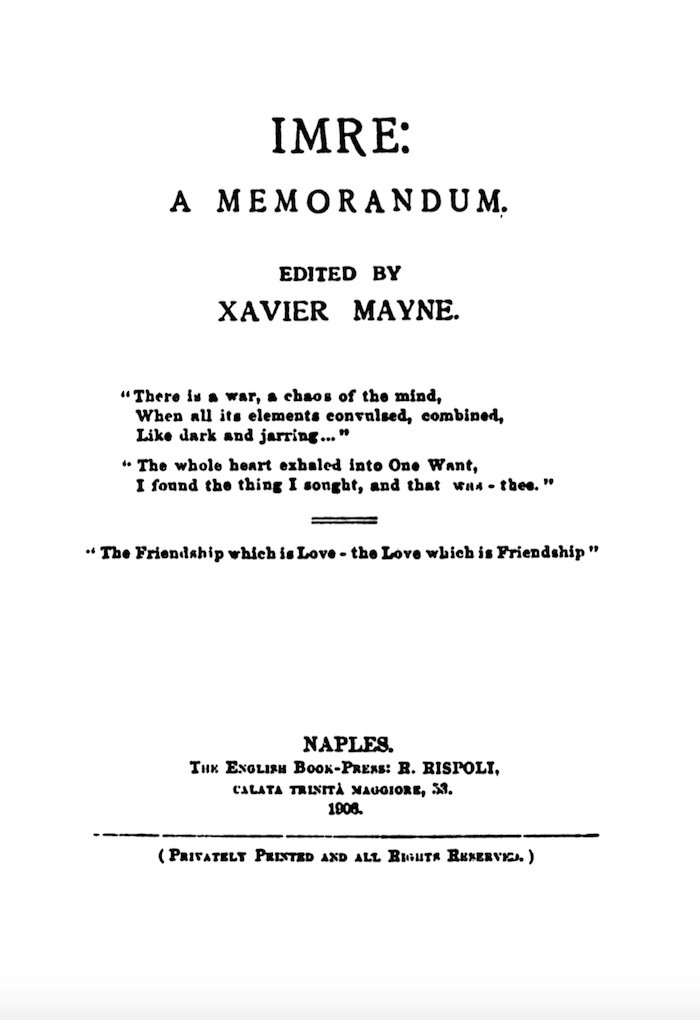
"Not the friendship which is love, the love which is friendship?" I said in a low voice; indeed, as I now remember more than half to myself.
Imre was looking at the darkened sky, the grey lawn—into the vague distance... at whatsoever was visible save myself. Then his glance was caught by the ghostly marble of the monument to the young Z.... heroes, at which I too was staring. A tone of appeal came as he continued:
"Once more, I beg, I implore you, not to make the mistake of—of—thinking me cold-natured. I, cold-natured?.. Ah, ah! If you knew me better, you'd not pack that notion into your trunks for London! Instead, believe that I value unspeakably all your friendship for me, dear Oswald. Time will prove that. I have had no friend like you, I believe. But though friendship can be a passion... can cast a spell over us that we cannot comprehend nor unbind"... here he withdrew his hand and pointed to the memorial-stone set up for those two human hearts that after so ardently beating for each other, were now but dust... "it must be only a spiritual, manlike regard! The world thought otherwise once. The world thinks—as it thinks—now. And the world, our to-day's world, must decide for us all! Friendship now—now—must stay as the man of our day understands it, Oswald. That is, if the man deserves the name, and is not to be classed as some sort of an incomprehensible... womanish... outcast... counterfeit.... a miserable puzzle—born to be every genuine man's contempt!"
We had come, once more, suddenly, fully, and because of me, on the topic which we had touched on, that night of our Lánczhid walk! But this time I faced it, in a sense of fatality and finality; in a rash, desperate desire to tear a secret out of myself, to breathe free, to be true to myself, to speak out the past and the present, so strangely united in these last few weeks, to reserve nothing, cost what it might! My hour had come!
"You have asked me to listen to you!" I cried. Even now I feel the despair, I think I hear the accent of it, with which I spoke. "I have heard you! Now I want you to listen to me! I wish to tell you a story. It is out of one man's deepest yet daily life... my own life. Most of what I wish to tell happened long before I knew you. It was far away, it was in what used to be my own country. After I tell it, you will be one of very few people in all the world who have known... even suspected... what happened to me. In telling you, I trust you with my social honour... with all that is outwardly and inwardly myself. And I shall probably pay a penalty... just because you hear the wretched history, Imre... you! For, before it ends, it has to do with you; as well as with something that you have just spoken of—so fiercely! I mean—how far a man, deserving to be called a man, refusing, as surely as God lives and has made him, to believe that he is.... what did you call him?... 'a miserable, womanish, counterfeit... outcast'... even if he be incomprehensible to himself... how such a being can suffer and be ruined in his innermost life and peace, by a soul-tragedy which he nevertheless can hide—must hide! I could have told you all on the night that we talked, as we crossed the Lánczhid. No, that is not true! I could not then. But I can now. For I may never see you again. You talk of our 'knowing each other'! I wish you to know me. And I could never write you this, never! Will you hear me, Imre?—patiently?"
"I will hear you patiently—yes, Oswald—if you think it best to tell me. Of that pray think, carefully."
"It is best! I am tired of thinking of it. It is time you knew."
"And I am really concerned in it?"
"You are immediately concerned. That is to say, before it ends. You will see how."
"Then you would better go on... of course."
He consented thus, in the constrained but decided tone which I have indicated as so often recurring during the evening, adding—"I am ready, Oswald."
"From the time when I was a lad, Imre... a little child... I felt myself unlike other boys in one element of my nature. That one matter was my special sense, my passion, for the beauty, the dignity, the charm... the... what shall I say?... the loveableness of my own sex. I hid it, at least so far as, little by little, I came to realize its force. For, I soon perceived that most other lads had no such passionate sentiment, in any important measure of their natures, even when they were fine-strung, impressionable youths. There was nothing unmanly about me; nothing really unlike the rest of my friends in school, or in town-life. Though I was not a strong-built, or rough-spirited lad, I had plenty of pluck and muscle, and was as lively on the playground, and fully as indefatigable, as my chums. I had a good many friends; close ones, who liked me well. But I felt sure, more and more, from one year to another even of that boyhood time, that no lad of them all ever could or would care for me as much as I could and did care for one or another of them! Two or three episodes made that clear to me. These incidents made me, too, shyer and shyer of showing how my whole young nature, soul and body together, Imre—could be stirred with a veritable adoration for some boy-friend that I elected.. an adoration with a physical yearning in it—how intense was the appeal of bodily beauty, in a lad, or in a man of mature years."
"And yet, with that beauty, I looked for manliness, poise, will-power, dignity and strength in him. For, somehow I demanded those traits, always and clearly, whatever else I sought along with them. I say 'sought'; I can say, too, won—won often to nearness. But this other, more romantic, emotion in me... so strongly physical, sexual, as well as spiritual... it met with a really like and equal and full response once only. Just as my school-life was closing, with my sixteenth year (nearly my seventeenth) came a friendship with a newcomer into my classes, a lad of a year older than myself, of striking beauty of physique, and uncommon strength of character. This early relation embodied the same precocious, absolutely vehement passion (I can call it nothing else) on both sides. I had found my ideal! I had realized for the first time, completely, a type; a type which had haunted me from first consciousness of my mortal existence, Imre; one that is to haunt me till my last moment of it. All my immature but intensely ardent regard was returned. And then, after a few months together, my schoolmate, all at once, became ill during an epidemic in the town, was taken to his home, and died. I never saw him after he left me."
"It was my first great misery, Imre. It was literally unspeakable! For, I could not tell to anyone, I did not know how to explain even to myself, the manner in which my nature had gone out to my young mate, nor how his being spontaneously so had blent itself with mine. I was not seventeen years old, as I said. But I knew clearly now what it was to love thus, so as to forget oneself in another's life and death! But also I knew better than to talk of such things. So I never spoke of my dead mate."
"I grew older, I entered my professional studies, and I was very diligent with them. I lived in a great capital, I moved much in general society. I had a large and lively group of friends. But always, over and over, I realized that, in the kernel, at the very root and fibre of myself, there was the throb and glow, the ebb and the surge, the seeking as in a vain dream to realize again that passion of friendship which could so far transcend the cold modern idea of the tie; the Over-Friendship, the Love-Friendship of Hellas—which meant that between man and man could exist—the sexual-psychic love. That was still possible! I knew that now! I had read it in the verses or the prose of the Greek and Latin and Oriental authours who have written out every shade of its beauty or unloveliness, its worth or debasements—from Theokritos to Martial, or Abu-Nuwas, to Platen, Michel Angelo, Shakespeare. I had learned it from the statues of sculptors, with those lines so often vivid with a merely physical male beauty—works which beget, which sprang from, the sense of it in a race. I had half-divined it in the music of a Beethoven and a Tschaikowsky before knowing facts in the life-stories of either of them—or of an hundred other tone-autobiographists."
"And I had recognized what it all meant to most people today!—from the disgust, scorn and laughter of my fellow-men when such an emotion was hinted at! I understood perfectly that a man must wear the Mask, if he, poor wretch! could neither abide at the bound of ordinary warmth of feeling for some friend of friends, that drew on his innermost nature; or if he were not content because the other stayed within that bound. Love between two men, however absorbing, however passionate, must not be—so one was assured—solemnly or in disgusted incredulity—a sexual love, a physical impulse and bond. That was now as ever, a nameless horror—a thing against all civilization, sanity, sex, Nature, God! Therefore, I was, of course... what then was I? Oh, I perceived it! I was that anachronism from old—that incomprehensible incident in God's human creation... the man-loving man! The man-loving man! whose whole heart can be given only to another man, and who when his spirit is passing into his beloved friend's keeping would demand, would surrender, the body with it. The man-loving man! He who seeks not merely a spiritual unity with him whom he loves, but seeks the embrace that joins two male human beings in a fusion that no woman's arms, no woman's kisses can ever realize. No woman's embrace? No, no!... for instead of that, either he cares not a whit for it, is indifferent to it, is smilingly scornful of it: or else he tolerates it, even in the wife he has married (not to speak of any less honourable ties) as an artifice, a mere quietus to that undeceived sexual passion burning in his nature; wasting his really unmated individuality, years-long. Or else he surrenders himself to some woman who bears his name, loves him—to her who perhaps in innocence and ignorance believes that she dominates every instinct of his sex!—making her a wife that she may bear to him children; or thinking that marriage may screen him, or even (vain hope) 'cure' him! But oftenest, he flies from any woman, as her sexual self; wholly shrinks from her as from nothing else created; avoids the very touch of a woman's hand in his own, any physical contact with woman, save in a calm cordiality, in a sexless and fraternal reserve, a passionless if yet warm... friendship! Not seldom he shudders (he may not know why) in something akin to dread and to loathing, though he may succeed in hiding it from wife or mistress, at any near approach of his strong male body to a woman's trivial, weak, feminine one, however fair, however harmonious in lines! Yes, even were she Aphrodite herself!"
"And yet, Imre, thousands, thousands, hundreds of thousands, of such human creatures as I am, have not in body, in mind, nor in all the sum of our virility, in all the detail of our outward selves, any openly womanish trait! Not one! It is only the ignoramus and the vulgar who nowadays think or talk of the homosexual as if he were an—hermaphrodite! In every feature and line and sinew and muscle, in every movement and accent and capability, we walk the world's ways as men. We hew our ways through it as men, with vigour, success, honour... one master-instinct unsuspected by society for, it may be, our lives long! We plough the globe's roughest seas as men, we rule its States as men, we direct its finance and commerce as men, we forge its steel as men, we grapple with all its sciences, we triumph in all its arts as men, we fill its gravest professions as men, we fight in the bravest ranks of its armies as men, or we plan out its fiercest and most triumphant battles as men.... in all this, in so much more, we are men! Why, (in a bitter paradox) one can say that we always have been, we always are, always will be, too much men! So super-male, so utterly unreceptive of what is not manly, so aloof from any feminine essences, that we cannot tolerate woman at all as a sexual factor! Are we not the extreme of the male? its supreme phase, its outermost phalanx?—its climax of the aristocratic, the All-Man? And yet, if love is to be only what the narrow, modern, Jewish-Christian ethics of today declare it, if what they insist be the only natural and pure expression of 'the will to possess, the wish to surrender'.. oh, then is the flouting world quite right! For then we are indeed not men! But if not so, what are we? Answer that, who can!"
"The more perplexed I became in all this wretchedness (for it had grown to that by the time I had reached my majority).. the more perplexed I became because so often in books, old ones or new, nay, in the very chronicles of the criminal-courts, I came face to face with the fact that though tens of thousands of men, in all epochs, of noblest natures, of most brilliant minds and gifts, of intensest energies.. scores of pure spirits, deep philosophers, bravest soldiers, highest poets and artists, had been such as myself in this mystic sex-disorganization.... that nevertheless of this same Race, the Race-Homosexual, had been also, and apparently ever would be, countless ignoble, trivial, loathesome, feeble-souled and feeble-bodied creatures!... the very weaklings and rubbish of humanity!"
"Those, those, terrified me, Imre! To think of them shamed me; those types of man-loving-men who, by thousands, live incapable of any noble ideals or lives. Ah, those patently depraved, noxious, flaccid, gross, womanish beings! perverted and imperfect in moral nature and in even their bodily tissues! Those homosexual legions that are the straw-chaff of society; good for nothing except the fire that purges the world of garbage and rubbish! A Heliogabalus, a Gilles de Rais, a Henri Trois, a Marquis de Sade; the painted male-prostitutes of the boulevards and twilight-glooming squares! The effeminate artists, the sugary and fibreless musicians! The Lady Nancyish, rich young men of higher or lower society; twaddling aesthetic sophistries; stinking with perfume like cocottes! The second-rate poets and the neurasthenic, précieux poetasters who rhyme forth their forged literary passports out of their mere human decadence; out of their marrowless shams of all that is a man's fancy, a man's heart, a man's love-life! The cynical debauchers of little boys; the pederastic perverters of clean-minded lads in their teens; the white-haired satyrs of clubs and latrines!"
"What a contrast are these to great Oriental princes and to the heroes and heroic intellects of Greece and Rome! To a Themistocles, an Agesilaus, an Aristides and a Kleomenes; to Socrates and Plato, and Saint Augustine, to Servetus and Beza; to Alexander, Julius Caesar, Augustus, and Hadrian; to Prince Eugene of Savoy, to Sweden's Charles the Twelfth, to Frederic the Great, to indomitable Tilly, to the fiery Skobeleff, the austere Gordon, the ill-starred Macdonald; to the brightest lyrists and dramatists of old Hellas and Italia; to Shakespeare, (to Marlowe also, we can well believe) Platen, Grillparzer, Hölderlin, Byron, Whitman; to an Isaac Newton, a Justus Liebig—to Michel-Angelo and Sodoma; to the masterly Jerome Duquesnoy, the classic-souled Winckelmann, to Mirabeau, Beethoven, Bavaria's unhappy King Ludwig;—to an endless procession of exceptional men, from epoch to epoch! Yet as to these and innumerable others, facts of their hidden, inner lives have proved without shadow of doubt (however rigidly suppressed as 'popular information') or inferences vivid enough to silence scornful denial, have pointed out that they belonged to Us."
"Nevertheless, did not the widest overlook of the record of Uranianism, the average facts about one, suggest that the most part of homosexual humanity had always belonged, always would belong, to the worthless or the wicked? Was our Race gold or excrement!—as rubies or as carrion? If that last were one's final idea, why then all those other men, the Normalists, aye, our severest judges, those others whether good or bad, whether vessels of honour or dishonour, who are not in their love-instincts as are we... the millions against our tens of thousands, even if some of us are to be respected.... why, they do right to cast us out of society; for, after all, we must be just a vitiated breed!... We must be judged by our commoner mass.
"And yet, the rest of us! The Rest, over and over! men so high-minded, often of such deserved honour from all that world which has either known nothing of their sexual lives, or else has perceived vaguely, and with a tacit, a reluctant pardon! Could one really believe in God as making man to live at all, and to love at all, and yet at the same time believe that this love is not created, too, by God? is not of God's own divinest Nature, rightfully, eternally—in millions of hearts?... Could one believe that the eternal human essence is in its texture today so different from itself of immemorial time before now, whether Greek, Latin, Persian, or English? Could one somehow find in his spirit no dread through this, none, at the idea of facing God, as his Judge, at any instant?... could one feel at moments such strength of confidence that what was in him so was righteousness... oh, could all this be?—and yet must a man shudder before himself as a monster, a solitary and pernicious being—diseased, leprous, gangrened—one that must stagger along on the road of life, ever justly shunned, ever justly bleeding and ever the more wearied, till Death would meet him and say 'Come—enough!—Be free of all!—be free of thyself most of all!'"
I paused. Doing so, I heard from Imre, who had not spoken so much as a word—was it a sigh? Or a broken murmur of something coming to his lips in his own tongue? Was it—no, impossible!... was it a sort of sob, strangled in his throat? The evening had grown so dark that I could not have seen his face, even had I wished to look into it. However... absorbed now in my own tenebrous retrospect, almost forgetting that anyone was there, at my side, I went on:
"You must not think that I had not had friendships of much depth, Imre, which were not, first and last, quite free from this other accent in them. Yes, I had had such; and I have many such now; comradeships with men younger, men of my own age, men older, for whom I feel warm affection and admiration, whose company was and is a true happiness for me. But somehow they were not and, no matter what they are they still are not, of the Type; of that eternal, mysteriously-disturbing cruel Type, which so vibrates sexually against my hidden Self."
"How I dreaded, yet sought that Type!... how soon was I relieved, or dull of heart, when I knew that this or that friend was not enough dear to me, however dear he was, to give me that hated sexual stir and sympathy, that inner, involuntary thrill! Yet I sought it ever, right and left, since none embodied it for me; while I always feared that some one might embody it! There were approaches to it. Then, then, I suffered or throbbed with a wordless pain or joy of life, at one and the same time! But fortunately these encounters failed of full realization. Or what might have been my fate passed me by on the other side. But I learned from them how I could feel toward the man who could be in his mind and body my ideal; my supremest Friend. Would I ever meet him?... meet him again?... I could say to myself—remembering that episode of my schooldays. Or would I never meet him! God forbid that! For to be all my life alone, year after year, striving to content myself with pleasant shadow instead of glowing verity!... Ah, I could well exclaim in the cry of Platen: