
Imre's youth had been, indeed, one long and lamentable obsession of precocious, inborn homosexuality. Imre (just as in many instances) had never been a weakling, an effeminate lad, nor cared for the society of the girls about him on the playground or in the house. On the contrary, his sexual and social indifference or aversion to them had been always thoroughly consistent with the virile emotions of that sort. But there had been the boy-friendships that were passions; the sense of his being out of key with his little world in them; the deepening certitude that there was a mystery in himself that "nobody would understand"; some element rooted in him that was mocked by the whole boy-world, by the whole man-world. A part of himself to be crushed out, if it could be crushed, because base and vile. Or that, at any rate, was to be forever hid.. hid.. hid.. for his life's sake hid! So Imre had early put on the Mask; the Mask that millions never lay by till death—and many not even then!
And in Imre's case there had come no self-justification till late in his sorrowful young manhood. Not until quite newly, when he had discovered how the uranistic nature is regarded by men who are wiser and wider-minded than our forefathers were, had Imre accepted himself as an excusable bit of creation.
Fortunately, Imre had not been born and brought up in an Anglo-Saxon civilization; where is still met, at every side, so dense a blending of popular ignorances; of century-old and century-blind religious and ethical misconceptions, of unscientific professional conservatism in psychiatric circles, and of juristic barbarisms; all, of course, accompanied with the full measure of British or Yankee social hypocrisy toward the daily actualities of homosexualism. By comparison, indeed, any other lands and races—even those yet hesitant in their social toleration or legal protection of the Uranian—seem educative and kindly; not to distinguish peoples whose attitude is distinctively one of national common-sense and humanity. But in this sort of knowledge, as in many another, the world is feeling its way forward (should one say back?) to intelligence, to justice and to sympathy, so spirally, so unwillingly! It is not yet in the common air.
Twice Imre had been on the point of suicide. And though there had been experiences in the Military-Academy, and certain much later ones to teach him that he was not unique in Austria-Hungary, in Europe, or the world, still unluckily, Imre had got from them (as is too often the hap of the Uranian) chiefly the sense of how widely despised, mocked, and loathed is the Uranian Race. Also how sordid and debasing are the average associations of the homosexual kind, how likely to be wanting in idealism, in the exclusiveness, in those pure and manly influences which ought to be bound up in them and to radiate from them! He had grown to have a horror of similisexual types, of all contacts with them. And yet, until lately, they could not be torn entirely out of his life. Most Uranists know why!
Still, they had been so expelled, finally. The turning-point had come with Karvaly. It meant the story of the development of a swift, admiring friendship from the younger soldier toward the older. But alas! this had gradually become a fierce, despairing homosexual love. This, at its height, had been as destructive of Imre's peace as it was hopeless. Of course, it was impossible of confession to its object. Karvaly was no narrow intellect; his affection for Imre was warm. But he would never have understood, not even as some sort of a diseased illusion, this sentiment in Imre. Much less would he have tolerated it for an instant. The inevitable rupture of their whole intimacy would have come with Imre's betrayal of his passion. So he had done wisely to hide every throb from Karvaly. How sharply Karvaly had on one occasion expressed himself on masculine homosexuality, Imre cited to me, with other remembrances. At the time of the vague scandal about the ex-officer Clement, whom Imre and I had met, Imre had asked Karvaly, with a fine carelessness,—"Whether he believed that there was any scientific excuse for such a sentiment?" Karvaly answered, with the true conviction of the dionistic temperament that has never so much as paused to think of the matter as a question in psychology... "If I found that you cared for another man that way, youngster, I should give you my best revolver, and tell you to put a bullet through your brains within an hour! Why, if I found that you thought of me so, I should brand you in the Officers Casino tonight, and shoot you myself at ten paces tomorrow morning. Men are not to live when they turn beasts.... Oh, damn your doctors and scientists! A man's a man, and a woman's a woman! You can't mix up their emotions like that."
The dread of Karvaly's detection, the struggle with himself to subdue passion, not merely to hide it, and along with these nerve-wearing solicitudes, the sense of what the suspicion of the rest of the world about him would inevitably bring on his head, had put Imre, little by little, into a sort of panic. He maintained an exaggerated attitude of safety, that had wrought on him unluckily, in many a valuable social relation. He wore his mask each and every instant; resolving to make it his natural face before himself! Having, discovered, through intimacy with Karvaly how a warm friendship on the part of the homosexual temperament, over and over takes to itself the complexion of homosexual love—the one emotion constantly likely to rise in the other and to blend itself inextricably into its alchemy—Imre had simply sworn to make no intimate friendship again! This, without showing himself in the least unfriendly; indeed with his being more hail-fellow-well-met with his comrades than otherwise.
But there Imre stopped! He bound his warm heart in a chain, he vowed indifference to the whole world, he assisted no advances of warm, particular regard from any comrade. He became that friend of everybody in general who is the friend of nobody in particular! He lived in a state of perpetual defence in his regiment, and in whatever else was social to him in Szent-Istvánhely. So surely as he admired another man—would gladly have won his generous and virile affection—Imre turned away from that man! He covered this morbid state of self-inclusion, this solitary life (such it was, apart from the relatively short intimacy with Karvaly) with laughter and a most artistic semblance of brusqueness; of manly preoccupation with private affairs. Above all, with the skilful cultivation of his repute as a Lothario who was nothing if not sentimental and absorbed in—woman! This is possibly the most common device, as it is the securest, on the part of an Uranian. Circumstances favoured Imre in it; and he gave it its full show of honourable mystery. The cruel irony of it was often almost humorous to Imre.
"... They have given me the credit of being the most confirmed rake in high life... think of that! I, and in high life!.. to be found in town. The less they could trace as ground for it, why, so much the stronger rumours!.. you know how that sort of a label sticks fast to one, once pinned on. Especially if a man is really a gentleman and holds his tongue, ever and always, about his intimacies with women. Why, Oswald, I have never felt that I could endure to be alone five minutes with any woman... I mean in—that way! Not even with a woman most dear to me, as many, many women are. Not even with a wife that loved me. I have never had any intimacies—not one—of that sort... Merely semblances of such! Queer experiences I've tumbled into with them, too! You know."
Oh, yes... I knew!
Part of Imre's exaggerated, artificial bearing toward the outer world was the nervous shrinking from commonplace social demonstrativeness on the part of his friends. To that mannerism I have already referred. It had become a really important accent, I do not doubt, in Imre's acting-out of a friendly, cheerful, yet keep-your-distance sort of personality. But there was more than that in it. It was a detail in the effort toward his self-transformation; a minor article in his compact with himself never to give up the struggle to "cure" himself. He was convinced that this was the most impossible of achievements. But he kept on fighting for it. And since one degree of sentiment led so treacherously to another, why, away with all!
"But Imre, I do not yet see why you have not trusted me sooner. There have been at least two moments in our friendship when you could have done so; and one of them was when.. you should!"
"Yes, you are right. I have been unkind. But then, I have been as unkind to myself. The two times you speak of, Oswald... you mean, for one of them, that night that we met Clement... and spoke about such matters for a moment while we were crossing the Lánczhid? And the other chance was after you had told me your own story, over there in the Z... park?"
"Yes. Of course, the fault is partly mine—once. I mean that time on the Bridge... I fenced you off from me—I misled you—didn't help you—I didn't help myself. But even so, you kept me at sword's length, Imre! You wore your mask so closely—gave me no inch of ground to come nearer to you, to understand you, to expect anything except scorn—our parting! Oh, Imre! I have been blind, yes! but you have been dumb."
"You wonder and you blame me," he replied, after busying himself a few seconds with his own perplexing thoughts. "Again, I say 'Forgive me.' But you must remember that we played at cross-purposes too much (as I now look back on what we said that first time) for me to trust myself to you. I misunderstood you. I was stupid—nervous. It seemed to me certain, at first, that you had me in your mind—that I was the friend you spoke of—laughed at, in a way. But after I saw that I was mistaken? Oh, well it appeared to me that, after all, you must be one of the Despisers. Gentler-hearted than the most; broader minded, in a way; but one who, quite likely, thought and felt as the rest of the world. I was afraid to go a word farther! I was afraid to lose you. I shivered afterward, when I remembered that I had spoken then of what I did. Especially about that man... who cared for me once upon a time... in that way... And so suddenly to meet Clement! I didn't know he was in Szent-Istvánhely; the meeting took me by surprise. I heard next morning that his mother had been very ill."
"But afterwards, Imre? You surely had no fear of what you call 'losing' me then? How could you possibly meet my story—in that hour of such bitter confidence from me!—as you did? Could come no further toward me? When you were certain that to find you my Brother in the Solitude would make you the nearer-beloved and dearer-prized!"
"That's harder for me to answer. For one reason, it was part of that long battle with myself! It was something against the policy of my whole life!... as I had sworn to live it for all the rest of it... before myself or the world. I had broken that pledge already in our friendship, such as even then it was! Broken it suddenly, completely... before realizing what I did. The feeling that I was weak, that I cared for you, that I was glad that you sought my friendship... ah, the very sense of nearness and companionship in that... But I fought with all that, I tell you! Pride, Oswald!... a fool's pride! My determination to go on alone, alone, to make myself sufficient for myself, to make my punishment my tyrant!—to be martyred under it! Can you not understand something of that? You broke down my pride that night, dear Oswald. Oh, then I knew that I had found the one friend in the world, out of a million-million men not for me! And nevertheless I hung back! The thought of your going from me had been like a knife-stroke in my heart all the evening long. But yet I could not speak out. All the while I understood how our parting was a pain to you—I could have echoed every thought that was in your soul about it!... but I would not let myself speak one syllable to you that could show you that I cared! No!... then I would have let you go away in ignorance of everything that was most myself... rather than have opened that life-secret, or my heart, as we sat there. Oh, it was as if I was under a spell, a cursed enchantment that would mean a new unhappiness, a deeper silence for the rest of my life! But the wretched charm was perfect. Good God!... what a night I passed! The mood and the moment had been so fit... yet both thrown away! My heart so shaken, my tongue so paralyzed! But before morning came, Oswald, that fool's hesitation was over. I was clear and resolved, the devil of arrogance had left me. I was amazed at myself. You would have heard everything from me that day. But the call to the Camp came. I had not a moment. I could not write what I wished. There was nothing to do but to wait."
"The waiting has done no harm, Imre."
"And there is another reason, Oswald, why I found it hard to be frank with you. At least, I think so. It is—what shall call it?—the psychic trace of the woman in me. Yes, after all, the woman! The counter-impulse, the struggle of the weakness that is womanishness itself, when one has to face any sharp decision... to throw one's whole being into the scale! Oh, I know it, I have found it in me before now! I am not as you, the Uranian who is too much man! I am more feminine in impulse—of weaker stuff... I feel it with shame. You know how the woman says 'no' when she means 'yes' with all her soul! How she draws back from the arms of the man that she loves when she dreams every night of throwing herself into them? How she finds herself doing, over and over, just that which is against her thought, her will, her duty! I tell you, there is something of that in me, Oswald! I must make it less... you must help me. It must be one of the good works of your friendship, of your love, for me. Oh, Oswald, Oswald!... you are not only to console me for all that I have suffered, for anything in my past that has gone wrong. For, you are to help me to make myself over, indeed, in all that is possible, whatever cannot be so."
"We must help each other Imre. But do not speak so of woman, my brother! Sexually, we may not value her. We may not need her, as do those Others. But think of the joy that they find in her to which we are cold; the ideals from which we are shut out! Think of your mother, Imre; as I think of mine! Think of the queens and peasants who have been the light and the glory of races and peoples. Think of the gentle, noble sisters and wives, the serene, patient rulers of myriad homes. Think of the watching nurses in the hospitals... of the spirits of mercy who walk the streets of plague and foulness!... think of the nun on her knees for the world...!"
The shadows in the room were almost at their deepest. We were still sitting face to face, almost without having stirred since that moment when I had quitted his side so suddenly—to divine how much closer I was to be drawn to him henceforth. Life!—Life and Death!—Life—Love—Death! The sense of eternal kinship in their mystery.... somehow it haunted one then! as it is likely to do when not our unhappiness but a kind of over-joy swiftly oppresses us; making us to feel that in some other sphere, and if less grossly "set within this muddy vesture of decay," we might understand all three... might find all three to be one! Life—Love—Death!...
"Oswald, you will never go away from me!"
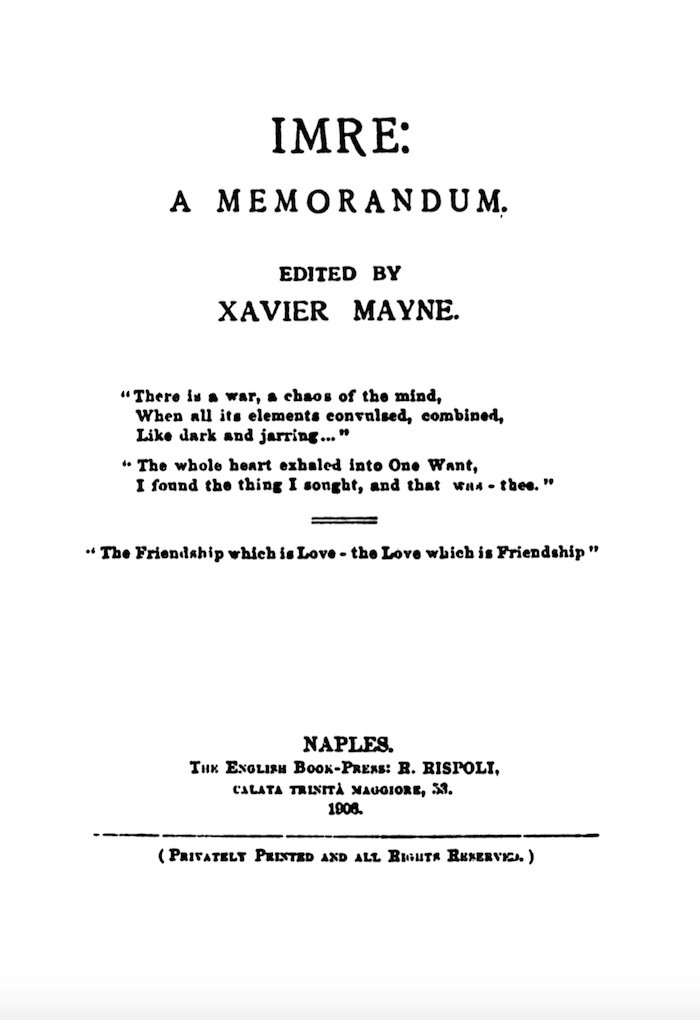
"Imre, I will never go away from thee. Thy people shall be mine. Thy King shall be mine. Thy country shall be mine,—thy city mine! My feet are fixed! We belong together. We have found what we had despaired of finding... 'the friendship which is love, the love which is friendship'. Those who cannot give it—accept it—let them live without it. It can be 'well, and very well' with them. Go they their ways without it! But for Us, who for our happiness or unhappiness cannot think life worth living if lacking it... for Us, through the world's ages born to seek it in pain or joy... it is the highest, holiest Good in the world. And for one of us to turn his back upon it, were to find he would better never have been born!"......
It was eleven o'clock. Imre and I had supped and taken a stroll in the yellow moonlight, along the quais, overlooking the shimmering Duna; and on through the little Erzsébet-tér where we had met, a few weeks ago—it seemed so long ago! I had heard more of Imre's life and individuality as a boy; full of the fine and unhappy emotions of the uranistic youth. We had laughed over his stock of experiences in the Camp. We had talked of things grave and gay.
Then we had sauntered back. It was chance; but lo! we were on the Lánczhid, once more! The Duna rippled and swirled below. The black barges slumbered against the stone rakpartok. The glittering belts of the city-lights flashed in long perspectives along the wide river's sweeping course and twinkled from square to square, from terrace to terrace. Across from us, at a garden-café, a cigány orchestra was pulsating; crying out, weeping, asking, refusing, wooing, mocking, inebriating, despairing, triumphant! All the warm Magyar night about us was dominated by those melting chromatics, poignant cadences—those harmonies eternally oriental, minor-keyed, insidious, nerve-thrilling. The arabesques of the violins, the vehement rhythms of the clangorous czimbalom!.... Ah, this time on the Lánczhid, neither for Imre nor me was it the sombre Bakony song, "O jaj! az álom nelkül"—but instead the free, impassioned leap and acclaim,—"Huszár legény vagyok!—Huszár legény vagyok!"
We were back in the quiet room, lighted now only by the moon. Far up, on the distant Pálota heights, the clear bell of Szent-Mátyás struck the three-quarters. The slow notes filled the still night like a benediction, keyed to that haunting, divine, prophetic triad, Life—Love—Death! Benediction threefold and supreme to the world!
"Oh, my brother! Oh, my friend!" exclaimed Imre softly, putting his arm about me and holding me to his heart. "Listen to me. Perhaps.. perhaps even yet, canst thou err in one, only one thought. I would have thee sure that when I am with thee here, now, I miss nothing and no one—I seek nothing and no one! My quest, like thine, is over!... I wish no one save thee, dear Oswald, no one else, even as I feel thou wishest none save me, henceforth. I would have thee believe that I am glad just as thou art glad. Alike have we two been sad because of our lonely hearts, our long restlessness of soul and body, our vain dreams, our worship of this or that hope—vision—which has been kept far from us—it may be, overvalued by us! We have suffered so much thou and I!... because of what never could be! We shall be all the happier now for what is real for us... I love thee, as thou lovest me. I have found, as thou hast found, 'the friendship which is love, the love which is friendship.'... Come then, O friend! O brother, to our rest! Thy heart on mine, thy soul with mine! For us two it surely is... Rest!"
THE END.
*Matthew Arnold
TRANSCRIBER'S NOTE
Obvious printing errors have been silently corrected throughout. Otherwise, inconsistencies and possible errors have been preserved, and some irregular and non-standard formatting and punctuation has likewise been retained.