
CHAPTER IV
IN THE WILDERNESS
That Boone had in mind an adventure beyond the Laurel Ridge was soon noised abroad.
“Going on a big hunt,” said one of the settlers to another. “Taking John Finley, who some years ago led a party to the Louisa River[3] region, and some others.”
“Means to stay for some time, too, I hear,” said the other.
The first speaker nodded.
“Dan’l’s boys are big enough to look after things now,” said he. “And I guess they have money enough to last a while. And besides the fun of the hunt, Boone’ll bring back rich furs, for they say the country he’s going into just swarms with game.”
But that Boone had any thought other than hunting was not known to the settlements; that Colonel Henderson contemplated having the backwoodsman inspect the wilderness as a preliminary to planting colonies therein was kept a close secret.
It was one fine day in May in the year 1769 that the little party assembled for the start. Besides Boone and Finley, there were James Moncey, John Stuart, William Cool and Joseph Holden, hardy woodsmen, dead shots and men who could be depended upon in any emergency.
Besides the sinewy, deep-winded horses which they rode, they had a number of pack animals laden with blankets, ammunition and camp equipment and provisions.
“We need not take much food,” said Boone, and Finley had agreed with him. “A little meal and salt and such like, that’s all. For the country into which we’re going, boys, is a paradise for riflemen. The streams have never been fished except by the wandering Injuns; the herds of deer and buffalo are endless; the small game, both furred and feathered, are not to be counted.”
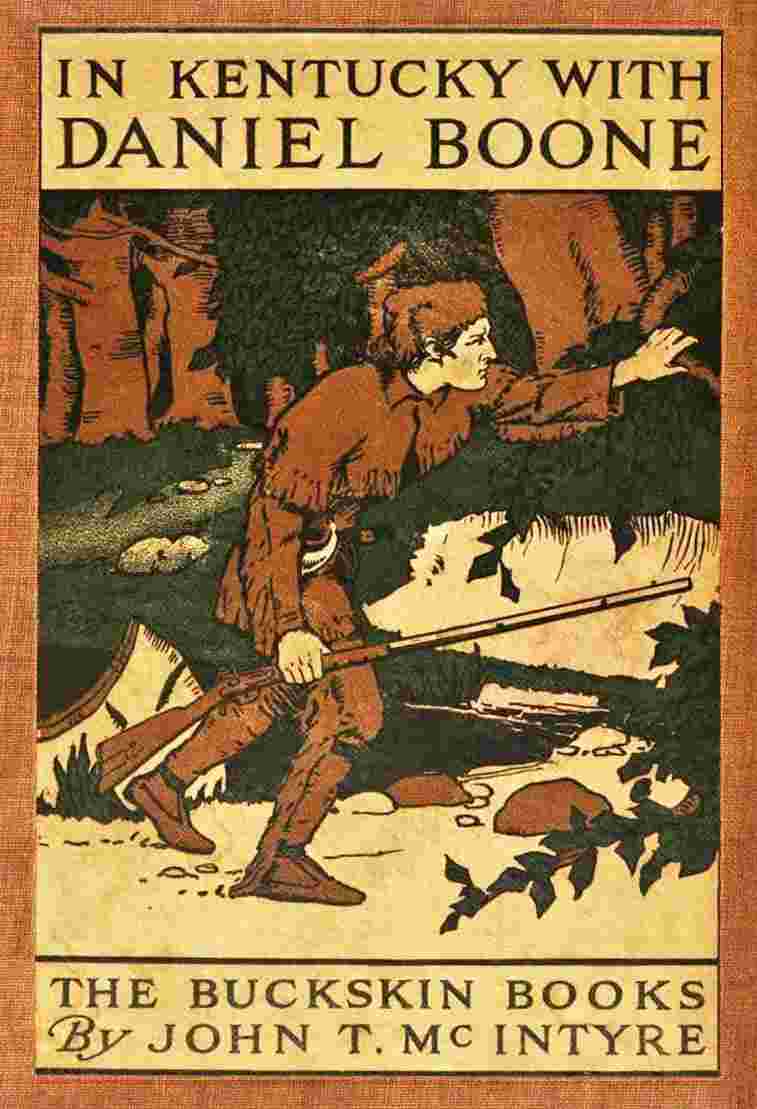
Each of the adventurers had slung across his back the very long, flint-lock rifle made famous by their breed and generation; they also carried keen, heavy knives and hatchets; only a few pistols were to be seen among them. They wore deerskin hunting shirts and tanned leggins of the same material; their powder-horns and bullet-pouches swung from their shoulders.
Boone and the others had said good-bye to their families and now sat their horses in the trail along the Yadkin, having a last word with Colonel Henderson, who had ridden from Hillsboro to see them off. Noll Barclay had borne him company, and Eph Taylor, eager and curious, had journeyed from the forest-encircled farm to hear the latest word.
“I suppose,” Oliver said to his uncle, “that you have reasons, but I can’t see why Eph and I could not ride with Mr. Boone on this adventure as well as not.”
“You are too young,” spoke the colonel, after the fashion of a man who had heard the suggestion in many forms before.
Boone looked at the straight, slight form of the lad, and then at the lanky Eph. He nodded his agreement with the other.
“Too young,” said he. “There are times, lads, when years count, and this is one of them. It’s not only your being short of endurance but of judgment that makes it impossible to take you along this time. You look at this thing as a bit of fun, and that is just what it is not. In a year or two, though,” he added, “you’ll both have picked up years and experience.”
“But in a year or two,” objected Noll, “there may be no trips into the wilderness.”
Both Boone and Colonel Henderson laughed.
“The wilderness will be there for many years to come,” spoke the colonel.
“And this, I think, is not the last trip into it by many,” said Daniel Boone.
Young Barclay had talked over the adventure of the wilderness with both Eph and Sandy, and while none of them hoped to be taken along on the expedition, they, like every lad for miles around, longed to have fate play an unexpected prank in their behalf.
“I don’t expect anything to happen,” Oliver had said, fervently. “But you can never tell.”
However, it did not happen, and the two boys watched the hardy band ride along the trail for the river, leading their pack animals, and plunge into the budding green sea of the forest.
Now began the long hardship of the journey across the mountains. For some days the going was not so difficult, because ways had been hewn in the forests by settlers tilling the land round about; but in a little while they penetrated beyond the settled district and were voyaging in the trackless wilderness where the foot of the white man had seldom fallen. They now followed the winding paths made by buffalo and other large animals as being attended with less labor than pushing their way through the dense undergrowth and interlacing vines. Through deep ravines, down roaring mountain streams, descending into wonderful valleys, fording deep rivers, they held their way across the mountain ridge which streaked so blue across the sky-line; and at length they found themselves on the verge of that far country of which they had been in search.
Here and there in the journey they had come across the tracks of redskins; once across the tree tops they had seen tall, pale columns of smoke lifting, which told of a camp of some size. And having no desire to become better acquainted with the wandering tribesmen, they had always changed their course and brought into play all those wiles known to the students of woodcraft to throw off their trail any one who might stumble upon it.
“It’s always best to be careful,” said Boone, during one of these sudden shifts in their course. “As far as I know there’s no big party in this region, because it belongs to no one tribe and is visited only by the hunters. But never take a chance that can be avoided—that’s the safe course to follow.”
However, as Daniel Boone had said to Colonel Henderson, the beautiful land of Kentucky was used, from time to time, as something more than a hunting-ground. Bands of Chickasaws, Shawnees and Cherokees frequently met in the heart of the wild, and when they did, savage fighting followed. So desperate were these conflicts that the region became known by an Indian name signifying “dark and bloody ground.”
Before the band of white men, as they stood upon an eminence of the ridge on the day they first sighted Kentucky, was a vast rolling country, roamed by herds of horned beasts, splendid streams and valleys which promised a rich yield to the hand which drove the plow through it.
But after a space given to wonder and admiration, Boone noted that the sun was slipping little by little behind the green rim of the forest.
“I think, boys,” suggested he, “we’d better look for a likely place to camp for the night. To-morrow we’ll plunge into the new country and have a close-at-hand look at everything.”
In the mountain-side was a small gorge across which a cottonwood had fallen and hidden by a dense growth of thicket. Limbs were cut by hatchet and knife and placed against the fallen tree in such a manner as to form a sort of roof. Bark was pulled from those trees which gave it readily, and fitted over the limbs; soft balsam boughs were placed in the bottom of the gorge for beds; and here the adventurers made a home in the wilds which they kept until the winter came with its snow and rigors.
A turkey was roasted above the coals, impaled upon a ramrod; flap-jacks were baked upon heated stones, and full of the spirit of the thing and gifted with wonderful appetites the adventurers fell to and made a hearty meal.
Then, afterward, they stretched out upon the soft boughs and watched the moon drift across the sky while they talked of what was to come. All was peace; save for the cry of some night bird, or the stirring of the breeze among the trees, there was no sound.
Then, without a word of warning, there was a sudden crash from the black looming forest, and the ring of a rifle-shot went echoing and reëchoing from level to level until it died away in the stillness.