
The Project Gutenberg eBook of In memoriam
This ebook is for the use of anyone anywhere in the United States and
most other parts of the world at no cost and with almost no restrictions
whatsoever. You may copy it, give it away or re-use it under the terms
of the Project Gutenberg License included with this ebook or online
at www.gutenberg.org. If you are not located in the United States,
you will have to check the laws of the country where you are located
before using this eBook.
Title: In memoriam
Author: Baron Alfred Tennyson Tennyson
Release date: June 9, 2023 [eBook #70950]
Most recently updated: November 10, 2024
Language: English
Original publication: United Kingdom: Edward Moxon, Dover street, 1850
Credits: Aaron Adrignola, Chuck Greif and the Online Distributed Proofreading Team at https://www.pgdp.net (This file was produced from images generously made available by The Internet Archive)
*** START OF THE PROJECT GUTENBERG EBOOK IN MEMORIAM ***
In Memorium
A list of books
published by
Edward Moxon, 44, Dover Street.
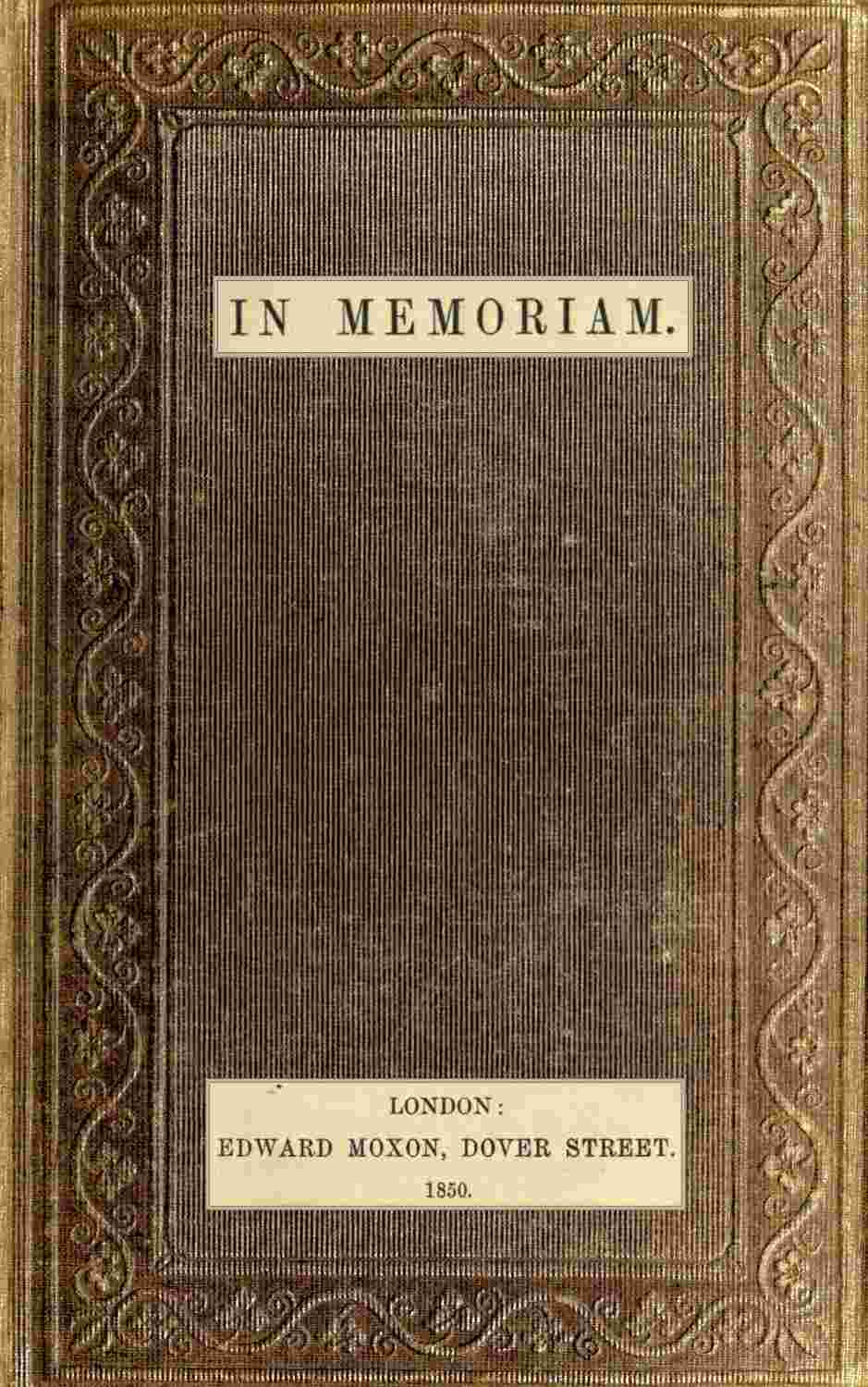
IN MEMORIAM.
IN MEMORIAM.
LONDON:
EDWARD MOXON, DOVER STREET.
1850.
LONDON:
BRADBURY AND EVANS, PRINTERS, WHITEFRIARS.
Strong Son of God, immortal Love,
Whom we, that have not seen thy face,
By faith, and faith alone, embrace,
Believing where we cannot prove;
Whom we, that have not seen thy face,
By faith, and faith alone, embrace,
Believing where we cannot prove;
Thine are these orbs of light and shade;
Thou madest Life in man and brute;
Thou madest Death; and lo, thy foot
Is on the skull which thou hast made.
Thou madest Life in man and brute;
Thou madest Death; and lo, thy foot
Is on the skull which thou hast made.
Thou wilt not leave us in the dust:
Thou madest man, he knows not why;
He thinks he was not made to die;
And thou hast made him: thou art just.
Thou madest man, he knows not why;
He thinks he was not made to die;
And thou hast made him: thou art just.
Thou seemest human and divine,
The highest, holiest manhood, thou:
Our wills are ours, we know not how;
Our wills are ours, to make them thine.
The highest, holiest manhood, thou:
Our wills are ours, we know not how;
Our wills are ours, to make them thine.
Our little systems have their day;
They have their day and cease to be:
They are but broken lights of thee,
And thou, O Lord, art more than they.
They have their day and cease to be:
They are but broken lights of thee,
And thou, O Lord, art more than they.
We have but faith: we cannot know;
For knowledge is of things we see;
And yet we trust it comes from thee,
A beam in darkness: let it grow.
For knowledge is of things we see;
And yet we trust it comes from thee,
A beam in darkness: let it grow.
Let knowledge grow from more to more,
But more of reverence in us dwell;
That mind and soul, according well,
May make one music as before,
But more of reverence in us dwell;
That mind and soul, according well,
May make one music as before,
But vaster. We are fools and slight;
We mock thee when we do not fear:
But help thy foolish ones to bear;
Help thy vain worlds to bear thy light.
We mock thee when we do not fear:
But help thy foolish ones to bear;
Help thy vain worlds to bear thy light.
Forgive what seem’d my sin in me;
What seem’d my worth since I began;
For merit lives from man to man,
And not from man, O Lord, to thee.
What seem’d my worth since I began;
For merit lives from man to man,
And not from man, O Lord, to thee.
Forgive my grief for one removed,
Thy creature, whom I found so fair.
I trust he lives in thee, and there
I find him worthier to be loved.
Thy creature, whom I found so fair.
I trust he lives in thee, and there
I find him worthier to be loved.
Forgive these wild and wandering cries,
Confusions of a wasted youth;
Forgive them where they fail in truth,
And in thy wisdom make me wise.
1849.
Confusions of a wasted youth;
Forgive them where they fail in truth,
And in thy wisdom make me wise.
1849.
IN MEMORIAM
A. H. H.
OBIIT MDCCCXXXIII.
I
I held it truth, with him who sings
To one clear harp in divers tones,
That men may rise on stepping-stones
Of their dead selves to higher things.
To one clear harp in divers tones,
That men may rise on stepping-stones
Of their dead selves to higher things.
But who shall so forecast the years
And find in loss a gain to match?
Or reach a hand thro’ time to catch
The far-off interest of tears?
And find in loss a gain to match?
Or reach a hand thro’ time to catch
The far-off interest of tears?
Let Love clasp Grief lest both be drown’d,
Let darkness keep her raven gloss;
Ah! sweeter to be drunk with loss,
To dance with death, to beat the ground;
Let darkness keep her raven gloss;
Ah! sweeter to be drunk with loss,
To dance with death, to beat the ground;
II
Old Yew, which graspest at the stones
That name the under-lying dead,
Thy fibres net the dreamless head;
Thy roots are wrapt about the bones.
That name the under-lying dead,
Thy fibres net the dreamless head;
Thy roots are wrapt about the bones.
The seasons bring the flower again,
And bring the firstling to the flock;
And in the dusk of thee, the clock
Beats out the little lives of men.
And bring the firstling to the flock;
And in the dusk of thee, the clock
Beats out the little lives of men.
O! not for thee the glow, the bloom,
Who changest not in any gale!
Nor branding summer suns avail
To touch thy thousand years of gloom.
Who changest not in any gale!
Nor branding summer suns avail
To touch thy thousand years of gloom.
III
O sorrow, cruel fellowship!
O Priestess in the vaults of Death!
O sweet and bitter in a breath,
What whispers from thy lying lip?
O Priestess in the vaults of Death!
O sweet and bitter in a breath,
What whispers from thy lying lip?
‘The stars,’ she whispers, ‘blindly run;
A web is wov’n across the sky;
From out waste places comes a cry,
And murmurs from the dying sun:
A web is wov’n across the sky;
From out waste places comes a cry,
And murmurs from the dying sun:
‘And all the phantom, Nature, stands—
With all her music in her tone,
A hollow echo of my own,—
A hollow form with empty hands.’
With all her music in her tone,
A hollow echo of my own,—
A hollow form with empty hands.’
IV
To Sleep I give my powers away;
My will is bondsman to the dark;
I sit within a helmless bark,
And with my heart I muse and say:
My will is bondsman to the dark;
I sit within a helmless bark,
And with my heart I muse and say:
‘O heart, how fares it with thee now,
That thou should’st fail from thy desire,
Who scarcely darest to inquire
What is it makes me beat so low?’
That thou should’st fail from thy desire,
Who scarcely darest to inquire
What is it makes me beat so low?’
Something it is which thou hast lost,
Some pleasure from thine early years.
Break, thou deep vase of chilling tears,
That grief hath shaken into frost!
Some pleasure from thine early years.
Break, thou deep vase of chilling tears,
That grief hath shaken into frost!
V
I sometimes hold it half a sin
To put in words the grief I feel;
For words, like nature, half reveal
And half conceal the Soul within.
To put in words the grief I feel;
For words, like nature, half reveal
And half conceal the Soul within.
But, for the unquiet heart and brain,
A use in measur’d language lies;
The sad mechanic exercise
Like dull narcotics, numbing pain.
A use in measur’d language lies;
The sad mechanic exercise
Like dull narcotics, numbing pain.
VI
One writes, that ‘Other friends remain,’
That ‘Loss is common to the race’—
And common is the commonplace,
And vacant chaff well meant for grain.
That ‘Loss is common to the race’—
And common is the commonplace,
And vacant chaff well meant for grain.
That loss is common would not make
My own less bitter, rather more:
Too common! Never morning wore
To evening, but some heart did break.
My own less bitter, rather more:
Too common! Never morning wore
To evening, but some heart did break.
O father, wheresoe’er thou be,
That pledgest now thy gallant son;
A shot, ere half thy draught be done
Hath still’d the life that beat from thee.
That pledgest now thy gallant son;
A shot, ere half thy draught be done
Hath still’d the life that beat from thee.
O mother, praying God will save
Thy sailor,—while thy head is bow’d,
His heavy-shotted hammock-shroud
Drops in his vast and wandering grave.
Thy sailor,—while thy head is bow’d,
His heavy-shotted hammock-shroud
Drops in his vast and wandering grave.
Ye know no more than I who wrought
At that last hour to please him well;
Who mused on all I had to tell,
And something written, something thought;
At that last hour to please him well;
Who mused on all I had to tell,
And something written, something thought;
Expecting still his advent home;
And ever met him on his way
With wishes, thinking, here to-day,
Or here to-morrow will he come.
And ever met him on his way
With wishes, thinking, here to-day,
Or here to-morrow will he come.
O! somewhere, meek unconscious dove,
That sittest ranging golden hair;
And glad to find thyself so fair,
Poor child, that waitest for thy love!
That sittest ranging golden hair;
And glad to find thyself so fair,
Poor child, that waitest for thy love!
For now her father’s chimney glows
In expectation of a guest;
And thinking ‘this will please him best,’
She takes a riband or a rose;
In expectation of a guest;
And thinking ‘this will please him best,’
She takes a riband or a rose;
For he will see them on to-night;
And with the thought her colour burns;
And, having left the glass, she turns
Once more to set a ringlet right;
And with the thought her colour burns;
And, having left the glass, she turns
Once more to set a ringlet right;
And, even when she turn’d, the curse
Had fallen, and her future Lord
Was drown’d in passing thro’ the ford,
Or kill’d in falling from his horse.
Had fallen, and her future Lord
Was drown’d in passing thro’ the ford,
Or kill’d in falling from his horse.
VII
Dark house, by which once more I stand
Here in the long unlovely street,
Doors, where my heart was used to beat
So quickly, waiting for a hand,
Here in the long unlovely street,
Doors, where my heart was used to beat
So quickly, waiting for a hand,
A hand that can be clasp’d no more—
Behold me, for I cannot sleep,
And like a guilty thing I creep
At earliest morning to the door.
Behold me, for I cannot sleep,
And like a guilty thing I creep
At earliest morning to the door.
VIII
A happy lover who has come
To look on her that loves him well,
Who lights and rings the gateway bell
And learns her gone and far from home,
To look on her that loves him well,
Who lights and rings the gateway bell
And learns her gone and far from home,
He saddens, all the magic light
Dies off at once from bower and hall,
And all the place is dark, and all
The chambers emptied of delight;
Dies off at once from bower and hall,
And all the place is dark, and all
The chambers emptied of delight;
So find I every pleasant spot
In which we two were wont to meet,
The field, the chamber and the street,
For all is dark where thou art not.
In which we two were wont to meet,
The field, the chamber and the street,
For all is dark where thou art not.
Yet as that other, wandering there
In those deserted walks, may find
A flower beat with rain and wind,
Which once she foster’d up with care;
In those deserted walks, may find
A flower beat with rain and wind,
Which once she foster’d up with care;
So seems it in my deep regret,
O my forsaken heart, with thee
And this poor flower of poesy
Which little cared for fades not yet.
O my forsaken heart, with thee
And this poor flower of poesy
Which little cared for fades not yet.
IX
Fair ship, that from the Italian shore,
Sailest the placid ocean-plains
With my lost Arthur’s loved remains,
Spread thy full wings, and waft him o’er.
Sailest the placid ocean-plains
With my lost Arthur’s loved remains,
Spread thy full wings, and waft him o’er.
So draw him home to those that mourn
In vain; a favourable speed
Ruffle thy mirror’d mast, and lead
Thro’ prosperous floods his holy urn.
In vain; a favourable speed
Ruffle thy mirror’d mast, and lead
Thro’ prosperous floods his holy urn.
All night no ruder air perplex
Thy sliding keel, till Phosphor, bright
As our pure love, thro’ early light
Shall glimmer on the dewy decks.
Thy sliding keel, till Phosphor, bright
As our pure love, thro’ early light
Shall glimmer on the dewy decks.
X
I hear the noise about thy keel;
I hear the bell struck in the night;
I see the cabin-window bright;
I see the sailor at the wheel.
I hear the bell struck in the night;
I see the cabin-window bright;
I see the sailor at the wheel.
Thou bringest the sailor to his wife,
And travell’d men from foreign lands;
And letters unto trembling hands;
And, thy dark freight, a vanish’d life.
And travell’d men from foreign lands;
And letters unto trembling hands;
And, thy dark freight, a vanish’d life.
So bring him: we have idle dreams:
This look of quiet flatters thus
Our home-bred fancies: O to us,
The fools of habit, sweeter seems
This look of quiet flatters thus
Our home-bred fancies: O to us,
The fools of habit, sweeter seems
XI
Calm is the morn without a sound,
Calm as to suit a calmer grief,
And only thro’ the faded leaf
The chesnut pattering to the ground:
Calm as to suit a calmer grief,
And only thro’ the faded leaf
The chesnut pattering to the ground:
Calm and deep peace on this high wold,
And on these dews that drench the furze,
And all the silvery gossamers
That twinkle into green and gold:
And on these dews that drench the furze,
And all the silvery gossamers
That twinkle into green and gold:
Calm and still light on yon great plain
That sweeps with all its autumn bowers,
And crowded farms and lessening towers,
To mingle with the bounding main:
That sweeps with all its autumn bowers,
And crowded farms and lessening towers,
To mingle with the bounding main:
XII
Lo! as a dove when up she springs
To hear thro’ Heaven a tale of woe,
Some dolorous message knit below
The wild pulsation of her wings;
To hear thro’ Heaven a tale of woe,
Some dolorous message knit below
The wild pulsation of her wings;
Like her I go: I cannot stay;
I leave this mortal ark behind,
A weight of nerves without a mind,
And leave the cliffs, and haste away
I leave this mortal ark behind,
A weight of nerves without a mind,
And leave the cliffs, and haste away
O’er ocean mirrors rounded large,
And reach the glow of southern skies,
And see the sails at distance rise,
And linger weeping on the marge,
And reach the glow of southern skies,
And see the sails at distance rise,
And linger weeping on the marge,
XIII
Tears of the widower, when he sees
A late-lost form that sleep reveals,
And moves his doubtful arms, and feels
Her place is empty, fall like these;
A late-lost form that sleep reveals,
And moves his doubtful arms, and feels
Her place is empty, fall like these;
Which weep a loss for ever new,
A void where heart on heart reposed;
And, where warm hands have prest and closed,
Silence, till I be silent too.
A void where heart on heart reposed;
And, where warm hands have prest and closed,
Silence, till I be silent too.
Which weep the comrade of my choice,
An awful thought, a life removed,
The human-hearted man I loved,
A spirit, not a breathing voice.
An awful thought, a life removed,
The human-hearted man I loved,
A spirit, not a breathing voice.
XIV
If one should bring me this report,
That thou hadst touch’d the land to-day,
And I went down unto the quay,
And found thee lying in the port,
That thou hadst touch’d the land to-day,
And I went down unto the quay,
And found thee lying in the port,
And standing, muffled round with woe,
Should see thy passengers in rank
Come stepping lightly down the plank,
And beckoning unto those they know,
Should see thy passengers in rank
Come stepping lightly down the plank,
And beckoning unto those they know,
And if along with these should come
The man I held as half-divine;
Should strike a sudden hand in mine,
And ask a thousand things of home;
The man I held as half-divine;
Should strike a sudden hand in mine,
And ask a thousand things of home;
XV
To night the winds began to rise
And roar from yonder dropping day:
The last red leaf is whirl’d away,
The rooks are blown about the skies;
And roar from yonder dropping day:
The last red leaf is whirl’d away,
The rooks are blown about the skies;
The forest crack’d, the waters curl’d,
The cattle huddled on the lea;
And wildly dash’d on tower and tree
The sunbeam strikes along the world:
The cattle huddled on the lea;
And wildly dash’d on tower and tree
The sunbeam strikes along the world:
And but for fancies, which aver
That all thy motions gently pass
Athwart a plane of molten glass,
I scarce could brook the strain and stir
That all thy motions gently pass
Athwart a plane of molten glass,
I scarce could brook the strain and stir
XVI
What words are these have fall’n from me?
Can calm despair and wild unrest
Be tenants of a single breast,
Or sorrow such a changeling be?
Can calm despair and wild unrest
Be tenants of a single breast,
Or sorrow such a changeling be?
Or doth she only seem to take
The touch of change in calm or storm;
But knows no more of transient form
In her deep self, than some dead lake
The touch of change in calm or storm;
But knows no more of transient form
In her deep self, than some dead lake
That holds the shadow of a lark
Hung in the shadow of a heaven?
Or has the shock, so harshly given,
Confus’d me like the unhappy bark
Hung in the shadow of a heaven?
Or has the shock, so harshly given,
Confus’d me like the unhappy bark
XVII
Thou comest, much wept for: such a breeze
Compell’d thy canvas, and my prayer
Was as the whisper of an air
To breathe thee over lonely seas.
Compell’d thy canvas, and my prayer
Was as the whisper of an air
To breathe thee over lonely seas.
For I in spirit saw thee move
Thro’ circles of the bounding sky;
Week after week: the days go by:
Come quick, thou bringest all I love.
Thro’ circles of the bounding sky;
Week after week: the days go by:
Come quick, thou bringest all I love.
Henceforth, wherever thou may’st roam,
My blessing, like a line of light,
Is on the waters day and night,
And like a beacon guards thee home.
My blessing, like a line of light,
Is on the waters day and night,
And like a beacon guards thee home.
XVIII
’Tis well, ’tis something, we may stand
Where he in English earth is laid,
And from his ashes may be made
The violet of his native land.
Where he in English earth is laid,
And from his ashes may be made
The violet of his native land.
’Tis little; but it looks in truth
As if the quiet bones were blest
Among familiar names to rest
And in the places of his youth.
As if the quiet bones were blest
Among familiar names to rest
And in the places of his youth.
Come then, pure hands, and bear the head
That sleeps or wears the mask of sleep,
And come, whatever loves to weep,
And hear the ritual of the dead.
That sleeps or wears the mask of sleep,
And come, whatever loves to weep,
And hear the ritual of the dead.
XIX
The Danube to the Severn gave
The darken’d heart that beat no more;
They laid him by the pleasant shore,
And in the hearing of the wave.
The darken’d heart that beat no more;
They laid him by the pleasant shore,
And in the hearing of the wave.
There twice a day the Severn fills,
The salt sea-water passes by,
And hushes half the babbling Wye,
And makes a silence in the hills.
The salt sea-water passes by,
And hushes half the babbling Wye,
And makes a silence in the hills.
The Wye is hush’d nor moved along;
And hush’d my deepest grief of all,
When fill’d with tears that cannot fall,
I brim with sorrow drowning song.
And hush’d my deepest grief of all,
When fill’d with tears that cannot fall,
I brim with sorrow drowning song.
XX
The lesser griefs that may be said,
That breathe a thousand tender vows,
Are but as servants in a house
Where lies the master newly dead;
That breathe a thousand tender vows,
Are but as servants in a house
Where lies the master newly dead;
Who speak their feeling as it is,
And weep the fulness from the mind:
‘It will be hard’ they say ‘to find
Another service such as this.’
And weep the fulness from the mind:
‘It will be hard’ they say ‘to find
Another service such as this.’
My lighter moods are like to these,
That out of words a comfort win;
But there are other griefs within,
And tears that at their fountain freeze;
That out of words a comfort win;
But there are other griefs within,
And tears that at their fountain freeze;
XXI
I sing to him that rests below,
And, since the grasses round me wave,
I take the grasses of the grave,
And make them pipes whereon to blow.
And, since the grasses round me wave,
I take the grasses of the grave,
And make them pipes whereon to blow.
The traveller hears me now and then,
And sometimes harshly will he speak;
‘This fellow would make weakness weak,
And melt the waxen hearts of men.’
And sometimes harshly will he speak;
‘This fellow would make weakness weak,
And melt the waxen hearts of men.’
Another answers, ‘Let him be,
He loves to make parade of pain,
That with his piping he may gain
The praise that comes to constancy.’
He loves to make parade of pain,
That with his piping he may gain
The praise that comes to constancy.’
A third is wroth, ‘Is this an hour
For private sorrow’s barren song,
When more and more the people throng
The chairs and thrones of civil power?
For private sorrow’s barren song,
When more and more the people throng
The chairs and thrones of civil power?
A time to sicken and to swoon,
When science reaches forth her arms
To feel from world to world, and charms
Her secret from the latest moon?’
When science reaches forth her arms
To feel from world to world, and charms
Her secret from the latest moon?’
Behold, ye speak an idle thing:
Ye never knew the sacred dust:
I do but sing because I must,
And pipe but as the linnets sing:
Ye never knew the sacred dust:
I do but sing because I must,
And pipe but as the linnets sing:
XXII
The path by which we twain did go,
Which led by tracts that pleased us well,
Thro’ four sweet years arose and fell,
From flower to flower, from snow to snow:
Which led by tracts that pleased us well,
Thro’ four sweet years arose and fell,
From flower to flower, from snow to snow:
And we with singing cheer’d the way,
And crown’d with all the season lent,
From April on to April went,
And glad at heart from May to May:
And crown’d with all the season lent,
From April on to April went,
And glad at heart from May to May:
But where the path we walk’d began
To slant the fifth autumnal slope,
As we descended following Hope,
There sat the Shadow fear’d of man;
To slant the fifth autumnal slope,
As we descended following Hope,
There sat the Shadow fear’d of man;
XXIII
Now, sometimes in my sorrow shut,
Or breaking into song by fits;
Alone, alone, to where he sits,
The Shadow cloak’d from head to foot
Or breaking into song by fits;
Alone, alone, to where he sits,
The Shadow cloak’d from head to foot
Who keeps the keys of all the creeds,
I wander, often falling lame,
And looking back to whence I came,
Or on to where the pathway leads;
I wander, often falling lame,
And looking back to whence I came,
Or on to where the pathway leads;
And crying, how changed from where it ran
Thro’ lands where not a leaf was dumb;
But all the lavish hills would hum
The murmur of a happy Pan:
Thro’ lands where not a leaf was dumb;
But all the lavish hills would hum
The murmur of a happy Pan:
When each by turns was guide to each,
And Fancy light from Fancy caught,
And Thought leapt out to wed with Thought,
Ere thought could wed itself with Speech:
And Fancy light from Fancy caught,
And Thought leapt out to wed with Thought,
Ere thought could wed itself with Speech:
And all we met was fair and good,
And all was good that Time could bring,
And all the secret of the Spring
Moved in the chambers of the blood:
And all was good that Time could bring,
And all the secret of the Spring
Moved in the chambers of the blood:
XXIV
And was the day of my delight
As pure and perfect as I say?
The very source and fount of Day
Is dash’d with wandering isles of night.
As pure and perfect as I say?
The very source and fount of Day
Is dash’d with wandering isles of night.
If all was good and fair we met,
This earth had been the Paradise
It never look’d to human eyes
Since Adam left his garden yet.
This earth had been the Paradise
It never look’d to human eyes
Since Adam left his garden yet.
And is it that the haze of grief
Hath stretch’d my former joy so great?
The lowness of the present state,
That sets the past in this relief?
Hath stretch’d my former joy so great?
The lowness of the present state,
That sets the past in this relief?
XXV
I know that this was Life,—the track
Whereon with equal feet we fared;
And then, as now, the day prepared
The daily burden for the back.
Whereon with equal feet we fared;
And then, as now, the day prepared
The daily burden for the back.
But this it was that made me move
As light as carrier-birds in air;
I loved the weight I had to bear,
Because it needed help of Love:
As light as carrier-birds in air;
I loved the weight I had to bear,
Because it needed help of Love: