
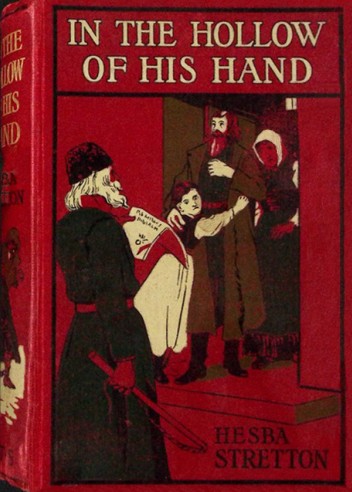
THE STAROSTA WAS READING FROM A DOCUMENT.
Michael and Velia drew near just as Okhrim, with a spiteful smile on his harsh face, read the plainly-worded order that the Starosta was to aid the parish priest in removing all children of Stundist parents, between the ages of two and ten years, and placing them in Orthodox families, where they would be brought up in the Orthodox faith. A wild frenzied shriek from Paraska rang through the quiet evening air; and Velia, who understood the slowly-uttered order, uttered a cry of terror, and flinging herself into her father's arms, clung closely to him, as if no power on earth could tear her from the shelter of his breast.
"Oh, my God!" cried Alexis. "What can I do?"
"Do?" repeated Okhrim contemptuously. "Why, become a good Christian, and go to church and pay the Church dues. Ay! And drink vodka as other Christians do. I believe you Stundists are the greatest fools living. The child is to be brought up Orthodox, and if you won't do it, somebody else must. I'll take her myself, and if fair means won't 'tice her to church, there is always this."
He cracked his whip, which he always flourished in his hand, and was not reluctant to use it on anybody he dared to tyrannise over. Alexis felt Velia tremble violently in his arms.
"O Father," he cried, "if it be possible, save us from this hour!"
"There you go," said Okhrim, with a sneer and a laugh, "as if God Almighty could hear you amid all His angels and archangels singing and chanting, to say nothing of the blessed saints. If I were in your plight, I'd pray humbly to one of the smallest saints, and get him to speak to those higher up; and maybe it might reach at last the ear of the Mother of God. Not that she'd do anything for a cursed Stundist. Besides, she'd never interfere with our archbishop and the consistory."
"Can we do nothing, father?" cried Michael.
"I must think," said Alexis, turning to him with an expression of almost hopeless anguish; "we have no power, no influence. Oh, if I had only sent Velia to Scotland with you, she would have been safe! But there are other fathers and other mothers. Oh, my God! Help us to bear it!"
For once in his life Okhrim's conscience stung him, and he turned away, slowly passing out of sight.
Alexis carried Velia into the house, and Paraska locked and barred the door, as if she could shut out the coming trouble.
It was a sleepless night for Alexis, as well as for Father Cyril. The thought crossed his mind that he would have time to carry Michael and Velia to Odessa, and get his wife's kinsman there to send them away to Scotland. But a step like this would only precipitate and intensify the storm ready to burst, not only upon himself but upon hundreds of fellow Stundists in the district. There were other parents, even in Knishi, who would have the same most heavy cross laid upon them. They were not only to be bereft of their children, but they knew those children would be brought up in tenets which they themselves renounced with such fervour that they were willing to sacrifice everything rather than profess to believe them. No, he could not save Velia in that way.
Then he thought pitifully of Tatiania, whose husband, Khariton Kondraty, had been in jail for nine months. She too would now have to give up little Clava, her youngest child, the pet and darling of the house. Poor Tatiania! Could she stand fast in her faith, so severely tried? Could any of the mothers refrain from going back to the Orthodox Church, if by doing so they could keep their little ones? Ah! This was the sharpest weapon of all in the Orthodox armoury. "Give me the children," the Church demanded, "and the mothers will follow."
Then Father Cyril was so good and kind and persuasive; so different from Father Vasili, who had been an idle, self-indulgent, and arrogant parish priest. It would make it much easier for the women to go back to the Orthodox Church. By slow degrees they would relapse into the old condition of superstitious observances, and the lamp of truth would be extinguished in Knishi, as it had been in other places.
But below every other thought there rang through his soul the cry, "Oh, Velia, my little child! Would to God we could die together, my child and I!"
The morning came, and a wretched circle assembled at breakfast. Michael and Velia had both slept, but their eyes were red, as if they had wept themselves to sleep and awoke with tears again. Paraska was heavy-eyed, and completely dumb. They were lingering together, as if they could not bear to separate, even for an hour, when Father Cyril appeared at the door.
"Ah, Okhrim has been before me!" he exclaimed. "I ought to have come last night. My poor Alexis! But the order is not to be executed before Sunday that the people may have time to make their submission, and be reconciled to the Church. Those parents who come to confession will keep their children, on condition that they bring them up as Orthodox Christians."
"We shall see who can bear the severest temptations," said Alexis, with a sad smile.
"But I will start off to Kovylsk at once if you can drive me," said Father Cyril; "and I will ask for an interview with the archbishop. Come, Alexis; I am a father too. I feel for you. I can guess the terror little Velia feels, poor lamb."
He sat down on the bench, and took the trembling little girl into his arms. The tears rolled slowly down his cheeks. He felt great shame in the errand forced upon him. This terrible order, which he was called upon to execute, seemed to him a monstrous attack upon a parent's rights—those primal rights which existed before the Church was founded. He sat in silence for some minutes, until he could command his voice. From time to time, he stroked Velia's hair and patted her cheek. And the child nestled close to him, much comforted.
"We must bestir ourselves, and do the best we can," he said, almost stammering.
"And leave the result to God," added Alexis. "But how can I quit my little daughter just now?"
"Let her go and play with my little ones," answered Father Cyril; "the Matoushka will be like a mother to her. We will put her down at the church-house; for we must tell my wife we shall be away for one or two nights."
CHAPTER IX
ORTHODOX REASONING
AS they drove across the steppe, in the two-wheeled cart without springs, at the slow, monotonous trot of the old mare, Father Cyril had a better opportunity than he had ever had before of a prolonged discussion with Alexis Ivanoff on the tenets and history of their young sect. He was filled with surprise and admiration. The absolute simplicity and truthfulness of the farmer, united as it was with mental strength and a close grasp of his subject, astonished the Batoushka. Alexis was not logical; he had had no training in a theological seminary, like Father Cyril. He argued as the fishermen of Galilee would have argued. But his convictions were as strong as theirs, who had seen the Lord with their eyes, and heard Him with their ears. Father Cyril could not help admitting that the worship of the Stundists was far more in accordance with that of the apostolic age than the ornate, multitudinous, and magnificent ceremonies of the Orthodox Church. He owned that the peasants, in their ignorance, did worship the icons with idolatry. Yet in fundamental Christian doctrines, he and Alexis were one. They prayed to the same Father in heaven; they believed in the same Lord; they studied the same Holy Scriptures. There was real spiritual communion between them, as they slowly crossed the brown autumnal steppe, now lying under a thin veil of mist, which hid the horizon, and enclosed them in a soft circle of mellowed light.
They reached Kovylsk too late to go to the consistory that night. But quite early in the morning Father Cyril presented himself at the gate, and inquired for Father Paissy, who was known throughout the diocese as the archbishop's right hand. They had been at the theological seminary together, where they had been on friendly terms, but they had seen nothing of one another since Father Paissy had elected to enter the order of the monastical clergy, who take vows of celibacy, and who alone can be raised to the higher ranks of the Russian priesthood. He was already a powerful personage. He was a small, sharp-featured man, with a soft voice, and a perpetual smile on his thin lips.
"Father Cyril, parish priest of Knishi?" he said interrogatively, without condescending to recognise him as his former comrade. "Ah! You have a troublesome flock. Heresy runs like an infectious disease among them. We must stamp it out—stamp it out effectually."
"I come in the hope of seeing the archbishop," said Father Cyril.
"He is in Moscow," interrupted Father Paissy, "but I can act in his stead."
It was a great blow to Father Cyril; for the archbishop never refused him an interview, and he had placed great hopes on his indulgence. It is easier to prevent a thing being done than to get it undone. There was no sign of indulgence in the hard face opposite him.
"I came to intercede for my poor parishioners," he said gently, "those unhappy parents who are to be deprived of their young children. Some of them are scarcely out of their mothers' arms, and still require a mother's care in childish maladies. Only a mother's patience is strong enough to bear them through the first seven years. A child's heart is capable of great sorrows, and its spirit is quickly broken if it is sent among strangers, and separated from all it has known from its birth."
"Ah!" said Father Paissy, with a deep breath, which sounded almost like a sigh.
Father Cyril went on, encouraged.
"The unfortunate people who have left our holy Church," he continued, "are most affectionate parents. It is their universal practice to treat their little ones with the utmost tenderness. They look upon their children as entrusted to their care by God Himself. True, that may be an error, but it is their belief. The children never hear uncivil words; they never see a drunken person in their homes. Think, your reverence, what it must be to children so carefully reared to be distributed among the houses of peasants who are ignorant and degraded by vodka-drinking. There would be great difficulty in finding suitable homes for them with our Orthodox peasants."
"You seem to think very highly of your heretics," said Father Paissy in a scoffing tone.
Father Cyril felt that he had forgotten himself.
"I grieve over their heresy night and day," he answered earnestly; "it makes my life in Knishi a burden to me. I never had this trouble to encounter before. But oh, believe me, harsh measures will never bring them back to us, above all, not such a measure as this! Every father, every mother worthy of the name, will cry out against it. I assure your reverence, I was gaining some influence over them; I have seen two or three steal in at the church door to listen to my sermons. Let me plead their cause to you. Do you, with your powerful influence, get this terrible order rescinded. The Stundists will bless you, and it will add greatly to my influence in the parish."
"Do you forget the children's immortal souls?" asked Father Paissy. "Is their salvation of no moment?"
"Alas!" cried Father Cyril. "If salvation means to be saved from sin, I must confess that these poor straying heretics have advanced farther along the path of salvation than our superstitious, half-pagan Orthodox peasants. I am striving my utmost to teach and raise them, but only a parish priest can know how deeply they are sunk in degradation and drunkenness."
"I can do nothing for you," said Father Paissy in a chilling voice; "the consistory has issued the order, and it must remain as it is. It must also be obeyed promptly, Father Cyril."
The Batoushka felt his heart sink within him, as he looked at the set and stubborn face before him, with its cruel smile still playing about its lips. Neither this man nor the archbishop could understand what a father's love was, and they had no knowledge of a child's nature. His chief hope was gone, but another was left to him.
"I may place the children as I please," he asked, "provided I settle them in Orthodox families? Some houses are much better than others."
"Just as you like—just as you like," said Father Paissy impatiently; "only let me warn you, Father Cyril, no indulgence to the heretics! We intend to weed them out, root and branch. Our long-suffering is at an end. Church or Siberia! Church or Caucasus! They must choose between them."
Alexis was waiting at the entrance to the consistory when Father Cyril came out. He had been to see two or three friends in Kovylsk, who had sympathised with him deeply, but gave him no hope that the order would be rescinded. It had been sent to many other villages besides Knishi, and there was lamentation and bitter weeping in them all: "Rachel weeping for her children refused to be comforted."
"Yet, 'Thus saith the Lord,'" said Alexis, "'Refrain thy voice from weeping, and thine eyes from tears: for thy work shall be rewarded, saith the Lord; and they shall come again from the land of the enemy. And there is hope in thine end, saith the Lord, that thy children shall come again to their own border.' Send that message to the churches, and bid them trust the Lord to keep His promises."
He knew the moment he caught sight of Father Cyril's downcast face that he had failed in his mission. But Alexis had regained his habitual courage and resignation. He said to himself, "'He that loveth son or daughter more than Me is not worthy of Me.'" Hard words! But they were the words of his crucified Lord.
They scarcely spoke to one another until they were some distance out of Kovylsk, and could no longer see the glittering domes of its numerous churches. Then Father Cyril owned his bitter disappointment. "It will break my heart," he said.
"The soul is stronger than the heart," replied Alexis. "Now I submit myself to God's will, and leave my little child in His hands. He loves her better than I can; yes, He loves her with an infinite and everlasting love."
"Velia and little Clava shall come to me," said Father Cyril.
Alexis dropped the reins and turned to him, as if he had not heard clearly what was said.
"My wife and I have settled that," Father Cyril went on, with tears in his eyes; "they shall be to us the same as our own children."
"Oh, you good man!" interrupted Alexis. "Oh, how can I thank you? What can I do for you? Oh, if all Batoushkas were like you!"
"I would take them all if I could," said Father Cyril, "but I will find the best houses I can for every one of them. Yarina will take two, I am sure. Then there are seven or eight more. The worst part of the order is that the parents are to have no intercourse whatever with the children, and not in any way to interfere with their training. But they will live in the same village, and see them from time to time, though at a distance. They will know they are all under my protection, and they can always come to the church-house and hear from me, or the Matoushka, of their welfare. Oh, I will do my best for them."
"You will teach them no false religion," said Alexis.
"Oh, as for religion," replied Father Cyril, "they must come to church, and be brought up to observe the Orthodox rites and accept the Orthodox doctrines. There is no way to escape that, but, Alexis Ivanoff, there is salvation to be found in every Church."
The telega stopped at the church-house after nightfall. Father Cyril called to Alexis to come to look through the uncurtained window. There, on a rug near the stove, sat Velia, with Father Cyril's two little daughters, one on each side of her. The children's heads were close together, and their faces shone in the lamplight. They were laughing merrily, and the Matoushka was laughing too.
"God bless them!" cried Father Cyril, as he grasped Alexis Ivanoff's hand.
"God bless you!" replied Alexis.
CHAPTER X
MOTHERS AND CHILDREN
BUT to get little Clava away from her mother, Tatiania, was a hard task, almost an impossible one. The other parents recognised the absolute impossibility of evading the order of the consistory, and they listened submissively to the arrangements made for their children by the Batoushka, who was supported by Alexis Ivanoff. But Tatiania would listen to no reasoning or persuasion. Her husband had been in prison for nine months, and but for Sergius and Marfa, who had done all the work on their land, and with their beehives, the family would have fallen into dire poverty. They were, of course, much poorer than they had been in former years. But she would not give up her darling, she declared—no, not if the archbishop himself came to take her away. The Matoushka came to entreat her to trust little Clava to her, but in vain.
"Oh, foolish woman!" cried Paraska to her. "You'd know where she was, and how kind they were to her, and you'd see her in the street, and watch her growing up and changing into a girl. And I shouldn't know my boys now if I saw them. They were babies when they took them from me eight years ago, and now—! No, I'd pass them in the road and not know them for my own sons."
It was not until a letter came from Khariton Kondraty, written in his prison cell in Kovylsk, bidding his wife give up the child, that Tatiania yielded, and little Clava went to the church-house, where Velia was already settled.
Profound grief, underneath which lay a presentiment of still heavier calamities, if that were possible, took possession of the little community of Stundists. Every house had lost one or two of its children. Several of the mothers, with their hungry love for their little ones, could not keep aloof from the village church, where alone they could see them and be for a short time under the same roof. Paraska told them they were highly favoured; she did not even know if her boys were living. Alexis Ivanoff in his great pity did not reproach the women for their stolen attendances at the parish church. Velia had returned to him for two or three days before he was compelled to resign her to the care of Father Cyril and the sweet-tempered Matoushka. They had been days of unutterable anguish, the Gethsemane of his soul. After this sacrifice to his faith, no trial could be too bitter.
The old Matoushka, Father Vasili's widow, took care that a report of the return of the heretic mothers to the Orthodox Church should reach Father Paissy's ears. He heard it with a smile of self-satisfaction. At last, then, he had discovered a way of dealing with the Stundists of the diocese.
Michael's spirit in those days was hot and mutinous within him. Not so much on account of Velia, whom he could visit frequently, but for the sake of his father and little Clava's mother, who could hold no intercourse with their children, and who were visibly aged by their grief. Why could not the Stundists do as the Scottish Covenanters had done before them, set up the standard of revolt, and defend themselves until the right cause triumphed? Why should not they strike a blow for freedom—at any rate, for freedom to serve and worship God according to their conscience? Alexis listened to his boy with a melancholy smile.
"First of all," he answered, "because we remember that our Lord suffered His enemies to take Him and crucify Him, though He might have had a legion of angels to take vengeance on them. He said to Simon Peter, 'Put up thy sword into its place: for all they that take the sword shall perish with the sword.' 'The cup that My Father hath given Me, shall not I drink it?' Yes, Lord, we must drink the cup that Thou givest us! Cannot God save us, if that be best for us and for our country?"
"Yes," replied the boy.
"That is the chief point," pursued Alexis, "but to revolt would be utter madness. It would mean our extermination. Scotland is a small country, and the Covenanters could easily band together. Besides, the people were mostly in their favour. But Russia is vast, and the people are our enemies, and will be as long as superstition and drink have the upper hand. Here in Knishi, with nearly a hundred parishioners—that is, heads of families—only nine of us are Stundists. Our nearest sister church is in Kovylsk, a day's journey from us; there are some thousands of inhabitants, and not more than a hundred brethren who are quite sound in the faith. Our little churches are feeble in themselves, and lie miles apart. Truly, if we took the sword, we should quickly perish with the sword. We could not combine for resistance; we can only do so for mutual sympathy and help. No, my boy, it is God's will, and we must submit to it."
The Russian people, like all Eastern nations, are fatalists; and Alexis Ivanoff was not without this strain in his temperament. There is an element of peace in it, but not much element of progress. Boy as he was, Michael chafed against it with all the love of freedom, and a desire to strike a blow for it, which he had inherited from his Scottish ancestors. God's will was ever for the right, and this persecution was wrong.
The children over ten years of age were suffering in many ways, besides having their younger brothers and sisters ruthlessly separated from them. They could not pass along the village street, or drive their parents' oxen to water at the village well, without having stones or clods thrown at them. If they went out in numbers for mutual protection, the Orthodox children formed bands which lay in ambush to attack them. At a lonely cottage, left in charge of two girls whilst their parents were working in the communal lands, the door was locked, and the young persecutors gathered a quantity of reeds and ill-smelling weeds, and set fire to them under the unglazed window, until the noisome smoke almost suffocated the terrified girls. It was useless to complain to the Starosta, and Father Cyril found himself powerless to prevent such outrages.
The women dared not send their girls to the shop; and only big boys like Michael and Sergius could water the cattle, or fill the buckets for home use. They did it under a constant shower of abuse, occasionally accompanied by skilfully aimed missiles. But on the whole the village boys were afraid of Michael.
One day, as Michael was going down to the river to look after some wicker fish-traps he had hidden in the water, he saw a girl standing in the track leading to the washing-place, with a big boy brandishing a whip over her. Before he could reach them, the long lash was falling upon the girl's bowed shoulders and bare ankles in rapid stinging stripes. She stood motionless, protecting her face with her hands, and uttering no cry. The clothes she had been washing lay trampled in the mud. It was Marfa, and the boy who was flogging her was Okhrim's grandson, and a bully and a coward. Michael had just been reading how Moses in Egypt saw one of his brethren suffer wrong, and forthwith avenged him that was oppressed, and smote the Egyptian. He considered the example of Moses was to be followed.
"Stop that!" he cried, seizing the whip, and breaking the handle of it in two. "You coward! Come on and fight me, if you dare, you mean, skulking, miserable coward!"
But the boy dared not fight. He stood still for a moment glaring at them; then, spitting at Marfa, turned away, running as fast as he could. Michael was for pursuing him, but Marfa held him fast by the arm.
"Oh, Michael, you shouldn't, you shouldn't!" she sobbed, lifting up her tear-stained face. "I could have borne it. Oh yes, I was bearing it. I was saying to myself, 'This is for Jesus Christ's sake.' I didn't cry out, did I, Michael?"
"No," he answered; "you were quite dumb. But I couldn't stand by and see a girl flogged like that. No, no, Marfa! I did right, and I should do it again."
"It will bring us both into trouble," said Marfa, picking up the soiled clothes, and carrying them back to the washing-stage.
Michael lingered about till she was ready to go home. And after seeing her there safely, he went on to his father's house, carefully avoiding the village street. Alexis looked greatly troubled when Michael told him what had happened.
"I will go and tell Father Cyril after dark," he said. "If anyone can help us, he can and will. You did right, but no one knows what the issue may be. Tell me, my son, did you feel angry with the boy?"
Michael flung back his head, and his face grew crimson.
"I felt as savage as a wild beast," he cried; "if I had not broken the whip and flung it away the first moment, I should have flogged him."
"Thank God you didn't!" answered Alexis. "But oh, Michael, my boy, you must learn to 'love your enemies, bless them that curse you, do good to them that hate you, and pray for them that despitefully use you and persecute you.' It is our Lord's command."
"It is too hard for me yet, father," said Michael frankly. "I could forgive them gladly and make friends again, if they wanted it. But they delight in being enemies. It's as much fun to some of them to lurk round corners and throw stones at us from behind, as it used to be to play games with us. But I'll try to keep our Lord's commands; I'll try my utmost. A boy can't be perfect all at once."
"Nor a man either," said Alexis, with a smile and a sigh. "It is a hard saying, but He who said it will give us grace to obey it. Only love Him, Michael, and, presently we shall learn to love all for whom He died."
In the dusk Alexis went to the church-house. It was somewhat larger than his own, and possessed a slate roof, and glass in every casement. It stood near the church, and not far from the cemetery, where, until the last few years, all the village comrades in life had found their last resting-place for their toil-worn and wearied bodies. But now the Stundists were forbidden to bury their dead beside their forefathers. Any unconsecrated hole was good enough for their unhallowed corpses. Father Cyril was sitting alone, but the voices of the Matoushka and the children could be heard in the kitchen, where supper was being prepared. Alexis heard Velia's beloved voice singing an evening hymn with the other little ones. Father Cyril was reading by the light of a lamp with three wicks. Through the uncurtained window could be seen the dim, great plain, which lay like a sea round the little island of Knishi. The first slight veil of snow was lying softly upon it, for the autumn was already over.
Father Cyril invited Alexis to sit down. The former Batoushka had zealously testified to his religion by not permitting a heretic to take a seat in his house. Alexis sat down by the window, gazing out at the white wilderness on which the moon was shining softly. He told his story simply, without looking at the Batoushka.
"Would to God I had been there instead of Michael!" exclaimed Father Cyril. "I always suspected that young rascal was the ringleader in this persecution of children by children. If I could but have laid my hand upon him! Then I would have sent a report to the archbishop. Surely no servant of God could wink at such an evil. It frustrates all my efforts to teach them mercy and loving-kindness. It is making them more savage and cruel than their parents were before them."
Father Cyril's voice faltered, and Alexis turned to see why he ceased speaking. He had buried his face in his hands, and the lamplight shone upon tears trickling through his interlaced fingers.
"Father, forgive them! They know not what they do," murmured Alexis.
"Amen!" said the Batoushka.
Before them both, the Orthodox priest and the heretical Stundist, there rose a vision of their crucified Lord, in the hour of His bodily anguish, when rude, rough hands were nailing Him to His cross on Calvary. Both thought of that hour with profound pity and love, but the remembrance brought more strength and comfort to Alexis than to Father Cyril.
"Amen!" he repeated. "Our Lord said it. And He also said, 'Blessed are you when men shall revile you, and persecute you, for My sake. Rejoice, and be exceeding glad.' Father Cyril, we are ready to follow where the Lord leads."
"But what about the persecutors?" said Father Cyril. "And I am on their side. Alexis, it will break my heart!"
They were silent for some minutes.
"I fear this will bring fresh trouble," said the Batoushka, "but I will send a report at once to the archbishop. You are sure Michael did not strike the Starosta's grandson?"
"He confesses he would have done it," replied Alexis, "if he had not broken the whip and thrown it away the first moment. But who will believe him?"
"I will go and see Marfa first thing in the morning," said Father Cyril. "Little Clava and your Velia are in there," he added, nodding towards the kitchen; "they are dear children to us."
The children had just finished singing, and pattering steps came towards the door to fetch Father Cyril to supper. He hastened to intercept them and send them back; for no heretic parents were permitted to hold any intercourse with the children taken from them.
CHAPTER XI
A HARD WINTER
FATHER CYRIL'S report to the archbishop did no good. The Starosta Okhrim, mad with rage, went to Kovylsk, and had a personal interview with Father Paissy, at the consistory. This priest had a special interest in the suppression of Stundism at Knishi. Some few years before he had been present at an outbreak of popular prejudice, excited by himself, which had resulted in the death of a Stundist woman named Ooliana Rodenko. Her son Paul, and Paraska's husband Demyan, had been exiled to Siberia, with other prominent men among the Stundists. If these sharp measures failed to root out heresy, they appeared almost like crimes. Father Paissy was resolved to attain his object. The end justified the means. But what if the end was not achieved? This time he determined to stamp out Stundism, once for all, in Knishi. If Father Cyril failed to win the heretics back to the Orthodox Church, they must be exterminated.
All the men of the Stundist households, nine in number, were arrested, and carried off to the prison in Kovylsk. The women were left without their natural protectors, and without breadwinners in their desolated homes. No one was left to do the necessary winter work except themselves, and the children between ten and fifteen years of age. Alexis Ivanoff gone, Michael was left with all the toil and care of the farm upon his shoulders, shared only by Paraska, who, under this new calamity, shook off the lethargy of her despair, and showed herself full of energy and resource. Tatiania, too, roused herself from the melancholy that had possessed her since the loss of little Clava, and she went from house to house comforting and encouraging the other women in the trouble still new to them. It was an old trouble to her, for it was nearly twelve months since her husband, Khariton Kondraty, had been imprisoned.
The Starosta, Okhrim, and his grandson paraded the village street with insolent triumph, but Father Cyril kept the day of arrest as a day of fasting and prayer in the solitude of the church vestry.
Winter had already set in, making the whole wide landscape white. The houses and barns stood out against the sky like huge heaps of snow. Every morning the street was trackless under the fresh falls that fell each night; and every evening the white surface was marked with countless footprints and furrows. All the cattle and sheep were under cover, and needed to be fed and watered every day. Michael was kept busily occupied, and Sergius came to help him as soon as his own work was done at home.
The village was cut off from all intercourse with the outer world until the snow was frozen hard enough to bear the sledges. There were only two sledges in Knishi, one belonging to Okhrim and the other to the innkeeper. There was no chance of hearing news of the prisoners in Kovylsk.
Father Cyril no longer checked the visits of Michael and Sergius to their little sisters in the church-house. On the contrary, he encouraged them; and the boys went often, on one pretext or another. Velia's childish heart was full of vague dreads and sharp sorrow for her father in prison, but little Clava was as gay and happy as a child can be. The Matoushka treated them exactly the same as her own children; whilst Father Cyril was, if possible, more tender and indulgent to them than to his own. He could not look at them without a feeling of the deepest pity.
As a loyal servant of his Church, he did his best to place its tenets in a clear manner before Michael and Sergius, feeling persuaded they did not know or understand them. The boys listened to him attentively and respectfully.
"Father Cyril," said Michael one day, "if a strong man came to your house, and dragged your sister from you, and carried your father off to a dreadful prison, could you think he was God's servant?"
"No," answered Father Cyril, almost smiling.
"That is what the archbishop has done," continued Michael; "he has done it both to Serge and me. You think he stands higher up in God's service than you do. We don't think so. We could never, never believe he is really serving God, for God is love."
Father Cyril gave no answer. He could not tell them the archbishop was ignorant—the excuse he always made for the peasants. He looked at the two earnest, sturdy lads before him with compassionate eyes.
"Be good, my boys!" he said. "Be good, and your conscience will tell you when you are disobeying God."
Michael and Sergius were much together. Sergius had only one cow and a few sheep to tend, whilst Michael had many cattle and horses and a numerous flock. The boys went to and fro daily between their homes, always avoiding the village street, infested as it was by foes, and making their way along by-paths, through deep drifts of snow. The active life and frequent exposure to extreme cold hardened their bodies.
"As hard as nails," Sergius declared.
On the contrary, Marfa and her mother Tatiania grew pallid and weakly with prolonged confinement to the house, and continual fretting about Khariton and little Clava. Only on Sunday morning Tatiania, with her hungry mother's heart, made her way along the white street, and stole within the church door during mass, that she might at least see with her own eyes her little girl sitting with the Batoushka's children.
By the New Year the snow was as hard as the roads were in summer, and much pleasanter to travel over, as it was smoother, and there were no clouds of dust. The sky, too, was clear, and of a deep blue, which contrasted beautifully with the unsullied snow. The road to Kovylsk was traced out plainly by the tradesmen's sledges, which had come to bring supplies to the village shops. But no letters had arrived from the prisoners in Kovylsk; and every heretic soul was longing for some tidings of them.
In Alexis Ivanoff's barn there was a rough sort of sledge, which he had been wont to use for carrying up reeds from the river. Michael and Sergius determined to get over to Kovylsk secretly in this old sledge, taking only Marfa and Paraska into their counsels. This was necessary, as they would have to tend the cattle during their absence. Tatiania they dared not tell, lest she should talk about it to some of their Stundist neighbours.
In the dead of the night the boys dragged the sledge along the silent street, hearing every little jar of the runners as if it had been a shriek loud enough to arouse the neighbourhood. They hid it behind a low hillock where the open steppe began; for luckily they found the gate at the barrier not securely fastened. At sunrise they led the mare, with sacks slung across her, through the street, as if they were going on some errand to Yarina's farm, which lay on that side of the village. Okhrim's grandson saw them, and shouted some words of abuse, but kept at a safe distance. No one else took any notice of them; and before long they were driving over the snowclad steppe.
It was bitterly cold, but they had on their sheepskin coats, and caps of Astrachan fur. In their sacks was food enough for three or four days, which Paraska had provided, besides a present for Markovin, to whose house Michael was bound. The air was stinging but wonderfully exhilarating. The low sun lay like a red ball in the filmy sky. The old mare ran at a much brisker pace than her jog-trot under the sultry sunshine. They were jolted and jerked by the shaking of the rough sledge, but this was part of the pleasure to the hardy lads. They sang and laughed and talked as if there was no sorrow for them in the past, the present, or the future.
The short day was over before they reached Kovylsk, but the night could not be dark on such a snowy plain, and under such brilliant stars. They parted as soon as they reached the town, Sergius going to a cousin who was living there, whilst Michael went to ask help and shelter from Markovin.
The timorous old man looked scared when he saw the boy, the notorious Alexis Ivanoff's son. But he could not find it in his heart to send him away. He felt a superstitious pleasure in the fact that he had never turned a Stundist away from his door, however terrified he was at harbouring them. The fresh outbreak of persecution redoubled his dread, though he had no reason to suppose the authorities suspected him of heresy. But who knew where a spy might be lurking? He diligently attended mass in the cathedral, where he had been for some years a verger; and he crossed himself, and bowed to the icons. When the brethren reproached him with time-serving, he excused himself by citing the example of Naaman the Syrian, who said to Elijah, 'Thy servant will henceforth offer neither burnt offering nor sacrifice to other gods, but unto the Lord. In this thing the Lord pardon thy servant, when my master goeth into the house of Rimmon to worship there, and he leaneth on my hand, and I bow myself in the house of Rimmon . . . the Lord pardon thy servant in this thing.' This history was a great comfort and support to Markovin, and he was generally known among the Stundists by the name of Naaman.
Markovin led Michael into an inner room, where no one could hear or see them, and almost in a whisper told him all he knew about the prisoners. They had been brought several times before a committee of investigation, of which Father Paissy was the chairman, held in the consistory. Every effort had been made to get them to recant; promises and threats had been showered upon them. But all remained firm and faithful to their convictions, except perhaps Nicolas Pavilovitch, who seemed shaken by the rigour of his prison experience, and the promise of reward if he returned to the Orthodox Church.
"Why can't they hold their opinions as I do?" asked old Markovin querulously. "The Scriptures don't say, 'Thou shalt not cross thyself, Thou shalt not bow to the icons'—"
"There you're wrong," interrupted Michael hotly; "did you never see the commandment, 'Thou shalt not make to thyself any graven image, neither of things in heaven, nor things on earth, nor things under the earth. Thou shalt not bow down to them, nor worship them'? Not bow down to them, Markovin Petrovitch! Not even bow down to them. And you know they worship them—pray to them."
"The icons are painted, not graven," answered Markovin; "besides, there was Naaman the Syrian—"
But before he could utter another word, a loud knocking at the outer door made his old knees tremble and his hands shake as with palsy.
"Did anybody see you coming in?" he asked in a terrified voice.
"I don't know," answered Michael, "but nobody in Kovylsk knows me."
Markovin threw himself on the bed.
"Go to the door," he murmured, "and tell them I'm ill in bed. Oh, I am ill, true enough!"
CHAPTER XII
A FRIENDLY JAILER
MICHAEL, feeling greatly disgusted by Markovin's cowardice, threw open the door boldly. The visitor, who was carefully wrapped up in a huge sheepskin coat, was no other than the friendly warder from the jail—Pafnutitch.
"Why—why—why!" he stammered. "Who thought of seeing you here?"
"Then you know me?" said Michael, in equal astonishment.
"Of course I do," answered the warder; "it's part of our business to know folks again. You're the young cock-of-the-walk that crowed so loud and ready to thrust your head into Kovylsk Jail last spring, to have a look at my jail-birds. Your father's one of them now. A good man; oh, as good almost as Loukyan the saint! What do you say to trying a rig like that?"
"Hush!" whispered Michael, pointing to the door of Markovin's bedroom. "Hush! It would kill him with fright. To see my father! Oh, I'm ready! When will it be?"
"Now! To-night," answered Pafnutitch. "Oh, what luck I came here to-night! Our head men are all going to the governor's ball, and we intend to have a jolly night of it. But you shall see your little father first; only you must have a bag o' tools, or something—"
"I have this," said Michael, throwing his well-filled sack over his shoulder.
"That will do," agreed the warder; "and don't you speak if anybody speaks to you. They'll think you are Mitiushka, my sister's son by her first husband, but he was flogged once for talking to a Stundist, and now he won't answer anybody he doesn't know very well. His mother, Matriona, had two husbands—but there, I can't tell you all about it now. I must be at my post in an hour. Tell Markovin Petrovitch you are going out a little while on business, but don't mention me. Now, then, Nephew Mitiushka."
Michael followed Pafnutitch through the streets, his heart beating high with courage. The wind was piercing, but he did not feel it. The stars glittered in the narrow strip of sky between the roofs of the houses; and he fancied they looked down on him like kindly eyes in heaven. Once again he had the strange sensation of feeling his mother near to him, walking unseen at his side, and telling him, without words, not to be afraid.
When they reached the jail the gatekeeper, who was playing at cards with a comrade, admitted them, with scarcely a glance at Michael. The light from the lamp was dull, and the man held a good hand of cards, which he was eager to play. The small door constructed in the heavy gates, through which they passed, clanged behind them, and the strong bolts were shot back into their places. Michael felt already the depressing and stifling atmosphere of a prison.
They went through long dark passages, and up two flights of stairs. On the topmost floor was a corridor, dimly lighted by one oil lamp at the head of the stairs. On each side were a number of little cells. Another warder met them half-way down this corridor, and gazed suspiciously at Michael.
"Go on, Mitiushka," said Pafnutitch. Drawing the other warder aside, "He's bringing some victual for the heretics," he whispered, "they've got powerful rich friends in town—friends that pay well; and I said my nephew, Mitiushka, should bring them some comforts. There's a bottle of the best vodka ever went down a man's throat—for me, you know; the poor heretics don't drink vodka. I'm just mad to taste it, and you and me 'll go and have some. I'll just turn Mitiushka in here," he added, stopping at the door of Alexis Ivanoff's cell; "you know he's a poor softy and won't, talk to anybody. I'll lock the door on him; and we'll see what the vodka is like."
He pushed Michael into the cell, and turned the key loudly in the lock. There was not a gleam of light, except that just under the ceiling a little square of sky, with two or three stars in it, was visible. Michael heard his father's voice in the darkness.
"Who is there?" he asked.
"It's me, father," he cried; "Michael!"
Groping till they felt one another in the narrow cell, the father and son stood for a few minutes clasped in one another's arms. Never had Michael felt a rapture so pure and overwhelming. For the moment he forgot they were in a prison. They were together again—he and his father. But very soon both of them remembered how precious time was. They sat down side by side on the wooden plank, which served for seat and bed, and Michael told briefly how it happened he was there. There was so much to say, and so short a time to say it in. Alexis gave Michael some news of the prisoners to take home, and messages to carry to sundry friends in Kovylsk, who were stretching to the utmost their influence on behalf of the imprisoned Stundists.
"For me," he said calmly, "it must be either Siberia or the Caucasus sooner or later. If it is sooner, before you are fifteen, you may get permission to go with me as my child. Tatiania and Sergius and Marfa will go with Khariton Kondraty. But we must leave Velia and little Clava behind us. They will never give back to us the little ones they have robbed us of."
"Father Cyril cares for them as if they were his own," said Michael.
"Ah! That is my only comfort," Alexis went on. "But oh, my boy, they will be brought up in the practices we denounce, and for which we are suffering even unto death! But we must leave them in God's hands, He loves them more than we can. If they keep us in prison for years, as some of our brethren have been, you and Sergius will be too old to go with us—"
"We will follow you wherever you go," interrupted Michael, "if we have to walk every step of the way. Paraska is saving up every kopek she can get to join her husband in Irkutsk. If a woman can do it, we can. If it was all round the world, we would follow you."
He threw his arms round his father's neck, and laid his head on his shoulder. Oh, if he could but remain with him now, and share his prison cell! By this time his eyes had grown used to the darkness, and he could see the dim outline of his father's face. He told him how he had fancied his mother was walking at his side as he came to the jail.
"Why not?" said Alexis. "Surely she loves us better than she did while she was here."
"But will not this make her miserable?" asked Michael.
"Not more miserable than our Lord," he answered; "what He can bear to see, she can bear. They know the end. Your mother has joined the cloud of witnesses which compasses us about; and though they see our afflictions, they also see the far more exceeding and eternal weight of glory laid up for us if we fight a good fight. It is even here a glory and a joy to suffer for Christ's sake."
Alexis spoke in a tone of sober gladness. But before he could say more, they heard the voice of Pafnutitch speaking loudly in the corridor.
"I'd clean forgotten the lad," he said; "he'll be scared out of his poor wits at being shut up in the dark with a cursed heretic. Come out, my poor boy, come out! Good sakes! This key wants oiling, I can scarcely turn it."
He fumbled at the lock for some seconds, giving Michael and his father time for a last embrace and farewell. Michael was breathing hard with stifled sobs as he stumbled out of the cell.
"Poor lad! Poor lad!" exclaimed Pafnutitch, catching him by the arm, and hurrying down the corridor, "Scared almost to death! Ay, scared to death! And he was always something of a softy. I'll put him out into the street, and be back in a jiffy."
His fellow-warder winked slowly behind his back, and wondered what heavy bribe Pafnutitch had received. If possible, he would make him share it. The vodka had been very good, but that was not what had made Pafnutitch run such a risk as this. Should he report the little incident to the governor? No. They were good friends; besides, Pafnutitch knew too much of what he had done himself. It was best to keep a still tongue in his head.
CHAPTER XIII
DENYING THE FAITH
FOR the next two days, Michael was busy delivering messages his father had sent by him to the brethren living in Kovylsk. He told no one how he had received these messages, for fear of betraying the warder, and thus closing the channel of communication between the prisoners and their friends outside. He could not help suspecting that someone made it worth while to Pafnutitch, though it was against the tenets and the customs of the Stundists to give bribes. Pafnutitch himself declared he ran the risks solely for love.
Now and then Michael met Sergius in the streets, but the boys took no notice of one another, thinking it safer not to appear acquainted. They imagined they saw a spy in every man and woman who happened to be walking in the same direction; and Markovin deepened this impression by his gloomy forebodings. He had no suspicion that Michael had been smuggled into the prison. The mere thought would have killed him. He was exceedingly glad when Michael bade him farewell, though he had shown him every kindness in his power. The old man kissed the boy on the forehead, with a profound sigh, and prayed that God's blessing might rest upon them both, "Me as well as him, O Lord!" he said in a trembling voice.
Michael and Sergius had much to say to one another as they drove homewards. Sergius had less to tell, for though he had been pitied and sympathised with as the son of Khariton Kondraty, who had been so long in prison for his faith, his father was not a well-known and beloved presbyter, as Alexis Ivanoff was. His arrest had been a blow to a score or more of little Stundist churches. Then there was Michael's adventure in the jail, and his stolen interview with his father, a secret which he confided to Sergius under a solemn vow of inviolable secrecy. There must not be a hint or a whisper of such an event, for fear of getting Pafnutitch into disgrace or danger, if he was found out.
They left their old sledge among the reeds growing along the margin of the river, and led their tired horse at nightfall by a narrow by-path to Ostron. Paraska hailed their arrival with a gladness the boys had never before seen on her joyless face. The news of their return soon spread, and before midnight, one woman after another stole in to ask if there was any news of their husbands, and any hope of their liberation. The wife of Nicolas Pavilovitch came amongst them, but Michael did not say a word to her that it was rumoured her husband was about to recant, and bear witness against the other Stundists. It seemed too shameful and too treacherous a thing for him to put into words.
It was not many weeks, however, before Nicolas himself arrived in a police-sledge. Every man and woman in Knishi ran into the frost-bound street to watch its progress. The sledge was driven straight to Father Cyril's house. Nicolas had been ordered to make his submission to his parish priest. When he entered the house under the eye of the policeman, he bowed profoundly to the icon, and with a tremulous voice asked for the priest's blessing, and humbly kissed his hand.
"Nicolas Pavilovitch, you desire to come back to the Orthodox Church?" said Father Cyril, after reading the order from the consistory.
"I do," answered Nicolas.
"Is this from conviction before God?" he asked. "Or from fear of man?"
Father Cyril's voice was stern, and his gaze penetrating. The miserable-looking man only bowed his head, he could not utter a word.
"You will have your children restored to you," continued Father Cyril; "and I am to see that they are carefully brought up in the sacred rites and doctrines of our holy religion. I am also to report to the consistory how frequently you and your wife come to mass and to confession. Go home now. To-morrow I will come and bless your house."
The driver of the sledge had already spread the news. And when Nicolas left the church-house he found he had to pass through groups of unsympathetic neighbours, most of whom jeered at him or hailed him with mock applause. Pale and haggard, enfeebled by long confinement and prison fare, he could not hurry homewards out of their way, but crawled along with bowed-down head and eyes almost blinded with tears. Was it for this he had belied his conscience and turned renegade and traitor? The veriest drunkard did not believe in his conversion. What were those words repeated again and again in his brain? "Seeing he has crucified to himself 'the Son of God afresh, and put Him to an open shame.'" Oh, terrible words!
His house was the peasant's hut next to Khariton Kondraty's, and Sergius, seeing his arrival, rushed in, after giving him a few minutes to greet his wife and children, to ask how it was he had been released. Surely his father would be set free too, and perhaps Alexis himself, though as presbyter he was least likely to escape exile.
Nicolas had thrown himself breathless and exhausted on the bench beside the stove, and his wife was standing before him speechless and bewildered.
"Is my father coming?" cried Sergius. "Are the others let off? Oh, Nicolas Pavilovitch, tell me quickly!"
"They could all come home if they'd do as I've done," answered Nicolas in a muffled voice.
"He has denied the faith," sobbed his wife. "He was a miserable drunkard before he joined the brethren, and now he is a lost soul."
"But you'll do as I do," said Nicolas.
"Never!" she cried. "Never! I'll throw myself into the river first!"
Sergius stole away quickly and silently. If that was the price to pay for liberty, he knew well his father would not give it. No, not to gain the whole world.
The recantation of Nicolas was a great shock to the little community of Stundists in Knishi, consisting now only of a few desolate women and their children. Father Cyril ordered the children of Nicolas to be sent home, notwithstanding his wife's persistent refusal to join her husband in abjuring her faith. The three little ones, all under ten years of age, were very dear to her, and to hold them again in her arms, or to work from dawn to dark for them, was a great consolation, but nothing would induce her to go to mass with them and their father. When she heard that her husband had given evidence, mostly false, against his fellow-prisoners, she refused to quit the house, or to hold any intercourse with her old friends and neighbours. Her tribulation was greater than that of the other women.
The winter wore slowly away; and the women's hearts grew heavier as they heard nothing of the liberation of their husbands. They were wanted sorely at home. As soon as the thaw came, the numerous labours on a farm, so necessary in the spring, must be done. They had patiently borne many hardships through the winter, but if their breadwinners did not come home soon, starvation would stare them in the face. Okhrim, the Starosta, exacted the taxes as if the men were at their usual work; and already some of the stock had been sold at low prices to meet his demands.
The snow melted away, and the fine blades of corn sown in the autumn began to push upwards through the rich, moist soil. Michael and Serge toiled from the first streak of dawn to the last gleam of light in the western sky, scarcely snatching time enough for food. But what could two boys do unaided? Besides, there were houses where there was not one child big enough for heavy work; and the women could not do it all. Even if they had possessed the means to hire labourers, they could not have done so; for it had been made illegal for a Stundist to have an Orthodox servant in any capacity.
CHAPTER XIV
LITTLE CLAVA
THE short spring-tide was almost spent when news came. The men were all sentenced to exile in Eastern Siberia for various periods; Alexis, whose term was the longest, for ten years. As usual, the wives who chose to go into exile with their husbands might do so, and take their children. Not one of the women, warned by Paraska's experience, chose to remain behind. There were only a few days for disposing of all their possessions, and they were forced to sell their goods for what their neighbours would give. Yarina, the richest woman in Knishi, bought a good deal of the stock; and it was noticed that the sellers looked satisfied and grateful, whilst Okhrim went about swearing at his daughter-in-law. Father Cyril seemed much pleased, and very friendly with her.
"You are not fifteen yet?" Father Cyril inquired of Michael.
The boy was so manly in his bearing and so well-grown it was difficult to believe him still under the age at which he could be entered in the convoy-list as a child.
"I shall be fifteen next Michaelmas," he replied.
"A good thing!" said Father Cyril. "But you will have to go as a child, my boy."
"I'd go as a baby," he answered, laughing, "rather than not go with my father. But there is Velia," he said, his face growing grave and anxious.
"She cannot go," said Father Cyril; "the children already separated from their parents are not to be restored to them. And it is best! Think of such a journey, month after month, through the bitter winter and the scorching summer, for little children. My heart aches whenever I think of it."
"But our poor little Velia!" exclaimed Michael, suddenly realising what his departure would be to her. How would the tender-hearted little soul bear the separation? He recollected her cry, "Never go away again, brother! Never leave little Velia again!"
"Michael," said Father Cyril, "trust me. Velia and little Clava shall be as my own children. They must observe the rites of our Church, but I will teach them the truths that lie underneath the symbols. Do not be afraid. They shall not cross themselves except when they do so in remembrance of our crucified Lord. They shall not pray to the icons, but to the saints whom the icons recall to our minds. I will take care no superstition is mixed up with their religion."
"But we pray straight to God," objected Michael, "neither to the icons nor the saints. Our Lord said, 'When ye pray, say, Our Father which art in heaven.' He did not speak of saints."
"They shall say the Lord's Prayer night and morning," answered Father Cyril gently; "my boy, you have no voice in this matter. Only trust in me. As far as mortal man can guide them into truth, I will do so. Trust Velia to God also. He loves her more than you can."
Tatiania, like the other women, had sold her few possessions, and made all the necessary preparations for joining her husband at Kovylsk with her children. But when she heard that little Clava would not be given back to her, she declared she would not stir without her. There were other almost broken-hearted mothers, who were leaving their little ones behind in far less happy circumstances than little Clava. But their remonstrances and entreaties were in vain. Tatiania sat down in her empty house, and refused to listen to anyone.
"She is going mad," said Sergius to Michael.
Michael, like the rest, had sold the cattle and sheep, and the store of grain left from last year's harvest, for a small sum indeed. But he was rich in comparison with the others, though he had given half the money to Paraska, who must now leave Knishi. She would be homeless and friendless, hardly able to earn a living, as no Stundist could be taken as a servant into an Orthodox family.
"Your mother is going mad!" she said to Sergius. "Tell her to think of me! I had the chance of going with Demyan, and I gave it up to stay with my children. They were torn away from me, my two little boys, and I never set eyes on them again, and never knew what became of them. That's enough to make a mother mad! But she knows good Father Cyril has adopted little Clava. I'll go and reason with her," she added, running off to Tatiania's house.
The poor mother was sitting on the side of the bed which was no longer her own, rocking herself to and fro.
"They were all born here," she cried; "and two of them died here before my little Clava was born. She is the dearest of them all! I'd rather see her lying dead here than leave her behind, and never know what was happening to her. She'd fret so after her mother if she didn't see me at mass in the church. No, I cannot go! I will not go without her."
"But you have sold all your goods," urged Paraska; "you have nothing left but a few roubles. After to-morrow, you'll not have even this roof over your head. Think of your husband! If you won't go, of course Serge and Marfa cannot go. Because it is you who choose whether you'll go or stay. They only count as children. You'll all be beggars together."
"Serge and Marfa are big and strong; they can work," said Tatiania.
"And who can they work for?" asked Paraska. "They mustn't work for the Orthodox folks, and there 'll not be a Stundist left in all Knishi. There's Vania has to leave three children."
"I'll never leave little Clava," interrupted Tatiania.
Paraska went back to Ostron, where Sergius was awaiting her return. Oh, how mournful the old familiar place looked, now the barns and the stables were empty! There was only the old mare left; and the telega, already holding her luggage and the small bundle of clothes which Michael was taking for his long journey to Siberia. There was no pleasant cackle of poultry in the deserted fold-yard, no bleating of young lambs and calves, as was usual at this time of the year. The broken-hearted woman all at once realised how peaceful had been her days of sorrow, protected and comforted by Alexis and Catherine Ivanoff. She was losing a second home and a second family.
"Paraska!" shouted Michael, as she lingered at the gate.
She hastened on to the desolate house, already stripped of furniture, and the two boys asked her eagerly what Tatiania said.
"She will go mad to-night, if she is not mad now this moment," answered Paraska. "She won't go; and of course nobody can make her. She is not a prisoner."
"But what can we do?" cried Sergius.
It was a cruel dilemma. He and Marfa could not accompany their father into exile if their mother persisted in her refusal. Now all their possessions were sold, the small sum realised by the sale would barely keep them through the summer. Unless they became Orthodox, they could not maintain themselves by labour; and both of them were old enough to know and understand the religion for which their father had suffered a long imprisonment, and was about to encounter exile. They could not renounce their faith, though the most miserable poverty, if not starvation, awaited them in the near future.
But the inmost heart of their distress was the thought of their father going alone, forsaken by his own wife and children, to his distant place of exile. He had never beaten them, as most other fathers did, had never even spoken an unkind word to them. Their mother had been fretful, and unreasonably angry at times, especially with Marfa, but their father never.
Then they would lose Michael; and what would Knishi be without him? He would go with his father, march by his side, share his lot all through the long journey by rail and river and on foot, till they reached their place of exile; and there he would make a new home in that far-off country. Sergius had looked forward to this fresh experience with profound interest. He had only once been out of Knishi, and that was when Michael and he had driven in the sledge to Kovylsk. He was longing to travel. He did not care how or where, but a passion for roving had taken possession of him.
"Let us go and tell Father Cyril," said Michael.
Never had Father Cyril been so unhappy as since the order had come to Knishi for a clean sweeping out of heresy from his parish. He could not bring himself to acquiesce in the stern decree; though rather than leave the victims of it to the cruel measures of the Starosta Okhrim, he had carried the tidings to the unfortunate women whose husbands had been in prison all the winter. Heartrending scenes he had witnessed, and harrowing petitions he had listened to, but he could do nothing. Those few days aged him by years.
"I cannot bear it!" he sometimes cried when he was alone.
But still he went about, comforting the sorrowful women, and as far as possible seeing that no very great injustice was done to them. It was through him that Yarina bought at fair prices many of the cattle. He had done all he could to soften the severity of the sentence.
"I will go and see Tatiania," he said to Michael.
But his persuasions were useless.
"Will you give me my child?" she asked.
"I cannot," he replied sorrowfully; "it is against the order. But she shall be as one of my own. My poor woman, you must submit to the will of God."
"It's not God's will I should be robbed of my child," she replied; "if He had been pleased to take her to Himself, I would say, 'Thy will be done!' They are cruel men who have torn her from my arms; and I'll stay here and die rather than forsake her."
"Think of your husband and Marfa and Sergius," said Father Cyril.
"I love her better than all the world," cried Tatiania passionately—"better than our Lord Himself. God forgive me!" she added, frightened at the sound of the words she had uttered.
Marfa shuddered, and Sergius stood aghast.
Father Cyril spoke softly, with tears in his eyes.
"Amen! God forgive you, poor mother!" he said. "She does not know what she is saying."
He went homewards, pondering in his heart the strange and terrible problem of how Christians could persecute their fellow-Christians. How was it possible they could think they were doing God service? To-morrow nine homesteads would be left desolate, and the hapless women and children would start on a journey of which many would never reach the end. And this was done in the name of the Lord, whom both oppressor and oppressed worshipped.