
CHAPTER XV
SKETCH OF CARSON’S LIFE
Christopher or “Kit” Carson was born in Madison County, Kentucky, in December, 1809. The great state had been opened only a few years and was, in many parts, still a trackless wilderness.
Kit was reared in the log house of the frontier; and like most noted frontiersmen grew accustomed to the rifle at an early age.
But however primitive Kentucky may have been there were apparently too many settlers to please the elder Carson; for a year after the birth of Kit, he packed his effects upon the backs of his horses, and with his family took up the trail for the more distant west. They crossed the Mississippi and settled in that vast country later ceded by Napoleon to the United States, and then known as Upper Louisiana.
Here Kit grew up among the wild spirits of the border, accustomed to the idea of danger and renowned even in his boyhood as a rifle shot, a hunter and the possessor of invincible resolution. He served two years as apprentice to a saddler; then the stories of the Santa Fé trail, the dangers and wonders thereof, appealed to him so strongly that he joined a party about to start over it.
This was the day when vast herds of buffalo roamed the great plains, when the Rocky Mountains were almost a thing of fable. And at the age of eighteen we find Kit Carson in the Mexican city of Santa Fé, with the whirl of the wonderful southwest all about him. The fur trade was approaching its height and the commerce of the prairies had centered about the town. To it came all the wonderful characters of the border, and from it started more expeditions than from any other city in the west.
Young Carson fell in love with the wild country; with rifle, hatchet and knife, he penetrated the hills to the north and there fell in with Kin Cade, an old mountaineer who taught him much of the lore of the West which afterward proved so useful to him. Later, Kit joined the train of a trader going back to Missouri. The Santa Fé trail was a thousand miles long, and through a savage region of wolves and Indians, and waterless deserts. But Kit did not mind this; he liked the toil of it and the danger. But, half-way over the trail, the thought came to him that he was going back “East.” At a ford on the Arkansas River they encountered another band of traders on their way to the west; Kit joined them and returned to Santa Fé. Reaching the fur market once more, Young Carson engaged with a Colonel Trammel, who was leading a trading expedition southward to the rich mines of Chihuahua. Having learned Spanish from Kin Cade, he was now to serve as interpreter.
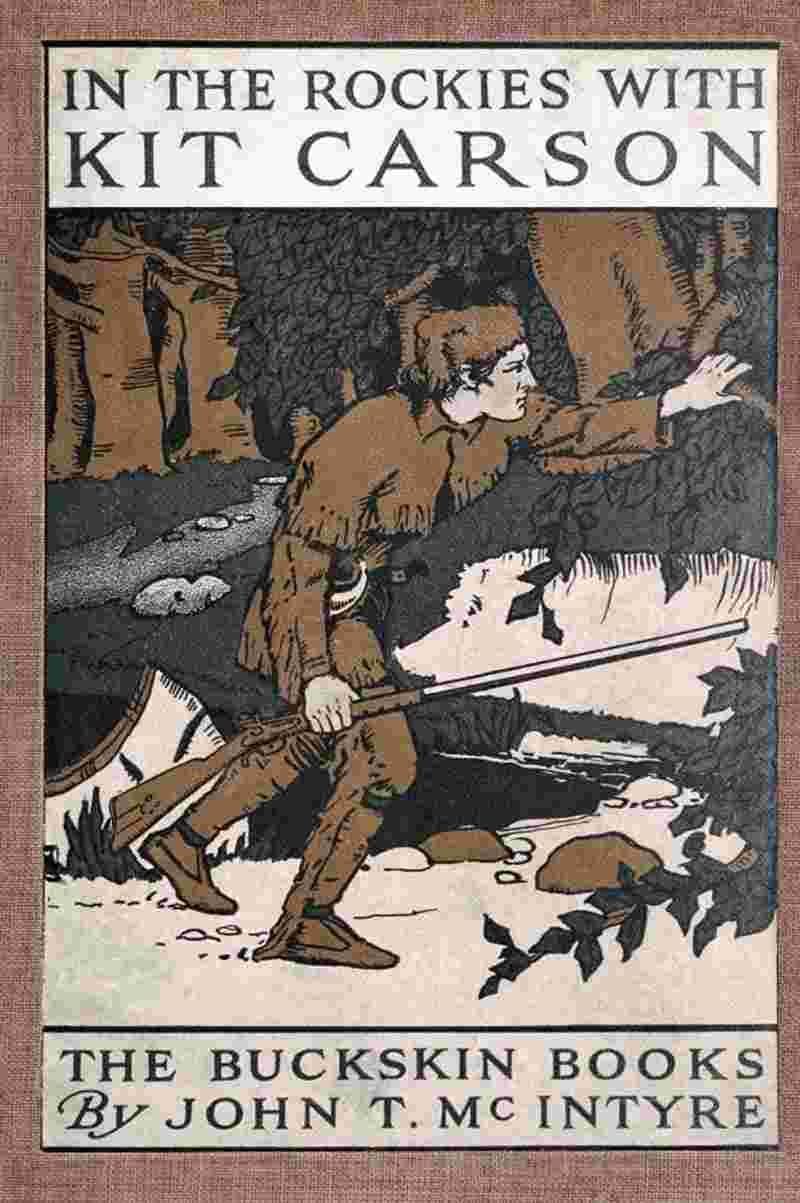
Returning from this venture he went to Taos, a trapper’s town about a hundred and fifty miles north of Santa Fé. Here he met the trapper, Ewing Young, for the first time, and was engaged as a camp cook. But Young was not long in seeing the qualities of his youthful recruit, and when he took up his march for California, where we find his party in the first chapter of “In the Rockies with Kit Carson,” Kit was a full fledged trapper.
After the great battle with the Blackfeet, as related in the last chapter of the story, Kit Carson joined a body of trappers at the summer rendezvous. Later he joined a trading party going into the country of the Navajos, a highly intelligent tribe who cultivated the arts and were quite rich. After a profitable venture among these people he became the hunter, or meat provider for the fort on the Platte River.
But he preferred trapping, it would seem; and after some smaller ventures joined a large party and once more ventured into the Blackfoot country. In the winter traces of Indians were seen near their camp; knowing that the savages must be in large force to venture so near to them, Kit Carson proposed that the whites strike the first blow, and so plant terror in the hearts of the Blackfeet.
Forty trappers took the trail; Kit was given the command. A band of savages were encountered and attacked. They fled, falling back upon a still larger band. A desperate battle followed, fought from behind trees and rocks, and as night fell, the Blackfeet, with many of their braves dead or disabled, retired across a frozen stream to an island in its middle, where they had erected a log fort. Under the cover of the darkness, however, the Indians left even this and hurried away.
Returning to camp a council was held. The trappers were sure the savages would return in great numbers, and they began to prepare for them. Intrenchments were prepared; trees, brush, stumps, fallen logs and boulders were cleared away from the camp upon every side. If the savages advanced, they must do so in the open.
At daybreak one morning the Indians came, a thousand or more in number, and advanced to crush the whites for good and all. But at the verge of the cleared space they halted, astonished. They could not advance without exposing themselves to the deadly fire of the long rifles; to take the fort meant an awful sacrifice. A council was held in which there was much speech-making. Then the host broke into two bands and moved away over the mountains; and after this that particular body of trappers were troubled no more.
But Kit was destined to have many encounters with the Blackfeet and other hostile tribes; and at the same time there were numerous others with whom he became quite friendly; indeed, many was the village into which he could ride and be greeted as a brother. In spite of all the opposition of the Indians of the mountains, the trappers persisted. But at length the price of furs fell to such a degree that hunting them grew unprofitable. And so Kit abandoned the pursuit and began a career as a hunter, during which he pushed his acquaintance with the nations of the Cheyennes, the Kiowas, the Arapahoes and the Comanches. Once he was instrumental in preventing a deadly war between the powerful Sioux people and the Comanche. The Sioux had intruded upon the hunting ground of the other tribe; this was resented; fights followed; the Comanches were beaten. Kit Carson was the friend of both peoples; he went to their chiefs; he parleyed and argued. The result was that the Sioux left the Comanche hunting ground, their chiefs giving their word that they’d never return.
Among the Comanches, Kit Carson found a wife—a beautiful Indian girl with a mind much superior to that of the women of her race. They had a daughter. Afterward the wife and mother died of a plague which had broken out; and when the child grew a little older, Kit took her to St. Louis to be educated and brought up amidst civilized surroundings.
Bound up the Missouri River from St. Louis, Kit fell in with Lieutenant John C. Frémont, of the Topographical Engineers Corps. This officer had been sent by the War Department to explore on the line of the Kansas and Great Platte Rivers, and between the South Pass in the Rockies and the frontier of Missouri. Frémont had a party of twenty-one boatmen who knew the western life; he had also engaged a guide, but this latter man had failed him. Learning this, Kit Carson offered his services as one who knew the mountains and streams, having trapped among them for sixteen years. He was accepted; and thus began that series of explorations that made the name of Frémont, the pathfinder, known the country over, and that of Kit Carson, frontiersman, famous throughout the world.
Three separate expeditions into the wilds were required before Frémont completed his work, and in each of these Kit Carson acted as his guide. They were expeditions crowded with Indian battles, with perils and escapes by flood and field.
After years of adventure, Kit began to farm and raise sheep, organizing a hunting party of his old friends now and then; later the government, because of his knowledge of the tribes, made him an Indian agent.
This difficult post he filled as probably it had never been filled before. During the rebellion he was of much service to the government on the border; and at the close of the war was breveted a brigadier general of volunteers. He died at Fort Lyon, Colorado, in May, 1868, in the sixtieth year of his age.
Another Book in this Series is:
IN KENTUCKY WITH DANIEL BOONE