
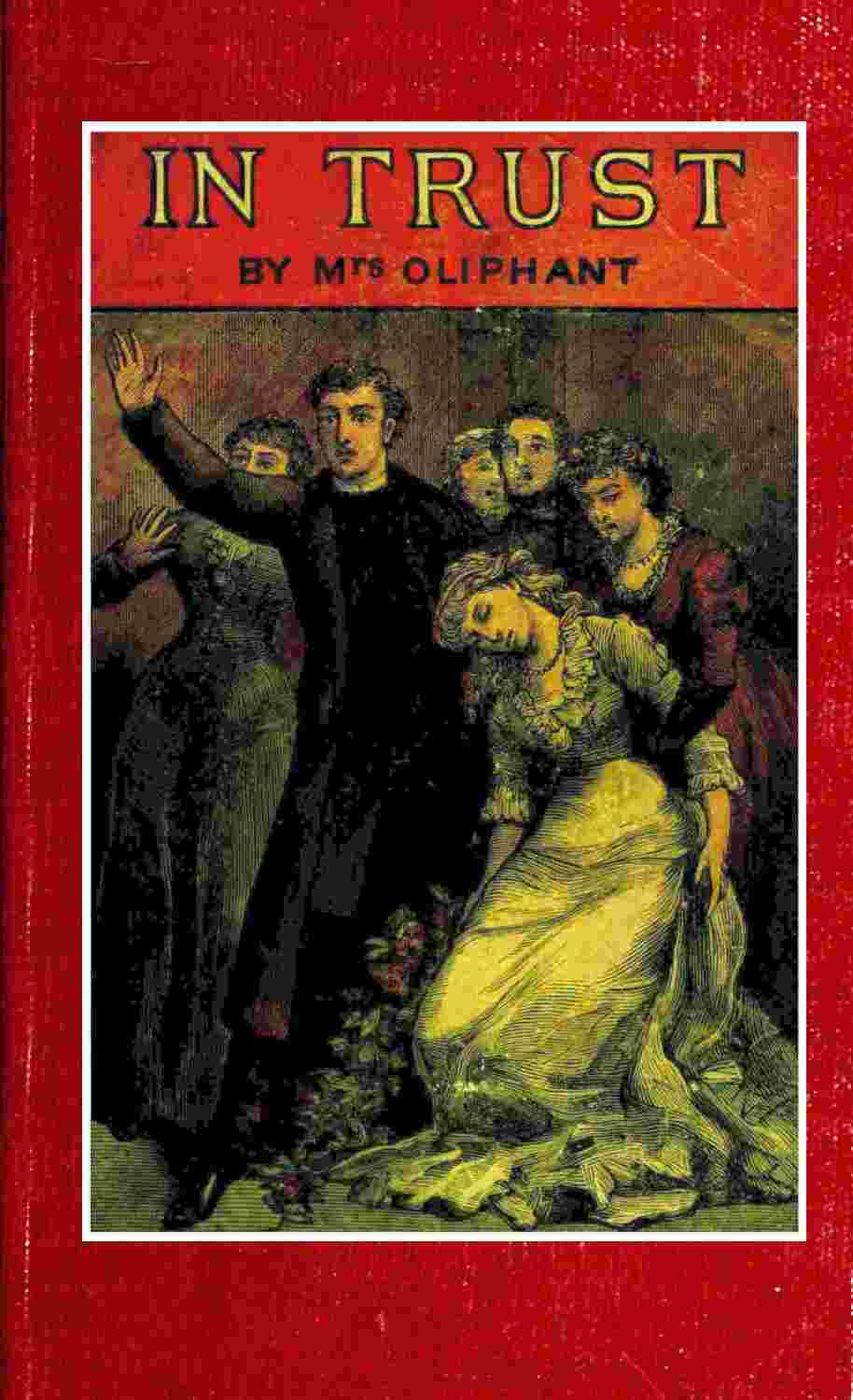
And Mr. Mountford alone in his library thought, and over again thought. Supposing after all, incredible as it seemed, that he was to die? He did not entertain the idea, but it took possession of him against his will. He got up and walked about the room in the excitement it caused. He felt his pulse almost involuntarily, and was a little comforted to feel that it was beating just as usual; but if it should happen as Loseby said? He would not acknowledge to himself that he had done a wrong thing, and yet, if anything of that sort were to take place, he could not deny that the punishment he had inflicted was too severe. Whereas, as he intended it, it was not a punishment, but a precaution; it was to prevent Anne throwing herself away upon an adventurer, a nobody. Better even that she should have no money than be married for her money, than fall into the hands of a man unworthy of her. But then, supposing he were to die, and this will, made—certainly, as he persuaded himself, as a mere precautionary measure—should become final? That would make a very great difference. For a long time Mr. Mountford thought over the question. He was caught in his own net. After all that had been said and done, he could not change the will that he had made. It was not within the bounds of possibility that he should send for that little busybody again and acknowledge to him that he had made a mistake. What was there that he could do? He sat up long beyond his usual hour. Saymore, extremely curious and excited by so strange an incident, came to his door three several times to see that the fire was out and to extinguish the lamp, and received the last time such a reception as sent the old man hurrying along the passages at a pace nobody had ever seen him adopt before, as if in danger of his life. Then Mrs. Mountford came, very anxious, on tiptoe in her dressing-gown, to see if anything was the matter; but she too retired more quickly than she came. He let his fire go out, and his lamp burn down to the last drop of oil—and it was only when he had no more light to go on with, and was chilled to death, that he lighted his candle and made his way to his own room through the silent house.
The victim herself was somewhat sad. She had spent the evening in a proud and silent indignation, saying nothing, feeling the first jar of fate, and the strange pang of the discovery that life was not what she had thought, but far less moved by what her father had done than by the failure round of her understanding and support. And when she had gone to her room, she had cried as did not misbecome her sex and her age, but then had read Cosmo’s letter over again, and had discovered a new interpretation for it, and reading between the lines, had found it all generosity and nobleness, and forthwith reconciled herself to life and fate. But her father had no such ready way of escape. He was the master of Anne’s future in one important respect, the arbiter of the family existence, with the power of setting up one and putting down another; but he had no reserve of imaginative strength, no fund of generous and high-flown sentiment, no love-letter to restore his courage. He did what he could to bring that courage back. During the hours which he spent unapproachable in his library, he had been writing busily, producing pages of manuscript, half of which he had destroyed as soon as it was written. At the end, however, he so far satisfied himself as to concoct something of which he made a careful copy. The original he put into one envelope, the duplicate into another, and placed these two packets in the drawer of his writing-table, just as his light failed him. As he went upstairs his cold feet and muddled head caused him infinite alarm, and he blamed himself in his heart for risking his health. What he had done in his terror that night might have been left till to-morrow; whereas he might have caught cold, and cold might lead to bronchitis. Every word a nail in his coffin! What warrant had Loseby for such a statement? Was there any proof to be given of it? Mr. Mountford’s head was buzzing and confused with the unusual work and the still more unusual anxiety. Perhaps he had caught an illness; he did not feel able to think clearly or even to understand his own apprehensions. He felt his pulse again before he went to bed. It was not feverish—yet: but who could tell what it might be in the morning? And his feet were so cold that he could not get any warmth in them, even though he held them close to the dying fire.
He was not, however, feverish in the morning, and his mind became more placid as the day went on. The two packets were safe in the drawer of the writing-table. He took them out and looked at them as a man might look at a bottle of quack medicine, clandestinely secured and kept in reserve against an emergency. He would not care to have his possession of it known, and yet there it was, should the occasion to try it occur. He felt a little happier to know that he could put his hands upon it should it be wanted—or at least a little less alarmed and nervous. And days passed on without any symptoms of cold or other illness. There was no sign or sound of these nails driven into his coffin. And the atmosphere grew more clear in the house. Anne, between whom and himself there had been an inevitable reserve and coldness, suddenly came out of that cloud, and presented herself to him the Anne of old, with all the sweetness and openness of nature. The wrong had now been accomplished, and was over, and there was a kind of generous amusement to Anne in the consternation which her sudden return to all her old habits occasioned among the people surrounding her, who knew nothing of her inner life of imaginative impulse and feeling. She took her cottage-plans into the library one morning with her old smile as if nothing had happened or could happen. The plans had been all pushed aside in the silent combat between her father and herself. Mr. Mountford could not restrain a little outburst of feeling, which had almost the air of passion. ‘Why do you bring them to me? Don’t you know you are out of it, Anne? Don’t you know I have done—what I told you I should do?’
‘I heard that you had altered your will, papa; but that does not affect the cottagers. They are always there whoever has the estate.’
‘Don’t you mind, then, who has the estate?’
‘Yes, immensely,’ said Anne, with a smile. ‘I could not have thought I should mind half so much. I have felt the coming down and being second. But I am better again. You have a right to do what you please, and I shall not complain.’
He sat in his chair at his writing-table (in the drawer of which were still those two sealed packets) and looked at her with contemplative, yet somewhat abashed eyes. There was an unspeakable relief in being thus entirely reconciled to her, notwithstanding the sense of discomfiture and defeat it gave him. ‘Do you think—your sister—will be able to manage property?’ he said.
‘No doubt she will marry, papa.’
‘Ah!’ he had not thought of this somehow. ‘She will marry, and my substance will go into the hands of some stranger, some fellow I never heard of; that is a pleasant prospect: he will be a fool most likely, whether he is an adventurer or not.’
‘We must all take our chance, I suppose,’ said Anne, with a little tremor in her voice. She knew the adventurer was levelled at herself. ‘I suppose you have made it a condition that he shall take the name of Mountford, papa?’
He made her no reply, but looked up suddenly with a slight start. Oddly enough he had made no stipulation in respect to Rose. It had never occurred to him that it was of the slightest importance what name Rose’s husband should bear. He gave Anne a sudden startled look; then, for he would not commit himself, changed the subject abruptly. After this interval of estrangement it was so great a pleasure to talk to Anne about the family affairs. ‘What do you think,’ he said, ‘about Heathcote’s proposal, Anne?’
‘I should have liked to jump at it, papa. Mount in our own family! it seemed too good to be true.’
‘Seemed! you speak as if it were in the past. I have not said no yet. I have still got the offer in my power. Mount in our own family! but we have not got a family—a couple of girls!’
‘If we had not been a couple of girls there would have been no trouble about the entail,’ said Anne, permitting herself a laugh. ‘And of course Rose’s husband——’
‘I know nothing about Rose’s husband,’ he cried testily. ‘I never thought of him. And so you can talk of all this quite at your ease?’ he added. ‘You don’t mind?’
This was a kind of offence to him, as well as a satisfaction. She had no right to think so little of it: and yet what a relief it was!
Anne shook her head and smiled. ‘It is better not to talk of it at all,’ she said.
This conversation had a great effect upon Mr. Mountford. Though perhaps it proved him more wrong than ever, it restored him to all the ease of family intercourse which had been impeded of late. And it set the whole house right. Anne, who had been in the shade, behind backs, resigning many of her usual activities on various pretences, came back naturally to her old place. It was like a transformation scene. And everybody was puzzled, from Mrs. Mountford, who could not understand it at all, and Heathcote, who divined that some compromise had been effected, to the servants, whose interest in Miss Anne rose into new warmth, and who concluded that she had found means at last ‘to come over master,’ which was just what they expected from her. After this everything went on very smoothly, as if the wheels of life had been freshly oiled, and velvet spread over all its roughnesses. Even the preparations for the ball proceeded with far more spirit than before. The old wainscoted banqueting-room, which had not been used for a long time, though it was the pride of the house, was cleared for dancing, and Anne had already begun to superintend the decoration of it. Everything went on more briskly from the moment that she took it in hand, for none of the languid workers had felt that there was any seriousness in the preparations till Anne assumed the direction of them. Heathcote, who was making acquaintance very gradually with the differing characters of the household, understood this sudden activity less than anything before. ‘Is it for love of dancing?’ he said. Anne laughed and shook her head.
‘I don’t know that I shall enjoy this ball much; but I am not above dancing—and I enjoy this,’ she said. ‘I like to be doing something.’ To have regained her own sense of self-command, her superiority to circumstances, made this magnanimous young woman happy in her downfall. She liked the knowledge that she was magnanimous almost more than the good fortune and prosperity which she had lost. She had got over her misfortunes. She gave her head a little toss aloft, shaking off all shadows, as she ran hither and thither, the soul of everything. She had got the upper hand of fate.
As for Mr. Mountford, he had a great deal more patience about the details of the approaching entertainment when Anne took them in hand. Either she managed to make them amusing to him, or the additional reality in the whole matter, from the moment she put herself at the head of affairs, had a corresponding effect upon her father. Perhaps, indeed, a little feeling of making up to her, by a more than ordinary readiness to accept all her lesser desires, was in his mind. His moroseness melted away. He forgot his alarm about his health and Mr. Loseby’s ugly words. It is possible, indeed, that he might have succeeded in forgetting altogether what he had done, or at least regaining his feeling that it was a mere expedient to overawe Anne and bring her into order, liable to be changed as everything changes—even wills, when there are long years before the testator—but for the two sealed envelopes in his drawer which he could not help seeing every time he opened it. A day or two before the ball some business called him into Hunston, and he took them out with a half smile, weighing them in his hand. Should he carry them with him and put them in Loseby’s charge? or should he leave them there? He half laughed at the ridiculous expedient to which Loseby’s words had driven him, and looked at the two letters jocularly; but in the end he determined to take them, it would be as well to put them in old Loseby’s hands. Heathcote volunteered to ride with him as he had done before. It was again a bright calm day, changed only in so far as November is different from October. There had been stormy weather in the meantime, and the trees were almost bare; but still it was fine and bright. Anne came out from the hall and stood on the steps to see them ride off. She gave them several commissions: to inquire at the bookseller’s for the ball programmes, and to carry to the haberdasher’s a note of something Mrs. Worth wanted. She kissed her hand to her father as he rode away, and his penitent heart gave him a prick. ‘You would not think that was a girl that had just been cut off with a shilling,’ he said, half mournfully (as if it had been a painful necessity), and half with parental braggadocio, proud of her pluck and spirit.
‘I thought you must have changed your mind,’ Heathcote said.
Mr. Mountford shook his head and said, ‘No, worse luck. I have not changed my mind.’
This was the only expression of changed sentiment to which he gave vent. When they called at Mr. Loseby’s, the lawyer received them with a mixture of satisfaction and alarm. ‘What’s up now?’ he said, coming out of the door of his private room to receive them. ‘I thought I should see you presently.’ But when he was offered the two sealed letters Mr. Loseby drew back his hand as if he had been stung. ‘You have been making another will,’ he said, ‘all by yourself, to ruin your family and make work for us lawyers after you are dead and gone.’
‘No,’ said Mr. Mountford, eagerly, ‘no, no—it is only some stipulations.’
The packets were each inscribed with a legend on the outside, and the lawyer was afraid of them. He took them gingerly with the ends of his fingers, and let them drop into one of the boxes which lined his walls. As for Mr. Mountford, he became more jaunty and pleased with himself every moment. He went to the haberdasher’s for Mrs. Worth, and to the stationer’s to get the programmes which had been ordered for the ball. He was more cheerful than his companion had ever seen him. He opened the subject of the entail of his own accord as they went along. ‘Loseby is coming for the ball: it is a kind of thing he likes; and then we shall talk it over,’ he said. Perhaps in doing this a way might be found of setting things straight, independent of these sealed packets, which, however, in the meantime, were a kind of sop to fate, a propitiation to Nemesis. Then they rode home in cheerful talk. By the time night fell they had got into the park; and though the trees stood up bare against the dark blue sky, and the grass looked too wet and spongy for pleasant riding, there was still some beauty in the dusky landscape. Mount, framed in its trees and showing in the distance the cheerful glow of its lights, had come in sight. ‘It is a pleasant thing to come home, and to know that one is looked for and always welcome,’ Mr. Mountford said. Heathcote had turned round to answer, with some words on his lips about his own less happy lot, when suddenly the figure at his side dropped out of the dusk around them. There was a muffled noise, a floundering of horse’s hoofs, a dark heap upon the grass, moving, struggling, yet only half discernible in the gloom, over which he almost stumbled and came to the ground also, so sudden was the fall. His own horse swerved violently, just escaping its companion’s hoof. And through the darkness there ran a sharp broken cry, and then a groan: which of them came from his own lips Heathcote did not know.
CHAPTER XIX.
THE CATASTROPHE.
All was pleasant commotion and stir in Mount, where almost every room had received some addition to its decoration. On this particular evening there was a great show of candles in the old banqueting hall, which was to be the ballroom, and great experiments in lighting were going on. The ball at Mount was stirring the whole county. In all the houses about there was more or less commotion, toilets preparing, an additional thrill of liveliness and pleasure sent into the quiet country life. And Mount itself was all astir. Standing outside, it was pretty to watch the lights walking about the full house, gliding along the long corridors, gleaming at windows along the whole breadth of the rambling old place. With all these lights streaming out into the night, the house seemed to warm the evening air, which was now white with inevitable mists over the park. Rose ran about like a child, delighted with the stir, dragging holly wreaths after her, and holding candles to all the workers; but Anne had the real work in hand. It was to her the carpenters came for their orders, and the servants who never knew from one half-hour to another what next was to be done. Mrs. Mountford had taken the supper under her charge, and sat serenely over her worsted work, in the consciousness that whatever might go wrong, that, at least, would be right. ‘As for your decorations, I wash my hands of them,’ she said. It was Anne upon whom all these cares fell. And though she was by no means sure that she would enjoy the ball, it was quite certain, as she had said to Heathcote, that she enjoyed this. She enjoyed the sensation of being herself again, and able to throw herself into this occupation with a fine indifference to her own personal standing in the house. If she had been dethroned in the will, only herself could dethrone her in nature. She felt, as she wished to feel, that she was above all that; that she was not even under the temptation of sullenness, and had no sense of injury to turn the sweet into bitter. She went about holding her head consciously a little higher than usual, as with a gay defiance of all things that could pull her down. Who could pull her down, save herself? And what was the use of personal happiness, of that inspiration and exhilaration of love which was in her veins, if it did not make her superior to all little external misfortunes? She felt magnanimous, and to feel so seemed to compensate her for everything else. It would have been strange, indeed, she said to herself, if the mere loss of a fortune had sufficed to crush the spirit of a happy woman, a woman beloved, with a great life before her. She smiled at fate in her faith and happiness. Her head borne higher than usual, thrown back a little, her eyes shining, a smile, in which some fine contempt for outside trouble just touched the natural sweetness of her youth, to which, after all, it was so natural to take pleasure in all that she was about—all these signs and marks of unusual commotion in her mind, of the excitement of a crisis about her, struck the spectators, especially the keen-sighted ones below stairs. ‘It can’t be like we think. She’s the conquering hero, Miss Anne is. She’s just like that army with banners as is in the Bible,’ said the north-country cook. ‘I don’t understand her not a bit,’ Saymore said, who knew better, who was persuaded that Anne had not conquered. Mrs. Worth opined that it was nature and nothing more. ‘A ball is a ball, however downhearted you may be; it cheers you up, whatever is a going to happen,’ she said; but neither did this theory find favour in old Saymore’s eyes.
What a beehive it was! Rooms preparing for the visitors who were to come to-morrow, linen put out to air, fires lighted, housemaids busy; in the kitchen all the cook’s underlings, with aids from the village, already busy over the ball supper. Even Mrs. Mountford had laid aside her worsted work, and was making bows of ribbons for the cotillon. There was to be a cotillon. It was ‘such fun,’ Rose had said. In the ballroom the men were busy hammering, fixing up wreaths, and hanging curtains. Both the girls were there superintending, Rose half encircled by greenery. There was so much going on, so much noise that it was difficult to hear anything. And it must have been a lull in the hammering, in the consultation of the men, in the moving of stepladders and sound of heavy boots over the floor, which allowed that faint sound to penetrate to Anne’s ear. What was it? ‘What was that?’ she cried. They listened a moment, humouring her. What should it be? The hammers were sounding gaily, John Stokes, the carpenter belonging to the house, mounted high upon his ladder, with tacks in his mouth, his assistant holding up to him one of the muslin draperies. The wreaths were spread out over the floor. Now and then a maid put in her head to gaze, and admire, and wonder. ‘Oh, you are always fancying something, Anne,’ said Rose. ‘You forget how little time we have.’ Then suddenly it came again, and everybody heard. A long cry, out of the night, a prolonged halloo. John Stokes himself put down his hammer. ‘It’s somebody got into the pond,’ he said. ‘No, it’s the other side of the park,’ said the other man. Anne ran out to the corridor, and threw open the window at the end, which swept a cold gust through all the house. A wind seemed to have got up at that moment, though it had been calm before. Then it came again, a long, far-echoing ‘halloo—halloo—help!’ Was it ‘help’ the voice cried? No doubt it was an appeal, whatever it was.
The men threw down their hammers and rushed downstairs with a common instinct, to see what it was. Anne stood leaning out of the window straining her eyes in the milky misty air, which seemed to grow whiter and less clear as she gazed. ‘Oh please put down the window,’ cried Rose, shivering, ‘it is so cold—and what good can we do? It is poachers, most likely; it can’t be anybody in the pond, or they wouldn’t go on shrieking like that.’ Saymore, who had come up to look at the decorations, gave the same advice. ‘You’ll get your death of cold, Miss Anne, and you can’t do no good; maybe it’s something caught in a snare—they cry like Christians, them creatures do, though we call ’em dumb creatures; or it’s maybe a cart gone over on the low road—the roads is very heavy; or one of the keepers as has found something; it’s about time for Master and Mr. Heathcote coming back from Hunston; they’ll bring us news. Don’t you be nervish, Miss Anne; they’ll see what it is. I’ve known an old owl make just such a screeching.’
‘Could an owl say “halloo,”’ said Anne, ‘and “help”? I am sure I heard “help.” I hear somebody galloping up to the door—no, it is not to the door, it is to the stables. It will be papa or Heathcote come for help. I am sure it is something serious,’ she said. And she left the great window wide open, and rushed downstairs. As for Rose she was very chilly. She withdrew within the warmer shelter of the ballroom, and arranged the bow of ribbon with which one of the hangings was to be finished. ‘Put down the window,’ she said; ‘it can’t do anyone any good to let the wind pour in like that, and chill all the house.’
Heathcote had been half an hour alone in the great wilderness of the park, nothing near him that could help, the trees rustling in the wind, standing far off round about like a scared circle of spectators, holding up piteous hands to heaven, but giving no aid. He was kneeling upon the horse’s head, himself no more than a protuberance in the fallen mass, unable to get any answer to his anxious questions. One or two groans were all that he could elicit, groans which grew fainter and fainter; he shouted with all his might, but there seemed nothing there to reply—no passing labourer, no one from the village making a short cut across the park, as he had seen them do a hundred times. The mist rose up out of the ground, choking him, and, he thought, stifling his voice; the echoes gave him back the faint sounds which were all he seemed able to make. His throat grew dry and hoarse. Now and then the fallen horse gave a heave, and attempted to fling out, and there would be another scarcely articulate moan. His helplessness went to his very heart; and there, almost within reach, hanging suspended, as it were, between heaven and earth, were the lights of the house, showing with faint white haloes round them, those lights which had seemed so full of warmth and welcome. When the first of the help-bringers came running, wildly flashing a lantern about, Heathcote’s limbs were stiffened and his voice scarcely audible; but it required no explanation to show the state of the case. His horse, which had escaped when he dismounted, had made its way to the stable door, and thus roused a still more effectual alarm. Then the other trembling brute was got to its legs, and the body liberated. The body!—what did they mean? There was no groan now or cry—‘Courage, sir, courage—a little more patience and you will be at home,’ Heathcote heard himself saying. To whom? There was no reply; the groan would have been eloquence. But he could not permit himself to believe that the worst had come. He kept on talking, not knowing what he was doing, while they brought something, he did not know what, to place the motionless figure upon. ‘Softly, softly!’ he cried to the men, and took the limp hand into his own, and continued to speak. He heard himself talking, going along, repeating always the same words, ‘A little longer, only a little longer. Keep up your heart, sir, we are nearly there.’ When they had almost reached the door of the house, one of the bearers suddenly burst forth in a kind of loud sob, ‘Don’t you, sir, don’t you now!—don’t you see as he’ll never hear a spoken word again?’
Then Heathcote stopped mechanically, as he had been speaking mechanically. His hat had been knocked off his head. His dress was wet and muddy, his hair in disorder, his whole appearance wild and terrible. When the light from the door fell full upon him, and Anne stepped forward, he was capable of nothing but to motion her away with his hand. ‘What is it?’ she said, in an awe-stricken voice. ‘Don’t send me away. I am not afraid. Did papa find it? He ought to come in at once. Make him come in at once. What is it, Mr. Heathcote? I am not afraid.’
‘Send the young lady away, sir,’ cried the groom, imperatively. ‘Miss Anne, I can’t bring him in till you are out o’ that. Good Lord, can’t you take her away?’
‘I am not afraid,’ she said, very pale, ranging herself on one side to let them pass. Heathcote, who did not know what it was, any more than she did, laid a heavy hand upon her shoulder, and put her, almost roughly, out of the way. ‘I will go,’ she said, frightened. ‘I will go—if only you will make papa come in out of the damp—it is so bad for his—— Ah!’ She fell down upon her knees and her cry rang through all the house. She had seen a sudden light from a lantern out of doors flash across the covered face, the locks of grey hair.
It was not long till everybody knew; from the top to the bottom of the great house the news ran in a moment. John Stokes, the carpenter, returned and mounted his ladder mechanically, to resume his work: then remembered, and got down solemnly and collected his tools, leaving one wreath up and half of the drapery. ‘There won’t be no ball here this time,’ he said to his mate. ‘You bring the stepladder, Sam.’ This was the first sign that one cycle of time, one reign was over, and another begun.
From that moment Heathcote Mountford’s position was changed. He felt it before he had gone up the stairs, reverently following that which now he no longer addressed with encouraging human words, but felt to be the unapproachable and solemn thing it was. A man had ridden off for the doctor before they entered the house, but there was no question of a doctor to those who now laid their old master upon his bed. ‘I should say instantaneous, or next to instantaneous,’ the doctor said when he came; and when he heard of the few groans which had followed the fall, he gave it as his opinion that these had been but unconscious plaints of the body after all sense of pain or knowledge of what was happening had departed. The horse had put his foot into a hole in the spongy wet turf—a thing that might have happened any day, and which it was a wonder did not happen oftener. There were not even the usual questionings and wonderings as to how it came about, which are so universal when death seizes life with so little warning. Mr. Mountford had been in the habit of riding with a loose rein. He had unbounded confidence in his cob, which, now that the event had proved its danger, a groom came forward to say by no means deserved his confidence, but had two or three times before stumbled with its rider. Heathcote felt that doctors and grooms alike looked to himself with something more than ordinary courtesy and respect. He walked away from the comfortable bedroom now turned into a solemn presence chamber, and all its homely uses intermitted, with a gravity he had not felt before for years. He was not this man’s son, scarcely his friend, that his death should affect him so. But, besides the solemnity of the event thus happening in his presence, it changed his position even more than if he had been St. John Mountford’s son. It would be barbarous to desert the poor women in their trouble; but how was he to remain here, a comparative stranger, their kinsman but their supplanter, become in a moment the master of the house in which these girls had been born, and which their mother had ruled for twenty years. He went to his room to change his wet and soiled clothes, with a sense of confusion and sadness that made everything unreal to him. His past as well as that of his kinsman had ended in a moment; his careless easy life was over, the indulgences which he had considered himself entitled to as a man upon whom nobody but Edward had any special claim. Now Edward’s claims, for which he had been willing to sacrifice his patrimony, must be put aside perforce. He could no longer think of the arrangement which an hour ago he had been talking of so easily, which was to have been accomplished with so little trouble. It was in no way to be done now. Actually in a moment he had become Mountford of Mount, the representative of many ancestors, the proprietor of an old house and property, responsible to dependents of various kinds, and to the future and to the past. In a moment, in the twinkling of an eye; no idea of this kind had crossed his mind during that long half-hour in the park, which looked like half a year. A fatal issue had not occurred to him. It was not until he had reached the threshold of the house, until he felt hope and help to be near, until he had heard Anne’s voice appealing to him to know what it was, that the whole meaning of it had burst upon him. St. John Mountford dead, and he himself master of the house! It was impossible that, apart from the appalling suddenness of the catastrophe, and the nervous agitation of his own share in it, the death of his cousin even in this startling and pitiful way should plunge him into grief. He was deeply shocked and awed and impressed—sorry for the ladies, stricken so unexpectedly with a double doom, loss of their head, loss of their home—and sorry beyond words for the poor man himself, thus snatched out of life in a moment without preparation, without any suggestion even of what was going to happen; but it was not possible that Heathcote Mountford could feel any private pang in himself. He was subdued out of all thought of himself, except that strange sensation of absolute change. He dressed mechanically, scarcely perceiving what it was he was putting on, in his usual evening clothes which had been laid out for him, just as if he had been dressing for the usual peaceful dinner, his kinsman in the next room doing the same, and the table laid for all the family party. Notwithstanding the absolute change that had occurred, the revolution in everything, what could a man do but follow mechanically the habitual customs of every day?
He dressed very slowly, sometimes standing by the fire idly for ten minutes at a time, in a half stupor of excitement, restless yet benumbed and incapable of either action or thought; and when this was accomplished went slowly along the long corridors to the drawing-room, still as if nothing had happened, though more had happened than he could fathom or realise. The change had gone down before him and was apparent in every corner of the deserted place. There were two candles burning feebly on the mantelpiece, and the fire threw a little fitful light about, but that was all; and no one was there; of course it was impossible that anyone should be there—but Heathcote was strange to family trouble, and did not know what happened when a calamity like this same crashing down from heaven into the midst of a household of people. Mrs. Mountford’s work was lying on the sofa with the little sheaf of bright-coloured wools, which she had been used to tuck under her arm when she went ‘to sit with papa;’ and on the writing-table there was the rough copy of the ball programme, corrected for the printer in Rose’s hand. The programmes; it floated suddenly across his mind to recollect the commission they had received on this subject as they had ridden away; had they fulfilled it? he asked himself in his confusion; then remembered as suddenly how he who was lying upstairs had fulfilled it, and how useless it now was. Ball programmes! and the giver of the ball lying dead in the house within reach of all the preparations, the garlands, and ornaments. It was incredible, but it was true. Heathcote walked about the dark and empty room in a maze of bewildered trouble which he could not understand, troubled for the dead, and for the women, and for himself, who was neither one nor the other, who was the person to profit by it. It was no longer they who had been born here, who had lived and ruled here for so many years, but he himself who was supreme in the house. It was all his own. The idea neither pleased him nor excited, but depressed and bewildered him. His own house: and all his easy quiet life in the Albany, and his little luxuries in the way of art and of travel—all over and gone. It seemed unkind to think of this in the presence of calamity so much more serious. Yet how could he help it? When some one came with a soft knock at the door he was startled as if it had been a ghost. It was Saymore who came into the room, neat in his evening apparel, dressed and trim whatever happened, making his little formal bow. ‘The ladies, sir,’ Saymore said, conquering a little huskiness, a little faltering in his own voice, ‘send their compliments and they don’t feel equal to coming down. They hope you will excuse them; and dinner is served, Mr. Mountford,’ the old man said, his voice ending in a jar of broken sound, almost like weeping. Heathcote went downstairs very seriously, as if he had formed one of the usual procession. He seated himself at the end of the table, still decorated with all its usual prettinesses as for the family meal; he did all this mechanically, taking the place of the master of the house, without knowing that he did so, and sitting down as if with ghosts, with all those empty seats round the table and every place prepared. Was it real or was it a dream? He felt that he could see himself as in a picture, sitting there alone, eating mechanically, going through a semblance of the usual meal. The soup was set before him, and then the fish, and then—
‘Saymore, old man,’ Heathcote said suddenly, starting up, ‘I don’t know if this is a tragedy or a farce we are playing—I cannot stand it any longer—take all those things away.’
‘It do seem an awful change, sir, and so sudden,’ cried the old man, frightened by the sudden movement, and by this departure from the rigid rules of ceremony—yet relieved after his first start was over. And then old Saymore began to sob, putting down the little silver dish with the entrée. ‘I’ve been his butler, sir, this thirty years, and ten years in the pantry before that, footman, and born on the property like. And all to be over, sir, in a moment; and he was a good master, sir, though strict. He was very particular, but always a kind master. It’ll be long before we’ll yet another like him—not but what I beg your pardon, Mr. Mountford. I don’t make no doubt but them as serves you will give the same character to you.’
This good wish relieved the oppression with a touch of humour; but Heathcote did not dare to let a smile appear. ‘I hope so, sir,’ Saymore said. He rubbed his old eyes hard with his napkin. Then he took up again the little silver dish. ‘It’s sweetbreads, sir, and it won’t keep; it was a great favourite with master. Have a little while it’s hot. It will disappoint cook if you don’t eat a bit; we must eat, whatever happens, sir,’ the old man said.
CHAPTER XX.
THE WILL.
It is needless to dwell upon the gloom of the days that followed this event. Mr. Loseby came over from Hunston, as pale as he was rosy on ordinary occasions, and with a self-reproach that was half pathetic, half ludicrous. ‘I said every word of that new will of his would be a nail in his coffin, God forgive me,’ he said. ‘How was I to know? A man should never take upon himself to prophesy. God knows what a murdering villain he feels if it chances to come true.’
‘But nothing you said could have made the horse put his foot in that rabbit-hole,’ Heathcote said.
‘That is true, that is true,’ said the little lawyer: and then he began the same plaint again. But he was very active and looked after everything, managing the melancholy business of the moment, the inquest, and the funeral. There was a great deal to do. Telegrams flew about the country on all sides, warning the guests invited to the ball of what had happened—yet at least one carriage full of ladies in full ball dress had to be turned back from the lodge on the night when so much gaiety had been expected at Mount. Charley Ashley had come up from the rectory at once and took the position of confidential agent to the ladies, in a way that Heathcote Mountford could not do. He thought it wrong to forsake them, and his presence was needed as mourner at his cousin’s funeral; otherwise he would have been glad to escape from the chill misery and solitude that seemed to shut down upon the house which had been so cheerful. He saw nothing of the ladies, save that now and then he would cross the path of Anne, who did not shut herself up like her stepmother and sister. She was very grave, but still she carried on the government of the house. When Heathcote asked her how she was, she answered with a serious smile, though with quick-coming moisture in her eyes: ‘I am not ill at all; I am very well, Mr. Heathcote. Is it not strange one’s grief makes no difference to one in that way? One thinks it must, one even hopes it must; but it does not; only my heart feels like a lump of lead.’ She was able for all her work, just as usual, and saw Mr. Loseby and gave Charley Ashley the list of all the people to be telegraphed to, or to whom letters must be written. But Mrs. Mountford and Rose kept to their rooms, where all the blinds were carefully closed and every table littered with crape. Getting the mourning ready was always an occupation, and it did them good. They all went in a close carriage to the village church on the day of the funeral, but only Anne followed her father’s coffin to the grave. It was when Heathcote stood by her there that he remembered again suddenly the odiousness of the idea that some man or other, a fellow whom nobody knew, had managed to get between Anne Mountford and all the rest of the world. It was not a place for such a thought, yet it came to him in spite of himself, when he saw her falter for a moment and instinctively put out his arm to sustain her. She looked round upon him with a look in which gratitude and something like a proud refusal of his aid were mingled. That look suggested to him the question which suddenly arose in his mind, though, as he felt, nothing could be more inappropriate at such a time and place. Where was the fellow? Why was he not here? If he had permitted Anne to be disinherited for his sake, why had he not hurried to her side to support her in her trouble? Heathcote was not the only person who had asked himself this question. The Curate had not looked through Anne’s list of names before he sent intelligence of Mr. Mountford’s death to his friend. The first person of whom he had thought was Cosmo. ‘Of course you will come to the rectory,’ he telegraphed, sending him the news on the evening of the occurrence. He had never doubted that Cosmo would arrive next morning by the earliest train. All next day while he had been working for them, he had expected every hour the sound of the arrival, saying to himself, when the time passed for the morning and for the evening trains, that Cosmo must have been from home, that he could not have received the message, that of course he would come to-morrow. But when even the day of the funeral arrived without Cosmo, Charley Ashley’s good heart was wrung with mingled wrath and impatience. What could it mean? He was glad, so far as he himself was concerned, for it was a kind of happiness to him to be doing everything for Anne and her mother and sister. He was proud and glad to think that it was natural he should do it, he who was so old a friend, almost like a brother to the girls. But the other, who had a closer claim than that of any brother, who had supplanted Charley and pushed him aside, where was he? On this subject Anne did not say a word. She had written and received various letters, but she did not take anyone into her confidence. And yet there was a something in her eyes, a forlorn look, a resistance of any support, as if she had said to herself, ‘Since I have not his arm I will have no one else’s support.’ Heathcote withdrew from her side with a momentary sense of a rebuff. He followed her down the little churchyard path and put her into the carriage, where the others were waiting for her, without a word. Then she turned round and looked at him again. Was it an appeal for forgiveness, for sympathy—and yet for not too much sympathy—which Anne was making? These looks of mingled feeling which have so much in them of the poetry of life, how difficult they are to interpret! how easily it may be that their meaning exists only in the eyes that see them! like letters which may be written carelessly, hastily, but which we weigh, every word of them, in balances of the sanctuary, too fine and delicate for earthly words, finding out so much more than the writer ever thought to say. Perhaps it was only Heathcote’s indignant sense that the lover, for whom she had already suffered, should have been by Anne’s side in her trouble that made him see so much in her eyes. Charley Ashley had been taking a part in the service; his voice had trembled with real feeling as he read the psalms; and a genuine tear for the man whom he had known all his life had been in his eye; but he, too, had seen Anne’s looks and put his own interpretation upon them. When all was over, he came out of the vestry where he had taken off his surplice and joined Heathcote. He was going up to Mount, the general centre of everything at this moment. The mourners were going there to luncheon, and afterwards the will was to be read. Already, Mr. Mountford being safely in his grave, covered with wreaths of flowers which everybody had sent, the interest shifted, and it was of this will and its probable revelations that everybody thought.
‘Have you any idea what it is?’ the Curate said; ‘you were in the house, you must have heard something. It is inconceivable that a just man should be turned into an unjust one by that power of making a will. He was a good man,’ Charley added, with a little gulp of feeling. ‘I have known him since I was that high. He never talked very much about it, but he never was hard upon anyone. I don’t think I ever knew him to be hard on anyone. He said little, but I am sure he was a good man at heart.’
Heathcote Mountford did not make any answer; he replied by another question: ‘Mr. Douglas is a friend of yours, I hear?’
‘Oh, yes, he is a friend of mine: it was I—we are such fools—that brought him. Just think—if it brings harm to Anne, as everybody seems to believe—that I should have to reflect that I brought him! I who would cut off a hand!—I see you are thinking how strange it is that he is not here.’
‘It is strange,’ Heathcote said.
‘Strange! strange is not the word. Why, even Willie is here: and he that could have been of such use——. But we must remember that Anne has her own ways of thinking,’ the Curate added. ‘He wrote half-a-dozen lines to me to say that he was at her orders, that he could not act of himself. Now, whether that meant that she had forbidden him to come—if so, there is a reason at once.’
‘I don’t think I should have been inclined to take such a reason,’ Heathcote said.
The Curate sighed. How could he consider what he would have done in such circumstances? he knew that he would not have stopped to consider. ‘You don’t know Anne,’ he said: ‘one couldn’t go against her—no, certainly one couldn’t go against her. If she said don’t come, you’d obey, whether you liked it or not.’
‘I don’t think I should. I should do what I thought right without waiting for anyone’s order. What! a woman that has suffered for you, not to be there, not to be by, when she was in trouble! It is inconceivable. Ashley, your friend must be a—he must be, let us say the least——’
‘Hush! I cannot hear any ill of him, he has always been my friend; and Anne—do you think anything higher could be said of a man than that Anne—you know what I mean.’
Heathcote was very sympathetic. He gave a friendly pressure to the arm that had come to be linked in his as they went along. The Curate had not been able to disburden his soul to anyone in these days past, when it had been so sorely impressed upon him that, though he could work for Anne, it was not his to stand by her and give her the truest support. Heathcote was sympathetic, and yet he could scarcely help smiling within himself at this good faithful soul, who, it was clear, had ventured to love Anne too, and, though so faithful still, had an inward wonder that it had been the other and not himself that had been chosen. The looker-on could have laughed, though he was so sorry. Anne, after all, he reflected, with what he felt to be complete impartiality, though only a country girl, was not the sort of young woman to be appropriated by a curate: that this good, heavy, lumbering fellow should sigh over her choice of another, without seeing in a moment that he and such as he was impossible! However, he pressed Charley’s arm in sympathy, even though he could not refrain from this half derision in his heart.
‘He might have stayed at the rectory,’ Charley continued; ‘that is what I proposed—of course he could not have gone to Mount without an invitation. I had got his room all ready; I sent our old man up to meet two trains. I never for a moment supposed—Willie, of course, never thought twice. He came off from Cambridge as a matter of course.’
‘As any one would——’ said Heathcote.
‘Unless they had been specially forbidden to do it—there is always that to be taken into account.’
Thus talking, they reached the house, where, though the blinds had been drawn up, the gloom was still heavy. The servants were very solemn as they served at table, moving as if in a procession, asking questions about wine and bread in funereal whispers. Old Saymore’s eyes were red and his hand unsteady. ‘Thirty years butler, and before that ten years in the pantry,’ he said to everyone who would listen to him. ‘If I don’t miss him, who should? and he was always the best of masters to me.’ But the meal was an abundant meal, and there were not many people there whose appetites were likely to be affected by what had happened. Mr. Loseby, perhaps, was the one most deeply cast down, for he could not help feeling that he had something to do with it, and that St. John Mountford might still have been living had he not said that about the words of an unjust will being nails in the coffin of the man who made it. This recollection prevented him from enjoying his meal; but most of the others enjoyed it. Many of the luxurious dainties prepared for the ball supper appeared at this less cheerful table. The cook had thought it a great matter, since there was no ball, that there was the funeral luncheon when they could be eaten, for she could not bear waste. After the luncheon most of the people went away; and it was but a small party which adjourned into the room where Mr. Mountford had spent most of his life, to hear the will read, to which everybody looked forward with excitement. Except Heathcote and the Rector, and Mr. Loseby, there was nobody present save the family. When Anne came, following her stepmother and sister, who went first, clinging together, she saw Charley Ashley in the hall, and called to him as she passed. ‘Come,’ she said softly, holding out her hand to him, ‘I know you will be anxious—come and hear how it is.’ He looked wistfully in her face, wondering if, perhaps, she asked him because he was Cosmo’s friend; and perhaps Anne understood what the look meant; he could not tell. She answered him quietly, gravely. ‘You are our faithful friend—you have been like our brother. Come and hear how it is.’ The Curate followed her in very submissively, glad, yet almost incapable of the effort. Should he have to sit still and hear her put down out of her natural place? When they were all seated Mr. Loseby began, clearing his throat:
‘Our late dear friend, Mr. Mountford, made several wills. There is the one of 1868 still in existence—it is not, I need scarcely say, the will I am about to propound. It was made immediately after his second marriage, and was chiefly in the interests of his eldest daughter, then a child. The will I am about to read is of a very different kind. It is one, I am bound to say, against which I thought it my duty to protest warmly. Words passed between us then which were calculated to impair the friendship which had existed between Mr. Mountford and myself all our lives. He was, however, magnanimous. He allowed me to say my say, and he did not resent it. This makes it much less painful to me than it might have been to appear here in a room so associated with him, and make his will known to you. I daresay this is all I need say, except that after this will was executed, on the day indeed of his death, Mr. Mountford gave to me in my office at Hunston two sealed packets, one addressed to Miss Mountford and the other to myself, with a clause inserted on the envelope to the effect that neither was to be opened till Miss Rose should have attained her twenty-first birthday. I calculated accordingly that they must have something to do with the will. Having said this, I may proceed to read the will itself.’
The first part of the document contained nothing very remarkable. Many of the ordinary little bequests, legacies to servants, one or two to public institutions, and all that was to belong to his widow, were very fully and clearly enumerated. The attention of the little company was lulled as all this was read. There was nothing wonderful in it after all. The commonplace is always comforting: it relieves the strained attention far better than anything more serious or elevated. An unconscious relief came to the minds of all. But Mr. Loseby’s voice grew husky and excited when he came to what was the last paragraph—
‘All the rest of my property of every kind, including——[and here there was an enumeration of the unentailed landed property and money in various investments, all described] I leave to my eldest daughter, Anne Mountford——.’ Here the reader made a little involuntary half-conscious pause of excitement—and all the anxious people round him testified the strain relieved, the wonder satisfied, and yet a new rising of wonder and pleasant disappointment. What did it mean? why then had their interest been thus raised, to be brought, to nothing? Everything, then, was Anne’s after all! There was a stir in which the next words would have been lost altogether, but for a louder clearing of the voice on the part of the reader, calling as it seemed for special attention. He raised his hand evidently with the same object. ‘I leave,’ he repeated, ‘to my eldest daughter, Anne Mountford—in trust for her sister, Rose——’
Mrs. Mountford, who had been seated in a heap in her chair, a mountain of crape, had roused up at the first words. She raised herself up in her chair forgetful of her mourning, not believing her ears; ‘To Anne!’ she said under her breath in strange dismay. Had it meant nothing then? Had all this agitation both on her own part and on that of her husband, who was gone, come to nothing, meant nothing? She had suffered much, Mrs. Mountford remembered now. She had been very unhappy; feeling deeply the injustice which she supposed was being done to Anne, even though she knew that Rose was to get the advantage—but now, to think that Rose had no advantage and Anne everything! So many things can pass through the mind in a single moment. She regretted her own regrets, her remonstrances with him (which she exaggerated), the tears she had shed, and her compunctions about Anne. All for nothing. What had he meant by it? Why had he filled her with such wild hopes to be all brought to nothing? The tears dried up in a moment. She faced Mr. Loseby with a scared pale face, resolving that, whatever happened, she would contest this will, and declare it to be a falsehood, a mistake. Then she, like all the others, was stopped by the cough with which Mr. Loseby recommenced, by the lifting of his finger. ‘Ah!’ she said unconsciously; and then among all these listening, wondering people, fell the other words like thunderbolts out of the skies, ‘in trust—for her sister, Rose——’ They sat and listened all in one gasp of suspended breathing, of eagerness beyond the power of description; but no one took in the words that followed. Anne was to have an income of five hundred a year charged on the property till Rose attained her twenty-first year. Nobody paid any attention to this—nobody heard it even, so great grew the commotion; they began to talk and whimper among themselves before the reader had stopped speaking. Anne to be set aside, and yet employed, made into a kind of steward of her own patrimony for her sister’s benefit; it was worse than disinheritance, it was cruelty. The Rector turned round to whisper to Heathcote, and Rose flung her arms about her mother. The girl was bewildered. ‘What does it mean? what does it mean?’ she cried. ‘What is that about Anne—and me?’
‘Mr. Loseby,’ the Rector said, with a trembling voice, ‘this cannot be so: there must be some mistake. Our dear friend, whom we have buried to-day, was a good man; he was a just man. It is not possible; there must be some mistake.’
‘Mistake! I drew it out myself,’ Mr. Loseby said. ‘You will not find any mistake in it. There was a mistake in his own mind. I don’t say anything against that; but in the will there’s no mistake. I wish there was. I would drive a coach and six through it if I could; but it’s all fast and strong. Short of a miracle, nobody will break that will—though I struggled against it. He was as obstinate as a mule, as they all are—all the Mountfords.’
‘Mr. Loseby,’ said Mrs. Mountford, ‘I did not approve any more than you did. It was not any doing of mine. I protested against it; but my husband—my husband had his reasons.’
‘There are no reasons that could justify this,’ said the tremulous old Rector; ‘it is a shame and a sin; it ought not to be. When a man’s will is all wrong, the survivors should agree to set it right. It should not be left like that; it will bring a curse upon all who have anything to do with it,’ said the old man, who was so timid and so easily abashed. ‘I am not a lawyer. I don’t know what the law will permit; but the Gospel does not permit such injustice as this.’
Mr. Loseby had pushed his spectacles up on his forehead and listened with an astonishment which was tinctured first with awe, then with amusement. The old Rector, feeblest of men and preachers! The lawyer gazed at him as at a curiosity of nature. It was a fine thing in its way. But to attack a will of his, John Loseby’s! He smiled at the folly, though he sympathised with the courage. After all, the old fellow had more in him than anybody thought.
Mrs. Mountford was roused too beyond her wont. ‘My husband had his reasons,’ she said, her pale face growing red; ‘he never did anything without thought. I would not change what he had settled, not for all the world, not for a kingdom. I interfere to set a will aside! and his will! I don’t think you know what you are saying. No one could have such a right.’
‘Then it will bring a curse and no blessing,’ said the Rector, getting up tremulously. ‘I have nothing to do here; I said so at the first. Anne, my dear excellent child, this is a terrible blow for you. I wish I could take you out of it all. I wish—I wish that God had given me such a blessing as you for my daughter, my dear.’
Anne rose up and gave him her hand. All the usual decorums of such a meeting were made an end of by the extraordinary character of the revelation which had been made to them.
‘Thank you, dear Mr. Ashley; but never think of me,’ Anne said. ‘I knew it would be so. And papa, poor papa, had a right to do what he pleased. We spoke of it together often; he never thought it would come to this. How was he to think what was to happen? and so soon—so soon. I feel sure,’ she said, her eyes filling with tears, ‘it was for this, and not for pain, that he groaned after he fell.’
‘He had need to groan,’ said the Rector, shaking his head—‘he had need to groan! I hope it may not be laid to his charge.’ Mr. Ashley was too much moved to recollect the ordinary politenesses; he pushed his chair away, back to the wall, not knowing what he was doing. ‘Come, Charley!’ he said, ‘come, Charley! I told you we had nothing to do here. We cannot mend it, and why should we be in the midst of it? It is more than I can bear. Come, Charley—unless you can be of use.’
But Mrs. Mountford felt it very hard that she should thus be disapproved of by her clergyman. It compromised her in every way. She began to cry, settling down once more into the midst of her crape. ‘I don’t know why you should turn against me,’ she said, ‘Mr. Ashley. I had nothing to do with it. I told him it would make me wretched if he punished Anne; but you cannot ask me to disapprove of my husband, and go against my husband, and he only to-day—only to-day——’
Here she was choked by genuine tears. Rose had kept close by her mother’s side all the time. She cried occasionally, but she gave her attention closely to all that was going on, and the indignation of the bystanders at her own preferment puzzled her somewhat narrow understanding. Why should not she be as good an heiress as Anne? Why should there be such a commotion about her substitution for her sister? She could not make out what they meant. ‘I will always stand by you, mamma,’ she said, tremulously. ‘Come upstairs. I do not suppose we need stay any longer, Mr. Loseby? There is nothing for us to do.’
‘Nothing at all, Miss Rose,’ said the lawyer. The men stood up while the ladies went away, Mrs. Mountford leaning on her child’s arm. Anne, too, stood aside to let them pass. There was no reason perhaps why they should have said anything to her; but she looked at them wistfully, and her lip trembled a little. There were two of them, but of her only one. One alone to face the world. She cast a glance round upon the others who were all of her faction, yet not one able to stand by her, to give her any real support. Once more, two of them at least felt that there was an appeal in her eyes—not to them, nor to any one—a secret sense of the cruelty of—what?—circumstances, fate, which left her quite alone at such a crisis. Then she, too, turned to the lawyer. ‘May I go too?’ she said. ‘No doubt there will be a great deal for me to learn and to do; but I need not begin, need I, to-day?’
‘My dear Miss Anne,’ cried Mr. Loseby, ‘I don’t know that you need to accept the trust at all. I said to him I should be disposed to throw it into Chancery, and to make your sister a ward of the Court. I don’t know that you need to accept it at all——’
‘Oh, yes,’ she said, with a smile. ‘I will accept it. I will do it. My father knew very well that I would do it; but I need not begin, need I, to-day?’
CHAPTER XXI.
WHEN ALL WAS OVER.
The night dropped over Mount very darkly, as dark a November night as ever fell, fog and damp heaviness over everything outside, gloom and wonder and bewilderment within. Mr. Loseby stayed all night and dined with Heathcote, to his great relief. Nobody else came downstairs. Mrs. Mountford, though she felt all the natural and proper grief for her great loss, was not by any means unable to appear, and Rose, who was naturally tired of her week’s seclusion, would have been very glad to do so; but her mother was of opinion that they ought not to be capable of seeing anyone on the funeral day, and their meal was brought up to their rooms as before. They played a melancholy little game of bézique together afterwards, which was the first symptom of returning life which Mrs. Mountford had permitted herself to be able for. Anne had joined them in Mrs. Mountford’s sitting-room, and had shared their dinner, which still was composed of some of the delicacies from the ball supper. In winter everything keeps so long. There had been very little conversation between them there, for they did not know what to say to each other. Mrs. Mountford, indeed, made a little set speech, which she had conned over with some care and solemnity. ‘Anne,’ she had said, ‘it would not become me to say a word against what dear papa has done; but I wish you to know that I had no hand in it. I did not know what it was till to-day: and, for that matter, I don’t know now. I was aware that he was displeased and meant to make some change, and I entreated him not to do so. That was all I knew——’
‘I am sure you had nothing to do with it,’ Anne said gently; ‘papa spoke to me himself. He had a right to do as he pleased. I for one will not say a word against it. I crossed him, and it was all in his hands. I knew what the penalty was. I am sure it has been a grief to you for some time back.’
‘Indeed, you only do me justice, Anne,’ cried her stepmother, and a kiss was given and received; but perhaps it was scarcely possible that it should be a very warm caress. After they had eaten together Anne went back to her room, saying she had letters to write, and Rose and her mother played that game at bézique. It made the evening pass a little more quickly than if they had been seated on either side of the fire reading good books. And when the bézique was over Mrs. Mountford went to bed. There are many people who find in this a ready way of getting through their superfluous time. Mrs. Mountford did not mind how soon she went to bed; but this is not an amusement which commends itself to youth. When her mother was settled for the night, Rose, though she had promised to go too, felt a little stirring of her existence within her roused, perhaps, by the dissipation of the bézique. She allowed that she was tired; but still, after her mother was tucked up for the night, she felt too restless to go to bed. Where could she go but to Anne’s room, which had been her refuge all her life, in every trouble? Anne was still writing letters, or at least one letter, which looked like a book, there was so much of it, Rose thought. She came behind her sister, and would have looked over her shoulder, but Anne closed her writing-book quickly upon the sheet she was writing. ‘Are you tired, dear?’ she said—just, Rose reflected, like mamma.
‘I am tired—of doing nothing, and of being shut up. I hope mamma will let us come downstairs to-morrow,’ said Rose. Then she stole a caressing arm round her sister’s waist. ‘I wish you would tell me, Anne. What is it all about, and what does it mean?’
‘It is not so easy to tell. I did not obey papa——’
‘Are you sorry, Anne?’
‘Sorry? very sorry to have vexed him, dear. If I had known he would be with us only such a little time—but one never knows.’
‘I should have thought you would have been too angry to be sorry——’
‘Angry—when he is dead?’ said Anne, with quick rising tears. ‘Oh, no! if he had been living I might have been angry; but now to think he cannot change it, and perhaps would do anything to change it——’
Rose did not understand this. She said in a little, petulant voice, ‘Is it so dreadfully wrong to give it to me instead of you?’
‘There is no question of you or me,’ said Anne, ‘but of justice. It was my mother’s. You are made rich by what was hers, not his or anyone else’s. This is where the wrong lies. But don’t let us talk of it. I don’t mean to say a word against it, Rose.’
Then Rose roamed about the room, and looked at all the little familiar pictures and ornaments she knew. The room was more cheerful than her mother’s room, with all its heavy hangings, in which she had been living for a week. After a few minutes she came back and leaned upon Anne’s shoulder again.
‘I wish you would tell me what it means. What is In Trust? Have you a great deal to do with me?’ she said.
Anne’s face lighted up a little. ‘I have everything to do with you,’ she said; ‘I am your guardian, I think. I shall have to manage your money and look after all your interests. Though I am poor and you are rich, you will not be able to do anything without me.’
‘But that will not last for ever,’ said Rose, with a return of the little, petulant tone.
‘No; till you come of age. Didn’t you hear to-day what Mr. Loseby said? and look, Rosie, though it will break your heart, look here.’
Anne opened her desk and took out from an inner drawer the sealed packet which Mr. Mountford had himself taken to the lawyer on the day of his death. The tears rose to her eyes as she took it out, and Rose, though curiosity was so strong in her as almost to quench emotion, felt something coming in her throat at the first sight of her father’s writing, so familiar as it was. ‘For my daughter Anne, not to be opened till Rose’s twenty-first birthday.’ Rose read it aloud, wondering. She felt something come in her throat, but yet she was too curious, too full of the novelty of her own position, to be touched as Anne was. ‘But that may change it all over again,’ she said.
‘It is not likely; he would not have settled things one day and unsettled them the next; especially as nothing had happened in the meantime to make him change again.’
Rose looked very curiously, anxiously, at the letter. She took it in her hand and turned it over and over. ‘It must be about me, anyhow, I suppose——’
‘Yes,’ said Anne, with a faint smile, ‘or me; perhaps he might think, after my work for you was over, that I might want some advice.’
‘I suppose you will be married long before that?’ said Rose, still poising the letter in her hands.
‘I don’t know—it is too early to talk of what is going to be done. You are tired, Rosie—go to bed.’
‘Why should I be tired more than you? You have been doing a great deal, and I have been doing nothing. That is like mamma’s way of always supposing one is tired, and wants to go to bed. I hate bed. Anne, I suppose you will get married—there can be nothing against it, now—only I don’t believe he has any money: and if you have no money either——’
‘Don’t let us talk on the subject, dear—it is too early, it hurts me—and I want to finish my letter. Sit down by the fire—there is a very comfortable chair, and a book—if you don’t want to go to bed.’
‘Are you writing to Mr. Douglas, Anne?’
Anne answered only with a slight nod of her head. She had taken her pen into her hand. She could not be harsh to her little sister this day above all others, in which her little sister had been made the means of doing her so much harm—but it cost her an effort to be patient. Rose, for her part, had no science to gain information from the inflections of a voice. ‘Why wasn’t he here to-day?’ was the next thing she said.
‘Rosie, dear, do you know I have a great deal to do? Don’t ask me so many questions,’ Anne said, piteously. But Rose was more occupied by her own thoughts than by anything her sister said.
‘He ought to have been at the funeral,’ she said, with that calm which was always so astonishing to her sister. ‘I thought when you went to the grave you must have known you were to meet him there. Mamma thought so, too.’
These words sank like stones into Anne’s heart; but there was a kind of painful smile on her face. ‘You thought I was thinking of meeting anyone there? Oh, Rose, did you think me so cold-hearted? I was thinking only of him who was to be laid there.’
‘I don’t mean that you are cold-hearted. Of course we were all wretched enough. Mamma said it would have been too much either for her or me; but you were always the strongest, and then of course we expected Mr. Douglas would be there.’
‘You do not know him,’ cried Anne, with a little vehemence; ‘you do not know the delicacy, the feeling he has. How was he to come intruding himself the moment that my father was gone—thrusting himself even into his presence, after being forbidden. A man of no feeling might have done it, but he——. Rosie, please go away. I cannot talk to you any more.’
‘Oh, was that how it was?’ Rose was silenced for the moment. She went away to the seat by the fire which her sister had pointed out to her. Anne had not noticed that she had still the letter in her hands. And then she was quiet for some time, while her sister resumed her writing. Cosmo’s conduct soon went out of Rose’s head, while she occupied herself with the other more important matter which concerned herself. What might be in this letter of papa’s? Probably some new change, some new will, something quite different. ‘If I am not to be the heiress after all, only have the name of it for three years, what will be the use?’ Rose said to herself. She was very sensible in her limited way. ‘I would rather not have any deception or have the name of it, if it is going to be taken away from me just when I should want to have it.’ She looked at the seals of the packet with longing eyes. If they would only melt—if they would but break of themselves. ‘I wonder why we shouldn’t read it now?’ she said. ‘It is not as if we were other people, as if we were strangers—we are his own daughters, his two only children—he could not have meant to hide anything from us. If you will open and read it, and tell me what it is, we need not tell anyone—we need not even tell mamma.’
‘What are you talking of, Rose?’
‘I am talking of papa’s letter, of course. Why should you keep it, not knowing what harm it may be going to do—— Anne! you hurt me—you hurt me!’ Rose cried.