
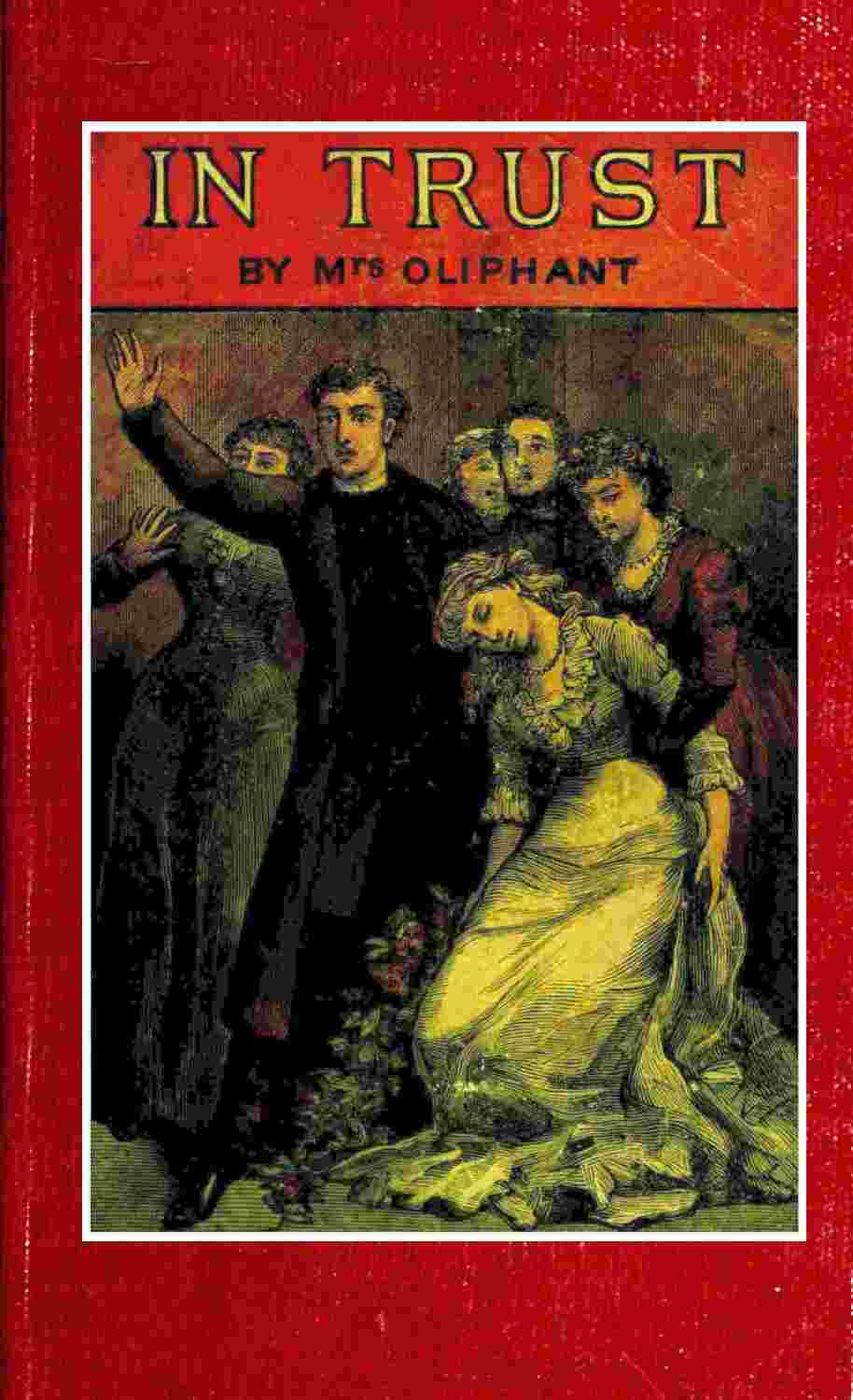
‘Come and sit here beside me,’ she said. ‘I am going to ask you a great many questions. Was that all true that you told me at dinner, or was it your fun? Please tell me in earnest this time. I want so very much to know.’
‘It would have been poor fun; not much of a joke, I think. No, it was quite true.’
‘All of it? About writing in the newspapers, and one person asking your advice once in a way? And about ladies asking you out to dinner?’
‘Perhaps that would be a little too matter-of-fact. I have always had enough to pay for my dinner. Yes, I think I can say that much,’ said Cosmo, with a laugh.
‘But that does not make very much difference,’ said Rose. ‘Well, then, now I must ask you another question. How did you think, Mr. Douglas, that you could marry Anne?’
She spoke low, so that nobody else could hear, and looked him full in the face, with her seeming innocence. The question was so unexpected, and the questioner so unlike a person entitled to institute such examinations, that Cosmo was entirely taken by surprise. He gave an almost gasp of amazement and consternation, and though he was not easily put out, his countenance grew crimson.
‘How did I think I could——? You put a very startling question. I always knew I was entirely unworthy,’ he stammered out.
‘But that isn’t what I meant a bit. Anne is awfully superior,’ said Rose. ‘I always knew she was—but more than ever now. I am not asking you how you ventured to ask her, or anything of that sort—but how did you think that you could marry—when you had only enough to be sure of paying for your own dinner? And I don’t mean either just at first, for of course you thought she would be rich. But when you knew that papa was so angry, and that everything was so changed for her, how could you think you could go on with it? It is that that puzzles me so.’
Rose was seated in a low chair, busy with a piece of crewel work, from which she only raised her eyes now and then to look him in the face with that little matter-of-fact air, leaving him no loophole of sentiment to escape by. And he had taken another seat on a higher elevation, and had been stooping over her with a smile on his face, so altogether unsuspicious of any attack that he had actually no possibility of escape. Her half-childish look paralysed him: it was all he could do not to gape at her with open mouth of bewilderment and confusion. But her speech was a long one, and gave him a little time to get up his courage.
‘You are very right,’ he said. ‘I did not think you had so much judgment. How could I think of it—I cannot tell. It is presumption; it is wretched injustice to her—to think of dragging her down into my poverty.’
‘But you don’t seem a bit poor, Mr. Douglas; that is the funny thing—and you are not very busy or working very hard. I think it would all be very nice for you, and very comfortable. But I cannot see, for my part,’ said the girl, tranquilly, ‘what you would do with Anne.’
‘Those are questions which we do not discuss——’ he was going to say ‘with little girls,’ being angry; but he paused in time—‘I mean which we can only discuss, Anne and I, between ourselves.’
‘Oh, Anne! she would never mind!’ said Rose, with a certain contempt.
‘What is it that Anne would never mind?’ said Mrs. Mountford. Anne was out of the room, and had not even seen this curious inquisition into the meaning of her betrothed.
‘Nothing at all that is prudent, mamma. I was asking Mr. Douglas how he ever thought he would be able to get married, living such an easy life.’
‘Rose, are you out of your senses?’ cried her mother, in alarm. ‘You will not mind her, Mr. Douglas, she is only a child—and I am afraid she has been spoiled of late. Anne has always spoiled her: and since her dear papa has been gone, who kept us all right——’
Here Mrs. Mountford put her handkerchief lightly to her eyes. It was her tribute to the occasion. On the whole she was finding her life very pleasant, and the pressure of the cambric to her eyelids was the little easy blackmail to sorrow which she habitually paid.
‘She asks very pertinent questions,’ said Cosmo, getting up from the stool of repentance upon which he had been placed, with something between a smile and a sigh.
‘She always had a great deal of sense, though she is such a child,’ said her mother fondly; ‘but, my darling, you must learn that you really cannot be allowed to meddle with things that don’t concern you. People always know their own affairs best.’
At this moment Anne came back. When the subject of a discussion suddenly enters the place in which it has been going on, it is strange how foolish everybody looks, and what a sense of wrong-doing is generally diffused in the atmosphere. They had been three together to talk, and she was but one. Cosmo, who, whatever he might do, or hesitate to do, had always the sense in him of what was best, the perception of moral beauty and ideal grace which the others wanted, looked at her as she came across the room with such compunctious tenderness in his eyes as the truest lover in existence could not have surpassed. He admired and loved her, it seemed to him, more than he ever did before. And Anne surprised this look of renewed and half-adoring love. It went through and through her like a sudden warm glow of sunshine, enveloping her in sudden warmth and consolation. What a wonderful glory, what a help and encouragement in life, to be loved like that! She smiled at him with the tenderest gratitude. Though there might be things in which he fell below the old ideal Cosmo, to whom all those scraps of letters in her desk had been addressed, still life had great gladness in it which had this Cosmo to fall back upon. She returned to that favourite expression, which sometimes lately she had refrained even from thinking of, and with a glance called him to her, which she had done very little of late. ‘I want your advice about Mr. Loseby’s letter,’ she said. And thus the first result of Rose’s cross-examination was to bring the two closer to each other. They went together into the inner room, where Anne had her writing-table and all her business papers, and where they sat and discussed Mr. Loseby’s plans for the employment of money. ‘I would rather, far rather, do something for the estate with it,’ Anne said. ‘Those cottages! my father would have consented to have them; and Rose always took an interest in them, almost as great an interest as I did. She will be so well off, what does it matter? Comfort to those poor people is of far more importance than a little additional money in the bank, for that is what it comes to—not even money to spend, we have plenty of that.’
‘You do not seem to think that all this should have been for yourself, Anne. Is it possible? It is more than I could have believed.’
‘Dear Cosmo,’ said Anne, apologetically, ‘you know I have never known what it is to be poor. I don’t understand it. I am intellectually convinced, you know, that I am a beggar, and Rose has everything; but otherwise it does not have the slightest effect upon me. I don’t understand it. No, I am not a beggar. I have five hundred a year.’
‘Till that little girl comes of age,’ he said, with an accent of irritation which alarmed Anne. She laid her soft hand upon his to calm him.
‘You like Rose well enough, Cosmo; you have been so kind to her, taking them everywhere. Don’t be angry, it is not her fault.’
‘No, it is my fault,’ he said. ‘I am at the bottom of all the mischief. It is I who have spoiled your life. She has been talking to me, that child, and with the most perfect reason. She says how could I think of marrying Anne if I was so poor? She is quite right, my dearest: how could I think of marrying you, of throwing my shadow across your beautiful, bright, prosperous life?’
‘For that matter,’ said Anne, with a soft laugh, ‘you did not, Cosmo—you only thought of loving me. You are like the father in the “Précieuses Ridicules,” do you remember, who so shocked everybody by coming brutally to marriage at once. That, after all, has not so much to do with it. Scores of people have to wait for years and years. In the meantime the pays de tendre is very sweet; don’t you think so?’ she said, turning to him soft eyes which were swimming in a kind of dew of light, liquid brightness and happiness, like a glow of sunshine in them. What could Cosmo do or say? He protested that it was very sweet, but not enough. That nothing would be enough till he could carry her away to the home which should be hers and his, and where nobody would intermeddle. And Anne was as happy as if her lover, speaking so earnestly, had been transformed at once into the hero and sage, high embodiment of man in all the nobleness of which man is capable, which it was the first necessity of her happiness that he should be.
CHAPTER XXVIII.
HEATHCOTE’S CAREER.
Heathcote Mountford went with his cousins to London, and when he had taken them to their house, returned to his chambers in the Albany. They were very nice rooms. I do not know why an unmarried man’s lodging should be called chambers, but it does not make them at all different from other rooms which are not dignified by that name. They were very comfortable, but not very orderly, with numbers of books about, and a boot or two now and then straying where it had no right to be, but also with the necessary curiosities and prettinesses which are now part of the existence of every well-bred person, though these were not shown off to the full advantage, but lost among a good deal of litter scattered here and there. He was not a man who put his best foot foremost in any way, but let his treasures lie about, and permitted his own capacities and high qualities to go to rust under the outside covering of indifference and do-nothingness. It had never been necessary to him to do anything. He had very little ambition, and whatever zeal for enjoyment had been in his life, had been satisfied and was over. He had wandered over a great part of the earth, and noticed many things in a languid way, and then he had come home and gone to his chambers, and, unpacking the treasures which, like everybody else, he had taken some trouble to ‘pick up’ here and there, suffered them to lie about among all sorts of trifling things. He had Edward to care for, his younger brother, who made a rush upon him now and then, from school first, and then from Sandhurst, always wanting money, and much indulgence for his peccadilloes and stupidities: but no one else who took any interest in himself or his possessions: and Edward liked a cigar far better than a bronze, and among all his brother’s possessions, except bank notes and stray sovereigns, or an occasional cheque when he had been more extravagant than usual, cared for nothing but the French novels, which Heathcote picked up too, not because he liked them much, but because everybody did so—and Edward liked them because they were supposed to be so wrong. Edward was not on the whole an attractive boy. He had a great many tastes and a great many friends who were far from agreeable to his brother, but he was the only real ‘object in life’ to Heathcote, who petted him much and lectured him as little as was possible. There seemed to be scarcely any other point at which his own contemplative, inactive existence touched the practical necessities of life.
He came back to London with the idea that he would be very glad to return again to the quiet of his chambers, where nothing ever happened. He said to himself that excursions into the outer world, where something was always happening, were a mistake. He had but stepped out of his hermitage without thinking, once in a way, to pay a visit which, after all, was a duty visit, when a whole tragedy came straightway about his ears—accident, death, sorrow, injustice, a heroine, and a cruel father, and all the materials of a full-blown romance. How glad he would be, he thought, to get into his hermitage again! Within its quiet centre there was everything a man wanted—books, an occasional cigar, an easy chair (when it was clear from papers and general literature) for a friend to sit in. But when he did get back, he was not so certain of its advantages: no doubt it was everything that could be desired—but yet, it was a hermitage, and the outlook from the windows was not cheerful. If Park Lane was brighter than the view across the park at Mount, the Albany, with its half-monastic shade, like a bit of a male béguinage, was less bright. He sat at his window, vaguely looking out—a thing he had never had the slightest inclination to do before—and felt an indescribable sense of the emptiness of his existence. Nor was this only because he had got used to the new charms of household life, and liked a house with women in it, as he had suggested to himself—not even that—it was an influence more subtle. He took Edward with him to Park Lane, and presented that hero, who did not understand his new relations. He thought Rose was ‘very jolly,’ but Anne alarmed him. And the ladies were not very favourably moved towards Edward. Heathcote had hoped that his young brother might be captivated by them, and that this might very possibly be the making of him: as the friends of an unsatisfactory young man are always so ready to hope. But the result did not justify his expectation. ‘If the little ‘un were by herself, without those two old fogeys, she might, perhaps, be fun,’ Edward thought, and then he gave his brother a description of the favourite Bet Bouncer of his predilections. This attempt having failed, Heathcote for his part did not fall into mere aimless fluttering about the house in Park Lane as for a time he had been tempted to do. It was not the mere charm of female society which had moved him. Life had laid hold upon him on various sides, and he could not escape into his shell, as of old. Just as Cosmo Douglas had felt, underneath all the external gratifications of his life, the consciousness that everybody was asking. ‘What Douglases does he belong to?’ so Heathcote, in the stillness of his chambers, was conscious that his neighbours were saying, ‘He is Mountford of Mount.’ As a matter of fact very few people knew anything about Mount—but it is hard even for the wisest to understand how matters which so deeply concern themselves should be utterly unimportant to the rest of the world. And by-and-by many voices seemed to wake up round him, and discuss him on all sides. ‘He has a very nice old place in the country, and a bit of an entailed estate—nothing very great, but lands that have been in the family for generations. Why doesn’t he go and look after it?’ He did not know if those words were really said by anyone, yet he seemed to hear them circling about his head, coming like labels in an old print out of the mouths of the men at his club. ‘Why doesn’t he look after his estate? Is there nothing to be done on his property that he stays on, leading this idle life here?’ It was even an object of surprise to his friends that he had not taken the good of the shooting or invited anyone to share it. He seemed to himself to be hunted out of his snug corner. The Albany was made unbearable to him. He held out as long as the ladies remained in Park Lane, but when they were gone he could not stand it any longer—not, he represented to himself, that it was on their account he remained in London. But there was a certain duty in the matter, which restrained him from doing as he pleased while they were at hand and might require his aid. They never did in the least require his aid—they were perfectly well off, with plenty of means, and servants, and carriages, and unbounded facilities for doing all they wanted. But when they went away, as they did in February, he found out, what he had been suspecting for some time, that London was one vast and howling wilderness, that the Albany was a hideous travesty of monasticism, fit only for men without souls, and lives without duties; and that when a man has anything that can be called his natural business in life, it is the right thing that he should do it. Therefore, to the astonishment and disgust of Edward, who liked to have his brother’s chambers to come to when he ‘ran up to town’—a thing less difficult then than in these days of stricter discipline—Heathcote Mountford turned his back upon his club and his hermitage, and startled the parish out of its wits by arriving suddenly on a rainy day in February at the dreary habitation which exercised a spell upon him, the house of his ancestors, the local habitation to which in future his life must belong, whether he liked it or not.
And certainly its first aspect was far from a cheerful one. The cook, now housekeeper, had made ready for him hastily, preparing for him the best bedroom, the room where Mr. Mountford, now distinguished as the old Squire, had lain in state, and the library where he had lived through his life. It was all very chilly when he arrived, a dampness clinging to the unoccupied house, and a white mist in all the hollows of the park. He could not help wondering if it was quite safe, or if the humid chill which met him when he entered was not the very thing to make a solitary inhabitant ill, and end his untimely visit in a fever. They did their very best for him in the house. Large fires were lighted, and the little dinner, which was served in a corner of the dining-room, was as dainty as the means of the place would allow. But it would be difficult to imagine anything more dreary than the first evening. He sat among ghosts, thinking he heard Mr. Mountford’s step, scarcely capable of restraining his imagination: seeing that spare figure seated in his usual chair, or coming in, with a characteristic half-suspicious inspecting look he had, at the door. The few lamps that were in working order were insufficient to light the place. The passages were all black as night, the windows, when he glanced out at them behind the curtains, showing nothing but a universal blackness, not even the sky or the trees. But if the trees were not visible, they were audible, the wind sighing through them, the rain pattering—a wild concert going on in the gloom. And when the rain ceased it was almost worse. Then there came silence, suspicious and ghostly, broken by a sudden dropping now and then from some overcharged evergreen, the beating of a bough against a window, the hoot of the owl in the woods. After he had swallowed his dinner Heathcote got a book, and sat himself down solemnly to read it. But when he had read a page he stopped to listen to the quiet, and it chilled him over again. The sound of footsteps over the stone pavements, the distant clang of a hansom driving up, the occasional voices that passed his window, all the noises of town, would have been delightful to him: but instead here he was at Mount, all alone, with miles of park separating him from any living creature, except the maids and outdoor man who had been left in charge.
Next morning it was fine, which mended matters a little. Fine! he said to himself with a little shiver. But he buttoned up his great-coat and went out, bent upon doing his duty. He went to the Rectory first, feeling that at least this would be an oasis in the desert, and found the clergy sitting in two different rooms, over two sermons, which was not a cheerful sight. The Rector was writing his with the calm fluency of thirty years of use and wont; but poor Charley was biting his pen over his manuscript with an incapacity which every successive Sunday seemed to increase rather than diminish. ‘My father, he has got into the way of it,’ the Curate said in a tone which was half admiring, half despairing. Charley did not feel sure that he himself would ever get into the way of it. He had to take the afternoon service when the audience was a very dispiriting one: even Miss Fanny Woodhead did not come in the afternoon, and the organ was played by the schoolmaster, and the hymns were lugubrious beyond description. As the days began to grow longer, and the winter chill to take ever a deeper and deeper hold, the Curate had felt the mournfulness of the position close round him. When Mount was shut up there was nobody to speak to, nobody to refer to, no variety in his life. A house with only two men in it, in the depths of the country, with no near neighbours, and not a very violent strain of work, and no special relief of interesting pursuits, is seldom a cheerful house. When Charley looked up from his heavy studies and saw Heathcote, he almost upset his table in his jump of delighted welcome. Then there succeeded a moment of alarm. ‘Are they all well?—nothing has happened?’ he cried, in sudden panic. ‘Nothing at all,’ Heathcote said, ‘except what concerns myself.’ And it amused the stranger to see how relieved his host was by this assurance, and how cheerfully he drew that other chair to the fire to discuss the business which only concerned so secondary a person. Charley, however, was as sympathetic as heart could desire, and ready to be interested in everything. He understood and applauded the new Squire’s sentiments in respect to his property and his new responsibilities. ‘It is quite true,’ the Curate said with a very grave face, ‘that it makes the greatest difference to everybody. When Mount is shut up the very sky has less light in it,’ said the good fellow, growing poetical. Heathcote had a comprehension of the feeling in his own person which he could not have believed in a little while ago, but he could scarcely help laughing, which was inhuman, at the profound depression in Charley Ashley’s face, and which showed in every line of his large, limp figure. His countenance itself was several inches longer than it had been in brighter days.
‘I am afraid,’ said Heathcote, with a smile, ‘that so much opening of Mount as my arrival will make, will not put very much light into the sky.’
‘And it is not only the company and the comfort,’ said the Curate, ‘we feel that dreadfully, my father and I—but there is more than that. If anyone was ill in the village, there was somebody down directly from Mount with beef-tea and wine and whatever was wanted; and if anyone was in trouble, it was always a consolation to tell it to the young ladies, and to hear what they thought. The farmers could not do anything tyrannical, nor the agents be hard upon a tenant—nor anyone,’ cried Charley, with enthusiasm, ‘maltreat anyone else. There was always a court of appeal at Mount.’
‘My dear fellow,’ said Heathcote, ‘you are thinking of a patriarchal age—you are thinking of something quite obsolete, unmodern, destructive of all political economy.’
‘That for political economy!’ said the Curate, snapping his fingers; his spirits were rising—even to have someone to grumble to was a consolation. ‘Political anything is very much out of place in a little country parish. What do our poor labourers know about it? They have so very little at the best of times, how are they to go on when they are ill or in trouble, without some one to give them a lift?’
‘Then they should have more for their work, Ashley. I am afraid it is demoralising that they should be so dependent upon a Squire’s house.’
‘Who is to give them more?’ cried the Curate, hotly. ‘The farmers have not got so very much themselves; and I never said they were dependent; they are not dependent—they are comfortable enough as a matter of fact. Look at the cottages, you will see how respectable they all are. There is no real distress in our parish—thanks,’ he added, veering round very innocently and unconsciously to the other side of the circle, ‘to Mount.’
‘We need not argue the point,’ said Heathcote, amused. ‘I am as sorry as you can be that the ladies will not retain possession. What is it to me? I am not rich enough to do all I would, and I don’t know the people as they did. They will never look up to me as they did to my predecessors. I hope my cousins will return at all events in summer. All the same,’ he added, laughing, ‘I am quite illogical’—like you, he would have said, but forbore. ‘I want them to come back, and yet I feel this infection of duty that you speak of. It seems to me that it must be my business to live here henceforward—though I confess to you I think it will be very dismal, and I don’t know what I shall do.’
‘It will be dismal,’ said the Curate; his face had lighted up for a moment, then rapidly clouded over again. ‘I don’t know what you will do. You that have been always used to a luxurious town life——’
‘Not so luxurious—and not so exclusively town,’ Heathcote ventured to interpose, feeling a whimsical annoyance at this repetition of his own thoughts.
‘—— And who don’t know the people, nor understand what to do, and what not to do—it takes a long apprenticeship,’ said Charley, very gravely. ‘You see, an injudicious liberality would be very bad for them—it would pauperise instead of elevating. It is not everybody that knows what is good and what is bad in help. People unaccustomed to the kind of life do more harm than good.’
‘You don’t give me very much encouragement to settle down on my property and learn how to be a patriarch in my turn,’ said Mountford, with a laugh.
‘No, I don’t,’ said the Curate, his face growing longer and longer. The presence of Heathcote Mountford at Mount had smiled upon him for a moment. It would be better than nothing; it would imply some companionship, sympathy more or less, someone to take a walk with occasionally, or to have a talk with, not exclusively parochial; but when the Curate reflected that Heathcote at Mount would altogether do away with the likelihood of ‘the family’ coming back—that they could not rent the house for the summer, which was a hope he had clung to, if the present owner of it was in possession—Charley at once perceived that the immediate pleasure of a neighbour would be a fatal advantage, and with honest simplicity applied himself to the task of subduing his visitor’s new-born enthusiasm. ‘You see,’ he said, ‘it’s quite different making a new beginning, knowing nothing about it, from having been born here, and acquainted with the people all your life.’
‘Everybody must have known, however,’ said Heathcote, slightly piqued, ‘that the property would change hands some time or other, and that great alterations must be made.’
‘Oh yes, everybody knew that,’ said the Curate, with deadly seriousness; ‘but, you see, when you say a thing must happen some time, you never know when it will happen, and it is always a shock when it comes. The old Squire was a hearty man, not at all old for his years. He was not so old as my father, and I hope he has a great deal of work left in him yet. And then it was all so sudden; none of us had been able to familiarise ourselves even with the idea that you were going to succeed, when in a moment it was all over, and you had succeeded. I don’t mean to say that we are not very glad to have you,’ said Charley, with a dubious smile, suddenly perceiving the equivocal civility of all he had been saying; ‘it is a great deal better than we could have expected. Knowing them and liking them, you can have so much more sympathy with us about them. And as you wish them to come back, if that is possible——’
‘Certainly, I do wish them to come back—if it is possible,’ said Heathcote, but his countenance, too, grew somewhat long. He would have liked for himself a warmer reception, perhaps. And when he went to see Mr. Ashley, though his welcome was very warm, and though the Rector was absolutely gleeful over his arrival, and confided to him instantly half a dozen matters in which it would be well that he should interest himself at once, still it was not very long before ‘they’ recurred also to the old man’s mind as the chief object of interest. ‘Why are they going abroad? it would be far better if they would come home,’ said the Rector, who afterwards apologised, however, with anxious humility. ‘I beg your pardon—I beg your pardon with all my heart. I forgot actually that Mount had changed hands. Of course, of course, it is quite natural that they should go abroad. They have no home, so to speak, till they have made up their mind to choose one, and I always think that is one of the hardest things in the world to do. It is a blessing we do not appreciate, Mr. Mountford, to have our home chosen for us and settled beyond our power to change——’
‘I don’t think Mrs. Mountford dislikes the power of choice,’ said Heathcote; ‘but so far as I am concerned, you know I should be very thankful if they would continue to occupy their old home.’
‘I know, I know. You have spoken most kindly, most generously, exactly as I could have wished you to speak,’ said the Rector, patting Heathcote on the shoulder, as if he had been a good boy. Then he took hold of his arm and drew him towards the window, and looked into his eyes. ‘It is a delicate question,’ he said, ‘I know it is a delicate question: but you’ve been in town, and no doubt you have heard all about it. What is going to happen about Anne?’
‘Nothing that I know of,’ Heathcote replied briefly. ‘Nothing has been said to me.’
‘Tchk, tchk, tchk!’ said the Rector, with that particular action of the tongue upon the palate, which is so usual an expression of bother, or annoyance, or regret, and so little reducible into words. He shook his head. ‘I don’t understand these sort of shilly-shally doings,’ he said: ‘they would have been incomprehensible when I was a young man.’
The same question was repeated by Mr. Loseby, whom next day Heathcote went to see, driving over to Hunston in the Rector’s little carriage, with the sober old horse, which was in itself almost a member of the clerical profession. Mr. Loseby received him with open arms, and much commended the interest which he was showing in his property. ‘But Mount will be a dreary place to live in all by yourself,’ he said. ‘If I were you I would take up my abode at the Rectory, at least till you can have your establishment set on a proper footing. And now that is settled,’ said the lawyer (though nothing was settled), ‘tell me all about Anne.’
‘I know nothing to tell you,’ said Heathcote. ‘Mr. Douglas is always there——’
‘Mr. Douglas is always there! but there is nothing to tell, nothing settled; what does the fellow mean? Do you suppose she is going to forego every advantage, and go dragging on for years to suit his convenience? If you tell me so——’
‘But I don’t tell you so,’ cried Heathcote; ‘I tell you nothing—I don’t know anything. In short, if you don’t mind, I’d rather not discuss the question. I begin to be of your opinion, that I was a fool not to turn up a year sooner. There was nothing to keep me that I am aware of; I might as well have come sooner as later; but I don’t know that anyone is to be blamed for that.’
‘Ah!’ said the old lawyer, rubbing his hands, ‘what a settlement that would have made! Anne would have kept her money, and little Rose her proper place and a pretty little fortune, just like herself—and probably would have married William Ashley, a very good sort of young fellow. There would have been some pleasure in arranging a settlement like that. I remember when I drew out the papers for her mother’s marriage—that was the salvation of the Mountfords—they were sliding downhill as fast as they could before that; but Miss Roper, who was the first Mrs. St. John Mountford, set all straight. You get the advantage of it more or less, Mr. Heathcote, though the connection is so distant. Even your part of the property is in a very different condition from what it was when I remember it first. And if you had—not been a fool—but had come in time and tried your chance—— Ah! however, I dare say if it had been so, something would have come in the way all the same; you would not have fancied each other, or something would have happened. But if that fellow thinks that he is to blow hot and cold with Anne——’
‘I don’t like the mere suggestion. Pardon me,’ said Heathcote, ‘I am sure you mean nothing but love and tenderness to my cousin: but I cannot have such a thing suggested. Whatever happens to Anne Mountford, there will be nothing derogatory to her dignity; nothing beneath her own fine character, I am sure of that.’
‘I accept the reproof,’ said Mr. Loseby, with more twinkle than usual in his spectacles, but less power of vision through them. ‘I accept the reproof. What was all heaven and earth about, Heathcote Mountford, that you were left dawdling about that wearisome Vanity Fair that you call the world, instead of coming here a year since, when you were wanted? If there is one thing more than another that wants explaining it is the matrimonial mismanagement of this world. It’s no angel that has the care of that, I’ll answer for it!’ cried the little man with comic indignation. And then he took off his spectacles and wiped them, and grasped Heathcote Mountford by the hand and entreated him to stay to dinner, which, indeed, the recluse of Mount was by no means unwilling to do.
CHAPTER XXIX.
CHARLEY INTERFERES.
Heathcote Mountford, however, notwithstanding the dulness and the dismal weather, and all the imperfections of the incomplete household, continued at Mount. The long blanks of country life, nothing happening from the arrival of one post to another, no stir of life about, only the unbroken stillness of the rain or the sunshine, the good or bad weather, the one tempting him out, the other keeping him within, were all novelties, though of the heavy kind, and gave him a kind of amused-spectator consciousness of the tedium, rather than any suffering from it. He was not so easily affected as many people would be by the circumstances of external life, and knowing that he could at any moment go back to his den at the Albany, he took the much deeper seclusion of Mount as a sort of ‘retreat,’ in which he could look out upon the before and after, and if he sometimes ‘pined for what was not,’ yet could do it unenviously and unbitterly, wondering at rather than objecting to the strange misses and blunders of life. Mr. Loseby, who had tutored Anne in her duties, did the same for Heathcote, showing him by what means he could ‘take an interest’ in the dwellers upon his land, so as to be of some use to them. And he rode about the country with the land-agent, and became aware, and became proud as he became aware, of the character of his own possessions, of the old farmhouses, older than Mount itself, and the old cottages, toppling to their ruin, among which were many that Anne had doomed. Wherever he went he heard of what Miss Anne had done, and settled to do. The women in the condemned cottages told him the improvements she had promised, and he, in most cases, readily undertook to carry out these promises, notwithstanding his want of means. ‘They’re doing it at Lilford, where Miss Anne has been and given her orders,’ said the women. ‘I don’t know why there should be differences made. We’re as good every bit as the Lilford folks.’ ‘But you have not got Miss Anne,’ said Heathcote. And then there would be an outburst of lamentations, interrupted by anxious questioning. ‘Why haven’t we got Miss Anne?—is it true as all the money has been left away from her?’ Heathcote had a great many questions of this kind to answer, and soon began to feel that he himself was the supposed culprit to whom the estate had been ‘left away.’ ‘I am supposed to be your supplanter,’ he wrote to Anne herself, ‘and I feel your deputy doing your work for you. Dear Lady of Mount, send me your orders. I will carry them out to the best of my ability. I am poor, and not at all clever about the needs of the estate, but I think, don’t you think? that the great Mr. Bulstrode, who is so good as to be my agent, is something of a bully, and does not by any means do his spiriting gently. What do you think? You are not an ignoramus, like me.’ This letter Anne answered very fully, and it produced a correspondence between them which was a great pleasure to Heathcote, and not only a pleasure, but in some respects a help, too. She approved greatly of his assumption of his natural duties upon his own shoulders, and kindly encouraged him ‘not to mind’ the bullying of the agent, the boorishness of Farmer Rawlins, and the complaints of the Spriggs. In this matter of the estate Anne felt the advantage of her experience. She wrote to him in a semi-maternal way, understanding that the information she had to give placed her in a position of superiority, while she gave it, at least. Heathcote was infinitely amused by these pretensions; he liked to be schooled by her, and made her very humble replies; but the burden of all his graver thoughts was still that regret expressed by Mr. Loseby, Why, why had he not made his appearance a year before? But now it was too late.
Thus the winter went on. The Mountfords had gone abroad. They had been in all the places where English families go while their crape is still fresh, to Paris and Cannes, and into Italy, trying, as Mrs. Mountford said, ‘the effect of a little change.’ And they all liked it, it is needless to deny. They were so unaccustomed to use their wings that the mere feeling of the first flight, the wild freedom and sense of boundless action and power over themselves filled them with pleasure. They were not to come back till the summer was nearly over, going to Switzerland for the hot weather, when Italy became too warm. They had not intended, when they set out, to stay so long, but indeed it was nearly a year from the period of Mr. Mountford’s death when they came home. They did not return to Park Lane, nor to any other settled abode, but went to one of the many hotels near Heathcote’s chambers, to rest for a few days before they settled what they were to do for the autumn; for it was Mrs. Mountford’s desire to go ‘abroad’ again for the winter, staying only some three months at home. When the little world about Mount heard of this, they were agitated by various feelings—desire to get them back alternating in the minds of the good people with indignation at the idea of their renewed wanderings, which were all put down to the frivolity of Mrs. Mountford; and a continually growing wonder and consternation as to the future of Anne. ‘She has no right to keep a poor man hanging on so long, when there can be no possible reason for it; when it would really be an advantage for her to have someone to fall back upon,’ Miss Woodhead said, in righteous indignation over her friend’s extraordinary conduct—extraordinary as she thought it. ‘Rose has her mother to go with her. And I think poor Mr. Douglas is being treated very badly for my part. They ought to come home here, and stay for the three months, and get the marriage over, among their own people.’ Fanny Woodhead was considered through all the three adjacent parishes to be a person of great judgment, and the Rector, for one, was very much impressed with this suggestion. ‘I think Fanny’s idea should be acted upon. I think it certainly should be acted on,’ he said. ‘The year’s mourning for her father will be over, if that is what they are waiting for—and look at all the correspondence she has, and the trouble. She wants somebody to help her. Someone should certainly suggest to Anne that it would be a right thing to follow Fanny Woodhead’s advice.’
Heathcote, who, though he had allowed himself a month of the season, was back again in Mount, with a modest household gathered round him, and every indication of a man ‘settling down,’ concurred in this counsel, so far as to write, urging very warmly that Mount should be their head-quarters while they remained in England. Mr. Loseby was of opinion that the match was one which never would come off at all, an idea which moved several bosoms with an unusual tremor. There was a great deal of agitation altogether on the subject among the little circle, which felt that the concerns of the Mountfords were more or less concerns of their own; and when it was known that Charley Ashley, who was absent on his yearly holiday, was to see the ladies on his way through London, there was a general impression that something would come of it—that he would be able to set their duty before them, or to expedite the settlement of affairs in one way or another. The Curate himself said nothing to anyone, but he had a very serious purpose in his mind. He it was who had introduced these two to each other; his friendship had been the link which had connected Douglas—so far as affairs had yet gone, very disastrously—with the woman who had been the adoration of poor Charley’s own life. He had resigned her, having neither hopes nor rights to resign, to his friend, with a generous abandonment, and had been loyal to Cosmo as to Anne, though at the cost of no little suffering to himself. But, if it were possible that Anne herself was being neglected, then Charley felt that he had a right to a word in the matter. He was experimenting sadly in French seaside amusements with his brother at Boulogne, when the ladies returned to England. Charley and Willie were neither of them great in French. They had begun by thinking all the humours of the bathing place ‘fun,’ and laughing mightily at the men in their bathing dresses, and feeling scandalised at their presence among the ladies; but, after a few days, they had become very much bored, and felt the drawback of having ‘nothing to do;’ so that, when they heard that the Mountfords had crossed the Channel and were in London, the two young men made haste to follow. It was the end of July when everybody was rushing out of town, and only a small sprinkling of semi-fashionable persons were to be seen in the scorched and baked parks. The Mountfords were understood to be in town only for a few days. It was all that any lady who respected herself could imagine possible at this time of the year.
‘I suppose they’ll be changed,’ Willie said to his brother, as they made their way to the hotel. ‘I have never seen them since all these changes came about; that is, I have never seen Rose. I suppose Rose won’t be Rose now, to me at least. It is rather funny that such a tremendous change should come about between two times of seeing a person whom you have known all your life.’ By ‘rather funny’ Willie meant something much the reverse of amusing: but that is the way of English youth. He, too, had entertained his little dreams, which had been of a more substantial character than his brother’s; for Willie was destined for the bar, and had, or believed himself to have, chances much superior to those of a country clergyman. And according to the original disposition of Mr. St. John Mountford’s affairs, a rising young fellow at the bar, with Willie Ashley’s hopes and connections, would have been no very bad match for little Rose. This it was that made him feel it was ‘funny.’ But still his heart was not gone together in one great sweep out of his breast, like Charley’s. And he went to see his old friends with a little quickening of his pulse, yet a composed determination ‘to see if it was any use.’ If it seemed to him that there was still an opening, Willie was not afraid of Rose’s fortune, and did not hesitate to form ulterior plans; and he stood on this great vantage ground that, if he found it was not ‘any use,’ he had no intention of breaking his heart.
When they went in, however, to the hotel sitting-room in which the Mountfords were, they found Rose and her mother with their bonnets on, ready to go out, and there were but a few minutes for conversation. Rose was grown and developed so that her old adorer scarcely recognised her for the first minute. She was in a white dress, profusely trimmed with black, and made in a fashion to which the young men were unaccustomed, the latest Parisian fashion, which they did not understand, indeed, but which roused all their English conservatism of feeling, as much as if they had understood it. ‘Oh, how nice of you to come to see us!’ Rose cried. ‘Are you really passing through London, and were you at Boulogne when we came through? I never could have imagined you in France, either the one or the other. How did you get on with the talking? You could not have any fun in a place unless you understood what people were saying. Mamma, I don’t think we ought to wait for Mr. Douglas; it is getting so late.’
‘Here is Mr. Douglas,’ said Mrs. Mountford; ‘he is always punctual. Anne is not going with us; she has so much to do—there is quite a packet of letters from Mr. Loseby. If you would rather be let off going with us, Mr. Douglas, you have only to say so; I am sure we can do very well by ourselves.’
But at this suggestion Rose pouted, a change of expression which was not lost upon the anxious spectators.
‘I came for the express purpose of going with you,’ said Cosmo; ‘why should I be turned off now?’
‘Oh, I only thought that because of Anne——; but of course you will see Anne after. Will you all, like good people, come back and dine, as we are going out now? No, Charley, I will not, indeed, take any refusal. I want to hear all about Mount, dear Mount—and what Heathcote Mountford is doing. Anne wishes us to go to Hunston; but I don’t know that I should like to be so near without being at Mount.’
‘Is Anne too busy to see us now? I should just like to say how d’you do.’
‘Oh, if you will wait a little, I don’t doubt that you will see her. But I am sure you will excuse us now, as we had fixed to go out. We shall see you this evening. Mind you are here by seven o’clock,’ cried Mrs. Mountford, shaking her fingers at them in an airy way which she had learned ‘abroad.’ And Rose said, as they went out, ‘Yes, do come; I want to hear all about Mount.’ About two minutes after they left the room Anne came in. She had not turned into a spider or wasp, like Rose in her Paris costume, but she was much changed. She no longer carried her head high, but had got a habit of bowing it slightly, which made a curious difference in her appearance. She was like a tall flower bent by the winds, bowing before them; she was more pale than she used to be; and to Charley it seemed that there was an inquiry in her eyes, which first cast one glance round, as if asking something, before they turned with a little gleam of pleasure to the strangers.
‘You here?’ Anne said. ‘How glad I am to see you! When did you come, and where are you staying? I am so sorry that mamma and Rose have gone out; but you must come back and see them: or will you wait? They will soon be back;’ and once more she threw a glance round, investigating—as if some one might be hiding somewhere, Willie said. But his brother knew better. Charley felt that there was the bewilderment of wonder in her eyes, and felt that it must be a new experience to her that Cosmo should not wait to see her. For a moment the light seemed to fade in her face, then came back: and she sat down and talked with a subdued sweetness that went to their hearts. ‘Not to Mount,’ she said; ‘Heathcote is very kind, but I don’t think I will go to Mount. To Hunston rather—where we can see everybody all the same.’
‘What is the matter with Anne?’ Willie Ashley asked, wondering, when they came away. ‘It can’t be because she has lost her money. She has no more spirit left in her. She has not a laugh left in her. What is the cause of it all?’ But the Curate made no answer. He set his teeth, and he said not a word. There was very little to be got out of him all that day. He went gloomily about with his brother, turning Willie’s holiday into a somewhat poor sort of merry-making. And when they went to dinner with the Mountfords at night, Charley’s usual taciturnity was so much aggravated that he scarcely could be said to talk at all. But the dinner was gay enough. Rose, it seemed to young Ashley, who had his private reasons for being critical, ‘kept it up’ with Douglas in a way which was not at all pleasant. They had been together all the afternoon, and had all sorts of little recollections in common. Anne was much less subdued than in the morning, and talked like her old self, yet with a difference. It was when the party broke up, however, that Willie Ashley felt himself most ill-used. He was left entirely out in the cold by his brother, who said to him briefly, ‘I am going home with Douglas,’ and threw him on his own devices. If it had not been that some faint guess crossed the younger brother’s mind as to Charley’s meaning, he would have felt himself very badly used.
The Curate put his arm within his friend’s. It was somewhat against the grain, for he did not feel so amicable as he looked. ‘I am coming back with you,’ he said. ‘We have not had a talk for so long. I want to know what you’ve been after all this long while.’
‘Very glad of a talk,’ said Douglas, but neither was he quite as much gratified as he professed to be; ‘but as for coming back with me, I don’t know where that is to be, for I am going to the club.’
‘I’ll walk with you there,’ said Charley. However, after this announcement Cosmo changed his mind: he saw that there was gravity in the Curate’s intentions, and turned his steps towards his rooms. He had not been expected there, and the lamp was not lighted, nor anything ready for him; and there was a little stumbling in the dark and ringing of bells before they got settled comfortably to their tête-à-tête. Charley seated himself in a chair by the table while this was going on, and when lights came he was discovered there as in a scene in a theatre, heavy and dark in his black clothes, and the pale desperation with which he was addressing himself to his task.
‘Douglas,’ he said, ‘for a long time I have wanted to speak to you——’
‘Speak away,’ said the other; ‘but have a pipe to assist your utterance, Charley. You never could talk without your pipe.’
The Curate put away the offered luxury with a determined hand. How much easier, how much pleasanter it would have been to accept it, to veil his purpose with the friendly nothings of conversation, and thus perhaps delude his friend into disclosures without affronting him by a solemn demand! That would have been very well had Charley had any confidence in his own powers—but he had not, and he put the temptation away from him. ‘No, thank you, Douglas,’ he said, ‘what I want to say is something which you may think very interfering and impertinent. Do you remember a year ago when you were at the Rectory and we had a talk—one very wet night?’
‘Perfectly. You were sulky because you thought I had cut you out; but you always were the best of fellows, Charley——’
‘Don’t talk of it like that. You might have taken my life blood from me after that, and I shouldn’t have minded. That’s a figure of speech. I mean that I gave up to you then what wasn’t mine to give, what you had got without any help from me. You know what I mean. If you think I didn’t mind, that was a mistake. A great many things have happened since then, and some things have not happened that looked as if they ought to have done so. You made use of me after that, and I was glad enough to be of use. I want to ask you one question now, Douglas. I don’t say that you’ll like to be questioned by me——’
‘No,’ said Cosmo, ‘a man does not like to be questioned by another man who has no particular right to interfere: for I don’t pretend not to understand what you mean.’
‘No: you can’t but understand what I mean. All of us, down about Mount, take a great interest—there’s never a meeting in the county of any kind but questions are always asked. As for my father, he is excited on the subject. He cannot keep quiet. Will you tell me for his satisfaction and my own, what is going to come of it? is anything going to come of it? I think that, as old friends, and mixed up as I have been all through, I have a right to inquire.’
‘You mean,’ said Cosmo, coolly knocking a pipe upon the mantelpiece with his back turned to the questioner, whose voice was broken with emotion, and who was grasping the table nervously all the while he spoke—‘you mean, is marriage going to come of it? at least, I suppose that is what you mean.’
The Curate replied by a sort of inarticulate gurgle in his throat, an assent which excitement prevented from forming itself into words.
‘Well!’ said the other. He took his time to everything he did, filled the pipe aforesaid, lighted it with various long-drawn puffs, and finally seated himself at the opposite side of the dark fireplace, over which the candles on the mantelpiece threw an additional shadow. ‘Well! it is no such simple matter as you seem to think.’
‘I never said it was a simple matter; and yet when one thinks that there are other men,’ cried the Curate, with momentary vehemence, ‘who would give their heads——’
Douglas replied to this outburst with a momentary laugh, which, if he had but known it, as nearly gave him over to punishment as any foolish step he ever took in his life. Fortunately for him it was very short, and in reality more a laugh of excitement than of mirth.
‘Oh, there’s more than one, is there?’ he said. ‘Look here, Charley, I might refuse point-blank to answer your question. I should have a perfect right. It is not the sort of thing that one man asks another in a general way.’
The Curate did not make any reply, and after a moment Douglas continued—
‘But I won’t. I understand your motives, if you don’t understand mine. You think I am shilly-shallying, that I ought to fulfil my engagement, that I am keeping Anne hanging on.’
‘Don’t name any names,’ cried Ashley, hoarsely.
‘I don’t know how I can give you an answer without naming names: but I’ll try to please you. Look here, it is not such an easy matter, plain-sailing and straightforward as you think. When I formed that engagement I was—well, just what I am now—a poor devil of a barrister, not long called, with very little money, and not much to do. But, then, she was rich. Did you make a remark?’
Charley had stirred unconsciously, with a movement of indignant fury, which he was unable altogether to restrain. But he made no answer, and Douglas continued with a quickened and somewhat excited tone—
‘I hope you don’t suppose that I mean to say that had anything to do with the engagement. Stop! yes, it had. I should not have ventured to say a word about my feelings to a poor girl. I should have taken myself off as soon as they became too much for me. I don’t hide the truth from you, and I am not ashamed of it. To thrust myself and her into trouble on my present income is what I never would have thought of. Well, you know all that happened as well as I do. I entreated her not to be rash, I begged her to throw me over, not so much as to think of me when her father objected. She paid no attention. I don’t blame her——’
‘Blame her!’
‘Those were the words I used. I don’t blame her. She knew nothing about poverty. She was not afraid of it: it was rather a sort of excitement to her, as they say a revolution was to the French princesses. She laughed at it, and defied her father. If you think I liked that, or encouraged that, it is a mistake; but what could I do? And what am I to do now? Can I bring her here, do you think? What can I do with her? I am not well enough off to marry. I should never have dreamt of such a thing on my own account. If you could show me a way out of it, I should be very thankful. As for working one’s self into fame and fortune and all that kind of thing, you know a little what mere romance it is. Some fellows do it; but they don’t marry to begin with. I am almost glad you interviewed me to get this all out. What am I to do? I know no more than you can tell me. I have got the character of playing fast and loose, of behaving badly to a girl whom I love and respect; for I do love and respect her, mind you, whatever you and your belongings may think or say.’
‘You could not well help yourself, so far as I can see,’ said the Curate hotly.
‘That is all you know. If you were in my place and knew the false position into which I have been brought, the expectations I have been supposed to raise, the reluctance I have seemed to show in carrying them out—by Jove! if you could only feel as I do all the miseries of my position, unable to stir a step one way or another——’
‘I know men who would give their heads to stand in your position——’
‘And what would they do in it?’ asked Douglas, pulling ineffectually at the pipe, which had long gone out. ‘Say yourself, for example; you are totally different—you have got your house and your settled income, and you know what is before you.’
‘I can’t discuss it in this way. Do you imagine that I have as much to spend, to use your own argument,’ cried the Curate, ‘as you have here?’
‘It is quite different,’ Douglas said. Then he added, with a sort of dogged determination, ‘I am getting on. I think I am getting the ball at my foot; but to marry at present would be destruction—and to her still more than to me.’
‘Then the short and the long is——’
‘The short and the long is exactly what I have told you. You may tell her yourself, if you please. Whatever love in a cottage may be, love in chambers is impossible. With her fortune we could have married, and it would have helped me on. Without it, such a thing would be madness, ruin to me and to her too.’
Charley rose up, stumbling to his feet. ‘This is all you have got to say?’ he said.
‘Yes, that is all I have got to say; and, to tell the truth, I think it is wonderfully good of me to say it, and not to show you politely to the door; but we are old friends, and you are her old friend——’
‘Good-night, Douglas,’ the Curate said, abruptly. He did not offer his friend his hand, but went out bewildered, stumbling down the stairs and out at the door. This was what he had yielded up all his hopes (but he never had any hopes) for! this was what Anne had selected out of the world. He did not go back to his hotel, but took a long walk round and round the parks in the dismal lamplight, seeing many a dismal scene. It was almost morning when his brother, utterly surprised and alarmed, heard him come in at last.
CHAPTER XXX.
THE RECTOR SATISFIED.
‘No, I did not get any satisfaction; I can’t say that he gave me any satisfaction,’ the Curate said.
He had put down his pipe out of deference to his father, who had come into the little den inhabited by Charley the morning after his return. Mr. Ashley’s own study was a refined and comfortable place, as became the study of a dignified clergyman; but his son had a little three-cornered room, full of pipes and papers, the despair of every housemaid that ever came into the house. Charley had felt himself more than usually that morning in need of the solace that his pipe could give. He had returned home late the evening before, and he had already had great discussions with his brother Willie as to Rose Mountford, whom Willie on a second interview had pronounced ‘just as nice as ever,’ but whom the elder had begun to regard with absolute disgust. Willie had gone off to Hunston to execute a commission which in reality was from Anne, and which the Curate had thought might have been committed to himself—to inquire into the resources of the ‘Black Bull,’ where old Saymore had now for some time been landlord, and to find out whether the whole party could be accommodated there. The Curate had lighted his pipe when his brother went off on this mission. He wanted it, poor fellow! He sat by the open window with a book upon the ledge, smoking out into the garden; the view was limited, a hedgerow or two in the distance, breaking the flatness of the fields, a big old walnut tree in front shutting in one side, a clump of evergreens on the other. What he was reading was only a railway novel picked up in mere listlessness; he pitched it away into a large untidy waste-paper basket, and put down his pipe when his father came in. The Rector had not been used in his youth to such disorderly ways, and he did not like smoke.
‘No, sir, no satisfaction; the reverse of that—and yet, perhaps, there is something to be said too on his side,’ the Curate said.
‘Something on his side! I don’t know what you mean,’ cried his father. ‘When I was a young fellow, to behave in this sort of way was disgrace to an honourable man. That is to say, no honourable man would have been guilty of it. Your word was your word, and at any cost it had to be kept.’
‘Father,’ said Charley with unusual energy, ‘it seems to me that the most unbearable point of all this is—that you and I should venture to talk of any fellow, confound him! keeping his word and behaving honourably to—— That’s what I can’t put up with, for my part.’
‘You are quite right,’ said the Rector, abashed for the moment. And then he added, pettishly, ‘but what can we do? We must use the common words, even though Anne is the subject. Charley, there is nobody so near a brother to her as you are, nor a father as I.’
‘Yes, I suppose I’m like a brother,’ the Curate said with a sigh.
‘Then tell me exactly what this fellow said.’
Mr. Ashley was wound up for immediate action. Perhaps the increased tedium of life since the departure of ‘the family’ from Mount had made him more willing, now when it seemed to have come to a climax, for an excitement of any kind.
‘It isn’t what she has a right to,’ said the Curate, painfully impartial when he had told his tale. ‘She—ought to be received like a blessing wherever she goes. We know that better than anyone: but I don’t say that Douglas doesn’t know it too——’
‘Don’t let me hear the fellow’s name!’
‘That’s very true, sir,’ said the Curate; ‘but, after all, when you come to think of it! Perhaps, now-a-days, with all our artificial arrangements, you know—— At least, that’s what people say. He’d be bringing her to poverty to please himself. He’d be taking her out of her own sphere. She doesn’t know what poverty means, that’s what he says—and she laughs at it. How can he bring her into trouble which she doesn’t understand—that’s what he says.’
‘He’s a fool, and a coward, and an idiot, and perhaps a knave, for anything I can tell!’ cried the Rector in distinct volleys. Then he cried sharply with staccato distinctness, ‘I shall go to town to-night.’
‘To town! to-night? I don’t see what you could do, sir!’ said the Curate, slightly wounded, with an injured emphasis on the pronoun, as much as to say, if I could not do anything, how should you? But the Rector shook off this protest with a gesture of impatience, and went away, leaving no further ground for remonstrance. It was a great surprise to the village generally to hear that he was going away. Willie Ashley heard of it before he could get back from Hunston; and Heathcote Mountford in the depths of the library which, the only part of the house he had interfered with, he was now busy transforming. ‘The Rector is going to London!’ ‘It has something to do with Anne and her affairs, take my word for it!’ cried Fanny Woodhead, who was so clear-sighted, ‘and high time that somebody should interfere!’
The Rector got in very late, which, as everybody knows, is the drawback of that afternoon train. You get in so late that it is almost like a night journey; and he was not so early next morning as was common to him. There was no reason why he should be early. He sent a note to Anne as soon as he was up to ask her to see him privately, and about eleven o’clock sallied forth on his mission. Mr. Ashley had come to town not as a peacemaker, but, as it were, with a sword of indignation in his hand. He was half angry with the peaceful sunshine and the soft warmth of the morning. It was not yet hot in the shady streets, and little carts of flowers were being driven about, and all the vulgar sounds softened by the genial air. London was out of town, and there was an air of grateful languor about everything; few carriages about the street, but perpetual cabs loaded with luggage—pleasure and health for those who were going away, a little more room and rest for those who were remaining.
But the Rector was not in a humour to see the best side of anything. He marched along angrily, encouraging himself to be remorseless, not to mind what Anne might say, but if she pleaded for her lover, if she clung to the fellow, determining to have no mercy upon her. The best of women were such fools in this respect. They would not be righted by their friends; they would prefer to suffer, and defend a worthless fellow, so to speak, to the last drop of their blood. But all the same, though the Rector was so angry and so determined, he was also a little afraid. He did not know how Anne would take his interference. She was not the sort of girl whom the oldest friend could dictate to—to whom he could say, ‘Do this,’ with any confidence that she would do it. His breath came quick and his heart beat now that the moment approached, but ‘There is nobody so near a father to her as I am,’ he said to himself, and this gave him courage. Anne received him in a little sitting-room which was reserved to herself. She was sitting there among her papers waiting for him, and when he entered came forward quickly, holding out her hands, with some anxiety in her face. ‘Something has happened?’ she said, she too with a little catching of her breath.
‘No—nothing, my dear, nothing to alarm you; I mean really nothing at all, Anne—only I wanted to speak to you——’
She put him into a comfortable chair, and drew her own close to him, smiling, though still a little pale. ‘Then it is all pleasure,’ she said, ‘if it is not to be pain. What a long time it is since I have seen you! but we are going to Hunston, where we shall be quite within reach. All the same you look anxious, dear Mr. Ashley—you were going to speak to me——’
‘About your own affairs, my dear child,’ he said.
‘Ah!’ a flush came over her face, then she grew paler than before. ‘Now I know why you look so anxious,’ she said, with a faint smile. ‘If it is only about me, however, we will face it steadily, whatever it is——’
‘Anne,’ cried the Rector, taking both her hands in his—‘Anne, my dear child! I have loved you as if you had been my own all your life.’
She thanked him with her eyes, in which there was the ghost of a melancholy smile, but did not speak.
‘And I can’t bear to see you slighted, my dear. You are slighted, Anne, you whom we all think too good for a king. It has been growing more and more intolerable to me as the months have gone by. I cannot bear it, I cannot bear it any longer. I have come to say to yourself that it is not possible, that it must not go on, that it cannot be.’
Anne gave his hands which held hers a quick pressure. ‘Thank you,’ she said, ‘dear Mr. Ashley, for coming to me. If you had gone to anyone else I could not have borne it: but say whatever you will to me.’
Then he got up, his excitement growing. ‘Anne, this man stands aloof. Possessing your love, my dear, and your promise, he has—not claimed either one or the other. He has let you go abroad, he has let you come home, he is letting you leave London without coming to any decision or taking the place he ought to take by your side. Anne, hear me out; you have a difficult position, my dear; you have a great deal to do; it would be an advantage to you to have someone to act for you, to stand by you, to help you.’
‘So far as that goes,’ she said with a pained smile—‘no: I don’t think there is very much need of that.’
‘Listen to me, my dear. Rose has her mother; she does not want your personal care, so that is no excuse; and all that you have to do makes it more expedient that you should have help and support. None of us but would give you that help and support, oh! so gladly, Anne! But there is one whom you have chosen, by means of whom it is that you are in this position—and he holds back. He does not rush to your side imprudently, impatiently, as he ought. What sort of a man is it that thinks of prudence in such circumstances? He lets you stand alone and work alone: and he is letting you go away, leave the place where he is, without settling your future, without coming to any conclusion—without even a time indicated. Oh, I have no patience with it—I cannot away with it!’ said the Rector, throwing up his arms, ‘it is more than I can put up with. And that you should be subjected to this, Anne!’
Perhaps she had never been subjected to so hard an ordeal as now. She sat with her hands tightly clasped on the table, her lips painfully smiling, a dark dew of pain in her eyes—hearing her own humiliation, her downfall from the heights of worship and service where she had been placed all her life by those who loved her, recounted like a well-known history. She thought it had been all secret to herself, that nobody had known of the wondering discoveries, the bitter findings out, the confusion of all her ideas, as one thing after another became clear to her. It was not all clear to her yet; she had found out some things, but not all. And that all should be clear as daylight to others, to the friends whom she had hoped knew nothing about it! this knowledge transfixed Anne like a sword. Fiery arrows had struck into her before, winged and blazing, but now it was all one great burning scorching wound. She held her hands clasped tight to keep herself still. She would not writhe at least upon the sword that was through her, she said to herself, and upon her mouth there was the little contortion of a smile. Was it to try and make it credible that she did not believe what he was saying, or that she did not feel it, that she kept that smile?—or had it got frozen upon her lips so that the ghost could not pass away?
When he stopped at last, half frightened by his own vehemence, and alarmed at her calm, Anne was some time without making any reply. At last she said, speaking with some difficulty, her lips being dry: ‘Mr. Ashley, some of what you say is true.’
‘Some—oh, my dear, my dear, it is all true—don’t lay that flattering unction to your soul. Once you have looked at it calmly, dispassionately——’