
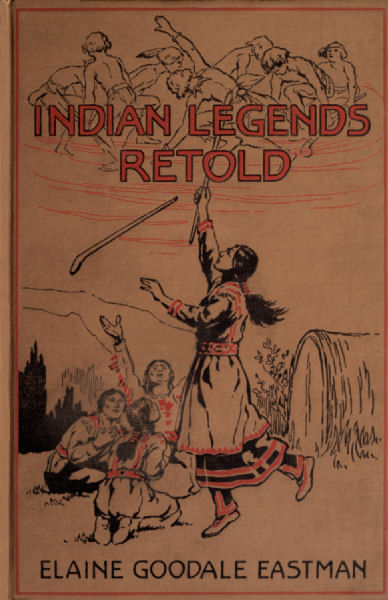
The Project Gutenberg eBook of Indian Legends Retold
Title: Indian Legends Retold
Author: Elaine Goodale Eastman
Illustrator: George Varian
Release date: April 19, 2011 [eBook #35909]
Language: English
Credits: Produced by K Nordquist, Sam W. and the Online Distributed
Proofreading Team at http://www.pgdp.net (This file was
produced from images generously made available by The
Internet Archive/American Libraries.)
INDIAN
LEGENDS RETOLD
BY
ELAINE GOODALE EASTMAN
WITH ILLUSTRATIONS BY
GEORGE VARIAN
BOSTON
LITTLE, BROWN, AND COMPANY
1919
Copyright, 1919,
By Little, Brown, and Company.
——
All rights reserved
Published, September, 1919
Norwood Press
Set up and electrotyped by J. S. Cushing Co., Norwood, Mass., U.S.A.
Presswork by S. J. Parkhill & Co., Boston, Mass., U.S.A.
| BOOKS BY ELAINE GOODALE EASTMAN |
| —— |
| Yellow Star |
| Indian Legends Retold |
| —— |
| In Collaboration with CHARLES A. EASTMAN |
| Wigwam Evenings |
THE CAPTIVE
The murdered dove instantly became a whole flock of hawks.
Frontispiece. See page 18.
ACKNOWLEDGMENT
The author wishes to thank the Bureau of American Ethnology, Washington, D.C., for kind permission to make use of certain of the stories contained in their collections.
INTRODUCTION
THE SIGNIFICANCE OF INDIAN LEGENDS
THE first Indian legends, repeated by the fireside to children, deal with the animals humanized, their gifts and their weaknesses, in such a way as to be a lesson to the young. Our view of the creation allows a soul to all living creatures, and rocks and trees are reverenced as sharers in the divine. Beyond their simplicity and realism there is always the unexplained, the background of mystery and spirituality.
These animal fables serve as an introduction to more complicated stories with human actors, which almost always have their hidden moral and are accepted by our people as guides to life. They are full of humor and poetry, of pride, tenderness, boastfulness, and real heroism. Human lives are mingled with the supernatural, with elements and mysterious powers, bringing swift punishment for wrong-doing. This is the basis of our Indian philosophy, the groundwork early laid in the mind of the child, for him to develop later in life by his own observation.
One who reads these stories carefully and thoughtfully will understand something of Indian psychology. Mystery to the Indian is not mystery after all, but a reflection of the Great Mystery which opens out as simply as a flower. To us nothing is strange or impossible. It seems natural that an animal or even a rock should speak; God is in it and speaks through it.
It must be remembered that these are only fragments of what were once consecutive and continued stories, too long and involved to be set down here in full. With just such stories the foundation of my early education was laid in the cold winter evenings, and the impression made was permanent. The characters were real people to me, and the tales of the old men and old women fostered a love of nature, reverence, a kindly spirit, and finally patriotism and the inspiration to heroic effort. Like the other boys, I was expected to learn them by heart and rehearse them in the family circle. It is gratifying to have these old stories saved for the children of another race and generation.
Charles A. Eastman (Ohiyesa).
CONTENTS
| PAGE | |
| Introduction | vii |
| A Little Talk about Indians | 1 |
| Pima Tales | 11 |
| Cherokee Tales | 23 |
| Choctaw Stories | 51 |
| Iroquois Tales | 65 |
| Tsimshian Tales | 77 |
| Alaskan Stories | 137 |
ILLUSTRATIONS
| The murdered dove instantly became a whole flock of hawks | Frontispiece | |
| One contrived to pull her son down but the other six went up into the sky | PAGE | 44 |
| He makes it choose one of three gifts | “ | 55 |
| He rudely pushed her backward until she fell down | “ | 83 |
| He discovered the woman in a small pool | “ | 111 |
| He took him to a tall stump in the very middle of the lake and there he left him | “ | 144 |
INDIAN LEGENDS RETOLD
A LITTLE TALK ABOUT INDIANS
MANY of us think of the American Indians as all one people. We talk of “the Indian language.” There are more than fifty distinct Indian languages.
There are many other important differences between the various tribes. The nature of the country, the kinds of game and other foods, the climate, winds, trees, all have their effect in molding the daily lives of the people. Their habits and customs are reflected in their legends and popular tales as in a looking-glass.
The mountains, plains, and seashore are the great natural features of our country, and corresponding to these we have coast tribes, prairie tribes, and forest-dwellers or mountaineers among the natives. If you try, you will soon be able to tell from reading a story what part of the country it came from. It is an interesting study to read and compare the legends of different tribes.
The Cherokees lived originally in the South Atlantic States and some few still have their homes in the mountains of North Carolina, but the greater part of the tribe was forcibly removed many years ago to the old Indian Territory. There they developed a civilized government, established schools and colleges, and are now well educated and intermixed with white people. The stories repeated here were gathered from the eastern or parent branch. Their shrewdness and quick wit is very noticeable. Sequoyah, whose impressive statue stands in bronze in the rotunda of the Capitol at Washington, was the famous Cherokee who invented an alphabet.
The Choctaws formerly lived in Mississippi and Louisiana but are now one of the Five Civilized Tribes of Oklahoma (once Indian Territory).
The Tsimshians are Indians of the North Pacific coast and in the old days lived mainly by fishing. They also hunted deer, bears, and other animals. Their houses and boats were made chiefly of cedar wood, and they also wove the bark of the cedar into baskets, ropes, mats, and even clothing. The salmon and the cedar were to them what the buffalo was to the Indians of the Great Plains, so you will not be surprised by the many references to them both in these stories. There is a strong likeness between their customs and those of the Alaskan tribes.
The home of the brave and manly Iroquois was in the valley of the St. Lawrence, the basins of Lakes Erie and Ontario, and most of what is now the State of New York. They were an exceptionally gifted people, wise in state-craft and active in warfare. They believed in the manlike form and magic power of the creatures and elements.
The Pimas are a gentle, peaceable, brown-skinned people, living in Arizona, making fine pottery, weaving beautiful mats and baskets, and raising corn. Like the other desert tribes, their songs and stories have much to do with the rain clouds, upon which their crops depend. They formerly stood in great fear of the warlike Apaches, who often attacked them and carried off women and children captive.
I suppose you all know that these legends were not written down at all until white people or educated Indians put them into books. They were made up by unknown story-tellers, far back in the past, and repeated by old men and women for the amusement and instruction of the young folks. Thus they were handed down, with some changes or additions, from one generation to another.
Indians had good memories. There were no libraries or museums or universities. All their wisdom and their traditions were stored up in the heads of the people, and a thing once forgotten was lost forever. They had not even a notebook or memorandum to help out a poor memory.
It is not so simple to invent a short tale that is witty and ingenious, with as much point and meaning as have most of these we are giving you, as you will soon find out if you try to make up some fables or fairy tales of your own. To remember and tell over such a story in a clear and effective way, without missing any of its logical or dramatic quality—even this is no very easy matter. The hearing and repeating of the legends took in large part the place of both school and story-books to the Indian boy or girl, and it is good practice for any of us.
It seems likely that every tribe has in its folklore a mischievous character with supernatural powers, who is at the same time a butt for jokes and a successful wonder-worker. He is boastful and resourceful, always trying to outwit other people, and in his turn is often outwitted. Among the Sioux this character is known as Unktomee, the Spider; the Tsimshians call him the Raven; the Cherokees the Rabbit.
Besides this clown, as it were, whose tricks and troubles are endless, every animal has its personal or human side, sometimes one that is obvious, and again it may be decidedly puzzling. The Turtle, for instance, is depicted as a famous warrior (we hardly see why) and the Porcupine as a wise man, which we should scarcely have expected. On the other hand, it seems quite natural to find the Grizzly Bear the chief among animals, and the Eagle the leader among birds.
Indian legends are broadly classed as “myths” and “folk tales.” The first tell in a fanciful way how the world was made, how winter, summer, fire, tides, and many other familiar things or conditions came into being. They go back to a time which all Indians believed in, when the animals were real people and could talk as we do. They could do many wonderful things besides that we cannot do. The Winds, Cold, the Stars, and so on are personified; that is, they are described and act as persons, and there are also giants, witches, water sprites and fairy people who change their nature at will.
In many of the folk tales, which come nearer being a record of actual or possible happenings, the lovable and domestic qualities of Indians are brought out very clearly. Notice the loving brothers and the affectionate husband in “The Woman Who Became a Beaver” and “The Wooden Wife.” The duty of hospitality is taught in the story of “Grizzly Bear and the Four Chiefs”, kindness to animals in “The Feast of the Mountain Goats”, patience with children in “The Naughty Grandchildren” and “The Stars and the Pine.” In every instance the right-doer is rewarded, the selfish man and the trickster are punished. I hope that you will enjoy these stories as much as I have done, and that they may help you to know and like better the first Americans.
PIMA TALES
CHILDREN OF THE CLOUD
THERE was sorrow on the Casa Grande (the Great Pueblo), for the prettiest woman in the village would accept no man for her husband. Her suitors were many and impatient, but her black glossy locks were still wound above her ears in the manner of virgins, and she steadily refused to allow them to hang down in the matron’s coils.
One day a great Cloud came out of the east, looked down upon the maiden and wished to marry her, for she was very beautiful. A second time and a third he floated silently overhead, and at last he found her tired out with work and lying asleep at her mat-weaving. He let fall a single drop of rain upon her, and by and by twin boys were born.
Now when the boys were about ten years old, they began to notice that other boys had fathers whom they welcomed home from war and the chase. “Mother,” said they, “who shall we call our father?”
“In the morning look to the east,” their mother answered, “and you will see a stately white cloud towering heavenward. That cloud is your father.”
Then they begged to go visit their father, and she refused, for she was afraid; but when the boys grew large and strong she could no longer keep them, since they were determined to go. She told them to journey four full days to the eastward and not to stop once on the way.
Her sons followed her instructions, and in four days they came to the house of the Wind. “Are you our father?” asked they.
“No,” replied Wind, “I am your uncle. Your father lives in the next house; go and find him.”
They did so, but Cloud sent them back to Wind, telling them that he was really the one whom they sought. Again Wind sent them to Cloud. Four times they went back and forth, and the fourth time Cloud saw that they were persistent and he said to them: “You say that you are my sons. Prove it!”
Instantly the younger son sent forked lightning leaping across the heavens, while the elder caused the heat lightning to flash in the distance. The skies opened and rain came down in torrents, enough to drown a mere mortal, but the boys only laughed at the roar and rush of the tempest. Then Cloud saw that they were in truth his children, and he took them to his house.
After they had been there a long time, they began to miss their mother sorely, and finally they wished to return to earth. Their father gave each a magic bow and arrows, strictly charging them to avoid any whom they might meet on the homeward path.
First the Eagle on mighty wing swooped toward them, and they turned aside. Then came the Hawk, and afterward the Raven, but the boys managed to elude all of these. Last the Coyote sought to intercept them, and whichever way they turned, he was always before them. So they stepped out of the road and stood one on either side to allow him to pass. But when Coyote came opposite to them, each was changed into a plant of the mescal, the sacred agave, which is both food and drink to the Indian.
THE CAPTIVE
There was once a little boy who was brought up by his grandmother. While he was yet very young, his mother had been taken captive by the warlike Apaches. He thought about her a great deal, for he had heard that they treat their prisoners cruelly.
One day he made up his mind to run away and find her. The way was long and hard, but at last he descried the enemy’s camp upon the plain, and when he came nearer, he could see a woman standing, looking toward the mesa and her old home. He knew her at once by the white scars which covered her arms, showing where she had been tortured with fire. The child turned himself into a dove and flew straight to his mother, who took him in her hands, and recognized him as her son.
She caressed and fondled him, but told him that he must fly home again before the Apache chief returned, as it would not be safe for him to stay. While they were talking together, the chief entered suddenly.
“What do you mean by whispering to that dove?” he demanded fiercely. “There is sorcery here.” And he took the bird in his powerful hands and squeezed it so that the delicate flesh and bones oozed out between his fingers.
The woman screamed, and the murdered dove instantly became a whole flock of hawks, which beat the chief down with their wings and pecked out his eyes. While they attacked him, the captive escaped, and returned to her own people.
THE NAUGHTY GRANDCHILDREN
An old woman had set her pot on the fire with the soup for dinner, and as her two grandchildren were playing near, she cautioned them not to upset the pot. The boy and girl were in a frolicsome mood, chasing one another with shouts of laughter; and as they ran they heedlessly struck against the pot, which rolled over and broke in pieces, spilling the rich broth into the ashes.
Now when their grandmother saw the mischief they had done in spite of her warning, she caught and whipped them both. Thereupon the children determined to run away.
As soon as she missed them, the old woman followed the runaways out into the desert, calling loudly upon them to come back, for she had only punished them for their own good and loved them both dearly. However, run as fast as she might, she could never come up with them. The two children were never seen again; but it is said that they were turned into two giant cacti and still stand side by side upon the plain.
BLUEBIRD AND COYOTE
In the old days the animals wore no such fine clothing as now, and the bluebird was of an ugly dun color, which made him very unhappy. One fine morning he came to a lake shining like turquoise, and something told him to bathe in the water.
Lightly he skimmed above the waves and dipped his wings four times, singing as he did so:
I go in—
I am all blue!”
The fourth time that he sang the verse and shook the water from his feathers, they really became bright blue!
Just then Coyote appeared, in time to see the transformation. “If you can make yourself beautiful by bathing in the lake, I can do as much,” said he, and accordingly he took the plunge. Coyote could not swim, and he choked and strangled and was almost drowned. When at last he contrived to get upon dry land, he was shivering with cold. He rolled and rolled in the warm sand, which stuck to his fur, and he became dirt color, just as you see him now.
CHEROKEE TALES
THE FIRST FIRE
IN the old days there was no fire on earth, and the world was a cold and a dreary place, especially at night and in the winter. Think what it would be if we had no hearth at which to warm ourselves, no coals to broil our venison!
One night, in the midst of a thunderstorm, the lightning struck a great hollow sycamore, and it began to burn. When the people saw it, they all wanted to get some fire, but the tree stood in a swamp where there was no firm ground for them to walk on. Many tried and were stuck fast in the bog.
The Raven easily flew across and got so close to the blaze that his feathers were burnt black, and black they have been to this day, but he brought back no fire. Then the Screech Owl tried, and he flew to the top of the burning tree from which he looked down on the hot coals, and got the red eyes that he has had ever since. The large Hooting Owl followed his brother, and the smoke gave him those white rings around his eyes that you have all noticed. The Black Snake said he would try, and he wriggled into a small hole at the foot of the tree, but he was immediately burnt black, and was scorched so badly into the bargain that he has done nothing but twist and squirm to this day. Not one of them brought back any fire.
At last the little Water Spider wove a silken basket which he placed on his back, and then he spun a fine silken thread for a bridge and ran across on it. He reached the tree safely, put a tiny live coal in the basket, and brought it back to the waiting tribes of earth.
ICE MAN PUTS OUT THE FIRE
Once upon a time there was a forest fire, and the fire went deep down to the roots of a poplar tree, and there it smoldered for a long time. The people tried to put it out, but they could do nothing. By and by they grew frightened, fearing lest it might burn down to the middle of the earth, or spread over all the world. So they sent a messenger to the far north, to beg the Ice Man to help them.
Now the Ice Man is a little fellow, with two heavy braids of black hair hanging over his shoulders. After he had heard all about the fire, he nodded, and loosening one braid he breathed upon the strands. Instantly the wind began to blow. He shook out the hair again, and it began to rain. When he undid the other braid, it hailed violently, and the fourth time he blew upon his hair, the storm became so terrific that the messenger hastened homeward.
When he got home, he saw the fire at the roots of the poplar was still burning, and the pit looked deeper and wider than ever. Many people were standing sadly about it, and as they stood there the wind began to blow. Soon a cold rain fell hissing on the hot coals. Then large hailstones were mixed with the rain, and before long the tempest grew so fierce that they were forced to run for shelter. When it stopped at last, they came out again to look, and the pit of fire was nothing but black coals covered with lumps of ice.
THE ORIGIN OF SICKNESS AND MEDICINE
There was a time when man and the animal people were friends, and talked the same language, and even intermarried with one another. Later on, the human race declared war upon the animals and began to kill them in great numbers, using their flesh for food and their skins for clothing, so that there was great fear and anger among them. At last the old White Bear chief called all the Bears in council to decide what should be done.
After much talk, it was agreed to make bows and arrows of their own with which to defend themselves, and one of the Bears sacrificed his life to furnish sinew for the bowstring. When all was ready, and the Bear chief undertook to try the new weapon, his long claws caught on the string so that he could not handle it. Some one then proposed that they all cut their claws, and they were on the point of doing this when the thought occurred to another that they would be unable to climb trees or seize their prey if they had no claws, and would be in danger of starving to death. In the end, the meeting broke up without coming to any decision, and Bears were hunted just the same as ever.
The White Deer next called all the Deer together, and they decided to punish with rheumatic pains every hunter who should kill one of their number without asking pardon for the offense. Ever since that time, the hunters have been very careful to beg the Deer’s pardon whenever it becomes necessary to shoot one, although now and then some one tries to avoid the penalty by building fires on his trail.
The other animals followed the Deer’s example, and each made haste to invent a disease with which to torment the human race. The Fish and the Snakes threatened him with bad dreams, and the little Grub, who was tired of being trodden upon, heard them with such joy that he fell over backward and has never stood on his feet since. Only the Ground Squirrel said modestly that as man had never done him any harm he had no wish for revenge, whereupon the others were so angry that they scratched him severely, and he bears the marks on his back to this day.
However, they reckoned without the plants, which were friendly to man, and promptly devised a remedy for each disease. We should be grateful to them whenever we are made to suffer by the revengeful spirit of the animals, for in the kindly vegetable world we can find a cure for every ill.
THE FIRST STRAWBERRY
It is told that the first man and woman quarreled, and the woman left her husband. He followed her sorrowfully, but she never once looked back. At last the Sun took pity on the man.
“Do you still love her?” asked the Sun, and the man said he did, and prayed to the Sun to help him win her back again.
Then the Sun caused all manner of delicious fruits to spring up in her path. The woman saw luscious purple huckleberries, but she went right on over them. A service tree laden with sweet red fruit stood in front of her, and she passed it by. Finally she came upon a patch of scarlet strawberries, the first that ever grew, and these she could not resist.
She stooped to taste one, and at once the thought of her husband came into her mind. All the sweetness of their love enfolded her, and she stood quite still in the strawberry patch until he came up with her, and embraced her, and they went back together.
HOW THE TERRAPIN BEAT THE RABBIT
The Terrapin once challenged the Rabbit to a race, which the latter regarded as a joke.
“The Terrapin is doubtless a wit,” said he, “and a great warrior as well, but every one knows that he cannot run. I shall give him a big handicap, and even then I cannot help beating him.”
The course lay over four ridges, and the Rabbit told the Terrapin to go ahead to the top of the first ridge, so that when the signal to start was given he was already out of sight.
When the Rabbit reached the top of the first ridge, he was surprised to catch a glimpse of the Terrapin almost at the top of the second. He ran faster, and as his rival was soon hidden in the long grass, he saw nothing more of him till he was mounting the second ridge, and there was the Terrapin already passing the third. When the Rabbit with great leaps ascended the third ridge, behold! the Terrapin was about to cross the fourth, and the next minute he had won the race.
This is the way it was done. The Terrapin had several friends who looked exactly like himself, so he stationed one of them at the top of each of the first three ridges, with orders to hide in the long grass as soon as the Rabbit came near. He himself stayed at the fourth rise until his competitor came in sight, when he crept over it and so came out ahead.
HOW THE TURKEY GOT HIS BEARD
Now the animals all suspected some trick in this case, and the Turkey in particular was heard to say that he would contrive to get even.
Soon afterward he saw the Terrapin coming back from war, creeping along with a fresh scalp hung about his short neck and trailing on the ground.
“How, my friend!” he exclaimed, “you do not wear your scalp right; only let me show you.”
The Terrapin let the Turkey take the scalp and hang it about his own neck, while he strutted proudly to and fro.
“Does it not look well?” the Turkey asked.
“Well enough,” the other admitted, “but you may give it back to me now.”
“First let me show you another way to wear it,” cried the Turkey, and he adjusted the scalp and flew with it into a tree where the other could not follow. Thus he boasts the stolen ornament to this day.
HOW THE DEER GOT HIS HORNS
Perhaps you never heard that there was once a time when the Deer’s head was as smooth as that of the doe, and as he and the Rabbit were both great jumpers and proud of their ability, a match was arranged, the winner to receive a fine pair of antlers as a prize. They were to start at one side of a dense thicket, and the first one to make his way through to the further side and back again would be judged the winner.
Now the Rabbit said that he had never before been in that part of the country, and he asked permission to look about a little, which was agreed to. However, he was gone so long that they suspected he might be up to one of his tricks, so one of the judges followed him quietly. There he was, busily gnawing off branches and making a road through the underbrush!
When he finally came out, he was told that on account of his dishonesty the horns would be given to the Deer, and furthermore, since he was so fond of gnawing at bushes, he might continue to do so for the rest of his life.
WHY THE DEER’S TEETH ARE BLUNT
Although it was not the Deer’s fault that the Rabbit lost the prize, the Rabbit was greatly provoked and laid his plans to get even. Cutting a stout grapevine almost in two with his teeth, he laid it across the Deer’s path and began leaping back and forth, snapping at the vine.
“What are you doing that for?” asked the Deer, when he caught him at this game.
“Only look! I can bite this tough vine in two with one snap of my sharp teeth,” replied the Rabbit.
“Let me see you do it,” the Deer suggested.
So the Rabbit sprang at the vine and bit it in two, where it was already almost cut through. “You cannot do anything like that,” he declared proudly.
“If you can do it, I am sure I can,” the Deer insisted, and the Rabbit made haste to drag forward a heavy vine. The Deer leaped at it and tried to bite it as the other had done, but caught his heels and fell headlong. Again and again he tried without success.
“My friend,” put in the Rabbit, who had been looking on and pretending to sympathize, “how can you expect to bite anything in two with such blunt teeth as you have? Just let me file them for you a bit, and they will soon be as sharp as mine.”
The Deer was hot and embarrassed and very foolishly gave his consent. Thereupon the sly Rabbit got a rough stone and filed off the Deer’s teeth almost down to the gums, so that he could not bite off anything at all.
WHY THE POSSUM’S TAIL IS BARE
A long time ago, the Possum had a fine bushy tail of which he was very proud, so much so that he would even sing of it at the dance. As the Rabbit’s tail is short and stubby, he had no patience with such absurd vanity, and at last he thought of a way to put a stop to it.
There was to be a large council and dance to which all the animals were invited, and Rabbit stopped in on his way home to inquire whether Possum was going.
“I shall not attend unless I can be assured of a good seat,” declared Possum with much dignity, “for I think my tail entitles me to so much, at least.”
“Certainly, I will arrange that,” replied Rabbit, with a great show of deference, “and I shall be glad if you will allow me to send a barber to comb and dress your beautiful tail so that it may appear to the best advantage.”
On these conditions Possum agreed to attend the dance, and the Cricket, who was an expert barber, was sent to him with private instructions. As fast as he combed and brushed the tail, he wrapped it around with red string to keep it smooth, and no sooner had he finished his work than Possum hurried away in good spirits.
He found the council house crowded, but all made room for him at once, and when his turn came he quickly unwrapped his long tail and took the center of the floor, waving it proudly as he danced. He was greatly surprised to be greeted with loud peals of laughter. He ventured to speak of his tail in the accompanying song, and the people laughed louder than ever. At last, looking down, he discovered that the Cricket, according to the secret orders he had received, had shaved that splendid tail to the very roots, and it has remained entirely bare ever since.
In his great mortification, Possum rolled over on his back helpless, and this he still does whenever he is taken by surprise.
THE OWL GETS MARRIED
There was once a woman who had a marriageable daughter. Many men came wooing, but the mother told the girl never to accept any but a skilled hunter, who would keep the lodge well supplied with meat.
One evening the Owl called, in the shape of a handsome young man, and asked the girl to be his wife.
“Are you a good hunter?” she asked.
He said that he was, and upon this she agreed to marry him.
On the day after the wedding, the bridegroom went forth to hunt, and at night he returned with nothing but some scraps that the hunters had thrown away. He excused himself by saying that he had had bad luck, and the next morning he declared that he would try fishing instead.
When at evening he brought home only a worthless minnow or two, the old lady advised her daughter to follow him quietly the next time and see what he did. She did so and was horrified to see her husband turn into a great Owl and fly to the top of a dead tree, where he sat watching for some small fish that might be dropped by a Hawk or an Eagle.
She went home in disgust, and presently he returned with a story of an Owl which had driven away his game.
“I think you are the Owl,” declared the young woman, and she turned him out of doors.
The poor Owl went off by himself and pined away till he lost all his flesh, and is now nothing more than a big head and a bundle of feathers.
THE STARS AND THE PINE
Once there were seven little boys who spent most of their time down at the town house, playing a game with wheel-shaped stones and a curved stick like a hockey-stick. Their mothers thought they played too much, and one day, when they were boiling the corn for dinner, they put some round stones in the pot and served these to the little boys instead of corn.
This made the boys angry, and instead of staying at home they went right back to the town house and began to dance. Round and round they went, faster and faster, until their feet came quite off the ground, and they were dancing on air. When their mothers came to look for them, they were already out of reach.
The mothers screamed, and one caught up a game stick and contrived to pull her son down, but the other six went straight up into the sky; and there they are now, as the six bright stars named Pleiades, which the Cherokees call “The Boys.”
As for the seventh little boy, he struck the ground with such force that he sank in and was seen no more. His wretched mother watered the spot every day with her tears, and after a long time there sprang up a slender shoot of green which grew into a pine tree. This was the very first pine. Perhaps you did not know that the Pine has a heart of flame and is a brother to the Stars.