
PLATE VII.—LE DUC D’ORLÉANS
(Musée de Versailles)
This grave and dignified portrait of the Duke of Orleans was ordered by the King in 1842. It is remarkable for the minuteness and care with which all the details of the uniform and the accessories are rendered.
But if Ingres doubted of human justice, he never doubted about his art. He devoted himself to it with renewed passion and enthusiasm. “The day I quitted Paris,” he wrote to one of his friends, “I broke for ever with everything that has to do with the public. Henceforth I will paint entirely for myself. I belong at last to myself, and I will belong only to myself.”
But, as a fact, neither Ingres’ influence nor prestige suffered from the want of success of his “St. Symphorian.” As director of the French Academy at Rome he remained the guide, counsellor, and example of all the young talents of his time. His proud ideal could not fail to attract the enthusiasm of his younger contemporaries. His teaching and example were helpful to others besides the painters. What was essential in his doctrines was applicable to all the arts: to music, which moved him so profoundly; and to sculpture—for did he not use his pencil and brush like a chisel?
Official favour also followed him in his angry retreat. The Duke of Orleans ordered a small historical picture from him, which gave him an immense deal of trouble but was at the same time a source of glorious compensation. He produced “Stratonice,” one of the most successful of his works.
The tragedy of which Stratonice was the heroine had haunted his imagination for years. He had meditated long on the subject, but had always conceived the picture on a large scale. Unfortunately, the picture had to be the same size as Paul Delaroche’s “Death of the Duke of Guise,” to which it was to serve as pendant, and Ingres was constrained to transform his grandiose conception into a miniature. Ingres took six years to paint what he called his “grand historical miniature.” And it is to be somewhat regretted that in his anxiety for archæological exactitude he invited the collaboration of the architect Hittorf. Hittorf was full of his rather excessive theories about the polychromatic architecture of the ancients. He imposed his ideas so completely on the unfortunate artist that he was permitted to paint the background of the picture. Hence the debauch of local colour, of coloured mosaics and bronzes, which threatens almost to swamp the figures. And what is worse, later archæologists have not failed to discover flaws in the pedantic architect’s too insistent details—strange anachronisms like that of placing well-known Pompeiian frescoes on the walls of the palace of Antiochus, together with motives borrowed from Greek vases at least four hundred years earlier in date. The example of this picture has had an important effect on the French school.
But in spite of these defects, the picture imposes itself on the imagination. The hopeless tragedy of the situation is admirably expressed without a trace of theatrical exaggeration. We see a young man, suffering from a grave and mysterious malady, extended upon his bed of suffering. The physician called in by his despairing father stands beside him and examines him. The father himself, overcome with grief, bows his head over his son’s couch. At this moment in the chamber of death a young woman enters. She is young, charming, and melancholy. She is the second wife of the heart-broken father, the mother-in-law of the dying son. And as she walks through the room with languishing steps the physician guesses the horrible truth. The man on the bed is dying of love. By signs which cannot deceive him, the man of science has divined the dreadful passion of the son for his father’s wife. Such was, in fact, the history of Stratonice. The second wife of Seleucus Nicanor was loved by Antiochus, the king’s son by his first marriage. The doctor, Erasistratus, having surprised this secret, declared that the young man would certainly die if Stratonice was not given to him, and his father’s love was great enough to enable him to make this sacrifice.
No other artist than Ingres could have placed this poignant drama on canvas without exciting ridicule. “Stratonice” was exhibited by the Duke of Orleans in one of the galleries of the Pavilion of Marsan, and the public were freely admitted to see it. All the visitors were enchanted with it. The dramatic character of the subject was not displeasing to the Parisian public, and the artists admired the delicate taste, the pathetic grace, and the impeccable style of the workmanship. Above all, the charm of the svelte and supple figure of the heroine, her head bowed under the weight of her culpable beauty, touched all hearts.
Another small picture, known indifferently as “The Odalisque with the Slave” or the “Small Odalisque,” was finished about the same time as the “Stratonice.” This was painted for the artist’s friend M. Marcotte, but is now in the Louvre. In the “Odalisque” as in the “Stratonice” we find a profusion of the details dear to Hittorf, but the figure of the beautiful Circassian curled up on the rich carpet of the harem is a masterpiece of plastic form. In this lovely body the artist has symbolised something of that perverse melancholy, that dangerous voluptuousness, which has found such moving expression in some of Baudelaire’s poems.
In the spring of 1841 Ingres returned to Paris. He found his reputation increased by the success of the “Stratonice.” His brother artists hailed him as their leader. A banquet was offered to him by all the artists present in the capital, painters, sculptors, and architects, the only prominent absentee being Eugène Delacroix, the leader of the Romantics. Delacroix did not wish to participate in the triumph of his rival, and this triumph, so unanimously accorded, only served to widen the breach between the two masters. Henceforth the struggle between them became more bitter. Each party pursued the other without mercy, neither disdaining to use any kind of weapon that came to hand.
Fortified by the homage offered to him, Ingres returned to his work with renewed ardour. The King asked him to paint a portrait of the Duke of Orleans, and Ingres, grateful for the Duke’s kindness with regard to the “Stratonice,” took much more pains over this portrait than he usually took with commissions of this kind. This was the last male portrait that Ingres painted, with the exception of a small monochrome medallion of the Prince Jéròme Napoléon, which he executed in 1855. But, on the other hand, he became the favourite painter of the exalted dames of the Monarchy of July and of the Second Empire, though very much against his will, for he regarded portrait-painting as a waste of time, and wished to devote himself entirely to his grand historical and religious compositions. Nevertheless, he painted some fine portraits of beautiful women—Madame d’Haussonville in 1845, Madame Frédéric Reisat in 1846, Madame James de Rothschild in 1848, Madame Gonse and Madame Moitessier in 1852, the Princess de Broglie in 1853, a second half-length portrait (the first was a full-length) of Madame Moitessier in 1856, and finally, in 1859, that of his second wife.
PLATE VIII.—JEANNE D’ARC
(In the Louvre)
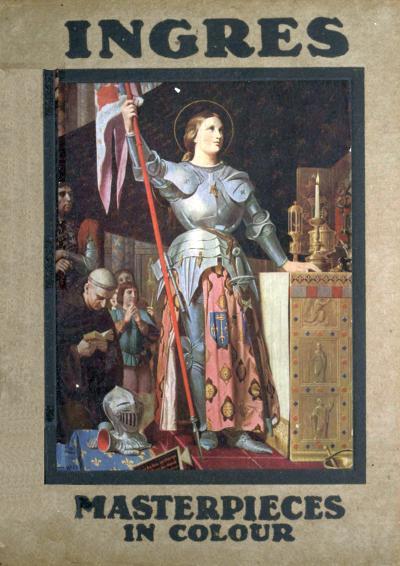
The picture of “Joan of Arc assisting at the Consecration of Charles VII. in the Cathedral of Reims” was painted for the gallery of Versailles, but is now in the Louvre. It is signed “J. Ingres, 1854.” The figure, the maid’s squire, standing immediately behind the kneeling priest, is said to be a portrait of the artist himself.
Soon after the portrait of the Duke of Orleans was finished he received another royal commission, the “Jesus among the Doctors,” which the Queen Marie-Amélie wished to present to the Château de Bizy. The work, badly conceived at the beginning, was still unfinished when the Revolution drove from France the patroness who had commissioned it. It remained almost forgotten in a corner of the artist’s studio till 1862, when Ingres decided to finish it and present it to the museum of his natal city. Of all Ingres’ productions, it is perhaps the only one where the inspiration and execution both seem feeble.
While he had been still in Rome, in 1839, Ingres had received from the Duc de Luynes a commission to decorate the great room at the Château of Dampierre with two large mural paintings representing “The Age of Gold” and “The Age of Iron.” He was delighted with the commission, as he was always dreaming of reviving the great traditions of decorative painting. He made numberless studies for these subjects, many of them among the most beautiful of his drawings. But as the painting had to be done actually on the walls at Dampierre, the work progressed very slowly. Years flew by, and the artist’s enthusiasm cooled. The noble Duke and the sensitive and proud painter could not get along well under the same roof. Ingres thought himself slighted on one occasion (in 1850) and brusquely threw up the commission, leaving his work unfinished. There exists of this gigantic work only a sketch at Dampierre, an infinite number of drawings at the Museum of Montauban, and a little painting executed from these drawings in 1862, a very feeble representation of what the definitive work would have been. As for “The Age of Iron,” we have only the preliminary studies.
As if to revenge himself for the loss of his promised masterpiece, Ingres now took up again a number of the works he had sketched in his youth and set himself to finish them or repaint them. He also busied himself painting replicas of others which had passed out of his hands but with which he was not entirely satisfied. He painted thus a repetition of the “Apotheosis of Homer,” adding a number of fresh figures and substituting others for some of the poets and artists of his first choice. After much anxious reflection and discussion with his pupils, he decided to banish Shakespeare, as he had already banished Goethe, from the group of the immortals. He also painted replicas of his “Sistine Chapel,” of “Roger delivering Angelica,” and variations of his “Œdipus” and “Stratonice.” He also painted four or five slightly different versions of the figure of the Virgin in his early picture of the “Vow of Louis XIII.” One of these developed into a picture of “The Virgin between St. Nicholas and St. Alexander”—a subject the Emperor of Russia had asked him to treat. We find another version of the same type in “The Virgin with the Host,” which forms one of our illustrations. In no other work of Ingres is his passionate admiration of Raphael more clearly displayed.
One of the new works which caused the liveliest sensation was “The Birth of Venus” or “Venus Anadyomene.” This had been begun forty years before, at the time of the early “Bathers” and “Odalisque.” The beautiful white body of the goddess detaches itself from the harmonious blue of the sea and sky, and groups of amorini flutter round and caress her youthful form. One of these delicious attendants offers her a mirror, another kisses the feet of the young goddess, while a third embraces her knees. It would be difficult to imagine anything more graciously tender or more natural than the infantile figures.
The “Venus Anadyomene” was finished in 1848; in 1851 Ingres painted his “Jupiter and Antiope,” and two years later he painted his “Apotheosis of Napoleon I.,” a large subject for the decoration of one of the ceilings of the Hôtel de Ville, at Paris. This was unfortunately destroyed by fire in the troubled days of the Commune in 1871. In 1854 his “Joan of Arc assisting at the Consecration of Charles VII.” was painted for the gallery of Versailles.
We have now reached the last years of the artist’s laborious life. They were as busy as his earlier years, but they were crowned with honour and glory. In 1855 all Europe flocked to Paris to see the Universal Exhibition. The life-work of Ingres was gathered together in a special gallery. It produced an immense impression. All criticisms of detail fell before the magnificent affirmation of the artist’s individual ideal. One of the grand medals was given to him by the unanimous votes of the artists, and the Emperor made him an officer of the Legion of Honour.
Then, in the following year, as if to crown his career by the evocation of a supreme masterpiece, Ingres finished the “Source,” a subject which had been begun at the same time as the “Venus Anadyomene.” This beautiful figure was not a passing vision which had animated the brush of the aged painter; it was indeed the daughter of his dreams, an emanation of his own soul, the slow growth of long meditations, and which, at last, incarnated itself in an immortal form. This calm and adorable figure seems a souvenir of our long-lost innocence. That is perhaps why we love it so, and why we bless the artist to whom we owe this divine dream.
Ingres died in 1867. He had finished his task, had spoken the last word of his austere but profoundly human genius.
Ingres has been spoken of as an ancient Greek lost and bewildered in our modern times. Such a view of his character is misleading. Like all the great creators, he expressed the aspirations of his race and his times. He was not only the child of his century and his country, but he represented them both in their classic reaction and in their impulse towards Romanticism. But the two tendencies were so nicely balanced in his temperament that he offended the extremists of both parties. He paid in his lifetime for his detachment from parties, for his exalted aims and sublime courage, but he reaps his reward from posterity. The creator of the immortal figures of Œdipus, the Odalisque, Angelica, Stratonice, and the Source to-day takes unquestioned rank among the great masters not only of French but of European art.
BIBLIOGRAPHY
The authoritative French accounts of Ingres’ life and work (from which the foregoing sketch has been compiled) are:—
Comte Henri Delaborde.—Ingres, sa vie, ses travaux, sa doctrine (1870).
Charles Blanc.—Ingres (1870).
Henry Lapauze.—L’Œuvre de Ingres (in “Melanges sur l’Art Français,” 1905).
Jules Momméja.—Ingres (“Les Grands Artistes” series).
T. de Wyzewa.—L’Œuvre peint de Jean-Dominique Ingres (1907).
Boyer d’Agen.—Ingres d’apres une Correspondence inédite (1909).
The plates are printed by Bemrose & Sons, Ltd., Derby and London
The text at the Ballantyne Press, Edinburgh