
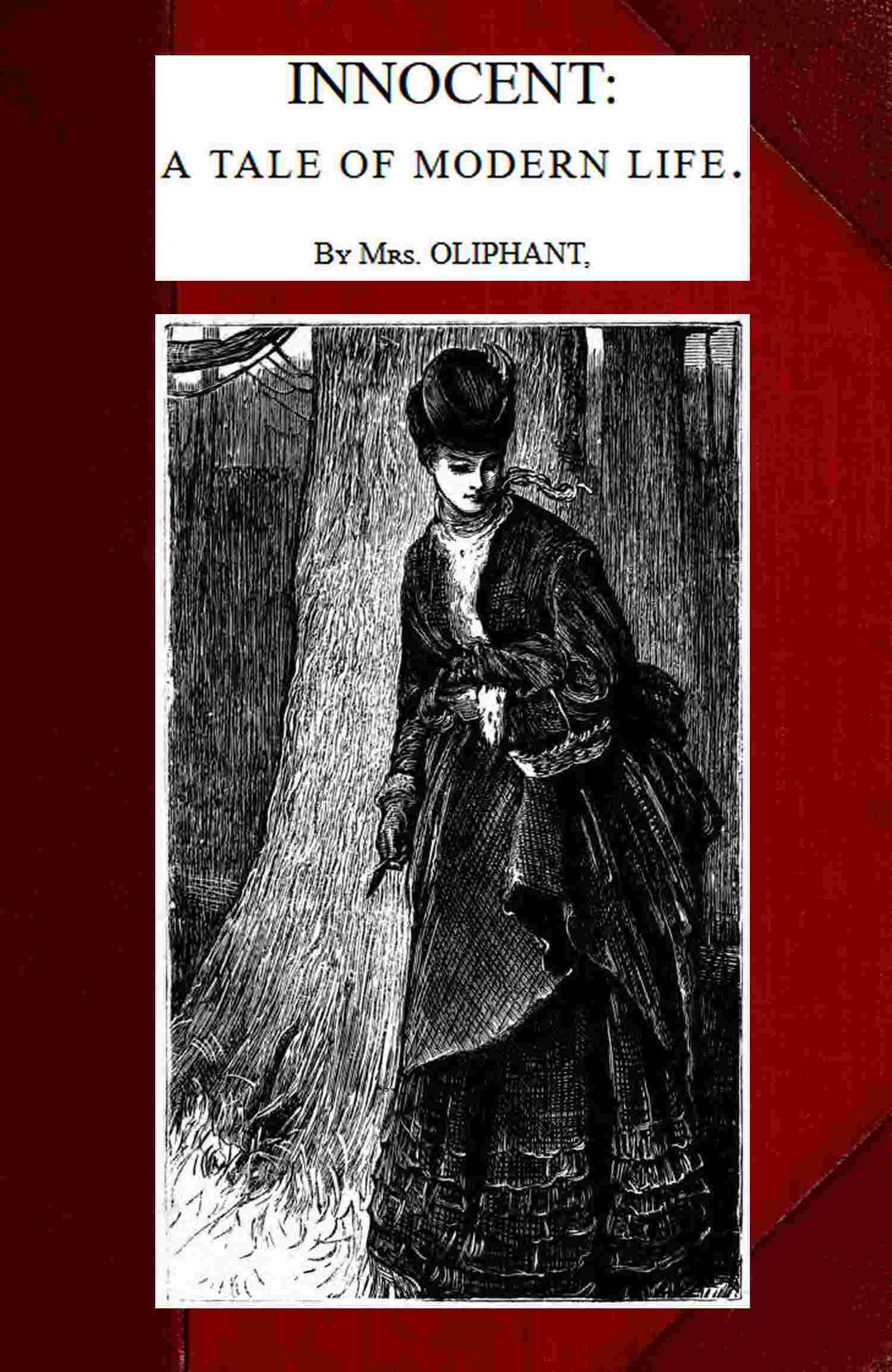
CHAPTER XII.
A LOVE TALE.
I am obliged at this moment to interrupt the history of Innocent’s entrance into English life by the intrusion of another event which occurred quite suddenly, and without adequate preparation, a few days after the arrival of the traveller, and which threw Innocent for the moment altogether into the shade. It was not a deeply premeditated event, as perhaps it ought to have been, aiming as it did at such very important results, and affecting two lives in so momentous a way. On this particular afternoon there had been a flood of visitors at the Elms, such as now and then occurs without rhyme or reason—every acquaintance the Eastwoods possessed seeming to be moved by a unanimous impulse. From two o’clock until five the callers kept pouring in. On ordinary occasions one or two a day kept the house lively; this was one of those accidental floods which obey, as philosophers tell us, some fantastic law of their own, like the number of undirected letters put into the post-office. Two gentlemen arrived among the latest, both of whom had hoped to find the ladies alone, and who grinned and shook hands with each other, and told each other the news with the most delightful amiability, though their internal emotions were less sweet. They arrived together, and as the room was still tolerably full, they became each other’s companions, and stood in a corner talking with the most confidential aspect, after they had shaken hands with Mrs. Eastwood. Nelly was at the other extremity of the room, at the door-window which opened into the conservatory, talking to Sir Alexis Longueville, a man with a rent-roll as long as his name, whom both the gentlemen I have mentioned regarded with unfavourable feelings.
“What do you suppose people see in that old ass, Molyneux,” said Major Railton, “that everybody kootoos to him?”
“His money,” said Molyneux sententiously; and for ten minutes more these gentlemen crushed Sir Alexis under their heels as it were, and ground him into powder, though no feminine spite could be involved in their proceedings. He was not an old ass. He was a cynical middle-aged man of the world, who, notwithstanding his romantic name, had sustained a great many prosaic batterings and fierce encounters with the world. He had come to his fortune after his youth was over, and after he had learned to think badly enough of most people about him, an opinion which was not altered by the great social success he had when he reappeared as Sir Alexis, after a somewhat obscure and not much respected career as Colonel Longueville. It was now generally understood that this hero, the worse for the wear, was disposed to marry, and indeed was on the outlook for a suitable person to become Lady Longueville; a fact which his kind but vulgar sister Mrs. Barclay, who had married a millionaire, made known wherever she was received. He was “looking for a wife.” Major Railton and Mr. Molyneux in their corner were both aware of this fact, and both of them were extremely bitter upon Mrs. Eastwood for allowing him, as she did quite placidly, to stand talking to Nelly “for hours,” as Mr. Molyneux expressed it afterwards.
“What a pity that the best of women should be so mercenary!” he said to his companion.
“They will give anything for a handle to their names,” said the misanthropical Major, stroking his moustache, with discomfiture in his countenance. He had come with an estimate in his pocket for the work that had to be done at the stables, and had calculated on an hour at least of confidential talk.
And Nelly stood and talked to Sir Alexis, pointing out to him quite eagerly the different flowers that thrust their pretty heads against the glass, peering into the room. He knew about flowers. This innocent taste reigned strangely in his cynical bosom among many other inclinations much less praiseworthy. He laughed with Nelly over their Latin names, and told her stories about them and about his conservatories at Longueville. Perhaps he was not aware of the reckless way in which he was laying himself open to the remarks of the young men in the room, who did not leave him a shred of reputation to cover him, as they stood behind snarling to each other, and united in a common enmity. He was more amusing than either of them, and though he had no particular designs upon Nelly, he liked her fresh young face, and her interest in all that he said. Perhaps, too, a man who is aware of all the advantages of the youth which he has outlived, has a pleasure in proving himself more entertaining than younger men. He detained Nelly, and Nelly was not unwilling to be detained. She had perceived the entrance of the two at the end of the room, and rather, I fear, enjoyed their gloomy looks; or rather, she thought nothing whatever about Major Railton, but was guiltily glad to see the gloom on the countenance of young Molyneux.
“It will teach him to be full five days without calling,” she said to herself. She had not acknowledged even to herself that she was in love with young Molyneux, but she had an inward conviction that he was in love with her, and on the whole liked him for it. Is it not always a sign of good taste at least? Therefore she stood and talked to Sir Alexis, looking up brightly in his face, till he, who had no designs that way, was half subjugated, and asked himself suddenly whether Nelly Eastwood would not do? which was going a very long way. Time, however, and Mrs. Barclay’s horses, could not wait for ever, and at last the baronet was borne away.
“Come to me soon, Nelly dear, and finish what you have begun,” said that lady, whispering in her ear, as she took leave. Finish what she had begun! Nelly had no idea what she could mean.
By this time most of the visitors were gone, and Nelly, after a few minutes’ talk with the pair at the other end of the room, proceeded to execute some business which she had been kept from doing before. “I am sure Major Railton and Mr. Molyneux will excuse me,” she said, “but I must get my primroses now before any one else comes in——”
“I don’t think you will find any,” said Mrs. Eastwood, making her a sign to stay. But it was getting dark, and Nelly, who was perverse, pretended not to understand. Any pleasure she might have in the society of one of the two was neutralized by the presence of both, and perhaps there was even a thought in her mind that a young lover might take heart of grace and follow. In the conservatory her white-furred jacket and little flower-basket were lying on a chair. Before she could throw on the wrap Molyneux had joined her. “I think Railton has some business to talk about,” he said aloud, with a slight nod of concealed triumph to his adversary; “May I come upon the flower-gathering expedition? Gathering flowers by moonlight has quite a poetical sound.”
“It is too cold to be poetical,” said Nelly. There had been just enough between this girl and boy to give them both a thrill of the heart when they went, out of sight and hearing, into the stillness of the garden, where, indeed, to tell the truth, few primroses were as yet to be found. It was one of those lovely nights of early spring which sometimes succeed a boisterous day. The wind had fallen with the evening. The sky in the west was still full of colour, a pink flush extending far into the blue. The gorgeous sunset clouds had broken up, but this great rose-tinted pavilion still stood, spreading out its film of lovely colour over the house. On the garden side there was a stretch of clear sky, untinged by this dispersing veil of glory; clear, somewhat cold, pale, and luminous, with one star set in the midst of it; and separated from this blue bit of heaven by billows of fleecy cloud, a soft, clear young moon in her first quarter. It was cold, but to think of cold was impossible with such a heaven above them—impossible, at least, for these two, who were young, and who were together. They went along under the trees for some time without saying anything, except a little exclamation about the beauty of the sky.
“I am tired,” said Nelly at length; “I am so glad it is over. Calls are the stupidest of all things. If people would come in in the evening, as they do abroad—but English people will never understand.”
“Your visitors were not all stupid, I think,” said Molyneux, warming with the heat of combat.
“Oh no; Sir Alexis, for instance, was very amusing,” said Nelly, feeling by instinct what was coming, and defying her fate.
“You seemed to think so,” said the young man, with the loftiest tone of disinterested comment.
“And indeed I did think so; he is excellent company,” said the girl.
Thus the first parallels of warfare were opened. The pair went on quite beyond the bit of lawn where the primroses grew, and the red in the west stretched out as if to cover them, and the moon in the east looked down as if it were hanging over some battlement of heaven to watch. Nelly’s delicate nostrils had dilated a little with a sense of coming battle, and as for Molyneux, he held his head high like a war-horse.
“Yes, I am aware that ladies take that view sometimes; he is not popular among men,” he said, with lofty calm.
“I suppose men are jealous of him,” said Nelly. “Oh dear, yes, men are very jealous of each other. If you think a girl can have been out two seasons without perceiving that——”
“I am sorry we should have given you such a bad opinion of us. I am at a loss to understand,” said Mr. Molyneux solemnly, “what kind of creature the man could be who would be jealous of an old roué like Longueville. His character is too well known among men, I assure you, Miss Eastwood, to make any such feeling possible.”
Nelly coloured with pride and shame. “He ought to have a label on him, then, to warn the ignorant. Not knowing what his crimes are, I cannot judge him; he is very amusing, that is all I know.”
“And that, of course, makes up for everything; and when any one ventures to warn you, Miss Eastwood, instead of listening, you turn your displeasure against the unfortunate man who feels it on his conscience——”
“Mr. Molyneux,” cried Nelly, quickly interrupting him, “I don’t know what right one gentleman, whom mamma knows, has to warn me against another. Mamma is the person to be spoken to if there is really anything to say.”
Thus the quarrel flashed and fizzed to the point of explosion; and what would have happened—whether they would have been driven apart in fragments, and their budding romance blown into dust and ruin in the ordinary course of events, had Molyneux responded in the same tone, I cannot say; but there are resources at the command of lovers which are not open to the general public. He did not go on in the same tone. He became suddenly lachrymose, as young men in love are permitted to be on occasion.
“Miss Eastwood,” he said dolefully, “there have been times when I have ventured to think that you would not quite place me on the same level with the last new-comer——”
“Oh, no,” said Nelly, with compunction, “I beg your pardon, that was not what I meant. We have known you a long time, Mr. Molyneux, and I am sure have always looked upon you as—a friend.”
“Well, as—a friend,” he said, in the same pathetic tone, “might I not be allowed to say something when I saw that you were being deceived? Dear Miss Eastwood, could I stand by, do you think, knowing all I do of you, and see a man making his way into your esteem under false pretences?”
“Making his way into my esteem?” cried Nelly with frank laughter. “Please don’t be so solemn. You can’t think surely for a moment that I cared for that old Sir Alexis!”
“You are quite sure you don’t?” cried the lover, brightening up.
“Sure! Now didn’t I say it was all jealousy?” cried Nelly, laughing; but when she had said the words she perceived the meaning they might bear, and blushed violently, and stopped short, as people in embarrassing circumstances constantly do.
“You are quite right, as you always are,” said Molyneux, stopping too, and putting himself directly in front of her. If it were not that the women who are being proposed to are generally too much agitated to perceive it, a man about to propose has many very funny aspects. Young Molyneux placed himself directly in Nelly’s way; he stood over her, making her withdraw a step in self-defence. His face became long, and his eyes large. He put out his hands to take hers, if he could have got them. “Yes, you are right,” he said, more lachrymose than ever; “you are always right. I should be jealous of an angel if he came too near you. I am jealous of everybody. Won’t you say something? Won’t you give me your hand? I don’t care for anything in the world but you, or without you.”
“Mr. Molyneux!” cried Nelly, drawing a little back, with her heart beating and her cheeks burning, in the soft, starry twilight. He had got her hands somehow, in spite of her, and was advancing closer and closer. How unforeseen and unintended it all was! Neither of them had meant anything half-an-hour ago of this tremendous character. But Molyneux by this time felt sure that his life depended upon it, and that he had thought of nothing else for ages; and Nelly’s heart beat so loud that she thought it must be heard half a mile off, and feared it would leap away from her altogether. Their voices grew lower and lower, their shadows more confused in the young moonlight, which made at the most but a faint outline of shadow. There grew to be at last only a murmur under the bare branches, all knotted with the buds of spring, and only one blot of shade upon the path, which was softly whitened by that poetic light. This happened in the Lady’s Walk, which was on the other side of the lawn from the elm-trees, narrower, and quite arched and overshadowed with branches. The pink had scarcely gone out of the sky overhead, and the one star was still shining serenely in its luminous opening, when the whole business was over. You might have been in the garden without seeing, and, certainly, without hearing; but then matters were delightfully arranged for such interviews in the leafy demesne of The Elms.
“Oh, dear! I have forgotten my primroses,” said Nelly, “and what will they think of us in-doors?”
“Never mind; Railton has been very busy talking to your mother about bricks and slates,” said Molyneux, with a laugh of irrepressible triumph. They both laughed, which was mean of Nelly.
“Oh, hush! What has poor Major Railton to do with it?” she said. She was leaning against a lime-tree, a spot which she always remembered. It was cold, but neither of them felt it. Nelly’s little toes were half frozen, and she did not mind.
“Look! all the sunset is dying away,” said Molyneux. “It would not go, Nelly, till it knew how things were going to turn out. ‘Go not, happy day, from the shining fields——’”
“Don’t talk nonsense—you should say, from the sodden lawn,” said Nelly. “Let us get the primroses now, or what can I say to mamma?”
“We shall both have a great deal to say to her. She will never once think of the primroses, Nelly.”
“Oh, don’t call me ‘Nelly’ so loud; some one will hear you. Must we go and tell directly?” said the girl, with a half-whimper, which the foolish young man thought celestial. This to be said by Nelly, a girl who had never in all her life kept a secret half an hour from her mother! The fact was that she wanted to have the telling herself, and quaked at the thought of presenting this ardent personage to her mother, and probably having her dignity compromised before that mother’s very eyes by “some of his nonsense.” Nelly was very shy, and half ashamed of coming into the light and looking even her wooer himself in the face.
There were but a very few primroses, and these were half frozen, cowering among their leaves. Young Molyneux carried away a little cluster of them, and gave another to Nelly, which was not placed in her basket, and then they made another final round of the garden, and walked down the elm-tree avenue solemnly arm in arm. How quickly the mind gets accustomed to any revolution! This little concluding processional march threw them years in advance of the more agitating contiguity of the Lady’s Walk.
“This is how we shall walk about everywhere ten years hence, when we are sober old married people,” he said; and there glanced over the imaginations of both a sudden picture, which both would have been sadly disconcerted to have described. A little tremulous laugh went from one to the other. How much emotion that cannot express itself otherwise has vent in such soft laughter? And a sense of the calm of happiness to come, so different from this delightful dream of the beginning, yet issuing naturally from it, stole over them and stilled their young hearts.
This was what was going on in the garden while Major Railton, not without many a horrible thought of his rival’s advantages, was talking bricks and slates, as Molyneux flippantly said, to Mrs. Eastwood. They had come to the length of a pipe and water-butt for the rain-water, and the plumber’s estimate, when Nelly and Molyneux were gathering the primroses. How the gallant Major’s heart was being torn asunder in the midst of those discussions, I dare not attempt to describe. He had seated himself so that he could see into the garden; but the flicker of the firelight filled the room, and the Lady’s Walk was invisible from the windows.
“Don’t you think Miss Eastwood will catch cold? There is an east wind, I fear,” he said, in the very midst of the discussion about the plumber.
“I told Nelly to wrap herself up,” said Mrs. Eastwood, calmly. She was not afraid of the east wind. The Eastwoods had never been known to have any delicacy about the chest. And as for a more serious danger Nelly’s mother, secure in full possession of her child, had not even begun to think of that.
She was scarcely alarmed even when the two entered somewhat flushed and embarrassed, as soon as Major Railton, who, poor man, had an engagement, had withdrawn breathing fire and flame.
“What a colour you have, Nelly,” said Mrs. Eastwood innocently. “I suppose it is the wind. The Major tells me the wind is in the east. You should not have stayed out so long. Come to the fire and warm yourselves, both of you. I see you have got no primroses after all.”
“There were none,” said Nelly guiltily, putting her hand over the little cluster in her belt. “It is too cold for them; but I don’t think I ever was out on such a lovely night.”
“You have no idea how beautiful it is,” said young Molyneux—and then he took his leave in the most embarrassed way. When he clutched one of her hands and held it fast, and groped in the dark for the other, Nelly thanked heaven in mingled fright and gratitude that she had put a stop to his intention of at once telling her mother. What might he not have done before Mrs. Eastwood’s very eyes?
“But Nelly,” said the mother, when he was gone, “you should not have stayed so long out of doors. I don’t want to be absurd, or to put things into your head; but Ernest Molyneux is quite a young man, and very nice-looking, and just the sort of person to have stories made up about him—and really what object you could both have, wandering about on a cold night, except chatter and nonsense——”
Nelly was kneeling before the fire, warming her cold little fingers. At this address she sidled up to her mother’s side, and put her flushed cheek down on Mrs. Eastwood’s silken lap, and began with the most coaxing and melting of voices,—
“Mamma!”
It is not to be wondered at if an event like this happening quite suddenly and unexpectedly in an innocent young house which had not yet begun to afflict itself with love-stories should for the moment have eclipsed everything, and put the strange inmate and all the circumstances of her first appearance at once into the shade.
CHAPTER XIII.
CONSULTATIONS.
The commotion produced in The Elms by the above event was very great. It was the first experience of the family in this kind of thing, and it affected everybody, from Mrs. Eastwood down to the kitchen-maid. Frederick was perhaps the least moved of all. He intimated it as his opinion that Molyneux was all right, seeing that he had a father before him; that he wondered at Nelly’s taste, but supposed it was her own look-out, and if she was pleased no one had any right to interfere. He made this speech rather disagreeable to his sister from the little shrug of the shoulders with which he announced his surprise at her taste; but otherwise he was friendly enough. Dick, for his part, said little, but he walked round her with a certain serious investigation in the intervals of his studies.
“You look exactly as you did yesterday; I can’t see any difference,” said Dick. “Why don’t you put on another kind of gown, or pin Molyneux’s card on you, to show you are disposed of?”
To this, however, Nelly paid no more attention than she did to the comments of Winks, who came and wagged his tail at her in a knowing, good-humoured sort of way. When Molyneux came to see Mrs. Eastwood next morning, Winks met him at the door, escorted him to the dining-room, where he was to have his audience, and then trotted in on three legs to where Nelly was sitting, and wagged his tail confidentially. “A very good fellow, on the whole, I assure you,” he said as plainly as could be said by that medium of communication.
Nelly did not sit in awful suspense while her lover was unfolding himself to her mother. She knew that mother well enough to be sure that nothing untoward would come in the course of her true love. But she awaited their coming with a certain importance and expectation. They had a long conversation in the dining-room, longer perhaps than Nelly approved. Mr. Molyneux had a great deal to say to Mrs. Eastwood. No one could be less disposed to “repent at leisure” after the hot haste of his declaration, but yet it is very probable, had he had time to think, that he would have decided on the prudence of waiting longer. When it occurred to him that he must tell Mrs. Eastwood that he was earning nothing, but lived on the allowance his father gave him, it made the young man uncomfortably hot and nervous. He avoided the mother’s eye as he told this part of the story, dwelling much upon what he would do in the future, and his eagerness to provide for Nelly “all the comforts she had been used to.” Mrs. Eastwood, though she was not a woman of business, knew enough about the world to shake her head at this. She was very well inclined to Molyneux, both for his own sake and for Nelly’s. He was good-looking, well-mannered, and always nicely behaved to herself, which naturally has a certain influence upon a mother. And his connexions were all that could be wished. Mr. Molyneux, Q.C., who was recognized by everybody as going to be Mr. Justice Molyneux at the very first vacancy, was perfectly satisfactory as a father-in-law for Nelly, and would secure for Nelly’s family a comfortable certainty of being well lawyered all their lives. And they were “nice people;” there was, on the whole, nothing in the world to be said against Mrs. Molyneux, Ernest’s mother, or the Misses Molyneux, his sisters. But nevertheless, as it is strictly necessary for a young couple to have something to live on, Mrs. Eastwood shook her head.
“Nelly has five thousand pounds,” she said, “but with my boys to place out in the world, I shall not be able to give her any more, and that is not much to depend upon. And, as a matter of principle, I don’t like to see young people depending upon allowances from their fathers and mothers—unless it might be an eldest son, with landed property coming to him. I don’t think it is the right way.”
Molyneux was rather surprised at this display of wisdom. He thought some one must have put it into her head. He had meant to slur over his want of income in his interview with the mother, as he could not have done with a father. And then Mrs. Eastwood was so “jolly,” so good-natured, and kind that he did not expect his position to be regarded as involving any want of principle. It must not be supposed, however, that the young man had any intention of deceiving, or that he was aware of having done wrong in obeying his impulse, and hastening by so many weeks or months his explanation with Nelly. Yet he felt that but for that overwhelming impulse it might have been prudent to have postponed the explanation; and now he received a sudden check, and for a moment experienced the sensations of a man who has been proceeding on false pretences, and did not know what to say.
“I am afraid you will think I have been premature,” he said. “The fact is, I should have made my way first before I ventured—but then, Mrs. Eastwood, you must make allowances for me, and recollect that to see Nelly often, and yet to continue quite prudent and master of myself——”
“But you need not have seen Nelly quite so often,” said Mrs. Eastwood with a smile.
“Supposing I had stayed away, what should you have thought of me? That I was a despicable fellow, laying myself out to please her, and then running away when I thought I had gone too far.”
“I don’t think I should have thought anything of the kind,” said Mrs. Eastwood, in that easy way which is so disconcerting to people who feel that the eyes of the world ought to be upon them. “I should have thought you were occupied, or had other engagements. Indeed, until Nelly told me last night, I never had distinctly identified you as being fond of her, Mr. Molyneux. No doubt it was my stupidity, but I should not have remarked it; I don’t know whether she might have done so.”
Molyneux felt considerably crushed by this calm and tolerant judgment, but he went on,—
“You may be sure this state of things won’t last,” he said; “I have a motive now, and I shall set to work. Of course I cannot press for an early marriage, as I should otherwise have done had I been wise, and made my preparations first——”
“No, of course not,” said Mrs. Eastwood. This gave her great pleasure, practically, but theoretically I am obliged to confess that she half despised her future son-in-law for his philosophy. It was quite right, and relieved her mind from a load. But still a woman likes her child to be wooed hotly, and prefers an impatient lover, unwilling to wait. Such a one she would have talked to, and reasoned down into patience, but, theoretically, she would have liked him the best.
“You will not oppose me?” said Molyneux, taking her hand; “you will be a good mother to me, and let me see Nelly, and be a sort of new son, to make up to me for having to wait? You are always good, to everybody—you won’t keep me at arm’s length?”
“No,” said Mrs. Eastwood, “I won’t keep you at arm’s length, for that would be to punish Nelly; but I think you should not have spoken till your prospects were a little more clear.”
“They are clear enough,” said the anxious lover. “It is only that I have been idle, and wanted energy; but now no man can have a stronger motive——”
Mrs. Eastwood shook her head again, but she smiled likewise, and gave him her hand, and even permitted a filial salute, which reddened her comely cheek, and softened her heart to Nelly’s betrothed. Perhaps, under the circumstances, it was permissible for a man to be imprudent. Molyneux spent the rest of the day in and about The Elms, appearing and disappearing, hanging about Nelly, disturbing all the household arrangements, and communicating to the visitors premature information as to what had happened. Not that he made any confidences, but that his mere presence there all the afternoon, his look of possession and triumph, the little air of being at home, which the young man could not resist taking upon himself, told the tale more clearly than words. Mrs. Barclay ran in “just for a moment,” as she said, to beg Nelly to go with her next day to a horticultural show, and “finish what you have begun, you little puss,” she whispered in the girl’s ear. “What have I begun?” Nelly asked, bewildered, while Molyneux, without any assignable reason, was so rude as to burst out laughing in his enjoyment of the joke. He put Mrs. Barclay into her carriage as if he had been the son of the house, she said afterwards, a proceeding which sent her away with a certain vague disquiet and resentment, though of course, as she allowed, she had no right to interfere. Major Railton, too, when he called about the plumber’s work, was infinitely disgusted to find Molyneux there, and to leave him there, when, after long waiting, he was obliged to relinquish the hope of out-staying his rival. “I must go,” he said at length, in tart and ill-tempered tones, “for alas! I am not so lucky as you young fellows with nothing to do. I have my duties to attend to.” This was a poisoned arrow, and struck the whole happy group, mother, daughter, and lover, with equal force.
“I am sure, Major Railton, you are an example to us all,” said Mrs. Eastwood; “always so ready to serve others, and yet with so much of your own work to do. But I hope Mr. Molyneux has his duties too.”
“Yes, I have my duties,” said the lover, in his insolent happiness turning a beaming countenance upon the unsuccessful one. It was growing dark, and he was so impertinent as to give a little twitch to Nelly’s sleeve in the obscurity, under Major Railton’s very eyes; who did not, indeed, see this flaunting in his face of his adversary’s banner, but felt that there was some bond unrevealed which joined the three before him in a common cause. He went away in a state of irritation for which he could not have given any just reason, and tore the plumber’s estimate to pieces when he emerged from the shrubbery in front of The Elms. Mrs. Eastwood had not taken kindly even to his plumber. She had stood by a certain old Sclater, an old jobbing Scotsman, for whom she had a national partiality.
“Why should I bother myself about their concerns? Let them get Molyneux to look after things,” the Major said to himself, with scorn that transcended all other expression; and he laughed what is sometimes described in literature as a “hollow laugh” of bitterness and sarcasm.
Indeed, I think Major Railton was right, and that Molyneux’s supervision of the roofs and water-butts would have come to very little good.
It had been resolved in the family that nothing was to be said about the engagement for the present, as it would in all probability be a long one; and this was how they began to carry out their resolution. I do not need to add that the servants knew it the first evening, and had already settled where the young people were to live, and what sort of an establishment they would keep up. Winks, too, was aware of the fact from the first, and, as I have said, was confidentially humorous about it with Nelly, and kept up her courage during the interview between her mother and her lover. But notwithstanding all we have been hearing lately about the communications made by dogs to their friends, I do not think he spread the news out of doors, or if he did whisper it to a crony, that crony was discreet.
On Saturday, which was the day following, Jenny came up from Eton to spend the Sunday with his adoring family. Jenny was extremely unlike his name—a big and bony boy of sixteen, promising to be the biggest of the family, though neither Frederick nor Dick were short. He had big joints and long limbs, and red wrists and prodigious knuckles projecting from the short sleeve of his coat. But notwithstanding so many appearances against him, he was the most intellectual of Mrs. Eastwood’s sons—a “sap” at school, and addicted to reading away from school, a fashion of Eton boy with which the world is not familiar. By way of making up for this, he was somewhat rough in his manners, and great in such exercises as demanded strength rather than skill. He was tremendous at football, though no one gave him the credit for clever play; and though his “form” was bad, and precluded all hope of “the boats,” he could carry a skiff along at a pace which no one could keep up with, and against the stream was the greatest oar of his years afloat on the Thames. In consideration of these qualifications the youth of Eton graciously looked over his “sapping,” or rather were vaguely impressed by it—as, to do him justice, the modern schoolboy generally is when intellectual power is combined with the muscular force, of which he has a clearer understanding. Jenny was not yet a “swell,” but he was in a fair way for being a swell—a title which at Eton bears a very different meaning from its meaning elsewhere. But he was very good to his family when he went home, and tolerant of their ignorance. Jenny’s name in the school list was all starred and ribboned, so to speak, with unknown orders of merit, such as the profane eye comprehends not. He had a big Roman letter before his name, and a little Greek one after it, and a double number after that—mystic signs of honours which the Eton man understands, but which I will not attempt to explain. It might have been confusing to a more mature intellect to contemplate all the novelties which were to dawn upon him on this visit; but Jenny was not emotional. He shook hands with his brother-in-law who was to be, with extreme composure.
“I suppose they have told you,” said Mr. Molyneux, good-humouredly permitting himself to be inspected by this big boy.
“Yes, they have told me,” said Jenny, “but I knew you before.”
“You did not know me in my present capacity. Indeed, I am not generally known in my present capacity,” said Molyneux; “and I don’t quite see why you should have been told. You would never have found out.”
“Oh, shouldn’t I!” said Jenny. “Last time I was at home, I said, ‘He’s going to be Mr. Nelly, that fellow;’ didn’t I, mamma? Of course you are Mr. Nelly. Women don’t get half justice in this world. I like her better than you, as a matter of course; so that’s your distinction to me.”
“Jenny goes in for Women’s Rights,” said his mother, with a smile.
“Of course I do; I’m a woman’s son; oughtn’t I to stand up for them? If you mean to tell me old Brownlow there has more sense than my mother, I tell you you’re a fool, that’s all. Nor Frederick hasn’t—not half so much—though he thinks himself such a swell,” said Jenny.
In point of negatives, boys, however learned in Greek and Latin, permit themselves occasionally, in English, a style of their own.
“I don’t want a vote, you silly boy,” said Mrs. Eastwood; “it is not in my way.”
“You may please yourself about that—but it’s a disgrace to England that you shouldn’t have it if you like,” cried the young politician hotly. And then he sunk suddenly from this lofty elevation, and asked, “Where’s the other girl?”
“Do you mean Innocent?”
“I mean her, if that’s her name,” said the boy, colouring slightly. “Don’t she stay with the rest of us? Ain’t you good to her? Where has she gone?”
“We are as good as we know how to be,” said Mrs. Eastwood, glad to plunge into a grievance, and with a new listener. “We don’t know what to make of her, Jenny. She does not care for Nelly and me. We have tried to coax her, and we have tried to scold her; but she will stay by herself. She comes down when the bell rings, and she speaks when she is spoken to: that is all; and I am at my wit’s end what to do.”
“But that is everything a woman ought to be,” said Molyneux. “Isn’t there a proverb about being seen and not heard, &c.? What a difference from some people! When I came in to-day, the first thing I heard was some one singing up-stairs—singing so that I felt inclined to dance. I suppose it was not this Innocent?”
“It must be your fault,” said Jenny seriously, taking no notice of this interpellation.
“My fault, Jenny!” cried Mrs. Eastwood, getting red; and then she paused, and subdued her tones. “Do you know, dear, I often think it must be. But what can I do?” she said humbly. “I try talking to her, and that fails; and then I try taking no notice. Yes, Jenny, I believe you are right. If I could love her heartily, right out, as I love Nelly——”
“That’s unreasonable,” said Jenny. “You can’t do that, because, you see, we love Nelly by instinct, not for anything in her. She’s not bad, for a girl—but if she were as disagreeable as an old cat, still we should have instinct to fall back upon. You have no instinct in respect to the other girl.”
“What an odd boy you are!” said Mrs. Eastwood, half affronted, half laughing; “and yet I believe there’s something in it. But I do blame myself. I want to be kind, very kind, to her; whereas, you know, if I had not been kind to her, but only had loved her at once, I should have done better, I am sure. As for girls being seen and not heard, I don’t think it applies to their families, Mr. Molyneux. It is all very well out in the world——”
“Out in the world one would rather they did say something now and then,” said Molyneux. “It may be good, but it is dull. We are in a new cycle of opinion, and don’t think as our grandfathers did. At the domestic hearth it might be very nice to have some one who would only speak when she was spoken to. There would be no quarrels then, Nelly; no settings up of independent judgment; no saying ‘Hold your tongue, sir——’”
“That ought to be said, however, sometimes,” said Nelly, making a little moue.
These were the light-horse skirmishings of conversation, part of that running dialogue about everything which these two young persons carried on in every corner, over everybody’s head, and through everybody’s talk. The others, to tell the truth, paid very little attention to their chatter, and Jenny came in with a steady march, as of the main body of the army along the beaten road.
“The question is, has she anything to say?” said Jenny. “I have felt myself, sometimes, What is the good of talking? I don’t blame you for not being fond of her, mother; for that, I suppose, you could not help. But she should not be left to go about like a ghost. I don’t believe in ghosts,” said the youth, propping himself up against the mantelpiece; “they are generally deceptions, or else it is quite impossible to prove them. But when I saw that girl I thought she was one. Her face is a face out of a picture: I saw it once at the Louvre, the year we were abroad. And she has something very queer in her eyes; and she glides as if she had not any feet. Altogether she is queer. Don’t she take to anybody in the house?”
“She is fond of Frederick, I think,” said Mrs. Eastwood, faltering. Jenny formed his lips into the appearance of “Whew!” He was taken by surprise.
“Fond of Frederick, and not care for them!” he said to himself, under his breath; this was a very curious indication of character. I am not sure that Jenny did not think, like most other human creatures, that it was possible his own attractions and influence might “bring out” Innocent. He gave her a considerable share of his attention that evening, and kept his eyes upon her. He was a theoretical sort of boy, and had read a great deal of modern poetry, and liked to think that he could analyze character like Mr. Browning. He tried to throw himself so strongly into her position that he should see the workings of her mind, and why she looked like a ghost. How Jenny succeeded in this noble pursuit of his will be seen hereafter. It occupied his mind very much all that Sunday, during which Nelly and young Molyneux were still in the ascendant, though the first novelty of their glory was beginning to fade.
CHAPTER XIV.
A MOMENTOUS INTERVIEW.
The course of Nelly’s true love did not, however, run so absolutely smooth as might have been supposed from this beginning. Her own family received it, as has been recorded, as a matter concerning Nelly’s happiness, with little of those grave considerations about means and money which generally attend the formation of such contracts. Perhaps this might be because she had no father to consider that part of the question, though Mrs. Eastwood did her best to be business-like. But then Mrs. Eastwood, being only a woman, believed in love, and chiefly considered Nelly’s happiness—which, after all, if it were involved, was of more importance than money. The other side cared nothing about Nelly’s happiness, and not very much for her lover’s—it concerned itself with things much more important, with the fact that five thousand pounds was but a small sum to pay for the honour of being daughter-in-law to Mr. Molyneux, Q.C., and that Ernest might have done better. And though Ellinor Eastwood was of better blood than the Molyneuxes, and better connexions, and really possessed something of her own, whereas her lover had nothing, his friends did not hesitate to say among themselves that Mrs. Eastwood had long had her eye upon him, that the Eastwoods had “made a dead set at him,” and many other flattering expressions of the same kind, such as are liberally used in polite society whenever a young man is “caught,” according to the equally polite expression, by the young woman who, of course, has been angling for him all her life long. This was the way in which the matter was regarded by Ernest’s family, who were very much like other people, neither better nor worse, and took the conventional way of treating the subject. They had not a word to say against Nelly, but were convinced she “had made a dead set at him.” Such is the way of the world.
A whole week passed before the Molyneuxes took any notice, and then it was announced to Mrs. Eastwood that the head of the house, the future Judge, was to call upon her before he went to his chambers in the morning. Mrs. Eastwood had been put upon her dignity by this treatment of her, and though she had allowed Ernest to come to The Elms constantly, and to dine there every evening, her manner had become day by day a little colder to him. This made Nelly unhappy, who coaxed and hung about her mother with appealing eyes.
“But you like Ernest? You are sure you like him?” she would ask ten times in a day.
“I have nothing to say against Ernest. It is his family, who are not acting as we have a right to expect of them,” answered her mother; and she received with great gravity the announcement of Mr. Molyneux’s intended visit. She would not allow to any one that she was excited by it, but the family breakfasted half an hour earlier on that particular morning, in order that everything might be cleared away, and the room in order for this interview. The dining-room was Mrs. Eastwood’s business room, where she transacted all her more important affairs. There is something in the uncompromising character of a dining-room which suits business; the straight-backed chairs up and down, without compromising curves or softness, the severe square rectangular lines of the table, the side-board ponderous and heavy, tons of solid mahogany—even the pictures on the walls, which were all portraits, and of a gravely severe aspect—made it an appropriate state chamber for great occasions. When Mr. Molyneux was ushered in, he found Mrs. Eastwood seated on a hard chair before the table, with a large inkstand and all her housekeeping books before her. He was amused by the pose, being clever enough to perceive that it, at least, was not quite genuine, but he lacked the power to go farther, and immediately made a vulgar estimate of her, such as vulgar-minded men invariably make of women whose youth and good looks are waning. Mr. Molyneux was a great speaker, a powerful pleader, but a vulgar-minded man notwithstanding. He was loosely made and loosely dressed, with a certain largeness and breadth about him which impressed his hearers as if it had been a moral quality—and his face was loquacious, especially the mouth, which had large lips, and lines about them bearing token of perpetual motion. These lips, and the peculiar way in which, in repose, they closed upon each other, were enough to prove to any spectator, that his powers of speech were not to be despised. It was not an eloquent mouth. There is a great difference between powerful loquacity and real eloquence. He was not eloquent. A lofty subject would have disconcerted him, and when he attempted to treat an ordinary subject in a lofty way, his grandeur became bathos, and called forth laughter when tears were intended. But he was tremendously fluent, and he was popular. He did almost what he liked with the ordinary British jury, and his name in a bad case was almost as good as a verdict of acquittal.
When this man was ushered in by Brownlow with an importance befitting the occasion, Mrs. Eastwood momentarily felt her courage fail her. She knew him but slightly, and had never come into much personal contact with him, and she had that natural respect, just touched by a little dread for him, which women often entertain for men of public eminence who have gained for themselves a prominent place in the world. Nor did he do anything to diminish her agitation. He looked at her with cool grey eyes which twinkled from the folds and layers of eyelids that surrounded them, and with a half sarcastic smile on his face; and he called her “ma’am,” as he was in the habit of doing when he meant to bully a female witness. Mrs. Eastwood, striving vaguely against the feeling, felt as if she too was going to be cross-examined and to commit herself, which was not a comfortable frame of mind.
“So our children, ma’am, have been making fools of themselves,” he said, with a twinkle of his eyes, after the preliminary observations about her health and the weather were over. He followed the words with a chuckle at the folly of the idea; and Mrs. Eastwood, who was anxiously determined to fill the part of “mère noble,” was taken aback, and scarcely knew what to reply.
“They have taken a step,” she said, breathless, “which must very seriously affect their happiness——”
“Just so,” said Mr. Molyneux, “and you and I must see what can be done about it. Ernest is not a bad fellow, ma’am, but he is sadly imprudent. He plunges into a step like this, without ever thinking what is to come of it. I suppose he has told you what his circumstances are?”
Mrs. Eastwood replied by a somewhat stiff inclination of her head.
“Precisely like him,” said his father, chuckling. “Not a penny to bless himself with, nor the least idea where to find one; and accordingly he goes and proposes to a pretty girl, and makes up his mind, I suppose, to set up housekeeping directly—Heaven help him!—upon nothing a year.”
“This is not what he has said to me,” said Mrs. Eastwood. “In the first place, though frankly avowing that he had nothing—beyond his allowance from you—I have understood from him that by greater diligence in the pursuit of his profession——”
Mrs. Eastwood was interrupted here, by a low “Ho, ho!” of laughter from her visitor—a very uncomfortable kind of interruption. To tell the truth, feeling that things were against her, and determined not to let down Nelly’s dignity, she had taken refuge in a grandeur of expression which she herself was conscious might be beyond the subject. No woman likes to be laughed at; and Mrs. Eastwood grew twenty times more dignified as she became aware of the levity with which the other parent treated the whole affair.
“Ho! ho! ho! I recognize my boy in that,” said Mr. Molyneux. “I beg your pardon, but Ernest is too great a wag to be resisted. Greater diligence in the pursuit of his profession! He ought to be made Lord Chancellor on the spot for that phrase. Are you aware, my dear ma’am, that he has never done anything, that boy of mine, in the pursuit of his profession, or otherwise, since he was born?”
“Am I to understand, Mr. Molyneux,” said Mrs. Eastwood, slightly tremulous with offence and agitation, “that your object is to break off the engagement between my daughter and your son?”
“Nothing of the sort, ma’am; nothing of the sort,” said Mr. Molyneux cheerfully. “I have no objections to your daughter; and if it did not happen with her, it would happen with some one else. It is for both our interests, though, that they don’t do anything foolish. What they intend is that we should pay the piper——”
“You must do me the favour to speak for yourself, and your son,” said Mrs. Eastwood, with spirit. “My child has no such idea. She has never known anything about such calculations; and I am sure she will not begin now.”
“I beg your pardon, and Miss Nelly’s pardon,” said the great man, with an amused look. “I did not mean to reflect upon any one. But if she has not begun yet, I fear she will soon begin when she is Ernest’s wife. They can’t help it, ma’am. I am not blaming them. Once they are married, they must live; they must have a house over their heads and a dinner daily. I’ve no doubt Miss Nelly’s an angel; but even an angel, when she has weekly bills coming in, and nothing to pay them with, will begin to scheme.”
“Such a thing appears to me quite impossible,” said Mrs. Eastwood, in a flutter of suppressed indignation, and then she added, pausing to recover herself, “I must say at once, Mr. Molyneux, that if this is the way in which you are disposed to look at the matter, I should prefer to end the discussion. My daughter’s happiness is very dear to me; but her credit, and my own credit, ought to be still more dear——”
“My dear ma’am,” cried Mr. Molyneux, “now, tell me, as a matter of curiosity, how your credit is concerned, or why you should be angry? My point of view is that, of course, the young people mean to get as much as they can out of us——”
“Perhaps your son does, sir!” cried Mrs. Eastwood, exasperated. “You ought to know him best.”
“Of course I know him best; and of course that is his object—to get as much as he can out of me,” said Mr. Molyneux, pausing upon the pronoun. “Since you don’t like it, I will leave the other side out of the question. I have known Ernest these eight and twenty years, and I ought to know what stuff he is made of. Now, as there are two parties to this bargain, we had better know exactly what we mean on either side. I did not want Ernest to marry now, and in case he did marry, he ought to have looked higher. I don’t mean to be unpleasant, but I should have liked him to look out—let us say brutally—for more money. He has cost a deal of money in his day; and he ought to have brought in more. It is very likely, indeed, that your views were of a similar character. In that case, instead of wrangling, we ought to agree. Miss Nelly might have done better——”
“A great deal better,” said the mother firmly, and with decision.
“Exactly so. At bottom we mean the same thing, though I may speak too roughly; but, like a couple of young fools, they have gone and run their heads into a net. Privately I admire your daughter very much,” said Mr. Molyneux, with a certain oily change in his tone—a confession that the present subject under treatment was not to be bullied, but required more delicate dealing; “and though I say it that shouldn’t, my son Ernest is a fine young fellow. They will make a handsome couple—just the kind of thing that would be delightful in a novel or in a poem—where they could live happy ever after, and never feel the want of money. But in this prosaic world things don’t go on so comfortably. They have not a penny; that is the question that remains between you and me.”
“Nelly has five thousand pounds; and he has—his profession,” said Mrs. Eastwood, with a certain faltering in her voice.
“Well, well, well,” said the wise man. “If we were all in a state of innocence, five thousand pounds would be something; and if we were a little wickeder, his profession might count; but the world is not so litigious as might be desired. My son is too grand to demean himself to criminal cases like that inconsiderable mortal, his father. And do you mean them to live in London, my dear ma’am, upon Miss Nelly’s twopence-halfpenny a year?”
“Indeed, I am not so foolish,” cried Mrs. Eastwood; “beside thinking it wrong as a matter of principle. He must work, of course, before he can marry. He must have at least the prospect of a sufficient income before I should ever give my consent.”
“A sufficient income earned by Ernest!” said Mr. Molyneux, with again that detestable “Ho, ho!” “Pardon me, my dear Mrs. Eastwood; but when I see how that boy has imposed upon you! No—believe me, who know him better, that if anything is to come of it, it must be done by you and me.”
“I do not understand, Mr. Molyneux——”
“I quite believe it,” he said, relapsing into carelessness just touched with contempt. “Ladies seldom understand such matters. If you will tell me the name of your solicitor, perhaps it would be better for me to talk the matter over with him.”
“What is there to talk over?” said Mrs. Eastwood, once more roused into indignation. “I think, Mr. Molyneux, that we are speaking different languages. Nelly has her little fortune—as you know—and I am willing to allow her to wait till Ernest is in a position to claim her. I should not allow this without your approval, as his father. But as, so far, you have given your approval, what more does there remain to say?”
The great lawyer looked at his simple antagonist with a kind of stupefaction.
“We are indeed talking two different languages,” he said. “Tell me who is your solicitor, my dear lady, and he and I will talk it over——”
“In a matter so important,” said Mrs. Eastwood, plucking firmness from the emergency, “I prefer to act for myself.”
Perhaps at this moment she achieved the greatest success of her life, though she did not know it. Mr. Molyneux was struck dumb. He stared at her, and he scratched his head like any bumpkin. He could not swear, nor storm, nor threaten, as he would sometimes do with the hapless people in the witness-box. He was obliged to be civil and smooth-spoken, and to treat her with a certain degree of politeness; for though he believed that Ernest might have done better, he had no desire to defy his son, who was, in his way, a formidable opponent, and he did not quite venture, knowing the sort of young man he had to deal with, to break off the match, or do anything violent tending that way.
“Then I must try what can be done by plainer language,” he said, hiding his bewilderment under a specious appearance of candour. “We must throw away all circumlocution. Let us be reasonable. I will give my son so much a year, if you will give your daughter so much a year. That is what it comes to. If we do this, there may be some possibility for them; but without this, nothing can be done; and of course, the allowance which you might be able to give her would determine to some extent what I should give him.”
“What I might be able to give my daughter?” said Mrs. Eastwood, in surprise; “but I have nothing to do with it. I give her nothing—she comes into it by her grandfather’s will.”
“The five thousand pounds—yes, yes, I understand all about that,” said Mr. Molyneux, with a mixture of disgust and weariness. This infinitesimal, but always recurring, morsel of money bored him. But he tried to keep his temper. He explained the duty of parents in such an emergency with great fulness. If a sacrifice had to be made, it must, he pointed out, be a mutual sacrifice. The question was not of five thousand pounds, or five thousand pence, but how to “make up an income” for the young people. Without an income there could be no marriage; it was not a matter of feeling, but of arrangement; if the one side did so much, the other side would do so much more. The great man explained the position with all his natural wealth of words, and with all the ease of wealth to which a hundred or two more of expenditure in a year mattered comparatively little. But Mrs. Eastwood, who, as the reader is aware, had enough, but not too much, listened with a dismay which she could scarcely disguise. She who had been obliged to put down her carriage in order to free her son, was not in a position to give large allowances to either son or daughter. She made the best effort she could to maintain her ground.
“I should have thought that your son, in your profession, in which you are so eminent——” she began with an attempt to propitiate her amicable adversary, who had changed the question so entirely from what appeared to her its natural aspect.
“In my profession, ma’am, a man stands on his own merits, not his father’s,” Mr. Molyneux answered, interrupting her with brusque decision. What was poor Mrs. Eastwood to do? She could not give to Nelly without being unjust to her other children, and yet how was she to have the heart to crush Nelly’s happiness by refusing? A vision of her child, hollow-eyed and pale, casting pathetic glances at her, which would be worse than reproaches, flitted before her eyes. Girls have died ere now of separation from their lovers, and Nelly (the mother thought) was the kind of girl to break her heart without a complaint. Could she risk the breaking of Nelly’s heart for a miserable question of money? This was an influence infinitely more subtle and potent than Mr. Molyneux’s eloquence. While he talked the good mother fought it out in her own bosom. She gave her consent that he should see her solicitor and talk over the matter, with a sort of despairing acquiescence and that desperate trust in Providence which springs up in an oppressed soul when driven to its last resources. Something might “come in the way.” Nothing could be resolved upon at once; neither to-day nor to-morrow could call for immediate action, and something might come in the way.
Mr. Molyneux saw Nelly before he went away, and was kind and fatherly, kissing her on the forehead, an act which Mrs. Eastwood half resented, as somehow interfering with her absolute property in her child. The lover she tolerated, but the lover’s father was odious to her. And this trial of her patience was all the more hard that she had to put the best face upon it before Nelly, and to say that Mr. Molyneux and she did not quite agree on some points, but that everything would come right by and by. Nelly had always been her mother’s confidant, knowing everything, and thrusting her ready youthful opinion and daring undoubting advice into whatever was going on, and to shut her out now from all participation in this crowning care was unspeakably hard.
And then the nature of the vexation which she had thus to conceal within herself was so doubly odious—a question of money, which made her appear even to herself as if she was a niggard where her child’s happiness was involved, she who had never grudged Nelly anything all her life! Other disagreeables, too, mingled in the matter. To be roused from the pleasant confidence that all your friends think well of you by the sudden discovery that some of them, at least, hold very lightly the privilege of your special alliance, is not in itself consolatory. Everything connected with the subject turned somehow into pain. Since the time when the carriage was put down, no such incident had occurred in the family, and Frederick’s debts, which were a kind of natural grief in their way (for has not every man debts?), were not half so overwhelming as this, nor did they bring half so many troubles in their train.
When the love of lovers comes into a house which has hitherto been kept warm and bright by the loves of parent and children, brother and sister, the first thing it does in most cases is to make a rent and division. It calls out the sense of self and personal identity, it breaks the soft silken bonds of nature, and turns the hands a little while ago so closely linked almost against each other. Nelly thought her mother was hard to her Ernest, and Ernest thought his future mother-in-law was already developing the true mother-in-law character, and was about to become his natural enemy. He could not help giving hints of this to his betrothed, which made Nelly unhappy. And then her mother would find her crying, and on asking why, would be assailed with pitiful remonstrances.
“Dear mamma, why should you turn against Ernest? You used to like him well enough. Is it because I am fond of him that you turn against him?” Thus Nelly would moan, rending her mother’s heart.
All this introduced the strangest new commotion into the peaceful household, and the reader will not wonder that poor Mrs. Eastwood, thus held on the rack, was a little impatient of other annoyances. On the very evening of the day on which she had the interview with Mr. Molyneux above recorded, when she was going through the hall on her way up-stairs, another vexing and suggestive incident disturbed her. The hall was square with one little deep window on one side of the door, the recess of which was filled with a window seat. Here some one was seated, half visible in the darkness, with a head pressed against the window, gazing out. Nothing could be more unlike the large windows of the Palazzo Scaramucci, but the attitude and act were the same. Mrs. Eastwood stopped, half alarmed, and watched the motionless figure. Then she went forward with a wondering uneasiness.
“Is it you, Innocent?” she said.
“Yes.”
“What are you doing here? It is too cold to stand about in the hall, and, besides, it is not a proper place for you. Go into the drawing-room, dear, or come up-stairs with me. What are you doing here?”
“I am waiting,” said Innocent.
“For what, for whom?” said the mother, alarmed.
“For Frederick,” said the girl, with a long drawing out of breath, which was almost a sigh.