
The Project Gutenberg eBook of Innocent
Title: Innocent
a tale of modern life
Author: Mrs. Oliphant
Release date: September 17, 2023 [eBook #71671]
Most recently updated: October 8, 2023
Language: English
Original publication: London: Sampson Low, Marston, Low, & Searle, 1874
Credits: Chuck Greif and the Online Distributed Proofreading Team at https://www.pgdp.net (This file was produced from images generously made available by The Internet Archive)
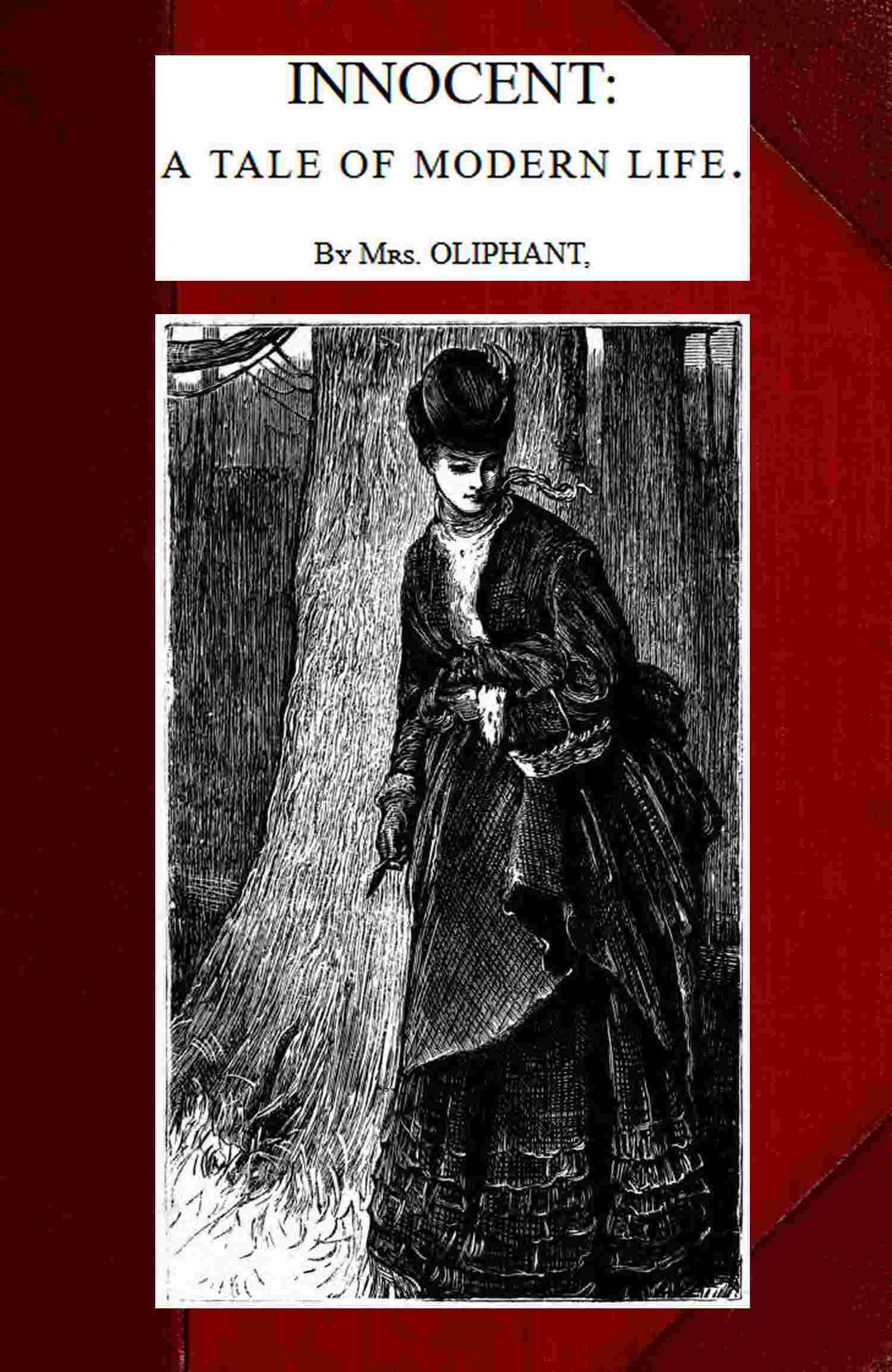
INNOCENT:
A TALE OF MODERN LIFE.
By Mrs. OLIPHANT,
AUTHOR OF “THE CHRONICLES OF CARLINGFORD,” ETC., ETC.
FOURTH EDITION, WITH ILLUSTRATIONS.
London:
SAMPSON LOW, MARSTON, LOW, & SEARLE
CROWN BUILDINGS, 188, FLEET STREET.
1874.
[All rights reserved.]
LONDON:
GILBERT AND RIVINGTON, PRINTERS,
ST. JOHN’S SQUARE.
CONTENTS.
INNOCENT:
A TALE OF MODERN LIFE.
CHAPTER I.
THE OLD HOUSE.
HE Eastwoods lived in an old house in one of the southwestern suburbs of London. It was one of those houses which, dating only from the prosaic age of Queen Anne, have come to be picturesque in their way—which they were never intended to be—and are comfortable, which they were intended to be, to a degree rarely attained by all our modern efforts. What advances we have made since then in every way! And yet all Belgravia did not hold a house so thoroughly good for living in, so pleasant, so modest, so dignified, and so refined, as the big brick house, partly whitewashed, partly retaining its native red, lichened all over with brown and yellow mosses, in which, at the outset of this history, Mrs. Eastwood lived with her children. It had been built by the Eastwoods of the time, more than a century and a half ago. It had given shelter to various generations since then—their mortal inn and lodging, the everlasting dwelling-place of their memory. They had left layers, so to speak, of old furniture, from the japanned screens and cabinets of the founder, to the hideous haircloth and mahogany of George IV.; and pictures and knick-knacks, and precious old china for which collectors would have given its weight in gold. All these riches were not shown off to advantage, as they might have been. You stumbled on them in corners; you found them in out-of-the-way cupboards, in rooms that were rarely used. In short, you could not take a walk on a wet day about this delightful house without finding something out that you had not seen before. For my own part I prefer this to the modern device of making a museum or china-shop of one’s drawing-room. The drawing-room was a place to live in at The Elms. It had a hundred prettinesses about, none of which had been bought within the memory of any of the young people, except, indeed, a few foolish knick-knacks belonging to Ellinor—for what girl worth calling such was ever without knick-knacks? But its supreme use was to be lived in, and for this it was infinitely well adapted. Its only drawback that I know—and that many people thought a great advantage—was that, being close to London, you saw nothing from the windows that you might not have seen a hundred miles deep in the country. The drawing-room windows looked out upon a great green lawn, set in old trees. In winter, when the trees had lost their leaves, bits of other old houses, red and mossy, looked in through the bare branches; but in spring the farther end of the lawn was carpeted with primroses, and canopied with foliage, and the long avenue of elms at one side, and the narrower path on the other under the lime-trees, which was called the Lady’s Walk, might have graced a squire’s house anywhere. Both of these ended in a high paling; but I defy you to have found that out when elms and limes alike were in their glory of summer array.
After having said so much about the house, I may introduce you to its inhabitants. Mrs. Eastwood was a widow, and had four children, all as yet at home under the maternal roof. The eldest son was in a public office; the second, Richard, commonly called Dick, was at home “reading” for one of those examinations which occupy all our youth now-a-days. The third boy, who bore the magnificent name of Plantagenet, usually, I am grieved to say, shortened into Jenny, was still at Eton. One only remains to be accounted for, and that was Ellinor. She was but one, counted according to ordinary arithmetic; but she was as good as three additional at least, reckoning by her importance in the household. “If you count girls, there are seven of us; but some people don’t count girls. I’m one,” said one of Mr. Punch’s delightful little boys in the old days of Leech. Ellinor Eastwood might have adapted this saying with perfect propriety to her own circumstances. The boys might or might not be counted; but to enter once into the house without hearing, seeing, divining the girl in it was impossible. Not that she was a remarkable young woman in any way. I don’t know if she could justly be called clever; and she certainly was not more perfectly educated than usual—and does not everybody say that all women are badly educated? Her brothers knew twenty times as much as she did. They had all been at Eton; and Frederick, the eldest, was a University man, and had taken a very good class, though not the highest; and Dick was costing his mother a fortune in “coaches,” and was required by the conditions of his examination to be a perfect mine of knowledge; they ought by all rules to have been as superior to their sister intellectually and mentally as daylight is to darkness. But they were not. I don’t venture to explain how it was; perhaps the reader may in his or her experience have met with similar cases, though I allow that they go against a good many theories. The household was a young household altogether. Mrs. Eastwood herself was under fifty, which, for a woman who has had neither bad health nor trouble in her life, is quite a youthful age. Her eldest son was six-and-twenty. There had never appeared a very great difference between them; for Frederick had always been the most serious member of the family. His name of itself was a proof of this. While all the others were addressed by a perpetually varying host of diminutives and pet names, Frederick had always remained Frederick. I need not point out how different this is from “Fred.” He was the only member of the household who had as yet brought any trouble or anxiety to it, but he was by far the most proper and dignified person in the house. The rest were very youthful indeed, varying, as we have said, from the light-hearted though sober-visaged youthfulness of seven-and-forty to the tricksey boyhood of sixteen. It was a house, accordingly, in which there was always something going on. The family were well off, and they were popular; they were rich enough to give frequent and pleasant little entertainments, and they had never acquired that painful habit of asking, “Can we afford it?” which is so dreadful a drawback to social pleasures. I do not intend to imply by this that there was any recklessness or extravagance in this well-ordered house. On the contrary, Mrs. Eastwood’s bills were paid as by clockwork, with a regularity which was vexatious to all the tradesmen she employed; but neither she nor her children—blessed privilege!—knew what it was to be poor, and they had none of the habits of that struggling condition. That ghost which haunts the doors of the less comfortably endowed, which hovers by them in the very streets, and is always waiting round some corner—that black spectre of indebtedness or scarcity had never been seen at The Elms. There was a cheerful security of enough, about the house, which is more delightful than wealth. To be sure, there are great moral qualities involved in the material comfort of having enough, into which we need not enter. The comfort of the Eastwoods was a matter of habit. They lived as they had always lived. It never occurred to them to start on a different pied, or struggle to a higher level. What higher level could they want? They were gentlefolks, and well connected; no sort of parvenu glitter could have done anything for them, even had they thought of it; therefore it was no particular credit to them to be content and satisfied. The morality of the matter was passive in their case—it was habitual, it was natural, not a matter of resolution or thought.
And yet there had been one break in this simple and uncomplicated state of affairs. Four years before the date at which this history begins, an event had occurred to which the family still looked back with a sort of superstition,—a mingled feeling of awe, regret, and pride, such as might move the descendants of some hero who had abdicated a throne at the call of duty. The year in which Frederick took his degree, and left Oxford, Mrs. Eastwood had put down her carriage. I dare not print such words in ordinary type. She said very little about the reasons for this very serious proceeding; but it cannot be denied that there was a grandeur and pathos in the incident, which gave it a place in what may be called the mythology of the family. Nobody attempted to explain how it was, or why it was. It gave a touch of elevating tragedy and mystery to the comfortable home-life, which was so pleasant and free from care. When now and then a sympathizing friend would say, “You must miss your carriage,” Mrs. Eastwood was always prompt to disclaim any need for pity. “I have always been an excellent walker,” she said cheerily. She would not receive any condolences, and yet even she got a certain subtle pleasure, without knowing it, out of the renunciation. It was the hardest thing she had ever been called upon to do in her life, and how could she help being a little, a very little, proud of it? But, to be sure, this sentiment was quite unconscious. It was the only unexplained event in her innocent life. Ellinor, of course, half by instinct, half by reason of that ineffable communion between a mother and an only daughter, which makes the one conscious of all that passes within and without the other almost without words, knew exactly how this great family event had come about; but no one else knew, not even the most intimate friends of the house.
The cause, however, was nothing much out of the course of nature. Frederick, the eldest son and hope, he of whom everybody declared that he was his mother’s stay and support, as good as the head of the family, had suddenly burst into her room one morning before she was up, like a sudden avalanche. He came to tell her, in the first place, that he had made up his mind not to go into the Church, for which he had been educated, and in which he had the best of prospects; and in the second place, that he was deeply in debt, and was going out to Australia by the next ship to repent and make up his deficiencies. Fancy having all this poured into your ears of a cold spring morning in your peaceful bed, when you woke up with the consciousness that to-day would be as yesterday, and, perhaps, still more tranquil and pleasant. Mrs. Eastwood was stricken dumb with consternation. It was the first time that trouble in this shape had ever visited her. Grief she had known—but that curtain of gentle goodness and well-seeming which covers the surface of life had never before been rudely rent before her eyes, revealing the abyss below. And the shock was all the greater that it was Frederick who gave it; he who had been her innocent child just the other day, and who was still her serious boy, never the one to get into mischief. The surprise was so overwhelming that it almost deadened her sense of pain; and then, before she could fully realize what had happened, the real importance of the event was still further confused by the fact, that instead of judging the culprit on his real demerits, she had to pray and plead with him to give up his mad resolution, to beg him not to throw his life away after his money. So urgent did this become that she gradually forgot all about the blame attaching to him, and could think of nothing but those terrible threats about Australia, which gradually became the central fact of the catastrophe. To do him justice, Frederick was perfectly sincere, and had no thought of the admirable effect to be produced by his obstinate determination. Where is the family that does not know such scenes? The result was that the carriage was “put down,” the debts paid, Australia averted; and after a short time Mr. Frederick Eastwood gained, after a severe examination, his present appointment, and all again went merry as marriage-bells. I don’t know whether the examination was in reality severe; but at least Mrs. Eastwood thought so, which pleased her, and did nobody any harm; and as time went on she found to her entire satisfaction that every thing had been for the best, and that Providence had brought good out of evil. In the first place, it was “noble” of Frederick, when he found he could not conscientiously enter the Church, to scorn all mercenary motives, and not to be tempted by the excellent living which he knew awaited him. And then what a comfort and blessing it was to have him at home, instead of away down in Somersetshire, and only paying his family a visit two or three times in a year! Thus the fault faded out of sight altogether by the crowding of the circumstances round it; and Frederick himself, in contemplating (for he was always serious) the providential way in which his life had been arranged for him in a new groove, forgot that the first step in this arrangement had been a very reprehensible one on his own part, and came to regard the “putting down” of the carriage as the rest did—as a tremendous and mysterious family event, calling forth an intense pride and melancholy, but no individual sense of guilt or responsibility so far as he was personally concerned. “I don’t like to take you out in a fly, Nelly,” Mrs. Eastwood would sometimes say, as she gave a last touch to Ellinor’s ribbons, and breathed a soft little sigh. “As if I cared!” cried the girl: “and besides, you can say, like Lady Dobson, that you never take your horses out at night.” Now Lady Dobson was very rich, and in trade, and a standing joke in the Eastwood circle; and the party went off very merry in the fly, with never another thought of the carriage which had been “put down.”
Light-hearted folk! That sudden tempest of trouble and terror which had driven Frederick into the Sealing-Wax Office, and the ladies into Mr. Sutton’s neat flys, gave, I think, on the whole, a zest to their happiness.
The drawing-room at The Elms was a large room, with a rounded end occupied by a great bow window, which opened like a door into a pretty conservatory, always gay with flowers. Opposite the fireplace were three other long and large windows, cut to the floor, from which you looked out over the long stretch of greensward embosomed in great trees which has been already described. In summer, the flower beds which were cut in the grass close under the windows were ablaze with brilliant colour; but in the meantime, on the afternoon when this story opens, nothing was visible but an interrupted golden line of crocus, defining each bed, and depending upon the sun to make the definition successful. When the day was bright the border bristled all round in close array with spikes of gold; but on this particular day it was gloomy, and the line was straggling and broken. On a damp February afternoon the strongest attraction is generally indoors; and the room was bright enough to satisfy the most difficult critic. Mrs. Eastwood had, as every mother of a family ought to have, her particular chair, with her particular little table and footstool, a detached and commanding position, a genial domestic throne, with the supremacy of which no one ever interfered. There was room for any one who wanted counsel to draw a chair by its side, and plenty of room for a big boy to stretch out his lazy length on the rug at its feet, resting a curly head, it might be, on the mother’s footstool. Mrs. Eastwood was seated here in her black gown with violet ribbons, which was her compromise between the world and her widowhood. Sometimes she went the length of grey and red. I don’t know what innocent prejudice she had to the effect that grey and red betokened still some recondite style of mourning; but such was her prejudice. She would have felt a blue ribbon to be profane. Need I say that she was plump, and had perhaps a little more colour than when she was twenty? But there were few wrinkles upon her pleasant face, and no clouds upon her forehead. She had known grief, innocent and holy, but no trouble of that wearing kind which saps the strength and steals the courage out of life, except that one of which the reader has been told; and that, as he has also been informed, had turned out for the best.
Ellinor was the only other member of the family present, except, indeed, a certain small Skye terrier, known by the name of Winks, who was a very important member of the family. As Winks, however, for the present is asleep coiled up in an easy chair, and happily unobservant of what is going on, we may leave him for an after occasion, and pass on to the young lady of the house. What can we say about her? Dear and gentle reader, you know half-a-hundred just like Nelly. She had brown hair, bright, dancing, brown eyes, and a nose which, thanks to Mr. Tennyson, we do not require to describe as retroussé. It was “tip-tilted, like the petal of a flower.” As there was not a straight line about her anywhere, this delicate little turn was appropriate. Although, however, it is true that there was no one straight line about the girl, the combination of a hundred soft curves produced a perfect pose of figure, light, firm, and elastic, like—well, like most girls of twenty. What can one say more? Nelly had no settled place like her mother. She was not restless, nor fidgetty, but she was everywhere at once. I don’t know why it was necessary that she should be always in motion—for she never crossed the room or went from one table to another without a reason for it—but somehow there was a perpetual play of movement and variety in every room where she was. Even when she was absorbed in the tranquillity of needlework, the motion of her hand kept things going. She was like a brook: a soft atmosphere of sound and movement—always soft, always pleasant—belonged to her by nature; but, like the brook, she tranquillized the surrounding scenery; or, like a bird, making the quietness seem more complete by its flitting from one branch to another, and delicious trying over of its favourite notes. Nelly was not alarmingly good, nor perfect in any way I know of; but she fulfilled this mission of the girl, which I fear, among greater aims, is falling a little into disrepute—she filled the whole house with her youth, her brightness, her gaiety, her overflowing life. No great demands of any kind had yet been made upon her. Whether she would be capable of responding to them when they came, no one could tell; but in the meantime she fulfilled her primitive use with the most thorough completeness. She was the life of the house.
Mrs. Eastwood had brought in some letters with her to the drawing-room. They had been delivered at luncheon, and as none looked very pressing, they had been suffered to wait. This happy household was in no anxiety about its letters. That continual fear of bad news which afflicts most of us had no place in the bosom of the easy soul who had but one of her children absent from her, and he within half-an-hour by railway. She went over them at leisure, reading here and there a few words aloud. “Fancy, Nelly, Claude Somerville is going to be married at last,” she said. “I wonder if his people will think her good enough; but indeed they will never think any one good enough; and poor little Mary Martin is going out as a governess. Now, how much better if Claude had married her, and saved such a sad experiment?”
“But did they ever care for each other?” asked Nelly, with open eyes.
“No, I don’t think they did. But what a nice arrangement it would have been! Whereas the girl he is going to marry is an heiress,” said Mrs. Eastwood, “and has no need of him, so to speak. Dear me! I do not mean to speak against Providence; but I should like sometimes to interfere.—Listen! ‘Poor little Mary bears up very bravely. She pretends to make light of it; but what a change it will be from her home, and her father who spoilt her?’”
“Mamma, let us have her here on a long visit,” cried Nelly. “I am sure if she chose she might spend her life among her friends.”
“She is a very independent little thing,” said Mrs. Eastwood doubtfully. “Frederick and she were once rather good friends; but you may write to her if you like, Nelly. It will always be kind. The Claude Somervilles are going to Italy for their wedding trip. Dear me! why can’t people stay at home? one hears of nothing but Italy. And, speaking of that, here is an Italian postmark. I wonder who it comes from.”
A few minutes passed, and Mrs. Eastwood made no further communication. “Where is it from?” Ellinor asked twice, not caring to be kept in suspense, for the correspondence of the house, like other things, was in common. Her mother, however, made no reply. She uttered various half articulate exclamations—“Dear me! dear me! Poor man; has it really come to that!” she murmured as she read. “What is it, mamma!” said Ellinor. Mrs. Eastwood read it all over, cried out, “Good gracious, Nelly!” and then turning back to the first page, read it over again. When Nelly found it impossible to bear this suspense any longer, she rose and went behind her mother’s chair, and looked over her shoulder: “Is it bad news?” she cried, looking at the cramped lines which she could not make out. “Dear! dear me! dear me! what shall I do, Nelly?” said Mrs. Eastwood, wringing her hands; and then she added, “Don’t write to Mary Martin, my dear, here is some one to be looked to of our own.”
CHAPTER II.
THE NEWS, AND HOW IT WAS RECEIVED.
Mrs. Eastwood had scarcely uttered these mysterious and affecting words, when a roll of wheels, a resounding knock, a peal at the outer door, announced visitors. “Oh, call Brownlow, Nelly, quick, before the door is opened!” she said. “Oh, Brownlow, stop a moment; I have just heard of a death in the family. I don’t think I can see any one; I don’t think that I ought to be able to see any one, Nelly?”
“Who is it, mamma?” cried Nelly, taking possession of the letter. Mrs. Eastwood took out her handkerchief and put it lightly to her eyes.
“I don’t mean that I was fond of him,” she said, “or could be, for I did not know him, scarcely—but still it is a shock. It is my brother-in-law, Nelly, Mr. Vane—whom you have heard of. I wonder now, who it is at the door? If it is Mrs. Everard, Brownlow, you can let her in; but if it is Lady Dobson, or Miss Hill, or any other of those people, say I have just heard of a death in the family. Now run! it must be some one of importance, for there is another knock at the door.”
“Mr. Vane—why he is not even a relation!” cried Nelly. “There! Brownlow is sending the people away. My step-aunt’s husband, whom none of us ever saw——”
“It would be more civil to call him your step-uncle, Nelly. People generally do—especially as he is dead now, poor man, and never can take anything upon him. Oh, dear! why, it was Mrs. Barclay, and her brother, Sir Alexis—people I really wanted to see. How unfortunate! Brownlow, I am sure I said particularly, Lady Dobson, or Miss Hill, or that kind of person——”
“You said Mrs. Everard was to come in, mum, and no one else,” said Brownlow, standing very stiffly erect with his tray, and the card on it, in his hand.
“That is how it always happens,” said Nelly, “when you say you are not at home. The nicest people always get sent away: the bores come at other times, and are admitted as a matter of course. Not to say that one should always tell the truth; it is the best policy, like honesty, and other good things.”
“Nelly, you forget yourself,” said Mrs. Eastwood. “When I say not at home, everybody understands what is meant. But in the present instance there is no fib. Of course, now we must keep it up for to-day, at least. You can say, ‘Not a near relation,’ Brownlow; ‘nothing to draw down the blinds for, but very unexpected and a shock.’ That is enough. Poor man! it is true I never saw him but twice, and my father never forgave poor Isabella for marrying him. Poor Isabella! But that is not all, dear. Give me the letter again.”
“I am reading it, mamma,” said Nelly, and she began to spell it out aloud, stumbling over the crabbed Italian, and somewhat mazed by mingled ignorance and wonder. “Here is something about a girl, a young lady. Who is this young lady, and what did you mean when you said some one of our very own?”
“I have been a wicked woman,” said Mrs. Eastwood. “When poor Isabella died, I never asked about the baby; I took it for granted the baby died too. And I did hate the man so, Nelly; he killed her; I am sure he killed her. And here has the poor baby been living all the time! I am a wicked woman. I might have been of some use, and taken her away from that dreadful man.”
“But she seems to have liked the dreadful man. It says here that she cannot be consoled. Poor thing! Don’t you know anything about her, mamma?” cried Nelly. Here Mrs. Eastwood took out her handkerchief once more, and this time cried in earnest with grief and shame.
“I am a hard-hearted, bad woman!” she said; “Don’t contradict me, Nelly. A girl that is my own flesh and blood; and I never even inquired after her—did not know of her existence——”
“Well, mamma, I think I will give you absolution,” said Nelly. “If you did not know of her existence, how could you inquire after her? Did poor Aunt Isabella die when she was born?”
“That is the worst of it all,” said Mrs. Eastwood. “I must make a clean breast of it. I must not deceive myself any more. Yes, I did know of the poor child’s existence. She must have been six or seven when Isabella died. The child had the fever too, and I persuaded myself she must have gone with her mother. For you see, Mr. Vane—poor man, he is dead; we must not speak any harm of him—was so very disagreeable in his letters. I know I ought to have inquired; but I had got to dislike him so much, and almost to be afraid of him——”
“I think it was not quite right of you,” said Nelly, with the gravity of a judge.
“I know it was not,” said the culprit, penitent. “Many a time I have said to myself, I would write, but always put it off again. However, it is not too late now to make amends to her; and as for him——. Give me the letter, Nelly. Oh! to think he should be dead—such a man as that.”
“Well, surely, mamma, he is no great loss, if he was such a man.”
“Not to us; oh no, not to us! Not to any one except himself; but for himself! Think, Nelly. However, we are not called upon to judge him, thank Heaven! And as for the poor child—the poor little girl——”
“It is a long time since Aunt Isabella died,” said Nelly. “How old is the little girl now?”
Mrs. Eastwood had to make a great effort of recollection. She had many landmarks all through her life from which to date, and after a comparison of these, and some trouble in fixing the exact one that answered, she at length decided that her sister’s death had taken place the year that Frederick had his fever, which was when he was sixteen. It is unnecessary for us to go into the details by which she proved her calculation—as that he grew out of all his clothes while he was ill, and had nothing to put on till his new mourning arrived, which was a melancholy business for an invalid. By this means, however, the fact was established, that “the poor little girl” must be at least sixteen, a startling conclusion, for which neither of the ladies were prepared.
“As old as Jenny,” said Ellinor, pondering, with unusual gravity upon her face.
“But then she is a girl, dear, not a boy, remember,” said Mrs. Eastwood. “Jenny is a dear boy, but two of him in the house would be trying—in London. That is the worst of London. When boys are at home for the holidays they have so little scope, poor fellows. I wonder if she has had any education, poor child?”
“I wonder,” said Nelly, still very grave. “Mamma, must this new cousin come here?”
“Where else could she go, Nelly? We must be very kind to her. Besides, she will be a companion for you. It will be very delightful, I don’t doubt, to have her,” said Mrs. Eastwood, with a certain quaver and hesitation in her voice.
Nelly made no immediate reply. “It will be very odd,” she said, after a pause, “to have another girl in the house—a girl not so far off one’s own age. Dear, what an unpleasant sort of creature I must be! I don’t feel quite so sure that I shall like it. Perhaps she will be much nicer than I am; perhaps people will like her better. I am dreadfully afraid, mamma, I am not good enough to be quite happy about it. If she had been six instead of sixteen——”
“Nelly, don’t say anything, dear. She is our own flesh and blood. You would be good to any stranger. As for being nicer than you, my Nelly!—But poor child, poor child, without either father or mother, without a friend to stand by her—inconsolable in a strange country——”
“But, mamma,” said Nelly, scarcely able to keep from crying in sympathy, “it cannot be a strange country to her if she has lived there all her life.”
“That does not matter, dear; nothing can change the fact,” said Mrs. Eastwood. “I have been in Italy, and I know how English people live. They hold themselves aloof. Though they live there all their lives, it is always a strange country to them. And he was not the sort of man to make friends. I dare say she has been brought up by some old servant or other, and allowed to run wild.” Here Mrs. Eastwood paused and sighed. She was the kindest woman in the world, but the idea of a girl of sixteen, with no manners or education, suddenly thrown upon her hands, a new member of her family, brought up under circumstances so different, and no doubt unlike them in every way, was not without its painful side. And she was angry with herself for seeing this, and grieved to think that she had so little natural affection or Christian charity. “Our whole hearts ought to go out towards her, poor thing,” she added, with profound compunction. “She has nobody else in the world to look to; and, Nelly, whatever may be our first momentary feeling, of course there can be no real hesitation——”
“Of course,” said Nelly, springing to her feet. “There is Mrs. Everard’s knock this time, and now I know you will tell her all about it. What room must she have? the little green room, or the room in the wing, or——”
“Dear,” said Mrs. Eastwood coaxingly, “the kindest and the warmest would be the little room, off yours—close to us both—to make the poor child feel at home.”
“I knew that was what you would say,” cried Nelly, half laughing, half crying; “it is exactly like you, mamma; not only take her in, but take her into the very centre of the nest, between you and me.”
“To warm her, poor child,” said the inconsistent mother, laughing and crying too; and Nelly ran off, stumbling in her way against Mrs. Everard, her mother’s friend, whom the rest of the family were not fond of. “Do not knock me down, Ellinor,” said that lady, giving Nelly a kiss, which she received without enthusiasm. Where was Nelly going? Straight up stairs without a pause to the little room which, already in her own mind, she too had destined to her unknown cousin. She went and looked at it with her head on one side, contemplating the little bed, which was decked with faded chintz, and the paper, which was somewhat dingy, and the carpet, which was so worn as to bear little trace of its original pattern. “This will never do,” Nelly said to herself. Her imagination, which was a very lively and sprightly imagination, instantly set off on a voyage of discovery through the house to make up what was wanting. She seized, always in her thoughts, upon here a picture, and there a set of shelves, and rooted out from the lumber-room the tiniest of easy chairs, and made up her mind as to the hangings. I do not mean to say that this was all pure kindness. To tell the truth, Nelly liked the job. The arrangement of the room, and its conversion out of a dingy receptacle for a nursery maid to a bower for a young lady, was the most delightful occupation to her. Did not some one say that a lady had lately set herself up in business as a house decorator? Ellinor Eastwood would have been her apprentice, her journeywoman, with all her heart.
It will be apparent from this that though the first idea of the new arrival startled both mother and daughter, the orphan was not likely to have a cold or unkindly reception. So much the reverse indeed was this to the real case, that by the time Mrs. Eastwood had confided all to her friend she herself was in high excitement and expectation of her unknown niece. Mrs. Everard had condoled with her on the burden, the responsibility, the trouble, every one of which words added to the force of the revulsion in her kindly and simple soul. “God forgive me, Nelly,” she said, when her daughter reappeared in the twilight, “if I thought my own sister’s child a burden, or shrank from the responsibility of taking care of my own flesh and blood. It seemed to hurt me when she said such things. She must have thought that was how I felt about it; when, Heaven knows, the very reverse——”
“It was just like her, mamma,” said Nelly.
“My dear, none of you are just to poor Mrs. Everard,” said the mother, driven back upon herself. She dared not grumble ever so little at this friend of her bosom without giving occasion, so to speak, to the Adversary to blaspheme. Therefore for the sake of peace she gulped down a great many of her friend’s opinions without venturing to say how much she disagreed with them. The two were sitting there, consulting over the fire, when Frederick came in. There were no lights in the room, the shutters were not closed, nor even the blinds drawn, and the trees were dimly discernible like processions of ghosts in the dim air outside. That still world outside, looking in through the window, was somewhat eerie and dreary; when it caught Mrs. Eastwood’s eye she was apt to get nervous, and declare that there was somebody in the grounds, and that she saw a face looking in. But this evening she had other things to think of. Frederick, however, as he came in, felt a shadow of his mother’s superstitions and alarms. The glimmering dark outside seemed to him full of possible dangers. “Why don’t you have the lamps lighted, and shut up the windows?” he said. “I can’t understand your liking for the firelight, mother. One can’t see to do anything, and anybody that chooses can see in.”
“We don’t want to do anything, and we don’t care who sees us,” said Nelly, who was sometimes saucy to her elder brother.
“Don’t wrangle, children: we were discussing something which will startle you very much, Frederick, as it did me. It will make quite a change in everything. Perhaps Frederick will feel it least, being out all day; but we must all feel it,” said Mrs. Eastwood. Frederick seated himself with his face to the window with a certain air of endurance. He did not like the firelight flashing over him, and revealing what he might happen to be thinking. Frederick liked to keep his thoughts to himself; to tell just as much as he liked, and no more. He put his hands into his pockets, and gave a half perceptible shrug to his shoulders. He did not expect to be at all startled. “A change in the fashion, I suppose,” he said to himself. He was supposed to be very fond of home, and a most domestic young man; and this was one of the ways in which he indemnified himself for the good character which he took pains to keep up.
They told him the story from beginning to end, and he was not startled; but he was interested, which was a great deal more than he expected to be. When the lamp was brought in he got the letter; but did not make very much of that, for to Ellinor’s great gratification he could not read it. It was written in Italian, as we have said. Now, Mrs. Eastwood was the only person in the house who knew Italian, though Nelly herself could spell it out. The mother was rather proud of her accomplishment. She had lived in Italy in her youth, and had never ceased to regard that fact as one of the great things in her life. It was with a thrill of pleasure that she read the letter over, translating it word by word. And it was something to have moved Frederick to such interest. He entered into the discussion afterwards with warmth, and gave his advice with that practical good sense which his mother always admired, though she was not unaware that it sometimes failed him in his own affairs. “She cannot come here by herself,” he said; “some one must go and fetch her. You can’t allow a girl of that age to travel alone.”
“That is quite true, Frederick,” said Mrs. Eastwood; “how odd I should never have thought of it before. Of course, she could not travel alone. Dear, dear, what must we do? I cannot go myself, and leave you all to your own devices. Could I send Brownlow, I wonder; or old Alice——?”
“Brownlow would never find his way to Pisa. He would break down long before he got there. And old Alice, what good could she do—an old woman?”
“She travelled with me,” said Mrs. Eastwood, with modest pride. “Wherever I went she went. She learned a little of the language too. She would take very good care of her. Whom else can I send? Dick is too young, and too busy about his examination.”
“If you will pay me well I don’t mind going myself,” said Frederick, stroking his moustache, and thus concealing a smile which lurked about the corners of his mouth.
“You, Frederick? It is very good of you to think of it. I never thought of you. What a pity we cannot make a party, and all go!” said Mrs. Eastwood. “To be sure that would cost a good deal. I would pay your expenses, of course, my dear, if you could make up your mind to go. That would, no doubt, be the nicest way of all. Yes; and although it is a melancholy occasion, it would be a little change for you too. You have been looking rather pale lately, Frederick.”
“Yes, I have been looking pale,” he said, with a little laugh, “and feeling pale. I’ll go. I don’t care much for the melancholy of the occasion, and I should like the change. To be sure, I am not much like old Alice; if the little girl wants a nursemaid I might be awkward——”
“She is sixteen,” said Mrs. Eastwood. Nelly made no remark; but she watched her brother with a scrutiny he did not quite like.
“Do you see anything extraordinary about me, Nell, that you stare at me like that?” he said, with a little irritation.
“Oh, nothing extraordinary,” said Ellinor. There was a frequent bickering between the two, which made the mother uncomfortable sometimes. “I was thinking you must want a change very much to be so ready to officiate as a nursemaid.”
“I do want a change,” he said.
“Don’t wrangle, my dear children,” said their mother; “what is the use of wrangling? You have always done it since you were babies. Nelly, I wish you were not so fond of having the last word.”
“I did not have the last word this time,” said Nelly hastily, under her breath.
“For, if you will think of it, it is very good of Frederick to bestow so much interest on a poor lonely little girl. Neither you nor I, Nelly, though we are women, and ought to have more feeling, ever thought of going to fetch her. The thing is, can you get leave, Frederick? You had your two months in the autumn, and then you had Christmas, and you have been out of town very often, you know, for three days. Can you have leave again so soon? You must take care not to hurt yourself in the office.”
“Oh, I can manage; I am not afraid of the office,” he said; but at this moment Brownlow rung the bell solemnly, meaning that it was time to dress. When they sat down to dinner together, four of them—for Dick had come in in the meantime—they were as handsome a young family party as could be seen. The table was bright with such flowers as were to be had; well lighted, well served. Perhaps of all the party Frederick was the most strictly handsome. He had a somewhat long face, with a melancholy look, which a great many people found interesting—a Charles I. look some ladies said; and he cultivated a small beard, which was slightly peaked, and kept up this resemblance. His features were very regular: and his fine dark brown hair longer than men usually wear it. He was very particular in his dress, and had delicate hands, shapely and white. He looked like a man to whom something would happen, the same ladies said who found out his resemblance to Charles I. There was one thing about him, however, that few people remarked at first sight; for he was aware of it, and did his best to conceal the defect of which he was conscious. He was not fond of meeting a direct look. This did not show itself by any vulgar shiftiness of look, or downright evasion of other people’s eyes. He faced the world boldly enough, forcing himself to do it. There was, however, a subtle hesitation, a dislike to do it, which affected people strangely who found this peculiarity out; it affected them with a certain vague doubtfulness, not strong enough to be called suspicion. This failing it was, undefined and undefinable, which attracted Nelly’s eyes so often to her brother’s face, and produced the “wrangling” which Mrs. Eastwood protested against. Nelly had, without quite knowing it, a wondering curiosity about Frederick; though he was her brother, she had not found him out.
“What’s the new girl’s name?” said Dick, who was exactly like all the other young men going in for examinations who abound in English society, and perhaps scarcely impress the general mind so much as their universal information gives them a right to do. He was not great in conversation, and he was fond of asking questions. Some people thought it was an admirable omen of his future success. If there was a new point to be found out in an exhausted topic, a new detail or particular (for Dick was very practical) which no one had investigated, one of his questions was sure to hit the mark. And it was wonderful, seeing the interest all young persons take in proper names, that this important inquiry had been left to him. “You talk of her as the little girl, and the cousin, and so forth; ain’t she possessed of a name?”
“To be sure; what is her name?” cried Nelly promptly.
Mrs. Eastwood went back into the recesses of her memory. She knew it was a great family name in the branch of the Vanes to which her brother-in-law belonged. It was something very unlike him; that she remembered: very much unlike him; for she recollected quite well thinking so when she heard it first. Not Angel; oh, no, though that was pretty, and quite the reverse of the father. No. Now she recollected. Innocent—that was the name.
“Innocent!” they all said, repeating it one after another all round the table. It impressed the family somehow, and made Mrs. Eastwood—I cannot tell you exactly for what reason—cry a little. There was something that went to her kind heart in the name.
And two days after Frederick started for the Continent, to bring the orphan home.