
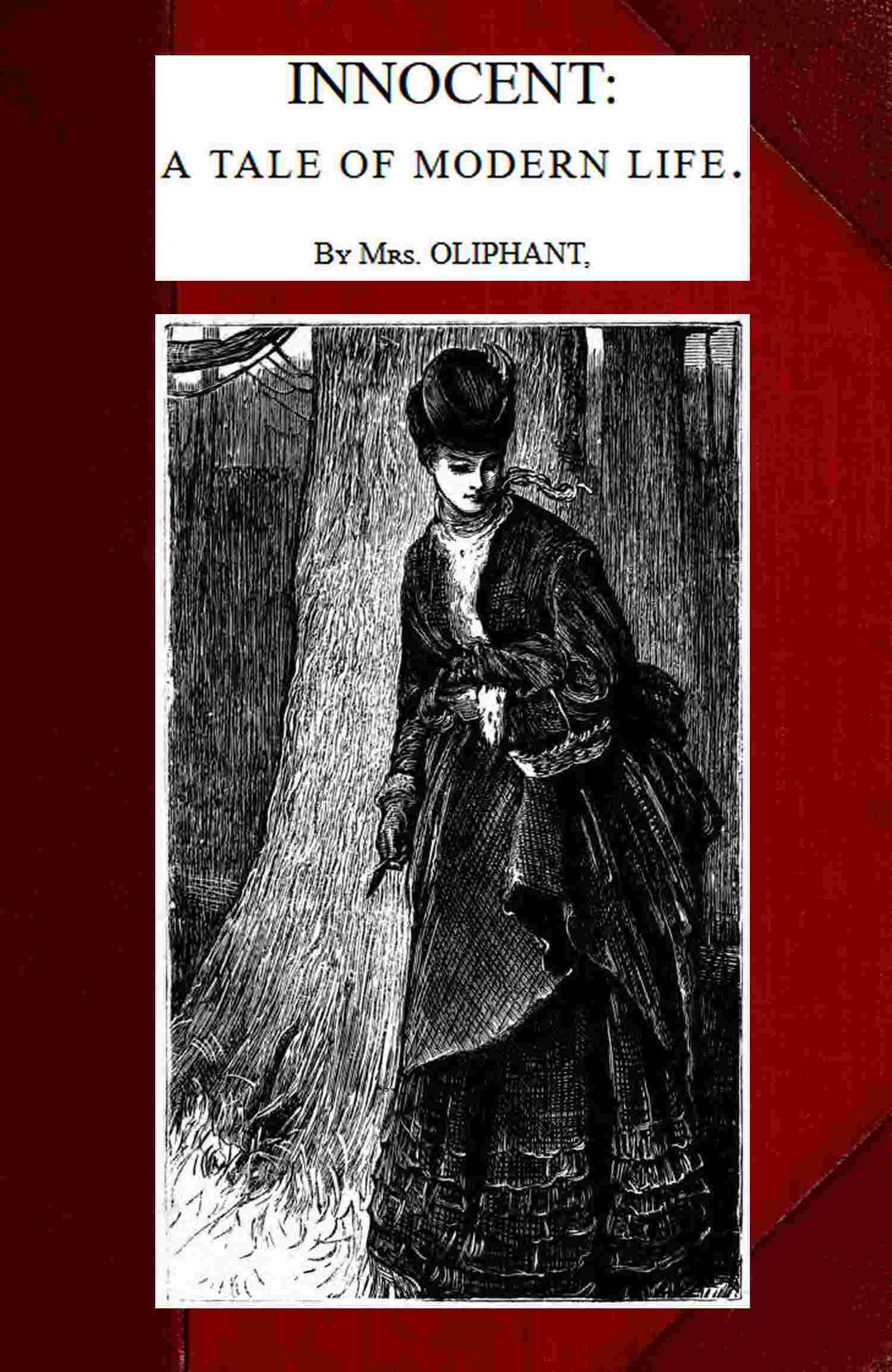
CHAPTER XXI.
A FAMILY DINNER.
While this wild love-fever of Frederick’s had run its course, Nelly’s little drama had also enacted itself, and the interview between Mrs. Eastwood and Mr. Molyneux, Q.C., had taken place, so that the moment had been an exciting one in the family story. The young people were absorbed in their different adventures, and it was only the mother who felt, even though she did not know, all that was going on, on either hand. She did not know what it was which had moved Frederick so much out of his usual composure, which had made him “engaged” and inaccessible to all family invitations or arrangements during one entire week. He had never mentioned Miss Batty or her beauty again, but he had been engaged every evening, going out early and staying late, and making no allusion to where he had been. Indeed during that period he had scarcely seen any of the family, except his mother herself, who had waited to pour out his coffee for him at breakfast, and who saw by his hurried manner and self-absorbed looks that something more than ordinary must be going on. But he had offered no confidences, and Mrs. Eastwood had not gone so far as to ask for any, partly from pride, and partly from a compassionate unwillingness to disturb him any more than he was already disturbed. The time when she could inquire into his troubles and set them right was over. But she was uneasy about him, not knowing what to think, anxious and unhappy; and she was still more distinctly disturbed about the Molyneux business, and the engagements which she might be forced into, against her will and her judgment, on Nelly’s account. The shadow which thus had come upon her overshadowed the whole house, as I have already said. It irritated Ernest Molyneux, and it made Nelly unhappy. Nelly, poor child, had never known what it was to have any cross influences in her life before. She had never been pulled two ways, never divided in her affections or her allegiance. Few people appreciate the difference this makes in a girl’s life. She is taken suddenly in the midst of an existence which is all tender, filial duty, or that sweet counterfeit of filial duty which animates the child’s mind who has a large part in deciding the will of the parent who guides her, and is unconsciously the inspiration of the very laws she obeys. This had been Nelly’s case. She and her mother had been as one soul—the one ruling, the other obeying, but neither able to discriminate from which came the original impulse; and now she felt herself suddenly placed in a position, if not of antagonism to her mother, yet at least of tenderest sympathy and union with one who declared himself so far her mother’s antagonist. This curious turn and twist of circumstances made the girl giddy,—it gave an uncertainty to all things, it confused her old ideas, the ideas which she had held as unchangeable till the day before yesterday, when they were suddenly undermined, and all her old gods made to totter in their shrines.
“Your mother does not like me,” Molyneux said to her one day, when Mrs. Eastwood, disturbed and worried by a communication from his father, had been cold and distant to him. “It is always the way. She was nice enough as long as I was only a young fellow dangling about the house; but as soon as everything is settled, and you are ready to have me, Nelly, she turns off at a tangent. Clearly, your mother does not like me——”
“How can you say so?” cried Nelly. “Oh, Ernest, as if it were possible——”
“Quite possible,—indeed, quite common,” he said, shaking his head. “You don’t know the world, darling, and I don’t wish you to; but when people have to make sacrifices to establish their children, they don’t like it. Nobody likes to have a sacrifice to make. I suppose I thought your mother different, because she was your mother; but human nature is the same everywhere,—though you, Nelly, Heaven be praised, have no knowledge of the world——”
“Is it mamma you mean by the world?” said Nelly, disengaging herself almost unconsciously from her lover’s arm.
“Don’t be vexed dear. Mothers are just like other people. When our interests come to be in opposition to those of our nearest and dearest——”
“How can mamma’s interests be in opposition to ours?” said Nelly, with open eyes.
“Well, I suppose our parents have got to provide for us,” said Molyneux. “They have got to part with so much, on one side and the other, to set us up—and they don’t like it—naturally. When it comes to be our turn we shall not like it either. There is always a struggle going on, though your dear, innocent eyes don’t see it; we trying to get as much as we can, they to give us as little as they can;—that is what makes your mother look so glum at me.”
“We trying to get as much as we can,—they to give us as little as they can?” repeated Nelly, with a dreamy wonder in her tone. She dwelt on the words as if she were counting them, like beads. She had withdrawn, quite involuntarily and unawares, from his side.
“I don’t want to vex you about it,” he said, drawing closer to her. “It can’t be helped, and after it is settled, things will come right again. You don’t know anything about business, and I don’t want you to know about it——”
“I know all about mamma’s business,” said Nelly. She withdrew again with a little impatience from his close approach. She fell amusing and thinking, and made some excuse, soon after, to get away from him. She was startled beyond measure in the straight-forwardness of a soul unacquainted with business. Very strange to her was this unexpected distinction and separation. Was it really possible that her mother’s interests were opposite to her own, for the first time in her life? “We trying to get as much as we can,—they to give us as little as they can,” she said to herself, in the solitude of her room, putting the fingers of one hand against those of the other, as if to count the words. Nelly was bewildered,—her head was dizzy through this strange whirlabout of heaven and earth,—the firm ground seemed failing beneath her feet.
It was about this time that another person appeared on the family scene, a man about whom none of the Eastwoods felt any particular interest, or rather, against whom they had all a decided prejudice. This was John Vane, a distant cousin of Innocent’s father, a squire in the north country, with considerable, but poor estates, who had lived a wandering life for some years, and who was considered by all who knew him “eccentric,” to say the least. His true name was Reginald or Roland, or something of a sentimental and ornamental description represented by the letter R; but Society, which has a way of identifying character by this simple means, called him John. He was a man of three or four and thirty, with a brown complexion tanned by much exposure to wind and weather, and a golden brown beard, which was the chief feature about him to a stranger. His hair had worn off his temples, and he had a threatening of baldness, as if the forest on his chin had drawn all his locks downwards. His forehead was clear and open and white, in contrast with the tanned and much-lined surface of the more exposed parts of his face. He was by no means the nearest or even a near relation of Innocent, but he had lost no time in seeking her out. He arrived on the very day when this first touch of doubt and pain came into Nelly’s belief in her lover; and it was by no means a happy household in which the new comer appeared one bright spring morning shortly after the events we have been telling. His mission was to ask what had become of his cousin’s child, to ascertain in the most delicate way possible what was her position in her aunt’s house, and to offer her, should that prove necessary, a refuge in his own. He made this offer with so much grace and natural kindness that Mrs. Eastwood’s prejudices against him fled like the morning dew. She was prejudiced against everything (except poor Innocent) that bore the name of Vane, and against this John Vane in particular, whose father had been a man of very unsettled opinions, and who was understood to have been badly brought up. Innocent, too, poor child, had been very badly brought up, and Mrs. Eastwood shuddered at the idea of what might follow if the one uninstructed nature was put into the hands of the other. But Mr. John Vane had that sure passport to a woman’s favour—a frank and open countenance, and a pair of smiling eyes which met your gaze frankly. He made so pleasant an impression that Mrs. Eastwood ended by inviting him to a very solemn dinner party which was to take place at her house that evening—a dinner at which “the Molyneuxes” were to be present, though the negotiations between Ernest’s side and Nelly’s side were yet far from being completed. Major Railton, who had been one of the invited guests, had felt his courage fail him at the last moment, and had sent an excuse on account of his health. “Mr. Vane is a kind of a connexion,” Mrs. Eastwood said, doubtfully, when she explained the change to her son. Frederick, who was full of other thoughts, made no objection, and Mr. Vane, who was not less pleased with his new acquaintances than they were with him, accepted frankly. This dinner-party was a very great event in the family; and though dinner-parties are not generally exciting occurrences, I may perhaps be pardoned, for the sake of the issues, if I dwell upon it a little. The chief guests were the Molyneuxes—Mr. and Mrs. and Miss, the latter of whom we may drop out of the present history, having already enough people on our hands. They were both of opinion that Mrs. Eastwood had “kept her eye upon” Ernest for years, and that Nelly had made “a dead set” at him; and they were accordingly dignified and a little condescending in their cordiality. Mr. and Mrs. Brotherton also formed part of the company, along with two other of Mrs. Eastwood’s advisers—Mr. Parchemin and Mrs. Everard; and the party was made up to the number of sixteen (which was all that could be comfortably accommodated at the Elms dinner table) by the presence of Sir Alexis Longueville and his sister. In opposition to the selection of this guest, Nelly had put forth the moral objections to him which her lover had on a certain evening pressed so warmly upon her, but had found, to her great amazement, that Ernest laughed at the whole matter, and declared Longueville one of the best fellows going; while Mrs. Eastwood silenced her with some indignation, declaring that she had known him for twenty years, and would not have any old scandals raked up. Poor Nelly, who knew nothing about the old scandals, but who felt the whole responsibility thrown upon her, withdrew, hot with angry blushes, from the discussion, feeling as if she had shown a shameful knowledge of the evil reports of the past, which the poor child was, in fact, as ignorant of as a baby. “We must forgive and forget,” even Ernest said to her. “Don’t be such a terrible moralist, Nelly.” This, too, wounded poor Nelly, in the ignorance and innocence of her youth.
The dinner went off as such dinners do everywhere. There was a great display of all the Eastwood plate, and the meal itself lasted two hours and a half, and included everything that was out of season, and all that was most costly in the way of eating and drinking. Mrs. Eastwood, at the head of her own table, with Sir Alexis on one side of her and Mr. Molyneux on the other, tried her very best to feel no sort of opposition to the latter, and to look as if nothing but family love and union was symbolized by their meeting. Frederick, at the other end, with his head full of Amanda Batty, endeavoured to give his best attention to the gorgeous Mrs. Barclay and the dignified Mrs. Molyneux. He had his Charles the First look upon him, and he was not judged severely by these ladies, who thought him superior to the rest of the family, and very probably worried by his mother, whom Mrs. Molyneux considered a scheming and worldly person. The other members of the party had, no doubt, their own cares; but their cares do not concern us greatly, except in so far as Nelly was concerned, whose poor little heart was wounded and her mind confused, and who, in her position of fiancée, felt this sort of formal reception of her by her lover’s parents to suggest all kinds of strange doubts and miseries, and to throw uncertainty instead of security upon the bond which had been tied so tightly, yet so happily, in the cold, half-frozen garden but a little while before. No doubt that she loved Ernest Molyneux, or that his love made her perfectly happy, had crossed her mind then. She had been as full of gentle bliss as a girl could be, when she had stolen in with him into the drawing-room in the firelight, frightened lest any one should see how he held her hand, and yet unable to conceive how anything or any one in the world could be ignorant of the new great flood of light and joy which had flooded earth and heaven. In that beatific moment, however, no idea of settlements or negotiations, or the suggestion that Ernest might have done better, or that it was his business and hers to try to get as much as they could, had entered into her mind. There are well-seasoned and justly-regulated minds, even of twenty, which understand all these accessories as well as the oldest of us, and have no nonsense about them, and are robust enough to enter into the whole question “as a matter of business.” But Nelly was not one of these. She had a great deal of nonsense about her. She was shocked, chilled, brought to a stand suddenly, in the first outset of her independent career. Her love seemed to have ceased to be real, now that it was being talked about and struggled over, and Ernest, Ernest himself——. She would not say, even in the depths of her own heart, any more than this; but her poor little heart gave an inarticulate cry when he opened up his philosophy to her with so much confidence, and congratulated himself that she knew nothing of business. Nelly did not know whether, perhaps, among the strange confusions of this world, he might not be right. She saw no way out of the maze. She did not know how she herself, if left to herself, could have bettered it; but her instinctive sense of what was noble and ignoble, lovely and unlovely, was deeply wounded. She was put out of harmony with herself and every one. If life was so—if such gulfs were ready to open under your feet at your very first step in it, was it worth living? Such was the painful question, not yet put into words, that breathed through poor Nelly’s heart.
Mr. John Vane was on one side of her, and Ernest on the other; but Mrs. Everard, who was a great conversationalist, had taken possession of young Molyneux, and was putting him through a catechism. Nelly did not feel herself capable of talk, but the kind looks of her next neighbour were comforting, and he was touched by her downcast, yet bright, face.
“Miss Eastwood,” he said, “may I guess at something? I am a stranger, but I am a connexion. You know your mother admitted my claims. This is a solemn family assembly to celebrate something that is to make your happiness. Have I guessed rightly; and will you forgive me, and let me make my congratulations too?”
Nelly looked up, blushing and bright and sorry, and very much tempted to cry. “Oh, Mr. Vane, I can’t bear it,” she said.
“What, not the happiness? I could bear a great deal of it if it ever came my way.”
“Has it never come your way?” said Nelly, looking at him wistfully. “But I did not mean—the happiness. I have always been very happy. It is the family assembly, and the talk, and the congratulations. If you don’t know, you can’t think how they hurt, how they——”
“Take the bloom off?”
“I suppose that is it,” said Nelly, with a soft little sigh.
Vane, who had a great deal more experience than she gave him credit for, looked past her at her lover, and concluded, on perfectly insufficient grounds, that Molyneux was not worthy of Nelly. The ladies of Ernest’s family were not only convinced of the fact that Nelly was quite unworthy of him, but that Frederick also was really misplaced in such a family. Why such ideas should be so readily entertained by the different halves of humanity, I cannot tell. It was something in Nelly’s tone and something in the cut of Ernest’s nose which decided Mr. Vane.
“And would it be impertinent of a stranger, who is a connexion, to ask if it is all settled,” he said, “and when it is to be?”
“Nothing is settled,” said Nelly, with a deeper blush than ever; and after a pause she turned to him with a despairing simplicity, which he did not quite understand. “Mr. Vane,” she said, “I should like to ask you something. You say it has never come your way. Yet you look as if one might ask you things. Do you think that people, relations, those who have been each other’s dearest friends—or more than friends—I mean,” said Nelly, “one’s father or mother even—do you think they change to you, when your interests are in opposition to theirs?”
“One’s father or mother?” said Vane, trying to follow her thought; “but that must be so rare a case, Miss Eastwood.”
“You think so too?” said Nelly brightly, recovering herself in a moment. “That is my opinion; but they tell me I know nothing of the world. How can one’s interests be in opposition to those of one’s own people? Since ever I have known anything, I have been taught the contrary. I am so glad you think as I do.”
“But stop a little,” said Vane, “perhaps we are going too far. Suppose we were to take an instance. Regan and Goneril felt their interests to be in opposition to their father’s, and it did make a great change in them. If we were to ask more than we ought from our nearest relation, it would wound his sense of justice and his trust in us; even love might be impaired. I have known men who threw themselves upon their friends to save them from ruin, real or supposed, and to whom there was no change of feeling. And I have known others who made demands upon the same friends for no greater sacrifice, to whom it was given with a sore heart and a deep sense of injury. All the difference depends upon the circumstances.”
Nelly grew wistful again; she was not satisfied. “Tell me this, then,” she said in a low voice, which he had to stoop to hear. “Is it natural that we should be always trying how much we can get, and they how little they can give?”
“Any one who told you so,” said Vane indignantly, “must have the lowest and meanest conception”—then he caught Nelly’s eye with a mingled look of fright and entreaty in it, which at the moment he could make nothing of, but which touched some instinct in his mind more capable of action than reason, and compelled him to change his tone. “I mean,” he said, with a forced laugh, “that this is the conventional way in which we speak in society, which sounds terrible but means nothing. It is the fashionable cynical view, which we all pretend to take to hide the real feeling, which it is not English to show. How didactic you have made me, Miss Eastwood, and what a serious strain we have drifted into! I am afraid you will never sit next to me again.”
“Indeed, I will, and like it,” said honest Nelly, smiling at him with her heart in her eyes. It seemed to Nelly that here was a sort of big brother, kinder than Frederick, wiser than Dick, who had suddenly come to her aid to disentangle for her that ravelled skein which had troubled her mind so much. She turned round to Ernest forthwith, and whispered something to him with a sweet compunction, to make up for the injustice she had done him in her heart. Mr. Vane, I am sorry to say, was not moved with like sentiments. He gave a short, audible breath of impatience through his nostrils, which he ought not to have done, and glanced at young Molyneux over Nelly’s head, and said to himself, “Confound the fellow!” I have observed that, towards a young man in Ernest’s position, this is a common sentiment—with men.
Innocent was on her cousin’s other side. Mrs. Eastwood had hesitated much about this, feeling that at sixteen, and with no education, the girl ought not perhaps to be allowed to assist at a dinner party. But Mr. Vane’s presence and the family character of the whole ceremony decided her. It was a very poor pleasure to Innocent. She was dressed in a black tulle dress, like nothing she had ever worn before, and which seemed to transmogrify her and turn her into some one else. Nelly had made a valiant effort to put up her hair, and give her something of the aspect of a young lady of the period, but this even Mrs. Eastwood had resisted, saying wisely, that if Innocent appeared with her hair hanging on her shoulders, as she always wore it, it would be presumed at once that she was “still in the schoolroom” (poor Innocent, who had never been in the schoolroom in her life!), a girl not yet “out.” She answered only “Yes” or “No” to the questions Vane put to her, and would have stolen away from the drawing-room afterwards altogether if she had not been detained by something like force. The great Mrs. Molyneux took condescending notice of her, and plied her with a great many questions, all actuated by an idea of which no one in the family had the smallest conception. “I don’t doubt they neglect her shamefully,” she said to her daughter, after she had ascertained that Innocent neither played, nor sang, nor drew; that she had never been to school, nor had a governess, nor masters, and that, in short, she knew nothing.
I am quite unable to tell why this discovery should have given pleasure to Ernest’s mother, but it did so, and was remembered and made use of afterwards in most unthought-of ways. But Innocent interested more people than Mrs. Molyneux. When Sir Alexis came into the drawing-room after dinner, he requested to be presented to the young stranger. “I think I knew her father,” he said, and he went and sat by her, and did his best to call forth some response. “Since he cannot have the one, he is going to try for the other,” said Mrs. Barclay in Mrs. Eastwood’s ear. But whatever his intentions or desires might be, he did not make much of Innocent, who was frozen back into her old stupefied dulness by the many strange faces and fresh appeals made to her. “You remember your father?” said Sir Alexis, meaning to move her. “Oh, yes,” said Innocent, but took little further interest in hearing about him. Perhaps, had it been Niccolo, he might have moved her more.
“Has she all her faculties?” he asked, hesitating, of Nelly.
“Oh, yes, I think so. She has never been taught anything. She has not got over her strangeness yet, and she does not care for any of us,” said Nelly, “except perhaps——”
Here she paused, not venturing to add the name that came to her lips. Young Molyneux laughed, and took up the words.
“Except, perhaps—yourself, do you mean? You made a wonderful picture once of the cousin whom you expected; how she was to be the most beautiful, clever, learned, accomplished of women, to throw everybody else into the shade; and how, in self-defence, you would have to be cruel to her, to banish her to the schoolroom——”
“That has come true,” said Nelly, smiling, “but it is the only thing. She is not Aurora Leigh.”
“She has a beautiful face,” said Sir Alexis. They all looked at the girl when he said so, for her beauty was not of a kind which struck every beholder at the first glance. She was sitting quite by herself, in the corner which she preferred, with her hands crossed upon her lap, and her head half turned, following Frederick with an undivided gaze. She was not conscious of any observation. She had eyes but for him alone.
CHAPTER XXII.
ABOUT ANOTHER MARRIAGE.
Frederick was in so strangely disturbed a state of mind that this evening’s entertainment—as well as all the other incidents of these hurrying days, which seemed years as they passed, yet appeared to have raced by him helter-skelter as soon as they were gone—was to him as a dream. He did not seem to know what he was about. Whatever he did was done mechanically. He declined all engagements, never went to his club, went home of nights, and shut himself up in the library or his own room, smoking a greater number of cigars than he had ever done in his life before, and thinking of her. Tobacco may be said to be the food of love to the modern man, as it is the food of musing minds, and intellectual work or idleness. Frederick lighted one after another mechanically, and brooded over the image of Amanda. He thought of her in every aspect under which he had seen her. He recalled to his mind, in detail, the times when they had met, and everything that had been said and done. And there came upon him a hunger for her presence which he could not overcome, and scarcely restrain. She was not an interesting or amusing companion in any intellectual way. Her talk was the merest chit-chat. The amusements and occupations she preferred were not of an elevated character; she ignored or was bored by everything serious; she was uneducated, sometimes almost vulgar. But all this made no difference, though he was sensible of it. He made, indeed, occasional efforts to throw off the spell that bound him; to try, if not to forget her, at least to consider all the obstacles that stood between them. Their condition of life was entirely different, and to this Frederick was deeply sensitive. He had trembled to have Batty find him out at his club, or visit him at his office. He had accepted the man’s invitation in haste to get rid of him, that no one might see the kind of person who claimed his acquaintance; and, good heavens! if that very man became his father-in-law! Then Frederick acknowledged to himself that Amanda would be “pulled to pieces by the women.” Men might admire her only too much; but, notwithstanding Frederick’s contempt for women, he felt the deepest angry humiliation at the thought that only men probably would approve of his wife—if she should become his wife. Then he had no means to gratify this sudden passion. He had been very lucky at the office, making his way by a series of deaths and misfortunes to a position which he could scarcely have hoped to hold for five or six years longer. Three or four hundred a year, however, though much for a public office, is not much to set up house upon, according to Frederick Eastwood’s ideas. He had, like Nelly, five thousand pounds, but what was that? he said to himself, having the exalted notions peculiar to the young men of the period. For a young man, living at home in a handsome house, which cost him nothing, and where he could entertain his friends when need was, this was very comfortable; but if he married, and had to keep up an establishment of his own, things would appear in a very different light. The marriage he ought to have made was with some one at least as rich as himself; he ought to have done as his father had done, whose wife had more than doubled his income. All this Frederick was deeply, sadly aware of. He knew that he ought to do exactly the reverse of what he wanted to do; he knew that at the very least he ought to pause and consider carefully all the penalties, all the misery involved. But in the very midst of his wisest thoughts a sudden recollection would sweep away every scrap of good sense he possessed, as well as all that paramount regard for self which had carried him over so many hidden rocks and dangers of which he alone knew. Perhaps it would be wrong to say that love had triumphed over self in this struggle. It was a victory more subtle still—it was the triumph of the self of passion over the self of prudence and worldly well-being. It was gratification as against profit—delight against honour. I may, perhaps, judge him harshly, for this class of sentiment is one, I am aware, in which women are apt to show a want of understanding; but the reader will decide in how far the credit of a generous passion, scorning consequences, may be attributed to Frederick Eastwood. I do not call this kind of frenzy love; but there are many that do. Of the true being called Amanda Batty he knew next to nothing, and what he did know would, had he been in his sober senses, have revolted his good taste, and disgusted all his finer perceptions. Even now he had a vague prevision that he would be bitterly ashamed of her, did she belong to him; and a certainty that he would be more than ashamed of her belongings, whom already he loathed; but the outside of her filled him with a hungry worship, which overcame his reason and all the sane portion of his mind. After he had forced himself to think over all the disadvantages, to represent to himself the descent into another sphere, the want of means, the horrible neighbourhood into which he would be thrown, there would suddenly gleam upon his mind that turn of her soft round shoulder when she flung away from him in disdain; the dimples in it, the velvet texture, the snowy whiteness just touched with tints of rose—and all his wiser self was at once trampled underfoot. Yet he stood out bravely, fighting with himself after the same fashion but more strenuously than he had done on other occasions, when not a lawful love, but a wild, lawless desire for pleasure, possessed him. Never before had he made so long or so hard a stand. In the other cases not much had been in question—a bout of dissipation might carry with it a good many headaches, an empty purse, and, if found out, a slur upon that spotless character which it was Frederick’s pride to maintain; but it could do no more; whereas this would compromise his life. Would it compromise his life? Might it not turn out for the best, as the other event did which had seemed to envelope him in ruin? Could not he cut the Batty connexion altogether—make a condition that she was to be entirely handed over to him, and never inquired about more? And must not his own innate refinement, his constant companionship, reform the beautiful creature herself into all that could be desired? This flattering unction sometimes Frederick succeeded in laying to his soul; but to do him justice he much more generally perceived and acknowledged to their full extent the obstacles in his way, and made his fight honestly, knowing what it was he was fighting against.
Things, however, came to a crisis before very long. He did not himself know how long the struggle lasted; it absorbed him at last out of almost all consciousness of what was going on round him. He kept his usual place, got through, somehow, his usual work, ate and drank, and answered when he was spoken to, and knew nothing about it. During this period perhaps Innocent was the greatest comfort he had. The spring had come with a bound in the beginning of April, after a long stretch of cold weather, and when after dinner he strayed out of doors to wander under the elms, and carry on his eternal self-conflict, it was rather soothing to him than otherwise when his cousin came stealing to his side in the soft twilight. Poor child! how fond she was of him! it was pleasant to have her there. She put her hand softly within his arm, and held his sleeve, and turned with him when he turned, as long as he liked, or at least until his mother’s sharp summons startled them both, and called in the unwilling girl.
“Why can’t they let her alone when she is happy?” he said to himself on such occasions. “Women are so spiteful.”
But when Mrs. Eastwood was otherwise engaged, or forgot, or got tired, as people will do, of constant interference, Innocent would stay with him as long as he pleased, saying scarcely anything—content only to be with him—making no demands on his attention. Sometimes she would lean her cheek softly against his arm, or clasp her hands upon it, with a touching, silent demonstration of her dependence.
“I am afraid they are not very kind to you,” he would say, bending over her, in intervals when he had roused himself from more serious thought.
But Innocent made no accusation; she said, “I like you best,” leaning upon him. Her mind was absolutely as her name. She thought of nothing better or higher in life than thus to be allowed to wander about with Frederick, doing whatever he might want of her, accepting his guidance with implicit faith. He had been the first to take possession of her forlorn and half-stupefied mind, and no one else had room as yet to enter in.
This, as may be supposed, made Mrs. Eastwood very seriously uneasy, and produced remonstrances to which Frederick in his pre-occupied condition paid not the slightest attention.
One evening, however, when he had come to the very verge of the crisis, she went out in the twilight, and took her son’s arm.
“If you must have a companion, Frederick,” she said, attempting a laugh, “I am the safest. You cannot turn my head, or have your own turned. I wish you would pay a little attention to what I say to you.”
“Mother,” he said breathlessly, finding himself forced at last into the resolution he had so long kept at arm’s length; “for the moment it is you who must listen to me.”
She was startled by the vehemence of his tone; but kept her composure. “Surely,” she said, “I am always ready—when you have any thing to say to me, my dear.”
“I have something to say—and yet nothing—nothing particular,” he cried. “The fact is that circumstances—have made me think lately—of the possibility—of marrying——”
He brought out the last words with something of a jerk.
“Of—marrying! You, Frederick?”
“Yes, I. Why not? There is no reason, that I know of, why I should not marry. There are Nelly and Molyneux setting me the example. She is a great deal younger than I am, and he has nothing. I do not know what there should be to prevent me——”
“Nothing, my dear,” said Mrs. Eastwood softly; “but before such an idea enters into a young man’s head there are generally preliminaries. You intend to marry somebody in particular? not just the first that comes in your way?”
“You mean that I should have determined upon the person before I suggest the event?” said Frederick. “One does naturally, I suppose; but let us imagine that to be done, and there still remains a great deal to do.”
“Is this all you can tell me, Frederick?” said his mother, aghast.
“Well, perhaps it is not all. It is all I have any right to tell you, for I have taken no decisive steps. You must be aware, mother, that before I do so I must ascertain what your intentions are—what you are willing to do for me. I can’t live with a wife and an establishment upon what I have. You would not like, I presume, to see your son in a back street, with a maid-of-all-work, living upon next to nothing.”
“Frederick, you have never given me any reason to suppose that you were thinking of this; you have taken me by surprise. I cannot tell you all in a moment without any warning, without the least indication—Frederick, for heaven’s sake,” cried Mrs. Eastwood, struck by sudden terror, “tell me who is the lady! do not keep me in this suspense. You cannot surely mean——”
She was about to say Innocent; but with natural delicacy she paused, looking anxiously at him.
“I don’t mean anybody that you have seen,” he said impatiently. “What is the use of going into particulars? If I told you her name a hundred times over you would be none the wiser.”
“I am the wiser already. I am relieved of one fear,” said Mrs. Eastwood; “but, Frederick, more than ever, if this is the case, you ought to be careful about that poor child. How can you tell what fancies you are putting into her head? You have made me most anxious, both on your account and hers.”
“Pshaw! Mother, I wish you would put away those womanish notions of yours, and for once understand what a man is thinking of when he has a serious object in hand. Dismiss all this nonsense about that baby Innocent. If she is a little fool, is it my fault?”
“If I was in your position, Frederick, I should feel it to be serious, and very much my fault.”
“Good heavens! this is how you treat a man when he wants to talk to you seriously. Will you pay a little attention to me for once without dragging in somebody else?”
“I have paid too much attention to you one time and another,” said Mrs. Eastwood; “and unless you can speak to your mother, Frederick, with proper respect——”
“Oh dear, yes, certainly, as much as you like,” he cried. “I don’t suppose you want me to say honoured madam, or go down on my knees for your blessing.”
There was a moment of silence, during which the fumes of this little quarrel dissipated themselves. He did not want to quarrel—it was contrary to his interests. And neither did she.
“We need not make a fuss about it,” he said, in a subdued tone. “It is natural enough. I shall be seven-and-twenty presently, which is not so unripe an age. I have got on well enough hitherto living at home, though I have never had a penny to spare, and I daresay there are a few debts here and there to look up; but, of course, if I married, the thing would be simply impossible. We could not come and live with you here, even if we wished it, and unless you could make a tolerable allowance, of course it is useless for me to think of such a thing.”
“A tolerable allowance! Frederick, that is what Mr. Molyneux is asking for Nelly.”
“I’d see him at Jericho first,” said Frederick; “a miserly old villain, who has money enough to set up a dozen sons. Why should he come to you? I need not point out to you, mother, the very great difference there is between Nelly, who is only your daughter, and myself, the eldest son.”
“Has the lady anything?” asked Mrs. Eastwood, skilfully making a diversion. “I hope she is very nice, my dear, and very good, both for your sake and my own; and I would not for the world have you mercenary in your marriage; but still I should like to know—has she anything? I take it for granted she has nice connexions, and every thing else satisfactory.”
“I don’t know anything about her means,” said Frederick, in a lordly and splendid way. “That is a question I never thought of asking. She may be richer than I am, though that is not saying much, or she may not have a penny. I cannot tell you. That is the last thing I should have thought it necessary to ask.”
“And indeed you are quite right,” said Mrs. Eastwood, faltering. She had herself inculcated this doctrine. Mercenary marriages she had held up many and many a time to the scorn of her family; but it is one thing to make a mercenary marriage, and another to inquire whether the future partner of your days has anything—“for her own sake,” said Mrs. Eastwood. But as Frederick was in a disagreeable state of mind, and ready to take offence on the smallest provocation, she did not take up this view of the question. The great revelation itself was the chief thing to be considered. “May I not know something at least about her, Frederick? Where did you meet her? So it is this that has absorbed you so much for some time? I have noticed it, though I did not know what it was. Is she pretty, is she nice? Do I know her? You will not refuse to tell me something about her, my dear.”
“I cannot tell you, for there is nothing settled. It would be unfair to her until I know myself,” said Frederick; “but, mother, the first part is entirely within your power. And this is what I wanted—not to pour out any sentimental secrets into your ear, but to ask what I shall have to calculate upon. Of course,” said the young man, whose veins were boiling with impatience, “unless I have some satisfactory settlement with you it would be dishonourable for me to open my lips at all.”
Mrs. Eastwood was silent. She seemed to have lost the power of utterance. Was Molyneux right after all? Was it to be a struggle to the death from henceforth—the children trying how much they could get, the parent how much she could withhold? She had not heard this suggestion made in words; but something like it she asked herself piteously, confused, and startled, and more shocked at herself for the shock and revulsion of feeling which this demand produced on her than with her son for making it. Was it possible that she was not ready instantly on the spot to give to him and all of them whatever they wanted to make them happy? She had said it of herself, and she believed it, that had they asked for the heart out of her bosom, she would have given it, and a kind of horror of herself fell upon her when she felt for the second time a rising of reluctance and almost resistance within her. On that well-remembered morning when the first appeal of this kind had been made to her, when Frederick had come to her bedside and told her he was ruined, no such feeling had been in her mind. She had cast about instantly what was to be done, and had made her sacrifice, with poignant grief for the cause, yet with a distinct pleasure in the power of succouring her boy. But this demand upon her excited no such feeling. Is it possible that a mother can deny her child anything that is for his good? she had asked often enough—and now she herself was in the position of denying. It struck at the very root of all her past principles of action, of all that she had believed and held by throughout her life. What did she care for in this world except her children? What was there in this world that she would not give up for her children? And yet she had (it was incredible) arrived at a moment when two of them asked a sacrifice from her for their happiness which in the depths of her heart she knew herself unwilling to make.
“You do not make me any answer, mother,” said Frederick.
“I cannot all at once,” she said, feeling desperately that to gain time was the best she could do. “You forget, Frederick, that I was totally unprepared.”
“But you must have foreseen that such a thing would happen some day,” he said.
“I ought to have done so, no doubt, but I don’t think I had thought of it. Of course I hoped you would both marry,” she said falteringly. Stray and vague thoughts that the marriage of her children should not have involved as a matter of necessity this attack upon herself floated through her mind—but she was so deeply penetrated by the absolute horror of her own reluctance to satisfy them that she felt unable to suggest any possible blame except to herself.
“I must beg, mother,” said Frederick, “that you will not speak of Nelly and myself as if we were exactly in the same position. Nelly has her fortune. Any further demand on her part is quite ridiculous. I, on the other hand, shall have the credit of the family to keep up. I shall actually be the head of the family on your death——”
On your death! Is there any human mind which is not conscious of a startling thrill and wince when these words are said? Mrs. Eastwood nodded her head in acquiescence, but felt as if her son had calmly fitted and fired an arrow which went tingling into her heart. Of course, what he said was quite true.
“I will consider the whole question carefully,” she said, in a tone which changed in spite of herself, “and I will ask advice. It is strange to take advice between my children and myself, but you have often told me, Frederick, I did not understand business. I must think it all over carefully before I can give you any answer. I have the boys to consider too.”
This she said in a very low tone, not for Frederick, but for herself; for indeed it was at the bar of a private court of her own that she was standing, striving to defend herself, which was not easy. She said this humbly by way of explanation to the judge sitting there, who was a hard judge, and received no weak excuses.
“The boys, pshaw!” said Frederick. “If Dick goes to India, and Jenny into the Church, they are both provided for. I do not see that you need to trouble yourself about the boys——”
“If you had gone into the Church you would have been well provided for,” said Mrs. Eastwood. “Jenny may have difficulties too——”
“Oh, I would make short work with Jenny’s difficulties!” said Frederick. That was totally a different question. He went on expounding his views to her about his brothers till Mrs. Eastwood found the evening cold, and went in shivering a little and far from happy. She had come to one of the enigmas of life of which the fin mot was yet to find, and out of which she could not see her way.
CHAPTER XXIII.
AMANDA.
Frederick’s fever had come to a crisis. The next day was Saturday, and, without waiting his mother’s answer, he went down to Sterborne in the afternoon. He could wait no longer. Sterborne is a little town with a large old church. It would be almost a village but for the minster, which gives it dignity; and all the people of the place are accustomed to consider their minster as their private property, and to exhibit it to strangers as something in which they themselves have had a hand, and for which thanks are due to them—and not only thanks, but shillings and sixpences. Frederick’s arrival at the little inn was accordingly set down without doubt to the attractions of the minster; and while he ate his luncheon the guides who particularly attached themselves to that establishment collected outside, to be ready for his service as soon as he should appear.
“The minster, sir? here you are, sir!” said one sharp small creature, half man, half boy, with elf looks and unnaturally bright eyes. “I’m the reg’lar guide,” said another. “Them fellows there don’t know nothing—not a single haltar, or the names of the tombs as are all about the place.” “I can do you a rubbing of the brasses, sir.” “Here’s photographs, sir, of all the favourite aspects.”
Thus he was surrounded and beset. He could have knocked them all down, with pleasure, as they struggled in his way; but as that was not practicable, he threw their ranks into utter rout by saying plainly, “I don’t want to go to the minster”—a speech which filled the crowd of Sterborne with absolute consternation, and almost produced an insurrection in the place. That any man should profess himself indifferent to the centre of their town and the world startled them beyond measure. “What did he come to Sterborne for, if not to see the minster?” While they dispersed from his path, with an assured conviction in their minds that he must be an infidel and revolutionary, Frederick called the imp who had first offered his services.
“I want to go to Mr. Batty’s,” he said.
“To old Batty’s!” cried the lad, turning a somersault on the spot: “here you are, sir.”
“He’s going to old Batty’s!” cried one of the assistants: and there was a roar of laughter, which Frederick did not understand, but which made him angry by instinct.
“Why did they laugh?” he asked, when he had left that mob behind him, and was following his guide through the High Street.
“We all laughs at old Batty,” was the reply.
“For what reason?” said Frederick sternly: but his conductor only laughed once more. To tell the truth, there was no reason. The ragamuffins of the place had made a custom of it; they “always laughed,” but they could give no reason why. Nevertheless, this very circumstance chilled Frederick. It was not powerful enough to stop him in his enterprise, but it chilled him. His old self—his serious self—sprang up at once, and looked his infatuated and impassioned self in the face, and asked him how he would like to be the son-in-law of a man at whom the very ragamuffins laughed. His foolish self replied that the die was cast, that he had committed himself, and had no way of escape—which, indeed, was a mere pretence, since he had as yet neither seen the lady of his love nor any one belonging to her; but it answered his purpose, and stopped the mouth of the gainsayer.
Batty’s house was in the outskirts of the little town. It was an old-fashioned house, low and straggling, opening direct from the road, with a little brass-knockered door, raised by one white step from the pavement. The door opened into a long passage, at the end of which was another door, which stood wide open, showing a large garden, green and bright with the afternoon sunshine. Mr. Batty was not at home, the maid informed him who opened the door; but if the gentleman would walk into the drawing-room or the garden she would see whether Miss Batty was visible. Frederick, in his restlessness and the agitation of his mind, preferred the latter, and went into the garden in a strange, tremulous state of excitement, scarcely knowing what he was about.
The house had looked pretty and small from the front, with rows of small twinkling windows and a low roof; but at the back the impression was very different. Various rooms built on to the original corps du logis stood out into the lawn, with great bow windows, with green turf at their feet and creeping plants mantling about them. One of these, evidently the drawing-room, displayed handsome and luxurious furniture, of a tasteless but costly kind, through the softly fluttering lace curtains. The garden itself was large and beautifully cared for, showing both wealth and understanding. This gave a little comfort to Frederick’s mind, for gardening is an aristocratic taste. He pleased himself with thinking that perhaps this was Amanda’s doing; for no one could suspect Batty himself of caring so much for mere beauty. He walked about the beds and bosquets with a surprised sense of pleasure, finding the surroundings so much more graceful than he had hoped—and began to feel that his passion was thus justified. Presently she would appear, and fill those paths with light. It would be very different from the aspect under which she appeared in the London hotel. Here she was at home, surrounded by circumstances which she herself had moulded, which were sweetly adapted to her: and here for the first time he could see her as she was. A hope of something better than he had yet known, better than he deserved, stole over Frederick’s mind, he had fallen in love with mere beauty—that beauty which is but skin deep, and which all moralists preach against. Could it be that in so doing he was to find goodness, good taste, and refinement too?
While he was thus musing, the sound of voices reached him from one of the open windows. It was a warm afternoon, almost like summer. A glimmer of firelight made itself visible in at least two of the rooms, and in both of these the windows were open. Frederick had no intention of eavesdropping, but when he heard the voice which he remembered so well he pricked up his ears. I am afraid there are few lovers who would not have done so. At first the talking was vague—not clear enough to reach him; but after a while it became louder in tone. The first to make itself heard was a voice which whimpered and complained, “After twenty years’ work for him and his: twenty years!” it said; and it wavered about as if the speaker was walking up and down the room with agitation. Sometimes she would stand still, and address the person to whom she was speaking, varying from complaint to anger. Frederick did not know this voice. It was only when another speaker burst in, in a still louder tone, that the situation became at all clear to him. The second voice rang at once into his heart. It was melodious enough in its ordinary sound—a round, full voice, not without sweetness; but something altogether new and unexpected came into it with these sharper and louder tones,—
“You are free to go away whenever you choose,” Amanda cried. “I will not be troubled like this. You know what all the doctors have said, and how wicked it is to worry me. No one can know better than you do. You are a wretch; you have no kindness, no feeling. Because you have quarrelled with papa you want to kill me. What is the use of bullying me? You know you can go as soon as ever you please. Go and be done with it. You are always threatening, always saying what you will do——”
“Go!” said the other. “Oh, ’Manda, you to speak of feeling! when I have been here twenty years, and taken care of you from your childhood. But you are as cold and as hard as a millstone, though you are so pretty. Oh, if people only knew how you can talk, and how heartless you are, and the things you say to your mother’s own sister—her that has brought you up and taken care of you for twenty years!”
“Taken care of me, indeed,” cried Amanda; “any servant could have taken care of me. You have been a nuisance since ever I can recollect: always reminding one that mamma was not a lady, and pulling us down as far as you could. What were you? Nothing but a lady’s maid. Here you’ve been tried to be made a lady of, and had handsome dresses given you, and all sorts of things. Of course it was for our own sakes. What was there in you to make us take any trouble? You are old, you are plain, and vulgar, and disagreeable. What right have you to be kept like a lady in pa’s house? You are only good enough to scrub the floor. Why have you always stayed on when nobody wanted you? I suppose you thought you might marry pa when ma was dead and gone, though it’s against the law. Of course that was what you wanted—to be mistress of the house, and get him under your thumb, and rule over me. Try it, aunty! You won’t find me so easy to rule over! Just try! An old, ugly, vulgar, spiteful creature, with no recommendation and no character——”
“’Manda, ’Manda,” cried the other, “Oh, don’t be so cruel!—--”
“I will be cruel, if you call that cruel. There’s more than that coming. What is the good of you, but to make a slave and a drudge of? Why should pa keep you but for that? Aunty, indeed! He was a fool ever to let me call you so. And so he is a soft-hearted fool, or he never would have kept you on for years and years. If he had but asked me, you should have been packed off ages ago. You to put on airs, indeed, and say you won’t do anything you’re told to do! Go, this minute, you wicked woman, and don’t worry me. Fancy, me! to sit here and listen to you as if you were worthy to be listened to—you who are no better than the dirt under my feet.”
“’Manda, you dare to speak like that to your own flesh and blood!”
“I dare do a great deal more,” cried Amanda. “I dare to turn you out of doors, bag and baggage; and I will, if you don’t mind. You old Jezebel—you old hag, as pa says—you horrid painted witch—you wicked woman! Get out of my sight, or I’ll throw something at you—I will! Go away! If you are not gone in one moment—you witch—you old hag——”
Here a smash of something breaking told that the gentle Amanda had kept her word. There was a suppressed cry, a scuffle, a scream, and then the bell was rung violently.
“Oh, I suppose it’s my fault,” cried the other voice, with a whimpering cry. “Bring the bottle out of her room—the one at her bedside. Give me the eau-de-cologne. Here’s she been and fainted. Quick! Quick! ’Manda! I didn’t mean it, dear! I don’t mind! Manda! Lord, you were red enough just now—don’t look so dead white!”
Was it Frederick’s guardian angel that had made him an auditor of this scene? The loud voice declaiming, the string of abusive words, the clash of the missile thrown, were horrible and strange to him as the language of demons. He was thunderstruck. Her language had not always been pleasant to him, but he was not prepared for anything like this. He walked up and down in a state of mind which it would be impossible to describe. His first impulse was flight. There was still time for him to get away altogether, to escape from this horrible infatuation, to escape from her and her dreadful father, and everything belonging to her. Should he go? Then he reflected he had given his card, and so far compromised himself. Was this sufficient to detain a man who had just been subjected to the hardest trial in the world, a sudden disgust for the woman whom he thought he loved? Frederick stood still, he paused, his heart was rent in two. He was within reach of her, almost within sight of her, and must he go without seeing her, unworthy as she might be? It was not necessary, he said to himself, that anything should follow, that he should carry out the intention with which he came. That was impossible—however lovely and sweet and fair she might be, he would not take a low-bred termagant into his bosom. No, no! that was over for ever. But how could he go without seeing her, after he had given his card and announced himself? This would be to expose himself to her wrath and her father’s, in whose power to some extent he was. He could hear the voices through the open window as he wandered about the garden, arguing with himself. Should he go? Should he stay? Strangely enough, though he had been told that agitation might be fatal to her, he was not anxious about her, though he surmised that she had fainted. His disgust took this form. If she were ill after her outbreak, she deserved it. On the whole he was almost pleased that she should be ill. She had humiliated him as well as herself, and he had a vindictive satisfaction in feeling that she was punished for it; but further than this he did not go. No; of course all was over; he could never be her suitor, never ask her to give him the hand with which she had thrown something which crashed and broke at her companion’s head. Never! that was over; but why should not he see her, behold her beauty once more—give himself that last pleasure? He would never seek her again; she had disgusted, revolted, turned his mind away from her. But since he was already so near, since he had given his card, since it would be known at once why he went away, this once, not for love, but for scornful gratification of his contemptuous admiration, just as he would look at a statue or picture, he would see her again.
This was the foolish reasoning with which he subdued the wiser instinct that prompted him to fly. Why should he fly? A woman capable of speaking, acting, thinking as this woman had done, could no longer have any power over a man who, whatever might be his moral character, had still the tastes and impulses of a gentleman. She had made an end of her sway over him, he thought; that dream could never come back again. Nobody but a madman would ask such a creature to marry him. To marry him? to be taken to his mother’s house, and promoted into the society of gentlefolk? Never! He laughed bitterly at the notion. But, thank Heaven! he had not betrayed himself. Thank Heaven! that merely to see her would commit him to nothing. No, he ended by convincing himself the most manly course was to pay his visit as if nothing had happened, to see the syren who was no longer a syren to him, but only a beautiful piece of flesh and blood, whom he might look at and admire like a statue. This was, he repeated to himself, the most manly course. The phrase was pleasant to him. To run away would look as if he had no confidence in his own moral force and power of resisting temptation. But the fact was that there could be no longer any temptation in the matter. To see her, and prove to himself that disgust had altogether destroyed the fierce violent wild love which had swallowed up all his better resolution, was the only manly course to take.
He was standing by one of the flower-beds, stamping down unconsciously with his boot the border of long-leaved crocuses which had gone out of flower, but quite unaware of the damage he was doing, when the maid who admitted him came back. She apologized for keeping him so long waiting. Miss ’Manda had been taken bad sudden—one of her bad turns—nothing out of the common—but now was better, and would he go up-stairs, please?
“Was she well enough to see him?” Frederick asked, with a momentary thrill of alarm, feeling his heart begin to beat.
“Oh, quite well enough. They don’t last long, these bad turns. You will find her a bit shaken, sir, and she didn’t ought to be excited or put out, but she’s better,” said the maid. Better! the scold, the termagant, the beautiful fury; but still Frederick’s heart beat at the thought of seeing her again.
She was lying on a sofa close to the open window, looking very pale and languid, just as she had been on that delicious evening which he had last spent in her company, looking as if nothing but gentle words could ever come out of those lovely lips. The woman whom she had called Aunty, and whom she had been abusing, sat by her holding a white hand, which looked as if it had been modelled in ivory. Was that the hand? One of poor aunty’s cheeks was red as fire, as if she had been struck on it, and she had evidently been crying. But she was full of solicitude for her charge, placing the cushions behind her comfortably, and whispering and soothing her. Frederick asked himself if he had been in a dream. Amanda held out her other hand to him with gentle languor, and smiled at him an angelic smile.
“Is it really you, Mr. Frederick Eastwood?” she said. “We have been wondering over your card. I could not think what could keep you here. Are you staying at the Court? But Sir Geoffrey is not at home——”
“No! I had business in this part of the country, and thought I would avail myself of your father’s invitation—that is for an hour or two. I must return to town to-night,” he answered, proud of his own fortitude, but feeling, oh, such a melting and dissolving of all his resolutions.
“That is a very short visit; but I hope papa may be able to persuade you to stay longer,” said Amanda. “You do not mind my receiving you on the sofa? I have been ill. Oh, you must not be too sorry for me,” she added, laughing, “it was my own fault,—entirely my own fault. I allowed myself to get into a passion. I am sure you never did such a thing. Mr. Eastwood, is it not shocking? I got angry at poor Aunty, here. Yes, I deserve to be whipped, I know I do,—and I always am punished, though not more than I deserve. They told me you were in the garden. I am so much ashamed of myself,—did you know, Mr. Eastwood, what a naughty, naughty girl I was?”
“I heard—something,” said Frederick, feeling all his armour of proof, all his moral courage drop from him. This fair creature, pale with agitation and exhaustion, smiling softly from her pillow,—caressing the hand of her homely attendant,—confessing her fault, this a termagant, a scold, a fury! The thing was ridiculous. Let him disbelieve his ears, his eyes, all his senses, rather than give up his faith in her.
“I don’t know how to look you in the face,” said Amanda, putting up her disengaged hand to hide herself. “Oh, I know I have been so very naughty. Please forgive me. It makes me so ill always. I am not let off. I get my punishment, but not more than I deserve——”
“Don’t speak of punishment!” said Frederick. He was ready to pledge his honour that no word which was not good and gentle could have come from those lips. Miss ’Manda sighed softly and shook her head.
“I have not a good temper. I never had. Unless it is born with you, you can never get it by trying,—and then when I am agitated it makes me ill. Nobody must ever cross me, you know, Mr. Eastwood, or some day or other I shall die——. It is dreadful to think you may die any day without having a moment’s time to prepare.” She rounded off this doleful anticipation with a gentle sigh. She lay back upon her pillows with her colour beginning to come back, but with a delightful gravity on her face. She throw an inkstand at any one? it was totally impossible,—though, indeed, there was a black mark on the carpet which a maid was mopping up, and a stain of ink on the front of Aunty’s dress; but this must have been accidental. Frederick looked at her and forgot his knowledge of the world, and threw away his independent judgment and the evidence of his senses. It must have been a mistake. He had all but seen it with his own eyes, but he felt it could not be true. If it had been true, would the assailed woman, she with the stain on her dress, be sitting by Amanda’s side, still holding her hand, and soothing her? It must have been an accident. Nothing more easy than to push over an inkstand from a table. It was the simplest accident. He suggested it to himself first, and then he believed it strenuously. He drew his chair close by the sofa, and asked what he could do to amuse her. Could he read to her?—what could he do?
“Oh, no,—if you can only stay for an hour or two, talk to me,” said Amanda, “tell me about town. I hate this horrid little place, where nothing ever happens. When any one dies it keeps us quite lively. That is the only kind of amusement we can get. Yes, Mr. Eastwood, sit there,—you have town written all over you. It is so nice to see any one from London; tell me how the parks are looking, and what ladies are most talked of, and what sort of dress is being worn. Tell me if there is any gossip going, or stories about anybody in high life.—Oh, I am so glad you have come to-day when I want rousing up. Do tell me all the London news.”
Frederick, to do him justice, was not much learned in London news. Having been brought up by a good mother, he hesitated to repeat to this young woman the stories he had heard at his club; for there are always stories floating on the surface of society, and they are always to be had at the club. After a while, moved by her persuasion, he did tell her some of them, to her intense interest and gratification,—a gratification which aroused Frederick’s pleasure in telling, and made him forget his scruples. And while he amused her, and received the flattering reward of her interest and attention, he was again inflamed and taken possession of by her beauty. Everything in the shape of reason melted out of his mind as he sat by Amanda’s side. All that he thought of was how to secure her,—how soon he could marry, and bind to himself that beautifulest form, that fairest face. If these had been the days when rash proceedings were possible, Frederick felt that it was in him to have carried her away to his den, as a wild beast carries his prey. The first moment that it was possible, as soon as they were left alone together, he poured out the story of his passion. He could not live without her, he said,—to go away again,—to tear himself from her side was an insupportable idea. Would not she have pity upon him? Thus this foolish young man, notwithstanding all warnings, notwithstanding the immediate interposition of providence and his guardian angel to save him from it, rushed upon his fate.