
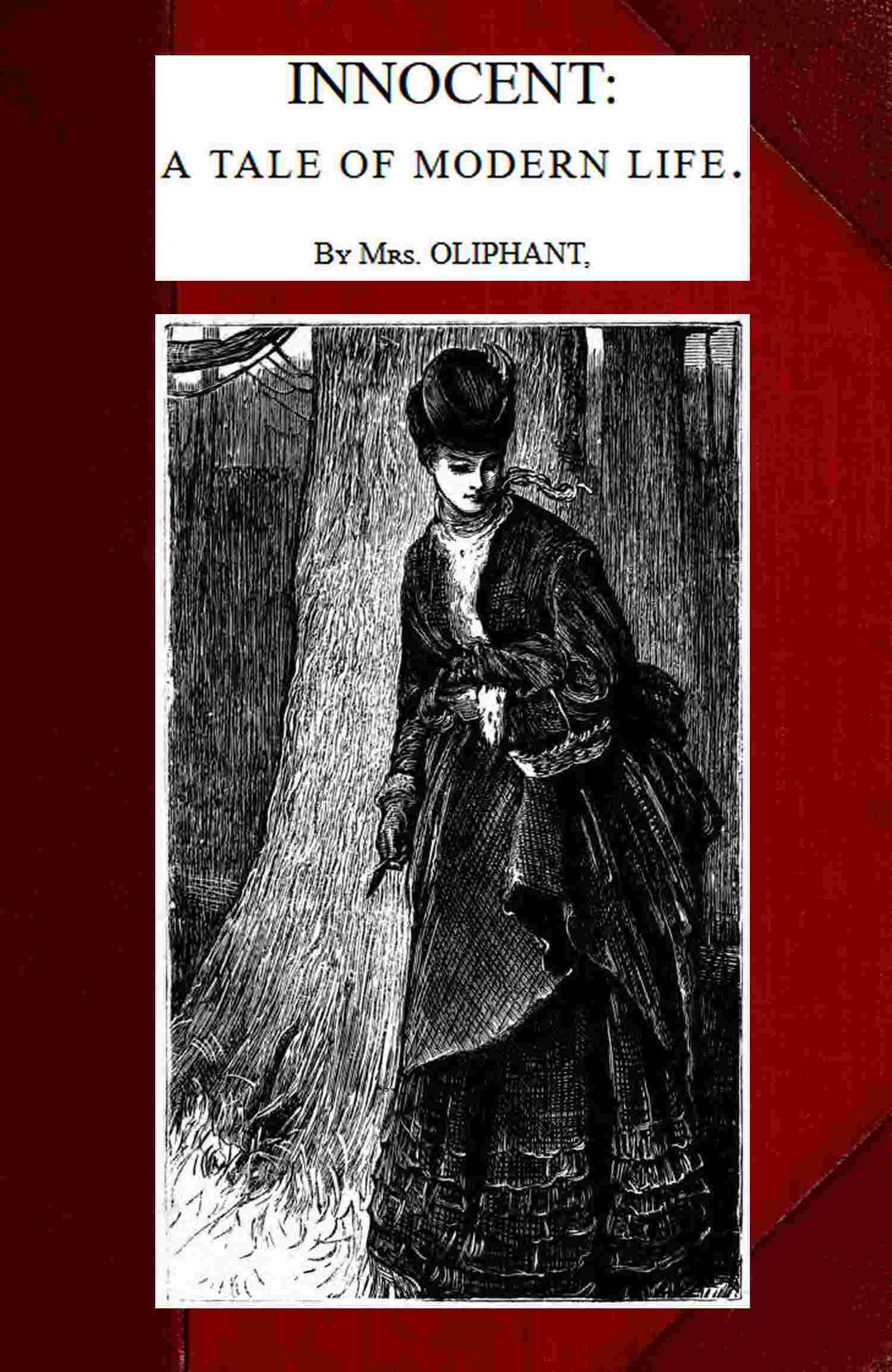
There came a moment, however, when the crisis of this doubtful intercourse between Innocent and her cousin could not be put off further. Mrs. Eastwood and Nelly were dining out, and Frederick had benignly announced his intention of staying at home to take care of Innocent. This benevolent proposal did not quite meet with the gratitude it deserved. His mother immediately hesitated about her engagement, wondered whether it was necessary that she should go, and betrayed a general uneasiness, in which Nelly shared. Innocent took little notice, but she did not look at him with soft grateful eyes as she once would have done. He was piqued, and he was rendered obstinate by this mingled indifference and opposition, and, as her engagement was one which Mrs. Eastwood could not really give up, Frederick had his way. Innocent and Dick and he dined together, and when Dick went off to his studies, as was needful, the two, between whom, as poor Innocent felt, that ghost stood, were left alone. It was winter by this time, and the drawing-room at The Elms was very warm and homelike when the ruddy curtains were drawn, the lamp lighted, and the room full of cheerful firelight. Frederick placed his little cousin in the easiest chair; he drew his own seat near her, and took the book he had been reading to her on the previous evening. It was a soft domestic scene, full of tender brotherly affection, kind and pious duty to that feeblest and gentlest of all the kindred, the youngest, the child of the house. Frederick felt a wave of warm and delightful feeling suffuse his heart. In some cases duty itself is the most pleasant of all pastimes, and this was one of those cases. How lovely that passive, dreamy face was as Innocent sat and listened! She was not at work, as so many women think it necessary to be. She was capable of doing absolutely nothing, sitting with her hands laid loosely across each other in her lap, listening—or dreaming—what did it matter? The book that Frederick read was a story of gentle and unexciting interest, a soft and simple narrative, such as Innocent was capable of following. He felt that it was good of him merely to read such a book—a book not adapted to his manly intelligence, food for babes; to have been seen with it in his hand was a kind of certificate of moral character. He, who had so many memories in his life which were far from being domestic or dutiful, felt in this tender moment such an accession of character as was enough to cover a great many peccadillos. And Frederick loved character as much, or even more, though not with so warm a passion as he liked self-indulgence. How exquisite was the sensation when for once in a way duty and self-indulgence went hand in hand!
“Do you like it, Innocent?” he inquired, after a time, pausing to look at her, and laying down his book.
“Yes,” said Innocent softly; but she did not look at him as she had been wont.
“You do not care very much for books, though? Do you remember, Innocent, in summer, the first summer you were here, when we used to walk about the garden together? you are changed since that time. You liked me better then than you do now.”
“I, Frederick? You were the only one I knew,” she said, with a startled look, moving uneasily in her chair.
“And you know the others now as well as me—my mother, and Nelly, and Jenny, and Dick, and we are all the same to you? Do you know, Innocent, I liked the old way best?”
She made no answer; her hands twined and untwined themselves in her lap; her soft cheek coloured; it was still pale enough, heaven knows—but the faint tint that came upon it was a blush for her.
“I like the old way best,” he continued, taking one of her hands into his. “Innocent, I have been very foolish, I have had a sad life of it for the last year. We must not say anything about the cause; but I have often been far from happy, and I never thought my little cousin would change to me. I could have understood any change in the world sooner than one in you.”
“I have not changed, Frederick.”
“Yes, dear, you have,” he said. “Once you liked nothing better than to sit with me, to walk with me; now you are uneasy and anxious to get away. Your hand is trying to escape from my hand; why should it? Do you know, when you used to put it on my arm in the old days in the garden, the soft little touch was always a comfort to me? Don’t you think I have more need of comfort now? but you take your hand away, Innocent.”
“It is not for that—it is not for that!” she cried. “Oh, Frederick, I must tell you now. My aunt will be angry, and perhaps you will be angry, and never speak to me again; but I must tell you—now.”
“What is it, dear?” he said in his softest tones. “I shall not be angry—nothing can make me angry with you.”
“Oh, Frederick, you don’t know—you never could imagine what I have to tell you. Do not touch me. I am too bad—too terrible! I killed—your wife.”
He looked at her with eyes of utter amazement, turning pale—not at this strange intimation, which seemed madness to him—but at the sharp recall to his real position, and the different ideas involved in it. Then he smiled—a somewhat forced smile.
“My dear Innocent, this is the merest madness,” he said. “I partly understand what you mean. You think it was your innocent presence that drove poor Amanda into this last fit of passion. Put away the thought from your mind, my poor darling—any one else—any trifling accident would have done the same——”
Innocent kept her eyes fixed upon him, learning what he meant from his face rather than from his words—the words themselves were not adapted to penetrate into her mind. But from his face she knew that he was not angry, that he did not understand—that he was soothing her, persuading her that she was mistaken, as her aunt had done.
“It was not the passion—it was what I gave her from the bottle,” she said, her voice falling very low—“her medicine to make her sleep; she shook me—she snatched it from my hand; that killed her—and it was I who did it. Now, now you understand!—and I know you will never speak to me again.”
“Good God!” he cried, and rose to his feet in sudden blind misery and bewilderment, driven wild for the moment by a horrible doubt, which brought up before him in a second of time half-a-dozen scenes and suggestions. He had seen Amanda live through so many paroxysms of passion—why should she have died of that one? And Innocent had fled like a hunted creature from the house; why had she fled? These questions, that never occurred to him before, fell upon him now all at once. He seemed to see again the darkened house, the sudden excitement and horror falling into the ordinary stillness of night, the sudden change from ordinary events and the usual tenor of existence to death—confusion and trouble for the survivors; eternal silence for the one who had been the most exuberant, the most violent in her vitality. God in heaven! was the child mad and raving; or could this horrible confession be true?
Innocent sat very still in her chair, looking at him with fixed eyes. She had made her confession, and calm had returned to her. Her pale, slender hands lay loosely clasped in her lap, relieved against the black dress which she wore as mourning for Amanda. Her eyes were anxious, following his every look and gesture, but perfect calm had fallen upon her slight figure, her habitual attitude. Her secret was told, and all her embarrassment and uneasiness gone. To look at her so, and to believe that she was an actor in any such tragedy was impossible. Frederick was overcome; his eyes filled with tears. He was surprised by an overflow of feeling which he did not know how to restrain. He went to the back of her chair and bent over her, putting down his hand upon hers.
“Innocent,” he cried, “you are dreaming, you are raving; it is impossible, anything is possible but this.”
She lifted her face to him, searching into the expression of his with her anxious eyes. “Oh, do not be angry,” she said, like a child that had done some petty wrong.
The incongruity of the appeal, the words so foolishly simple, the look so tragically anxious, had such an effect upon Frederick as nothing in his life had ever had before. Was the murder of which she accused herself no more to this child than the breaking of a piece of china, the neglect of some trifling duty? God help them all! Wonder, horror, pity, love, all complicated with the mystery of a doubt which could not be shaken off, and a certainty which was above all doubt, distracted the very soul of the man, who could no more understand Innocent than she could understand him. He took her uplifted face in his hands and kissed the forehead again and again. “Innocent, forget this madness,” he said, “you make me wretched as well as yourself, for I love you—I love you better than anything in the world.”
“Ah!” she cried, freeing herself and turning away; “but I cannot forget, I can never forget. For I did it; I did not mean it, but I did it. Do not be angry; but you must never say you love me again.”
CHAPTER XXXVIII.
INTO FURTHER DEEPS.
When Mrs. Eastwood came back she found that Innocent had gone to bed with a headache, and Frederick, with an agitated face, sat silent, brooding over the fire by himself. He had no book nor paper to occupy him, and his face was clouded, as it had been in the days of excitement before his marriage, or those of unhappiness which followed after. He said little while Nelly was in the room, but suggested crossly that she should go and look after Innocent. “If you will take the trouble,” he said. His tone was full of irritation, as it had been in the old times, but seldom in the new. Mrs. Eastwood made Nelly a sign to obey. She saw at once what had happened. She went and stood by her son’s side as Nelly went up-stairs.
“What does this mean, mother?” he said, turning moody eyes, which looked red and feverish, upon her. “What does it mean? Innocent has been raving about something I don’t understand. Surely anything which concerns me so much might have been told me. For God’s sake! what does it mean?”
“A delusion,” said Mrs. Eastwood quietly, laying her hand upon his shoulder.
“A delusion! It is too serious, too terrible, to be a delusion. She must be mad. The shock must have turned her brain.”
“It is mere delusion,” said Mrs. Eastwood, with tears. “I went down to Sterborne, as you know, and inquired into everything. You remember that terrible morning, Frederick? You thought I went out of regard for your wife and her father. I went for Innocent’s sake;—now I can tell you. I inquired into everything. It is a mere delusion; there is no foundation for it, nothing to rest upon. But I cannot chase it from the poor child’s mind, and I knew she would tell you some day. I would not have had you know for much; but now that you do know, you must help me with Innocent. She must be convinced.”
“Tell me the whole,” said Frederick; and she sat down by him by the fireside, and told him everything, omitting only by instinct to mention the presence of the housemaid when poor Innocent made her first confession. He drew from her by degrees every particular of the poor girl’s arrival at home, her consistent story, from which she had never departed, and the little phial which had been clasped in her hand. This she showed him, taking it out of a desk in which she had locked it up. It had still a few drops of the opiate in it, and was labelled with the name of Mrs. Frederick Eastwood, and the date. The sight of this strange piece of evidence made Frederick shiver. It made him feel strangely for a moment, as if Amanda still lived, and could have still such drugs administered to her. “It would be better to destroy this,” he said, taking it out of his mother’s hand. She took it back from him anxiously, and put it in the desk again.
“Why should we destroy it?” she said.
“It is the sort of evidence that would tell,” he said, with once more a nervous shiver.
“Oh, Frederick!” cried his mother, “you don’t mean to tell me that you think—it may be true?”
“I don’t know what to think,” he said gloomily. “Mother, I am very unhappy. I care more for Innocent than I ever thought I did. God help us—it sounds very real. Why should she have taken such a thought into her simple mind?”
“God knows!” said his mother, and, moved in her turn, she began to cry, all her doubts and fears returning at the mere thought that some one else thought it possible, thought it true. They sat together over the dying fire, and talked it over in detail, entering into every particular, every recollection. They drew close together in mutual confidence; but they gave each other no comfort. Broken words that had seemed to have no connexion with anything actual came floating back to their memories. Frederick even remembered, with the feeling as of an arrow which had suddenly struck and stung him, the words he himself had heard as he entered his wife’s room on that eventful night, “Can judges get people off?” and both of them were well aware how freely, how simply Innocent had announced her dislike to Frederick’s wife. I do not believe that Frederick had ever been so deeply affected in his life; but even at that moment there came into his mind a certain sombre consciousness of satisfied vanity which made things look still more black for Innocent. “Her known affection for me will supply the motive at once,” he said; his very vanity made him believe the whole strange tale. His mother wavered between wondering doubts how if it were quite untrue such an idea could have come into Innocent’s mind, taking possession of it so strongly—and a sense that it was impossible, that nothing so hideous and terrible could be. But Frederick, by mere stress of conviction that Innocent loved and had always loved him, found possibility, reality in the story at once. He did not even believe her own dreary assertion that she had not meant it. With the certainty of intuition he felt that, being alone with her rival, some irresistible impulse which she perhaps scarcely understood had come over her, some impulse which, being but momentary, had faded perhaps from her recollection. He was very miserable. If ever self-complacency brought its own punishment, this did. His unhappiness was intense in proportion to his conviction, which allowed of no doubt. “What shall we do with her?” he said.
“Oh, Frederick!” said Mrs. Eastwood, “you take everything for proved; and nothing is proved, not even the very first step. Neither you nor any one at Sterborne had the slightest suspicion. Nobody thought of Innocent as implicated. The death arose from natural causes, which had been foreseen, understood. The doctor himself——”
“Ah, the doctor,” said Frederick, “perhaps I ought to see the doctor. But it might excite suspicion. The doctor was going away—he had got an appointment somewhere abroad.”
“But I saw him,” said Mrs. Eastwood, “he was most distinct in what he said to me—more medical than I could understand—but very clear. He said he had expected it for years, that Mr. Batty knew—that you even had been told——”
“Yes, yes, I know,” said Frederick, “that was all very well. Her heart was affected; and very fortunate it is for us that such an idea existed. But, mother, Amanda, poor girl, has been in a much greater passion with me than she ever could have been with Innocent, and did not die. Why did she die just then, with no one else present, and with this business about the opiate? I wish you would throw that little bottle into the fire. It is the sort of thing which would affect a stupid juryman more than evidence.”
“Oh, Frederick!” said Mrs. Eastwood, trembling and crying; “for God’s sake, don’t talk as if it could ever come to that.”
“Why shouldn’t it come to that? If Batty once gets hold of the story, he will not let it rest, I promise you. He knows I hate him, and have always done so, and he would believe it. Unfortunately, poor Amanda was aware of Innocent’s feeling for me.”
“Frederick,” said Mrs. Eastwood, “Innocent, I am sure, had no feeling for you that an innocent girl might not have for her first friend, her protector, her relation——”
Mrs. Eastwood was not so sure of this as she professed to be, and the want of certainty showed itself in her voice. And Frederick was convinced to the contrary, and felt that he was right, whatever any one might say.
“You did not always think so, mother,” he said. “I wish with all my heart it had not been so—but you must see that this feeling on Innocent’s part changes at once the whole character of the story. It gives it a motive, it makes it possible. A girl would not do such a thing for nothing; but the moment you supply the motive——”
“Frederick, for heaven’s sake! you speak not only as if she had done it, but as if she had meant to do it——”
“I speak as Batty would think, and as his lawyer would put it,” said Frederick, with sombre certainty. “The best thing we could do, mother, would be to send her away. If she were taken to some out-of-the-way place—in Italy, perhaps, as she knows Italy——”
“I cannot give up my poor child’s cause like this,” cried his mother. “Send her away as if she were guilty—banish her from her home——”
“It will be easier, you may take my word for it, to prevent an inquiry than to defend her if once accused,” said Frederick. “To have her accused would be ruin and misery to us all. I might be brought in. Don’t you see that mere acquittal would do little for us? The scandal is the terrible thing; and everybody would believe it, whether it was proved or not.”
Such was the consultation going on down-stairs while Innocent, strangely moved and agitated, lay in her little white bed looking at Nelly. The girl was not as she had been before; new thoughts were in her mind, new troubles in her heart. But she could not confide these to her cousin. She said simply, “I have told Frederick,” as Nelly kissed her and asked after her headache. No such pretences as headaches were possible to her simple soul.
“You have told Frederick?—Oh, Innocent!—of this delusion, this fancy——”
“Of what happened,” said Innocent, “and he was very kind to me; he was not angry. Nelly, tell me—will he always live here——”
“I suppose so,” said Nelly, “but never mind Frederick. Innocent, you promised not to think of this—not to talk of it. It is a dream, a delusion. Mamma told you so. You promised to think of it no more——”
Innocent shook her head with a faint smile. “I cannot help it,” she said. “But you are sure Frederick will stay here always, Nelly?”
“Oh, what has Frederick to do with it?” said Nelly impatiently; and she kissed her little cousin again and bade her go to sleep. When she had got to the door, however, her heart smote her that she had been unkind. She came back with tears in her eyes.
“What have you done, you poor child,” she said, “that you should be tormented like this? Oh, Innocent, say your prayers and ask God to put it away out of your mind.”
“I will try,” said Innocent.
Nelly went to her own room and wept—out of grief, out of pity, out of impatience and impotence. Everything was out of joint, and nothing poor Nelly could do would set it right. When her mother came up some time after and told her the scope of her conversation with Frederick, and his suggestion to send Innocent away, Nelly blazed into generous momentary passion. “Give her up altogether!” she cried. “Send the poor child away whom God has trusted to us——”
“That is what I feel, dear,” said Mrs. Eastwood, “but Frederick says——”
“Oh, I don’t want to know what Frederick says! I am sick of Frederick—and all men,” said poor Nelly. “Mamma, let us all go away somewhere and hide ourselves from this horrible world——”
“Nelly, Nelly,” said her mother with a smile, “which of us would tire soonest of that? You have other bonds which you forget in your haste—and I have the boys.”
When Nelly was told of these other bonds she held her peace, with a flush upon her face. Yes, she had other bonds, and of all the four unhappy people who lay down under the kindly old roof of The Elms on that agitating night, she perhaps was the most unhappy. A heart running over with love, pity, generous impulses, but obstructed wherever her feet turned, unable to leaven her little world with her own generous thoughts, unable to convince it of what seemed so clear to her, bound down by meannesses, by selfishness at which her soul revolted. The others were free more or less to follow their own instincts, but for her she was in bonds—a spirit imprisoned, writhing under the cords that tied her, struggling with her fate.
“Oh, Nelly,” said Mrs. Eastwood before she went to bed, “what can have become of John Vane? He is the one man in the world I could talk to about it all, and who could tell us what was best.”
Nelly made no reply. Her thoughts, too, had travelled perhaps the same way, but even while they did so it made her heart sore and bitter to think that it was John Vane, and not another, who was “the one man in the world” to help them in their terrible strait.
Innocent slept little that night. Something new was working in the girl’s mind. All the household almost without exception believed that she had been “in love” with Frederick from the time he brought her home; and Frederick himself believed it most completely of all, as has been shown. But Innocent herself had never thought of love, had known nothing of it, nor what it was. She had learned it for the first time that night. The discovery she made was not of anything in herself. She, in her simplicity, in her preoccupation, was as quietly still and affectionate in her emotions as she had ever and always been. But Frederick’s looks, his words, his touch, had startled her in her unbroken virginal calm. He had told her he loved her. Perhaps under other circumstances Innocent would have received this with childlike gratitude, and have said to herself simply that he was “kind”—how kind he was! But there was something in this interview which made so gentle an interpretation of the words impossible. Innocent felt without knowing that there was a difference, and the difference alarmed her, she could not tell why. It did not occur to her to think that the outburst was momentary, nor could she have believed that Frederick himself at that very moment was plotting her banishment. The impression made on her mind was not complex but single. He loved her not as the others loved, with a love which Innocent vaguely knew led to other ties and other consequences. This thought did not move her, as does the first suggestion of love which is destined to be happy; it filled her with fright and pain. She felt by instinct that between her and Frederick there was a gulf which could never be passed—a ghost, which kept them apart from each other; yet they were here, under the same roof, compelled to meet daily—and he loved her! The more she thought of it the more alarmed and sick at heart Innocent grew. How could she avoid him, resist him, put away from her all the old habits which had grown into her life? She who had been used to put her hand in his, to take his arm, to talk to him more freely than to any one else—all this would be impossible if he loved her. She would shrink from the warmer incomprehensible sentiment, but how could she shrink from Frederick? What would they all say? What would they think if she, who had so clung to him, were to turn from him? she could not do it. With an imagination newly awakened, which had sprung up suddenly in self-defence, she saw herself constrained to do as Frederick pleased: led with him where he chose to lead her, drawn into new circumstances which she did not understand, yet shrank from. To put these vague sentiments of fright, repulsion, and alarm into words is to do them wrong, and to give to them a distinctness which they did not possess, but words are the only medium I have for conveying to the reader any idea of the state of confusion, shame, pain, and terror which vaguely filled the mind of Innocent. This terror of Frederick’s love was, perhaps, quite undue and unnecessary, since Frederick had already realized the necessity for quenching anything like love for Innocent, and thought himself quite strong enough to do so. But perhaps it was some subtle consequence of the mistaken notion he had so long entertained of her love for him, which produced this mistaken notion on her part of his love for her, and became the motive of the most decided act of her life. She did not sleep. The long, long winter night, which felt as if it would never end, spun out its lingering hours of darkness, while all these things passed darkly through her mind—but as she waked and dreamed there suddenly occurred to her a way of escape—a prospect of help. She had made a promise of which no one knew—a promise which had never before recurred to her mind from the moment she made it; this promise suddenly returned to her memory in her moment of deepest darkness. She had promised if she needed help, if she wanted change—a thing impossible at that moment, impossible a few hours ago, but now so real and so necessary—to seek it from one man; not the friend for whom Mrs. Eastwood sighed, whom Nelly bitterly and against her will involved in her thoughts; a saviour, whose name occurred to poor Innocent now as a sudden and only refuge in her trouble. When she thought of him, and remembered her promise to him, Innocent fell asleep. She had some one in whose hands she could place her difficulty, and at once her own labouring mind, unused to any such burdens, was eased.
She said nothing to any one of her purpose. She felt instinctively that had she spoken of it she would have been prevented from carrying out her intention. She did nothing, and said nothing, even to Alice, until next afternoon, when Mrs. Eastwood and Nelly went out on some necessary business. They thought it too cold for Innocent, and placed her in an easy chair by the fire, with the storybook which Frederick had been reading to her on the previous night. If anything had been wanting to confirm her resolution, this book would have done it. As soon as they were gone she went to her room and dressed herself carefully. She took care to make no appeal to Alice, who would have stopped her, she knew, and dressed herself without aid, taking out her best dress, the new mourning which became her pale and dreamy beauty. No one observed her as she went out, and very swift and straight, looking neither to the right hand nor the left, she pursued her way. She had gone with Mrs. Eastwood and Nelly more than once to the house where Sir Alexis Longueville had so often something to show his friends—now a new picture, now a rare flower, now some costly and elaborate piece of furniture. He was fond of everything that was rare and costly, and his bachelor house was one of the sights which connoisseurs delighted to be admitted to. It was not very far from The Elms, a detached house surrounded by a garden, which, in its way, was a sight too, notwithstanding the near neighbourhood of London smoke. Sir Alexis lived by himself in this dainty dwelling-place. It was like a child to him; he was constantly making alterations, projecting this and that, improving upon the unimprovable; and the house was a show-house. Nevertheless, when Innocent, young and alone, made her way to the door, and asked for Sir Alexis, the man who opened it to her was startled. Sir Alexis had not always been the irreproachable middle-aged gentleman he was now, and his old servant, as well as his old friends, recollected passages in his life which were not such as to make the visit of a young girl alone a natural occurrence. The servant stared at Innocent, and told her that his master was engaged, and made various excuses. But Innocent was imperious to all such hesitations. She would not tell what her business was, she would not be put off. “Tell him I want him,” she said, walking in, in her simplicity. Such a girl, absolutely pre-occupied, unconscious of any evil, pursuing her object without arrière pensée, without fear or thought of harm, is, I believe, safe to go over the world without let or hindrance. She hesitated only when the man asked her her name. “Say it is Innocent,” she answered at last, with a look of perfect gravity which checked the smile which began to form about his lips.
“A young lady?” said Sir Alexis, when the message was delivered to him. “Alone? it must be some mistake.”
“No mistake, Sir Alexis,” said the man, suffering the incipient grin to show itself, but with a cautious watchfulness lest it should be out of place. “When I asked if there was any name, she gave me a queer name. I don’t know if she’s all right here. She bid me to tell you, Sir Alexis, as how it was Innocent——”
“Innocent!” said Longueville, starting up. “You idiot, why did not you tell me? Where have you put her?” and with a haste and anxiety which put all thought of a grin out of his attendant’s head, Sir Alexis rushed out, thrusting away the man, whose mind changed on the subject in the twinkling of an eye.
CHAPTER XXXIX.
AN APPEAL.
“Innocent! you here, and alone—where are the others?” cried Sir Alexis, taking both her hands.
“I have come—because I promised,” said Innocent—“no one knows. You were to help me if I wanted help; I have come—for that. If I ever wanted to go away—to have some one to help me—that was what you said.—Surely you recollect?”
“Recollect! yes, I recollect,” he said, in agitation and dismay, and led her to a seat. He looked at her with a wonder which words could not express, and with a troubled sense of his accountability for having made such a promise which had never occurred to him at the moment it was made. To have her here in his house, all alone, was an indecorum which struck the old man of the world as it never would have struck Innocent. “My dear child, tell me what it is—I will walk home with you,” he said in his confusion, not knowing what other suggestion to make.
“But I do not want to go home,” said Innocent. “I came to you to help me. I have a great deal to tell you; but if they see me they will take me back, they will not understand. Oh, keep me here!—help me as you said——”
“Innocent! you bewilder me. What has happened—what can I do? But, whatever I can do, my dear child, it will be better for you to be at home.”
“I do not think so,” she said; “and I have been thinking a great deal—I have been very unhappy—there is a great deal, a very great deal to tell you. But for thinking of you, I do not know what I should have done. It was because you said so yourself that I have come——”
“Yes, I did say so,” he murmured in his confusion. He was confused, but she was perfectly calm; her eyes met his with their childish look of appeal; no consciousness, no embarrassment, nothing in them that was not simple as her soul. The man’s heart was touched beyond expression. “Yes, my dear,” he said, “I did say so—and this house is yours, and everything in it. You shall stay if you will—you shall do with it as you please. I am grieved—grieved to the heart that you should be unhappy. Have confidence in me—I will do everything for you that I could do for—my own child.”
“Thanks,” she said gently, “you were always kind;” and then seemed to fall into a half-reverie—a dreamy, self-absorbed pause. “I have so much to tell you,” she resumed, “I don’t know where to begin——”
“Tell me first why you have left home?” he asked.
A faint colour came upon her cheek—“That comes last of all,” she said, “and till you hear the first you will not understand. Frederick has come home. He lives with us again as he used to do; and last night—we talked—and he said he loved me. He must not love me, it is terrible so much as to think of it, after what has happened. And how could I live there and see him every day when that is what he is thinking? So I remembered you, and came to you to help me. Now, please, I want to go away—to stay there no longer—Take me, as you said you would—Take me away.”
“Innocent, do you understand what you are saying?” he asked, once more taking both her hands in his. Her words roused him out of all secondary feelings. There was no passion left in his steady, middle-aged soul for any woman; but this strange creature had charmed him by her strangeness, her rarity, the pathos of her beauty. She had refused him as few men are refused, and now had she come to offer herself to him? Middle-aged as he was, he could not refuse to be moved by a quickening thrill of excitement; nothing could have made him an impassioned lover, but he was glad to have her, and his heart grew fond and tender as he held her hands. “Innocent!” he repeated, “do you mean this? Think! Do not encourage me and then disappoint me. There is but one way that I can take you anywhere. You must marry me first; do you know?”
She shrank a little instinctively, looking at him all the time with serious eyes, which shrank not, and then said slowly, “Yes—I know.”
He was so startled by this assent, so taken by surprise, and, at the same time, so put upon his guard by all the decorums and punctilios of which she knew nothing, that he made no such response as a lover might have made. He uttered some broken exclamations in his bewilderment. The surprise was a joyful one; but yet it was a surprise, and brought as much wonder with it as pleasure. Then Sir Alexis remembered suddenly, in the midst of his confusion, what was owing to the self-respect of a woman who had thus rashly risked herself and her womanly credit. He kissed the small, slender, girlish hands one after another with reverential fervour. “Thanks, a thousand times, for your generous confidence,” he said. “I hope I am worthy of the trust. It is settled between us, then, of your free will, Innocent—of your free will? you will be my wife?”
“Yes,” she said once more, grave as if she were uttering the sentence of her own fate. He bent over her, and kissed her forehead; then rising hastily rang the bell.
“Go to my sister,” he said, giving his orders at the door of the room, orders which Innocent neither heard nor comprehended; “and ask her to come to me at once. She will do me a great service if she will be here in half an hour.” Then he came back, and sat down by his future bride.
“Innocent, my darling, now that this is settled between us you can speak to me with confidence. What is it? Frederick would not, could not, have been rude to you? He is a gentleman at least. It is well for me, however, that this happened; but tell me, dear, what it was,” he said, drawing her close to him. It seemed incredible to see her there in his house, bestowing herself upon him, she who only the other day had been so startled by his advances. He was flattered, touched, startled, full of wonder, not knowing what to do or to say.
“Yes,” said Innocent, with a sigh, “but there is a great deal to say first. Perhaps when I have told you, you will cease to care, you will be angry, you will not want me. You say No; but you don’t know what I have to say.”
“Nothing you can say will affect me, my dear,” he said, with almost fatherly fondness, and an incredulous, admiring smile.
“Ah, but you do not know!” cried Innocent; and then her voice fell into a low strain of narrative—gentle yet penetrating and clear as a bell. “I was sent down to the High Lodge——”
“Has it something to do with that?” said the new bridegroom, gradually glowing into elevation of feeling more fitted to the occasion. “Then let us put off talking of it. You have been ill, my poor child. Your pretty cheek is pale. You are looking worn and thin. You shall go to Italy, to Pisa, Innocent——”
“Ah!” she said, with a deep sigh, long drawn out, and tremulous; “but first you must hear.”
“Not first, my darling—after, when we have spoken of things more important. We will go to Longueville first, and then to Italy. You shall take me to your old house, and we will find your old Niccolo——”
“Ah!” she said again, this time with a slight nervous shiver; “but you must hear—first you must hear. When I tell you, perhaps it will change everything. I was sent to the High Lodge; but it is not about that—Frederick saw me in the church, and took me to see his wife.”
“Is it about Frederick and his wife? I am tired of Frederick. You are trembling, Innocent. Leave this story for another time. It cannot make any difference to me.”
“To see his wife,” said Innocent, going on in a low, steady tone, as if, once started, she had no longer power to stop. “She was ill. She used to have fits of being angry. She would raise her voice and scold every one, it did not matter whom, even Frederick. He was very kind to me—he always was very kind.”
“Enough about Frederick,” said Sir Alexis, with some impatience. “Innocent, you cannot think that your cousin is particularly interesting to me.”
“Do not be angry,” she said, with an appealing look. “He took me to his wife. I stayed with her a long time. She made me read. Sometimes she was angry, sometimes she was kind. I read and read; and then I fell asleep——”
“Selfish cur!” cried Sir Alexis, “to put the nursing of that terrible wife of his upon you.”
“I woke up to hear her scolding. Oh, how red she was! how her eyes blazed! She shook me and called to me, and cried that she would strike me. I was not half awake; I was trembling——”
“Poor Innocent, you are trembling now. My darling, what does all this matter? Another time will do——”
“I had to drop the drops,” said Innocent, sinking her voice lower; “I had never done it before. My hand shook and she scolded, and I could not. At last—oh, do not be angry—she seized it out of my hand, and drank it. Listen! she drank it—and then she died. Do you know what that means? I killed Frederick’s wife!”
“Good God! Innocent!”
“I was afraid—I was afraid!—I knew you would be angry!” she cried.
Sir Alexis withdrew the arm he had put round her. He was speechless with wonder and horror. “Good God!” he repeated, when he had found his voice; “what did you do?”
“What did I do?” she asked vaguely, looking at him with wonder and incomprehension.
“Yes; you alarmed the people, of course? You told them what had happened?—you had everything done that could be done? How strange that I should have heard nothing of all this!” he said, rising to his feet.
Innocent’s heart sank within her. She looked up at him with anxious eyes, into which the tears were coming. No one had been angry before. They had all wept over her, comforted her. But now, at last, he was angry in whom she had placed her last hope. Sobs began to rise in her throat; she deserved that he should be angry, she knew—yet she looked up at him with a pitiful appeal against his wrath. She was guilty of killing Frederick’s wife; but of all this that came after—this which she ought to have done, and did not—no one had ever told her. She made him no reply save by her look, by the big tears that rose into her eyes.
He had risen from her side rather in excitement and dismay than with any intention of deserting the poor child who had thus thrown herself upon him. When his eyes returned to her, and he met her piteous look, his heart melted. He came back and sat down by her again. “Poor Innocent,” he said, “poor little bewildered child! What did you do?”
“I came home,” she said, shivering. “When they told me she was dead, I could not stay any longer. It was dark night—very late. I never was out so late before. I came home——”
“And you never told them? you did not say what you had done?”
“Do not be angry!” said poor Innocent, bursting into sobs that were piteous to hear.
He took her into his arms, and did what he could to comfort her. Poor child! poor man, who had bound himself unawares to her foolish fate! He never doubted her story for a moment, nor supposed that she had told him anything less or more than the simple facts; and while he soothed her, and tried to subdue her sobs, his mind set to work seriously, thinking how a way was to be made for her out of this coil which she had woven about her own feet. He was not less sorry for her than the others had been, but his mind was cooler and more ready to act in this emergency. To suppose that she had killed Frederick’s wife, as she thought, was absolute folly, of course, he said to himself; but her flight, her silence as to what she had done, her hurried return home, howsoever effected, would be terribly against her. He set his whole faculties to work to find a way out of it. “I am not angry,” he said to her, “my poor child! how could I be angry? Innocent, Innocent, you must compose yourself. You must stop crying, and let me think what it is best to do.”
Just then the door opened hastily, and Mrs. Barclay bustled in smiling and rustling, and gay, with her ample silken skirts and cheerful countenance.
“What is all this, Alexis?” she said; “what do you want me for in such a hurry? What do you mean by having young ladies here? Ah, Innocent, my sweet! I had it borne in upon me that it must be you.”
Sir Alexis stumbled up to his feet, and Innocent checked her sobs as by magic, and turned wondering to the new comer. “My dear sister, you have judged rightly,” he said. “Innocent has come to me about a difficulty she is in. I will go now to your aunt and see about it, my darling, and my sister will take care of you. Lucilla, this is Lady Longueville that is to be. You are the first to know it; you will take care of my poor little darling? She is ill and nervous! give her some wine, or tea, or something, and make her lie down and rest.”
“That I will,” said kind Mrs. Barclay, “I’ll take care of her—the little puss! I knew this was coming. I said it all along from the very first day you saw her, Alexis; and I hope she’ll be a sweet little wife to you, as good as she’s pretty. I could not say more than that. My dear brother, how I wish you joy!”
And she kissed him heartily, and kissed Innocent, and laughed and cried in honest pleasure, the strangest contrast to the grave emotion, the piteous self-abandonment upon which she came like the very angel of commonplace life, good-humour, and kindly feeling. She went with her brother to the door, shaking hands with him in her satisfaction. “Do you mean to say there has been some quarrel with the Eastwoods?” she said in an undertone.
“No quarrel, but something, I don’t quite know what. Make her rest, Lucilla, and don’t allow her to talk. Let me find her well when I return—for then we must decide what to do.”
“Trust me, I’ll take care of her,” said the cheerful woman, and in another moment Innocent found herself all alone with this stranger, in a new world, deserted by everybody, everything strange around her, except the kind words which she was used to hear, though not from this voice. Her head swam, and there was a ringing as of bells in her ears. But amid the desolation and pain she felt, there was also a sense of calm pervading her whole soul. This time she had put off the burden bodily, and some one else had taken it up. She had a trust in Sir Alexis, which was produced perhaps by the different way in which he had treated her confession. He had gone away to do something, to deliver her somehow. To bring back Amanda to life, perhaps, and make the dream come to an end; the dream of death or the dream of life, it did not seem to matter much to Innocent which was brought to an end. For what was she herself from her first chapter till now but a dream—a very dream?
Sir Alexis, too, felt very much like a man in a dream as he took his hat and buttoned his coat with habitual composure, though his whole being was shaken by the extraordinary position in which he found himself, and the extraordinary revelation just made to him. He walked along the suburban road towards The Elms with his mind full of strange and painful deliberations. His pretty Innocent, the rare and strange creature whom he had coveted as the very crown and flower of all his rarities and costly possessions, was it possible that the first sign of his acquisition of her was this plunge into terrible realities affecting life and death? He took a different view of the matter from that which had occurred to the Eastwoods. He never doubted that things were as she had said, and that Amanda’s death had really been caused by the excessive opiate. Such things had happened ere now, a painful and haunting recollection, no doubt, to those unhappily involved in them, but not coming within any possible range of crime, or calling for the penalties of justice. To any creature in her senses the situation, though most painful, would have been simple enough. Had Innocent alarmed the house at once, had she called for instant help, and informed the attendants what had happened, she might indeed have regretted and grieved all her life, but she would have been delivered from all blame. But—God help the poor child!—she had done everything, on the contrary, to draw suspicion upon her, to give an air of real guilt to her wild proceedings. Sir Alexis could not even make out how it was that up to this time no notice had been taken of such an extraordinary incident. Had the family concluded to hush it up? had they managed to bribe or intimidate the doctor to hush all reports? That seemed almost incredible too. As he went quickly along he planned out and resolved upon a totally different style of proceeding. To have the matter investigated at once, and have Innocent’s real share in it fully ascertained, seemed the only expedient possible. Without that what horrors might hang over her; what accusations ready to be brought up in after days if she made any enemies, or if he made any enemies, which was more likely! Thus he went on with a very anxious face to The Elms, where Innocent’s absence had just been discovered with consternation. Nelly had been searching for her through the garden, and came in breathless through the conservatory, as Sir Alexis entered by the drawing-room door.
“She is not in the garden,” he heard Nelly say, in a tone of fright and anxiety. The ladies were both pale, and looked at each other with miserable embarrassment when he came in. Here was one of those domestic agonies which women have to suffer so often—a terrible emergency demanding all their thoughts, and an indifferent visitor suddenly thrust into it, to whom they must say nothing, betray nothing. Sir Alexis relieved them however at once of their pain.
“You are anxious about Innocent?” he said. “I have come at once to relieve you. She is with me—that is, with my sister—she is quite safe——”
“With you, Sir Alexis? Where did you find her? She must have gone out—for a walk—” said Mrs. Eastwood, struggling to show neither her great surprise nor her still greater relief.
“We are old friends,” cried Sir Alexis, taking Mrs. Eastwood’s hand. “We have known a great deal about each other for years. Do not let it vex you that I know this. Innocent has told me everything; she has put herself in my hands.”
“Innocent—has put herself in your hands?—Are we dreaming, Nelly?” cried Mrs. Eastwood, struck by the apparent slight, the apparent abandonment, and looking at her visitor with mingled offence, mortification, and wonder. “Do you mean that she has gone to you—from us—— Sir Alexis, this cannot be the child’s doing. It is an unpardonable interference—an—intrusion——”
“Hear me first,” he said. “I am guiltless in the matter. It is the child’s own doing. Something frightened her—about Frederick—I cannot tell you what. I had told her that I was at her service if ever she wanted me. You know how one says such words. She came to me this morning. She has consented to be my wife—” he went on gravely, after a pause—“of her own will—and she has told me all her story. Naturally I have come to you at once——”
There was a pause—they looked at each other, each uncertain what was the next step to be taken—the next word to be said.
“She has—consented——” Mrs. Eastwood repeated in dismay. “Sir Alexis, I am her nearest relation, her only guardian;—I cannot let you suffer for the sake of honour. When you spoke to her first there was no such cloud upon her, poor child. I cannot let you take our burden upon yourself.”
“I do not object to the burden,” he said gravely—“with her I accept it, such as it is. I do not ask for your sanction, because you gave it formally—you authorized my addresses to her. The question is now what can we best do to set this painful business at rest—to prove that it was mere accident—a chance that might happen to any one——”
“It is a delusion!” cried Mrs. Eastwood. “A mere delusion! there is nothing in it. Oh, Sir Alexis, believe me, though my children doubt. I hastened down to Sterborne as soon as Innocent came back; I got there on Monday morning—I saw all Mrs. Frederick’s family, every one concerned; the doctor assured me positively that she died of heart disease, as he had expected for years she would. Nobody had the slightest thought of Innocent as any way involved. There is not a suspicion—not an idea—in any mind but her own.”
Sir Alexis had risen as she began this statement, and gradually went forward to her, holding out his hands. Mrs. Eastwood rose, too, half sobbing, as she concluded, and gave him hers.
“Is this true?” he cried, with the water in his eyes, the unspeakable sense of relief proving to him, for the first time, what a horrible weight had been lying on his heart.
“Absolutely true!” she said, through her tears—feeling as she said it convinced by his faith, and by the intensity of her own words. What could be more sure? Every word she said to him was fact, as distinct and clear as it could be expressed—and yet——
Sir Alexis’ relief was so great that he rose into instant exhilaration and happiness. He dismissed the subject for the moment, and unfolded to Innocent’s guardian all he meant and wished to do. No end could be served, he said, by delay. He wished to marry her as soon as possible, to take her to Longueville, to Italy, to restore the freshness of her mind by new scenes. And the others, glad of the relief, entered into this lighter talk, and became almost merry over Innocent’s prospects. Yet Sir Alexis left The Elms almost with as grave a countenance as he had entered it. When the conversation returned to the subject of poor Innocent’s “delusion,” the further information they gave him brought back painful uncertainty to his mind. Was it simple delusion after all—or was there something true at the bottom—something which might still produce grief and sorrow to her, unhappy, and to all concerned?
CHAPTER XL.
FAMILY OPINIONS.
It was thought best that Innocent should be brought back that evening to The Elms, where Mrs. Barclay accompanied her full of smiles and congratulations. “Since he could not have the one, my dear, he set his heart upon having the other,” she said to Mrs. Eastwood; “otherwise I am sure he would never have married at all. He had made up his mind to have one of your girls. A good mother makes a good daughter; that has always been the doctrine in our family,—and oh, how glad I am that the old stock is not to be allowed to die out! It will be such a disappointment to the Huntly Longuevilles, they never could bear Alexis,—and I am sure if I once saw him with a nice wife and a young family, I would wish for nothing more in this world——”
“We must not go so fast,” said Mrs. Eastwood.
“Oh, no, of course we must say nothing about that,” said Mrs. Barclay, nodding and laughing in supreme satisfaction. She and her brother remained to dinner, and but for the moroseness of Frederick, who contemplated the whole matter with almost savage dissatisfaction, the evening would have been a more cheerful one than the Eastwood family had passed for some time. Frederick, however, was half frantic in his opposition when the party dispersed. He asked his mother how she could permit such a sacrifice,—how she could allow such a child to pledge herself to a man old enough to be her grandfather? “If you call that love for Innocent, I don’t know what love means,” he said.
“It is Innocent’s own doing,” said his mother in self-defence; “it is she alone who is responsible. I have had nothing to do with it, for I feel as you do, Frederick,—to some extent.”
“To some extent!—I don’t know how you can limit the extent,” he cried in fiery indignation,—“and how about this,—what do you call it?—this fancy,—this delusion——? She ought not to be allowed to go out of the family with such a notion in her mind.”
“Frederick, I am afraid you will be annoyed,” said poor Mrs. Eastwood, “I was very much distressed myself. She—told him everything;—though, indeed, if they are to be married, it was indispensable that he should know——”
Frederick almost foamed at the mouth with rage and vexation. He refused to believe that Innocent could have done anything of the kind of her own initiative,—he insisted that some one had suggested it, that she had been frightened,—that the idea had been put into her mind. After the improvement and amelioration of his manners, to which they had been gradually getting accustomed, he went to the very farthest bound of their endurance. He would be no party to the arrangement, he declared,—they might carry it out if they would, but without him. Frederick, indeed, was stung to the quick by what seemed to him the most manifold and most complicated invasion of his rights. Innocent had been his slave since ever he knew her, and she was to be taken from him,—and the secret of her delusion, or whatever it was, was exposed to a stranger. His wife’s death, and Innocent’s connexion with it, whatever that might be, all talked of, discussed, pulled to pieces by others! I think Frederick had some ground for general irritation, though he had no right to blame any one individually; he was very sore and very angry at this revolution of affairs; he had begun to think that Innocent was very pretty and sweet, and that he might reward her for her devotion to him, when lo, there came, first this story about Amanda’s death, and then Innocent’s sudden, unaccountable throwing of herself into Longueville’s arms! By degrees he became less sore, and began to think that he understood the latter incident, and Innocent, feeling what a great gulf lay between them now, now that he knew what had happened, had fled to Sir Alexis from her own despair and his. This made him less sore, but not less sorry. He had been conscious that he must think of her no more when he heard her revelation on the previous night, but as soon as further thinking of her was useless, he felt that the revelation she had made was nothing,—that it was indeed mere delusion, as his mother said, and that Innocent, once removed out of his reach, became the thing he most longed for in the world. Altogether, that night brought him little comfort. He was impatient, unhappy, irritable, nay furious; and, naturally, his fury fixed upon those who deserved it least,—upon his mother and sister, who were absolutely innocent, and upon Sir Alexis, who had been brought into the matter by appeal, without any action of his. It was some days after this before he could even secure a chance of speaking to Innocent alone. They kept her from him watchfully, yet so naturally, that much as he chafed, he could say nothing,—and Longueville was there in the evenings, filling him with suppressed rage. At last fortune favoured him, and he found her for a few minutes alone.
“Innocent,” he said, “I fear you are going to take a very foolish step. Who has advised you to do it? You ought not to marry Longueville,—a man whom you cannot care for,—a man so much older than yourself.”
Innocent shrank from him into the corner of the sofa where she was sitting. She made no answer,—but she shrank unquestionably, which made him more angry still.
“You are very foolish,—because you have been unhappy, you determine to be more unhappy, to leave no way of escape for yourself. If you marry that man you can have no sympathy with him. He is older than your father. Was there no one else in the world to help you, Innocent, that you should have referred to him?”
“Do not be angry,” sighed Innocent, softly, turning upon him her anxious, deprecating eyes. “No one else offered to help me. He is very kind——”
“Oh, kind!” cried Frederick, “is any one unkind? When you say such a thing you accuse us all. Surely I could have helped you better than Longueville——”
“Not you, Frederick,” said the girl. She did not withdraw her eyes from him, but a faint flush came upon her face.
“Why not I? You are thinking of this business about—my wife. That was no reason why you should turn from me. Innocent, be wise in time, and give this man up.”
He did not remember that she too had suggested to him to give up his marriage, with more simplicity, but not less unreasonableness. She shook her head half-sadly, half-smiling. She had no wish to marry Sir Alexis. The thought, indeed, filled her with vague alarm when it occurred to her. But he had taken her burden on his shoulders,—he had promised to set it right. And Innocent, not asking any questions, had been able to believe him. Such help no one else in the world had offered her. It seemed the only thing she understood or cared for in her life.
Thus the time stole away,—the interval between this rapid settlement of affairs and the marriage-day, which was so strangely unlike other marriage-days. Innocent had her trousseau prepared like other brides, and The Elms was full of the excitement of the preparations. I am not even sure, notwithstanding all the circumstances involved which tempered the pleasure, that Mrs. Eastwood and Nelly did not derive a certain enjoyment from choosing her dresses, and buying her “things,” and deciding how this and that was to be made. She was passive herself, and took little interest in what was going on, but she was a very patient lay figure in their hands, suffering draperies of all sorts to be tried upon her, without active rebellion. The other ladies had the satisfaction of artists in dressing Innocent. She had never been “dressed” before, and to get her up as Lady Longueville ought to be got up, was a delightful exercise of skill and ingenuity. Men, no doubt, have other solacements of a like character,—but one requires to be a woman to understand the genuine, simple, and natural pleasures which Nelly Eastwood, though her heart was sore, and her mind full of a thousand anxieties, got out of her cousin’s trousseau. To try how one thing after another would look upon Innocent, to see which shade, which fashion would become her best, to fit her out, in short, for her new position, according to their own ideal of what that position was, amused the mother and daughter as few other things could have done, and distracted them from their own cares. If you despise Mrs. Eastwood and Nelly for this, my dear reader, I do not agree with you. The marriage itself was one in which they had no responsibility. They had not been consulted in it—it was Innocent’s own doing,—and considering all the circumstances, and the peculiarity of Innocent’s character, it was, to Mrs. Eastwood at least, as she said, “a matter of great thankfulness,” that Innocent had selected for herself so efficient a protector, so kind a guardian as Sir Alexis. “He will give her everything that this world can give,” Mrs. Eastwood said, addressing an indignation meeting of her own two younger boys which had been hastily convened on the occasion. “He is very fond of her, and will consider her happiness in everything. He is an old friend of the family, and it need not trouble us to know that he is acquainted with all our circumstances.” This last remark was intended for Frederick, who stood sullenly at the window, turning his back upon the others, with his figure relieved against the light.
“Our circumstances?” said Jenny. “Is there anything in our circumstances that may not be known to all the world?”
“That is all very well, mother,” cried Dick, who was less observant, “but I don’t know how you can make up your mind to give Innocent to an old fogie like Longueville. He looks a hundred and fifty. He has old ways of thinking, old habits; in short, he is an old fogie, neither more nor less, and she is eighteen. It is the sort of thing one reads of in novels. Such things don’t happen in real life——”
“My dear boy—” began Mrs. Eastwood.
“At least they oughtn’t to,” said Dick, “and as for its being Innocent’s own choice, what does she know about it? She has been talked over. She has been seduced by all that trash of dresses and finery—-”
Dick had spent half the precious morning helping to decide between a blue silk and a green one, and he was naturally wrathful (after it was over) at that loss of his valuable time.
“Innocent doesn’t care for that sort of thing,” said Jenny. “Has some one been hard upon her? has some one worried her? I don’t know what my mother means about our circumstances. I thought Innocent was to get the same as the rest of us. She may have my share, if that will keep her from marrying old Longueville. I don’t see why she should want to marry any one;—I don’t.”
“How can I explain it to you?” said poor Mrs. Eastwood; “a girl is not like a young man. If anything was to happen to me, what would become of Innocent?—who would take care of her? You, or you? Dick, who is going to India, or Jenny who has his own way to make in the world,—or Nelly? Nelly will have some one else to consult——”
“You seem to put me out of the question altogether,” said Frederick, “though it seems to me I have a right to be considered——”
“You!—oh, Frederick!—when you know how impossible, how out of all question that would be—— But Innocent has put it out of my hands, she has chosen Sir Alexis herself,—and when I think how much more he can give her than I ever could,—what advantages—what means of developing——”
“The fact is, women are all mercenary,” said Frederick, “they cannot help it. Money carries the day with them, whatever may be the drawbacks. I have long known it. Innocent is simple enough in other things, but in this she is like all the rest.”
And thus the family conclave broke up, even Jenny, who was his mother’s champion, being unable to see his way to her defence in this particular. Dick gave up the question with more light-heartedness, being unaffected by theories, but Jenny went back to Oxford somewhat melancholy, wondering if indeed “all women” were to be condemned wholesale, or whether there would be any other meaning in the allusion to the circumstances which could be trusted to Sir Alexis. What these circumstances were, and the special mystery which enveloped poor Innocent, neither of the boys knew.
The effect, however, upon the world at large was very different. In the opinion of the Molyneuxes, for instance, Mrs. Eastwood rose to a far higher degree of estimation than they had ever bestowed upon her before. They even thought it might be as well that Ernest should be “settled,” now that things had taken this turn. Nelly was not a bad match, all things considered, and to be married would probably settle Ernest, and the connexion was good. Besides, when the mother had done so well for her niece, a poor girl whom she had “shamefully neglected,” what might she not aspire to for her daughter? I do not know that Ernest was stimulated in distinct words by these sentiments—but such feelings convey themselves otherwise than by words—and the conviction came to his mind also that now was the moment to conclude his long probation, as he now chose to call it. “Don’t you think I have been kept hanging on and waiting long enough?” he said to Nelly, whom he found immersed in Innocent’s business, one morning, when, contrary to his habit, and very unexpectedly to them all, he sauntered into the drawing-room at The Elms.
“Kept hanging on?” said Nelly, with a surprise she did not attempt to conceal.
“Of course, you don’t suppose it is of my own will that I have waited for you like this,—almost as long as Jacob, eh, Nelly?—longer, I should say, considering how much faster things go now-a-days——”
“I did not know that you had ever tried to shorten it,” said Nelly slowly, growing very red.
“I don’t pretend to be able to subdue circumstances,” said Molyneux; “we are all the victims of them, and I as much as other men. But it seems to me, Nelly, that now’s our chance; now that Frederick has been providentially released from his encumbrance, and that your mother has made this triumphant stroke, and booked old Longueville for Innocent——”
“Ernest! I will not permit such words——”
“Well, well, don’t let us quarrel about the words—now that Sir Alexis is about to be made happy with the hand, &c. By Jove, you may say what you like, Nelly, but it is the cleverest coup I have heard of for a very long time. Altogether the family is in luck; and if you play your cards well, and we can get hold of your mother when she is in a good humour——”
Poor Nelly’s endurance had been greatly tried. Her troubles which she dared not confide to her lover—the sense that he could not be trusted to enter into the closer circle of her family anxieties, and consequently that his sympathy with herself could never be complete—had long been gnawing at her heart and embittering all his careless words and irreverent thoughts. She turned red and then pale, tremulous and then rigid, in the passionate tumult of feeling which took possession of her; but she kept herself calm with all her might, and answered him with an artificial coldness which filled Molyneux half with ridicule, half with dismay.
“How am I to play my cards?” she said, “and what is it that you mean to ask from my mother when she is in a good humour?”
“Nelly!” he said, half laughing, half angry, “what does this tragedy-queen air portend? surely it is a little late to get on stilts with me. Of course you know as well as I do what I have to propose to your mother. We can’t marry without her help; the responsibility lies upon her of keeping you from being settled and done for—I and my people are ready enough. When I talk of playing your cards, I take it for granted you want our business to be decided as much as I do,—and the very first step for us is to know how much she means to do.”
“I look at it in a different way,” said Nelly, plunging desperately into the centre of the question which she had so long avoided. “Ernest, now we must understand each other at last; I will not have any such proposal made to mamma. I will not!—it does not matter what you say. If we cannot do with what we have and your profession, it is better to put an end to it altogether. I have not wished for anything, nor thought of any thing beyond what we could afford,” cried Nelly suddenly, the tears coming in spite of her,—“but I will not take our living from mamma!”
Molyneux was thunderstruck. “Why, Nelly!” he said, in the half-derisive, half-affectionate tone which had so often disarmed her, “you innocent little goose!” and he drew her within his arm. But Nelly was wrought to a point which did not admit of this treatment. She withdrew from his clasp, and stood fronting him, tears in her eyes, but resolution in her face.
“We must understand each other,” she cried. “I have long tried to say it. Now I have had courage to speak, and I cannot go back. I will live as poorly as you like—if you like; but I will not fight with my own mother for money; I will not take our living from hers; I am determined. But I must not bind you,” she added, faltering slightly, “if you think otherwise. If you think otherwise—if there is no other alternative—Ernest, I must set you free——”
“To speak to your mother?” he said, with a laugh in which there was some relief. “I should have done it without all this declamation, Nelly.”
“No,—but to be free from me,” said Nelly, folding closely together the hands which he tried to take.