
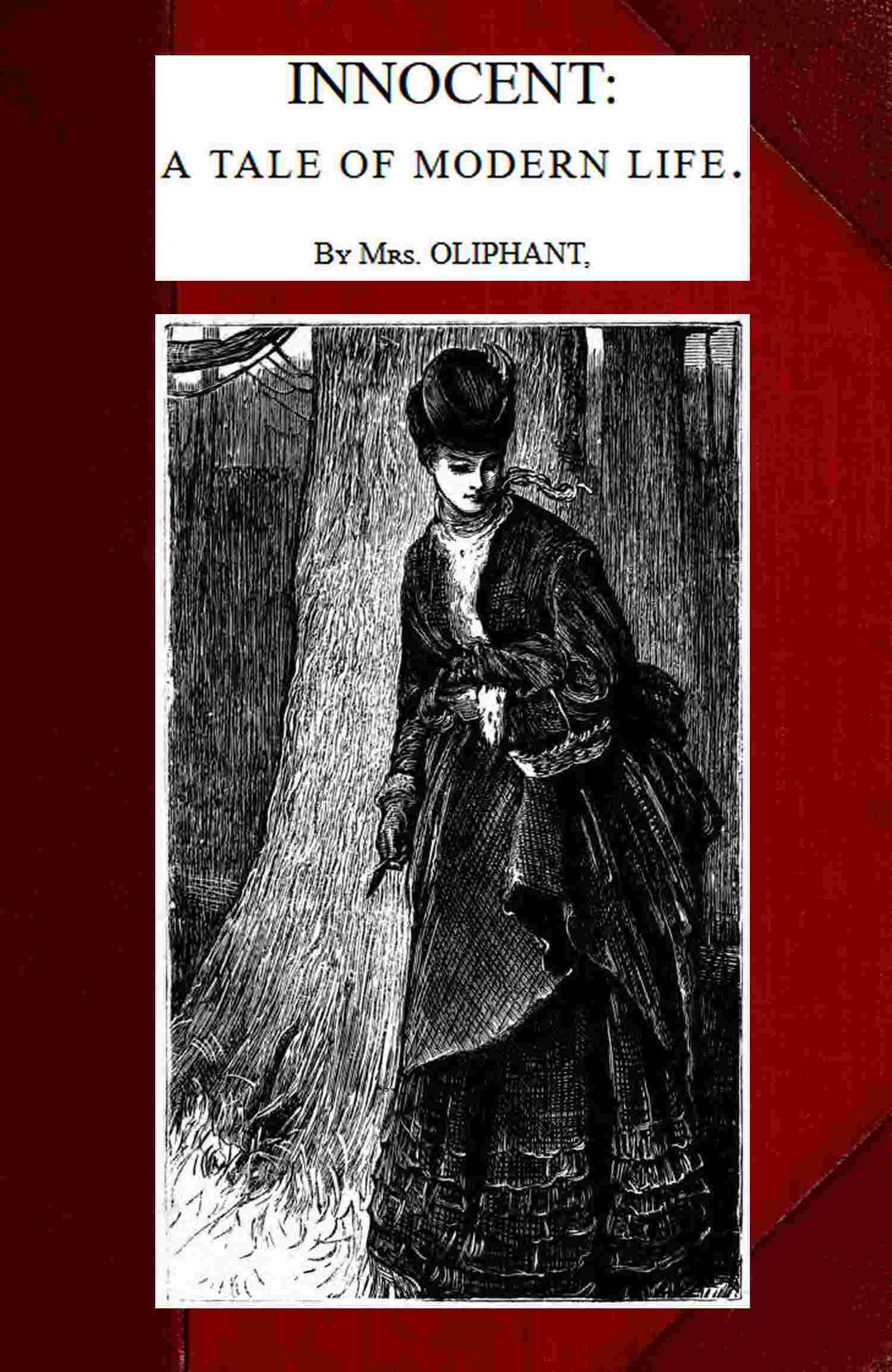
“The Miller’s Daughter!” Our poet was not the great poet we know when he wrote that soft and youthful pastoral. There was nothing in it too deep for Innocent. She listened, with her heart gently stirred, with a sense of all the peace surrounding her, and the grave, calm love that cherished her, and her own ineffable safety from all evil—smiling when her husband laid his hand upon her shoulder. There have been scenes of more exalted, more profound emotion; but none more soft, more safe, more peaceful, safe, and sure than this afternoon scene at Longueville. The very afternoon was tranquil in its slumberous peacefulness, like the girl’s heart.
They were disturbed by the sounds of wheels ringing sharply upon the gravel of the avenue, and dispersing the pebbles on all sides, as if some one in hot haste was on his way to the Hall. The avenue was invisible from the terrace; but this harsh sound offended Sir Alexis. It was no carriage, but some impertinent two-wheeled thing like a dog-cart which made this ado—he could tell as much by the sound. His brow puckered with impatience; he stopped his reading. Something of the look which had made Innocent think he was “angry,” a sharp anxiety, a sudden pallor, came over his face.
“It is some Cockney party to see Longueville, no doubt,” he said, in a voice which sounded harsh to Innocent. “But, thank heaven! they will be disappointed to-day.”
The sound ceased, but he could not resume his reading all at once.
“That is the nuisance of having a handsome house,” he said; “all the fools in the country think they have a right to come and see it. I have no doubt these impertinent intruders will go away quite angry that we choose to keep our house to ourselves. I do not know what the world is coming to. But whom have we here?”
Two men were approaching, following the butler, who was a very solemn personage, looking like a bishop at the least, but who this time was pale and scared, with a curious look of warning and alarm. The men who followed at first only conveyed to the beholder the impression that they were “not gentlemen.” As, however, they advanced closer an indefinable air about them began to take effect upon Sir Alexis, as it seemed to have done upon his servant. The paleness of his face increased till it grew ashen-grey.
“Had you not better go in, Innocent?” he said hoarsely, laying his hand once more on her shoulder; but his voice was strange, not like the gentle tone in which he usually gave her his instructions, and Innocent kept her place by him, falling a step behind him, but showing no other appearance of embarrassment or shyness. She was not looking at them, but saw vaguely that the new-comers were not interesting to her. She waited because her husband waited, to see what they wanted. It was an interruption—but interruptions did not affect Innocent as they do most people. “The Miller’s Daughter” and the lingering warmth of the spring afternoon would wait.
“Two—gentlemen, Sir Alexis—to speak with you,” said the butler, standing aside with an air of fright. He did not go away when he announced them in this simple way, but stood still, like a man paralyzed, not seeming to know what he did.
Shabby men—not such men as had any right to penetrate there—into that region of refinement and splendour. They kept very close to each other. One of them, the shabbiest of the two, kept so close on his companion’s track that their shadows fell into one along the grass. The other cleared his throat, shifted from one foot to another, took out his handkerchief, and wiped his face. He was embarrassed and uncertain.
“Is there anything in which I can serve you, gentlemen?” said Sir Alexis, with a voice so strangely altered by restrained excitement that even Innocent looked up at him wondering, not recognizing the sound.
“I don’t want to do nothing disagreeable,” said the foremost, “or to make any unpleasantness as can be spared. It is an ’orrible business, make the best of it as you can. We won’t give no trouble as we can help, Sir Alexis. She may go in her own carriage, and you may go along with her, if you please. But I can’t disguise from you as my lady must come with us. I don’t know how much you knows about it—and I don’t doubt as one way or other she’ll get off——”
“What is the meaning of this?” said Longueville. O God! how well he knew what it meant! He made a step forward in front of his wife by instinct, then stopped short in the confusion of impotence, knowing that he could do nothing, and that his only policy was to submit.
“I beg your pardon, sir,” said the man, moulding his hat in his hands with real embarrassment. “I feels for you with all my heart. I have my warrant all in order. You shan’t be deceived nohow—and anything as we can do to make the blow less ’eavy and spare ill-convenience you may calculate upon. But I have to do my duty——”
“Of course, you must do your duty,” said Sir Alexis, pale, but nerving himself for the worst. “But, my good fellow, here is evidently some mistake. What”—he paused with an effort, for his lips were parched—“what—do you mean?—whom—do you seek here?”
“If I must say it in so many words,” said the officer, “I have come for my Lady Longueville. Here’s my warrant. It’s all in the paper.—‘Dame Innocent, wife of Sir Alexis Longueville, Bart.——’”
“For what? Good heavens!”
How vain it was to ask!—as if since even he saw these men the certainty of it, the shame, the misery, the horrible possibilities which might follow, had not risen like a picture, pale against a lurid background of suffering, before his eyes.
“For the murder of Amanda Eastwood, at Sterborne, on the 21st of October last——”
For the first time Innocent was fully roused. She uttered a low cry—she turned to her husband with a wild look of wonder and appeal.
“You said it would all be made right—all right!” she said, clasping her helpless hands, appealing against her sudden misery to heaven and earth.
CHAPTER XLV.
THE FIRST DESERTER.
The next morning after this event, Ernest Molyneux, with a newspaper in his hand, jumped out of a hansom at the door of The Elms and rushed into the house. The door was open; a certain air of agitation and excitement was about the place, some trunks stood in the hall, corded and labelled as for a journey. He told Brownlow, who came out of the dining-room at the sound of his arrival, to send Miss Eastwood to him directly, and made his way into the drawing-room, which was empty. Empty, arranged with all its usual peaceful order and grace, full of sunshine, sweet with the flowers which looked in brightly through the round window-door of the conservatory, with novels from Mudie’s on the table, Mrs. Eastwood’s work-basket, and Nelly’s knitting. Nothing can excuse untidiness in an English house—the housemaid must do her duty whether we live or die, or even if things happen to us which are worse than life or death. Molyneux was confounded by the tranquil comfort, the brightness and calm of this shrine of domestic life. It checked him in his eagerness and heat. The horrible news in the paper seemed to lose all appearance, all possibility of truth. He calmed down. He asked himself what he would have to say to Nelly after demanding her presence in such hot haste if this rumour was not true. A little shame, a little compunction came into his mind. He had not come here to console, but to reproach. He had to wait for some time before she came, and in the meantime the absolute stillness of the house, the tranquillizing warmth and brightness of the sunshine, worked upon him with the most curious effect. He became more and more ashamed of himself, and I do not know what moral result might have been produced in the end had Nelly delayed her coming much longer, or had her own demeanour carried out the effect of this scene. But Nelly came in with red eyes and pale cheeks, in the simplest of travelling dresses, with this look of mingled excitement and exhaustion which more than anything else betrays “something wrong” in the history of a family. She came in eagerly, almost running to him, with that instinctive and unconscious appeal which is conveyed by visible expectation, and which it is so difficult to disappoint, her hands outstretched, her eyes ready to fill with tears. The sight of her emotion, however, had an effect upon Molyneux which totally counteracted the calm of the house. It restored him to his position of criticism and superiority. He took her hands, it is true, and even kissed her cheek, though with something of that indifference which comes with habit. But he made no demonstration of sympathy. He said hastily, “Nelly, I am come to you for information. Have you seen what is in the papers? Surely, surely, it cannot be true!”
The check and sudden revulsion which comes to all who expect too much came to Nelly. She withdrew her hands from him. Her tears, which were ready to fall, went back somehow. She retreated a little from his side; but her pride supported her. At that moment and for ever Nelly closed the doors of her heart against her lover. It is true indeed, as the reader will perceive, that she threw them open again once, and once only, not knowing that her decision had been made, and believing there was still a place of repentance; but certainly, though she was not aware of it, those doors closed now with a crash of sound which rang in her ears and made her deaf to everything else. She thought for the moment, however, that the ringing in her ears meant only weariness and pain, and sat down, to keep herself from fainting, in her mother’s chair.
“If you mean is it true that Innocent, poor Innocent, has done what they say,” said Nelly, low and trembling, “but all the rest is true enough. They have put her in—— Oh me! Oh me! how can I say it? It is those dreadful people, whom Frederick bound himself to for a curse to us all.”
“But,” said Molyneux—he was more bewildered than I can say to find himself uncontradicted, to know that anything so incredible was really true—“but those dreadful people, as you call them, could not do this without some cause, something to build upon. For God’s sake, tell me! How do they dare? Is there any foundation?”
“Mamma went down to inquire the very day,” said Nelly dreamily, repeating the old story; “she lost no time. She came back saying it was sheer delusion, nothing more. There was no foundation. Every one was quite satisfied that Mrs. Frederick died of heart-disease. Nobody, except Innocent herself, ever dreamt of anything of the kind.”
“But Innocent herself—what was it that she dreamt of? What was the delusion?”
“She had to give a sleeping draught, and she gave—too much,” said Nelly simply. “She was frightened to death. She left the house instantly, and came home. Oh, how well I recollect that dreadful morning. She came in accusing herself, and Jane heard what she said. Ernest, could such evidence harm her? Is it possible? Her own wild idea, nothing more.”
“I am bewildered by all this,” said Molyneux. “You have known it ever since Mrs. Frederick’s death, and I have been allowed to—— You have never breathed a syllable to me.”
“Oh, how could I?” cried Nelly. “Think, to put it into words was like giving some sanction to it; and you were not fond of her as we were. It was on my lips a hundred times. But, Ernest, you were not fond of her.”
“No, thank Heaven!” he said, walking up and down the room. The chief feeling in his mind was anger, mingled with a certain satisfaction in the sense that he had a right to be angry. “I hope, at least, Longueville knew,” he added, after a pause. “I hope you think he, being fond of Innocent, had the right——”
“Ernest,” said Nelly piteously, moved by one of those last relentings of love which cannot, for very pity, consent to its own extinction, “surely you have some feeling for us in our great trouble. It was because poor Innocent told him, appealed to him, that they ever married at all. He was very, very kind, very good—to us all.”
“Apparently, then, everybody has been considered worthy of your confidence but myself,” said Molyneux; but, notwithstanding, the knowledge that Sir Alexis knew made him think better of the business. Longueville, he thought, was not such a fool as to have married a girl against whom there was real evidence of such a tremendous character. “It is a very good thing that you have Longueville to depend upon,” he said, after a pause. “Of course, it is chiefly his business; of course, he has been making his arrangements to meet the danger; he will get the best counsel—the best——”
“Ernest,” said Nelly, rising from her seat. She put her hands together unconsciously as she went up to him—“Ernest! We have often talked of what might be, if something really worth your while should offer; not mere troublesome law-business, but something that would really exercise your mind—something worthy of you. And, Ernest, would it not be all the more great, the more noble, if it was to save an innocent creature from destruction? You know her almost as well as we do,” cried the girl, the big tears running down her pale cheeks. “You have seen her grow from almost a child. You know how simple she is, how innocent, like her name. Perhaps she was slow at first to see that we loved her. Perhaps we did not go the right way. But you have seen it all, Ernest; you have known her from the first—from a child. She never was anything but a child. And you are eloquent—you could bring any one through whose cause you took up. Oh, what a power it is—and when you can use it to save the innocent, Ernest! I do not say for my sake——”
She stood before him more eloquent in her tears than he, with all his cleverness, could ever have been, with one soft appealing hand on his arm, and the other raised in passionate entreaty. Her eyes were fixed upon him with a prayer as passionate—all Nelly’s heart, all her soul, was in this appeal. It was for Innocent—to save her; it was for Ernest—to save him; it was for herself, poor Nelly, to change her despairing into life and hope. Never was face more full of emotion than the glowing, moving, tearful face, every line quivering, every feature inspired, which she turned upon him. Her very look was a prayer intense and passionate. But opposite to this entreating face was one which lowered like the skies when everything is black with storm. Ernest shut himself as heaven itself seems to close sometimes upon the prayers of the despairing. He stood obdurate, unmoving, unmoved, looking at her with blank brows, answering with a hard abstinence from all emotion the imploring look, the impassioned words. Nelly saw how it was before she had ceased speaking; but she repulsed the chill of certainty from her heart, and prayed on with eyes and gestures, even when she felt herself to be praying against hope.
At last he threw off, not roughly, but crossly, her hand from his arm, and, as he himself would have said, “put a stop to it.”
“Nelly,” he said, “are you mad? What do you mean? Longueville, you may be sure, has secured counsel already; I suppose he has not been taken by surprise as I have been? And supposing I could do it, would you have me begin my career under such unfavourable circumstances, on the spur of the moment, for the sake of mere family connexion? I have often heard that women carried their feeling for their own family a very long way; but to prefer this girl and her folly to the interests of your future husband—to ask me to commit myself—— Are you mad, Nelly? Why, my interests are yours—my character is yours. You should beg me rather to keep out of it—you should keep out of it yourself, for my sake. What is Innocent to us?—a silly, creature, half idiot, an ungrateful little minx, fond of nobody but Frederick, and, I daresay, capable of striking a bold stroke for him, as she seems to say she has done. Don’t look at me as if you would eat me. I don’t say she has done it. I know nothing but what you have told me.”
Nelly shrank away from him to her mother’s chair. A burning blush covered her face; her tears dried up as if by scorching heat. Her eyes flashed and shone; her whole aspect, her very figure seemed to change.
“I may ask at least one thing of you,” she said; “and that is to forget what I told you. I was very foolish to say so much. Women are prone to that, I suppose, as you say; but I may trust to your honour to forget it? not to repeat it to any one? I shall be very thankful if you will promise that.”
“Why, Nelly!” he cried, “I repeat what you have said to me! You don’t take me for a scoundrel, I hope, because I don’t act upon everything you say——”
She smiled faintly, and bowed her head, accepting the assurance; and then between these two, who had loved each other, who were betrothed and bound to each other, there ensued a pause. She said nothing, she did not even look at him; and he looking at her, feeling somehow that greater things had happened even than those which appeared, cast about in his mind how to speak, and did not know what to say.
“Nelly,” he said, at last, clearing his throat, “I see you are angry with me; and, though I think you are rather unreasonable, I am very sorry to vex you. I would do as much as most men for the girl I love; but I should be compromising your prospects, as well as my own, were I to plunge into this business without reflection, as you tell me. I am sure, when you are cool and able to think, you will see the justice of what I say.”
Still Nelly made no answer. She could not trust herself to speak; her heart beat too loudly, her breath came too fast. But to him it seemed obduracy, determined and conscious resistance, like his own.
“If this is how you take it, of course I can’t help myself,” he said; “but you are very unjust—and unreasonable. A woman may stretch her demands too far. There is much that I would be glad to do for your sake; but, even for your sake, it is best that I should employ my own judgment; and I cannot do what that judgment condemns——”
“No,” said Nelly, “No—I did not say for my sake; but if I did it would not have mattered. No, you must use your own judgment. But will you excuse me now,” she added, after a momentary pause, “if I say good-bye? We are going—to Sterrington directly, and I have still some things to do.”
“To Sterrington! To mix yourself up with Innocent, and trumpet your connexion with her to all the world!”
“To stand by one of mamma’s children in her trouble,” said Nelly, looking at him with tears shining in her eyes, and with a smile which increased his exasperation a hundredfold. “I am sorry you do not understand. Mamma’s place is with Innocent, and mine with mamma.”
“This is folly, Nelly,” he cried, “absolute folly. She has her husband to look after her. Have I no claims? and for my sake you ought not to go.”
She rose, holding out her hand to him, still with that pale smile upon her face. “Let us part friends,” she said. “This is not a time to discuss any one’s claims. What you cannot do for my sake I will not do for yours. Good-bye.”
“Is this final?” he cried, in rage and dismay.
“It would be best so,” said Nelly gently.
But she did not know how he went away. She kept her composure, and appeared, so far as he could make out, as resolute as she was calm; but there was a dimness in Nelly’s eyes and a ringing in her ears. The room seemed to swim about her, and his face, which flamed into sudden rage, then went out, as it were, like an extinguished light. Gradually the darkness that closed over everything lightened again, and she found he had gone. She had not fainted nor lost consciousness, but a mist had overspread her soul and her thoughts, and all that was done and said. She sat still where he left her, quite silent, coming to herself. She forgot that she had things to do, and that it would soon be time for the train. She sat still, realizing what had happened, looking, as it were, at what she had done. She was not sorry but stunned, wondering how she came to do it—not grieved that she had done it. I don’t know how long she sat thus; it seemed to her hours, but that of course was a mere impression. What roused her at last was the entrance of another man, as much excited, as anxious, and curious as Ernest had been. He came to offer his services, to ask if he should go at once and put himself at the disposal of Sir Alexis; and in the second place—only in the second place—to ask what it meant. Nelly sat and listened to his eager questions, and then burst into sudden tears. She gave him no reason for them—why should she? There were reasons enough and to spare, without diving into her personal history, for any outburst of sorrow. John Vane put no questions, but he had met Ernest rushing in the opposite direction, and I think he divined that some reflection of a personal misery was in Nelly’s paleness and agitation. But he asked her no questions, and he tried not to ask himself any, which was harder still.
When Mrs. Eastwood came into the room, which she did very soon after in her bonnet and cloak ready for the journey, Vane went up to her, holding out his hand.
“Forgive me,” he said humbly, “for having done you a temporary wrong in my thoughts.”
“How so, Mr. Vane?” said Mrs. Eastwood, with a faint smile, the first that had relieved the tension of her pale face since the terrible news came.
“I can understand now all about Innocent’s marriage,” he said. “God forgive me for doubting her best friends. I thought you were like other women—thinking of a good match above everything.”
“Are you so sure that other women think of a good match above everything?” said Mrs. Eastwood, once more with a smile, and then as she had spared a moment from Innocent, compunction seized her. “What are we to do,” she cried, “oh, what are we to do for my poor child?”
“I am going with you,” said Vane, to whose own eyes (though he was a man not given to emotion) the moisture rose. Mrs. Eastwood sent Nelly away to put on her bonnet, knowing nothing of the interview which Nelly had gone through in the meantime—and entered into all the dismal story which Nelly had briefly unfolded to him. He made no reproaches as Ernest had done—that he had not been told at the time. He understood without explanations how unwilling they must have been to confide such a story to any one, even to Innocent’s relation; and he listened with the deepest attention to Mrs. Eastwood’s account of her own cursory visit to Sterborne, and the total absence of all suspicion at the time of Amanda’s death. John Vane, an idle man, had read for the bar in a wrong way in his youth, not pursuing the study, but yet retaining some fragments of knowledge—and it seemed to him that this was very important. He discussed the whole matter closely, giving, his companion thought, his whole attention to it; but yet—will the reader think less well of John Vane for it?—within a corner of his mind or heart, if you like the word better, he was following Nelly, wondering why she took so long to put on her bonnet—whether she was crying, poor soul, over some lost illusion, some disappointed hope of her own, as well as over her cousin? He was almost glad to think that he alone was, as it were, in her confidence—that even her mother did not know that Molyneux had been there and had disappointed Nelly. He must have disappointed her (this train of thought went on like an undercurrent while he discussed, and that with an anxiety beyond words, the fate of Innocent)—he must have disappointed her, for he had left her. No true lover—no man worthy to be Nelly’s husband—would have left her at such a moment. Had she been wise enough to see this? Would she be strong enough to perceive it hereafter? Mrs. Eastwood did not know—she made not the slightest allusion to Ernest. When Nelly had come down-stairs, and the cab had driven up to the door which was to take them to the railway, she left detailed instructions with Brownlow as to the messages to be given to callers. “You can tell Mrs. Everard and Mr. Brotherton, if they call, that they will hear from me very soon,” she said; “and the same to Mr. Molyneux; though, indeed, Nelly, it is negligent not to have let Ernest know sooner.”
“I have let him know,” said Nelly softly; and Vane thought she gave him a piteous appealing look, as if to beg him not to say anything—a look which almost made him glad, though she was in trouble, and they were all in trouble. There are things that make one’s heart rise even in the midst of lamentation and woe.
“That is well—that is always something spared,” said Mrs. Eastwood, with a sigh; “and be careful of the young gentlemen, Brownlow. Ask Mr. Eastwood if he would like any change made in the dinner-hour while I am away, and see that Mr. Richard is called regularly at seven, and that he has his coffee. My poor Dick must go on working, whatever happens,” she said, taking her place in the cab with a sigh.
And thus Innocent’s friends, all who loved her, gathered round in her direst need. There was but one deserter, and he no friend of hers.
CHAPTER XLVI.
THE EVIDENCE.
“But it is true—I killed Frederick’s wife,” said Innocent.
Her voice was tranquil as usual; but her eyes were dilated and full of woe, like the eyes of a dumb creature hardly used. The scene had strangely changed for her. Instead of the sunny terrace at Longueville, the sunny garden at The Elms, the four gray walls of a prison-cell surrounded her. I will confess to the gentle reader that I never was in a prison, and I do not know how it looked; but I never heard that there were special hardships in poor Innocent’s case, and I believe, indeed, that she was allowed many relaxations of the ordinary prison rules. She was seated on her little bed, Mrs. Eastwood was with her, her husband, and Mr. Pennefather, the solicitor, who had visited Sir Alexis at Longueville, had come down to Sterrington with the eminent lawyer who was to defend poor Innocent, to have a personal interview with her. These two learned persons were subjecting the poor girl to a private examination, and straining all their faculties to get at the exact facts of the case.
“Oh, Innocent,” said Mrs. Eastwood, “how often have I told you, dear, that you are mistaken. Do not give this gentleman a false idea. It is a delusion, a mere delusion——”
“Let her tell me her own story,” said Mr. Serjeant Ryder, the lawyer. He was impatient of interference, and it seemed to him that a woman in tears, ready to interrupt his unfortunate client’s story by weak denials of a guilt which the culprit confessed, was a most undesirable assistant at this interview. “Let her tell me her own story,” he repeated, “there is nothing so important as that I should know the whole truth.”
He had heard the story already, and had been led to believe the case simple enough. But an experimental lawyer, accustomed to all the subtilities of crime, does not easily believe in the most obvious story. “Mere delusion” might, indeed, tempt a fool to accuse himself, but it was not enough to explain a criminal prosecution, and all the solemnities involved. I cannot describe the feelings with which the two bystanders kept silence, and listened to Innocent’s story, which she repeated as she had so often repeated it. Sir Alexis did not say a word, and he put his hand on Mrs. Eastwood’s arm, restraining her when she would have spoken. Innocent was left free to tell her own tale, which she did in her simplicity, giving all the details with absolute exactness and that curious matter-of-fact truth which was as characteristic of her as her visionary looks. She forgot nothing, she left out no circumstances. It was not until the second time of going over it that she even interposed that gentle profession of innocence, “I did not mean it,” in the midst of her full confession of guilt.
“You did not mean it?”
“Oh,” said Mrs. Eastwood, unable to keep silence, “how can you ask her such a question? She mean it! She did not even do it, though she thinks so—but mean it? Oh, Sir Alexis, this is too much.”
“I must take my own way,” said the lawyer. “I beg your pardon, but I cannot be interrupted. You did not mean what? To hurt the sick woman, or to put more than twenty drops in the glass? These, you perceive, are two different things. Pray let me put my questions my own way. If I could be permitted to see Lady Longueville alone, it would be much better. Your feelings, I am sure, are perfectly natural, but if I could see her alone——”
Innocent put out her hand and caught at her aunt’s dress with a low cry. “Oh, do not go away!” she cried, roused out of her usual calm. “It would be better to kill me than to leave me here alone. Oh, if you knew what it is to be alone!—all strange faces—nothing you ever saw before—and not even the window as there used to be in Pisa, and Niccolo to come in before he went away. Oh, Niccolo, Niccolo!” cried the girl, her voice rising in a cry of such loneliness as went to the heart even of the men who questioned her. She calmed down next moment, and looked with a faint smile from one to another—from her aunt to her husband. “When it is day and you are here it is different; but at night it is all a mist and dark, and there seems no one but Niccolo in all the world, and Niccolo is not here.”
“Oh, Innocent, my darling,” said Mrs. Eastwood, “if they would but let me stay with you night and day——”
“Niccolo never stayed the night,” said Innocent, wandering off, with a vague smile, into her recollections. “When he had put down the salad and said, ‘Felicissima notte,’ he went away. I could hear his steps all the way down the stairs; but I never was frightened. If he would but come in and say, ‘Good-night,’ I should be happier—for sometimes I think I am in Pisa now, only the room is smaller and there is no window,” she said, looking up wistfully at the high window in the wall, which, with all her exertions, she could not reach. While she was thus gazing with her head turned away, the two lawyers exchanged significant glances. Mr. Serjeant Ryder looked at Sir Alexis with a faint elevation of his eyebrows, and shut his note-book with something between impatience and despair.
“I don’t think,” he said, “that I need trouble Lady Longueville any further to-day.”
“Go and ask him what he thinks,” said Mrs. Eastwood anxiously in the ear of Sir Alexis; but Longueville, too, shook his head. He saw well enough what Innocent’s counsel thought; he had no desire to have his conclusion put into words. He himself could not banish from his mind a chill sense that Innocent had retrograded, that she had gone back ever so far from the mental condition to which she had reached when he read to her on the terrace at Longueville. A chill dread struck his heart that this terrible event in her life would contradict all his hopes, would put a final end to all her possibilities of development, and reduce the simple unopened mind into mere idiocy. This horror of doubt being in his own mind, it may be supposed that he had no wish to have it confirmed and forced upon him by the voice of another. He shook his head and threw himself down in the languor of despondency upon the wooden stool from which his counsel had risen. This was almost the most bitter moment he had yet gone through. She for whom he had hoped so much, his crowning glory, his rare, unique blossom of humanity, would this be her conclusion? She would be acquitted—on the score of idiocy! It seemed the most hopeful, the only prospect before them.
Mrs. Eastwood happily did not give herself up to any such thoughts. Her office for the moment was to cheer Innocent, not to forecast what was coming. She sat down beside her on the bed, and told her everything she could think of which would amuse her. She told her minutely how Nelly and herself had found lodgings opposite the prison. “You cannot see us, my darling; but we can see you,” she said, with a show of cheerfulness, “at least we can see your window. One of us is always watching you, Innocent. Is not that a little comfort to think of? If we cannot say good-night, so that you can hear, we say it in our hearts. Nelly sat half the night through watching, looking up at the window. What a pity it is so high—if it were not so high you could look across the road to us, and then you would feel as if you were at home. But when you say your prayers, dear, then you can make sure that we are with you; for I don’t think there is one hour—not an hour, my darling—that Nelly and I are not praying for you.” Here for a moment Mrs. Eastwood broke down.
“Yes,” said Innocent, pleased, like a child. “I will do so too. Saying your prayers is a very good way; but I wish I could go down-stairs and across to the Spina as I used to do. I liked the chapel at the High Lodge; the minster is too great. It is so strange,” she went on, with a smile. “I cannot get it out of my heart that the Arno is down there, and the Spina Church just as it used to be. It is because I cannot look out of the window.”
“Yes, dear,” said Mrs. Eastwood caressingly; “but of course you know that the Spina is not there.”
“Oh, yes,” said Innocent; “and sometimes I think it must be Longueville and the great trees stretching for miles—it is so strange not to see; but I never think it is home. I do not feel that it could be home.”
“Listen,” said Mrs. Eastwood in Longueville’s ear. “She is as sensible as any one can be—full of imagination, poor darling; but nothing else. God bless her! she was fond of Niccolo, and all that. And it has a very strange effect upon one, when one cannot see out of the window. She is as sensible as you or me.”
Longueville shook his head still, but took comfort. I think, however, that when he went away it was, on the whole, better for the poor prisoner; for though the anxiety of the watch he kept upon her was disguised as far as he could do it, it still disturbed vaguely the absolute confidence which alone made Innocent happy. The doubt disturbed her—she could not have told why. It was only when she knew that she was entirely in possession of the sympathy of her surroundings, a knowledge which she attained by no intellectual process, but by something in the air, that Innocent lost her look of woe. Even the prison, the terrible loneliness of the night which she had to look forward to; the shock of this dreadful event which had taken place in her life did not prevent her smile from regaining much of its simple sweetness when her aunt talked to her alone, prattled to her—Heaven help them!—of subjects much unlike those which one would expect to be discussed in a prison cell, of every gentle folly that occurred to her, and trifles far enough from her aching heart.
Mr. Ryder and Mr. Pennefather remained in Sterrington that night, and there was a long and solemn consultation held after the prison was closed to Innocent’s relations in the little sitting-room opposite the jail where the Eastwoods were living. The Spring Assizes were approaching very closely, and Innocent’s anxious defenders were divided upon one important subject—whether to seek for delay and gain time to collect all the evidence they could in her favour, including that of the doctor’s, who had left Sterborne after Amanda’s death, and who was naturally a most important witness, or whether to allow the case to come on at the Assizes which was to be held in less than three weeks, and for which the quiet country town of Sterrington was already preparing with unusual flutter of anticipation, for an exciting and interesting trial, a very romance in real life, which would draw the eyes of the world upon it, was no common occurrence. Both the lawyers were anxious for delay, but the family more immediately concerned were equally anxious that the trial might be got over as speedily as possible; partly, perhaps, because it was impossible for them to believe in any but a favourable issue as soon as the case was fully gone into, and partly from the more serious and substantial reason that all felt the impossibility of Innocent bearing up against a lengthened interval of loneliness and suspense. “The child will die,” Mrs. Eastwood said. Sir Alexis did not explain his fears, but they were of a still more miserable kind. Whether she lived or died, she would probably, he believed, have fallen into a blank idiocy even before these three terrible weeks were over, and if the three weeks were lengthened into three months, there could be no hope for her whatever. “The trial must come on as soon as possible,” he said, with an obstinacy which his confidential adviser, Mr. Pennefather, who flattered himself that he knew Sir Alexis to the very depths of his soul, could not understand, and no argument could move him from his position. Altogether, the lawyers, I fear, were not satisfied with the unhappy “relations.” It is true that relations are apt to be either over-confident or over-frightened, and to insist illogically upon the innocence of the accused, when the thing to be done is to prove that innocence—a very different matter from believing in it. But their obstinacy on the point of the trial, their indifference to the necessity of the doctor’s presence, and the irrelevant interruptions made by the ladies, at last provoked Mr. Ryder, who was not famed for his temper. “These matters ought to be left entirely in our hands,” he said peremptorily. “The doctor, so far as I can see at present, is the only witness on whom we could depend.”
“But when I tell you,” cried Mrs. Eastwood, “that I was there—that no one thought of such a thing—that it was a mere delusion——”
“What was a mere delusion?” said the lawyer sharply. “Did Lady Longueville give the draught or not? Is she under a delusion as to the actual opiate, or simply as to having killed the patient? If it is certain that she gave the draught, then the medical evidence is all important. We must discriminate between these two points. Is there any proof, except her confession that she gave the draught at all?”
Mrs. Eastwood looked up quickly, with a hard, sudden drawing of her breath. She looked round the men, who were none of them in her confidence, and a sudden sense of fright sealed her lips. “They have no proof that I know of,” she answered, faltering, and, taking courage, bore the steady look which Mr. Ryder gave her without shrinking. As for Alexis, his mind was absorbed in his own gloomy thoughts, and he paid no attention to this little episode. Vane, for his part, had not heard of the trial. Mrs. Eastwood withdrew soon after, trembling from head to foot, and went to the little room, in which Nelly was sitting, gazing up at poor Innocent’s high window with tender superstition, and threw herself upon her child’s shoulder, sobbing and sick with misery. Frederick had taken the phial out of her desk, and had thrown it into the fire at the first rumour of doubt about Amanda’s death. She had suffered him to do it, she could not tell why, and now how was she to explain? What was she to do? To say that he had done it would be to involve him, already, unhappily, too much involved, for whose sake it would be the effort of the prosecution to prove the deed had been done. And it was easier to be silent about it altogether than to tell how so fatal a mistake had been made. The more Mrs. Eastwood thought of it, the more she felt how serious a mistake it was; and if she could have said truly that she herself had done it, I think she would have gone back at once and told her story. But to say that Frederick had interfered, that he had destroyed the only tangible proof of poor Innocent’s wild tale—he whom everybody thought badly of already, who was supposed the cause of all; who to every vulgar imagination, even to his own, supplied the motive necessary to make Innocent’s guilt possible,—how could she mention his name? how involve him doubly, making him, as it were, an accomplice? With dismal confidence in chance, she said to herself that no one knew anything about the phial; that it would not be thought of unless she herself mentioned it. But after this she shrank from discussion of the subject. She avoided any encounter with the lawyers. She was to be, poor soul, one of the principal witnesses, and many a miserable, anxious prayer did the poor woman make that God would direct the minds of her questioners away from this one point upon which she had gone astray. It seemed easier to her to trust to a miracle for deliverance than to confess the truth.
During the interval which followed it would be impossible to describe the alternations of hope and of misery which swept over the unhappy family, who kept together in their little lodging opposite the prison. They were allowed to be with poor Innocent during the greater portion of the day, and then the ladies put on a semblance of ease, and even gaiety, which was far from real. But in the dreary evenings they were apart from her—and the evenings of March are still long—the vicissitudes of feeling to which they were subject were like the changes of a fever. Sometimes it seemed so impossible to them that any one could for a moment believe so incredible an accusation; and again all the horrible accumulation of proof would gather round their souls. The love of the poor girl for her cousin—love which they had themselves believed, and of which they but dimly now had come to recognize the real character; her dislike, openly professed, for Amanda; her strange vigil by Amanda’s side, brought about in so simply accidental a way, yet which might be made to bear the aspect of a deliberate plot; her sudden and unaccountable flight; her confession. When they recollected all these things, horror would come over them, dismay, and almost despair.
These and a great many other particulars were in all the papers, reported and dwelt upon with all the avidity natural when the public mind has a story so interesting presented to it—a romance in real life. There had been the usual horrible preliminaries, into which it is not necessary for me to enter, before the warrant was produced for Innocent’s arrest. Poor Amanda’s last repose had been disturbed to furnish evidence, though, owing to the lapse of time, with little or no result; but the circumstantial evidence had seemed so strong to the magistrates before whom Innocent was first examined as to warrant her immediate committal. All that the public knew in her favour was mere supposition and hearsay, while the facts on the other side were very apparent. One dismal feature in the case, however, which appalled all who heard of it, was that while all Innocent’s friends were called for the prosecution, it was by some cursed spite of fate only her enemies, with one exception, who could be called for her defence. Frederick was the only witness capable of saying anything about Amanda’s death who would not be the personal enemy of the unhappy girl, and every one was aware under what difficulties, and with what prejudices against him, the man whom the public supposed the cause of the whole would appear before a British jury. In such cases women have the best of it. A woman who has been the cause of a deadly struggle between two men is not discredited, but rather gains a fictitious interest by it. But a man for whom two women have appeared to contend bears always a miserable aspect. Men despise him, and women hate him; his evidence in favour of a culprit is worth nothing, for he is supposed bound in honour to perjure himself, if necessary, to shield the creature who has risked her life for him. The public, as was natural, regarded Frederick with scorn and disgust. And yet, with the exception of Frederick, only Innocent’s enemies, the father, the nurse, the women servants, all committed to proceed against her, could be called for her defence—a thought which might well have appalled the stoutest heart.
Jenny Eastwood had started at once in search of the doctor, whose evidence it was believed was of so much importance, and who had gone, not to the Colonies, as Frederick said, but to Transylvania, and other remote parts of Europe, with a scientific expedition. It was hoped that he might be brought back in time for the trial. And the anxious days went on—terrible days, but so full of eager consultation, of anxious reviewing of every circumstance, of the efforts made by all to keep each other up, and to support the poor girl herself, whose mind certainly seemed to weaken under the effects of her confinement, that they fled as if on wings. The unhappy family living at the prison gates, going to and fro constantly, identifying themselves with the poor young prisoner, yet probably destined to prove her guilt, became the object of much public compassion. The newspapers enlarged greatly on the attractive theme, and some graphic and eloquent journals went out of their way to paint this striking picture of family devotion and suffering. But there were some facts which even the Semaphore itself was not aware of, which deepened every stroke of pain. Batty pursued the prosecution like a fiend, calling, as I have said, Innocent’s dearest friends to convict her, to prove her foolish love, her wild expressions of dislike, her distracted avowal of guilt; and the case, thus complicated and embittered, would naturally fall to be tried by the youngest judge on the bench, the well-known and justly-celebrated Mr. Justice Molyneux. Could there be any bitterer drop in that cup of tears?
CHAPTER XLVII.
THE TRIAL.
The trial of Lady Longueville for the wilful murder of Amanda Eastwood came on about the 2nd of April, after some unimportant business had been got over. The trial was one which was not only interesting in itself, but doubly attractive to the district in which the Eastwoods had their ancestral home, and where Miss Vane had set up so remarkable an establishment. Sterborne, like every other place, had very strong opinions about the semi-conventual life of the community which had possession of the High Lodge. Some wished the sisters and their strange lady abbess well, thinking that, whether wisely or not, they were women really attempting a great piece of work while so many of us content ourselves with saying that work ought to be done. But a great many were virulent against Miss Vane, especially among the lower classes, and these felt themselves almost flattered in their amour propre by the discovery that a niece or a relative of the mistress of the High Lodge was to be tried for her life. Many of them thought it served her right, many more that it was the natural result of nunneries, and that, on the whole, it was rather a good thing that light should thus be thrown on the doings habitual to them. Of others, and better-informed people, many were curious on behalf of the Eastwoods, and some on behalf of the Vanes. Sterrington, the county town, was sufficiently near Sterborne to be affected by the strong feeling on the question which naturally existed there: and the county itself attended the Assizes almost in a body, half-glad and half-sorry that Innocent had never belonged to its “set.” Batty’s daughter, too, was very well known in the district, her beauty, her violent temper, and the match she had made having each and all of them attracted public attention to her. Thus the ordinary attractions of a trial in which the romantic element was involved, and dark stories of love and mystery promised to be unfolded, were enhanced by everything that local interest could add to it. The court was thronged. There was as distinguished an audience as if the Queen herself had come to Sterrington, or as if Titiens or Patti had been about to sing; and the anxiety to get places was more eager than it would have been on either of these occasions, for it was a real tragedy, at which all the good people intended to assist, and which thrilled them with the liveliest emotions of sympathy, horror, and fear.
Thus the court was crowded from an early hour in the morning when people went to take their places as for a spectacle; every seat was filled, almost from the floor to the roof, the Town Hall was one throng and sea of faces, and it was with difficulty that the judge himself made his way to the bench. Within the last week it had been expected that Mr. Justice Waterhouse, Molyneux’s colleague, would try the case; but the day before Sir Edward Waterhouse took ill, and there was no escape for the other, whose usually good-humoured countenance looked gloomy enough on this particular occasion. When Innocent appeared, who was the chief object of the popular curiosity, there was that thrill through the place which testified to the tension of excited nerves and highly-strained feelings. She came in very quietly, with a wondering, scared look in her eyes, but no other sentiment. She was not abashed, nor afraid to meet the gaze of so many. Why should she shrink from their gaze? Innocent had been by many supposed to be shy, but she had never really been shy—she had not enough imagination for that painful feeling. Therefore she was not abashed nor shame-faced, though a faint additional colour came upon her colourless face. Her eyes had a look of fright because she did not know what was going to happen to her, but of the scene she saw, or the people who looked at her, Innocent was not afraid. She was in the same dress of clinging white cashmere which she had worn on the day when she was arrested, and had the little gray-blue cloak upon her shoulders. A very light little bonnet, more like a white veil arranged about her head, and throwing up her pathetic face against its white background—a bonnet which had been made by a fanciful milliner to suit the strange beauty of the poor young bride—was on her head. There had been many consultations about this dress. Mrs. Eastwood had desired that her niece should wear black, as being less subject “to be remarked;” but Innocent had been unusually obstinate. She had carried her point, and accordingly made her appearance in a costume which was quite bridelike, and certain “to be remarked.” Nelly sat near the bar, as close to it as she could be permitted to place herself, so that Innocent might see her, and feel the support of a friend at hand if her heart failed her. Sir Alexis was on the other side. She was surrounded at least by those who loved her best, and perhaps no young woman ever stood in such a terrible position who was less deeply impressed by it. She believed herself to be guilty, but her mind was not weighed down by the sense of guilt. She had a vague consciousness that something terrible might be done to her, she scarcely knew what; but she was not given to forecasting the future, and for the present moment perhaps Innocent was the least painfully excited of all the family. She could do nothing, she was in the hands of those people who surrounded her, billows of faces which indeed she did not know, but who looked on her, some with visible pity, some even with tears, few with an angry aspect. When the jury came in to whom she had been told to look as the arbitrators of her fate, none of them appeared to Innocent to be angry; and from the presiding seat, where sat the man to whom everybody looked, and to whom the privilege of finding fault with everybody seemed allotted, there appeared to her a countenance she recognized, not awful, scarcely severe. And her husband and Nelly were close by her, to take care of, to speak for, to prevent her from being scolded. She knew vaguely that there was something worse than scolding to be apprehended, but poor Innocent had never known anything worse, and therefore her fears were not lively on this point. To be sure she had already been imprisoned, which was worse than scolding; but the effect the prison had upon her was much more that of highly disagreeable lodgings than anything worse. She did not like them, she longed to go home; but still she had been brought there in preparation for this trial, and the very unpleasant room in which she had to live was one of the circumstances rather than any positive infliction in itself. She came into the court with these subdued feelings, and looked round her wistfully with an appealing, pitiful look, in which, however, there was neither terror nor overwhelming shame. Nelly felt the shame a great deal more deeply, and so did Miss Vane, who was trying hard to accept and subdue it as a mortification of the flesh, but who kept murmuring to herself in her corner, “A Vane! one of our family!” with humiliation unspeakable. Innocent did not feel the humiliation. She was scared, but not abashed, and as she got used to the faces, her eyes grew more and more piteous, wistful, appealing. When would they make up their minds, all these strangers, and say to her what had to be said, and do to her what had to be done, and let her go home?
Before I begin this part of my story, I have to confess to the gentle reader that I was not there, and that I am very little learned in the mode of conducting such tragical inquiries. Everybody knows how confused are the narratives which those who have taken part in such a scene give to the historian. Sometimes one informant will lose all general sense of what was going on in a mere detail, or another burst forth into laments of mournful shame over a foolish answer he or she has given, instead of making the unfortunate narrator aware what that answer was. Under these disadvantages I have to set forth this scene, which is the most important in poor Innocent’s history, and I trust the kind reader who knows better will forgive me when I go wrong.
There was some difficulty to start with in getting Innocent to utter the plea of “Not Guilty,” a difficulty which had been foreseen, and which indeed could only be overcome by the exertions of all her friends, who had exacted a pledge from her that she should say the words, which were, they explained eagerly, a “matter of form,” and profoundly true, at all events, so far as her intention went. All her immediate supporters drew a long breath when this danger was safely surmounted. It was, indeed, more than a relief, for the pathetic way in which she replied to the question, “What is your name?” by her ordinary, simple answer, “I am Innocent,” went to the hearts of the multitude, and produced one of those altogether unreasoning but most powerful moments of popular sympathy which transcend all argument. A distinct pause had to be made to permit the general emotion to subside before the first formal evidence could be heard, and vain and foolish hopes of foolish acquittal by acclamation swelled the breast of Nelly, at least, who, poor girl, with old Alice alone to support, her mother being a witness, sat searching for sympathy with her anxious eyes through all the eager crowd.
The first important witness called was Aunty, who came into the witness-box in her deep mourning, subdued yet triumphant, feeling something of that fierce pleasure in having the life of another in her power, which seems to move humanity so strangely. She was by nature a kind soul. Under any other circumstances she would have cried over Innocent, and followed her fate with hysterical interest. But now she could not keep herself from feeling a certain elation—a certain satisfaction and superiority—at having the girl’s life, as it were, in her hands, and being able to crush the family who had been unfriendly to Amanda—the “other side.” She came fortified with a large white handkerchief and a large double smelling-bottle, ruby and gold, which had been one of Amanda’s properties, picked up during the unhappy visit to Frederick’s house. Aunty, otherwise Miss Johnson, proved all the particulars of the death in her examination-in-chief. She related the unexpected arrival of Innocent—the sudden determination of Amanda to be attended by her husband’s young cousin—and the preliminary scene in the afternoon, before dinner. The witness had no intention of saying anything untrue, but unconsciously she gave to her account of Innocent’s behaviour in the sick-room an air of hostility and evil purpose.
“Mrs. Eastwood was in so little danger at this moment that you could feel it right to confide her to the charge of a young girl?” said the counsel for the prosecution.
“Bless you, she was in no danger at all!” said Aunty. “She was as she had been often and often before.”
“And the young lady came, knowing she was ill, to help to nurse her?”
“Mrs. Frederick didn’t take it in that way; she wanted no new nurses; she made the young lady stay with her to keep her from Mr. Eastwood, as was a gentleman with taking ways. That is the truth, if I should die for it! It was thought by his poor wife, and many more than her, as the prisoner was fonder of Mr. Frederick than ought to be between cousins——”
“I must appeal to the Court,” said Mr. Serjeant Ryder, “that this is the introduction of an entirely new element not at all to the purpose.”
“If my learned brother will wait a little he will see that it is very much to the purpose,” said the other. “I must really be allowed to examine my witnesses in my own way. I have no doubt he will afterwards make them as uncomfortable as possible in his cross-examination.—The deceased had, then, a strong reason for retaining the prisoner with her?”
“As strong as a woman can have,” said Aunty. “She knew as her husband was no better than making love to his cousin. I have seen it myself over and over. She kept knocking all the time of dinner for them to come up. And then they went into the garden. My poor dear was angry. I don’t know who wouldn’t have been; lying there ill, not able to move, and knowing as your husband was carrying on in the garden with a silly young girl.”
“It must be acknowledged that the position was disagreeable. When the prisoner was finally summoned did she show symptoms of displeasure? Did she resist the call?”
“She was not one as showed much of anything,” said the witness. “She did something or said something as quieted poor ’Manda. I was sent away for quietness, as I told you, sir; and the prisoner got the book as I had been reading, and read her to sleep.”
Then there followed a description of the next two hours, to which the court listened with rapt attention. Aunty was not eloquent; but she had a homely natural flow of words, and for this part at least of her story the veracity of an eye-witness. She described the silence which gradually fell over the room—how the patient dropped to sleep, not all at once, but after repeated dozes, as was her custom, during which time the reading went on; how at last all was still—how she, half dozing too in the passage outside, went softly, and, looking in at the door, saw Innocent also asleep, or feigning sleep, with her head on her breast, the book lying on her knee, and the little table, with all its medicine bottles, illuminated by the lamp beside her. This silence lasted so far as she could judge for about an hour and a half, when she was suddenly aroused by a loud outburst of voices from the sick room. “I was not frightened—not to say more frightened than usual,” said Aunty. “She often did wake up like that, all in a flurry. I heard the prisoner’s voice, so I know she was awake, and Mrs. Frederick a-crying and screaming for something. No, I wasn’t frightened even then; that was her way; when she did not get what she wanted that very moment, she would scream and go into a passion. It was through never being crossed. The house was all still, everybody gone to bed but me; I heard the Minster clock strike, and then I could hear her calling for her drops. I couldn’t make out nothing else. Then I heard a moving about and a rustling, and then all at once, all in a moment, everything was still. I can’t say as I took fright even then, for now and again the passion would go off like that all in a moment. I waited and waited, listening; at first I thought as she had gone to sleep again. I said to myself, Now she’s dropped off, she’ll have a good sleep, and the worst of the night’s over.”
“Did anything occur then to excite your suspicions?” said the counsel, as the witness paused.
“Oh, sir, nothing as I could put into words,” cried Aunty. “There was a creepy sort of feeling, as went all over you, like as if it was a chill, cold and quiet, both at once. I felt it, but I didn’t say nothing till Mary the cook came slipping down-stairs in a fright. Then I took fright as well, for she was always subject to fainting fits was poor ’Manda, and the doctor had warned us. I dashed into the room, and there was the poor darling lying back with her mouth open, and her big blue eyes wide and staring, and oh! I’ll never forget that night as long as I live.”
The witness hid her face in her handkerchief. The feeling was perfectly spontaneous and natural, and it affected the audience as natural feeling always does.
“Compose yourself,” said the counsel soothingly. “Take your time; no one wishes to hurry you. What was the demeanour of the prisoner during the sad event?”
“I hadn’t no time to think of her,” said Aunty, sobbing. “She stood about, that’s all I know, while Mary called up the other servants, and we tried cold water, and everything I could think of. I can’t tell you either how long it was before I ran to my poor child, or how long it was before I saw that nothing was of any good. It felt like hours and hours. The prisoner stood about in the way of the maids, and never did nothing to help us. I think she asked me what was the matter, but I can’t swear to it. The only thing I can swear to was as I saw her stealing quietly out of the room when nobody was looking. I thought, perhaps, she was going to call some one. I never thought as she intended to run away.”
“And that was the last you saw of her? She did not wait to see Mr. Eastwood? She did not make any explanation, or offer any help?”
“Not a thing, sir, not a word, as I’m a living woman. She went right off like a ghost. Mary, the cook, saw her a-standing at the door in the moonlight, and she says——”
“May I ask if Mary, the cook, is to appear as a witness?” asked Mr. Ryder.
“Certainly, a most important witness. We will, therefore, wait for Mary’s own appearance to hear what she said.—In the meantime, I suppose, you perceived the opiate had been administered?”
“That wasn’t till some time after,” said Aunty, with a little confusion. “There was the glass on the bed as had rolled out of her poor dear hand, and a drop or two of black stuff on the coverlet.”
“Was the opiate black?”
“Not as it ought to have been given,” said Aunty; “many and many’s the time I give it, so I ought to know. It didn’t ought to have coloured the water——”
“You did not attach so much importance to these circumstances at the time—for what reason? The deceased, you have informed us, was not dangerously ill?”
“It was along of them fainting fits,” said Aunty. “She was subject to them—the doctors had always warned us as she might go off in one any day, if we didn’t take care. We had to be very careful not to cross her. As long as she was at home she was never crossed; but when a lady’s married it’s different. I had been frightened for the faintings so long that I never thought of nothing else—that’s the truth. If I’d had my wits about me, I’d have seen in a minute; but being as it was, with all them warnings against the faints, and knowing as she had been crossed badly, and in a temper just before——the other was never put into my head in a moment like; though it would have been, if I’d had my wits about me,” she concluded, in a tone of defiance, facing the eager listeners round her. The wary prosecution perceived coming danger, and dismissed her with soothing compliments.
“You have given your evidence with great distinctness; that will do, Miss Johnson. For the present I will not trouble you any more.”
Mr. Serjeant Ryder was peremptory in ordinary life, but he could be very suave and sweet to a witness. He began his cross-examination with the same compliments.
“You have given your evidence with so much distinctness,” he said, “and discharged your onerous duty so well, that I am sure there are a few further particulars with which you can favour us.—May I ask, for instance, how your suspicions were first directed against the accused?”
This was an embarrassing question, with which the witness was scarcely prepared to cope; but she got through it by a vigorous exercise of mother wit, and told, not ineffectively, how Jane’s story cleared up to her many difficulties which had dwelt in her mind in respect to Amanda’s death, and how she felt at once that a flood of light had been poured upon that event which, ever since it happened, she had been brooding over, feeling that there was something inexplainable in it.
“I saw it all as clear as daylight,” she said; and as here again the feeling was natural, she carried the audience with her, as every practised eye could see.
“Still you felt no necessity at the time for any other explanation except the faulting fits to which the deceased was liable. How long had she been subject to these fainting fits?”
“From a child,” said Aunty. “When she was a baby she had to have everything she wanted, or she’d have cried herself into fits. So every doctor told us; it was not her fault, poor dear. It was something as affected her heart. She could not put up with things as other folks have got to put up with. She had very fine feelings, had poor Amanda,” the witness said, once more hiding her face in her handkerchief. The feeling, however, was fictitious here, and consequently did not tell.
“But it is sometimes highly inconvenient to have very fine feelings,” said Serjeant Ryder. “You have said that she did not approve of the friendship between her husband and his cousin. Was this the chief cause of the excitement which brought on those fainting fits?——”
“Oh, bless you, sir, anything would do,” cried the witness incautiously. “I have seen her fly out at myself for opening the door too quick or too slow, or for putting a thing down on a table or for pinning my collar wrong. It didn’t matter what it was!”—— Here Aunty discovered her mistake, and added falteringly,—“I mean since she was married. When a lady is married she is in the way of being put out, more than a young girl at home in her father’s house——”
“How is that, now,—tell me,—I should like some information on that subject,” said the bland lawyer. “Is it because a lady who is married gets so much more of her own way? or less?”
“Lord, sir, what a question,—less of course. She was never put out, nor allowed to be put out when she was at home with us; but when a girl goes into the world, and has to be troubled with servants, and bills, and all that,—not to say with a husband as would be enough to try a saint——”
(Episodes of this kind are amusing and exhilarating, I suppose, to both the witnesses and the counsel, as well as to the audience, whose feelings are thus preserved from undue tension,—but they are somewhat hard upon the persons principally concerned,—Innocent’s friends looked on with blank and rigid faces at this encounter of wits.)
“Are we to understand, then, that the deceased was cruelly tried by her husband?”
“I don’t know what you mean by cruelly tried—between cruelty as you can go to law for, and the way a man ought to behave as is fond of his wife, there’s a deal of difference,” said the witness, feeling that she had the best of it. “All I have got to say against him is, that he was aggravating in his ways,—most gentlemen is.”
At this there was a laugh,—notwithstanding the pale, piteous face of Innocent at the bar—notwithstanding the tremendous issues involved to a creature so young and so simple—and notwithstanding all the blank faces, almost awful in their indignation, of her friends, the court and the jury relieved their feelings by momentary laughter. Mr. Justice Molyneux kindly allowed his features to relax; even in the midst of a tragedy it is well to have a little buffoonery to lighten the strain. The cross-examination went on, and Serjeant Ryder elicited many details of the life of Frederick and Amanda, which proved conclusively that no suppositious Rosamond was necessary to awaken her jealousy, and that indeed jealousy itself, or any such intense feeling, was not needed to rouse the excitement which was followed by those dangerous faints. A large proportion of the audience present had some knowledge beforehand of Amanda Batty’s temper, so that the revelation was very complete; and it was a highly-interesting revelation, and gratified the curious. Every popular assembly is greedy of such details of those exceptional human lives which are separated by misfortune or crime from the decorum of ordinary privacy, and delivered over to the gaze of the world. But though it was thus interesting as a revelation, it did not advance the cause of the prisoner at the bar, whose conduct in that mysterious moment when she was with the sick woman was neither explained nor affected by any of the details of Amanda’s previous life. Much less interesting to the general mind were Serjeant Ryder’s attempts to elicit distinct information from the witness as to the time which had elapsed between Amanda’s last outburst of passion and the moment when Aunty rushed into the room—“It felt like hours,” she said, and she thought, but could not swear, that the hour which she heard strike while Amanda was talking must have been eleven; or perhaps the chimes for the half-hour after ten. This discussion, however, wearied the public which had been allowed to taste more exciting fare.
After Miss Johnson’s examination terminated, the maids were called to confirm her evidence, one of whom gave a picturesque account of the sudden appearance of Innocent at the open door in a flood of moonlight, while she was looking out for the doctor. She was herself standing in the deep shadow on the other side, looking down the lane by which the doctor must come. She described her own fright and wonder as the noiseless figure paused, looked round, and then glided along through the moonlight, until the next bank of shadow swallowed it up. She thought it was a ghost, and could not scream for very terror; and it was not until she knew that the young lady had disappeared that she identified the noiseless, gliding figure. The maids both thought Innocent’s disappearance thus very odd, but they both confessed that they had given no importance to it at the time. Nor were either of these witnesses clear about the time. One was of opinion with Aunty that it was eleven o’clock which struck; while the other, who had not heard the clock, concluded the hour to be later. These were the chief witnesses to the event itself, for neither Batty nor Frederick were called. The former had held himself ready up to the last moment, but his vindictive impulse was so visible and so tremendous that the gentleman who held his brief had almost thrown it up after an interview with him, and had insisted upon excluding him from the witness-box.
Mrs. Eastwood was then called. This poor lady had been more unhappy than I can tell ever since she was aware that her testimony would be called for against poor Innocent. “What shall I say?” she had asked, with clasped hands and streaming eyes, of Innocent’s counsel, from whom first she learned the real gravity of her position.
“Tell the truth, ma’am,” that functionary had said sharply; for he was prepossessed against the aunt, who had, he thought, endeavoured to keep Innocent from speaking freely, and who had, no doubt, forced the poor girl into a marriage which destroyed what little mind she had. Poor Mrs. Eastwood tried to dry her tears and smother her indignation. And now the dreadful moment had come when she must tell that truth in all its naked bareness, without the explanations which she knew changed its character so completely. Her appearance was for the public at least the most exciting event of the day.