
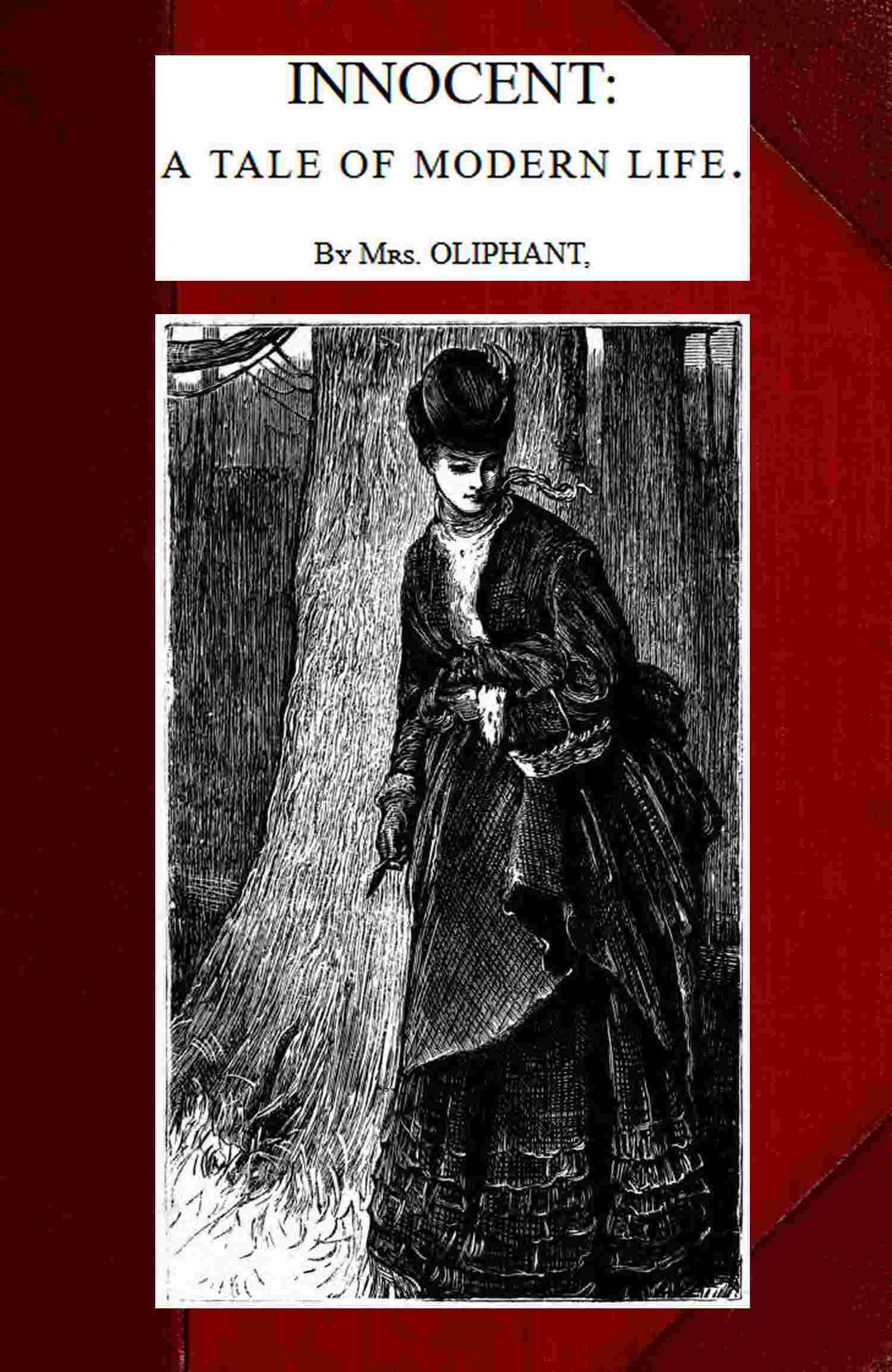
CHAPTER LI.
THE NUNNERY.
The Eastwoods spent several weeks at the High Lodge. They saw it at its very best, in all the spring blossoming, when the trees put on their most delicate greenery, and all the children, big and little, and all the orphans, and even the young ladies of the Upper School, got “their new things” for Easter. I am not sure that Mrs. Eastwood entered as she intended to do into “the humours” of the establishment. She disapproved of a great many things. She disapproved, for instance, totally of Father Featherstone, who directed the consciences of the community, and walked about indoors in a soutane, out of doors in a very ugly black cloak—an insignificant little individual, of whom Miss Vane and her sisters professed to stand much in awe, a profession in which Mrs. Eastwood did not believe. She herself disliked the odd little nondescript, and still more strongly disapproved of him. “Why should you neglect the clergy of the parish?” she said. “I think your rector might have good reason to be affronted——”
“But my rector is not affronted. He has no time to look after our services,” said the lay-abbess.
Mrs. Eastwood, however, was not convinced. She shook her head at Father Featherstone’s petticoats. She asked whether it was supposed that there was anything wicked in a man’s ordinary dress, and called the poor little priest “it” with a shocking Protestantism which was terrible to Miss Vane. But John Vane, who was there constantly—not as an inmate, for that would have been considered impossible at the High Lodge, but as a visitor—took Mrs. Eastwood’s hint with peals of profane laughter. “Ni homme—ni femme—prêtre,” he said, when he saw the black-robed father making his way through the sunshiny April gardens, and laughed and coaxed his sister who loved him, as pious sisters often love scoffing brothers, out of all offence. Miss Vane herself admitted that she could not go against Reginald—no one in the family had ever been able to go against him. “But everybody calls Mr. Vane John——” said Nelly. “My dear, there never was a John in our family,” said Sister Lætitia, with momentary tartness; but then she added, softening, “You shall call him John, if you like, Nelly.” To such a sudden, insidious attack, what could Nelly answer? She professed not to be aware of the meaning of the things that were said to her. She made a conscientious endeavour not to allow herself to feel that her heart was a great deal lighter than it had been, now that there was no struggle of divided duty; and when Jenny’s bold comparison of one man with another came into her mind, she tried to think that it was novel to her, that it was indifferent to her, that she had nothing to do with such a question. And in reality Nelly shrank, as every pure-minded and high-spirited girl naturally does, from the thought of replacing one with another—of giving her hand into the hand of another. The transfer was horrible to her, even though her heart had made it unawares. At the end of a fortnight, indeed, John Vane went abruptly away, leaving time and silence to work for him. He too saw that an immediate transfer was a thing impossible, though his sister was slow to see it. “Why shouldn’t they settle it all at once and get done with it?” Miss Vane said; “I never had any time to waste in nonsense. They will be far happier if they make up their minds at once.” And perhaps, on the whole, she was right. But what does it matter who is right when fantastic questions of feeling are to be considered?
When John Vane went away Nelly breathed more freely. She had got free from the toils in which her foolish youthful feet had been caught unawares. She ran about the High Lodge as she had been used to do at The Elms, with that tinkle of her pleasant steps like a brook, that flutter of her coming and going like a bird among the branches, which had been peculiar to her in the old days at home. There was perpetual movement of light young steps and gleam of cheerful faces in that well-populated place; but Nelly’s kept their special character, and were always recognizable. I do not think, for my own part, that Ernest Molyneux enjoyed his release as Nelly did. I don’t believe he enjoyed it at all. And this was strictly poetic justice, as the gentle reader will perceive who remarks how Molyneux worried Nelly and rent her gentle being in twain. He has been very bitter about women ever since, and he it is, I am informed, who has written the most virulent of those articles on the subject which have appeared from time to time in a very able and amiable periodical known to all men. Let us hope that in thus developing his sentiments he found as much ease to his mind as Nelly did when, after her long and feverish struggle to keep loving him and approving of him, to keep faithful to her promise, and steadfast in her duty, she got free from his toils, and turned her back on love, and healed herself among the spring blossoms and the admiring girls at the High Lodge. How they all admired her! She was not so saintly, not so abstracted as poor Innocent, predoomed (they thought) to the crown of martyrdom. But Nelly could do so many things; she was so clever, she was so pretty; and was it not whispered in the community that she had rejected one lover because he had failed to come up to the full standard of her ideal; and had they not seen how Mr. Vane, whom everybody at the High Lodge regarded as the very type of manly excellence, was at her feet? The girls thought there had never been any one seen so delightful as Nelly. They copied her very tones, her little gestures, her modes of speech; and Nelly healed herself of her long warfare in the midst of the cheerful order of the community, amongst the girls and the flowers.
CHAPTER LII.
WHAT BECAME OF LADY LONGUEVILLE.
Sir Alexis took his wife abroad early in the summer. His former intentions of spending the season in town, and producing his beautiful new prize in the world for the envy of all beholders, had been of course abandoned. To take her away, to keep her quiet, to abstract the too well-known Lady Longueville from the observation of all spectators, was his only policy now; and the pang with which Sir Alexis consented to this necessity was all the more severe, that he was too proud to disclose it to any one. Even to Innocent’s friends he said nothing of the mortification and disappointment which had replaced all his hopes. When the Eastwoods paid their visit at Longueville he was very kind, very attentive to them, but their visit was paid to a lonely and silent dwelling, which had already, in sentiment at least, abdicated its supremacy. It was, it is true, more the show-house of the county than ever, and visitors came eager to inquire into the habits and looks of the Lady Longueville who had been tried for murder, but its stately calm of sovereignty was over. No guests entered its doors that year. The friends of Sir Alexis sent their cards to evidence their sympathy, but they were in town, or they were going abroad, or they were afraid to intrude upon his privacy at a moment of trouble; so that the great house was solitary as an island in the middle of the sea.
“I don’t think we shall attempt any society this year,” Sir Alexis said to Mrs. Eastwood, with a constrained smile. He was a gentleman, and he showed no signs either to Innocent or her friends of the heavy burden which he felt he had to bear. At least, he concealed it from Innocent herself, and to some extent from Nelly; but Mrs. Eastwood read the proud man’s mortification in every look and word. And he had no deep and true love to fall back upon, only a faltering kindness and fondness for the poor little girl who was no longer the crown of the connoisseur’s collection, more delicate than his Dresden, more lovely than his best picture, a living Leonardo, as he had hoped the whole world would acknowledge her to be. Instead of remaining in that heaven of passive art-perfection, Innocent had stepped unawares into the living world, and had become the object of vulgar stares and curiosity, the heroine of a cause célèbre. Poor Sir Alexis! he bore it with stoical fortitude, but still the fact that he had much to bear became visible to instructed eyes. He became—not cross, it is too harsh a word—rather consciously forbearing and forgiving to his poor little wife. He made the best of her, but he was worried secretly by the simplicities which a little while before had been her crowning charm. He had to accept her as a woman instead of glorying in her as the highest triumph of art; and when he took her down from the pedestal he had himself erected, poor Innocent was not qualified to enact the part of woman as he understood it. She was a child, little more, perfect so long as you looked at her with the eyes of a connoisseur, but not perfect when the eyes that were turned upon her were those of a husband, very proud, and unwilling to fall below the mark which became a Lady Longueville. Alas, Innocent had not been trained to be Lady Longueville, the mistress of a great house, the companion of a man of the world. She was only Innocent—no more.
He took her abroad; he took her to Pisa, where, poor child, her recollections were sadly confused and uncertain, and where even Niccolo—whom Sir Alexis, true to all that honour and kindness demanded of him, did not fail to seek out, appeared to her through a mist, not the same Niccolo she had known, though his features were unaltered, and his delight at seeing her genuine. But Innocent had not lived at all consciously in those old days, and it struck her with strange wonder to find how little reality there was in her recollections of them, and how, in the midst of them, her heart would return to home. Home meant The Elms, however, to Innocent, not Longueville, nor her husband’s pretty house in town, with all its treasures. But she went to Santa Maria della Spina, and said her prayers, though even that visit was paid with little comfort, for her husband was with her, not unindulgent of her prayers, but a little disquieted and annoyed by her long pause after them. Why should she sit there doing nothing? he wanted to know; especially as the little church was soon filled by a party of English travellers, to whom he felt some one was pointing out “the celebrated Lady Longueville—she whose case was in all the papers, you know.” Sir Alexis could never get rid of this fear. Whenever any one looked at his wife (and whosoever has travelled in Italy knows the simple and honest admiration with which all Italians, meaning no harm, regard beauty), Sir Alexis felt that they were staring at the woman who had been tried, the heroine of the murder case which had made so much noise in the papers. When any one in his hotel took up the travellers’ book, he shuddered with the consciousness that Lady Longueville’s name would be the first to be noticed. Thus he fretted himself day by day. I do not suppose that Innocent had the least idea of this in its full meaning and import, but she felt instinctively the change of atmosphere round her, the absence of that genial warmth to which her half-conscious soul had responded during the first days of their marriage, and the coming in of something new, irritating and painful. The sensation was very strange to her. It was the first time she had ever been in an atmosphere of criticism—the first time she had ever felt the effect of that constant, involuntary watch upon herself and her actions with which a husband, no longer admiring, and not much in love, so often regards his wife. She began to wake up, poor child, to the necessity of considering her own words and ways, of thinking what she should do and what she should say to please him. Even this was not for a long time a conscious process in her mind, any more than Sir Alexis was conscious that his fretted and troubled mental condition betrayed itself sufficiently plainly to command her comprehension. Neither was quite aware of what was going on between them, but yet life was changing to both, new influences coming into being, old things passing away.
The Longuevilles were gone for more than a year—they returned to England only towards the close of the London season, Sir Alexis being still anxious to avoid society, and afraid of the consequences of taking his young wife anywhere. They saw few people, except Mrs. Barclay, who did her best to be as kind and effusive as ever, but who was disappointed bitterly by all the consequences of her brother’s marriage with which she had been so much enchanted. There was now, however, an expectation which made up for a great many drawbacks to this good woman, and one about which she made herself very important and very busy. “After all, the old Longuevilles are not to die out,” she said to all his friends; and in the flutter of that delightful hope she forgot the disadvantages which Innocent’s misfortune had brought about—the banishment of her brother, and the fading of those glories which he had worn for so short a time. “It is almost forgotten by this time; take my word for it, that if next season is at all a good one, and if anything out of the way turns up, nobody will remember that such a thing ever happened,” she said, by way of consolation to her brother, who was not in very good health, and who was in more fretful spirits than she had ever seen him. “A change of Ministry, or a Japanese Embassy, or even another scandal in high life, would make it all right for Innocent even now. There are people, you know, who would make her a lion directly.”
“A pleasant thing for a man to have his wife made a lion, and for such a cause,” said Sir Alexis, with a growl, which was half of pain and half of irritation. Poor man! he was suffering from suppressed gout, I believe, as well as many mental maladies, of which the pangs are still more severe.
“Well, Alexis—but it is not so bad as it might have been,” said Mrs. Barclay; “and before next season you will find it entirely forgotten, and Lady Twyford will present Innocent, and what with the heir we hope for, and all——”
Sir Alexis was mollified; but still he uttered another groan, not loud, but deep. He had lost his beautiful manners; he was not the serene man of the world, the urbane art collector and connoisseur, who had been pronounced delightful on all sides. To be sure, his friends remarked, marriage of itself often produces something of this effect; a man no longer feels it necessary to please everybody when he has secured some one to please him, and this rule tells more surely with your old bachelor than with a young man. But yet there was more than this in the churlishness and irritability which often veiled his once benign countenance. Irritability and churlishness are hard words—too hard, perhaps, to apply to a man who consciously restrained himself, and was at all times a great deal sweeter and gentler than he might have been had he indulged his temper as he often wished to do. But he was ill in health, never having surmounted the excitement, horror, and anxiety of the trial, and he was not young enough to possess the elasticity which can throw off the effects of such a blow. And Innocent, who ought by all rules to have felt it most, had thrown it off entirely; she had never even been ill, which seemed to her husband (though he never said so) the most extraordinary proof of her want of feeling; it had scarcely affected her one way or another, though she was in reality the cause of it all, and ought to have been the chief sufferer; but it had nearly killed him. This gave him a second grievance, and subject of unexpressed complaint against his wife; but yet, with all this sense of injury, and with all his consciousness that Innocent, as a woman and a wife, and the mistress of his house, was a failure, he was very good to her. He changed nothing in his mode of treating her. Nothing was changed save the atmosphere; but then the atmosphere was precisely the one thing which moved Innocent, and in which she was capable of feeling the change.
And various strange thoughts had been working in her also during this year. She had learned to express herself in a different way, and she had learned—what Innocent had never done before—to restrain and conceal herself in some degree. Words would sometimes rise to her lips which she did not utter—a curious symptom of mental advance—and she learned unawares to step out of herself and shape her mind to her husband. She did more for him a great deal than at first. She read to him, whereas he had been used to read to her. “The Miller’s Daughter” had long slid back into the past, but she read the newspapers to him, and books about art, and tried hard to understand, and show at least a semblance of interest. She was fond of pictures by nature, though to read about them was very puzzling, but even the newspapers Innocent attempted, and there were long tracts of reading which she got over with her lips, though her mind escaped from them, and refused to have anything to do with those arid pastures. All this she strained at to please her husband—by the action of the profound, unexpressed, inarticulate conviction in her mind that she had ceased to please him. She was a very good nurse, at least, never weary, finding it possible to be quite still without occupation, without movement, when her patient required rest—ready to read to him as long as he pleased—to do whatever he pleased with a docility unbounded. Shortly after their return to England Sir Alexis had occasion to put this quality to the fullest test. He was taken ill with a complication of disorders, and for a fortnight was in bed, nursed night and day by his wife, who would not leave him, though her own condition required a great deal more care than she gave it. Innocent, however, was impervious to all representations of this kind. “Me! I am well. I am quite well; I never was ill in my life,” she said, smiling upon the anxious matrons, her aunt, and Mrs. Barclay, who regarded her proceedings with dismay. Even the hopes which excited the Longuevilles so much did not excite Innocent. Her passive mind did not awake to the future—her imagination was not yet active enough to fix even upon the kind of hope which moves women most. The present was all she knew, and in that she lived and had her entire being.
Sir Alexis began to get well, and he was grateful, so far as he was able, for the devotion she had shown him. But yet his gratitude was tinctured by blame.
“It is very kind of you to nurse me; but when you think of the circumstances, Innocent, it would be still kinder not to wear out and tire yourself,” he said, in the half-weary tone of a man bound to give thanks, yet more willing to find fault. Very gentle was his fault-finding—but still it was fault-finding. He allowed her to sit by him all day as he recovered, but with a servant in the next room to do what he wanted, lest she should be fatigued. Even this consideration for her had a certain tacit reproof in it—a reproof too subtle to wake Innocent’s intellect, but which yet she felt eagerly as an evidence that she had not quite succeeded in pleasing him. He was not angry—he did not scold her; but yet he did not accept her service with that frank and perfect satisfaction which makes service happy. One of these days, however, Sir Alexis’s man, an old servant who had been long with him, got tired in his turn, and was replaced in the ante-room by another not so agreeable to the master. Innocent took her old offices upon her with a furtive delight when she perceived this. She began again to administer her husband’s medicine, to give him his drinks and tonics. In the afternoon the patient became a little cross and restless. Something disturbed his calm, I cannot tell what—some crease in his pillow, some twist of the coverlet, or something, perhaps, in the news of the day which Innocent had been reading. His mind took that evil turn which makes a man ready to be irritated by every trifle, to think of everything that is uncomfortable, and to say many things which are not pleasant to hear. All of us, I suppose, take this ill turn sometimes in the afternoon when the tide of being runs low, and every trifling contradiction becomes a wrong and injury to us. Sir Alexis tried to restrain himself, but he had not entirely succeeded. He even called for his attendant, and consciously vented his ill-temper on the man, that he might not be tempted further; but he had not quite exhausted the vein. Some time after this outbreak Innocent rose softly and went to the table.
“Why cannot you keep still, Innocent?” he said fretfully, “when you know that you ought not to be constantly in motion! What is it now? You disturb more than I can say——”
“It is the hour for your tonic,” she said. She was standing with her face towards him, smiling at him, with the smile he had once thought so strangely beautiful—with a Venice glass in one hand, milky white, and of a graceful shape, the very cup for such a hand to hold. With the other she took a bottle from the table, still looking at him. “You are no wiser than me in this,” she said; “because it is bitter, you would rather forget it; but you must not forget——”
He lay and looked at her strangely. She was to him at that moment as a picture—a picture he had seen somewhere and half-forgotten. He paid little attention as she approached him with the glass, but kept following out the thread of thought this idea suggested. God knows—or rather the devil knows, which is more appropriate—what evil spirit put it into his head. He looked at her fixedly as she came up to the bedside. He made no movement to take the glass when she held it out to him.
“Habit goes a long way,” he said, more to himself than her. “Put it down, Innocent; I don’t want my medicine from you; habit goes a long way—I wonder—will she ever do it again!”
He looked from her to the glass as he said this, and waved it away from him. I do not know by what magic Innocent understood instantly and distinctly what he meant. He would never have permitted himself to say it, had he not been confident in the slow and dim working of her mind, which generally lost all allusions and understood only plain speaking. But this time, for his punishment and for his fate, she saw in a moment what he meant. She gave a low cry. She looked at him with such a pathetic look as no human creature had ever turned on him before—like that dumb mystery of reproach which sometimes comes to us from the eyes of a speechless creature, an injured animal, without words in which to form a complaint. Her hand shook, the little milk-white glass fell and crashed in a hundred fragments; and without saying a word Innocent turned away. With the sense of some spell upon him, which kept him speechless, Sir Alexis watched her go softly, quietly out of the room. He called her name before her dress had disappeared from the door, but she did not come back. What had he done? He lay there for some minutes, confounded, scarcely realizing what had happened, as wonder-stricken as though a marble figure had shown signs of feeling. Then he called loudly to the servant in the next room. “Ask Lady Longueville to come back, I want her—instantly!” he said. A strange impatience flushed over him. “Nonsense, nonsense!” he said to himself, “what can happen? It is not possible that she understood me—and if she did? Pooh! Is it Innocent I am frightened for?” He laughed, all by himself, lying there in silence. How strange that laugh sounded! not as if it came from him, but from some mocking demon. He looked round, alarmed, to see who it was. “Innocent! Innocent!” he cried aloud, in a terror he could not account for. The servant did not come back. It seemed to him an age while he waited, listening, not hearing a sound in the house. “Innocent!” He sprang out of bed, feeble though he was, and clutched at his dressing-gown, and hurried to the door. There he met the servant coming back.
“Lady Longueville! Where is Lady Longueville?” he said.
“I beg your pardon, Sir Alexis, but my lady has just gone out. I might have caught her at the door had I gone there first, but I went up-stairs to call Mrs. Morton; she’s not in her room, Sir Alexis; and John tells me as my lady is gone out.”
“Gone out!” cried Sir Alexis in dismay. “Gone out—alone! Where has she gone? Go and ask which way she went. Go and ask if she said anything. Good God! can’t you make haste! I mean—Lady Longueville, of course, has gone to take the air. Why didn’t you or John, or some one, go with her? a set of idiots! Why on earth is my wife to go out unattended with all of you there?”
“I was here, Sir Alexis,” said the man in an injured tone, “and, besides, my lady——”
“Yes, yes, yes,” said Longueville in increasing agitation. “Let John go after her at once, as he saw what direction she took, and tell her to come to me directly. I have something to say—Go! go! go! don’t lose a moment; and send for my sister,” cried Sir Alexis, distracted. His head was throbbing, his limbs failing under him. He could send only his servants after his wife, he could not go himself to bring her back; he had to fling himself down on his bed exhausted, cursing himself and his fate. What had he done? What had he said? What horrible temptation had beguiled him? He said to himself that it could be but for a moment, that she must come back—that his sweet, simple Innocent would soon and surely forgive the evil words he never meant; but God help him! as he fell back on the weary bed from which he could not rise, what a miserable sinking, what a sense of some dreadful unknown calamity was in his heart!
Innocent went out of her husband’s house, poor child, she knew not how,—with that strange, helpless repetition of what she had done before, which seems to be natural to the undeveloped mind when stung with sudden pain. It was the only resource she had. What he had said to her was not an offence to her,—to use such simple words; it was as if he had cut her down suddenly, without mercy or warning,—cut her to the very heart. It did not seem possible to her that she could live and go on after it; it brought back to her all the misery of the past,—all her own conviction of guilt,—all the bewildered, wretched sensation with which she had fled from the house in Sterborne, in which Amanda lay dead. Had she tried to do the same again? Her brain reeled when she attempted to ask herself that question;—certainly that had not happened again what had happened then. The glass had fallen out of her hand and broken. Sir Alexis was living. He had not died. But what had put those terrible words into his mouth? Had she tried to do it again? She wandered forth in her horror and trouble, stricken to the heart,—ill in body,—torn by sufferings she did not understand,—and still more ill in soul, wondering was there not something that she, too, could take, and die? When she fled from Sterborne, her way was clear to go home,—but where could she go now? Not to The Elms, to bring more trouble upon them,—to some hole or cover, anywhere, where she could lie down—only lie down and die.
She wandered about through one narrow lane and another,—she did not know nor care where she went;—and every moment it became more difficult to keep erect—not to fall down and perish altogether. She would have done so, and died probably in a dreary little suburban street, no one knowing who she was, had not old Alice come out of one of the humble houses where dwelt a sewing-woman to whom she had just taken work, as the forlorn creature wandered by. Alice, divining evil with the instinct which never fails a woman who knew so much of life as she had done, rushed to the girl’s side, and clutched at her, as blind and sick with pain she tottered by. “Miss Innocent! where are you going?—oh, what ails you, what ails you?” cried Alice.
“Take me somewhere,” gasped poor Innocent, clasping her arms with a sudden cry of anguish, round the old friend who came to her like an angel out of heaven,—“take me somewhere, or I shall die——”
The poor needlewoman stood wondering at her door; and into her poor little room Lady Longueville was taken,—half conscious only of all that was happening to her. What a strange, sudden, miserable nightmare it seemed, after the quiet and peace of the morning!—pain of body, pain of heart, anguish which made her cry aloud, and a sick despair, which quenched and silenced every hope and wish in her. There was no time to ask questions, or to send for those who should have been by her in her suffering. Alice was the only support, the only help she had in heaven and earth. She clung to her, refusing to leave her hold.
“I want no one—no one but Alice,” she said, when they spoke to her of her husband and of her friends. And in this poor little house it was that the last hope of the Longuevilles perished and came to nothing—that which had given Innocent new importance in the family, and was to afford her a new beginning, as everybody hoped both in the family and the world.
Meanwhile Sir Alexis’ servants went wandering far and near, seeking for her. They went to The Elms first of all, and roused that peaceful house into anxiety and wonder.
“This time my lady has gone clean off her head altogether, as I always expected,” the messenger said to the servants of the house, who shook their heads as he drank his beer, and agreed with him that they too had always expected it. I cannot describe the tumult, the vain searching, the runnings to and fro which ensued. It was late at night before any one remarked that Alice had not come home, a discovery which, mysterious as it was, gave a little comfort to the Eastwoods, at least. Nelly and her mother consulted together, and set out immediately on foot to the needlewoman’s whom Alice had gone to visit, hoping to hear some news of her, some indications which they could follow out; and there they lighted quite simply, unawares upon Innocent, lying like one dead, speechless, colourless, the ghost of herself, with eyes which never brightened at sight of them, which seemed as if they could make any interchange of kindness ever more with other tender human eyes.
This new catastrophe fell upon them all like lightning from a cloudless sky—like the storm which bursts without warning or sign of evil. Sir Alexis, it is true, who lay at home in a state indescribable, took the blame entirely on himself, and accused himself of cruelty and barbarous folly, such as his attendants would have laughed to hear of, had they not been so much frightened by the condition into which remorse and excitement drove him, calling back his half-departed malady with a hundred cruel aggravations. He moaned over his poor Innocent in all the paroxysms of his disorder in a way that was pitiful to hear.
“Bring her back to me, and I will be better to her than I have ever been. Bring her back, and all shall be well; if I live—if I live!” he said, with a wail that was sometimes shrill with hope, and sometimes bitter with despair.
This, however, was not to be. Innocent, paler than ever, blank and passive as she had been years ago, was brought back to him as soon as she could be removed, but only in time to see her husband in his last lucid moments, to receive his blessing, and to bid him farewell.
“You have been a good child to me, poor Innocent. God bless you!” said the dying man, putting his hand upon her head; and then he asked feebly and anxiously, “You forgive me for what I said?”
“I did not do it,” said Innocent, looking at him very earnestly. “I did not do it.” There was no anger in her eyes, only a firm, almost wild denial, which yet she was anxious that he should believe.
“I know you did not,” he cried. “Oh, Innocent, my child, kiss me and forgive me! you have been as good as an angel to me. It is I that have been unkind, only I——”
She stooped down over him, her face melting a little, and kissed him—then by a sudden impulse knelt down by his side. Innocent had but one thing that it came into her head to do when she knelt down upon her knees. She said “Our Father” reverently and slowly like a child by her husband’s bedside: “Forgive us our trespasses as we forgive them that have trespassed against us.” I have heard that there was not a dry eye in the room; and when she rose up from her knees she kissed him again, and held his hand till he died.
CHAPTER LIII.
CONCLUSION.
Some time after this last calamity a large party was assembled, one bright October morning, in the drawing-room at The Elms. The house was full of flowers,—it was full of commotion. Many carriages had cut up the orderly little gravel drive round the shrubbery in front,—the door had been standing open all the morning, there were groups of people everywhere, even in the bedrooms, and the maids, in white ribbons, fluttered about the staircase, and bran-new trunks, with shining leather covers, stood in the hall. The dining-room door stood open, disclosing more flowers; a large, long table, covered with the remains of a feast; chairs thrust aside, and white napkins lying about as they had been left when the party adjourned into the drawing-room, where they had all gathered together in bright-coloured groups, waiting till the bride should be ready. The bridegroom was already in the hall, looking at his watch, and hearing gibes about the putting on of bonnets, and the putting up of baggage, which was henceforward to be his accompaniment through life;—his kind eyes shone as if they had been ten years younger,—you could scarcely guess that he was getting bald about the temples, so glorified was the man with that wonderful glow of happiness which has a certain pathos in it when it comes a little later than usual. And yet it was not late; he was quite a young man still, even the bridesmaids said,—and his two young brothers-in-law, and his old sister, all clustering about him at this moment in the hall, were ready, at a moment’s notice, all three of them, to have gone to the stake for John Vane. It speaks well for a man when he is thus supported on both sides. A great deal of talk was coming from the drawing-room, where the friends of the family, left to themselves, were discussing the matter, as people say our friends always discuss us when our backs are turned. There was nobody to keep this crowd in order. Mrs. Eastwood was up-stairs with the bride. The rest of the domestic party were in the hall, as I have said, consoling the bridegroom. Mrs. Everard, who rather took it upon her to do the honours of the place when the head of the house was absent, was herself the ringleader in this talk. Perhaps the gentle reader would like to know what they were saying, before Nelly, in her grey gown,—Nelly sobered out of her white into walking costume,—Nelly with her eyes rather red, and her lip trembling a little,—comes down-stairs.
“I never believed in the other business, for my part,” said Mrs. Everard, dropping her voice. “Of course, we must not so much as allude to it now, but you remember as well as I do when Nelly was supposed to be going to do something very different. I never believed in it, not even when we met him here continually, and the poor dear mother, who is too good for this world, let it all go on without taking the most ordinary preventives——”
“But, dear me!” said Mrs. Brotherton, the clergyman’s wife, “we heard that every arrangement was made, and that the judge and his family went into it quite as heartily as the Eastwoods did. Indeed, my husband met them here at dinner when the engagement was declared.”
“Oh yes, exactly; so did I,” said Mrs. Everard, “but there are wheels within wheels. I don’t mean to say I approve of that sort of thing, for I’ve known it to spoil a girl’s prospects, and cause a great deal of unhappiness; but, if you don’t care about feelings, acquiescing in an engagement is a great deal better than opposing it, and often comes to exactly the same thing.”
“I always understood,” said Mrs. Brotherton, indignantly, “that the Eastwoods broke it off in consequence of the way in which he behaved when poor Innocent was in trouble.”
“Are you talking of young Molyneux?” said her husband, interrupting; “My dear, the less said about that the better. No man likes to remember that his wife was once to have been somebody else’s wife——”
“Oh, you always take the man’s view of everything,” said the parson’s wife, “but what I say is that it was Nelly who broke it off, and that she was quite justified, and I wish all girls had as much spirit and sense, to stand up for proper treatment.”
“Take my word for it, the Molyneuxes never meant it to come to anything,” said Mrs. Everard, “they wouldn’t oppose, of course, for the judge is wise, and knew that opposition is the very best way to fix a young man. But I saw through it, from the beginning. I said to them over and over again, ‘Why don’t you settle about the marriage?’”
“And why didn’t they? because he had not the heart to go and work at his profession,” cried Mrs. Brotherton; “he was not well enough off to marry, and he never will be, unless the judge dies and leaves him rich, or unless he marries a woman with heaps of money. I am glad Nelly would have nothing to do with him,” cried the parson’s wife, who stood up for her own side. “What a comfort it is when a girl shows some spirit—there is so little in the world.”
“I doubt if Nelly’s spirit had so much to do with it as you think,” said Mrs. Everard mysteriously. “It was very silly of her mother not to tie him up and settle the business. I always said so from the first. She played into the judge’s hand, and let him do as he liked. You may depend upon it, he never meant it to come to anything from the very first.”
“Then he is a shabby wretch, and worse than I thought even a man could be!” cried the other, with vehemence.
“Oh, trust me, he always knew what he was doing; and the poor dear Eastwoods are sad simpletons,” cried Mrs. Everard, shaking her head with a pity which was not, perhaps, quite respectful. And, indeed, I think that this view of the question was generally adopted by society, which likes to think that the woman has had the worst of it in all such cases. Some one advanced however at this moment to ask information about “poor Lady Longueville” in the most hushed and sympathetic tones, putting an end to the previous subject.
“One does not like on such a day as this to say anything which could bring a painful suggestion,” said this considerate personage; “but I should like to know what has become of that poor girl.”
“She is very well indeed,” interposed Mrs. Brotherton. “She is with her cousin, Miss Vane, at that quaint establishment of hers—You never heard of it? It is not a sisterhood, and it is not a school——”
“I disapprove of all such mummery and nonsense,” said another guest, rushing in. “Sisterhoods! what do we want with sisterhoods? Popish rubbish—I’d send them all off to Rome; a pack of silly women——”
“‘Silly’ is the appropriate adjective to women, I believe,” said Mrs. Brotherton, who was advanced in her views; “just as my husband puts ‘grey-haired’ to the noun ‘father,’ and ‘kind’ to the noun ‘mother’ in his sermons. Innocent, however, is very happy among these silly women—being silly herself, I suppose.”
“Very happy? after all that has happened?” said the sympathetic questioner, holding up her hands with wonder and horror.
“Well! after a great misfortune, which was no fault of hers—and which, fortunately, ended in no harm; to be sure she has lost her husband, poor little thing—”
“That was a mistake—another mistake,” said Mrs. Everard, shaking her head. “Poor Innocent is as well as can be expected, Lady Dobson. She is very childish, and never will be anything else, I fear. She ought not to have been allowed to marry. As for poor dear Sir Alexis, she could not appreciate him when he was living, and she can’t be expected, I suppose, to feel his death very much. It was a mistake altogether. Of course, nobody could expect Mrs. Eastwood to do anything but jump at such a marriage for her niece. But it was injudicious—and, for my part, I always knew she was making a mistake.”
“What a sad story altogether! and to end in a convent—how romantic!”
“Convent, indeed! I did not know they went so far as to use that word in Protestant England! What are we coming to, good heavens!”
“But the Eastwoods were always an obstinate race—- no getting them to take advice—whenever they make up their minds to anything, wild horses would not move them. What, Nelly coming down-stairs! Then let us see the last of her, ladies,” said Mrs. Everard, remembering that it was her place to do the honours as the most intimate friend of the house.
Nelly stood on the threshold in her grey gown; her mother held her by one hand, her husband by the other. She looked back upon a cloud of faces, all smiling, throwing good-byes and kind wishes at her—and, on the other side, the horses pranced and tossed their proud heads, the gates stood open, the sunshine streamed down through the brown trees, the world lay before her.
“Good-bye, everybody,” she said; “and to you, for a little while, mamma.” And that was the last of Nelly. There was never a Nelly yet carried off by eager horses, by an eager bridegroom, among storms of white shoes and good wishes, who was more dearly taken care of thereafter than was the Nelly who signed herself from that day in stately fashion, “Ellinor Vane.”
“You are all that are left to me now, boys,” said Mrs. Eastwood, as she sat between them that evening, over the first fire of the season, which had been lighted for consolation. “Nelly will come back, but she will not be quite Nelly; one has to put up with it. You are all that are left to me now——”
“And Innocent.”
“Yes, Innocent, poor child!—--”
“Look here, mother,” said Jenny, somewhat hoarsely, “none of us know yet what Innocent will come to. She’s had hard work for a beginning,—none of us have had such hard work. As for Dick’s and mine, though we’re sorry enough for ourselves, what has it been to hers? But you’ll see there’s something to come of it. I suppose all that trouble is not likely to be for nothing, is it?” he said, almost indignantly, as if some one were opposing him; “if you mean what you say about Providence, do you think that can be all for nothing? I don’t.”
“God bless her, poor child!” said the mother, with more faith than conviction. “You always believed in her, Jenny.”
“And I do now more than ever,” said the boy, with a flush on his cheek, going to the window, where he stood for five minutes, gazing out into the darkness, though there was nothing to see. He was twenty by this time, and his mind was one of those which work up to conclusions long made, with an obstinacy which often brings about its own long-determined aim. “It’s a fine night,” he added, coming back, as if the weather had been all his thought. “What a bore that there’s no river to Sterborne! I tell you what, Dick, the next best thing is to drive,—we’ll get a carriage to-morrow, and drive my mother there——”
“What, drive me all the way?” cried the mother, half alarmed, yet pleased that her boy should think of her pleasure.
“We could do it in two short days—like the people in the book you are reading,” said Jenny: “why not? We’ll take you to the High Lodge to Innocent, instead of going by the railway—and of course you’ll bring her back with you here—Dick and I will look after the carriage to-morrow morning—and we’ll expect you to be ready by twelve, mamma.”
“Bravo, old fellow!” said Dick, delighted; “and, Winks, my old friend,” he added, as Winks dropped from his chair and came forward, stretching himself, to inquire into the proposition which had startled him out of a nap, “you shall go too——”
“But, my dear boys——” Mrs. Eastwood began in a tone of remonstrance.
“The best thing in the world for you, mamma,” said Dick, “and jolly for us, once in a way, to have you all to ourselves.”
What could mortal woman, being the boys’ mother, say more? I am afraid she would have considered favourably the idea of going to Nova Zembla, wherever that may be, under such conditions. And Winks, though he yawned as he listened, thought well of it too; he liked driving, on the whole, though too much of it bored him, and he had not at all approved when his mistress “put down” her carriage. They set off next morning in the brightness of noon, through the country which had not yet lost any of its beauty, though here and there the trees had yellow patches on them, and the parks were all burnt brown with the heat of summer. They were a very merry party, notwithstanding that the final examination was hanging over Dick’s head, and the parting which must follow. Winks, for his part, after two or three hours of it, got bored with the levity of the conversation, and rustled about so, that he was put out of the carriage to run for the good of his health. He went along for a mile or two, pleased enough, gathering dust in clouds about him. But when he intimated a desire to be taken in, the boys, hard-hearted beings, laughed in the face of Winks.
“A run will do you good, old fellow,” said Dick, with cruel satisfaction. A short time afterwards, I am sorry to say, a dreadful accident, nature unknown, happened to Winks. He uttered a heart-rending shriek, and appeared immediately after making his way towards the carriage, holding up one feathery paw in demonstrative suffering. The anxious party stopped immediately, and Winks made his way to them, laboriously limping and uttering plaintive cries. But when, all a-dust as he was, this hypocrite was lifted into the carriage, holding up the injured member—and was softly laid upon the softest cushion to have it examined, words fail me to express the sardonic grin with which he showed his milk-white teeth. There was no more the matter with the little villain’s paw, my gentle reader, than with yours or mine.
Never was there a pleasanter two days’ journey than this which Mrs. Eastwood made with her boys through the sunshiny autumn country, along the road, where gold-coloured leaves dropped in her lap as they drove her along, now one on the box, now another, in their turn; till the High Lodge at last appeared in sight all covered with white downy clusters of clematis done flowering, with late roses, and matted network of interlacing leaves. Innocent rushed to the door, slim and pale in her black dress, her eyes shining with sudden delight, her soft face inspired.
“You have come to take me home. I am Nelly now!” she cried, throwing her arms about the common mother. Jenny, whom she had not noticed, leant back upon the carriage, looking at her with eyes that glowed under his dark brows. He had always stood by Innocent since the day when he had read Greek to her in the Lady’s Walk; he had always been sure that “something would come of her.” “We don’t know half what Innocent will come to!” he repeated now to himself.
GILBERT AND RIVINGTON, PRINTERS, ST. JOHN’S SQUARE, LONDON.