
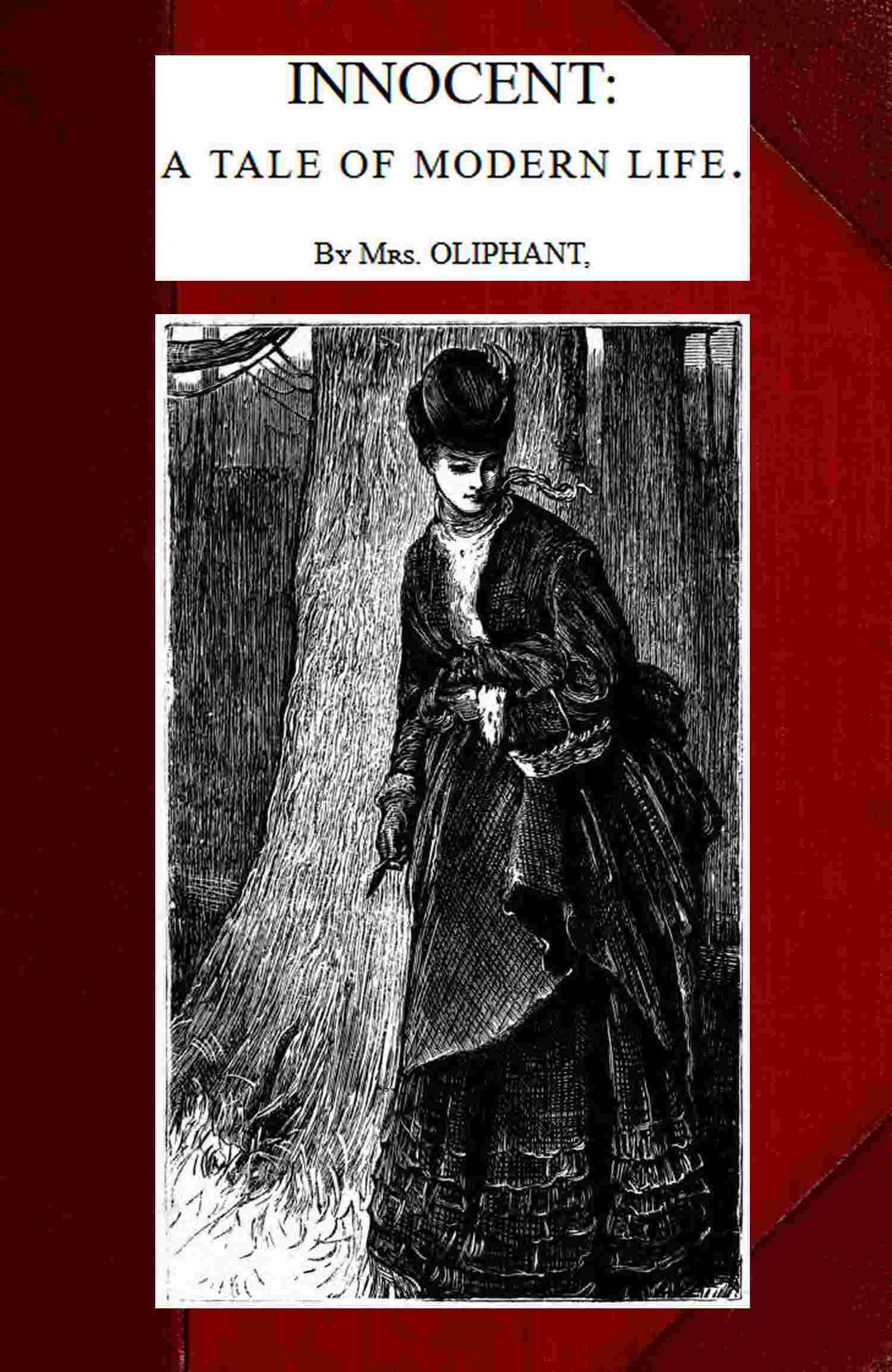
CHAPTER VI.
PISA.
Frederick had left Paris between the lamps and the stars, as I have said, on a chilly night, when the darkness and confusion in his own mind agreed better with the mist and rolling steam that made a cloud about the train as it dashed into the darkness, than with the serene celestial lights which tried in vain to penetrate that veil of vapour. He came into the harbour at Leghorn again between stars and lamps, but this time in the blue-green dawn of an Italian spring morning, too early for any stir except that which attended the arrival of the steamer. Do people still have that long promenade sur l’eau through the green sea basin from point to point before they are allowed to land, and be subjected to the final examination at the Dogana? I suppose all that has been changed with so many other things, with the abolition of passports, and other hindrances to the traveller. Frederick Eastwood did not now feel so hurried as when he was in Paris. He had arranged how he was to write home, and to telegraph to the office, begging for the extra week’s leave which was inevitable. He wrote his mother a long letter, telling her how he had been seized with “unpleasant symptoms” in Paris, but would not send her word of it lest he should alarm her; how he had managed to come on to Leghorn, taking the journey easily, and really had not suffered as he feared he would; how, on the whole, he was much better; how he intended to proceed to Pisa in the evening after a rest; and how within a week they might expect to see him back with his cousin. “Don’t be uneasy about me,” he said, “I am really a great deal better. I feel sure I shall now get home quite comfortably; but, as you remarked before I left, I was not well when I started—too much confinement, I suppose”—— I don’t attempt to explain this other fiction which he put forth with perfect gravity, and without much feeling of guiltiness. “Unpleasant symptoms” might mean anything, and I fear that from schoolboy days the excuses given at home are not judged by a very high standard of truthfulness. Frederick’s conscience did not trouble him much on this subject. He telegraphed to his chief at the office, announcing his detention by illness, without entering into any particulars as to where that illness had occurred, and claiming so many days’ extension of leave as would re-establish his health for the journey home. He felt ill enough, it must be allowed, after all he had gone through—ill enough almost to feel justified in the report he gave of his ailing condition—“seedy,” as he would have called it, to the last degree. He could not eat anything, he slept badly, his lips were parched, his hand hot and tremulous, and his looks bore him unimpeachable testimony, better than a medical certificate. Yet he felt rather happy in his unhappiness, as he rested and tried to eat a little minestra at the hotel at Leghorn. It was not so good as the bouillon he would have got in Paris, or the beef-tea at home, but it was all he was capable of. In the evening he proceeded on his short railway journey to Pisa—and on the way his mind, if not his body, mended rapidly. It was again dark when he arrived. He went to one of the hotels on the Lung’ Arno, and took a feeble walk in the evening to see the place, though so little could be seen. He had never been in Italy before, and though the circumstances were such as to damp enthusiasm, there was in Frederick’s mind a certain new-born freshness of a man returned to the paths of duty which we can compare to nothing but the feelings of one recovering from an illness. It was over; he felt languid, weak, but good. He had turned his back alike on temptation and upon sin. He was convalescent. Now there is no real moral excellence in being convalescent even after a fever; but that sufferer must have had unkindly tending and little love about him in his malady, who does not feel that it is good of him to get better, and that he has done something for which all his friends are justly grateful to him. Frederick, though he had no friends to be grateful, felt precisely in this condition. He felt good. In Paris he had felt miserable, mournful, and what he called penitent—that is he had felt that pleasure carried too far ends by becoming unpleasant, and that it costs very dear, and that the amount of satisfaction to be got out of it is scarcely proportioned to the outlay. This mood had lasted during the greater part of his journey. But after a man has so accounted for his misfortunes as Frederick had done, and has got the means of beginning again, and feels himself clear of the toils for the time being, such a mood does not last very long; and by the time he reached Pisa he had got fully into the convalescent state, and felt good. While his dinner was preparing he took a walk down by the side of Arno, in which once more the stars above and the lamps below were reflecting themselves with serene composure, the lights of heaven asserting no proud superiority over the lights of earth; and then turned aside to that wonderful group of buildings of which everybody has heard. Nothing in all Italy belongs to our childhood like that leaning tower. Frederick looked up at it, bending towards him through the darkness, and recollected pictures in books at home which his mother had shown him of evenings when he stood by her knee in pinafores, before “life” began. His reminiscences gave the softest domestic turn to his mind, and made him feel still more good than before. Even in the dark there were still some beggars about, flitting out of corners at the sight of the stranger, and he emptied his pocket among them, giving them francs and half francs with a wild liberality which increased tenfold the numbers of these waiters upon Providence next evening in the Piazza del Duomo. There were fitful gleams of moonlight coming now and then from out a mass of clouds, and sending broad beams of momentary glory behind and between the different buildings. Frederick was awed and impressed, as well as touched and softened. This was like the higher light of religious feeling coming in to elevate the domestic piety to which his heart had been suddenly opened by recollection. Thus impressed and ameliorated the convalescent walked back to his hotel to dinner, and was able to eat something, the reader will be glad to hear.
It was late, and he did not feel disposed to break the almost holy calm of his feelings after so many agitations, by making any effort to see his cousin that evening. He looked up at the tall houses as he went along, wondering if perhaps one of the faint lights he saw might be hers, but he was content to remain in this state of doubt till next day. One night could make little difference. When he had finished the meal, which was slight, but more satisfactory than anything he had been able to have since he left Paris, he made inquiries of the genial Italian waiter as to the position of the Palazzo Scaramucci, and whether anything was known of its English inhabitants. Antonio indicated to him exactly where the house was, and was eager to add that he knew the servant of the English gentleman who had died there. “Figure to yourself,” he said, “that Mademoiselle, his daughter, is all alone in that house of the dead.” The conversation was carried on in French, and Antonio was eloquent. He gave the stranger instantly a sketch of the girl thus left without any one to take care of her. “Letters have come from the friends in England, but no one has arrived,” said Antonio. “What kind of hearts can they have, blessed Madonna! Niccolo does not know what will become of the poor young lady. The Forestieri here are kind to her, but what is that when she is left all alone by her friends? Monsieur perhaps may know some of her friends? She is a beautiful young lady, but strange, neither like the English Meeses, nor the Italian Signorine, and Niccolo says——”
“Did you say she was beautiful?” said Frederick. This was a particular which it was impossible to hear without a certain interest.
“She will be beautiful when she is older, when she has more embonpoint,” said Antonio. “But she is not English in her beauty, nor in anything else. Niccolo says she will sit for days together and never speak. She had a very strange father. He is buried in the English cemetery, so I believe all must be right. But in my opinion, though Monsieur may think it droll, the old Englishman was tant soit peu sorcier!”
“Sorcier?” said Frederick, with a languid smile.
“Of course Monsieur thinks it droll—but for my part I believe he has thrown a spell over Mademoiselle. No one can melt her. She sheds no tear, Niccolo says. She listens to the English ladies without replying a word. The only Christian thing about her is that she goes often to St. Maria della Spina, the little, little, very little church which Monsieur may have remarked; and as she is Protestant, I suppose that must be a sin. Perhaps, if Monsieur knows any of the English in Pisa, he will be able to see this strange and beautiful young girl”——
“Perhaps,” said Frederick, taking the key of his bedroom and the candle from Antonio’s hand. He did not choose to say that he was the lingering messenger whom her friends had sent for Innocent. But his mind was compassionately moved towards her. Beauty is always a point in everybody’s favour, and the sense of power and protection in himself was pleasant to him. It quite completed, if anything had been wanted to do so, the rehabilitation of Frederick Eastwood in Frederick Eastwood’s own eyes. What a change his appearance would make in the position of this deserted young creature, whose melancholy soul no doubt only wanted the touch of his kindness and compassion to rouse it into warmer life! “Poor child,” he said to himself almost tenderly, as he went to bed. He would be a brother to her, and to do them justice at home, they would be good to the poor girl. Yet somehow he could not but feel that his own influence, as the first to go to her, would do most for Innocent. The thought diffused a pleasant warmth and revival about his heart.
Pisa is not a cheerful place. It has neither the beauty of situation, nor the brightness of aspect, nor even the larger historical interest which belongs to Florence, its near neighbour and whilom rival. It has fallen out of the race as a town may do as well as an individual. But, on the other hand, it has no keen ice-wind to sweep its streets like those that chill the very blood in your veins in the deep ravines cut through lofty blocks of houses which form the Florentine streets. The equable temperature of Pisa hangs about it like a cloud, stilling the life in it that it may never grow loud enough to disturb the invalids who set up their tents in those old palaces. They have a little society among themselves, gentle, monotonous, and dull, such as befits invalids. A great many English people are in that subdued winter population, people who are, or are supposed to be, poitrinaires, and people in attendance upon these sufferers, and finally, people who go because other people go, without either knowing or caring about the special advantages of the place. An English doctor and his wife, and an English clergyman and his wife, are generally to be found in all such places, and most usually these excellent persons do all they can to reduce the little colony of English, living in the midst of the quaint old foreign town, into the aspect of a village or small country place in England, where everybody talks of everybody, and knows his or her domestic grievances by heart. Mr. Vane, when he came to Pisa to die, had sought the assistance of the doctor, but not of the clergyman; so it was Mrs. Drainham, and not Mrs. St. John, who had taken Innocent in hand when her father died, and had tried to make something of the forlorn girl. Though Frederick of course knew nothing about this, two letters had been despatched but a few days before to Mrs. Eastwood and another relation, adjuring them to come to the help of the young stranger. The doctor had himself written in a business like way to Sir Edmund Vane, but Mrs. Drainham had taken Mrs. Eastwood in hand, and had written her what both herself and the doctor felt to be a very touching letter. The author of this affecting composition had been reading it over to some select friends on the very evening on which Frederick arrived in Pisa. Dr. and Mrs. Drainham lived on the first floor of the Casa Piccolomini, on the sunny side of the Arno, in a very imposing apartment, where they often assembled round them a little society “in a very quiet way,” for the doctor himself was something of an invalid, and practised in Pisa as much for his own health as for that of his patients. They were people who were generally understood to be well off, an opinion which it is good for everybody, and especially for professional people, to cultivate about themselves. Every Wednesday and Saturday, tea and thin bread and butter, cut exactly as bread and butter is in England, were to be had from eight till eleven in the Drainhams’ handsome drawing-room. On the evening in question the English colony at Pisa was very well represented in this modest assembly. There was Mr. and Mrs. St. John, accompanied by a gentle young English curate with pulmonary symptoms, who was staying with them, and giving the benefit of his services when he felt able for it. There was old Mr. Worsley and his pretty daughters, one of whom was suffering from bronchitis, and the other from ennui, the latter the more deadly malady of the two. The healthy portion of the population was rather in the background, and not held in much estimation. Mr. St. John himself, who now weighed nearly sixteen stone, had come to Pisa also with pulmonary symptoms, and was fond of citing himself as an instance of the cures effected by its wonderful equability of temperature. “But a winter in England would kill me still. I could never survive a winter in England,” he would say, tapping his ample bosom with his hand, and coughing to show that he had not quite lost the habit. On this particular occasion he uttered these words, which were very frequent on his lips, in order to console and encourage poor little Mrs. O’Carroll, the wife of a gigantic Irishman, who had broken all his bones one after another in riding across country, and who stood gaunt and tall in a corner conversing with the doctor, with red spots upon his high cheekbones, and a hollow circle round his big eyes, which did not promise such a comfortable termination.
“Oh, then, and you’ll tell Harry,” said the anxious woman, with the mellow tones of her country. “You’ll tell him all about it, Mr. Singin, dear, and what you took, and how you lived?”
“There is nothing to tell, my dear lady,” said the clergyman. “Pisa air, and a regular life, and taking care never to be out late or early, and nourishing food as much as I could take. But the air is the great thing. There is a serenity and equability in this Italian climate.”
“Ah, then!” cried poor Mrs. O’Carroll, “to get him to take care is all the battle. He never was ill in his life, and he won’t allow he’s ill, not if I were to preach to him night and day.”
The only persons present who had no uncomfortable symptoms were two ladies who sometimes dominated the party, and sometimes were snubbed and cast into the shade, according to the influence which prevailed. These were the two Miss Boldings, ladies in the earlier half of middle-age, one of whom studied Art, while the other studied Italy; women of perfect independence, and perfect robustness, who when Mr. St. John was not there, carried matters with a high hand, and dismissed the question of health as unworthy to occupy the first place in the conversation. “You think a great deal too much about your lungs,” Miss Bolding would say. “Let them alone, and they will come all right. Don’t fuss about your health. Pisa is no better than any other place, and no worse. Don’t think about it. Occupy yourself with something. Neither I nor Maria ever take the smallest trouble about our healths, and what is the consequence? We have never ailed anything since we had the measles. Don’t mind Mr. St. John, that’s his hobby. If you’ll meet me to-morrow morning in the Campo Santo—unless you are afraid——”
“Oh, no, not at all afraid,” said the gentle curate, with a flush of youthful shyness and wounded pride. All these conversations were interrupted by Mrs. Drainham, who called at once to Miss Bolding for her advice, and to Mrs. O’Carroll for sympathy.
“I want you to tell me whether you think I have done right,” she said, with much humility. “I am so anxious about poor Miss Vane. I have just written a letter to her aunt, though with much hesitation, for I have not your gift in writing, dear Mrs. St. John. Would you mind just listening to what I have said? If I had your approval I should feel encouraged after having sent it. It is very badly expressed, I am afraid, but it comes from the heart,” said Mrs. Drainham, casting an appealing glance round her. She had pretty eyes, and was rather apt to give appealing glances. The audience gave a vague murmur of assent and applause, and Mr. St. John added, in a bold and round voice, his certainty of approval.
“It will be an excellent letter, that I don’t doubt for a moment,” said the clergyman; and on this encouragement Mrs. Drainham proceeded to read it, her husband standing behind her, feeling his own pulse, with a benevolent and complacent smile. And indeed the letter was more than excellent, it was eloquent. It appealed to the feelings of the distant aunt in the most touching way. It bade her remember the sister with whom no doubt her own childhood had been passed, and oh! to extend her motherly protection over that dear sister’s orphan child; and it brought forward many religious, as well as natural, arguments to soften the heart of poor Innocent’s nearest relation. In short it was just such a letter as was calculated to bring tears into Mrs. St. John’s eyes, and which drove Mrs. Eastwood half frantic with indignation when she read it. “Does this woman think I am an unnatural wretch, to want all this talking to?” poor Mrs. Eastwood asked, half crying with anger and wounded feeling. But the company in the Casa Piccolomini thought it a beautiful letter. They thought the relations must be hardened indeed if they could resist such an appeal as that.
“I am sure the aunt must be a dreadful woman,” said Clara Worsley, “or she would have come by this time. Will you take me to see her to-morrow, dear Mrs. Drainham? After that letter everybody ought to take an interest in her——”
“You have expressed all our feelings, my dear,” said Mrs. St. John, pressing the hand of the doctor’s wife with mingled admiration and envy. “I doubt very much if I could have done it half as well.”
“Oh, that from you!” said Mrs. Drainham, with enthusiasm, for Mrs. St. John was literary, and the highest authority on matters of style.
“But I hear the girl is a very odd girl,” said Miss Bolding. “Doctor, what did her father die of? Are they wrong in their heads? I knew a Vane once, of a West Country family, who were all very queer. I wonder if they were the same Vanes? Devonshire, I think, or Somersetshire, I am not sure which”——
“They are a Devonshire family,” said Dr. Drainham. “And there is nothing wrong about their brains. He died of general break-up, Miss Bolding, a high-tempered man who had lived hard. I have met him about Italy in all sorts of places. The poor girl has been oddly brought up, that is all.”
“I fear without any sort of religious training, which accounts for a great deal,” said Mr. St. John.
“Not without some sort of religion,” said Miss Maria Bolding. “She is constantly coming over to the little Church of the Spina, the toy church, as my sister calls it. A perfect little gem; I prefer it myself to the Duomo. The girl has good taste, and she is wonderfully pretty. Not the Raphael style perhaps, but just such a face as Leonardo would have given anything for. I called her the Leonardo before I knew who she was.”
“Don’t you think, my dear, you take rather a superficial view of the matter?” said Mrs. St. John. “Think what a terrible thing to be said of an English girl—that all she knows of religion is to be constantly in the Church of the Spina! It is bad enough for the poor Italians who know no better——”
“You must go and see her, Martha,” said Mr. St. John, coughing. “I have had a delicacy about it, as her poor father declined to see me. Yes, he declined to see me, poor man,” he added, shaking his head mournfully, with a sigh. “I don’t like to mention it, but such was the case. I fear he was sadly deficient, sadly deficient——”
“If he is the Vane I suppose him to be,” said Mr. Worsley, in a hoarse voice, “he was as great a scamp as I ever met in my life. A man you saw everywhere—well connected, and all that. A fellow that played high, and ruined every man that had anything to do with him. And died poor, of course; all those scapegraces do,” said the comfortable invalid, putting his hand instinctively into his pocket.
“But his poor child. Whatever he was, we must not let that detract from our interest in the poor girl,” said Mrs. Drainham. “I have tried hard to get her to talk to me, to open her heart and to have confidence in me as a true friend. You would think she did not understand the meaning of the words.”
“Have you heard that poor Lady Florence Stockport has arrived, with that delicate boy of hers?” said Mrs. St. John: and then Miss Worsley began to consult with Mrs. Drainham about the music at church, and whether Miss Metcalfe, who played the harmonium, could not be induced to give up in favour of young Mr. Blackburn, who had taken a musical degree at Oxford, and written a cantata, and meant to spend the spring months in Pisa.
“It would make such a difference to our little service,” said Miss Worsley; “and don’t you think, with all the attractions of the Roman Catholic ritual around us, we ought to do everything we can to improve our services?”
Thus the general tide of the conversation flowed on, and Innocent was remitted back into obscurity.
All this took place on the evening when Frederick Eastwood arrived in Pisa. From his chamber, where he was already asleep, and from the windows of the Casa Piccolomini, might have been seen the faint light in the third-floor windows which marked where the lonely girl was sitting. She was all by herself, and she did not know, as Mrs. Drainham said, what the meaning of the word friend was. But I must turn this page and make a new beginning before I can tell you what manner of lonely soul this poor Innocent was.
CHAPTER VII.
THE PALAZZO SCARAMUCCI.
A long, bare room, the walls painted in distemper, with a running border of leaves and flowers, and the same design running across the rafters overhead; three huge windows, with small panes, draped with old brocaded hangings round the top, but without either blinds or curtains to shut out the cloudy glimpses of the sky; very sparely furnished; some old cabinets and rococo tables by the walls, some old settees and chairs, which had once been handsome; the floor tiled with red triangular tiles, with pieces of carpet before the sofas. At one end a stove, which opened to show the little fire, erected upon a stone slab like a door-step, and with an ugly piece of black tube going almost horizontally into the wall, had been added for the advantage of the English Forestieri, who insisted—benighted northern people—upon such accessories of what they called comfort. Another old rug, faded out of its natural brightness into sweet secondary tints of colour, had been laid before this impromptu fireplace; but the aspect of the place was cold, chilling the spectator to the bone. One or two dark portraits, painted on panels, hung on the walls; they were very grim and very old; for this was the terzo piano, let at a cheap rate, and with few elegancies to boast of. Near the stove, on a little marble-topped table, stood the tall lamp, with its two unshaded wicks blazing somewhat wildly, for it had not been trimmed for some time. The oil in it, however, one good, cheap luxury, which even the poor may have in Italy, was so sweet and pure that the air was quite untainted. On a little tray was a long loaf of the brown, very dry bread of the country, a plate of green salad, and a thin flask of common red wine—a pretty supper to look at, but scarcely appetizing fare for a delicate appetite. At the first glance there seemed to be no one in the room to benefit by these preparations, but after a while you could perceive in the recess of one of the windows a shadowy figure, leaning up in a corner, with its head against the pane, looking out. All that could be seen from that window was the cloudy sky, and some occasional gleams of moonlight, which threw silver lines upon the dark floor, and—when you looked down, as into a well—the Arno, flowing far below, with the stars, and clouds, and fitful moon, all reflected in it; and on its very edge the little Church of St. Maria della Spina, with all its tiny pinnacles tipped with silver. She who looked out from this high window could not be looking for any one; the people below were as specks hurrying along in the cold, with cloaks twisted over their shoulders. The watcher was nearer the heavens than the earth. She stood there so long, and was so motionless, that gradually the blazing light, blown about softly by some draught from door or window, the little table with the salad and the wine-flask became the centre of the still life, and the human shadow in the window counted for nothing. No breath or sound betrayed that something was there more alive than the light of the lamp or the glimmer of the wood embers, which, indeed, fell now and then in white ashes, and broke the utter silence of the place.
This silence, however, was much more effectually broken by the entrance of a stout, middle-aged Italian, with a cloak over one of his shoulders, and the cache-nez in his hand in which he was about to muffle his features when he went out. He looked round and round the large room, apparently unable to see the figure in the window, and then, with an impatient exclamation, went to the table and snuffed the blazing wicks and trimmed the lamp. “Just like her, just like her,” he said to himself, “gazing somewhere; never eating, never considering that one must live. If I were to add a slice of salami—though the child is fastidious, she does not eat salami——”
“I am here, Niccolo,” said a voice from the window.
“So I supposed, signorina; I knew you must be in some corner. May I be permitted to remark that life is not supported by the eyes, but by the mouth? If you will not eat the cena I have prepared for you, what can I do? I cannot take you on my knees and feed you like a baby. Oh, I have done it; I have been obliged to do it, when I had the poor padrone’s authority to sustain me, before now.”
“Niccolo,” said the voice, “I shall not want anything more to-night. If you are ready you may go.”
“Oh yes, I may go,” said Niccolo fretfully, “not knowing whether I may not find you a little heap of cinders in the morning, or fallen down in the window and frozen to death, Madonna Santissima! without the power to raise yourself up. If you would but have Philomena to stay with you, at least, in case you should want anything.”
“I want nothing,” said the girl. She came out of the window, advancing a few steps, but still keeping quite out of the cheerful circle of the light.
“No, the signorina wants nothing; the signorina will soon not want anything but a hole in the heretic cemetery beside her father; and when one goes sinfully out of the world by one’s own wickedness, besides being a Protestant and believing nothing, what can one look for? If I were the signorina, I should take very good care as long as I could not to die, and put myself in the power of those beings with the prongs that you see in the Campo Santo. I should take very great trouble, for my part, not to die.”
Upon this she came out altogether out of the darkness, and approached the fire. “Do you think that not eating kills people?” she asked. “I cannot eat, I have no appetite, but I do not wish to die.”
“At least, under any circumstances, one can drink a little wine,” said Niccolo, with disapproving dignity; “no effort is necessary to swallow a little wine. Signorina, I have put everything in order. I will leave the key with Luigi down-stairs, that the Philomena may enter in the morning without disturbing you. I now wait only to bid you a felicissimina notte. Buona notte, my little mistress—sleep well; and the Madonna and the saints take care of you, poor child!”
This little outburst was not unusual. The girl extended her hand to him with a smile, and Niccolo kissed it. Then throwing his cloak over his other shoulder, and wrapping it round him, he left her in her solitude. The guests at the Casa Piccolomini were dispersing at the same time, escorting each other, and escorted by their servants through the still streets. As Niccolo closed the great door after him, the sound seemed to reverberate through the blackness of the great staircase, down which he plunged, darkling, groping his way by the walls. Mr. Worsley, who lived on the first floor, had a coil of green wax-taper in his pocket, which he lighted to guide himself and his daughter to the door. They were a little afraid when they heard the footsteps stumbling down, not having been able to divest themselves of the idea that stiletto-thrusts were the natural accompaniments of a dark staircase. And with his cloak doubled over his left shoulder, and his red cache-nez hiding his countenance, Niccolo looked dangerous, more like killing his man in a corner than watching with the tenderness of a woman over the wayward child whom he had just left with an ache in his honest heart.
All alone in the house! The appartamento was not so large as that of Mr. Worsley down-stairs, for it was divided into two, as being adapted for cheaper lodgers. Besides this large salone, however, there was an ante-chamber, of which while Mr. Vane was alive he made a dining-room; and then a long stone passage, echoing and dreary, through which the solitary girl had to pass to her bed-room, another terrible stone room, floored with tiles, at the other end of the house. She had to pass her father’s room by the way, and another gaping empty chamber, full of the furniture which, with Italian superstition, had been turned out of the chamber of death. She was not afraid. She had been used to such constant solitude that it seemed natural to her. While her father was alive she had been as solitary as she was now, and it did not seem to her, as it did to everybody else, that his mere presence in the house made so much difference. She had been brought up in a Spartan-Italian fashion, to bear the cold and heat as things inevitable. She put her feet upon the stone slab, which did duty as a hearth, more from custom than for the warmth, which she scarcely thought of. A small scaldino stood under the table, full of fresh embers, which Niccolo had brought with him from the kitchen; but though she was cold she did not take it up and warm her hands over it, as a thorough Italian would have done. She was half Italian only, and half English, rejecting many habits of both nations. She had a small cloak of faded velvet drawn round her shoulders, old and cut after no fashion that had prevailed within the memory of man. It had come, I believe, originally from a painter’s studio, but it was warm and kept her alive in the penetrating cold. Kind Mrs. Eastwood, in her luxurious chamber, was wondering at that moment how the poor child would brave an English winter, and if “the little room” would be warm enough, with its soft carpets and close-drawn curtains, and cheery fire. If she could have seen the Italian girl with her old mantle on her shoulders, and the scaldino at the foot of her chair!
I am afraid I am describing too much, which is a fatal weakness for a historian to fall into; but yet, of course, the gentle reader who does not scorn that delightful title would prefer to hear what this solitary girl was like. She had a straight, slim figure, too slim for beauty, though that defect of youth is one which it is easy to forgive. Her hair was dark and soft, and hung about her face, framing it with a soft fold, very slightly undulating at the ends, though not in anything that could be called a curl. I must warn my dear friend and gentlest auditor, that this sounds a great deal better in words, and looks a great deal better in a picture, than it does in reality; for a girl of sixteen with hair thus hanging about her, neither curled nor dressed, is apt to be an objectionable young person, inclining to untidiness, and to look like a colt, unkempt and untrimmed. But Innocent was a neglected girl, who had never known any better. She did not strike you at the first glance as beautiful. She had no colour, and even had been called sallow by some observers. The chief beauty that struck the beholder was the perfect shape of her face, a pure oval, with the chin somewhat accentuated, as in the pictures of Leonardo da Vinci, and the eyes somewhat long in shape. Miss Bolding was right when she called the girl a Leonardo. She wanted the crisped hair, and that subtle, sidelong sweetness in the eyes, which is so characteristic of that great master; but otherwise the character of her face was the same—somewhat long, and with all the softness of youth in the prolonged and perfect curve of the colourless cheek. The eyes were heavy-lidded; they were not “well-opened eyes.” Only in moments of emotion did she raise the heavy lids freely, and flash the full light of her look upon you. At the present moment those lids were doubly heavy with dreams. The lips, which were thin and rather straight, without curves, were closed upon each other with the closeness of meditation; her hair fell into the hollow of her neck on either side, and lay in a half ring and careless twist upon her shoulder. A very simple back dress, without trimmings, appeared under the velvet cloak; these were the days before the Watteau fashion became popular, when dresses were made with but one skirt, and long, sweeping over the wearer’s feet. Such was her costume and her appearance. She took a little of the wine from the flask, and a morsel of the dry brown bread, and swallowed them as it seemed with great difficulty, bending over the fire in the stove, which began to sink into white ashes. Silence, cold, solitude, all around; and here in the empty house, in the empty world, this solitary creature, so young and forlorn. But she was not afraid. After a while she rose quite calmly, and lifted the long stalk of the lamp, and went away through the long echoing, ghostly passage. She saw nothing, feared nothing; her imagination was not at liberty, it was absorbed about other things.
Next morning it was more cheerful in the great salone; there was light, at least, which was much, and I think there was sunshine; but the gentle reader will forgive me if I confess that I have forgotten whether the Palazzo Scaramucci was on the sunny or the shady side. At all events, there was daylight, and a blue, clear, shining sky, and the sight of sunshine outside if not its actual presence. When Mrs. Drainham, who was really concerned about the girl, came to see her before twelve next morning, she found her seated by the same little table which had held her lamp on the previous night, with a little dish of polenta before her, and again the dry brown bread and the small flask of wine. It seemed the strangest, most distasteful breakfast to the Englishwoman. “Oh, my dear,” she cried, “do send away that mess, and have a nice cup of tea. Wouldn’t you enjoy a nice cup of tea? If you will come with me, my maid will make you one directly—and perhaps an egg and a little delicate bread and butter. I don’t wonder that you have no appetite, my poor child.”
“I like polenta,” said Innocent, playing with her spoon, “and I don’t like tea.”
This seemed immoral to Mrs. Drainham. “If you go to England, my dear, you must not say you have been in the habit of having wine for breakfast,” she said, “It would be thought so very strange for a young girl.”
Innocent made no immediate answer. With a perverse impulse she poured out a little of the nostralé wine, the commonest and cheapest, and diluted it with water. I do not, I confess, think it was an attractive beverage. “Probably I shall never be in England,” she said in a very low tone.
“Oh, you must go to England; that is one thing there can be no doubt of. What are you to do here, poor child? Friends have been raised up to you here, but it is not likely that people who are not connected with you would continue—and the apartment, you know,” continued Mrs. Drainham, in her eagerness to prove what was self-apparent, “must be let. The marchese is very poor, and he could not be expected to lie out of his money, and Niccolo must find another situation. Everything, in short, is at a standstill until you go away.”
Something hot rushed to the girl’s eyes—but if they were tears it was so unusual to shed them, that they rushed back again after an ineffectual effort to get forth. She made no answer. She had learned ere now, young as she was, the benefit of taking refuge in silence. Mrs. Drainham had drawn a chair near her, and sat looking at her, with eyes full of a curiosity not unmixed with disapproval. Mrs. Drainham, in short, disapproved of everything about her—her loose hair, her odd dress, her old velvet cloak, even the polenta on the tray before her, and the coloured water she was drinking. “What will they do with her in England?” she asked herself in dismay; but then her responsibility, at least, would be over, and her mind relieved.
“You have never been at school, my dear, I suppose?”
“No.”
“Nor learned anything? But you must have had some resources; you must be able to do something? Needlework at least, or tapestry, or something to amuse yourself with? You must have been very lonely in your papa’s time, as I hear he never saw any one. And you could not sit all the day with your hands before you; you must have been able to do something?” Mrs. Drainham cried, impressed almost against her will by the silence of her companion.
“I can read,” said Innocent.
“And no more? I hope your aunt, Mrs. Eastwood, is well off. It would be dreadful indeed if your relations were not well off. Girls in your position frequently have to go out as governesses. I don’t want to be unkind; but, my dear, it is for your advantage that you should look your circumstances in the face. Most girls of your age (you are past sixteen?) would have thought of that already. Suppose, for instance, that you were compelled to try and work for your own living. Now, what would you do?”
The suggestion was so strange that Innocent lifted her eyelids, and turned a wondering look upon her questioner; but apparently perceiving that nothing was to be made of it, cast them down again, with a slight shrug of her shoulders, and made no reply. “Why should I take the trouble to talk?” she seemed to say, which was not very civil to Mrs. Drainham, nor encouraging to that lady’s benevolence, it must be allowed.
“You never thought of that view of the matter?” said the persevering woman. “But you ought to think of it. Few people, unless they are very rich, are disposed to take all the responsibility of a girl like you. They might help you, and be kind to you; but they would most likely think it was right and best that you should contribute at least to your own support.”
“I do not know what you mean,” said Innocent looking at her with mingled wonder and resentment. She pushed away her little tray from her, and in sheer bewilderment took up the scaldino, putting it in her lap, and holding her hands over it. This was another thing upon which the doctor’s wife, as she herself avowed, could not look with any toleration. She made a little gesture of distress, as if she would have put it away.
“Oh, for heaven’s sake, my dear, don’t let me see you with that odious thing on your knee! An English girl keeps her hands warm with doing something or other. You will find nothing of that sort in England. There your time will be all filled up in a rational way. There is always something going on, and you will find no time to nurse your hands in your lap. Of course, there is a great deal that will be very novel. Put down that scaldino, dear. I can’t bear to see you with it. It is such an odd thing for an English girl to do.”
“Am I an English girl?” said Innocent dreamily. She did not respond to what was said to her. “She never gives you a reasonable answer,” Mrs. Drainham said afterwards, with an impatience for which it was not difficult to account.
It was just then that the tinkling bell at the door pealed, and Niccolo after some parley admitted a stranger. Niccolo recognized the name at once, though no English visitor could have recognized it had he heard it from Niccolo’s lips. “Signor Estvode,” he said, looking in at the door, and pausing, with the true instinct of an Italian servant, to watch the effect of the announcement. Innocent started to her feet, in her haste, dropping instinctively from her shoulders her old velvet mantle, and Mrs. Drainham sat and stared with genuine British composure, without any thought of politeness. Frederick came in, looking (as he was) something of an invalid still. He was pale; he had that look of convalescence we have already referred to on his interesting countenance. He came forward, holding out both his hands to the girl, who stood devouring him with her eyes, which for once were fully opened. She could not say anything; she could scarcely breathe. Many speculations had crossed her mind as to the kind of messenger who might arrive. This young man, looking not unlike one of the heroes of her dreams, pale, melancholy, yet smiling, holding out his hands to her, made such a sudden lodgment in the girl’s inexperienced heart as I can neither define nor account for. The chances are that his mother, who was much kinder than Frederick, would have made no impression at all upon Innocent. She looked at him with her eyes all aglow and shining, with a sudden glad contraction and then expansion of her heart. She put down the scaldino, and went a step forward. “You are my little cousin,” said Frederick, in a voice which the natural impulse of kindness and the pleasant sense of beneficence made melodious. He looked at her with no criticism in his eyes, rather with admiration and pleasure. The girl paused all aglow, on tiptoe, her sudden impulse betraying itself in every line of her slim figure. Then she obeyed that impulse, poor, forlorn child. She threw herself forward, took the outstretched hands, and bent down and kissed them in her pretty Italian way. “Yes, I am Innocent,” she said; “oh, take me away! take me away!”
CHAPTER VIII.
THE COUSINS.
This little scene was odd and somewhat embarrassing to a young Englishman utterly unaccustomed to have his hand kissed; but I think it highly probable that Frederick would have felt much less objection to it had it not been for the presence of that Gorgon of British propriety, which kept staring at him with an expression of shocked and suspicious watchfulness from the other side of the stove. He laughed with the embarrassment common to his nation under the circumstances. There is nothing so awkward, so unhappy, and unready, as an Englishman who is called upon to show any natural feeling of the softer kind before strangers. Why we all, and we alone, should feel that we are ridiculous when our hearts are touched, I cannot tell; but so it is. Frederick Eastwood was affected by the eager passion of his welcome; but with Mrs. Drainham’s eyes upon him, he could do nothing but laugh. The primitive-minded girl, who was not aware of this tacit necessity, shrunk back into herself when, as she thought, he laughed at her. But the spectator felt that it was the right thing to do, and her disapproval softened. She indicated a chair to the new comer with a little wave of her hand.
“Dear child,” she said in a caressing tone, “you must moderate your feelings. We all understand you; we all excuse you; but these are not English ways. Sit down a little, while I talk to you and to this gentleman. Mr. Eastwood, I think?—so far as one can understand an Italian’s version of the name we were expecting to hear—”
“Yes,” said Frederick, “I should have arrived a week ago, but for—indisposition. I am glad to find my cousin in such good hands.”
Here they paused, and looked at each other, with sentiments which were not unfriendly, but a certain English community of feeling that made them sensible of the necessity of some sort of preliminary antagonism before the one agreed to accept the other as the person he claimed to be. Mrs. Drainham was a pretty woman, though it was appointed to her at this moment to act the Gorgon’s part. And Frederick, with his peaked beard and melancholy eyes, was a handsome young man. The tone of the British matron perceptibly softened, as she took in at a glance the various evidences before her that the new comer was “a gentleman”—all-expressive and all-embracing phrase. She even laughed a little in her turn, and coloured very becomingly as she executed the sterner part of her duty.
“I am afraid you will think me impertinent,” she said; “and I feel ridiculous; but as my husband and I have taken a great interest in Miss Vane, would you pardon me for asking if you have—any credentials—or authority? I am sure I beg your pardon. You will understand what I mean——”
Then they both laughed together, which advanced matters still farther.
“I have a letter from my mother to my cousin,” he said. “I might have got a certificate of identity, had I thought she was so well guarded. And here is my card,” he added, taking it out smilingly.
It was the card Batty had found in the Paris hotel, which was the first one that came to his hand. He knew it by a crease in the corner, and pushed it back again with a little shudder which he could not account for: for indeed the Batty episode had faded into unimportance already. The card, however, was given and accepted with a gracious smile and bow. That celestial address, the “Junior Minerva,” impressed Mrs. Drainham, as it had impressed Frederick’s less desirable acquaintance. A little conversation of the most amicable character ensued, winding up by an invitation to dinner for that evening.
“And you will come too, my dear,” said the doctor’s wife; “though it is a thing you could not do in ordinary circumstances. Nobody could reflect upon you for departing from the usual rules in your position. I will ask no one to meet you. Mr. Eastwood will bring you to us at seven o’clock.”
Innocent had listened to this conversation vaguely, in a kind of stupor, feeling as if they spoke a language of which she had never before heard a word. Greek would have been as intelligible to her. It even hurt her vaguely that they seemed to understand each other in the language which she could not understand. She had been thrust back upon herself, which is always painful—thrust back after, as she thought, a gleam of new life and a new world, into the old dreary world, much drearier than ever by the contrast, though it was but momentary. The visionary intensity of a mind living in its own sensations almost annihilates space and time; and though it was but half an hour since Frederick Eastwood came upon the scene at all, there was room enough in that half hour to make the girl feel the force of two revolutions—the one from her dreary solitude into a new sphere of brightness, tenderness, companionship, which was as a revelation of heaven to her; and the other, a dreary circle back again, out of the light, out of the society, out of the strange delightful newness which seemed to have changed her being all in a moment. The one was a sudden sun-rising, the other an equally sudden eclipse. She had been raised up to heaven and then suddenly tossed down again. The amount of emotion involved was quite excessive and extravagant, out of all keeping with the momentary character of the incidents; but Innocent was not aware of this, nor could have believed how utterly unimportant to the others was the half hour which subjected her to such vicissitudes of feeling as she had never before felt in her life. She made no reply to Mrs. Drainham’s invitation, which, indeed, she scarcely comprehended. She did not understand the civilities with which her two companions parted, Frederick accompanying Mrs. Drainham to the door. What she imagined was that he had thus gone away without taking any further notice of her, and that all was over, and the new hope to which she seemed to have a right, taken from her. She sat in a stupor, watching them go away, fingering the folds of the old velvet cloak, which she had picked up mechanically from the floor, and feeling a mingled chill—of her shoulders from the want of her mantle, and of her heart from this strange desertion—which made her shiver all over, and gave her that nervous and passionate impulse to cry, which children and women are so seldom able to resist, but which poor Innocent had been victorious over often, tears being among the things which her father turned into highest ridicule. She had ceased almost to be able to weep—forgotten the way; the natural emotions had been frozen in their fountains. But the thrill of new existence of which she had been conscious had broken those frozen chains, and she began to struggle with a hysterical passion which roused all her pride and all her spirit to conquer it. No doubt, she thought, this new cousin, like her father, would despise the weakness which women indulged in. Innocent despised herself for being a woman, and she would have died sooner than yield to what she supposed to be a purely feminine impulse. She was struggling thus with herself, fighting the hardest battle she had fought since the time when goaded by his ridicule she had rushed upon her father like a little tiger, beating him with her baby fist, choking with suppressed passion, when the door opened again, and Frederick came in once more. She gazed at him with her breast heaving, and her eyes dilated, in the fierceness of her struggle to keep off the tears. And if he had laughed, or treated her emotion lightly, Innocent would have conquered. But Frederick’s heart was really touched. He felt benevolent, paternal, full of patronage and kindness. He went up to her, and laid his hand caressingly on her head.
“My little cousin, we must make friends now that woman is gone,” he said, smiling upon her.
Poor child, she knew nothing of self-control, scarcely anything of right and wrong. She threw out her arms and clung to him, in a simple effort of nature to grasp at something; and fell into such a passion of sobs and cries on his bosom as frightened him. But yet what was more natural? She had just lost her father; she had no one in the world to turn to, except this new relation who belonged to her. She had been undergoing an unnatural repression, concealing her feelings in that stupor which grief so often brings. Frederick thought he understood it all, and it affected him, though he was glad there was no one else in the room. He put his arm round her, and even kissed the cheek which was partially visible, and said all the kind things he could think of. It lasted so long that, not being very strong himself, he began to totter a little under the unexpected burden, and would gladly have freed himself and sat down by her. But Innocent had been carried away by the tide, and could not stop herself. This was the beginning of their acquaintance. There were no preliminaries. She had never “given way” in her life before, except on the occasion we have already referred to—and heaven knows what strange processes were going on in the girl’s half-developed, much-suppressed nature, as for the first time she gave her tears and emotion way.
When the hysterical sobbing came to an end, Innocent lifted her head from his breast, and looked at him, still holding him by the arms. She looked up suddenly, half beseeching him not to despise her, half daring him to do so; but there was no scorn in Frederick’s eyes. He was very sorry for her.
“My poor child!” he said, smoothing the ruffled hair upon her forehead.
Then a sudden flush came to her face, and light to her eyes. She released him as suddenly as she had clutched him. She sank back gently into her chair, with a shy, deprecating smile.
“I could not help it,” she said, putting out her hand. She wanted to retain some hold of him, to be sure that he would not melt quite away like one of the dreams.
As for Frederick, though his first feeling, I confess, was great thankfulness at being permitted to sit down, he had no objection to have his hand held by those soft, long fingers, or to bear the eager look of eyes which shown upon him with a kind of worship. He told her how he had been coming to her for a long time, but had been detained—how he had come to take her home—how they must start next day, if possible, and travel as quickly as possible; and how his mother and sister were awaiting her anxiously, hoping to make her happy, and to comfort her in her trouble. Innocent leant back in her chair, and smiled and listened. She made no reply. It did not seem necessary to make any reply. She held his hand fast and let him talk to her, not caring much what he said. I don’t know if her intelligence was much developed at this period of her life. She understood what he was saying, but it was as a song to her, or a story that he was telling. She did not mind how long she listened, but it required no personal response—took no personal hold of her. The picture he made of The Elms, and his mother and sister, produced no sort of effect upon her mind. She was satisfied. Everything was unreal and vague except the one tangible fact, that he was sitting beside her and that she was holding his hand. It was not love at first sight. The child did not know, and never inquired what it was. She had got some one—some one belonging to her like other people, some one who did not sneer or ridicule, but smiled at her: who called her name softly: who found no fault. She was altogether transported by this wonderful sensation. She wanted no more; no mothers nor sisters, no change, no conditions such as make life possible. She knew nothing about all that. Her understanding had nothing to do with the question. It was barely developed, not equal to any strain; and in this matter it seemed quite possible to do without it; whether she understood or not did not matter. She was happy; she wanted nothing more.
“Must you go away?” she cried with a start, holding his hand closer, as he moved.
“Not to leave you,” he said; “but if we go away to-morrow—Can you go to-morrow, Innocent?”
“I will go when you go,” she said.
“My dear cousin, you must be less vague. Can you be ready? Can you have your packing done, and all your little affairs settled? Where is your maid? She will know best.”
“I have no maid. I have nothing to pack. I am ready now, whenever you please; only you must not leave me. You must never leave me,” she cried, clasping her hands round his arm.
“I have no intention of leaving you,” he said, half flattered, half embarrassed, “till I have taken you to my mother. It is my mother whom you are going to—my mother—I told you—and Ellinor——”
“Will you leave me when we get there?” the girl asked eagerly, still holding him. Yes, it was flattering; but possibly it might become a bore.
“No, no,” he said, “I live there too. I am not going to leave you. But my mother will be the chief person then—my mother and Nelly, not me. They are ladies, they will be your chief friends and companions——”
“I would rather have you; I know you; and I don’t like women,” said the girl. “Listen! Could not we live somewhere without letting them know? I can cook some dishes—very good maccaroni; and I can cook birds. I could do what you wanted, and make your spese. This would be far better than going to live with your mother. I do not like women.”
She warmed as she spoke, turning to face him, with her hand still clasping his arm.
“You must not say such things,” he said.
“Why? This is the first time you have said ‘you must not.’ My father says women are all bad—not some here and there like men. I am one, but I cannot help it. I always try to be different. I would not do the things they do—nor look like them if I could help it. Are you rich?”
“No,” said Frederick, becoming bewildered. He had risen up, but she detained him with her two hands holding his arm.
“That is a pity. We were never rich. If you had been rich we might have taken Niccolo, who could have done everything—he is so clever. We might have stayed here. Stop!” she said suddenly, “there is a little cloud coming up over your face. Do not let it. Smile. You smiled when you came in first, and I knew that it was you, and was so happy.”
“My poor child! Why were you happy?”
“Because I knew it was you,” she said vehemently. “And now you talk of your mother. I do not want to go to your mother. Let me stay with you.”
“Listen, Innocent,” he said, with a shade of impatience stealing over him. “There is no possibility of questioning where you are to go. You must go to my mother. I live there too. I cannot afford to have a house for myself. You must learn to be fond of my mother, and do whatever she wishes. Now let me go, please. I am going out to see the place. If we leave to-morrow, I may not have another opportunity. Come, come, you must let me go.”
She was looking up into his face, studying it intently, as if it were a book, a close, penetrating gaze, before which his eyes somewhat wavered, hesitating to meet hers. An idea that she would find him out if she gazed thus into the depths of his soul crossed his mind and made him half angry, half afraid. Perhaps she divined this feeling; for she let his arm go slowly, sliding her hands away from it, with a half caressing, half apologetic motion. She smiled as she thus released him, but said nothing. There was something pretty in the act by which she set him free—a mingling of resignation and entreaty that at once amused and touched him. Go if you will—it seemed to say—but yet stay with me! It was hard to resist the moral restraint after the physical was withdrawn. But Frederick reflected that to spend this his only day in a strange new place—in Italy—shut up tête-à-tête with a girl who was a stranger to him, though she was his cousin, would be extremely ridiculous. Yet he could not leave her abruptly. He stroked her soft hair once more paternally as he stood by her.
“I will come back in time to take you out to this lady’s to dinner,” he said. “I suppose they have been kind to you? And in the meantime you must see after your packing. I have no doubt you will find a great many things to do. I am sorry you have not a maid to help you. Have you wraps for the journey? You will want something warm.”
She took up her old velvet mantle with a startled look, and turned it round in her hands, looking at it. It was a garment to delight the very soul of a painter; but, alas! it was not such a garment as Frederick Eastwood, who was not a painter, could walk about by the side of, or travel with.
“Is that all you have?” he asked, with a little dismay.
“I have a shawl,” said Innocent, looking at him with astonished eyes.
“Ah! I must speak to Mrs. Drainham about it,” he said, with some impatience. “Good-bye for the moment. Will you dress and be quite ready when I come back? and then we can have a talk about our start to-morrow and all our arrangements. I am sure if you are to be ready in time there is not a moment to lose.”
Ready in time! The words seemed to echo about poor Innocent’s ears when he was gone. Ready for what? For going out with him in the evening to the house of the lady who found fault with her; who had come to her and talked and talked so much that the girl neither tried nor wished to understand. Ready! She sat and tried to think what it meant. She had but the black frock she wore—no other—with its little black frill of crape about her neck; no edge of white, such as people wear in England. She could smooth her hair, and put on a locket, or her mother’s brooch; but that was all she could do. The packing she never thought of. Niccolo had been nurse and valet combined. He had always arranged everything, and told her what to do. She sat for a long time quite still, pondering over the mourning with a strange happiness and a still stranger poignant pain in her agitated breast. Then she rose, and putting her cloak round her—the poor cloak which she was afraid he had despised—she went down the long stairs and across the road to the tiny little church upon the edge of the Arno. Nobody who has been in Pisa will forget Santa Maria della Spina. I do not know whether its tiny size took the girl’s fancy, or if the richness of the elaborate architecture pleased her, for she had no such clearly developed ideas about art as her relations in England gave her credit for. Perhaps after all it was but a child’s fancy for the dim, decorated religious place, which, notwithstanding its mystery and silence, and the awe which hung about it, was not so big as the great bare salone in which she sat at home. She went in, crossing herself according to the custom which she had seen all her life, mechanically, without any thought of the meaning of that sign, and held out her hand to give the holy water to a peasant woman who entered along with her, mechanically too, as she might have offered any habitual courtesy. This poor girl had scarcely been taught anything except what her eyes taught her. She went in, according to her custom, and knelt for a minute on a chair, and then, turning it round, sat down with her face to the altar. I think what she said under her breath was simply the Lord’s Prayer, nothing more. It was very brief and mechanical too, and when she sat down I cannot pretend that her thoughts were of a religious kind. They were possessed by the occurrences of the morning. Her heart was in a tumult, rising and falling like the waves of the sea. The dead stillness with which the day before she had sat in the same place, full of a certain dumb, wistful quiet—almost stupor of mind, had passed away from her. Life had come along with the new living figure which had placed itself in the foreground of her picture. Her heart beat with the vibration of her first strange childish happiness at the sight of her cousin; but in the very midst of this there came a sting of sharp wonder and pain, that acute surprised disappointment which women are apt to feel when the man whose company they themselves prefer to everything shows himself capable of going away from them, and preferring some kind of pleasure separate from them to that which can be had in their society. “If he was glad to find me, if he came so far for me, why could not he have stayed with me?” Innocent was not sufficiently advanced either in intellectual or emotional life to put such a question into words, but it was vaguely in her mind, filling her in her childish inexperience with a pain almost as great as the new pleasure which had come with her new friend. The morning masses were all over; there was no service going on, no candles lighted upon the altar, which glimmered with all its tall white tapers through the gloom. Everything was silent; now and then a half seen figure stealing in, dropping down to say a prayer or two, and with mysterious genuflexion gliding away again. A few people, like Innocent, sat in different corners quite still, with their eyes towards the altar; they were chiefly old people, worn old women and benumbed old men, doing nothing, perhaps thinking nothing, glad only, like the forlorn child, of the peacefulness, the stillness, the religiousness about. Here and there was one who, with clasped hands and rapt face, gazed up at some dark picture on the wall, and “wrestled” like Jacob; but the most part showed little emotion of any kind; they found a shelter perhaps for their confused thoughts, perhaps only for the torpor of their worn-out faculties. But anyhow, they were the better for being there, and so was Innocent. She sat quite still for a long time, rather the subject of her thoughts than exercising any control over them, and then she turned her chair round again and knelt and said the Lord’s Prayer, and went away.
She went to Mrs. Drainham’s with her cousin as mechanically as she had said her prayers. Her appearance was strange enough on that strange evening, which she passed as in a dream. With an idea that ornament was necessary, and perhaps not without some pleasure in the novelty of having the little morocco box full of trinkets, which her father had always kept in his own hands, handed over to her keeping, she had put on a trinket which took her fancy, and which was attached to a little chain. It was a very brilliant ornament indeed, set with emeralds and rubies, in a quaint design, the background of which was formed by small diamonds. The effect of this upon her very simple black frock may be conceived. Mrs. Drainham was scandalized, yet impressed. Impossible not to look upon a girl possessed of such a jewel with some additional respect—and yet the impropriety, the unappropriateness of wearing it at such a time was almost “past speaking of,” Mrs. Drainham felt.
“You should wear nothing but jet ornaments with such deep mourning,” she said. “A plain gold locket might have done if you have no jet; but this, my dear, is quite out of character. You must try and recollect these things when you go among your relations. They will wonder that you know so little. They might perhaps think it heartless of you. Was it your mother’s? It is very pretty. You must take great care of such an ornament as this; but you must be sure never to wear it when you are in mourning.” This was said when she was alone in the drawing-room with Innocent after dinner. And then she, too, began to inquire into the packing and the wraps for the journey. She gave Innocent a great deal of advice, which I fear was quite lost upon her, and offered to go next day to “see to” her preparations. The girl sat much as she had sat in the Church of the Spina, with her hands crossed on her lap, listening vaguely. She did not know what to say, and her attention wandered often as the stream of counsel flowed on. She had done no packing still, and had no idea what to do about the wraps; and Frederick scarcely seemed to belong to her, in this strange room, where she sat in a kind of waking dream, ashamed of her poor frock, ashamed of her rich jewel, not knowing what to make of herself. Poor little Innocent! perhaps, on the whole, in this new rush of emotions that filled her there was rather less pleasure than pain.