
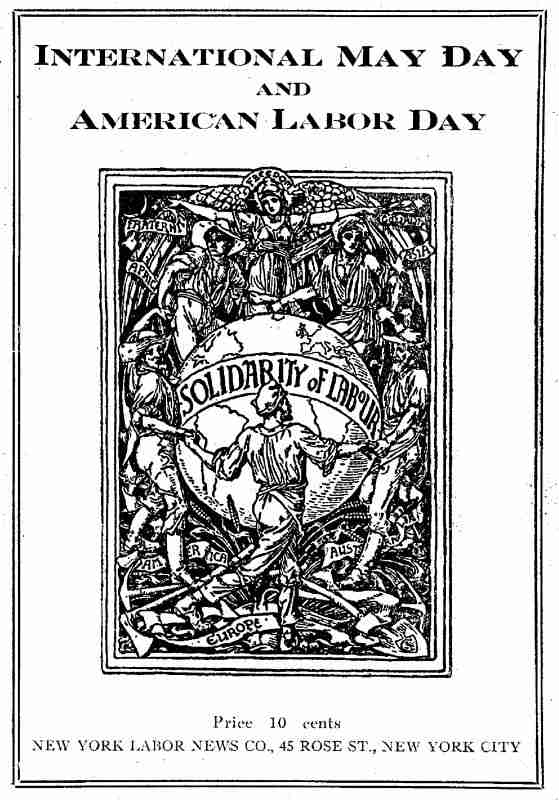
MAY DAY AND LABOR DAY—A CONTRAST.
The workers who are more or less familiar with the Labor and Socialist Movement in this country and especially in European countries, often wonder why most American workingmen celebrate “Labor Day” on the first Monday of September instead of May Day, on the first of May.
We shall endeavor, in this pamphlet, to give a sketch of the difference in the character and effect of these two holidays of Labor.
Except that both these holidays are dedicated to Labor and are primarily participated in by working people, there is nothing in common between them. In fact, they contradict and stand in opposition to each other, the same as the organized International Socialist and Labor Movement, which established the May Day, contradicts in all essentials and stands in opposition to the American Federation of Labor,—the organization under whose auspices the American Labor Day is celebrated.
May Day was created by a resolution adopted, upon the initiative of American Socialists, at the International Socialist Congress held in Paris, France, in July, 1889. The resolution had for its prime object to get the workingmen of all countries, races, climes and nationalities, speaking all the innumerable languages of the earth, to celebrate on the same fixed day their own holiday, and thus graphically to demonstrate to the world that, in spite of all the differences in language, nationality, etc., they are all members of the same class, the proletariat,—the propertyless wage-earning class—that their interests are the same and, like members of the same family, they stand for the Workers’ Brotherhood, International Solidarity and Universal Peace.
May Day was thus created by the workingmen themselves, in defiance of the capitalist class and its governments, and up to the present time the working people in many countries are compelled on the First of May to fight for their holiday at the sacrifice of their jobs, liberty, blood, and even life. When the police and cossacks of different countries appear on the scene on May Day it is always for the purpose of clubbing, maiming, arresting, and killing working people; for the police and cossacks recognize that May Day is the drilling day for the Social Revolution.
The American Labor Day, on the contrary, was a “gift” which the workers received from their masters, the capitalists, through the capitalist politicians. That first Monday in the month of September was made a legal holiday under the name of Labor Day, at first by the legislature of one state some thirty years ago; the politicians of other states followed the clever example, so that at present Labor Day is a legal holiday all over the country.
A vampire, when he settles down upon the body of a sleeping person and sucks its blood, is known to fan his victim with his wings, to soothe the victim’s pain, and to prevent him from waking up and driving the vampire away. So was the Labor Day created by the political agents of the American capitalists to fan the sleeping giant, the American working class, while the capitalists are sucking its blood.
American Labor Day can also be considered as a modern, capitalist version of the ancient custom of the days of serfdom and slavery. In those days the masters, for recreation and amusement, often-times set aside one day to celebrate the “enthronement of slaves.” They would take a slave, take the chains off his limbs, put him on a mock throne, put a mock crown on his head and, bowing to him in mock humility and obedience, would humbly serve him and overwhelm him with flattery. And the Silly Pool on the mock throne would throw out his chest and swell with pride. But the day of mockery over, the chains were again clapped on his limbs, and the miserable slave, groaning, would resume his life of a beast of burden.
Likewise with the unawakened American workman on Labor Day. On that day the chains of wage-slavery are, figuratively speaking, taken off his limbs; he is made the hero of the day; his masters, the capitalists, stand before him in mock humility; their spokesmen in the press, pulpit and on their political platforms, overwhelm him with flattery; and the modern Silly Fool, likewise, throws out his chest and swells with pride. But, the day of mockery and of the Fool’s Paradise over, the masters,—who during this day are only slyly smiling—break out into sardonic laughter—though unheard by the slave—clap the chains back on his limbs and he again hears only the crack of the whip of Hunger and Slavery.
It is only natural, therefore, that when the capitalist masters send out on Labor Day their hired bodyguard—the police and militia—they send them not to molest or injure the workingmen, but to march, as honorary escort, at the head of their Labor Day parades.
And why shouldn’t they? Don’t they know that the American Labor Day is only a day for the annual injection of a new dose of narcotic “dope,” of the antidote against the Social Revolution?!
What, indeed, is the key-note to the speeches delivered at Labor Day gatherings in America by the capitalist politicians, clergymen and professional “labor-lieutenants” of the capitalist class—the Gomperses, the Mitchells, the Duncans, the O’Connells, the Lennons, etc.? It is the biggest Lie of the Age, the lie that wealth is the joint product of Brother Capital and Brother Labor, that is, of the capitalist class and of the working class; that the interests of both are identical or reciprocal, that the two can and should live in harmony, peace and brotherhood with each other, and that the aim of the Labor Movement is to maintain indefinitely that harmonious equilibrium, and thus perpetuate the capitalist wage system by securing for the workers “a fair day’s pay for a fair day’s work” by means of an “equitable division” of that “joint product of Brother Capital and Brother Labor.”
Craft Union “Organization” and Spirit.
For this purpose the American Federation of Labor—the celebrant of Labor Day—gathers the masses of the workers, who in their blindness, ignorance and anxiety to secure immediate relief, respond to its luring call and flock to its banner. The gathered masses are then cut up into innumerable “independent and autonomous” craft divisions. They are taught to respect the claim of “Brother Capital” and to be guided in their actions not by the consideration of solidarity and identity of interests of all workers of the world, not even of those of the working class of America, not even of those of the American workers belonging to the same craft, but merely by the consideration of the interests of their personal jobs.
Accordingly, to monopolize their jobs they proclaim the principle of “America for Americans,” and try to build a Great Chinese Wall around America by means of reactionary anti-immigration laws and, in the meanwhile, build innumerable small Chinese walls around their unions by means of high, often prohibitive, initiation fees, dues and assessments; apprenticeship rules, catchy, tripping examinations of applicants for membership; system of “closing books” to all new applicants; forcing “troublesome” members out of the union and jobs by unjust and excessive fines, etc.
It is again only natural that labor “unions” of this type, built upon the principle of CLASS PEACE instead of CLASS STRUGGLE, discard the up-to-date ammunition from the arsenal of modern social warfare and persistently train their armies of “organized labor” to use the worse than worthless wooden swords and wooden bullets of conciliation, mediation and arbitration. Every careful observer of the American Labor Movement knows that the only effect of these weapons always was to break the aroused fighting spirit of the workers; to lead the electricity of the social storm into the ground; to make workers lose the advantageous position and opportune moments for securing substantial gains; to put them, broken in power and demoralized in spirit, at the mercy of their masters, and to give their false leaders the opportunity they so much crave for “settling the strike” and,—feathering their own nests financially, politically, or both.
Likewise is it only in keeping with this spirit and character of the heroine of Labor Day, the American Federation of Labor, that much of its time and energy is spent in fratricidal jurisdiction fights, fights over the question whether it should be the exclusive privilege of this, that or the other union to control certain kinds of jobs.
These jurisdiction fights, together with the system of agreements and contracts concluded by separate craft unions with the employers, without consideration of the interests of the other unions, and of the welfare of the labor movement generally,—contracts by means of which the members of the contracting unions are delivered over to the employers tied hand and foot and deprived even of the right to strike,—lead in innumerable cases to acts of betrayal and even of direct scabbing of members of one union against those of another.
Labor Day and Politics.
If the American Labor Day does not represent real unity and solidarity of the workers in their immediate field—the economic field—what wonder that it represents the same disruption and betrayal in the political field? That Labor Day plays a considerable part in the politics of the country no person familiar with the question can deny.
It must be remembered that America is a county where most of the workingmen, and now a rapidly growing number of working women, have a right to vote, and, as the working class—in America, of all countries—is the class to which the overwhelming majority of the people belong, no politician can get his fingers into the public pie, and the capitalist class cannot secure the control over the powers of government they need so badly, without employing some means of fooling the working people out of their votes.
American Labor Day is one of the institutions that is made to serve that purpose, too. The capitalist politicians have conveniently fixed it for the early part of September, about two months before Election Day, the season when the politicians make or prepare to make their nominations of candidates. The big gatherings of union men, voters, at Labor Day parades, mass meetings and picnics, supply splendid opportunities for advertising the candidacy of some capitalist politician claiming to be a “friend of Labor.” They give the false and treacherous leaders of the unions a chance, in expectation of good reward, to render these politicians a good service by securing them as speakers at these gatherings, and otherwise advertising them. They also give these false and ambitious union leaders a chance to boost their own stock on the political market by demonstrating to the politicians what a big crowd of voters the leader can influence for the one or the other political party of capitalism. It is in this respect both surprising and amusing how easily the labor fakers bluff and swindle at this game the politicians, who are otherwise supposed to be such shrewd men.
It is therefore not an accident only that at most, if not at all of the Labor Day gatherings, prominent politicians are invited to speak, and that those parades generally lead the mass of the workers past the City Hall and other such buildings, from the windows of which the politicians review the parade and flatteringly cheer the tramping hosts of poor, deluded workers. What is needed to reveal the true political significance of the performance is that the union leaders,—hungry for political jobs or nominations—should order a big banner carried in the parade bearing an inscription about as follows: “Look, gentlemen-politicians! See what a big herd of voting cattle we have this time to sell! How, what are you going to bid for them? What nominations will you give to us, the leaders; what appointments to political jobs will you promise to us if we deliver the votes of this herd to you?”
Judas Reward of “Labor Leaders”.
And the result generally is that the politicians generally conclude, in order to insure the success of their capitalist parties, to bait their political hooks with some prominent “union leaders” whom they nominate for some insignificant office on their tickets, and the mass of deluded workers, out of misplaced loyalty to their brother-union man, swallow bait, hook and all, dividing their forces between the leading capitalist parties.
Another form of rewarding the union leaders, who succeed in advertising their value on the political market or who render valuable services to capitalists, is to have them supplied with good political jobs. Not to mention smaller instances of local character, few of the many instances of prominent appointments could be cited as illustrations.
Ex-President Taft, following the example of his predecessors, as soon as he assumed power, appointed a “labor-leader,” Daniel O’Keefe, of the Longshoremen’s Union, to the office of Federal Commissioner of Immigration, with a fat salary and fatter emoluments. President Wilson appointed two prominent “labor leaders” to positions on the Federal Commission on Industrial Relations—they were: John B. Lennon, of the Journeymen Tailors’, an anti-Socialist and member of the National Executive Committee of the capitalist organization, known as the “National Civic Federation,” and James O’Connell, of the International Association of Machinists, and also a member of the National Executive Committee of the reactionary “Militia of Christ,” organized by the Roman-Catholic political machine to fight Socialism. The Commissioners are paid more than liberally by the Government.
Case of Secretary of Labor, Wm. B. Wilson.
The United Mine Workers have among their leaders in Pennsylvania a certain William B. Wilson. He soon became a proprietor in the mining business, but retained membership and leadership in the miners’ union. That helped him to get nominations on capitalist tickets, and he was thus elected Congressman on such a ticket. In the Congress in Washington he became the leader of the so-called Labor Group, that is, of other such Congressmen with union cards in their pockets, upon several of whom Col. Mulhall has since cast considerable light. When agitation was begun to create the Department of Labor as a new department of the Federal Government, with a seat for the Secretary of Labor in the Cabinet of the President of United States, President Gompers and other leaders of the American Federation of Labor began to agitate that “our Bill,” Mr. William B. Wilson, should be given the job and the power of Secretary of Labor. Accordingly, when the Department of Labor was created and President Woodrow Wilson assumed power, he immediately gave to “our Bill” the job of Secretary of Labor, with a salary of $12,000 a year, and power to distribute a large number of good political jobs to his friends. One of the first things William B. Wilson did when he became Secretary of Labor was to give to the son of Samuel Gompers one of the best jobs at his disposal. It was thus a complete case of one hand washing the other.
John Mitchell Case.
Take again the case of John Mitchell, the former President of the United Mine Workers and still a national leader of that organization. He is likewise a member of the National Executive Committee of the anti-Socialist “Militia of Christ.” He belonged to the National Civic Federation too, and held there a job of “settling” big strikes for which he received $6,000 a year salary. But the union miners woke up and compelled him, if he did not want to be expelled from the union, and lose his value to the capitalists, to give up that job and get out of the debauched and debauching Civic Federation. Poor John, shedding the tears of sacrifice and martyrdom, left the Civic Federation. But he did not like to remain long in the ranks of the “unemployed.” Though even during the period when he had no “steady job” he was “turning an honest penny” lecturing all over the country as the apostle of Peace between Capital and Labor, charging good admission fees to his lectures, having the railroads run special excursion trains to the towns where he lectured, etc., he was still yearning for a steady position.
Finally the Democratic capitalist Governor Sulzer of New York, believing that such virtuous men must be rewarded properly, and anxious to boost his own political stock by demonstrating his appreciation of the services of the Labor Leaders, took upon himself to champion the cause of John Mitchell’s career. There is in New York State a good paying political office known as Commissioner of Labor. Its chief and real function is to act as peacemaker whenever Brother Capital and Brother Labor are engaged in any of their interminable scraps. When the Tammany Hall politician Dix was Governor he gave that job to a “labor” politician Williams, who boasts of carrying in his pocket the membership card of the Carpenters’ Union. Williams’ term recently expired, and Governor Sulzer, Dix’s successor, seized the opportunity for playing “labor politics.” He appointed John Mitchell to the position of Commissioner of Labor at an increased salary, bringing it up to $8,000 a year. But here he struck a snag. Such a fat job was bound to make the mouth water not of Mitchell alone. Mitchell is not the only Labor Leader on the political market. There are other politicians, among Labor Leaders and otherwise, who would be glad to get hold of such a job, and besides, these others are more partisan Democrats than Mitchell is, and, consequently, enjoy the support of the more strictly Democratic partisan members of the Senate of the State of New York, who must ratify Governor Sulzer’s appointments. Accordingly the Senate refused to ratify the appointment of Mitchell to the position. Sulzer sent to the Senate for the second time the appointment of Mitchell to the same position. The Senate again refused to ratify and thereupon the legislature adjourned for the summer. Here, thought Sulzer and Mitchell, was their chance to put through their deal. Since the term of Commissioner Williams had expired, and he was only holding over awaiting the appointment of his successor, Sulzer, Mitchell, and Williams put their heads together and hatched out a nice little scheme. Williams put in his resignation from the office to take place immediately. Governor Sulzer accepted it and, since a vacancy was thus created and the Legislature was not in session, he, as a “matter of emergency,” immediately appointed Mitchell to fill the vacancy at a salary of $8,000 a year. Mitchell, on the spot, took the oath of office. He then turned around and appointed Williams to act as his first Deputy Commissioner of Labor, at a salary of $5,000 a year. Everything appeared to be smooth sailing. Mitchell was already planning how he would distribute among his labor leader friends the many other jobs at his disposal, but—“there is many a slip ‘twixt the cup and the lip,” as poor Sulzer and Mitchell learned to their sorrow.
The State Comptroller, who is responsible for the payment of salaries to state officials, took the stand that he had no right to authorize the payment of salaries to Mitchell and his appointees on the ground that Governor Sulzer had no legal right to appoint Mitchell without the consent of the State Senate, even if it was as a “matter of emergency” during the recess of the Legislature. Attorney-General Carmody of the State of New York took the same stand. The fight over poor Mitchell’s job was taken from stage to stage till it reached the highest court in the State, the Court of Appeals, which finally settled the fight by deciding against Mitchell and Sulzer. If Mitchell lost this fat job, it was only because of too strictly partisan politics played in this case, because Mitchell was not strict enough a Democrat to suit the Democratic majority in the State Senate. It was not opposed to him as “representative of Labor.” And there can be no doubt that Mitchell will not remain long on the list of politically “unemployed,” that at the very first opportunity he will be given a good fat political job.
Oh, you can leave it to the capitalists, they know how to appreciate such friends of theirs, how to take care of such “labor lieutenants” of theirs, as the late capitalist and leading politician Senator Mark Hanna called the leaders of the American Federation of Labor.
Case of James T. Lynch.
The latest instance of this policy of the capitalist politicians occurred only a short time ago. When Governor Sulzer, of New York, was finally prevented by the Court of Appeals from rewarding his pet John Mitchell with that fat job of State Commissioner of Labor, what did he do? He looked around in the market for other available “labor lieutenants,” and found a whole raft of them standing in line waiting for their political rewards and ready to be “seduced” without much coaxing. His attention was attracted to the big, towering, Taft-like figure of James T. Lynch, of Syracuse, N. Y. Governor Sulzer began to do some figuring:
“First—Has Lynch enough of a following and influence in the Labor Movement to be able to ‘deliver the goods,’ to influence his followers in favor of myself and my Democratic party?”
Why yes, Jim Lynch is the International President of the International Typographical Union, one of the pillars and most influential leaders of the American Federation of Labor.
“Good! Next. How about his politics? Is he a good enough Democrat? Won’t I have the trouble with him I had about Mitchell’s appointment?”
Don’t worry! Lynch is a solid “a number one” Democrat.
“Fine! Now, what is his position in the Labor Movement? Is he safe and sane? May be he is one of those radical, Socialistic Labor Leaders?”
Who? Jim Lynch?! Isn’t he one of the most bitter, rabid enemies of Socialism? Isn’t he a member of the National Executive Committees of both the National Civic Federation and of the Ultramontane Roman-Catholic “Militia of Christ”?
“Beautiful! Now to his record in the struggles between Capital and Labor, what is it?”
Why, it can’t be beat! Lynch is the most prominent apostle of sanctity of contracts between employers and employees, the most faithful watch-dog of the employers’ interests and upholder of the employers’ claim to the lion’s share of the wealth produced. He not only preaches it, but practices it with an iron hand. When the Newspaper Solicitors’ Union in San Francisco, in 1910, was compelled to declare a boycott against the publishers of a local capitalist daily, and the boycott was endorsed and taken up by the entire force of organized labor in that city, it was Lynch who telegraphed to them to stop that boycott, got the International Presidents of Union Pressmen, Stereotypers, etc., to send similar telegrams, and finally succeeded in breaking that boycott with the aid of President Gompers himself.
Again, when the union pressmen were locked out by the newspaper publishers in Chicago in 1912 and the union stereotypers joined their fight to help them in the trouble and union compositors of the I. T. U. intended to do likewise, it was Jim Lynch who rushed to Chicago and by threats of withdrawing their charter compelled the union compositors to stay in and scab it on union pressmen. The International President of the union stereotypers followed a similar policy, actually taking away the charter of the union stereotypers who were struggling together with the pressmen, and thus both he and Lynch broke the fight of the union men against the daily papers in Chicago. Don’t worry. Jim Lynch never hesitates to break a strike of union men when his and his friends’, the employers’, interests are crossed.
“That’s bully! Why, Lynch is even better than Mitchell. Now, one more thing. Would he be willing ‘to be insulted’ by the offer to him of a nice, juicy political job?”
Would he? Just try him! Wasn’t he only a few weeks ago fishing in Washington, D. C., for the appointment to the federal job of Public Printer? He came very near landing that job, only it slipped off the hook as Mitchell’s job in New York State slipped off.
“It’s O. K.” concluded the Governor, approached Jim Lynch,—and discovered, or at least surmised, that he was the very man who was pulling the wires through his friends, the politicians, to prevent the State Senate from ratifying Mitchell’s appointment so that the job should go to him, Jim Lynch. The friendship between dogs ceases when a bone is thrown to them. The friendship and “solidarity” between “labor lieutenants” of the capitalist class ceases, and they are ready to stab each other in the back, when a good job is at stake. As to the Governor, it made no difference to him who got the job, Mitchell, Lynch or anybody else, so long as his political fences were thereby mended. So the upshot of it was that Jim Lynch who was drawing $3,500 yearly salary as President of the International Typographical Union was named for New York State Commissioner of Labor with an $8,000 yearly salary. May God have mercy on the souls of the working people of New York State when James T. Lynch is in charge of the Labor Bureau!
While handing out this political plum to Lynch, Governor Sulzer, to make assurance doubly sure, gave to another “labor lieutenant,” Charles J. Chase, leader of union locomotive engineers, another good political job. He made him member of an up-state Public Service Commission.
Many more such cases of “labor politics” could be cited, but the above will suffice to show the character of the political fruits of the American Federation of Labor. And the Sun of Labor Day helps to ripen them!
Corrupting Influences.
The demoralizing and corrupting effect of the general character and the whole atmosphere of the American Federation of Labor, the celebrant of the Labor Day, is also seen in the matter of “controlling the jobs by the workers.” One of the aims of the Labor Movement is to secure such changes in the run of things that “the workers should own their jobs.” Well, some of the unions of the A. F. of L., bakers, printers, etc., have secured such a hold upon their trade in certain localities that they succeeded in putting into their contracts with the employers provisions that the union is to act as the employment agency for the employer, and the latter, whenever he needs help, must take whomever of its membership the union will send to him. On the face of it it looks as though “the workers control their jobs,” a step to “the workers’ owning their jobs.” In reality this “victory” is only an additional source of corruption in these unions. The actual power of distributing the jobs is in the hands of the business agent of the union and his hangers-on, or of the chairman of the union chapel of the shop. This power to manipulate the assignment of certain members of the union to more steady, easier and better paying jobs, and others, on the contrary, as mere “subs” to jobs for only few hours or days or for half-time jobs, or for harder and poorer paid jobs, inevitably leads in the selfish and corrupt atmosphere of the A. F. of L. unions to exactions of bribes by the leaders from the unemployed union members, to favoritism, to keeping of the “kickers” against leaders on the unemployed lists or on bad jobs. This ulcer upon the American Labor Movement has led even to the formation among the union printers, under the leadership of the above mentioned Jas. T. Lynch, of a secret malodorous organization, known as “Wahneta,” within the International Typographical Union.
In view of the above features of the American Federation “unions,”—and they by no means exhaust the list—it is only natural that when the “hosts of Labor” are marching in Labor Day parades they do not march to the strains of the battle-hymn of the modern revolutionary proletariat,—the “International” or the “Marseillaise”—unless some misguided Socialists disgrace Socialism by participating in such parades. No, it is to the tune of the vulgar rag-time and of the stale, capitalist patriotic hymns that the “organized labor” forces are marching on Labor Day. These rag-time melodies and patriotic hymns send the cheer of joy and hope and triumph to the hearts of capitalists and politicians. But to the ears of awakened class-conscious wage slaves and revolutionists these tunes are worse than a funeral dirge for the hopes and aspirations of the proletariat!
Such is the true character, aim and spirit of the American Federation of Labor under whose auspices Labor Day is celebrated.
How Different the May Day!
It is the awakened, intelligent, class-conscious Working Class of the World that stands back of the May Day. In America May Day is celebrated by the revolutionary Socialists in the political arena and, besides a few progressive locals of the American Federation of Labor, by the Industrial Workers of the World in the economic arena.[1]
1. The original Industrial Workers of the World, formed in Chicago in 1905, and having at the time of this writing its headquarters in Detroit, and not the Anarcho-industrialist “Chicago I. W. W.”, is meant in this and subsequent paragraphs.
The key-note to May Day is the greatest Truth of the Age, the solidarity of the working class of the world and the struggle for the overthrow of the capitalist class and its wage system.
As the Preamble of the Industrial Workers of the World, one of the most compact utterances of a revolutionary workers’ organization, expresses it:
“The working class and the employing class have nothing in common. There can be no peace so long as hunger and want are found among millions of working people and the few, who make up the employing class have all the good things of life.
“Between these two classes a struggle must go on until all the toilers come together on the political, as well as on the industrial field, and take and hold that which they produce by their labor....
“The rapid gathering of wealth and the centering of the management of industries into fewer and fewer hands make the trades unions unable to cope with the ever-growing power of the employing class, because the trades unions foster a state of things which allows one set of workers to be pitted against another set of workers in the same industry, thereby helping defeat one another in wage wars....
“These sad conditions can be changed and the interests of the working class upheld only by an organization formed in such a way that all its members in any one industry, or in all industries, if necessary, cease work whenever a strike or lockout is on in any department thereof, thus making an injury to one an injury to all.”
Fully in keeping with these basic principles are the sentiments and ideas given utterance to at May Day celebrations, as are also the functions and the work of the organizations, both political and industrial, which unequivocally rally under the Banner of the International May Day.
Lessons Taught to Labor.
On May Day, of all days, the men, women and children of the working class, whatever line of work they may be engaged in in a given industry, are appealed to by industrial union representatives to form one compact union of the workers of the industry, and all such industrial unions to form one nation-wide union of the working class.
They are taught that to accomplish this unification of the labor forces the labor union must be an open union; that it is criminal and suicidal for labor to prevent a single wage-earner, whatever his creed, color, nationality or race may be, from becoming or remaining a member of the union of his or her industry; that, consequently, exclusion laws against wage-earners of any race or nationality whatever, high initiation fees, assessments and dues, catchy trade examinations of applicants for membership, practically prohibitory apprenticeship rules, “closing of union books,” driving of members from the union by imposition of unjust and excessive fines, that these and similar measures are only contrivances to prevent the forces of Labor throughout the country and throughout the world from coming together to advance their common interests.
The workers are taught on May Day that a true, up-to-date labor union must recognize that it is not true that wealth is the joint product of capital and labor, in other words, of the capitalist class and the working class whose claims can and should be harmonized through “collective bargaining” and methods of conciliation, mediation and arbitration.
It must recognize that, on the contrary, LABOR ALONE PRODUCES ALL WEALTH and TO LABOR BELONGS ALL IT PRODUCES.
It must recognize that the employing class as a class of social parasites, has no real claim to any part of the wealth produced that the workers should be bound to respect.
It must recognize that instead of the absurd aim of securing “a fair day’s pay for a fair day’s work” the labor union movement must aim to secure for the wealth producers the opportunity to enjoy with their families every particle of the wealth they helped to produce and all the benefits of a civilized society.
It must recognize that such a union, planted upon the ground of the class struggle instead of class peace, must, in order to succeed, be militant in character, democratic in conduct, and be guided in all its acts and utterances by the spirit of brotherhood and solidarity of the international working class. It follows therefrom that:
To preserve and develop its militant spirit the union must leave the work of providing for sick benefits, death benefits and other such ambulance and insurance features to insurance companies, fraternal orders and other such organizations outside of the union proper;
The union must never conclude contracts or agreements with employers which in the least interfere with the right of any member of the union to strike or deal any blow at the employers whenever considerations of self-preservation or of solidarity of the Labor Movement require it;
To protect itself against being sold out, against favoritism, corruption and demoralization the membership of the union must retain in its own hands and not entrust in the hands of a leader or leaders the final power of ordering or calling off strikes, control over distribution of jobs, etc.
The Goal—Emancipation.
Organized into a compact body of workers of a whole industry and guided by the spirit of class solidarity the union at last will be free from suicidal jurisdiction fights and be able to present a solid, united front against the common enemy, the capitalist class.
A prominent feature of May Day, distinguishing it from Labor Day, is also the recognition of the fact that “knowledge is power,” that education of the workers in true principles of the Labor Movement, is a vital thing. That is the reason one never sees ignorant and treacherous politicians disgrace the Labor banner by speeches at May Day meetings as they do at Labor Day gatherings.
As the key-note of May Day is UNITY of the working class with regard to international solidarity and industrial union action so it represents the principles of united action of the workers in the political arena as well. On May Day the working people are appealed to unite politically as a class, as well as industrially. But they are appealed to to stand and pull together politically not for the purpose of begging from the masters for political alms or to secure a political job for some “labor leader,” but to protect and secure what improvements may be possible under the present social system and prepare that material force—the industrial organization of the working class—which is necessary to secure the final emancipation of the working class.
Accordingly, while the Labor Day does not object to the yoke of capital being kept upon the neck of Labor indefinitely and, at best, is emblematic of the attempt to have the yoke padded, the International May Day as even its battle hymn, the “International” expresses it—is a challenge to the capitalist class, is a demand upon them to surrender, is an appeal to the wage slave class of the world to close their ranks, to rise and fight to secure their own emancipation, better future for their children, to redeem the human race.
May Day marshals the forces for the impending Proclamation of Labor’s Independence! It is the harbinger of the Social Revolution!
“As an economic interpretation of three important crises in European history it is perhaps one of the best, considering the brevity of the work. Dr. Bang here employs to the best advantage the Marxian key, and succeeds in unravelling what to the average reader usually appear to be mysteries or near-mysteries. As the author explains in his introduction, the motive power of historical changes is to be found in the economic basis of a given society, in the methods of production and exchange peculiar to that society. To put it in this manner is, of course, to lay oneself open to the charge of teaching that the economic basis, and nothing else, influences the historical processes. Dr. Bang, however, in the concrete examples chosen furnishes ample evidence to show that while that undoubtedly is the chief, and in the long run the really important factor, the line cannot be drawn too sharply between cause and effect, seeing the effect frequently reacts upon the cause, stimulating it and aiding in accelerating (or retarding temporarily, as the case may be) the historical process.”—From the preface.
TRANSCRIBER’S NOTES
- Silently corrected typographical errors.
- Retained anachronistic and non-standard spellings as printed.