
"I doan't understand it," said Barnabas. "He told me i' the prison that he had evidence as would ha' proved me guilty."
It was a sign of how thoroughly the brothers knew each other that he had never considered it necessary to assert his innocence to Tom.
"The deuce he did!" said Tom. "He's found it not so easy as he thought, then. If ever that gentleman gets his deserts, may I be there! Your wife 'ud look t'other way out o' her sense o' duty,—but she'd want to clap her hands; she allowed as much as that."
"Not now," said Meg quickly. "You don't know, Tom. No one ever knows exactly what another man's deserts are." She coloured, fearing to betray what she had promised to keep secret; and Tom laughed.
"Ye may well blush when ye turn devil's advocate," he remarked. "I wonder ye dare stand up for him; only ye've allus got Barnabas to back ye now. Ye weren't so charitably disposed on Saturday," pursued Tom, looking rather hard at her.
"Eh, my lass!" said Barnabas. "Did Tom bully ye so that ye didn't dare say what ye liked when I wasn't by?"
He smiled, and Meg laughed, relieved at the change of subject. "Yes," she said; "Tom beat me with a poker and threw boots at me—whenever he had the chance!"
"That's why she's glad to see ye," said Tom coolly. "She's larnt as a husband may be useful—she missed ye on occasions."
"No, I didn't," said Meg. "When one wants any one much, one doesn't want him 'on occasions'; one wants him every time one draws one's breath."
"Well, he ain't much to boast on, now ye've got him," said Tom. "I say, lad, come back wi' me to-morrow, and shake the dust o' this ant-hill off your feet and pick up your flesh again. Ye'd do to scare the crows at present!"
"I'll get all right again. I'm tougher than ye think," said the preacher. "But I wouldn't be able to do farm work for a bit, and I ain't goin' to live on dad—no, not for a day. It's natural like that he shouldn't ha' been sure o' me, for he never did think much o' me. Happen, if I'd been hanged, he'd ha' thought I desarved it; but I'll not take help from him."
"Did not your father believe in you?" cried Meg. "Oh, Barnabas, I can never understand it—he is so good to me always."
"So he is," said the preacher. "I'm beholden to dad for that anyway."
After supper, when the two men sat together, Tom recurred to that subject.
"It's a shame, lad!" he said gravely. "Dad's been down on you all your life; but it's just the queer twist in his mind; I doan't know as he can rightly help it. Times when ye were a lad, I've thought if I could stand up for ye more; but ye were allus strong enough to stand by yoursel', and he ain't. It's odd how he turns the best side to your wife; she's never even seen him at his worst."
"Poor old dad!" said Barnabas. The firelight played on the brothers' faces, both strongly marked, both bearing the impress of hard lives. The queer strain in the father's character had not turned to weakness in the sons; but, probably, there were traces of it in them too.
"Poor old dad! he sartainly couldn't abide me as a boy, but o' late years I fancied he'd come round quite wonderful. Ye've been right to stick by him; but I fancy there'll be a good many his way o' thinkin'. I'm not fairly cleared, Tom."
"There's more nor I can feel the bottom to," said Tom; "but ye'll live it down."
"Ay, I'll do that, an' I'll live it down here," said the preacher. "Giles 'ull be glad to ha' me back; an' I can keep a roof over Margaret's head an' to spare at that trade; and do my special work as well."
"Do 'ee think your preaching 'ull go down after this?" asked Tom bluntly. "Happen they'll refuse to listen to ye."
"Very like," said Barnabas; "but if one won't be silent, one 'ull be heard—i' th' end. I larnt that in Newgate."
Tom nodded with rather a grim smile. How far he sympathised with his brother's religious views he never said; but he had long ago given up opposing them.
"An' your wife 'ull bide with ye?"
"She'll do as she likes," said the preacher; "but I've small doubt which that 'ull be." And Tom shot a quick glance at his brother, as he knocked the ashes out of his pipe.
"Oh, ay, ye've won her at last," he said. "It's ta'en a near sight o' the gallows to make her like ye, lad; but I fancy it 'ud take a deal more nor that to kill the liking. She's not the soart as 'ull be any trouble to keep. She'll hold to 'ee now through thick and thin; but,—ye might mind, times, that the ways ye walk are rough to a woman's feet; in especial one as was born i' cambric sheets. She'll never remind ye o' that; doan't 'ee quite forget it."
"I doan't," said the preacher. "But the ways must be stiff that lead uphill;" and Tom, looking at his brother's whitened hair and bowed shoulders, was silent.
Barnabas' wife was not likely to have an easy time of it; but, after all, there are a good many things that are more worth living for than easy times. He went back to the farm the next day, carrying with him a small packet, which Meg had charged him to throw unopened into the bottomless depths of the Pixies' Pond. It was not safe for her to keep it, for more reasons than one; and she felt no pang at parting with it. She had flung away more than diamonds for Barnabas! Tom asked no questions, and accepted and carried out the commission with no comments. If he guessed anything, he kept a still tongue on the subject. Barnabas' wife trusted him utterly, and neither he nor the pixies betrayed the trust. This time the diamonds did not return.
Timothy never confessed. After a time, he reappeared, limping ragged and foot-sore over the marshes to his mother's hut, looking over his shoulder as he shambled along. He was nearly starved and very thin, and weak and dirty. His mother received him with unbounded joy. He did not tell her where he had been; only vouchsafed the information that "the preacher had 'lain' the fellow, else he could never have come back".
No one connected him with the attempted murder of Mr. Sauls, but he was less mischievous and less restless than of old. He never understood that Barnabas Thorpe had nearly been hanged in his stead; but he had certainly lost his hatred of the preacher, and even, oddly enough, showed some rudimentary signs of a conscience. Barnabas would possibly have counted that in itself worth going to prison for; and, that being so, Barnabas was hardly, perhaps, to be pitied, though the cloud on his name was never cleared, and though there were always some, generally those who had not fallen under his personal influence, who considered him more knave than fool.
He never betrayed that confession, and the consequences that followed his hearing it did not make him one whit more cautious; but, to the end of his days, he felt "'shamed" when he reflected on his own "cowardliness" in the prison. He believed he might have done more for his Master, if he had not been weighed down during the whole of one afternoon by a most despicable and self-seeking weakness. His devotion to the miserable, his deep sympathy with the fallen, were the greater for that recollection.
It must be owned that from the moment he was certain that he possessed Meg's heart, his hatred of George Sauls ceased to trouble him; that knowledge exorcised that devil more effectually than all his prayers and fastings,—a fact which he put down to his want of faith, but which would rather have amused the doctor; though it is doubtful whether either Dr. Merrill or Barnabas Thorpe had arrived at an entirely just conclusion about the universe in general, and themselves in particular.
Both being honest men in their way, perhaps both had got hold of a splinter of the truth. Perhaps there will be a general piecing one day, when each generation and even individual will bring the precious fragment he has practically believed in, to the "saving of his soul"—materialist and mystic alike!
The last chapter of the story necessarily inclines one to end one's sentences with a query, seeing that an ending must always mean a fresh beginning somehow and somewhere.
The preacher and Margaret moved into the rooms over Giles' shop. He recovered his health to a certain extent; for his constitution, like his will, took a great deal of breaking. His horror of living in a city was lost in his growing desire to fight against the evil of it. Nevertheless, he meant to take a holiday and see the country he loved, when he should be no longer needed. I do not know when that day dawned;—possibly when his body was in its coffin; but one would not like to be sure even of that, for the rest of Heaven must surely mean to such strenuous souls as his, but "increased service".
His mistakes, at any rate, we may hope are over now; his battles fought, his besetting sins burnt away in that fire of the Lord in whom he believed. He followed the light, when he saw it, to the best of his ability, and he fell into bogs and ditches! Was the light therefore a delusion? Was his zeal wasted? I trow not. Our martyrs are troublesome people, troublesome both to themselves and to their generation. They see through curiously coloured glasses, they have a huge capability for tilting at windmills, and tumbling into pitfalls. They spill their own blood freely, and occasionally their brothers' as well; and yet, clinging to their ideal at all costs and to the uttermost, they are still saving salt in the world, witnesses of something that is worth suffering, worth dying—worth even living for. That noble army is drawn from every nation, and its members are of every creed. They are sometimes, alas! persecutors as well as persecuted; but in one point they are alike: their lives and actions preach the gospel of endurance and courage. They lift anew symbols of sacrifice, and so draw men's hearts after them.
George Sauls never met Meg again after the interview which lost him the case. She considered herself under an everlasting debt of gratitude to him; but it was a debt which, unfortunately, could never be cancelled. Gratitude, like friendship, was "not what he wanted". She never did full justice to the nature that was so unlike her own; but then "justice" is a rather rare commodity.
"I didn't know that I had it in me to be such a soft idiot," he said to his mother curtly, when he had told her that the preacher had been acquitted and that she must forget that dream they had had about the finding of diamonds.
Mrs. Sauls looked at him, with the rare tears standing in her eyes. "My dear, the world would have been a worse place for me anyhow, if you had not had any soft spot in your heart," she said.
"Oh d——n my heart! One should be made without one," said George.
And the old lady laughed and shook her head. "It's too good to be damned, my son." And, to herself she added: "And two women can swear to that who've good cause to know".
Of her own blood relations Meg saw little in the years that followed. Her life and theirs were too wide apart for it to be practicable for her to hold both to them and to her husband. Some women might, perhaps, have managed to cling to both; but Meg was not capable of a divided allegiance. She lived and worked for and with Barnabas, giving her strength and heart and soul as entirely and ungrudgingly as ever woman gave, and finding her happiness in the giving. No doubt she found sorrow too, seeing that increased capabilities of joy mean also increased capabilities of grief; but, after all, roses are worth their thorns even in this world.
On the evening of the day following the trial she stood beside the preacher at the window of their room in Stepney. The sun was going down like a red ball, sinking slowly behind the many twisted chimney-pots. Meg looked out on the murky yellow haze, and the crowded street, and in her heart was a great thankfulness.
"I've been thinkin' ower som'ut that Tom said last night. Would ye as lief bide wi' my father a bit till I ha' got things straighter for ye?" said Barnabas.
Meg shook her head. "No, I wouldn't. What has Tom been saying?"
"That my ways are rough for your feet; for that, when all's said and done, ye come of a different kind. Are ye quite content now, Margaret? Ye told me once that we had made a mistake."
Margaret turned to him with a smile that was answer enough. "Contentment is hardly the right state of mind for your wife, is it?" she said. The wistful tenderness in her face deepened. "You will never rest contented while there is a single 'unawakened' person left. I am more than contented now; though I am not so hopeful as you are. Only keep me very close to you, please, if your way is rough."
"What a sight o' houses, an' full—full to the cellars!" said the preacher. Meg knew what he was thinking when she saw his nostrils dilate and his eyes brighten like those of an old war horse when he hears the sound of a drum.
"To-morrow," cried Barnabas, "to-morrow I'll begin again. These last months have gi'en me a lesson. Ay, they've taught me I am too ready by times to serve two masters; that I've thought a deal too much o' my bodily life."
And his wife sighed under cover of her smile. That moral was perhaps hardly the one that most people would have drawn from late events. But a man sees what he has eyes to see, and that only!
"Barnabas," she said, "do you think from the bottom of your heart that your mistakes in life have generally arisen from a time-serving backwardness, from over-prudence and cowardliness?"
After a moment's silence, he answered, with reddening cheek:—
"Ay, lass; those ha' been my sins; I'd not call 'em mistakes. Mistakes one's bound to make, but they doan't matter. So long as a man follows the light as he sees it, he's bound to near it in time, and naught else is worth th' counting; but an' he holds back for fear o' mishaps, and is neither hot nor cold, phew!—the devil himsel' might be 'shamed o' that soart. Happen it takes all hell to warm some into life! For the rest, of course one must pay for blunders; it's a child's part to cry over that. We are apt to make a deal too much fuss about suffering, though we call ourselves the servants o' Him who chose it."
He frowned, looking over the housetops with eyes that saw the inside of Newgate and Jack dying.
"As a man sows, he reaps," he said. "An' there ain't no such thing as escaping payment. One sees that payment in the hospitals and the streets and the prisons. But it's a just law; and a remission of it 'ud mean death, not life. There is none, I fancy, lass, unless the Lord ceases to be merciful."
"Ah," said Meg, "I never know whether I think your creed most stern or most merciful, Barnabas; but, if there is no such thing as escaping payment, then what does the Cross mean?"
"It saves us from our sins!" said the preacher. "The devil tempts us to be cowards through our lusts, through our love o' ease; His Cross is the overcoming o' the fear o' suffering, the banner o' Him who chose and conquered pain."
And she laid her head on his shoulder as they stood together, hoping in her heart that her womanly fears for him might be forgiven, seeing that they could never hold him back. "Ah, you may be right," she said. "At any rate yours is a brave creed, and one fit for a man who loves fighting. But I shall never rise to thinking that 'nothing else matters' so long as one is following the light. Barnabas, that is beyond me! I could pretend I did not mind being hurt," said Meg; "but at the bottom of my soul I should know it was a pretence. I can't understand that!"
"You can't understan' that?" said the man; and he drew her closer to him. "Sweetheart, who was it that said that if she stood with me on the scaffold there would be no such thing as shame for her? That she would find it easy if she might die with me? Was that a pretence?"
"No, no. It was truer than anything else," cried Meg. "But that was for you, and any woman would have felt that if she cared for you. Why, there is not a poor creature who haunts Newgate but would understand that. It is so simple! A sacrifice is no pain when it is for the person one loves. It ceases to be a sacrifice. One doesn't 'count' it."
"I see," said the preacher. "So any woman finds that simple, eh?" He looked at the woman by his side, his truly now, and there crept over his face that tender reverence which a good man gives so freely, and which always half shamed, half touched Margaret.
"Help me, lass," he said; "that I may find it simple too. I am cold at times. I doan't allus practise what I believe. I am a terrible coward, Margaret. Help me, that the fire o' th' Lord may be kindled afresh in me, to the savin' o' many!"
"I think it will be," said Meg, her own eyes kindling. "Oh, Barnabas, it is a difficult world; but, at least, you never tell one to be satisfied with makeshifts, because there is nothing else to be had."
A recollection of her girlhood was in her mind when she spoke.
"God forbid!" said Barnabas Thorpe. "Shall we satisfy our souls with swine's food? Better go hungry than that! That creed is fit for neither man nor woman. It's born o' despair an' ower-softness, an' it means a givin' up o' th' fight, which is a shamefu' thing. Isn't it queer to think o' th' hundreds i' those houses? I'll preach by the river to-morrow. It's good to be free again! One got kind o' sick with feeling eyes always on one by night and day, and no place to breathe alone in."
"Forget Newgate now, dear," said Meg.
"No, I'll not do that," he answered. "One has no business to 'forget' till the day when the coming of the Lord shall set the prisoners free. But we'll begin afresh to-morrow, an' we'll ha' fewer doubts, an' we'll do more."
THE END.
A FEW PRESS OPINIONS
ON
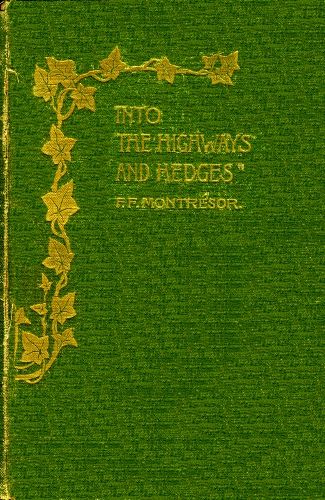
INTO THE HIGHWAYS and HEDGES
Academy.
"This book is so admirably conceived and written that Mr. Montrésor's next venture must excite unusual interest."
Speaker.
"This book will undoubtedly rank high amongst the notable novels of 1895."
Athenæum.
"Whoever wrote 'Into the Highways and Hedges' wrote no common novel. A touch of idealism, of nobility of thought and purpose, mingled with an air of reality and well-chosen expression, are the most notable features of a book that has not the ordinary defects of such qualities. With all its elevation of utterance and spirituality of outlook and insight it is wonderfully free from overstrained or exaggerated matter, and it has glimpses of humour. Most of the characters are vivid, yet there is restraint and sobriety in their treatment."
Daily Telegraph.
"This exceptionally noble and stirring book. Recounted with unflagging verve and vigour, we unhesitatingly say that it has hardly a dull or superfluous page."
New Age.
"A remarkably strong novel. I often thought of George Eliot when reading this book, which I advise every one to read." (Katherine Tynan.)
Manchester Courier.
"Mr. Montrésor's next book will be eagerly awaited by all those who make the acquaintance of his first, for a more strikingly original or a stronger novel has not appeared for some time."
World.
"'Into the Highways and Hedges' would have been a remarkable work of fiction at any time; it is phenomenal at this, for it is neither trivial, eccentric, coarse, nor pretentious, but the opposite of all these, and a very fine and lofty conception. The man is wonderfully drawn, realised with a masterly completeness, and the woman is worthy of him. The whole of the story is admirably conceived and sustained. A wonderful book."
Glasgow Herald.
"This is a remarkable and powerful book, which is likely to leave a strong impression of itself upon every intelligent reader. One of the most interesting novels that one has seen for some time."
Manchester Guardian.
"The characters are conceived strongly. Since the days of Dinah Morris there has not, perhaps, been quite so successful a portrait of a man or woman consumed by the passion of humanity. The dialogue throughout the book is excellent."