
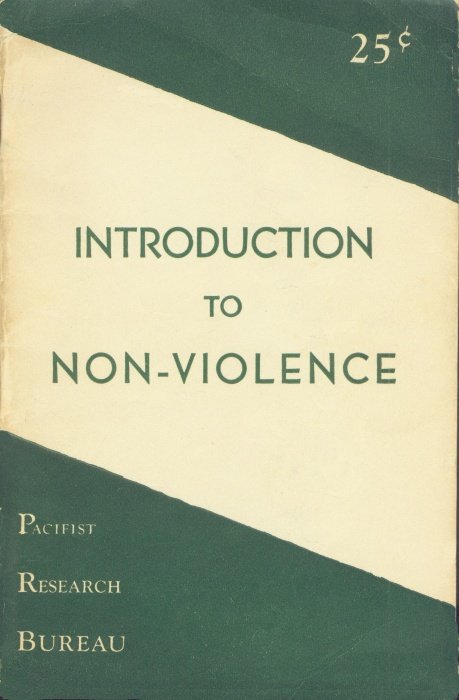
The Project Gutenberg eBook of Introduction to Non-Violence
Title: Introduction to Non-Violence
Author: Theodore Paullin
Release date: June 2, 2006 [eBook #18493]
Language: English
Credits: Produced by Mark C. Orton, Martin Pettit and the Online
Distributed Proofreading Team at http://www.pgdp.net
NON-VIOLENT ACTION
IN TENSION AREAS:
Series III: Number 1
July 1944.
INTRODUCTION
TO
NON-VIOLENCE
By
THEODORE PAULLIN
THE PACIFIST RESEARCH BUREAU
1201 CHESTNUT STREET
PHILADELPHIA 7, PENNSYLVANIA
MEMBERS OF THE PACIFIST RESEARCH BUREAU
| Charles Boss, Jr. | Isidor B. Hoffman |
| Henry J. Cadbury | John Haynes Holmes |
| Allan Knight Chalmers | E. Stanley Jones |
| Abraham Cronbach | John Howland Lathrop |
| Albert E. Day | Frederick J. Libby |
| Dorothy Day | A. J. Muste |
| Edward W. Evans | Ray Newton |
| Jane Evans | Mildred Scott Olmsted |
| F. Burt Farquharson | Kirby Page |
| Harry Emerson Fosdick | Clarence E. Pickett |
| Harrop A. Freeman | Guy W. Solt |
| Elmer A. Fridell | Douglas V. Steere |
| Richard Gregg | Dan West |
| Harold Hatch | Norman Whitney |
| E. Raymond Wilson | |
FINANCIAL SUPPORT
The Pacifist Research Bureau is financed entirely by the contributions of organizations and individuals who are interested in seeing this type of research carried on. We trust that you may desire to have a part in this positive pacifist endeavor to aid in the formulation of plans for the world order of the future. Please make contributions payable to The Pacifist Research Bureau, 1201 Chestnut Street, Philadelphia 7, Pennsylvania. Contributions are deductible for income tax purposes.
TABLE OF CONTENTS
- DIRECTOR'S FOREWORD
- PREFACE
- I. INTRODUCTION: ON TERMS
- Definition of Terms
- II. VIOLENCE WITHOUT HATE
- Revolutionary Anarchism
- Abraham Lincoln
- The Church and War
- III. NON-VIOLENCE BY NECESSITY
- Non-Violent Resistance to Invaders
- Chinese Boycotts Against Foreigners
- Egyptian Opposition to Great Britain
- IV. NON-VIOLENT COERCION
- The Labor Strike
- The Boycott
- Non-Violent Coercion by the American Colonies
- Irish Opposition to Great Britain After 1900
- Strikes with Political Purposes
- Non-Violence in International Affairs
- V. SATYAGRAHA OR NON-VIOLENT DIRECT ACTION
- The Origins of Satyagraha
- The Process of Satyagraha
- The Philosophy of Satyagraha
- The Empirical Origins of Gandhi's Method
- Non-Cooperation
- Fasting
- The American Abolition Movement
- VI. NON-RESISTANCE
- The Mennonites
- The New England Non-Resistants
- Tolstoy
- VII. ACTIVE GOODWILL AND RECONCILIATION
- Action in the Face of Persecution
- Coercion or Persuasion?
- Ministering to Groups in Conflict
- The Power of Example
- Work for Social Reform
- Political Action and Compromise
- The Third Alternative
- VIII. CONCLUSIONS
DIRECTOR'S FOREWORD
"When I use a word," Humpty Dumpty said, in a rather scornful tone, "it means just what I choose it to mean—neither more nor less."
"The question is," said Alice, "whether you can make words mean different things."
In the writings of pacifists and non-pacifists concerning theories of and experiences with non-violence, there is a clear lack of uniformity in the use of words.
The present booklet, introducing the Bureau's new series on Non-Violent Action in Tension Areas, distinguished by green covers, critically examines pacifist terminology. But it does more, for it analyzes various types of non-violence, evaluates examples of non-violence referred to in previous literature, and points to new sources of case material.
Dr. Theodore Paullin, Assistant Director of the Bureau, is the author of this study. The manuscript has been submitted to and reviewed by Professor Charles A. Ellwood and Professor Hornell Hart, both of the Department of Sociology, Duke University; and by Richard B. Gregg, author of several works on the philosophy and practice of non-violence. Their criticisms and suggestions have proved most helpful, but for any errors of interpretation the author is responsible.
The Pacifist Research Bureau frankly bases its work upon the philosophy of pacifism: that man should exercise such respect for human personality that he will employ only love and sacrificial good will in opposing evil and that the purpose of all human endeavor should be the creation of a world brotherhood in which cooperative effort contributes to the good of all. A list of pamphlets published or in preparation appears on the back cover.
HARROP A. FREEMAN,
Executive Director
Any organization ordering 500 or more copies of any pamphlet published by the Pacifist Research Bureau may have its imprint appear on the title page along with that of the Bureau. The prepublication price for such orders is $75.00 for each 500 copies.
PREFACE
The purpose of the present study is to analyze the various positions found within the pacifist movement itself in regard to the use of non-violent techniques of bringing about social change in group relationships. In its attempt to differentiate between them, it makes no pretense of determining which of the several pacifist positions is ethically most valid. Hence it is concerned with the application of non-violent principles in practice and their effectiveness in achieving group purposes, rather than with the philosophical and religious foundations of such principles. It is hoped that the study may help individuals to clarify their thinking within this field, but the author has no brief for one method as against the others. Each person must determine his own principles of action on the basis of his conception of the nature of the universe and his own scale of ethical values.
The examples chosen to illustrate the various positions have been taken largely from historical situations in this country and in Europe, because our traditional education has made us more familiar with the history of these areas than with that of other parts of the world. It also seemed that the possibilities of employing non-violent methods of social change would be more apparent if it was evident that they had been used in the West, and were not only applicable in Oriental societies. It is unfortunate that this deliberate choice has eliminated such valuable illustrative material as the work of Kagawa in Japan. The exception to this general rule in the case of "Satyagraha" has been made because of the wide-spread discussion of this movement in all parts of the world in our day.
I want to acknowledge with great appreciation the suggestions I have obtained from the preliminary work done for the Pacifist Research Bureau in this field by Russell Curtis and Haridas T. Muzumdar.
THEODORE PAULLIN
July 1, 1944
INTRODUCTION TO NON-VIOLENCE
I. INTRODUCTION: ON TERMS
"In the storm we found each other." "In the storm we clung together." These words are found in the opening paragraphs of "Hey! Yellowbacks!" The War Diary of a Conscientious Objector. Ernest L Meyer uses them to describe the psychological process by which a handful of men—a few professors and a lone student—at the University of Wisconsin grew into unity because they opposed the First World War, when everyone around them was being carried away in the enthusiasm which marked the first days of American participation. If there had been no storm, they might not have discovered their affinity, but as it was, despite the disparity of their interests and backgrounds, they found themselves in agreement on the most fundamental of their values, when all the rest chose to go another way. By standing together they all gained strength for the ordeals through which each must go, and they were filled with the spirit of others before them and far removed from them, who had understood life in the same way.[1]
The incident may be taken as symbolic of the experience through which pacifists have gone in this Second World War, too. Men and women of many creeds, of diverse economic backgrounds, of greatly divergent philosophies, with wide variations in education, have come together in the desire to sustain one another and aid one another in making their protest against war. Each in his own way has refused to participate in the mass destruction of human life which war involves, and by that refusal has been united by the strongest bonds of sympathy with those of his fellows who have done likewise. But it is the storm that has brought unity. When the skies clear, there will be a memory of fellowship together, but there will also be a realization that in the half light we have seen only one aspect of each other's being, and that there are enormous differences between us. Our future hope of achieving the type of world we want will demand a continuation of our sense of unity, despite our diversities.
At present pacifism is no completely integrated philosophy of life. Most of us would be hard pressed to define the term "pacifist" itself. Despite the fact that according to the Latin origins of the word it means "peace maker," it is small wonder that our non-pacifist friends think of the pacifist as a negative obstructionist, because until the time came to make a negative protest against the evil of war we ourselves all too often forgot that we were pacifists. In other times, if we have been peace-makers at all, we have thought of ourselves merely as doing the duty of citizens, and, in attempting to overcome some of the causes of conflict both within our domestic society and in the relations between nations, we have willingly merged ourselves with other men of goodwill whose aims and practices were almost identical to ours.
Since the charge of negativism strikes home, many pacifists defend themselves by insisting that they stand primarily for a positive program, of which war-resistance is only a pre-requisite. They oppose war because it is evil in itself, but they oppose it also because the type of human brotherhood for which they stand can be realized only when war is eliminated from the world. Their real aim is the creation of the new society—long and imperfect though that process of creation may be. They share a vision, but they are still groping for the means of moving forward towards its achievement. They are generally convinced that some means are inappropriate to their ends, and that to use such means would automatically defeat them; but they are less certain about the means which will bring some measure of success.
One section of the pacifist movement believes that it has discovered a solution to the problem in what it calls "non-violent direct action." This group derives much of its inspiration from Gandhi and his non-violent movement for Indian independence. For instance, the Fellowship of Reconciliation has a committee on non-violent direct action which concerns itself with applying the techniques of the Gandhi movement to the solution of pressing social issues which are likely to cause conflict within our own society, especially discrimination against racial minorities. As a "textbook" this group has been using Krishnalal Shridharani's analysis of the Gandhi procedures, War Without Violence.[2] The advocates of "non-violent direct action" believe that their method can bring about the resolution of any conflict through the ultimate defeat of the forces of evil, and the triumph of justice and goodwill. In a widely discussed pamphlet, If We Should Be Invaded, issued just before the outbreak of the present war, Jessie Wallace Hughan, of the War Resisters League, maintained that non-violent resistance would be more effective even in meeting an armed invasion than would reliance upon military might.[3]
Many pacifists have accepted the general thesis of the advocates of non-violent direct action without analyzing its meaning and implications. Others have rejected it on the basis of judgments just as superficial. Much confusion has crept into the discussion of the principle and into its application because of the constant use of ill-defined terms and partially formulated ideas. It is the purpose of the present study to analyze the positions of both the friends and opponents of non-violent direct action within the pacifist movement in the hope of clarifying thought upon this vitally important question.
Before we can proceed with our discussion, we must make a clear distinction between non-violence as a principle, accepted as an end in itself, and non-violence as a means to some other desired end. Much of the present confusion in pacifist thought arises from a failure to make this distinction.
On the one hand, the absolute pacifist believes that all men are brothers. Therefore, he maintains that the supreme duty of every individual is to respect the personality of every other man, and to love him, no matter what evil he may commit, and no matter how greatly he may threaten his fellows or the values which the pacifist holds most dear. Under no circumstances can the pacifist harm or destroy the person who does evil; he can use only love and sacrificial goodwill to bring about conversion. This is his highest value and his supreme principle. Though the heavens should fall, or he himself and all else he cherishes be destroyed in the process, he can place no other value before it. To the pacifist who holds such a position, non-violence is imperative even if it does not work. By his very respect for the personality of the evil-doer, and his insistence upon maintaining the bond of human brotherhood, he has already achieved his highest purpose and has won his greatest victory.
But much of the present pacifist argument in favor of non-violence is based rather upon its expediency. Here, we are told, is a means of social action that works in achieving the social goals to which pacifists aspire. Non-violence provides a moral force which is more powerful than any physical force. Whether it be used by the individual or by the social group, it is, in the long run, the most effective way of overcoming evil and bringing about the triumph of good. The literature is full of stories of individuals who have overcome highwaymen, or refractory neighbors, by the power of love.[4] More recent treatments such as Richard Gregg's Power of Non-Violence[5] present story after story of the successful use of non-violent resistance by groups against political oppression. The history of the Gandhi movement in India has seemed to provide proof of its expediency. Even the argument in Aldous Huxley's Ends and Means, that we can achieve no desired goal by means which are inconsistent with it, still regards non-violent action as a means for achieving some other end, rather than an end in itself.[6]
So prevalent has such thinking become among pacifists, that it is not surprising that John Lewis, in his closely reasoned book, The Case Against Pacifism, bases his whole attack on the logic of the pacifist position upon the theory that pacifists must, as he does, hold other values above their respect for individual human personalities. Even in speaking of "absolute" pacifism he says, "The most fundamental objection to war is based on the conviction that violence and the taking of human life, being themselves wrong, cannot lead to anything but evil."[7] Thus he defines the absolute pacifist as one who accepts the ends and means argument of Huxley, which is really an argument based upon expediency, rather than defining him correctly as one who insists that violence and the taking of human life are the greatest evils, under any conditions, and therefore cannot be justified, even if they could be used for the achievement of highly desirable ends.
Maintaining as Lewis does that respect for every human personality is not their highest value, non-pacifists attack pacifism almost entirely on the ground that in the present state of world society it is not expedient—that it is "impractical." Probably much of the pacifist defense of the position is designed to meet these non-pacifist arguments, and to persuade non-pacifists of goodwill that they can really best serve their highest values by adopting the pacifist technique. Such reasoning is perfectly legitimate, even for the "absolutist," but he should recognize it for what it is—a mere afterthought to his acceptance of non-violence as a principle.
The whole absolutist argument is this: (1) Since violence to any human personality is the greatest evil, I can never commit it. (2) But, at the same time, it is fortunate that non-violent means of overcoming evil are more effective than violent means, so I can serve my highest value—respect for every human personality—and at the same time serve the other values I hold. Or to say the same thing in positive terms, I can achieve my other ends only by employing means which are consistent with those ends.
On the other hand, many pacifists do in fact hold the position that John Lewis is attacking, and base their acceptance of pacifism entirely on the fact that it is the best means of obtaining the sort of social or economic or political order that they desire. Others, in balancing the destruction of violent conflict against what they concede might be gained by it, say that the price of social achievement through violent means is too high—that so many of their values are destroyed in the process of violence that they must abandon it entirely as a means, and find another which is less destructive.
Different as are the positions of the absolute and the relative pacifists, in practice they find themselves united in their logical condemnation of violence as an effective means for bringing about social change. Hence there is no reason why they cannot join forces in many respects. Only a relatively small proportion, even of the absolutists, have no interest whatever in bringing about social change, and are thus unable to share in this aspect of pacifist thinking.
FOOTNOTES:
[1] Ernest L. Meyer, "Hey! Yellowbacks!" (New York: John Day, 1930), 3-6.
[2] Krishnalal Shridharani, War Without Violence (New York: Harcourt Brace, 1939); Selections from War Without Violence was published by the Fellowship of Reconciliation, 2929 Broadway, New York, as a pamphlet, in 1941.
[3] Jessie Wallace Hughan, If We Should Be Invaded: Facing a Fantastic Hypothesis (War Resisters League, New York, 1939). A new edition with the title Pacifism and Invasion was issued in 1942.
[4] Many later writers have selected their examples from the large number presented by Adin Ballou, Christian Non-Resistance: In All Its Important Bearings (Philadelphia: Universal Peace Union, 1910); first published in 1846.
[5] Richard B. Gregg, The Power of Non-Violence (Philadelphia: Lippincott, 1934). A new and revised edition of this book is to be published by Fellowship Publications, N. Y., 1944.
[6] Aldous Huxley, Ends and Means: An Inquiry into the Nature of Ideals and the Methods Employed for Their Realization (New York: Harpers, 1937).
[7] John Lewis, The Case Against Pacifism (London: Allen and Unwin, 1940), 23.
Definition of Terms
Both in pacifist thought and in the criticisms of pacifism, a great deal of confusion arises because of the inexact use of terms. We have already seen that pacifists of many shades of opinion are united in their refusal to participate in war. In this objection there is a negative quality. The very word "non-violence" used in the title of this study suggests this same negative attitude, and it was not long ago that pacifists were generally known as "non-resistants." Although some of those who oppose participation in war still insist upon calling themselves "non-resistants"[8] many of the modern pacifists disclaim the term because it is negative, and insist that the essence of pacifism is the element of active goodwill toward all men.[9] Yet when confronted with evil, even he who thinks of his pacifism as a positive attitude must decide not only what means he will use to oppose evil, but what means he will not use. At the moment when the society of which he is a part insists that every one of its members participate in an enterprise to employ these proscribed means, the pacifists of all shades of opinion become "conscientious objectors." To what is it exactly that they object?
Most answers to this question would say that they oppose "the use of force," "violence," "coercion," or in some cases, any "resistance" to evil whatever. But pacifists themselves have not been agreed upon the meanings and implications of these terms, and the opponents of pacifism have hastened to define them in such a way as to deny validity to the pacifist philosophy. Before we can proceed with our discussion we must define these terms for ourselves, as we shall use them in the present study.
Force we may define as physical or intangible power or influence to effect change in the material or immaterial world. Coercion is the use of either physical or intangible force to compel action contrary to the will or reasoned judgment of the individual or group subjected to such force. Violence is the willful application of force in such a way that it is physically or psychologically injurious to the person or group against whom it is applied. Resistance is any opposition either physical or psychological to the positive will or action of another. It is the negative or defensive counterpart of coercion.
The very diversity of terms used to describe the pacifist position shows that none of them satisfactorily expresses the essence of the pacifist philosophy. Among those commonly used are: (1) non-resistance, (2) passive resistance, (3) non-violent resistance, (4) super-resistance, (5) non-violent non-cooperation, (6) civil disobedience, (7) non-violent coercion, (8) non-violent direct action, (9) war without violence, and (10) Satyagraha or soul force.[10]
Of these terms only "non-resistance" implies acquiescence in the will of the evil-doer; all the rest suggest an approval of resistance. Every one of them, even "non-resistance" itself, contemplates the use of some intangible moral force to oppose evil and a refusal to take an active part in committing evil. At least the last five indicate the positive desire to change the active policy of the evil-doer, either by persuasion or by compulsion. As we shall see, in practice they tend to involve a coercive element. Only in their rejection of violence are all these terms in agreement. Perhaps we are justified in accepting opposition to violence as the heart of the pacifist philosophy. Under the definition of violence which has been suggested, this would amount to virtually the same thing as saying that the pacifist has such respect for every human personality that he cannot, under any circumstances whatsoever, intentionally inflict permanent injury upon any human being either physically or psychologically. This statement deserves further examination.
All pacifists approve the use of "force," as we have defined it, and actually do use it, since it includes such things as "the force of love," "the force of example," or "the force of public opinion."[11] There are very few pacifists who would draw the line even at the use of physical force. Most of them would approve it in restraining children or the mentally ill from injuring themselves or others, or in the organized police force of a community under the proper safeguards of the courts and law.[12]
Many pacifists are also willing to accept coercion, provided it be non-violent. The strike, the boycott, or even the mass demonstration involve an element of coercion as we have defined that term. Shridharani assures us that despite Gandhi's insistence to the contrary, "In the light of events in India in the past twenty years as well as in the light of certain of Gandhi's own activities, ... it becomes apparent that Satyagraha does contain the element of coercion, if in a somewhat modified form."[13] Since to some people "coercion" implies revenge or punishment, Shridharani would, however, substitute the word "compulsion" for it. Gandhi himself and many of his followers would claim that the techniques of Satyagraha are only a marshalling of the forces of sympathy, public opinion, and the like, and that they are persuasive rather than coercive. At any rate a distinction, on the basis of the spirit in which they are undertaken, between types of action which are outwardly similar seems perfectly valid.
There are other pacifists who would even accept a certain element of violence, as we have defined it, provided it were not physical in nature. Some persons with boundless good will feel that even physical violence may be justified on occasion if it is not accompanied by hatred toward its object.[14] However, there would be few who consider themselves pacifists who would accept such a position.
We are again forced to the conclusion that it is violence as we have defined it to which the pacifist objects. At this point, the chief difference between the pacifist and the non-pacifist is that the latter defines violence as does Clarence Case, as "the unlawful or unregulated use of destructive physical force against persons or things."[15] Under such a definition, war itself, since it is sanctioned by law, would no longer involve violence. Thus for the non-pacifist it is ethically acceptable to use lawful violence against unlawful violence; for the pacifist, violence against any personality is never ethically justified.[16]
On the other hand, a very large group of pacifists insist upon discarding these negative definitions in favor of one that is wholly positive. Maurice L. Rowntree has said: "The Pacifist way of life is the way that brings into action all the sense and wisdom, all the passion of love and goodwill that can be brought to bear upon the situation."[17]
In this study, no attempt will be made to determine which of the many pacifist positions is most sound ethically. Before any person can make such a determination for himself, however, it is necessary that he understand the differences between the various approaches to the problem of influencing other people either to do something which he believes should be done, or to refrain from doing something which he feels ought not to be done.
It might be helpful for us in our thinking to construct a scale at one end of which we place violence coupled with hatred, and at the other, dependence only upon the application of positive love and goodwill. In the intermediate positions we might place (1) violence without hatred, (2) non-violence practiced by necessity rather than because of principle, (3) non-violent coercion, (4) Satyagraha and non-violent direct action, and (5) non-resistance.
We need, at the outset, to recognize that we are speaking primarily of the relationships between social groups rather than between individuals. As Reinhold Niebuhr has so ably pointed out, our ethical concepts in these two areas are greatly at variance with one another.[18] The pacifist principles are already widely accepted as ideals in the affairs of individuals. Every ethical religion teaches them in this area, and the person who rejects them is definitely the exception in our western society, until the violent man is regarded as subject to the discipline of society in general.
Our real concern in this study is with non-violent means of achieving group purposes, whether they be defensive and conservative in character, or whether they be changes in the existing institutions of the social order. The study is not so much concerned with the religious and ethical bases of these techniques as it is with a consideration of their application in practice, and their effectiveness in achieving the purposes which the group in question has in view. We shall begin at one end of our scale and proceed to discuss each type of action in turn.
FOOTNOTES:
[8] Guy F. Hershberger makes a definite distinction between non-resistance and pacifism. He says that the former term describes the faith and life of those "Who cannot have any part in warfare because they believe the Bible forbids it, and who renounce all coercion, even nonviolent coercion." He goes on to say, "Pacifism, on the other hand, is a term which covers many types of opposition to war. Some modern so-called pacifists are opposed to all wars, and some are not. Some who oppose all wars find their authority in the will of God, while others find it largely in human reason. There are many other differences among them." "Biblical Nonresistance and Modern Pacifism," The Mennonite Quarterly Review, XVII, (July, 1943), 116.
Hershberger is here defining pacifism broadly to include the European meaning of opposition to war, but not necessarily a refusal to take part in it. In the United States, and generally in Great Britain, the term is ordinarily applied only to those who actually refuse participation in war.
[9] See Devere Allen, The Fight for Peace (New York: Macmillan, 1930), 531-540.
[10] On the origins of these terms see Haridas T. Muzumdar, The United Nations of the World (New York: Universal, 1942), 201-203.
[11] John Haynes Holmes, using the older term rather than "pacifist," has said, "The true non-resistant is militant—but he lifts his militancy from the plane of physical, to the plane of moral and spiritual force." New Wars for Old (New York: Dodd, Mead, 1916), xiii.
[12] Cecil John Cadoux, Christian Pacifism Re-examined (Oxford: Basil Blackwell, 1940), 15-16; Leyton Richards, Realistic Pacifism (Chicago: Willett, Clark, 1935), 3.
[13] Shridharani, War Without Violence, 292.
[14] John Lewis says, "We must draw a sharp distinction between the use of violence to achieve an unjust end and its use as police action in defence of the rule of law." Case Against Pacifism, 85.
[15] Clarence Marsh Case, Non-Violent Coercion (New York: Century, 1923), 323. Italics mine.
[16] C. J. Cadoux has clearly stated his position in these words: "He [the pacifist] will confine himself to those methods of pressure which are either wholly non-coercive or are coercive in a strictly non-injurious way, foregoing altogether such injurious methods of coercion as torture, mutilation, or homicide: that is to say, he will refrain from war." Christian Pacifism, 65-66.
[17] Maurice L. Rowntree, Mankind Set Free (London: Cape, 1939), 80-81.
II. VIOLENCE WITHOUT HATE
Occasions may arise in which a man who genuinely abhors violence confronts an almost insoluble dilemma. On the one hand he may be faced with the imminent triumph of some almost insufferable evil; on the other, he may feel that the only available means of opposing that evil is violence, which is in itself evil.[19]
In such a situation, the choice made by any individual depends upon his own subjective scale of values. The pacifist is convinced that for him to commit violence upon another is itself the greatest possible evil. The non-pacifist says that some other evils may be greater, and that the use of this lesser evil to oppose them is entirely justified. John Lewis bases his entire Case Against Pacifism upon this latter assumption, and says that in such a conflict of values, pacifists "continue to be pacifists either because there is no serious threat, or because they do not expect to lose anything, or perhaps even because they do not value what is threatened."[20] The latter charge is entirely unjustified. The pacifist maintains his opposition to violence in the face of such a threat, not because he does not value what is threatened, but because he values something else more.
Cadoux has phrased it, "Pacifism is applicable only in so far as there exist pacifists who are convinced of its wisdom. The subjective differences are of vital importance, yet are usually overlooked in arguments on the subject."[21] This means that our problem of considering the place of violence and non-violence in human life is not one of purely objective science, since the attitudes and beliefs of pacifists (and non-pacifists) themselves become a factor in the situation. If enough people accepted the pacifist scale of values, it would in fact become the true basis for social interaction.[22]
In our western society, the majority even of those who believe in the brotherhood of man, and have great respect for the dignity of every human personality, will on occasion use violence as a means to attempt the achievement of their goals. Since their attitude is different from that of the militarist who would place violence itself high in his scale of values, it would pay us to consider their position.