
PREFACE
Among the many difficulties confronting those who wish to acquire a knowledge of psycho-analysis, not the least has been the absence of a suitable text-book with which they could begin their studies. They have hitherto had their choice among three classes of book, against each of which some objection could be urged from the point of view of the beginner. They could pick their way through the heterogeneous collection of papers, such as those published by Freud, Brill, Ferenczi, and myself, which were not arranged on any coherent plan and were also for the greater part addressed to those already having some knowledge of the subject. Or they could struggle with more systematic volumes, such as those by Hitschmann and Barbara Low, which suffer from condensation because of the difficulty of having to compress so much into a small space. Or, finally, it might be their fate to come across one of the numerous books, which need not be mentioned by name, that purport to give an adequate account of psycho-analysis, but whose authors have neglected the necessary preliminary of acquiring a proper knowledge of the subject themselves. The gap in the literature of psycho-analysis has now been filled by the writer most competent of all to do it—namely, Professor Freud himself, and the world of clinical psychology must be grateful to him for the effort it must have cost to write such a book in the midst of his other multitudinous duties. In the future we can unhesitatingly deal with the question so often asked, and say: This is the book with which to begin a study of psycho-analysis.
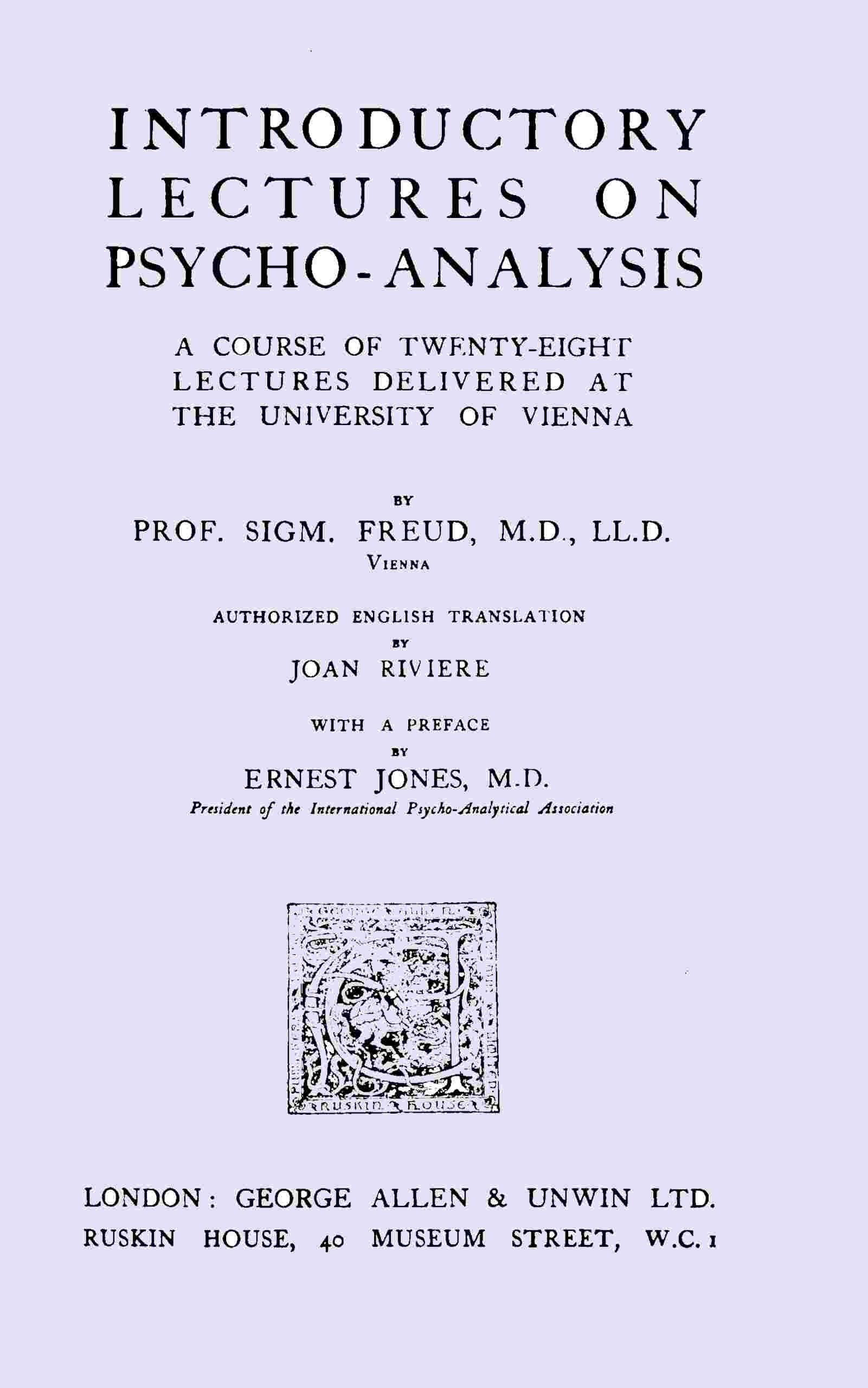
Even here, however, the reader should be warned that it is necessary to add a few modifications to the statement that the present volume is a complete text-book of psycho-analysis. The circumstances of its inception forbid its being so regarded. The book consists of three separate courses of lectures delivered at the University of Vienna in two winter sessions, 1915–1917. The first two of these presuppose absolutely no knowledge of the subject, and the style in which they were delivered constitute them an ideal introduction to the subject. But in the third year Professor Freud, doubtless assuming that those of his audience who had pursued their studies so far would by then have widened their reading otherwise, decided to treat them no longer as mere beginners, and so felt himself free to deal more technically with the more difficult subject-matter of the third course—the psycho-analysis of neurotic affections. The result is that the second half of the book is of a much more advanced nature than the first, a fact which, it is true, has the advantage that the author was able here and there to communicate some of his latest conclusions on obscure points. Every student of psycho-analysis, therefore, however advanced, will be able to learn much from this volume.
One must also remark that the book does not convey an adequate impression of the extensive bearing that psycho-analysis has on other humanistic studies than those here dealt with. Apart from a few hints scattered here and there, there is little indication of the extent to which psycho-analysis has already been applied, to sociology, to the study of racial development, and above all, to the psychology of the normal man. The book is definitely confined to its three topics of psychopathology of everyday life, dreams, and neuroses, these having been chosen as constituting the most suitable subject-matter with which to effect the author’s purpose—namely, to introduce students to psycho-analysis.
An American translation of the book has already appeared, but, apart from its deficiencies of style, it contained so many serious falsities in translation—a passage, for instance, to the effect that delusions cannot be influenced is translated in such a way as to commit Professor Freud, of all people, to the statement that obsessions cannot be cured—that it was decided to issue a fresh translation. This has been carried out with scrupulous care by Mrs. Riviere, aided by drafts carried out by Miss Cecil M. Baines of the eleven lectures in Part II. I have compared the whole book with the original, and have discussed doubtful and difficult points with Professor Freud and Mrs. Riviere. Mrs. Riviere’s English translation will be its own recommendation: I can give the reader the assurance that it is a faithful and exact rendering.
December 1921.