
WeRead Powered by ReaderPub
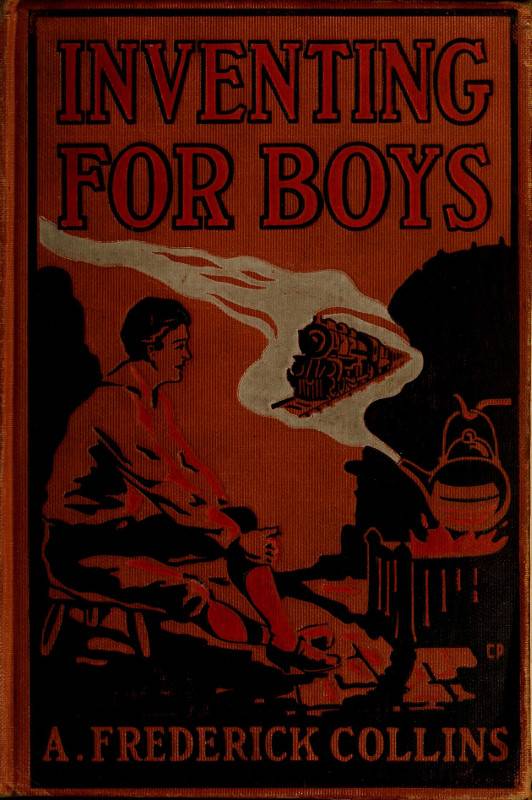
Inventing for Boys cover

Inventing for Boys

Chapter 3: ILLUSTRATIONS
Open in WeRead

Explore more books like this:

About This Book

A practical, illustrated manual for young inventors that explains how to conceive, develop, and monetize mechanical, electrical, chemical, and electro-chemical inventions. It guides readers through idea generation, drawing and modeling techniques, experiment design, patent procedure, and building working prototypes, then addresses manufacturing, funding, forming companies, and marketing and selling inventions. Additional chapters suggest project ideas, survey notable inventions and their commercial outcomes, and summarize legal protections, fees, and terminology. Practical checklists, diagrams, and appendices support hands-on work and provide reference material for turning simple concepts into working, marketable devices.


INVENTING
FOR BOYS

BY

A. FREDERICK COLLINS

INVENTOR OF THE WIRELESS TELEPHONE

WITH NUMEROUS ILLUSTRATIONS AND
DIAGRAMS

NEW YORK
FREDERICK A. STOKES COMPANY
PUBLISHERS

Copyright, 1916, by
Frederick A. Stokes Company

All rights reserved

TO
JOHN ROLLER COLLINS
A THINKER OF THOUGHTS
NEW AND NOVEL


A WORD TO THE BOY

Every boy is a born inventor.

And since you are a boy it follows as the night the day that you have your share of inventive ability and you ought to make good use of it.

To find out some new way of making or doing a thing—for this is what inventing means—is the most fascinating game that I know of to take up a fellow’s time and thought and energy.

You may say how about wireless, or star-gazing, or baseball, or shooting, or chess, or any one of a dozen other pastimes and sports and I shall be bound to admit that all of them are highly entertaining and some of them instructive but inventing is all that the others are and besides it is constructive while they are not.

By constructive I mean that you take an idea that had its origin in your brain and this vague, intangible conception, which takes up no space, has no weight and is not bound by time, you build up step by step of wood and steel and like materials until at last you have created something out of nothing, or as nearly as it can be done.

To watch your invention grow, especially if you build it with your own hands, from the time you make the first rough sketch of your idea until it stands completed and in working order, gives you a wonderful feeling of pride and satisfaction for you are the creator of it and this means that you are more than a mere boy, greater than an ordinary man—that you are in very truth a demi-god.

These are the real pleasures of inventing but to make a success of it you have to drop back to earth again and take up the mean, the sordid part, and that is to try to make money out of it. And if you have an invention of merit you will have to forget that you are a demi-god and become a hard and fast mortal again or it will not be long before some other body owns it lock, barrel and stock; and then you will have a chance to start another idea rolling and to build up another invention.

In this book I have tried to point out to you not only how to invent, but how to make money out of your invention as well, and so, I say unto you, from the moment the big idea strikes you be as gentle as a dove and as wise as a serpent, to the end that your days as an inventor may be long and that any profits which may accrue from your invention will be yours instead of some one’s else. And now may peace be with you.

A. Frederick Collins.

Lyndon Arms,
524 Riverside Drive,
New York City.


CONTENTS

CHAPTER PAGE
Preface vii
I. GETTING AN IDEA 1
How to Get an Idea
The First Raw Idea.—Accidental Discoveries.—Thought out Ideas.—Reading up Your Subject.—Working out Ideas by Experiment.—Ideas for Inventions in General.—Ideas for Mechanical Inventions.Ideas for Electrical Inventions.—Ideas for Electro-Mechanical Inventions.—Ideas for Chemical Inventions.—Ideas for Electro-Chemical Inventions.
Protecting Your Raw Ideas
II. WORKING IT OUT ON PAPER 19
Tools for Making Simple Drawings
How to Make Simple Working Drawings
A Simple Way to Draw in Perspective
How to Make Isometric Paper.—Drawing Tools you Need.
How to Draw Isometric Ellipses
An Easy, Rough Way and a Hard, Accurate Way.
How to Shade Drawings
How to Make Electrical Symbols
How to Read Electrical Diagrams
Some Aids to Drawing
Making Cardboard Models
III. THE STATE OF THE ART 45
What is Meant by the State of the Art
Use of the State of the Art
How to Learn the State of the Art
Having a Patent Attorney Look It Up
How to Look It Up Yourself
What to Do When You Find
(a) There are no other improvements like yours.—(b) That there is a resemblance to yours.—(c) When others are exactly like yours.
IV. HOW TO EXPERIMENT 58
How to Experiment with Machines
Work, Energy and Power.—Work Against Friction.—Forms of Energy.
Machines and the Principles of Machinery
The Uses of Machines
The Six Mechanical Powers
Compound Machines.—Books
How to Experiment with Electricity
Forms of Electricity
Static Electricity.—Current Electricity.—Magnetism.—Radiation.
Your Electrical Equipment.—Books
How to Experiment with Chemistry
Your Chemical Equipment.—Books
How to Experiment with Electro-Chemistry
V. MAKING A MODEL 91
Kinds of Models
Rough Models.—Scale Models.—Working Models.
Ways to Make a Model
Making a Model Yourself.—Having a Model Maker Make It.
The Tools You Need
The Vernier.—The Micrometer.—A and S Wire Gage.—Drill Press.—Screw Cutting Lathe.
Buying Materials
About Making Patterns
Casting in Brass and Iron
VI. HOW TO PATENT YOUR INVENTION 112
What a Patent Is
Choosing a Patent Attorney
Applying for a Patent Yourself
Applying for a Patent Through a Patent Attorney
What You May Patent
Looking Ahead
What a Patent Consists of
The Petition.—The Drawings.—The Specifications.—The Claims.—The Oath.
While Your Patent is Pending
Interference
When Your Patent is Granted
About Paper Patents
VII. MAKING YOUR INVENTION PAY 131
How to Raise the Initial Funds
About an Interest in a Patent
Royalties, Shop Rights, etc.
Forming a Partnership
Where the Promoter Comes in
What a Stock Company Is
How a Stock Company Is Organized
The Fees of the State.—Outfit Needed.
How a Stock Company Is Operated
About Retaining a Lawyer
VIII. SOME HINTS OF MANUFACTURING 146
Problems of Manufacturing
Farming out the Work.—Starting Your Own Shop.—Buying Machine Tools.—Buying the Stock.—Organizing a Shop Force.—The Stock Room.—The Finished Product.—Overhead Charges.
Where Your Profits Come in
IX. PUTTING IT ON THE MARKET 166
How Best to Do It
Agents Wanted.—The Mail Order Business.—A Series of Follow-Up Letters.—Selling Through Sales Agents.—Selling Direct from Factory to Consumer.—Selling Through the Trade.
Getting Publicity
Advertising
X. THINGS FOR YOU TO INVENT 180
Some Little Things Needed
For the Person.—For the House.—For the Farm.—For the Office.—For Fun.
Some Big Inventions Needed
Safety First.—Automobiles.—Aviation.—Chemistry.—Electricity.—Electro-Chemistry.—Building.—Mining and Metallurgy.—Printing.—Moving Pictures.
What Not To Invent
XI. WHAT SOME INVENTIONS HAVE PAID 200
A Tour of the Inventive World
Little Inventions
Simple Inventions
Real Inventions
Great Inventions
The Steam Engine, Locomotive, and Steamboat.—The Telegraph.—The Perfecting Press.—The Sewing Machine.—The Ice Machine.—The Steel Process.—The Gas Engine.—The Dynamo and Motor.—The Air Brake.—The Telephone.—The Typewriter.—The Phonograph.—The Storage Battery.—The Snap-shot Camera.—The Steam Turbine.—The Automobile.—The Incandescent Light.—The Trolley Car.—The Electric Locomotive.—The Linotype.—Moving Pictures.—The Wireless Telegraph.—The Wireless Telephone.—The Aeroplane.
XII. PROFITABLE INFORMATION 216
Design Patents
Assignments
Caveats
Patent Office Fees
Trade Marks
Copyrights
Government Fees for Patents and Least Charges of Patent Attorneys
Foreign Patents
APPENDICES 229-252
SOME WORDS and Terms Used in This Book 253-260
INDEX 261-270

ILLUSTRATIONS

PAGE
Patent granted to the author Frontispiece
A popular idea of an inventive genius 2
Where the big idea really originates 3
A model self-inking printing press 9
A velocipede scroll saw with boring attachment 10
A standard single cylinder air pump 11
A horizontal steam engine 12
A fireless cooker 13
A loud speaking telephone largely used on ship-board 14
A common electric bell 15
An ordinary telegraph sounder 16
A telautograph 17
The gyro compass of a ship 18
A twelve inch rule 19
A pair of cheap compasses 19
An isometric perspective drawing of a box 20
Top, side and end view of same 20
Cross-section of same; drawing of hook 21
Side view of a steam engine 22
End view of same 23
Top view of same 24
Cross-section of same 24
The side valve shown in detail 25
An isometric perspective drawing of a steam engine 25
A sheet of isometric drawing paper 26
First step in isometric perspective drawing 27
The next step in isometric perspective drawing 27
A crank shaft drawn on isometric paper 28
A drawing board; a triangular scale 29
A set of inexpensive drawing instruments; a protractor 30
The position of the protractor on paper 31
The proportion of an isometric ellipse 32
How ellipses stand out in relief 33
How an isometric ellipse is drawn 34
Shading and lettering chart for drawings 35
Chart of electrical symbols 37, 38
A simple wiring diagram 39
Aids to drawing a manikin; proportions drawn on cross-section paper; trial positions of manikin 40-42
Cardboard model of a gyro engine 44
The Official Gazette; Patent specifications; Index to Patents 53
A lever of the first class; a pair of pliers 63
A lever of the second class; wire splicing clamps 63
A lever of the third class; a pair of sugar tongs 64
A bent lever 65
A compound lever 65
Wheel and axle 66
A train of wheels or wheel works 66
A fixed pulley 67
An incline plane and one of its uses 67
A simple wedge; a printer’s quoin 68
The theory of a screw; a screw clamp 68
Some useful mechanical movements 70-73
A steady direct current; an interrupted direct current; a pulsating direct current; an alternating current; alternating current changed into an interrupted direct current; a periodic oscillating current; a sustained oscillating current 76-78
Some useful electro-mechanical devices 80-81
An ammeter; a voltmeter 82
A resistance box 83
Side and end view of a winding device 84
Making a ruby by chemistry; ruby boules as they come from the furnace; synthetic rubies after they are cut 85
Some useful chemical apparatus 87
An electric furnace showing parts and in operation 88-89
Rough model of an electric motor drive for a locomotive 92
A scale model of an aeroplane 93
A toy helicopter 94
A working model of a locomotive 95
Some useful jewelers’ and machinists’ tools 101
A small hand drill press 102
A foot power screw-cutting lathe 103
A vernier for accurate measurement 103
A micrometer 105
A standard wire gage 106
Useful stock materials made by automatic machinery 107
A standard for a telegraph sounder 109
Pouring a mould 110
Rules of Practice of the Patent Office 116
A page of drawings 121
Specification of one of Mr. Collins’ patents 123
The Claims of the same patent 123
The U. S. Patent Office, Washington, D. C. 129
Certificate of Incorporation 139
Stock certificate 141
A seal press 142
A gas furnace 150
A grinder and polisher 151
A plain lathe for turning metal with hand tools 152
An engine lathe 153
Pillar type of power drill 154
A planer for surfacing metal work 154
A shaper for shaping up metal work 155
A universal milling machine 156
A jig saw 157
A band saw 158
A time stamp 162
A high frequency machine 163
From manufacturer to canvasser, to consumer 167
From manufacturer to order agent, to consumer 169
From manufacturer to his agent, to consumer 172
Selling direct from factory to consumer 173
Selling through the trade 174
Old style and improved tooth brush 182
The old and the new way in sweeping carpets 183
A labor saving painting machine 184
A quick figuring and bookkeeping machine 185
A rubber dagger 186
Bumping-the-bumps 187
A novel, life-saving gun 188
The Owen magnetic clutch 189
A gyro stabilizer 189
A liquid air machine 190
The cheapest form of light 190
A tube system of electric light 191
The high tension electric generator 192
Cutting steel girders with oxy-acetylene 193
Apparatus for prevention of mine disasters 194
A steel plate engraving machine 195
An attempt to improve the movies 196
Tesla’s tower at Wardencliffe, L. I. 197
A perpetual motion machine 198
Perpetual motion as seen by a patent attorney 199
The first telephone 205
The first typewriter 206
The first phonograph 207
The first incandescent light 210
Collins wireless telephone 214
Design patent 216
A registered trade mark 220
Application blank for copyright of a book 222-223
Cross-section of gear 238
The four chief thermometric scales 251