
Emboldened by success, the Scots extended their operations to the south of Belfast, slew John White, landlord of Dufferin, and proposed to make a settlement on the western shores of Lough Strangford. Hugh MacNeill Oge, who held the district between that inlet and Belfast Lough, took their part, and the Prior Magennis and his kinsman, the Bishop of Dromore, were authorised to make large offers with a view of detaching him from his allies; but he refused to come to Bagenal. The Baron of Dungannon had some trifling success against the Scots, and another officer drove some of their cattle through Ards to Strangford, apparently crossing the ferry there, and thence into the Pale. One thousand cows were also taken from Hugh MacNeill Oge; but he promptly recouped himself from the herds of his neighbours on every side, so that the balance was soon again in his favour. The expedition was evidently a failure, and the ‘Four Masters’ represent it as a disastrous one; the English and their allies losing 200 men.[368]
The general directions to Croft for his conduct in ecclesiastical matters was much the same as those given to St. Leger. Public worship in English was to be made general, and a translation to be made into Irish for use in such places as required it. He was sworn in on May 23, and on June 16 he wrote to Dowdall, who was at St. Mary’s Abbey, inviting him to take part in a conference concerning the disputed points in religion. The Lord Deputy said much about what was due to Cæsar, hinted that he should be sorry to see the Primate removed from his great office, and entreated an answer by the hands of the Bishop of Meath, who, as chief of his suffragan, seemed the fittest intermediary. Dowdall answered very truly that no discussion could bring about agreement between those who differed as to fundamentals, and excused himself from waiting on his lordship, as he had for some time withdrawn from public affairs. Mohammed decided to go to the mountain, and the discussion took place in the hall of St. Mary’s Abbey, Croft being supported by two bishops, Staples of Meath, who conducted the case for the Crown, and Lancaster of Kildare. The debate first turned on the new liturgy, Dowdall treating it as an innovation, and his opponent as the Mass purified from gross corruptions. The following is the most remarkable part of what was said:—
Dowdall. Was not the Mass from the Apostles’ days? How can it be proved that the Church of Rome has altered it?
Staples. It is easily proved by our records of England. For Celestinus, Bishop of Rome, in the fourth century after Christ, gave the first introit of the Mass which the clergy were to use for preparation, even the psalm, Judica me, Deus, &c., Rome not owning the word Mass till then.
D. Yes, long before that time; for there was a mass called St. Ambrose’s Mass.
S. St. Ambrose was before Celestinus; but the two prayers, which the Church of Rome had foisted and added unto St. Ambrose’s works, are not in his general works; which hath caused a wise and a learned man lately to write that these two prayers were forged, and not to be really St. Ambrose’s.
D. What writer dares write or doth say so?
S. Erasmus, a man who may well be compared to either of us, or the standers by. Nay, my lord, no disparagement if I say so to yourself; for he was a wise and a judicious man, otherwise I would not have been so bold as to parallel your lordship with him.
Lord Deputy. As for Erasmus’s parts, would I were such another: for his parts may parallel him a companion for a prince.
D. Pray, my lord, do not hinder our discourse; for I have a question or two to ask Mr. Staples.
L. D. By all means, reverend father, proceed.
D. Is Erasmus’s writings more powerful than the precepts of the Mother Church?
S. Not more than the Holy Catholic one, yet more than the Church of Rome, as that Church hath run into several errors since St. Ambrose’s days.
D. How hath the Church erred since St. Ambrose’s days? Take heed lest you be not excommunicated.
S. I have excommunicated myself already from thence.
Opposite opinions were then given about the Virgin and her power to mediate; and the Primate finally appealed to the consecration oath, which Staples had taken as well as he. The Bishop of Meath said he held it safer for his conscience to break it than to keep it, and he praised the oath of supremacy. And thus, without any approach to an understanding, but with many mutual expressions of courtesy and goodwill, the champions of Rome and of England measured swords and parted.[369]
A few days after this the Primate disappeared, and it was understood that he had gone abroad like a traitor, as Browne said, who with indecent haste demanded that the old contest between Armagh and Dublin should be finally decided in his favour. Dowdall, he said, claimed by the ‘Bishop of Rome’s bulls and I by the King’s majesty and his most noble progenitors’ grants and gifts.’ He recounted the services of his predecessors in supporting the Government of the Pale, and asked not only for the empty title and honours of Primate of all Ireland, but for ‘all and every the spiritual profits, living, and commodities,’ belonging to Armagh. The King granted the chief place to Browne, who in the Anglican succession remained Primate of all Ireland till deprived by Queen Mary. Those who adhere to Rome of course ignore the interruption in Dowdall’s primacy, but his withdrawal beyond seas was considered as a resignation by the English Government.[370]
The sees of Armagh, Cashel, and Ossory being vacant, Croft recommended that they should be filled with peculiar care. The negligence of the Bishops and other ministers allowed the old ceremonies to remain in many places. It was necessary to send over good, zealous men to fill up the bishoprics as they fell vacant. If this could not be done, Croft begged that at least he might have a competent adviser in ecclesiastical matters to enable him to direct the bishops, who were blind, obstinate, negligent, and very seldom learned. For Armagh it would be well to choose a divine with some property in England, who might act as a commissioner for deciding the daily quarrels arising in the North. For the bishopric of Ossory, Croft, Protestant as he was, ventured to recommend Leverous, Gerald of Kildare’s old tutor, who had been pardoned for his offence in carrying him out of the realm. For learning, discretion, and decorous life there was no one superior in Ireland, and Croft had heard him ‘preach such a sermon, as in his simple opinion he heard not many years.’ Personally unobjectionable, Leverous was known to be attached to the old doctrines, and Croft’s advocacy failed, as he himself expected. The see of Ossory was conferred after some delay upon John Bale, a Carmelite friar, born in Suffolk and educated at Jesus College, Cambridge. The arguments of a layman, Lord Wentworth, according to his own account, enforced by the charms of a young lady, according to the account of his enemies, converted Bale to the Reformation. He married a wife, who was his companion in all his wanderings and vicissitudes, and became a professed Protestant. It was not in his nature to hide his light under a bushel; he preached openly against the Roman doctrine, and suffered imprisonment in consequence. Having been released through Cromwell’s intercession, he spent eight years in Germany. Returning to England on Edward’s accession, he became Poynet’s chaplain, and obtained the living of Bishopstoke. The King happening to see and hear him at Southampton, of his own accord promoted him to Ossory. Bale was a multifarious writer, a man of learning and eloquence, and unquestionably sincere; but coarse and violent, with no respect whatever for the feelings of others, and remarkably unfit for the task of persuading an unwilling people to embrace the Reformation.
Though partially shorn of its glories, the see of Armagh, claiming as it did to be founded by the national apostle, was still of great importance. Pending an appointment in England, Croft proposed that Basnet, late Dean of St. Patrick’s, should enjoy the first-fruits of the vacant see along with the revenues of his old deanery. The Lord Deputy was moved to this by the curious practical consideration that Basnet was ‘experimented in the wars of the country.’ Make it worth his while to live at Armagh, and he would be most useful to Bagenal and the Baron of Dungannon. But the young King, who had already opinions of his own, was scandalised at the idea, and shrunk from making bishops of any but ministers earnest in setting forth God’s glory. He directed that Deans and Chapters should maintain divine service and preach the gospel in vacant sees, declaring that he minded the education of his people above all things. If the dignitaries proved negligent the Lord Deputy might appoint occasional ministers to do the duty.[371]
Cranmer named four persons as fit for the archbishopric of Armagh, but none of them were in haste to go to Ireland. Of these the King selected Richard Turner, a Staffordshire man, but vicar of Chartam in Kent. Cranmer described him as an earnest preacher, merry and witty withal, who wanted nothing, loved nothing, dreamed of nothing but Christ only. He had shown courage in the late Kentish insurrection, and that would be a useful quality in Ireland. ‘He preached,’ says Cranmer, ‘twice in the camp that was by Canterbury; for the which the rebels would have hanged him, and he seemed then more glad to go to hanging, than he doth now to go to Armachane, he allegeth so many excuses, but the chief is this, that he shall preach to the walls and stalls, for the people understand no English. I bear him in hand Yes, and yet I doubt whether they speak English in the diocese of Armachane. But if they do not then I say, that if he will take the pain to learn the Irish tongue (which with diligence he may do in a year or two) then both his doctrine shall be more acceptable not only unto his diocese, but also throughout all Ireland.’ But Turner would not go. Perhaps he estimated more correctly than Cranmer the difficulty of learning Irish, and his wit and liveliness would only enable him to forecast the misery of a man who should preach to unwilling congregations in halting and uncertain language. Cranmer’s other three nominees also failed him; and he then recommended Hugh Goodacre, who was induced to accept the unenviable post. The archbishopric of Cashel had not even the dignity of Armagh to make it attractive, and it remained vacant during the rest of Edward’s reign.[372]
The King had a reasonable dislike to pluralities, and resisted the union of Clonfert and Elphin in the hands of Clanricarde’s uncle, Rowland Burke. ‘A good pastor,’ he said, ‘cannot nourish two flocks at once, and it agreeth not with our religion.’ But he gave in when it was proved to him that the sees were small and poor, and that their union would be likely to further rather than to hinder religion.[373]
It would have been well if Edward or his advisers had paid as much attention to honesty in civil government. The attempt to give a forced course to bad coin had had its usual evil effects. The Irish currency had always been less pure than that of England, but practically little difficulty had occurred until the late changes. An English groat was worth sixpence Irish, and everyone understood what he was doing. But now the country was flooded with base coin of uncertain value, and men bargained, as they do still at Cairo, for sterling money, foreign crowns, and livres Tournois. Trade with England was necessarily conducted by means of a reputable currency; and the whole of the new Irish coinage being only available for local use, felt the effects of inflation as well as of its own intrinsic baseness. There was great confusion in every trade, and all was attributed to the coin, which every one thought would be cried down, and therefore feared to have in possession. ‘Being put to sale of all men,’ said Croft, ‘and no man desirous to buy it, it must needs be good cheap.’ It was urged that, coins being only counters for exchange, they should be taken at the proclaimed price, but Croft rightly argued that gold and silver had been chosen on account of their fitness for the purpose and also for their intrinsic value. The effect of laws against usury is to raise the rate of interest, and the effect of putting an artificial value on coin, in conjunction probably with other causes, was to raise necessaries to a famine price. Corn that had been worth 6s. 8d. had risen to 40s.; leather, iron, boots and shoes, wine and hops, had all become dear. Six herrings sold for a groat. Englishmen, and especially officials with fixed salaries, could not live in Ireland. The native Irishman was somewhat better off, for ‘he careth only for his belly, and that not delicately.’ ‘We that are stipendiaries,’ said the Lord Deputy, ‘must live upon our stipends, and buy with our money which no man esteemeth.’ The native lords used coyne and livery, and did what they could to make their vassals keep all provisions in the country, so that the markets were unsupplied, and the Government had scarcely any alternative but to practise like extortions.[374]
The inhabitants of Dublin, Waterford, Limerick, Cork, Drogheda, and Galway were consulted, and they all attributed the state of trade to the currency. A petition signed by the attorneys of those communities, by seven peers, and by many others of high position was sent to the King; and the petitioners prayed that the coin might be of the same weight, value, and fineness in both kingdoms. ‘By the whole consent of the world,’ said the Lord Deputy and Council, ‘gold and silver have gotten the estimation above all other metals, as metest to make money and be conserved as a treasure, which estimation cannot be altered by a part or little corner of the world, though the estimation were had but on a fanciful opinion, where indeed it is grounded upon good reason, according to the gifts that nature hath wrought in those metals whereby they be metest to use for exchange, and to be kept for a treasure. So as in that kind they have gotten the sovereignty, like as for other purposes other metals do excel; and so is everything good, as God said at the beginning, whereof followeth that the thing which we count naught cometh of the misuse.’ No laws or proclamation could prevent the value of money from depending on the quantity of bullion it contained, and without money exchanges could not be made. Men saw that an artificial scarceness was created, and blamed the Government for not taking the obvious step of crying down the coin. Croft apologised for his importunity in pressing the currency question, observing that one string would put a harp out of tune, and that the tuner would naturally strike that the oftenest. The King’s advisers did not deny the facts, but hesitated to make the necessary sacrifice. Next year, however, they found it absolutely necessary to act. Two of the despised groats were proclaimed equivalent to fourpence English, and an immediate revival of trade was the result.[375]
The hope of making some profit out of Ireland to set against the cost of governing her had attracted the attention of Henry VIII.’s ministers to her mineral resources. Traces of lead, tin, copper, iron, and alum had been found, and St. Leger hoped to turn them to account. In the last year of his reign Henry authorised an advance of 1,000 marks sterling, and it was thought that the mines would soon be self-supporting. The only serious attempt made was at Clonmines, near Bannow, in Wexford. Silver was found mixed with lead, and much expense was incurred. Germans were employed in the work under the direction of Joachim Gundelfinger, and a large mass of ore was raised. A smelting-house was built at Ross, both wood and coal being used, and there were stores at Newtown Barry and Ballyhack. There was some jealousy of the foreigners, who received very high wages, and it was thought that Englishmen would be better and cheaper. The English surveyor reported that the strangers cost 260l. a month, and scarcely earned 40l., and he proposed to dismiss them, at least until the work of sinking deep shafts had been completed by less expensive labour. The Germans retorted that the surveyor himself was to blame. But there was sickness among the miners, and some of them died; and after some further trial the Germans were sent home and the works stopped. It was found that the King had lost nearly 6,000l. in two years.[376]
The early part of the new year was disturbed by rumours of invasion. Wauchop had just died at Paris, but his spirit still animated Ulster, and help was confidently expected from Scotland. The French were trying to recruit in Ireland, and some of those who held the seaports might as well have been Frenchmen or Spaniards so far as the State was concerned. Old O’Connor, who had received messages and tokens from the ubiquitous George Paris, managed to escape from the Tower, but was caught near the border and brought back. Walter Garrett, a soldier of Berwick, probably an Irishman, who had deserted and gone as far south as Newcastle, was taken trying to cross the Tweed or the Solway in a boat without oars. He confessed his knowledge of O’Connor’s movements, and this roused suspicion as to the fidelity of the great frontier garrison. Leix and Offaly were still unleased, the forts cost 7,000 marks yearly without any return, and a rising among the friends of the old chief might undo the little that had been done. The garrisons were most oppressive, taking 1l. worth of wheat for five shillings, and 4l. of beef for twelve shillings, and the people were ready to rebel on the mere chance of shaking them off.[377]
Tyrone and his countess were detained in Dublin, while Shane continued his fire-raisings in Ulster. The Earl complained bitterly of his own treatment, of Bagenal’s incursions, and of Cusack’s intrigues. The Marshal had taken 1,000 kine and 300 mares from him, and had billeted himself and his army at Armagh. O’Donnell had suffered from similar extortions. In St. Leger’s time, he said, all had been quiet, and he sent a statement of his grievances to the late Lord Deputy, who, very wisely, sent it to Northumberland with the seals unbroken. Against the Chancellor Tyrone could find no better accusation than that he had twice dissuaded him from sending hawks as presents to the King. Cusack maintained that Tyrone’s arrest was justified by his negligent and savage behaviour. ‘If there were but one plough in the country,’ the candid barbarian had boasted, ‘he would spend upon the same, with many other indecent words for a captain of a country to say.’[378]
The fort at Athlone remained a memorial of Bellingham’s military plans, and under its shelter Westmeath submitted to the government of a sheriff; but it cannot be said that the garrison kept Connaught quiet, either by force or example. They sacked Clonmacnoise, and took away the bells from O’Rourke’s Tower, and left neither bell, image, book, gem, nor window-glass in the whole place. ‘Lamentable was this deed,’ say the annalists, ‘the plundering of the city of Ciaran, the holy saint,’ and by no means calculated to increase the popularity of the King’s religion. Whether on account of this outrage or not, Croft found it necessary to visit Athlone himself, and try to establish some order in Connaught. The dissensions of the young Earl of Clanricarde with his kinsman Ulick, who was loth to part with his authority, had laid the whole country waste. Cusack with a small force succeeded, after a few executions, in placing the Earl quietly, and swearing the gentry of the district to obey him. Agriculture again flourished, and Cusack boasted that he had increased the ploughs in use from 40 to 200, and that both ploughs and cattle could be left safely in the open field. Clanricarde made use of his new power to seize Roscommon, about which O’Connor Roe and O’Connor Don were disputing, and to hand it over to Cusack for the reception of a garrison. The warlike Chancellor brought O’Kelly to terms, and then succeeded in getting a promise from the chiefs that they would assemble a force of 1,500 men to support the Earl in chastising MacDermot of Moylurg, who had been plundering the O’Connors’ cattle. Cusack thought there should be a president to govern Connaught in conjunction with Clanricarde and MacWilliam of Mayo, who was well disposed.[379]
Leaving Cusack in the West, the Lord Deputy went into Leinster, and made successful arrangements for maintaining peace there. He gave a lamentable account of the state of the country. The Kavanaghs were indeed quiet, and the O’Byrnes supported soldiers without grumbling; but the poor in the towns were starving, and their cry sounded continually in his ears. They were too wretched even to state their own grievances, and this was done for them by the neighbouring gentry. Croft’s regulations for the garrisons at Carlow and Leighlin show considerable forethought. The constables were prohibited from levying contributions themselves, but might obtain the necessary supplies from the country through four ‘cessers,’ chosen by the freeholders for each garrison. No kerne were to be quartered on the people, except thirty, which William Keating covenanted to keep always ready for police purposes, and these were to be billeted as the ‘cessers’ should appoint. Under the circumstances the young Earl of Ormonde’s rents were not very well paid, but Croft managed to send him 400l. The state of the currency was such that the Earl would lose one half if it were paid in Ireland. Gerald of Kildare, who was now in England, was less fortunate, and the Lord Deputy declared that he could get nothing for him. At a masque given by the King this adventurous young man, who was now twenty-seven years old, and very handsome, had met Mabel Browne, step-daughter to the fair Geraldine. According to the family historian she fell in love with him. They were married, and her father’s influence procured the honour of knighthood for the returned exile, and a patent restoring his estate. He did not, however, come to Ireland till the next reign.[380]
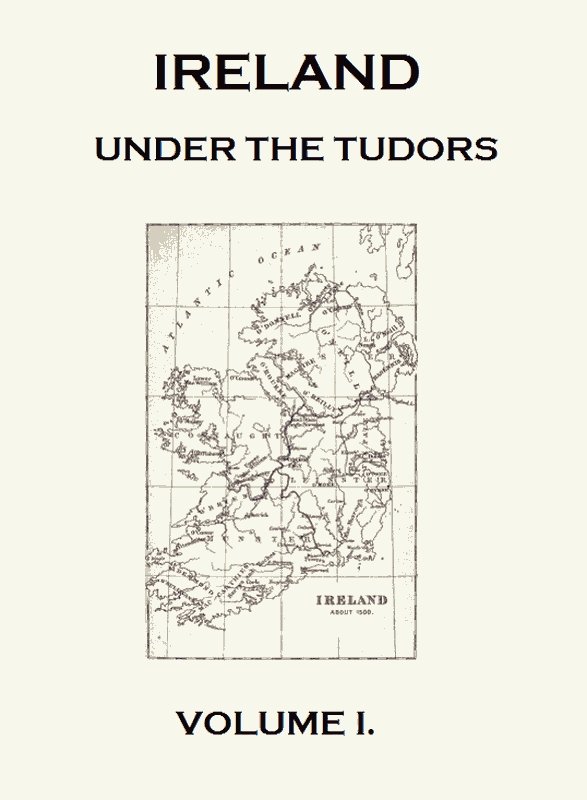
Passing eastwards again, Cusack found the O’Farrells peacefully paying rent and supporting soldiers, but O’Reilly, who had seven warlike sons and 1,600 men, was less submissive. With 1,200 followers he met the Chancellor, who had only 200, and agreed to give hostages for the restoration of spoils taken out of the Pale, and to pay a fine of 200l. Cusack made it a rule to impose a fine, since the Brehon code required restitution only; but as the fines were seldom paid, the chiefs made little real concession. O’Reilly refused to go to Dublin, lest he should be imprisoned like Tyrone, but admitted that that chief deserved his bonds if he had behaved as Cusack reported, and that he should deserve them also in like case. The MacMahons and the O’Hanlons were found equally well disposed, and Magennis kept house like an English gentleman, and exercised the office of sheriff of Down. From this point the Scots’ handiwork began to be visible. John White, the farmer of Dufferin, had been murdered by them, and the murderers kept possession of the district. The fertile lands of Lecale seemed to invite settlers, but the neighbouring region of Ards warned them off, being laid waste by the invasions of the islanders. Hugh MacNeill Boy, the chief of Clandeboye, had agreed to meet Cusack, but, hearing of the landing of some six or seven score Scots archers, he broke his appointment. Through his frequent conflicts with Bagenal there was scarcely anything left in the country worth destroying, and the Chancellor was fain to leave a small party of soldiers behind him, and to await the action of the Council in Dublin. Permanent garrisons at Belfast and Castlereagh were the means he proposed for bridling this part of the North. The O’Cahans and MacQuillins in northern Antrim were willing to obey the Baron of Dungannon, but were coerced by the Scots, who disposed of their force as they pleased. Cusack had a fruitless interview with the formidable Shane O’Neill, and Shane went straight from the meeting to burn his father’s house at Dungannon, which was only four miles off. Led by the light, Cusack’s horsemen were able to save the building, and he afterwards succeeded in capturing 700 of Shane’s kine, and many horses. The Baron of Dungannon took charge of the castle, and 300 gallowglasses were quartered on the county, but Cusack saw plainly that nothing permanent could be done without a resident governor. The Chancellor was somewhat more successful with O’Donnell and his rebellious son Calvagh, both of whom came to Dublin and bound themselves to keep the peace.[381]
Soon after this the Lord Deputy made another attempt to punish the Scots for the Rathlin disaster, and Hugh Oge O’Neill for supporting them. O’Neill attacked the advanced guard at Belfast, then ‘an old castle standing on a ford,’ and killed Savage of Ards, with fifty others. The main body crossed the Laggan safely, and proceeded to fortify the old stronghold. Meanwhile the Baron of Dungannon had brought up his forces, but incautiously encamped in the open field before effecting a junction with Croft. There he was set upon by the sleepless Shane, and utterly routed, so that the whole expedition ended in failure. Sir William Brabazon, the Vice-Treasurer, who had served so long and so well in Ireland, died on the march. His body was buried in Christ Church, Dublin, but his heart, according to the annalists, was ‘sent to the King, in token of his loyalty and truth towards him.’[382]
Tyrone complained to the King of his continued detention. His country, he said, suffered by his absence, and he offered either to plead his own cause in England, or to submit unreservedly to Commissioners sent from thence. Danger was still feared from Scotland, but the English party there procured the arrest of George Paris, on the information of one of O’Connor’s sons. On the whole it was thought better to release Tyrone, his countess and her son remaining as pledges for him, and Shane’s brother for that troublesome person. The Earl bound himself in 6,000l. to keep the peace towards the King’s adherents, the Baron of Dungannon, Calvagh O’Donnell, Maguire, and Tirlogh Luineach O’Neill.[383]
The Corporation of Waterford praised Desmond for visiting remote parts of his district, and training the wild people; a task for which few, if any, of his ancestors had shown any taste. Cusack wrote in the same strain, and advised that Dungarvan should be taken from the Butlers, and restored to him. The Chancellor’s pet idea was to have a President at Limerick, less as a governor than as a general referee in all disputes, and he believed that by such peaceful means permanent civilisation might be cheaply attained.[384]
At this time the King granted leave of absence to Croft, whom he apparently intended to send back; but the O’Connors became uneasy, and Sir Henry Knollys was sent to stop the Lord Deputy. The clouds blew over, and Croft was able to go before the end of the year, leaving the government to Cusack and Chief Justice Aylmer. Tyrone was released a few days later, and followed Croft to London; and Hugh O’Neill submitted, apologising for the past, and making promises for the future. The latter chief received certain monastic lands rent free, especially stipulating for the friary at Carrickfergus, where his ancestors were buried. Belfast Castle was restored to him. The Government had in fact been unable to chastise him, and put the best face they could upon matters. It can hardly be doubted that the three secular priests whom Hugh intended to maintain at the family burying place were not likely to advance the King’s views in religion.[385]
Sir James Croft bears a fair character among Irish governors. He did nothing very striking, nor did he contribute much towards a final pacification; but he was considered a just man, and he made no personal enemies. He was at least no bigot, for he received warm praise from Archbishop Browne, though he did not hesitate to recommend Leverous for a bishopric. It was, however, decided that St. Leger should return to Ireland in his stead. Sir Anthony’s government had been cheap, and not ineffectual. During the last five years of Henry’s reign there had been a small annual surplus; but since his death there had been a constantly growing deficit, which could only be met by increasing the taxation of the obedient shires, by employing Irish soldiers almost exclusively, and by maintaining such troops as were necessary at free quarters upon the country. Miserable expedients certainly; but the English Government could devise nothing better, and they were determined to keep down the expenses. It was resolved not to increase the existing force of 2,024, and to make no attempt at a thorough conquest. The arrangement with Tyrone was dishonourable, but was to be adhered to, lest a breach of faith should lead to war, and consequent expenditure. The King’s death prevented a full return to his father’s policy, and those who had lately governed in his name immediately lost all influence.[386]
Goodacre was consecrated to Armagh and Bale to Ossory on the same day by Browne, Lancaster of Kildare, and Eugene Magennis of Down. Where Bale was there was sure to be controversy, and a fierce one arose about the ritual proper to the occasion. The Archbishop would have postponed the ceremony, and Bale, who frequently denounces him as an epicure, declares that his object was to ‘take up the proxies of any bishopric to his own gluttonous use.’ Lockwood, Dean of Christ Church, was supreme in his own cathedral, and his timidity led him to wish for the pontifical order. Bale accordingly stigmatises him as an ass-headed dean, a blockhead who cared only for his kitchen and his belly. But Lockwood had the law on his side; for King Edward’s first book only had been proclaimed in Ireland, and it contained no form for consecration. Browne and Cusack also wished to stand on the old way. Goodacre was for the form contained in the second book, and now used in England, but he was willing to waive his own opinion. Bale, however, positively refused to be consecrated according to the old usage, boldly maintaining that one king makes one law, and that Ireland must necessarily follow England. His vehemence carried the day, and the consecrations took place according to the new Anglican use. The Communion Service followed, and Bale rejected the consecrated wafer, successfully arguing that common bread should be used. He afterwards preached twelve strong Protestant sermons in Dublin, insisting particularly on the marriage of priests; and he flattered himself that he had established the people ‘in the doctrines of repentance, and necessary belief in the gospel.’[387]
Goodacre seems never to have seen his cathedral, to which access was barred by Shane O’Neill. Bale says he was a man of remarkable sincerity and integrity, and a zealous and eloquent preacher. He also informs us that he was poisoned by the procurement of certain priests of his diocese, ‘for preaching God’s verity, and rebuking common vices.’ This contemporary statement has been doubted, on account of Bale’s prejudices, but it is repeated by Burnet on the authority of Goodacre’s fourth lineal descendant. Burnet’s informant received the story from his grandfather, who was Goodacre’s grandson. According to this tradition the actual murderer was a monk, who pledged Goodacre in poisoned wine, and died himself of the effects. Bale says he was himself warned by letter to beware of the Archbishop’s fate. Whether the joint authority of Ossory and Sarum is to be rejected or not will much depend upon the reader’s opinion of two learned, and in some respects not dissimilar divines.
Bale soon proceeded to Kilkenny. On his journey from Waterford to Dublin he had already passed through part of his diocese, and had been much scandalised by what he saw and heard. The parish priest of Knocktopher boasted that he was a son of William, late prior of the Carmelites there—not the legitimate son, as he was careful to point out. The marriage of a friar would have been a heinous offence, but an irregular connection was venial, and it was thought honourable to be the offspring of a spiritual man, whether bishop, abbot, monk, friar, or secular priest. Bale, who had himself been a Carmelite, and who had married a wife, rebuked this candid ecclesiastic, and resolved to set himself as bishop to the work of reform. He admits that he had no success; and none could be expected where public opinion sanctioned the pleasant vices of the clergy.[388]
Far more questionable was Bale’s zeal against images, the destruction of which will never make men Protestants. His opinions were hopelessly at variance with those in vogue in Ireland, as may be judged from the following autobiographical passage:—
‘Many abominable idolatries maintained by the epicurist priests, for their wicked bellies’ sake. The Communion or Supper of the Lord was there altogether used like a popish mass, with the old apish toys of Antichrist in bowings and beckings, kneelings and knockings; the Lord’s death after St. Paul’s doctrine neither preached nor yet spoken of. There wawled they over the dead, with prodigious howlings and patterings, as though their souls had not been quieted in Christ and redeemed by His passion; but that they must come after and help at a pinch with requiem æternam to deliver them out of hell by their sorrowful sorceries. When I had beholden these heathenish behavers, I said unto a senator of that city that I well perceived that Christ had there no bishop, neither yet the King’s Majesty of England any faithful officer of the mayor in suffering so horrible blasphemies.’
This was at Waterford. At Kilkenny things were no better, and on his arrival Bale proceeded to show his zeal for reform. All the statues of saints were turned out of St. Canice’s Cathedral, but the Bishop had the good taste to preserve the fine painted windows erected in the fourteenth century by his high-handed predecessor Ledred. The less artistic Cromwellians afterwards destroyed what Bale had spared, and some fragments were dug up in 1846. Bale had some supporters, chiefly laymen. The clergy, whose moral failings he had lashed so mercilessly, were not convinced by hearing the host called a ‘white god of their own making,’ nor easily persuaded that the lucrative practice of saying masses for the dead was useless, nor inclined to admit a liturgy which condemned all that they most valued. The deanery was in the hands of Bishop Lancaster, who could give no help, and among the prebendaries there was either obstructive apathy or violent opposition to change. Bale was certainly wrong in trying to impose King Edward’s second book without legal warrant; but he had gained his point with Browne, and disdained to yield to the inferior clergy. The latter pleaded that they had no books, and quoted the Archbishop against their own diocesan, who says he was ‘always slack in things appertaining to God’s glory.’ Bale’s sincerity is unquestionable, but he had set himself an impossible task, and his violence made him enemies who showed no quarter when their turn came. The most patient of men might have done nothing in such a position, but his reputation would have been better had he shown some Christian moderation. Bedell afterwards fell into the hands of his opponents, but his imprisonment was relieved by expressions of sympathy and admiration from the most unlikely quarters, and he must have felt that he had not worked in vain. Bale could have no such consolation.[389]
On the first rumour of Edward’s death it became evident that the Bishop of Ossory’s authority was at an end. Oddly enough the priests hastened amid general rejoicing to proclaim Queen Jane. They were eager for change, and probably knew little of the fair saint whose innocent life was sacrificed to the ambition of others. Justice Howth, who had been Bale’s strongest opponent, censured him for not being present at the ceremony; ‘for indeed,’ says the Bishop, ‘I much doubted that matter.’ In order, he adds, to ‘cause the wild people to bear the more hate to our nation,’ the priests also propagated a report that the young Earl of Ormonde and Barnaby Fitzpatrick had been slain in London. The forts were attacked, and many Englishmen killed. Mrs. Matthew King, the clerk of the check’s wife, was robbed ‘to her very petticoat’ on the highway by the Fitzpatricks and Butlers. But rumour and uncertainty were soon at an end, and the priests and people of Kilkenny learned that Catherine of Arragon’s daughter was Queen of England.[390]
FOOTNOTES:
[358] St. Leger to Cecil, Jan. 19, 1551; Brady’s Episcopal Succession.
[359] This conference is detailed in Mant’s Church History, pp. 194, 199. See also Ware’s Life of Browne. The conference was held in St. Mary’s Abbey, the residence of Dowdall, he having refused to attend the Lord Deputy at Kilmainham.
[360] Browne to Warwick, ut supra. Examination of Oliver Sutton, March 23, 1552.
[361] St. Leger to Cecil, Jan. 19, 1551. Deposition of Sir John Alen, March 19, in the deponent’s own hand. ‘The Bishop of Kildare (Lancaster),’ he says, ‘came to me persuading me on his behalf to put in writing the words Mr. St. Leger spoke to me in Kilmainham, to whom I made this answer, “Show my lord that albeit I love his little toe better than all Mr. St. Leger’s body, yet I will do nothing against truth.”’
[362] Bicton’s curious will is printed in Cotton’s Fasti, vol. ii. Appendix.
[363] Croft to Warwick, May 1551; Instructions to Desmond and others July 1; Archbishop Browne to Warwick, Aug. 6.
[364] Cusack to Warwick, Sept. 27, 1551.
[365] Cusack to Warwick, Sept. 27, 1551; Instructions to Mr. Wood, Sept. 29, with Cecil’s notes, ‘Keep him (Tyrone) still, participating the cause thereof to the nobility;’ Hill’s MacDonnells of Antrim, chap. iii.
[366] Ancient Laws and Institutes of Ireland, vol. iii. p. 146; Maine’s Early History of Institutions, p. 53.
[367] Bagenal to Croft, Oct. 27, 1551.
[368] Bagenal to Croft, Nov. 11, 1551; Sir Thomas Cusack’s Book, May 8, 1552; Four Masters, ad ann. 1551.
[369] Mant, pp. 209-210, from a Clarendon MS. The letters which passed between Croft and Dowdall are given by Mant from the Harris MSS.
[370] Browne to Warwick, Aug. 6, 1551; Ware’s Browne.
[371] Instructions for Mr. Thomas Wood, July 28, 1551; and the King’s answer, Aug. 17.
[372] Strype’s Cranmer, book ii. chap. xxviii., and Appendices 65 and 66.
[373] Instructions for Mr. Wood, Sept. 29, 1551. Cecil wrote on the margin ‘denied for the King liketh no union.’ The King’s amended answer, Nov. 26.
[374] Croft to Cecil, March 14, 1552; to the Marquis of Winchester, March 22.
[375] W. Crofton to Cecil, April 12, 1551; Lord Deputy and Council to Privy Council, Aug. 30, and the answer in Nov.; Croft to Northumberland, Dec. 22; Lord Deputy and Council to the Privy Council, Jan. 27, 1552—‘idleness decayeth nobility, one of the principal “kayes” of a commonwealth, and bringeth magistrates in contempt and hatred of the people,’ and the petition enclosed. Croft to Cecil, March 14, and to Winchester, March 22. Ware’s Annals.
[376] Wicklow tinstone has never been thought workable, see Kane’s Industrial Resources, p. 210. Dr. Kane does not seem to have known anything of the Clonmines venture. Lord Deputy St. Leger and Council to Henry VIII., Oct. 24, 1541, and June 4, 1543. St. Leger acted on the advice of Thomas Agard, a mining expert. Minute of Council in S.P., 1546. St. Leger, Croft, and others to the Privy Council, May 20, 1551; Robert Record, surveyor of mines to the Privy Council, Feb. 1552. Harman’s certificate, same date. Joachim Gundelfinger to the Privy Council, May 15. Reports on the mines, Aug. 1552, and Feb. and April, 1553. Instructions to St. Leger in Carew, July 1550, p. 228, as to alum. The MSS. contains many details interesting to specialists, especially the certificate of Gerrard Harman, a German.
[377] Privy Council to Croft, Feb. 23, and May 29, 1552. Sir Thomas Cusack’s ‘Book,’ in Carew, 1553, p. 241.
[378] The Earl of Tyrone’s articles, Feb. 9, 1552; St. Leger to Northumberland, March 10. Sir Thomas Cusack’s ‘Book,’ in Carew.
[379] Cusack’s ‘Book’ in Carew. Four Masters, 1552.
[380] Earls of Kildare. The patent of restoration is dated April 25, 1552. Orders for Leighlin and Carlow in Carew, April 30. Croft to the Privy Council, April 16, May 1, and May 31.
[381] Cusack’s ‘Book’ in Carew, No. 200. It is there wrongly dated 1553.
[382] The facts of this expedition (June and July 1552) are given by the Four Masters; and see Ware’s Annals.
[383] Tyrone’s complaint, July 1552; Privy Council to George Paris, Oct. 25; to Croft, Dec. 10; Cusack to Privy Council, Dec. 22; Memorandum concerning Tyrone, Dec. 30, in Carew.
[384] Mayor, &c., of Waterford to the Privy Council, Dec. 18; Cusack and Aylmer to the Privy Council, Dec. 22 and 30; Declaration of Desmond’s title, Dec. 30; Cusack in Carew, ut supra.
[385] Northumberland to Cecil, Nov. 25, 1552; Cusack’s ‘Book’ in Carew, vol. i. p. 236; King’s letter in Lodge’s Patent Officers; Ware’s Annals.
[386] A paper calendared under Jan. 1553 (No. 75) calculates the average expenses from 33 to 38 Hen. VIII. at 8,500l. a year. In the six years of Edward’s reign they rose by regular gradation from 17,000l. to 52,000l. The average revenue for the former period was 9,000l., for the latter, 11,000l. See also No. 83, ‘a device how to keep Ireland in the stay it now remaineth upon the revenues only.’
[387] The consecrations took place on Feb. 2, 1553.
[388] Bale’s ‘Vocation,’ in the Harleian Miscellany.
[389] Church histories of Mant, Killen, Brennan, and Reid. Graves’s History of St. Canice. They all derive their chief inspiration from Bale’s own ‘Vocation.’ Fuller has preserved the nickname of ‘biliosus Balæus,’ given to the Bishop in contemporary controversy.
[390] Browne and Bale were friars; yet Protestants will not blame them for entering the holy estate of matrimony, any vows to the contrary notwithstanding. To modern England a married clergy seems quite natural, but the scandal was great during the transition period, and Queen Elizabeth felt the awkwardness herself. The following statement of Harpsfield may be true or false, but it shows what could be said by a contemporary. It should be remembered that Harpsfield was Archdeacon of Canterbury. ‘Against these kind of marriages, and maintenance of the same, King Henry, in his latter days, made very sharp laws, whereupon many so married put over their women to their servants and other friends, who kept them at bed and board as their own wives. And after the death of King Henry they received them again (as love money) with usury; that is, the children in the mean season begotten by the said friends, whom they took, called and brought up as their own, as it was well known, as well in other as in Browne, Archbishop of Dublin. It would now pity a man at the heart to hear of the naughty and dissolute life of these yoked priests,’ &c.