
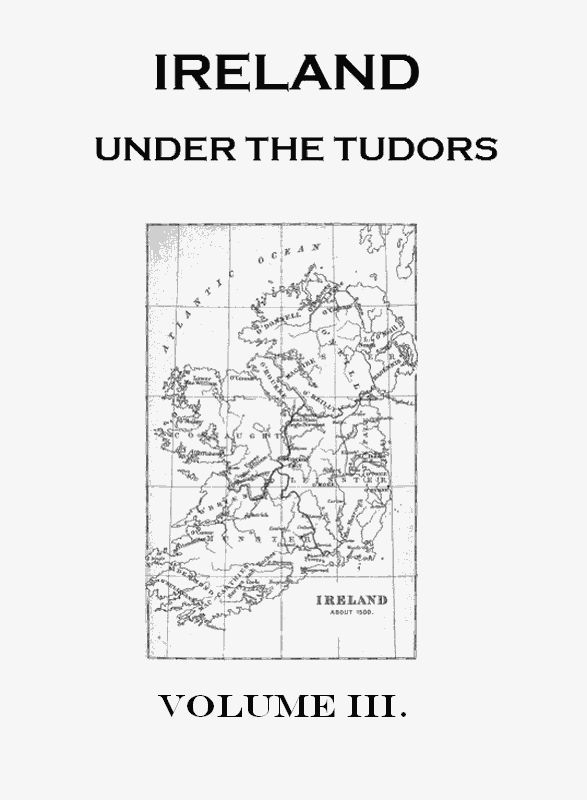
The Project Gutenberg eBook of Ireland under the Tudors, with a Succinct Account of the Earlier History. Vol. 3 (of 3)
Title: Ireland under the Tudors, with a Succinct Account of the Earlier History. Vol. 3 (of 3)
Author: Richard Bagwell
Release date: August 3, 2016 [eBook #52713]
Most recently updated: October 23, 2024
Language: English
Credits: Produced by Brownfox and the Online Distributed Proofreading
Team at http://www.pgdp.net (This file was produced from
images generously made available by The Internet Archive)
IRELAND UNDER THE TUDORS
VOL. III.
2 vols. 8vo. 32s.
IRELAND UNDER THE TUDORS.
WITH A SUCCINCT ACCOUNT OF THE EARLIER HISTORY.
By RICHARD BAGWELL, M.A.
Vols. I. and II.
From the First Invasion of the Northmen to the year 1578.
London: LONGMANS, GREEN, & CO.
IRELAND UNDER THE TUDORS
WITH A SUCCINCT ACCOUNT OF THE
EARLIER HISTORY
BY
RICHARD BAGWELL, M.A.
IN THREE VOLUMES
VOL. III.
LONDON
LONGMANS, GREEN, AND CO.
AND NEW YORK: 15 EAST 16th STREET
1890
All rights reserved
PREFACE
TO
THE THIRD VOLUME.
By a mistake which was not the author’s, the title-pages of its first instalment described this book as being in two volumes. A third had, nevertheless, been previously announced, and this promise is now fulfilled. The Desmond and Tyrone rebellions, the destruction of the Armada, the disastrous enterprise of Essex, and two foreign invasions, have been described in some detail; and even those who speak slightingly of drum and trumpet histories may find something of interest in the adventures of Captain Cuellar, and in the chapter on Elizabethan Ireland.
A critic has said that your true State-paper historian may be known by his ignorance of all that has already been printed on any given subject. If this wise saying be true, then am I no State-paper historian; for the number of original documents in print steadily increases as we go down the stream of time, and they have been freely drawn upon here. But by far the larger part still remains in manuscript, and the labour connected with them has been greater than before, since Mr. H. C. Hamilton’s guidance was wanting after 1592. Much help is given by Fynes Moryson’s history. Moryson was a great traveller, whose business it had been to study manners and customs, who was Mountjoy’s secretary during most of his time in Ireland, and whose brother held good official positions both before and after. Much of what this amusing writer says is corroborated by independent evidence. Other authorities are indicated in the foot-notes, or have been discussed in the preface to the first two volumes. Wherever no other collection is mentioned, it is to be understood that all letters and papers cited are in the public Record Office.
It has not been thought generally necessary to give the dates both in old and new style. The officials, and Englishmen generally, invariably refused to adopt the Gregorian calendar, but the priests, and many Irishmen who followed them, naturally took the opposite course. As a rule, therefore, the chronology is old style, but a double date has been given wherever confusion seemed likely to arise.
It has often been said that religion had little or nothing to do with the Tudor wars in Ireland, but this is very far from the truth. It was the energy and devotion of the friars and Jesuits that made the people resist, and it was Spanish or papal gold that enabled the chiefs to keep the field. This volume shows how violent was the feeling against an excommunicated Queen, and, whether they were always right or not, we can scarcely wonder that Elizabeth and her servants saw an enemy of England in every active adherent of Rome.
At first the Queen showed some signs of a wish to remain on friendly terms with the Holy See, but she became the Protestant champion even against her own inclination. Sixtus V. admired her great qualities, and invited her to return to the bosom of the Church. ‘Strange proposition!’ says Ranke, ‘as if she had it in her power to choose; as if her past life, the whole import of her being, her political position and attitude, did not, even supposing her conviction not to be sincere, enchain her to the Protestant cause. Elizabeth returned no answer, but she laughed.’
The Elizabethan conquest of Ireland was cruel mainly because the Crown was poor. Unpaid soldiers are necessarily oppressors, and are as certain to cause discontent as they are certain to be inefficient for police purposes. The history of Ireland would have been quite different had it been possible for England to govern her as she has governed India—by scientific administrators, who tolerate all creeds and respect all prejudices. But no such machinery, nor even the idea of it, then existed, and nothing seemed possible but to crush rebellion by destroying the means of resistance. It was famine that really ended the Tyrone war, and it was caused as much by internecine quarrels among the Irish as by the more systematic blood-letting of Mountjoy and Carew. The work was so completely done that it lasted for nearly forty years, and even then there could have been no upheaval, but that forces outside Ireland had paralysed the English Government.
My best thanks are due to the Marquis of Salisbury for his kindness in giving me access to the treasures at Hatfield, and to Mr. R. T. Gunton for enabling me to use that privilege in the pleasantest way.
Marlfield, Clonmel,
March 17, 1890.
CONTENTS
OF
THE THIRD VOLUME.
| CHAPTER XXXVI. | |
| REBELLION OF JAMES FITZMAURICE, 1579. | |
| PAGE | |
| Papal designs against Ireland | 1 |
| James Fitzmaurice abroad | 3 |
| The last of Thomas Stukeley | 6 |
| Defencelessness of Ireland | 8 |
| Ulster in 1579 | 9 |
| Fitzmaurice invades Ireland | 10 |
| Manifestoes against Elizabeth | 13 |
| Attitude of Desmond | 17 |
| Nicholas Sanders | 17 |
| Murder of Henry Davells | 20 |
| The Geraldines disunited | 22 |
| Death of Fitzmaurice | 23 |
| CHAPTER XXXVII. | |
| THE DESMOND REBELLION, 1579-1580. | |
| English vacillation | 25 |
| Progress of the rebellion | 26 |
| Last hesitations of Desmond | 28 |
| Desmond proclaimed traitor | 31 |
| Youghal sacked by Desmond | 33 |
| Ormonde’s revenge | 35 |
| The Queen is persuaded to act | 38 |
| Irish warfare | 40 |
| Pelham and Ormonde in Kerry | 42 |
| Maltby in Connaught | 43 |
| State of Munster | 44 |
| Ormonde’s raid | 48 |
| Rebellion of Baltinglas | 51 |
| A Catholic confederacy | 52 |
| Results of Pelham’s policy | 54 |
| Low condition of Desmond | 57 |
| CHAPTER XXXVIII. | |
| THE DESMOND WAR—SECOND STAGE, 1580-1581. | |
| Arrival of Lord-Deputy Grey | 59 |
| The disaster in Glenmalure | 60 |
| Consequences | 63 |
| Spanish descent in Kerry | 65 |
| Siege and surrender of the Smerwick fort | 72 |
| The massacre | 74 |
| State of Connaught | 79 |
| An empty treasury and storehouses | 79 |
| The Earl of Kildare’s troubles | 80 |
| Confusion in Munster | 83 |
| Raleigh | 85 |
| Ormonde superseded | 87 |
| Death of Sanders | 89 |
| CHAPTER XXXIX. | |
| THE DESMOND WAR—FINAL STAGE, 1581-1582. | |
| Partial amnesty—William Nugent | 91 |
| Maltby in Connaught | 92 |
| John of Desmond slain | 93 |
| Savage warfare | 96 |
| Recall of Grey | 97 |
| William Nugent’s rebellion | 99 |
| Ormonde is restored | 101 |
| How ill-paid soldiers behaved | 102 |
| Desmond’s cruelty | 103 |
| General famine | 104 |
| Abortive negotiations | 105 |
| The rebels repulsed from Youghal | 107 |
| Ormonde shuts up Desmond in Kerry | 107 |
| Last struggles of Desmond | 108 |
| Ormonde and his detractors | 110 |
| Death of Desmond | 113 |
| The Geraldine legend | 114 |
| CHAPTER XL. | |
| GOVERNMENT OF PERROTT, 1583-1584. | |
| Case of Archbishop O’Hurley | 116 |
| Spanish help comes too late | 118 |
| Murder of Sir John Shamrock Burke | 119 |
| Trial by combat | 121 |
| First proceedings of Perrott | 122 |
| Sir John Norris and Sir Richard Bingham | 124 |
| The Church | 125 |
| Munster forfeitures | 126 |
| The Ulster Scots | 127 |
| A forest stronghold | 131 |
| Proposed University | 131 |
| Hostility of Perrott and Loftus | 134 |
| State of the four provinces | 135 |
| CHAPTER XLI. | |
| GOVERNMENT OF PERROTT, 1585-1588. | |
| The MacDonnells in Ulster | 138 |
| Perrott’s Parliament | 140 |
| Composition in Connaught | 147 |
| Perrott’s troubles | 148 |
| The Desmond attainder | 149 |
| The MacDonnells become subjects | 150 |
| Bingham in Connaught | 151 |
| The Scots overthrown in Sligo | 154 |
| Perrott’s enemies | 157 |
| Irish troops in Holland—Sir W. Stanley | 161 |
| The Irish in Spain | 163 |
| Prerogative and revenue | 165 |
| Bingham and Perrott | 166 |
| Perrott leaves Ireland peaceful | 168 |
| The Desmond forfeitures | 169 |
| CHAPTER XLII. | |
| THE INVINCIBLE ARMADA. | |
| Unprepared state of Ireland | 172 |
| Sufferings of the Spaniards—Recalde | 173 |
| Wrecks in Kerry, Clare, and Mayo | 174 |
| Wrecks in Galway | 176 |
| Alonso de Leyva | 177 |
| Wrecks in Sligo | 180 |
| Adventures of Captain Cuellar | 183 |
| Spanish account of the wild Irish | 185 |
| Summary of Spanish losses | 188 |
| Tyrone and O’Donnell | 190 |
| Wreck in Lough Foyle | 191 |
| Relics and traditions | 192 |
| The Armada a crusade | 193 |
| The last of the Armada | 194 |
| CHAPTER XLIII. | |
| ADMINISTRATION OF FITZWILLIAM, 1588-1594. | |
| Ulster after the Armada | 196 |
| O’Donnell politics | 197 |
| The Desmond forfeitures—Spenser | 198 |
| Raleigh | 199 |
| Florence MacCarthy | 200 |
| The MacMahons | 201 |
| Bingham in Connaught | 203 |
| O’Connor Sligo’s case | 208 |
| Bingham and his accusers | 210 |
| Sir Brian O’Rourke | 212 |
| Mutiny in Dublin | 217 |
| Tyrone and Tirlogh Luineach | 218 |
| Rival O’Neills | 220 |
| Rival O’Donnells | 221 |
| Hugh Roe O’Donnell | 222 |
| Tyrone and the Bagenals | 223 |
| CHAPTER XLIV. | |
| ADMINISTRATION OF FITZWILLIAM, 1592-1594. | |
| Escape of Hugh Roe O’Donnell | 226 |
| O’Donnell, Maguire, and Tyrone | 227 |
| Trial and death of Perrott | 228 |
| Spanish intrigues | 233 |
| Fighting in Ulster | 234 |
| Recall of Fitzwilliam | 236 |
| Tyrone’s grievances | 237 |
| Fitzwilliam, Tyrone, and Ormonde | 238 |
| Florence MacCarthy | 240 |
| Remarks on Fitzwilliam’s government | 241 |
| CHAPTER XLV. | |
| GOVERNMENT OF RUSSELL, 1594-1597. | |
| Russell and Tyrone | 242 |
| Russell relieves Enniskillen | 244 |
| Tyrone generally suspected | 245 |
| The Wicklow Highlanders—Walter Reagh | 246 |
| Feagh MacHugh O’Byrne | 247 |
| Recruiting for Irish service | 248 |
| Soldiers and amateurs | 250 |
| Sir John Norris | 251 |
| The Irish retake Enniskillen | 252 |
| Murder of George Bingham | 253 |
| Tyrone proclaimed traitor | 254 |
| Quarrels of Norris and Russell | 255 |
| Ormonde and Tyrone | 255 |
| Bingham, Tyrone, and Norris | 256 |
| Death of Tirlogh Luineach O’Neill | 258 |
| Tyrone’s dealings with Spain | 258 |
| A truce | 259 |
| O’Donnell overruns Connaught | 260 |
| Liberty of conscience | 261 |
| Confusion in Connaught | 263 |
| Elizabeth on the dispensing power | 264 |
| Norris and Russell | 265 |
| Story of the Spanish letter | 267 |
| Spaniards in Ulster | 268 |
| Bingham in Connaught | 268 |
| Bingham leaves Ireland | 271 |
| Crusade against English Protestants | 272 |
| Disorderly soldiers | 273 |
| Death of Feagh MacHugh | 274 |
| Dissensions between Norris and Russell | 276 |
| Bingham in disgrace | 278 |
| CHAPTER XLVI. | |
| GOVERNMENT OF LORD BURGH, 1597. | |
| Last acts of Russell | 280 |
| Norris and Burgh | 282 |
| Burgh attacks Tyrone | 283 |
| Failure of Clifford at Ballyshannon | 285 |
| Gallant defence of Blackwater fort | 286 |
| Death of Burgh | 287 |
| Death of Norris | 288 |
| Belfast in 1597 | 289 |
| Disaster at Carrickfergus | 290 |
| Tyrone and Ormonde | 291 |
| Brigandage in Munster | 292 |
| Florence MacCarthy | 293 |
| CHAPTER XLVII. | |
| GENERAL RISING UNDER TYRONE, 1598-1599. | |
| Bacon and Essex | 294 |
| The Blackwater fort | 295 |
| Battle of the Yellow Ford | 297 |
| Panic in Dublin | 300 |
| The Munster settlement destroyed | 301 |
| The Sugane Earl of Desmond | 302 |
| Spenser, Raleigh, and others | 305 |
| The native gentry and Tyrone | 307 |
| Religious animosity | 308 |
| Weakness of the Government | 309 |
| O’Donnell in Clare | 310 |
| Tyrone in Munster | 311 |
| CHAPTER XLVIII. | |
| ESSEX IN IRELAND, 1599. | |
| Essex offends the Queen | 313 |
| His ambition | 315 |
| Opinions of Bacon and Wotton | 316 |
| Great expectations | 318 |
| Evil auguries | 320 |
| Sir Arthur Chichester | 321 |
| Essex in Leinster | 323 |
| In Munster | 324 |
| Siege of Cahir | 325 |
| Deaths of Sir Thomas and Sir Henry Norris | 326 |
| Harrington’s defeat in Wicklow | 328 |
| Failure of Essex | 331 |
| Anger of the Queen | 332 |
| Death of Sir Conyers Clifford | 336 |
| Essex goes to Ulster | 339 |
| Essex makes peace with Tyrone | 340 |
| The Queen blames Essex | 342 |
| Who goes home without leave | 343 |
| Harrington’s account of Tyrone | 344 |
| Reception of Essex at court | 346 |
| Negotiations with Tyrone | 347 |
| Folly of Essex | 348 |
| Liberty of conscience | 349 |
| CHAPTER XLIX. | |
| GOVERNMENT OF MOUNTJOY, 1600. | |
| Raleigh’s advice | 351 |
| Tyrone’s Holy War in Munster | 352 |
| Arrival of Mountjoy and Carew | 353 |
| Tyrone plays the king | 354 |
| Ormonde captured by the O’Mores | 355 |
| Carew in Munster—Florence MacCarthy | 360 |
| Docwra occupies Derry | 361 |
| Carew in Munster | 363 |
| O’Donnell harries Clare | 365 |
| Mountjoy and Essex | 366 |
| James VI. | 368 |
| The Pale | 369 |
| The midland counties | 370 |
| Mountjoy bridles Tyrone | 372 |
| Progress of Docwra | 373 |
| Relief of Derry | 375 |
| Spaniards in Donegal | 376 |
| Carew reduces Munster | 377 |
| The Queen’s Earl of Desmond | 379 |
| The end of the house of Desmond | 384 |
| CHAPTER L. | |
| GOVERNMENT OF MOUNTJOY, 1601. | |
| Mountjoy and the Queen | 386 |
| Final reduction of Wicklow | 387 |
| Mountjoy and Essex | 388 |
| Confession of Essex—Lady Rich | 389 |
| The last of the Sugane Earl | 391 |
| Mountjoy in Tyrone | 392 |
| Plot to assassinate Tyrone | 393 |
| An Irish stronghold | 394 |
| Brass money | 395 |
| CHAPTER LI. | |
| THE SPANIARDS IN MUNSTER, 1601-1602. | |
| The Spaniards land at Kinsale | 398 |
| Mountjoy in Munster | 399 |
| The Spaniards come in the Pope’s name | 400 |
| The siege of Kinsale | 401 |
| O’Donnell joins Tyrone | 403 |
| Spanish reinforcements | 404 |
| Irish auxiliaries | 406 |
| Total defeat of Tyrone | 408 |
| Kinsale capitulates | 411 |
| Importance of this siege | 414 |
| Great cost of the war | 415 |
| CHAPTER LII. | |
| THE END OF THE REIGN, 1602-1603. | |
| The Spaniards still feared | 417 |
| The Queen’s anger against Tyrone | 418 |
| Carew reduces Munster | 419 |
| Siege of Dunboy | 421 |
| Death and character of Hugh Roe O’Donnell | 425 |
| Last struggles in Connaught | 426 |
| Progress of Docwra in Ulster | 427 |
| The O’Neill throne broken up | 428 |
| Last struggles in Munster | 429 |
| O’Sullivan Bere | 430 |
| Submission of Rory O’Donnell | 432 |
| Tyrone sues for mercy | 433 |
| Famine | 434 |
| Tyrone and James VI. | 435 |
| Death of Queen Elizabeth | 437 |
| Submission of Tyrone | 438 |
| Elizabeth’s work in Ireland | 439 |
| CHAPTER LIII. | |
| ELIZABETHAN IRELAND. | |
| Natural features | 441 |
| Roads and strongholds | 442 |
| Field sports | 444 |
| Agriculture | 445 |
| Cattle | 445 |
| Fish | 447 |
| Trade and manufactures | 447 |
| Wine, ale, and whisky | 448 |
| Descriptions of the people | 450 |
| Tyrone’s soldiers | 451 |
| Costume | 452 |
| Conversion of chiefs into noblemen | 453 |
| Bards and musicians | 454 |
| Tobacco | 455 |
| Garrison life | 456 |
| Spenser and his friends | 457 |
| CHAPTER LIV. | |
| THE CHURCH. | |
| Elizabeth’s bishops | 459 |
| Forlorn state of the Church | 460 |
| Zeal of the Roman party | 461 |
| Bishop Lyon | 463 |
| Position of Protestants | 464 |
| Papal emissaries | 465 |
| Protestant Primates | 466 |
| Miler Magrath | 468 |
| The country clergy | 469 |
| Trinity College, Dublin | 470 |
| Irish seminaries abroad | 472 |
| Early printers in Ireland | 473 |
| Toleration—Bacon’s ideas | 474 |
| Social forces against the Reformation | 475 |
| INDEX | 477 |
MAPS.
| MUNSTER | To face p. 24. |
| ULSTER | To face p. 244. |
Errata.
| Page 18, line 12 from bottom, for provided to Killaloe read provided to Killala. |
| Page 56, bottom line, before Sanders insert and. |
| Page 384, line 4 from bottom, for Butler read Preston. |
IRELAND UNDER THE TUDORS.
CHAPTER XXXVI.
REBELLION OF JAMES FITZMAURICE, 1579.