
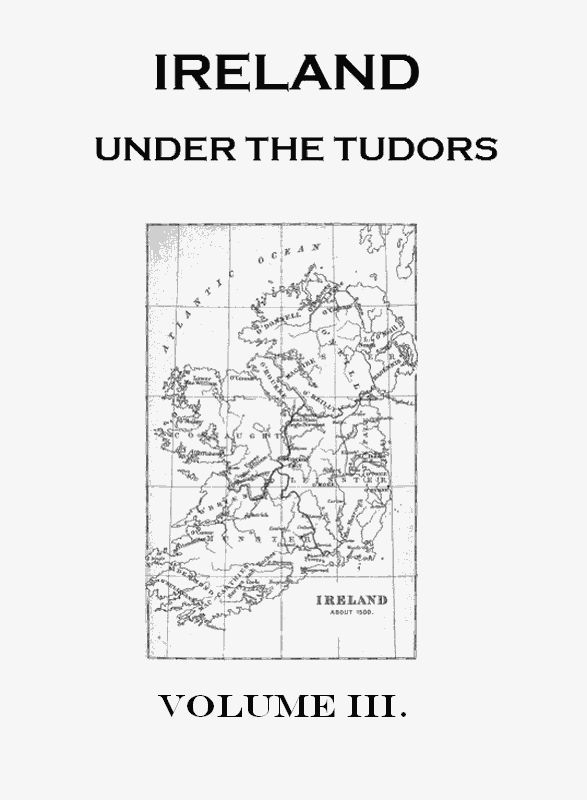
At this juncture one French and one Spanish vessel arrived in Dingle Bay with letters for Desmond and earnest inquiries for Dr. Sanders. They were well received by the country people, and the bearers of the letters were conducted to Castle Island, where they found the men they sought. The foreigners said it had been reported at the French and Spanish Courts that no Geraldine was left alive. Sanders ‘railed and reviled them’ for not performing their promises to perfect Christians; but they still maintained that 20,000 were ready in Spain to sail with James Fitzmaurice’s sons, and that France would also help as soon as the truth was known. One Owen O’Madden, a foster-brother of Desmond who was present, fell into Ormonde’s hands, and reported that Desmond and Clancare had solemnly sworn to join their forces; ‘which oath was ministered by Dr. Sanders, having a mass-book under their feet and a cloth spread over their heads.’ He believed that Lord Fitzmaurice would also join them. The confederacy would command a force of 600 gallowglasses, 1,600 kerne, and 80 horse, with 200 musketeers. Sympathy with the Geraldines was universal among the common people, but men who had something to lose were in no great hurry to commit themselves. ‘I suppose,’ said Pelham, ‘it is now considered that what foreign prince soever come, he will not allow to any freeholder more acres than he hath already, nor more free manner of life than they have under our Sovereign. And further I am told that some of the traitors themselves begin to consider that the invaders will put no great trust in those that do betray their natural prince and country.’[34]
Pelham left Waterford about the middle of February, having with great difficulty made such preparations as would give likelihood of a successful campaign. Unable to feed pack-horses he had his provisions carried by 300 strong countrymen, and he vigorously describes the pleasures of Irish warfare. ‘Touching the comparison between the soldier of Berwick and the soldier of Ireland, alleging him of Berwick to serve in greater toil... all the soldiers of Christendom must give place in that to the soldiers of Ireland; and so much difference for ease... as is between an alderman of London and a Berwick soldier.’ And surely, said Captain Zouch, ‘the wars here is most painful, in respect that of force we make great and long journeys without victual, by which means we have great sicknesses, and, do what we can, we shall never fight with them unless they have a will to fight with us.’ But a good spirit prevailed, and some companies stood so much on their reputation that they begged to be mustered, in order that their wants might be known and supplied.
Ormonde joined the Lord Justice at Clonmel, where it was arranged that the Butlers should guard the eastern end of the Aherlow fastness. Pelham proposed to make all the country from Askeaton to Dingle ‘as bare a country as ever Spaniard set his foot in.’ At Limerick he spent more than a fortnight listening to reports of what was going on in Kerry and in Spain, and waiting for Wallop and Maltby. On March 10, he met Ormonde at Rathkeale, and each assumed his own share in the work of destruction. The Earl took the Shannon side, the Lord Justice kept inland, spoiling the country far and wide, and meeting with no enemy. Near Shanet Castle, the original seat of the Desmonds, from which their war-cry was derived, the two camps were not far apart, and the country was scoured to the foot of the mountain in which the Feale and the Blackwater take their rise. According to the Four Masters, they killed ‘blind and feeble men, women, boys and girls, sick persons, idiots, and old people.’ Four hundred were killed in the woods on the first day, and everything that would burn was burned. The next camp was at Glin, where provisions had been collected, and thither came Lord Fitzmaurice, who thought it time to declare himself on the side of the strongest. Pelham and Ormonde then determined to cross the mountain into Kerry, having heard that ships with stores had arrived at Dingle. Desmond had already gone that way, in the belief that the ships were Spanish. Passing the Feale a little above Listowel, the army marched unopposed to Tralee, and on the march Patrick Fitzmaurice, heir of the house of Lixnaw, followed his father’s example. Everything between Castle Island and Tralee was already destroyed by the rebels, and Tralee itself was burned, with the exception of the abbey. Three hundred men, under Sir William Stanley, were detached to Castlemaine, and Pelham and Ormonde started for Dingle, but were driven back by a furious snowstorm from the foot of the Corkaguiny mountains. In the meantime the ships had gone to the Shannon, and Pelham, having no means of feeding the men, was forced to withdraw Stanley’s division from Castlemaine. Clancare had promised to come to Tralee, but excused himself on account of the floods. The same reason prevented Pelham from recrossing the mountains, and he lost men and horses in fording the Feale near its mouth. The ships had arrived at Carrigafoyle, and immediate preparations were made to besiege the castle, which was held by nineteen Spaniards and fifty natives. The commandant was Captain Julian, ‘who reported himself to be a very notable engineer,’ and who had undertaken the defence at Lady Desmond’s request.
While the guns were being landed, Pelham went forward to view the place, and had a narrow escape from a shot. ‘The villains of Spaniards, and the traitors,’ said Ormonde, ‘railed like themselves at Her Majesty, especially the Spaniards, who had named the King of Spain King of Ireland, which, or it be long, God willing, they shall dearly pay for.’ Julian probably trusted in the strength of the castle, which was eighty-six feet high, surrounded by water, and defended by several outworks. On the land side there were two separate ditches, divided by a wall, and a strong earthwork. Vessels of 100 tons could go up to the wall at high tide. The pieces used in the attack were three cannons, one culver, and one culverin—not a formidable battery according to modern ideas, but too much for the old castle, even with Julian’s additional defences. The hyperbolical Four Masters say such guns had never yet been heard in those parts, and that their tremendous and terror-awakening roar penetrated every glen from Mizen Head to Tuam. A cannonade of six hours on two successive days was enough to make a practicable breach, both in the barbican and in the inner walls, which crushed many as they crumbled. The storming party soon mastered all but one turret, which stood farthest from the battery and was still intact. The fire was directed upon this point, and two or three shots dislodged the garrison, of whom, says Zouch, ‘there escaped not one, neither man, woman, nor child.’ Those who swam were shot in the water, others were put to the sword, and a few who surrendered, including one woman, were hanged in the camp. Captain Julian was kept prisoner for two or three days and then hanged. The people began to curse Desmond for bringing all these misfortunes upon them. He answered that, if no help from Pope or Spaniard came before Whit Sunday, ‘he should seek a strange country and leave them to make their compositions.’ The castles of Balliloghan and Askeaton were abandoned by their defenders when they saw the fate of Carrigafoyle. Those at Askeaton escaped across the water, having made an unsuccessful attempt to blow up the castle. Pelham occupied this last stronghold, and the war was turned into a hunt.[35]
Sanders and Desmond failed to rouse Connaught, which Maltby had retained after Drury’s death. Richard Burke, called Richard-in-Iron, husband of the redoubtable Grace O’Malley, alone ventured to take arms, in reliance upon the remoteness and natural strength of his country. He collected all the loose men of Connaught, and sent for 100 Scots bowmen from Ulster. But the Hebrideans were disinclined to join him, knowing that they would encounter English soldiers and a skilful leader. To prevent them from changing their minds, Maltby secured Sligo, through which they would have to pass. O’Connor Sligo, and O’Rourke—proudest man in Ireland though he was—agreed to Maltby’s terms, and kept their words as to excluding the Scots. He had two English companies, to which he added 100 native horse and 400 foot, who were to pay themselves in Richard-in-Iron’s country, and to cost the Queen nothing. Burke, with 1,000 men, had spoiled the devoted district about Athenry and the northern part of Roscommon, but he fell back to the shore of the Atlantic before Maltby could advance. When all was ready, he went from Athlone to Ballinasloe, where he hung six malefactors, and to Athenry, where he hung another. At Clare Galway he met John and Ulick Burke, full of complaints against each other, between whom he made a truce till he had leisure to hear them. He then marched by Shrule and Ballintubber to Clew Bay. The fate of a castle held by a priest, who was Richard-in-Iron’s chief counsellor, is thus concisely described:—
‘I put the band, both men, women, and children, to the sword, whereupon all the other castles in the country were given up without any resistance.’ Grace O’Malley came to him with some of her kinsmen, but her husband took refuge with his forces in the islands in Clew Bay. Burrishoole Abbey, where Maltby encamped, was chosen by him as the site of a walled town, the people seeming very willing to have such a place among them, and MacWilliam Burke, who accompanied the governor of his own accord, offered land for its support. Richard-in-Iron, finding Maltby too strong for him, said he was ready to submit. Maltby sent for boats to Achill, but the weather was so bad that he could not reach the island for a week. In the meantime more than 100 of Richard’s followers had died of starvation—a little episode which shows what Irish warfare sometimes was. In the end Burke submitted to the garrison which Maltby left at Burrishoole. The return journey to Athlone was accomplished in deep snow. The starved pigs and sheep with lambs came out of the woods into the camp, but they were killed and eaten. During the siege of Carrigafoyle, Maltby was in Scattery Island, and in frequent communication with Pelham, whom he joined at Limerick after the capture of Askeaton.[36]
Pelham’s policy was to bridle the Desmond district with garrisons, who should be strong enough to eat up the country and to fatten themselves while the rebels starved. He hoped thus to localise the struggle in Kerry, which was too poor to maintain it unaided. The English fleet would look after the seaboard. The garrisons seem to have performed perfectly their rather inglorious duties. Captains Hollingsworth and George Carew had 400 foot at Askeaton, but no horse, the soil being already too bare to support them. The soldiers drove in all the sheep and cows in their neighbourhood, and killed twenty-five of the miserable people who ventured to protect their own. Sir George Bourchier, who had two companies and a troop of horse at Kilmallock, scoured the woods in the Maigue district, and killed sixty rebels in a skirmish, making good his retreat and keeping his spoils. Captain Walker, who held Adare with 200 men, met Desmond himself on one of his forays. The Earl had about 600 followers, who stood well to their pikes for a time, but were ultimately worsted with great loss. Captain Dowdall occupied Cashel with 300 men. With the help of Lord Dunboyne, he penetrated Aherlow wood, and brought off 300 cows and ponies. Pelham himself lay chiefly at Limerick, endeavouring to do his part by diplomacy, while Ormonde was securing his own district against Piers Grace and other marauders.[37]
The 10th of May was appointed by the Lord Justice for a general assembly of the Munster lords at Limerick. Ormonde duly appeared, bringing with him White, the Master of the Rolls, who had just returned from England, Lords Dunboyne and Power, and Sir James Fitzgerald, of Decies. Lord Roche and his son Maurice, who had for a time been in rebellion, and Sir Thomas, of Desmond, came from Cork, and two days later they were followed by Lord Barry and by Sir Cormac MacTeigue. Thomond also attended. None of the western chiefs came, but Lord Fitzmaurice took the precaution of sending an excuse.
Sir William Burke, whose son had lost his life in taking that of James Fitzmaurice, received his patent as Baron of Castle Connell, and was invested by Pelham. ‘The poor old gentleman,’ says White with a certain pathos, ‘made many grateful speeches in his language, and afterwards, partly from joy at his own promotion, partly from some natural remembrance of his child, and partly from the unwonted straitness of his new robes, fell suddenly in a swoon at the Lord Justice’s table, so as he was like to have been made and unmade all of a day.’ Seeing no hopes of many more, Pelham conferred with those who were present. Lords Barry and Roche were sworn to forego their private quarrels and to join with Sir Cormac in prosecuting the rebels, under Ormonde’s directions, and particularly in keeping them out of the county of Cork. A like arrangement was made for Waterford, and Ormonde was to encamp at or near Kilmallock. The deliberations at Limerick were concluded by a volley of three or four hundred shots. Pelham himself decided to visit Kerry. As the plot thickened round Desmond, Dr. Sanders redoubled his assurances that help was coming from Spain. Six thousand Italians were reported to be in the Asturias, ready to sail. The Lord Justice believed himself well able to deal with invaders; but want of provisions and arrears of pay in the Queen’s army helped the rebels more effectually than any foreigners could do.[38]
After many delays Pelham and Ormonde prepared to enter Kerry together. The Earl lay for some time at Cashel, where he enjoyed the society of Sir Nicholas White. The Master of the Rolls complained, with an odd professional conceit, that he had to sleep in the Star Chamber—that is, in the open air. Clancare’s eldest son was also in the camp, and Ormonde declared that if the father wavered in his allegiance he would ‘graft him to the highest tree in his country. ‘In the meantime they probably amused themselves with coursing, for White says her Majesty had many countries forsaken of the people, but well stocked with hares. Pelham left Askeaton on June 11, joined the Adare garrison, and marched up the Maigue valley to Bruree. Edward Fenton, who had an eye for scenery rare in those days, was struck by the pleasantness of the scene. The neighbourhood was explored next day, but neither rebels nor cows were caught in any numbers, and the army crossed the hills which divide Limerick from Cork. Ormonde broke up his camp and joined the Lord Justice near Buttevant, where Lord Roche came to pay his respects, but offered very little help in the way of provisions. Pelham noted this in silence, and led the whole army up the Blackwater, driving the MacCarthies and O’Callaghans with their cattle into the vast woods. Then followed a toilsome and dangerous march through the hills to Castle Island, the Lord Justice riding in advance and taking up the ground himself. ‘The island,’ says White, and the ruins attest it, ‘is a huge, monstrous castle of many rooms, but very filthy and full of cowdung. ‘Desmond and Sanders had but just time to escape, and the Earl’s store of whiskey, the Countess ‘kerchers,’ and certain sacerdotal vestments, which Pelham calls masking furniture, fell into English hands. White secured the sanctus bell, a cruciform lectern, and the cover of a chalice. ‘Never,’ he says, ‘was the bad Earl and his legate a latere so bested in his own privy chamber and county palatine of Kerry.’ The bell and lectern went to his patron, Burghley, ‘with remainder to Mrs. Blanche as toys.’ The valley of the Maine was full of cattle, but the soldiers were too tired to do much. Some horsemen, who were fresher than the rest, managed to bring in 1,500 kine and 2,000 sheep. Desmond and his wife had a narrow escape, being carried on men’s shoulders through the bogs. The best of the cattle were driven off into Clanmaurice, but Lord Fitzmaurice and his son Patrick came into the camp. While Pelham was at Castlemaine, Ormonde searched the recesses of Glenflesk, where he found no cattle, but many of the Munster chieftains, Clancarties, O’Callaghan, MacAuliffe, O’Donoghue More, and MacGibbon. All offered their services, and he took them with him to Pelham at Castlemaine. Thus accompanied, the whole army marched to Dingle, having first erected a breastwork to protect the cattle which had been taken.[39]
At Dingle they found the squadron under Winter. Pelham dined on board the admiral, and afterwards went round the fleet, the ‘Swallow’ firing a royal salute when he went ashore. Over 8,000 pounds of biscuit and 10 tuns of beer were sent round to Castlemaine. Dingle was found razed to the ground by John of Desmond, though the merchants’ houses had been ‘very strong and built castle-wise.’ The inhabitants—Bonvilles, Hallys, Scurlocks, Knolts, Sleynys, Angelis, Goldings, Horgetts, Rices, and Trants—hung about their ruined homes, cursing John of Desmond, the Knight of Kerry, and Dr. Sanders, as the root of all their calamities. The ‘Merlin’ was sent to ransack the numerous harbours between Dingle and Cork, and Pelham and Winter scoured the country; on one occasion amusing themselves by robbing an eagle’s nest. The Lord Justice came by chance upon a deserted bakehouse belonging to the Knight of Kerry, and converted a barrel of meal into bread, from the want of which he had suffered much. After exploring both shores of Dingle Bay, even sending light vessels to the Blaskets, lest cattle should be harboured in those sea-beaten islands, Winter and Pelham returned to Castlemaine, and came suddenly upon a vast herd of cows, not less than 4,000 or 5,000, which they drove into their entrenchments, and slaughtered for the use of the fleet. The starving people of the county besought Winter for God’s sake to give them something to eat, and he left them twelve or thirteen cows, a few goats, and 400 sheep, the distribution being entrusted to one MacMorris, a steward of Desmond’s, who had deserted, and from whom some service was expected. The works made for the protection of the prey were then razed, and the fleet sailed for Berehaven.[40]
Ormonde accompanied Pelham to Dingle and left him taking in provisions from the fleet, while he went to look for James of Desmond in O’Sullivan More’s country. He had to pass round the bottom of Dingle Bay through Clancare’s territory, and that Earl met him and acted as guide. The expedition was not expected, and 1,000 cows were taken; but Ormonde’s followers were closely pursued by O’Sullivan’s sons. Many of the chief’s tenants sided with the strongest, and with their help the cattle were brought away. Beef and water formed the only sustenance of Ormonde’s men, but they did not lag in their work of destruction, and the fires which they raised in Valentia were seen across the bay at Ventry. Pelham returned to Castlemaine, where Ormonde, ‘sore broken in his feet with rocks,’ joined him after a foray of five or six days. He brought with him Clancare, O’Sullivan Bere, and O’Sullivan More, ‘Mac Fynyn of the kerne,’ MacDonogh, O’Keefe, O’Callaghan, MacAuliffe, O’Donoghue More, and all the other chiefs of Desmond except O’Donoghue of Glenflesk, who remained with the traitor earl. The combined forces of Pelham and Ormonde encamped between Pallice and Dunloe by the lower lake of Killarney, ‘the famous lake called Lough Leane.’ Sir N. White notes forty islands, an abbey—Innisfallen—in one, a parish church in another, in a third a castle, ‘out of which came to us a fair lady, the rejected wife of Lord Fitzmaurice, daughter to the late MacCarthy More, eldest brother to this earl.’ Edward Fenton was struck by the beauty of the scene, and interested by the report of large mussels containing pearls; but he was even more struck by Clancare’s castle, ‘called the Palace, a name very unfit for so beggarly a building, not answerable to a mean farmer’s house in England, and his entertainment much like to his dwelling.’ O’Sullivan More’s castle of Dunloe had been razed by Ormonde during his first expedition against James Fitzmaurice. Leaving Killarney, the army explored Glenflesk, which White, with Virgil and Cacus in his mind, calls a ‘famous spelunce.’ But they saw neither men, monsters, nor cattle, and crossed into the upper valley of the Blackwater without any fighting. Near Kanturk Ormonde recovered his heavy baggage which he had left behind on first entering the mountains, and the whole army then marched by Mallow to Cork. The citizens, who were half-starved themselves, were very slow to relieve their wants, but at last agreed to send Pelham 100l., to give 100l. worth of wine on credit, and 100l. worth of friezes, brogues, and stockings. Many soldiers had broken down for want of bread. They could do anything, White said, ‘if they had but bread, the lack whereof is their only overthrow, and nothing else.’[41]
In White’s quaint language, all the lords and chiefs ‘cisalpine and transalpine the mountains of Slieve Logher,’ were present at Cork. Pelham found that nearly as many Barries as Geraldines were in rebellion; but nevertheless Lord Barrymore stood the stiffest on his defence. The rest had very little to say for themselves, and Ormonde bitterly upbraided them, ‘charging himself with their faults for making of Her Majesty to conceive so well of them.’ Desmond, he says, was their ancient scourge and enemy, and as they had favoured him he would cast them off and bid each shift for himself. He would utterly refuse their friendship and spend his blood against them all and against all Her Majesty’s enemies, ‘advising such as loved him to follow his ways, and such as would not bade them defiance, swearing a great oath and clapping his hand upon the Bible, that if Her Majesty did proclaim them traitors with the rest he would lay it on their skins, and in conclusion advised the Lord Justice to carry them all with him to Limerick till better order were taken with them.’ All were received to mercy except Lord Barrymore, who was committed for trial. ‘He is,’ said Ormonde, ‘an arrant Papist, who a long time kept in his house Dr. Tanner, made bishop here by the Pope, who died in my Lord of Upper Ossory’s house, being secretly kept there. Believe me, Mr. Secretary, you shall find my Lord of Upper Ossory as bad a man as may be.’ Pelham took Clancare, Barrymore, and several others with him, and, having been delayed at Mallow by a summer flood in the Blackwater, arrived at Limerick without further adventure. He professed himself fairly satisfied with the progress made. Frequent inroads, and still more the steady pressure of the garrisons, would soon starve out the rebels, unless help came from abroad. In that case, he said, ‘I look their strength will be infinitely multiplied.’[42]
As if to fill the time till the Spaniards came, a movement now began which defeated Pelham’s calculations. The new rebel was James Eustace, who had lately succeeded his father as Viscount Baltinglas, and who was an enthusiastic Catholic. He was already connected with the turbulent O’Byrnes, and his father had been in opposition on the cess question; but it is clear that religion was the chief motive. Before he succeeded to the title, Sanders and others persuaded him to go to Rome, and what he saw there under Gregory XIII. had exactly a contrary effect on him to what the Rome of Leo X. had upon Luther. On his return he heard mass, boldly gloried in the fact before the Ecclesiastical Commission, and was mulcted in the statutable fine of 100 marks, Sidney quaintly declaring that he could not countenance ‘Papistry and abolished religion.’ Loftus was told to exact the money or a bond, and to imprison in default. The young lord went to gaol for twenty-four hours, and was pardoned on signing the bond. But fine and imprisonment never convince, though they sometimes silence, and Baltinglas was in no way changed by what courtly officials called her Majesty’s godly proceedings. ‘I mean,’ he wrote to a Waterford merchant, ‘to take this holy enterprise in hand by the authority of the Supreme Head of the Church.’
The letter fell into Ormonde’s hands, and the bearer seems to have been hanged in chains. Ormonde had already warned the Viscount to be careful, and he now sent an answer which at once committed him irretrievably and almost without hope of pardon. He said he had been commanded to take the sword by the highest power on earth, and would maintain the truth to the extent of his means.
‘Questionless,’ he added, ‘it is great want of knowledge, and more of grace, to think and believe that a woman uncapax of all holy orders, should be the supreme governor of Christ’s Church; a thing that Christ did not grant unto his own mother. If the Queen’s pleasure be, as you allege, to minister justice, it were time to begin; for in this twenty years’ part of her reign we have seen more damnable doctrine maintained, more oppressing of poor subjects, under pretence of justice, within this land than ever we read or heard.... If Thomas Becket, the Bishop of Canterbury, had never suffered death in the defence of the Church, Thomas Butler, alias Becket, had never been Earl of Ormonde.’[43] Ormonde sent the letter by express to Walsingham, for the Queen’s eye, characterising it as ‘foolish, traitorous, popish, and devil-persuaded,’ praying that God might confound all her unnatural subjects and give her victory over all His enemies.
‘Sir, I pray you tell her Majesty that poor Lucas will remain constant in the true faith, whoever follow the Pope and do the contrary, and that neither Becket nor Canterbury shall alter him.’
It was a year of great activity among the English Catholics. Parsons and Campion had just landed; the air teemed with rumours, and papers were freely circulated to prepare men for something extraordinary. A Devonshire gentleman named Eve brought one of these to Waterford, and it was not calculated to make the task of the Irish Government easier. Ten or twelve thousand men from the Pope, rather more from the King of Spain, and rather fewer from the Duke of Florence, were expected to invade England, and there to reassert the Pope’s lawful sovereignty. Elizabeth was declared ineligible, both as bastard and as heretic, to wear the vassal crown, and it was proposed to publish the Bull of excommunication in every Christian church and court. The English Catholic nobles were, however, to be allowed to crown one of their own number, who was to be independent of Spain, but her faithful ally in reducing the Hollanders. All Church lands were to be restored. The importer of this notable scheme was arrested by the Mayor of Waterford, and sent in irons to Clonmel, with his companion, a merchant of Bridgewater, to be dealt with by Pelham. We may, however, be sure that for one such production intercepted, many escaped the notice of the officials, and that Baltinglas had reason to expect support from outside. But he probably rested his hopes mainly upon the help of his neighbours, and even fancied he could get Kildare to join him.[44]
On July 14th, nearly a fortnight before the insurrection actually broke out, the Archbishop of Dublin met Kildare on the legendary hill of Tara. Baltinglas was only two miles off, and in charge of the Earl’s own troop. Kildare had been told everything, and he informed Loftus that the Viscount and other Papists had conspired and were ready to rebel. ‘The first exploit they will do,’ he said, ‘is to kill you and me; you, for the envy they bear to your religion, and me, for that being taken away, they think there is no one to make head against them.’ Dr. Loftus indeed might have had a bad chance had he fallen into their hands, but there is no likelihood that they had any murderous intention towards Kildare. The threat was probably used as likely to have weight with one whose sympathies were already more than half-gained: The Archbishop pressed the Earl to arrest the traitor and more than once received an evasive answer; but at last Kildare confessed what was doubtless the true cause of his inaction. ‘I should heap to myself universally the hatred and illwill of my country, and pull upon my house and posterity for ever the blame.’ At last he agreed to make an appointment with Baltinglas, and to arrest him, provided the Archbishop had an agent present to charge him on his allegiance. In the meantime he went to the Viscount several times in a quiet way, and did nothing until he and Feagh MacHugh O’Byrne were in actual rebellion. After this Baltinglas wrote to tell the Earl that he had unfurled his Holiness’s banner, and asking for an interview at the bridge of Ballymore Eustace. Kildare not appearing, he wrote again to express his regret and to urge him to join the good cause. ‘I trust therefore the day shall never come that strangers shall say that when Christ’s banner was in the field on the one side, and the banner of heresy on the other side, that the Earl of Kildare’s forces were openly seen to stand under the heretical banner.’ The charming was not particularly wise, yet Kildare did not altogether refuse to hear it. In the end he so managed matters as to alienate both sides.[45]
At the very moment that Baltinglas broke out, Lord Grey de Wilton’s patent as Deputy was signed in England. Pelham had but a few weeks of authority left, and he did not pass them in idleness. By the advice of Sir Warham St. Leger, and with the consent of Ormonde, he detained most of the Munster lords and chiefs at Limerick; and, having thus laid hands on the shepherds, he proceeded to make his own terms with the flock. ‘My manner of prosecuting,’ he wrote to the Queen, ‘it is thus: I give the rebels no breath to relieve themselves, but by one of your garrisons or other they be continually hunted. I keep them from their harvest, and have taken great preys of cattle from them, by which it seemeth the poor people that lived only upon labour, and fed by their milch cows, are so distressed as they follow their goods and offer themselves with their wives and children rather to be slain by the army than to suffer the famine that now in extremity beginneth to pinch them. And the calamity of these things have made a division between the Earl and John of Desmond, John and Sanders seeking for relief to fall into the company and fellowship of the Viscount Baltinglas; and the Earl, without rest anywhere, flieth from place to place, and maketh mediation for peace by the Countess, whom yesterday I licensed to have speech with me at Askeaton, whose abundance of tears betrayed sufficiently the miserable estate both of herself, her husband, and their followers.’ It was by just such means that Mountjoy afterwards put down a much greater rebellion and a much abler rebel than Desmond, and those Englishmen who knew Ireland best could see no alternative. ‘It shall be found,’ said Bagenal, ‘how severely and thoroughly good Sir William Pelham hath handled Munster; as in all his government here he deserved with the best that preceded him, so in that wrought he good perfection, and so weakened the traitors there, that John Desmond is fled to Leinster, where he is to salve his drained estate with Baltinglas. His own actions, if his commendation should be withdrawn, will sufficiently express his desert.’[46]
All important persons who sued for mercy were first required to imbrue their hands in some better blood than their own, and special services in proportion to their rank were required of leading rebels. Rory MacSheehy, a noted captain of the Desmond gallowglasses, was given to understand that he could have a pardon if he gave up Sanders alive. Sir John of Desmond sought to confer with St. Leger; he was told that he could have his own life by giving up his eldest brother, Dr. Sanders, and the seneschal of Imokilly. Sanders himself might perhaps be spared, if he would lay bare the whole network of foreign intrigue. The detained magnates were let loose one by one as they seemed likely to do service. Sir Cormac MacTeige MacCarthy was sheriff of Cork; he made humble submission, confessed his negligence, took a new oath, and departed with 150 English soldiers under Captain Apsley and Captain Dering. Soon afterwards Sir James of Desmond entered Muskerry and collected 2,000 of Sir Cormac’s cattle, which he proposed to drive off into the mountains west of Macroon. The sheriff came up with him, and a skirmish followed, in which Sir James was wounded and taken. He was carried from Carrigadrohid to Blarney and thence to Cork, where he was tried and condemned, having in vain begged for summary decapitation to avoid a public trial. After two months, during which he gave earnest attention to religious subjects, he was hanged, drawn, and quartered, or as the Four Masters say, cut into little pieces, dying a fervent Catholic and, as his enemies allowed, ‘a yielding to Godward a better end than otherwise he would have done if he had not died the death.’ ‘And thus,’ says Hooker, ‘the pestilent hydra hath lost another of his heads.’[47]
Lord Fitzmaurice was at liberty, but his two sons were detained at Limerick, and he was told that he could only make his peace by intercepting Desmond or the Seneschal, or at the very least by procuring the release of Sir James Fitzgerald, of Decies, who was imprisoned in Kerry by the rebels. Sir Owen O’Sullivan Bere it was thought safe to keep at Limerick; but his neighbour Sir Owen MacCarthy Reagh was released, his tanist Donell na Pipy being retained as a hostage. Clancare had been protected by Ormonde, and the engagement was kept, but he was required to leave his son, Lord Valentia, in pledge. Lord Barrymore remained contumacious, and was sent to Dublin Castle, his sons being encouraged to come in under protection, but St. Leger was told to keep them safe until they offered good security. Sir Warham, who was always for harsh courses, advised that the father should be executed and his estate confiscated. The example, he thought, would be salutary, and the land would pay the whole cost of the war.[48]
In the meantime the garrisons were busy. Sir George Bourchier was near taking a rich prize at Kilmallock. During a night foray, the soldiers fell in accidentally with Sanders and John of Desmond. Sir John was wounded, and both he and Sanders were over an hour in company with the soldiers, whose suspicions they disarmed by exhorting them, in English, to slay the Irish. An Englishman in Sanders’ service was taken and killed by the soldiers, because he would confess nothing. James O’Hea, a friar of Youghal, was made prisoner, and gave important information.
A division of opinion had arisen between Desmond on the one hand, and his brother Sanders on the other. The Earl was inclined to sue for peace, but the others were determined to fight it out to the last. Finding themselves straitened in Kerry, they made their way to Leinster, where Baltinglas eagerly expected them. With about five-and-twenty followers, they passed through the glen of Aherlow, and crossed North Tipperary into the Queen’s County, where they were helped by the remnant of the O’Mores, and by the veteran Piers Grace, until they joined the O’Byrnes near the border of Wicklow. They had an escape on the road, which Pelham called strange, and which a Catholic writer evidently thought miraculous. They met Ormonde—or more probably one of his brothers—who called out that they were in the net. ‘A sudden tempest,’ we are told, ‘arose on a fine day—whether at the Doctor’s prayers, or not, God knows—and the rain was so thick that the Earl, with the ministers of Satan, could not advance against the Catholics, nor even hold up their heads for a whole hour.’ The fugitives, who had the wind at their backs, threw away all superfluous weight, and escaped. Having lost their best leader, the Munster rebels sought terms for themselves. Baltinglas summoned Desmond himself to join him, for defence of the Catholic faith, but the Earl’s people said they were starving, and could endure no longer war; and they openly reviled Sanders as the cause of all their misery.[49]
Wearied by want of bread and all comforts, the rebel Earl began to feel that the game was up, and he besought Winter to give him a passage to England. Pelham did not object, provided the surrender was unconditional; but would allow no agents to pass, nor the Countess to go over without her husband. The poor lady’s tears showed him that her cause was desperate. Chief Secretary Fenton was principally struck by her impudence in venturing to defend her husband’s conduct. Pelham was inclined to believe that they both meant nothing but villainy, and were only seeking time to get in the harvest, and he directed Bourchier at Kilmallock, and Case at Askeaton, to give the fugitive Earl no rest for the sole of his foot. The hunted wretch might have surrendered to Winter had it not been for the change of government, which, both before and since, in Ireland, has often been wrongly supposed to denote a change of policy. He had perhaps been told that Grey’s orders from the Queen were to treat him leniently. At all events he changed his tone, though he had but 120 gallowglasses with him. These men clamoured loudly and vainly for their quarter’s pay, and the camp was followed by a horde of poor starving creatures, who begged such scraps as unpaid soldiers could give. In spite of all this, Desmond now declared that he would yield to Grey only, for that he remembered former hard treatment in England, and doubted that it would be worse than ever. And so the matter stood when Pelham, who had himself desired to be relieved, received the order to go to Dublin, and there surrender the sword to his successor. He had declared himself willing to serve under the new governor in Munster, with or without the title of Lord President, and the latter was directed to take advantage of his zeal, his experience, and his martial skill. As it was, he left Ireland on the nominal ground of health, perhaps because he could not get on with Grey, or because the Queen was frightened at the expense. He afterwards found work in the Netherlands, and Bourchier was left in charge of Munster with the rank of Colonel, Ormonde having enough to do in defending his own country against the Leinster insurgents.[50]
FOOTNOTES:
[22] Drury to Walsingham, Aug. 23, 1579; Walsingham’s letters of Aug. 5, 6, and 7; E. Tremayne to Burghley, Aug. 5; Proportions of victual, &c. Aug. 24; Wallop to Walsingham, Aug. 27, and Sept. 3, 4, and 14; Instructions to Sir John Perrott, Aug. 19.
[23] Lord Justice and Earl of Kildare to the Privy Council, Aug. 3, 1579; Waterhouse to Walsingham, Aug. 22; Gerard to Walsingham, Wilson, and Burghley, Sept. 10, 15, and 16; Drury to Walsingham, Sept. 14 and 17; Wallop to Burghley, Sept. 20. Drury died Sept. 30, and what Sanders said about him is in a letter of Feb. 21, 1580, printed in Strype’s Parker, appendix 77.
[24] Maltby to Walsingham, Oct. 12, 1579, with enclosures.
[25] Maltby to Walsingham, Oct. 12, 1579, and to Leicester, April 8, 1580; The Jesuit Allen is not mentioned by the Four Masters, by O’Sullivan, by O’Daly, or by several other Irish authorities, but frequently by Hooker, who says he was Irish-born. Russell mentions him, but calls him an English priest, and this seems probable.
[26] Ormonde to Walsingham, July 27 and August 10, 1579; Desmond to Ormonde and also to some powerful person at court Oct. 10; and the letters in Carew from Oct. 17 to Nov. 1.
[27] Waterhouse to Walsingham, Nov. 4, 1579. The proclamation is in Carew, under Nov. 2.
[28] Ormonde to Walsingham, Nov. 7, 1579; Walsingham to Waterhouse, Nov. 8; Pelham to Wilson, Nov. 28; to the Queen, Dec. 15 and 28; and many other letters in Carew.
[29] O’Sullivan Bere, ii. iv. 15; Pelham to Burghley, Nov. 28, 1579; Arthur and White to Maltby, Nov. 27; St. Leger to Ormonde, Dec. 1; Ormonde to Burghley, Dec. 27; Pelham to Burghley, Jan. 27, 1580. Abstract of examinations Jan. 4, 1580. Hooker says Desmond’s horde took five days to collect the spoils, and that Ormonde sent an armed vessel which recovered some guns, but that her master was killed. See also the examination of Friar James O’Hea in Carew, Aug. 17, 1580, and the petition of Anyas, Burgomaster of Youghal, Sept. 9, 1583. Edmund Tanner, S.J., to the General of the Jesuits, Oct. 11, 1577, in Hibernia Ignatiana.
[30] Pelham to the Irish Council, Jan. 26, 1580, in Carew. Ormonde to Burghley, Dec. 27, 1579; Wallop to Burghley, Dec. 29; Letters of Dec. 3, in Carew; Hooker.
[31] Ormonde to Walsingham, Jan. 4, 1580; Burghley to Ormonde, Jan. 26; Pelham to Wallop, Feb. 9; to the Privy Council, Feb. 28; to Walsingham, May 20; Lord Justice and Council to the Privy Council, Jan. 29: the four last in Carew.
[32] Burghley to Pelham, Dec. 30, 1579; and to Ormonde, Jan. 26, 1580.
[33] Pelham to Burghley, Feb. 4, 1580; Waterhouse to Walsingham, Feb. 3; G. Fenton to Burghley, Feb. 18; Lord Justice and Council to the Privy Council, Jan. 29, in Carew.
[34] Pelham to Wallop, Feb. 9, 1580; to the Privy Council, Feb. 10 and 28; to the Queen and to Leicester, Feb. 16; Lord Roche to Ormonde, Feb. 11: all these in Carew.
[35] Pelham to the Queen and to Burghley, April 1, 1580; and to the Queen, April 5; Zouch to Walsingham, April 8. Hooker.
[36] Discourse of Sir N. Maltby’s proceedings, April 8, 1580, and his letter to Walsingham of that date.
[37] Pelham to the Privy Council, April 11 and 16, 1580, in Carew.
[38] Pelham to the Privy Council, May 20; James Golde to Leicester, May 20; White, M.R., to Leicester, May 31, all in Carew. White to Burghley, May 31; Pelham to the Queen. May 18.
[39] Sir N. White, M.R., to Burghley, Walsingham, and Leicester, May 31, 1580, the last in Carew; Journal of Occurrences, July 2; Pelham to Wallop, June 21; Edw. Fenton to Walsingham, July 11; Ormonde to Walsingham, July 21; White, M.R., to Walsingham, July 22; Pelham to the Privy Council, July 9, in Carew.
[40] Chiefly from Journal of Occurrences, July 2.
[41] Edw. Fenton to Walsingham, July 11; Ormonde to same, July 21; White M.R. to same, July 22; Pelham to the Privy Council, July 4 and 8 in Carew.
[42] White M.R. to the Privy Council, July 22, 1580, where Ormonde’s speech is given; Ormonde to Walsingham, July 21; Pelham and his Council to the Privy Council, July 9 and 12, in Carew.
[43] Baltinglas to Ormonde, received before July 24, 1580, to R. Walshe, July 18; Ormonde to Walsingham, July 24. I believe the connection of the Butlers with the Beckets has never been proved.
[44] Eve’s seditious libel, July 3; Pelham to the Mayor of Waterford, July 26, in Carew.
[45] Baltinglas to Kildare, July 22, 1580; Deputy Grey to the Queen, Dec. 23; Earls of Kildare, ii. 198 sqq.
[46] Pelham to the Queen, Aug. 12, 1580, in Carew; Sir N. Bagenal to Leicester, Oct. 3, in Wright’s Elizabeth.
[47] Pelham to Lord Fitzmaurice, July 27, 1580; to St. Leger, Aug. 15; the Estate wherein Pelham left Munster, Aug. 28: these three in Carew. St. Leger and P. Grant to Ormonde, Aug. 6; St. Leger to Burghley, Oct 9.
[48] Pelham to Burghley, July 15, 1580; to St. Leger, Aug. 26; the latter in Carew. State in which Pelham left Ireland, Aug. 28, in Carew. St. Leger to Burghley, July 15.
[49] Paper by J. Holing, S.J., in Spicilegium Ossoriense, i. 94. Pelham to Bourchier, Aug. 5, 1580; to the Queen, Aug. 12; to Winter, Aug. 16; State in which Pelham left Ireland, Aug. 28; all in Carew. G. Fenton to Burghley and Leicester, Aug. 8; Wallop to Walsingham, Aug. 9.
[50] Pelham to Winter, Aug. 24, 1580; Winter to Pelham, Aug. 24; Directions to Sir G. Bourchier, Aug. 28: all in Carew. Gerard, White, M.R., and Wallop to Burghley, Oct. 7; Wallop to Walsingham, Sept. 28; Grey to the Queen, Oct. 5. Grey landed Aug. 12, and was sworn in Sept. 7.
CHAPTER XXXVIII.
THE DESMOND WAR—SECOND STAGE, 1580-1581.