
SECOND PREFACE.
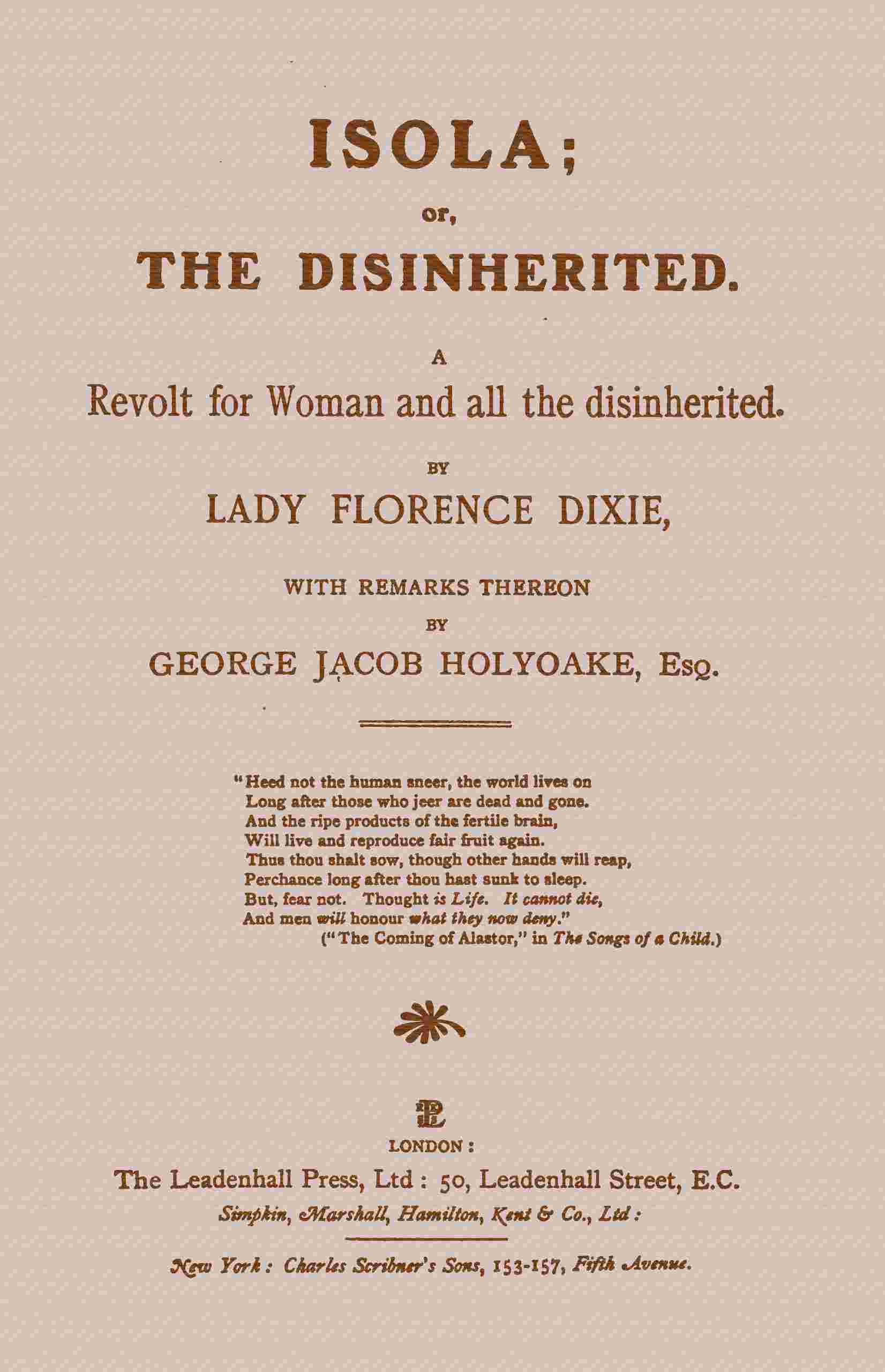
Isola first appeared in Young Oxford in September, 1902, and ran in serial form for six months through that publication. The drama itself was written many years ago. It is not for me to deal with its merits or demerits. These are handled generously by the true-hearted and honest gentleman to whom I have the honour to dedicate the piece. At nineteen or twenty the heart is more concerned with ideals, than the brain with thoughts of literary excellence. The soul, longing to uphold Truth and destroy Falsehood, forgets the p’s and q’s of literary etiquette, and I fear influences the pen to give premier consideration to the former.
The drama, Isola, opposes many established customs, but if these rest their claim to existence on antiquated and erroneous ideas, they must be remorsely uprooted. Man cannot make lasting laws. That is in Nature’s power alone, for Progress, Research and enlarged Thought Force will not be bound by the cramped and immature ideas of gloomy ages gone. Superstition has persecuted many, but the time has come to repudiate it, for in its wake follows Misery, and to it is due the sorrows of Mankind.
In my preface to Young Oxford occurs the following paragraph:
“Let us in imagination soar above our Earth and look down on it revolving in space, and then look round on that infinite space, in which myriads of other worlds are also revolving. As we look down on our Earth, shall we not see upon its surface the glories of Nature’s beauty, and the hideous scars inflicted thereon by Man? As we look down on these unsavory sights, and realise how contemptible they are, shall we not resolve to eradicate them and make the picture one of peace, contentment and joy? Instead of looking down on blood, carnage, cruelty, torture, suffering and injustice, let us look down on the reverse, and in order to do so, let us realise the simple, rational and natural ideas of ‘Isola.’ Advanced, are they? Not a bit of it. Unusual? Maybe. But because they are unusual does not make them wrong. Nothing Natural can be aught but right, for it is the offspring of Nature, the only true God. ‘Isola’ demands the practice of the true laws of the only true God.”
I shall always stand by this assertion.
In conclusion, I desire to make the following statement. My publishers have pointed out to me that in some of the names of places and countries I have chosen, there might arise cause for the belief that my characters in Isola are drawn from life. I am glad to here state frankly that, in so far as royal personages are concerned, they are purely fictitious and concern no living human being whatever. Customs and etiquettes I certainly openly attack. Who would not who desires, as I do, to see justice done, not only to the poor disinherited human and suffering non-human, but also to our disinherited and manacled rulers? The unjust laws in regard to woman I also vigorously attack, and for Superstitious Falsehood I have no reverence whatever. Nevertheless, judge me as they may, let no one accuse me of Mockery or Infidelity, for I innately worship the Inscrutable and believe in Nature, both of which are God alone. Let us have “Truth at any price,” no matter what idols we have to cast down to attain it. In the attainment of Truth, Justice, Love and Kindness shall rule in the place of Selfishness, Cruelty and Greed, and Fair Play be meted out to all.